weight MERCEDES-BENZ A-CLASS HATCHBACK 2008 Owners Manual
[x] Cancel search | Manufacturer: MERCEDES-BENZ, Model Year: 2008, Model line: A-CLASS HATCHBACK, Model: MERCEDES-BENZ A-CLASS HATCHBACK 2008Pages: 305, PDF Size: 5.43 MB
Page 10 of 305
7F
Fastening seat belts Childre n............................................ 51
Fire extinguisher................................ 201
First-aid kit......................................... 200
Flat tyre Equipment. ..................................... 253
MOExtended run-flat system ..........262
Preparing the vehicle. .....................253
TIREFIT kit....................................... 253
Floormat............................................. .165
Foglamps Display message ............................. 218
Fording................................................ 185
Frequencies Telephone. ...................................... 276
Front airbag .......................................... 40
Front-passenger airbag........................ 40
Front-passenger seat Folding the backrest forward/
back................................................ 158
Removing/fitting. ........................... 156
Fuel...................................................... 292
Diesel. ............................................ 170
Gauge. .............................................. 26
Loss. ............................................... 232
Petrol .............................................. 169
Fuel consumption...................... 293, 294Fuel filler flap
Emergency release. ........................242
Opening/closing ............................ 168
Fuel filter
Display message ............................. 214
Fuel level
Calling up the range (on-board
computer). ...................................... 113
Fuel line
Malfunction..................................... 232
Fuel tank
Defect ............................................. 232
Fuse allocation chart......................... 271
Fuse box............................................. .271
Fuses................................................... 271 G
Genuine Mercedes-Benz parts.......... 274
Glove compartment........................... 160
Gross vehicle weight, maximum
permissible................................. 287, 288 H
Handbrake Display message ............................. 214
Head/thorax airbags........................... 41Headlamps
Cleaning. ........................................ 194
Cleaning system. .............................. 81
Misting up. ...................................... 237
Headlamps delayed switch-off
see Exterior lighting delayed switch-off
Head restraint
Active head restraint......................... 42
Adjusting (front).......................... 64, 65
Adjusting (rear). ................................ 66
Removing (rear). ............................... 66
Heating
see Air conditioning
High-pressure cleaners..................... 193
Hill start assist..................................... 90 I
Immobiliser........................................... 57
Indicator and warning lamp Air conditioning (malfunction) .........222
Automatic child seat recognition
(malfunction). ................................. 223
Brakes (red). ................................... 226
Engine diagnostics ..........................227
PASSENGER AIRBAG OFF .........45, 223
Reserve fuel. ................................... 229
Seat belt. ........................................ 228
SRS........................................... 37, 226
Thermotronic (malfunction) ............222
Indicator and warning lamps............ 224 Index
169_AKB; 2; 4, en-GB
wdomann,
Version: 2.10.6 2008-07-16T08:52:06+02:00 - Seite 7Dateiname: 6515_0315_02_buchblock.pdf; preflight
Page 15 of 305
12Centre console.
.............................. 160
Glove compartment. .......................160
Luggage compartment. ...................161
Stowage space
Cup holder ...................................... 144
Submenu (on-board computer)......... 107
Convenience ................................... 108
Instrument cluster .......................... 107
Lighting........................................... 108
Time/date. ..................................... 107
Vehicle............................................ 108
Summer opening
see Convenience opening
Sun visor............................................. 162
Supplemental Restraint System see SRS
Surround lighting
Switching on/off (on-board com-
puter). ............................................. 110
Switching off the alarm
ATA. .................................................. 57T
Tailgate Display message ............................. 212
Opening/closing. .............................. 62
Tail lamps
changing. ........................................ 250Tank
see Fuel tank
Tank capacity..................................... 292
Technical data Acceleration. .................................. 281
Engine............................................ .278
Speed. ............................................ 280
Trailer loads .................................... 291
Tyres. .............................................. 283
Vehicle dimensions. ........................286
Vehicle weights............................... 286
Wheels. ........................................... 283
Telephone
see Mobile phone
Telephone compartment................... 160
Temperature Coolant. ............................................ 97
Outside temperature......................... 98
Thermotronic
Malfunction indicator lamp. ............222
Third brake lamp
Display message ............................. 217
Through-loading................................. 147
Tightening torque............................... 262
Time Setting (on-board computer).......... .109
Setting the time (on-board com-
puter). ............................................. 109
TIREFIT kit
Using. ............................................. 253TopTether..............................................
49
Total distance recorder............... 26, 100
Tow-away protection........................... 58
Towing................................................. 269
Towing eye Fitting ............................................. 269
Removing....................................... .270
Tow-starting ........................................ 270
Trailer 7-pin connector .............................. 191
Display message ............................. 216
Power supply. ................................. 190
Trailer loads
Technical data. ............................... 291
Trailer tow hitch
Notes on care ................................. 196
Trailer towing
Active parking assist .......................127
Driving tips ..................................... 188
Malfunction..................................... 240
Mounting dimensions .....................290
Parktronic. ...................................... 123
Transmission
Display message ............................. 209
Transmission output (maximum)
Telephone/two-way radio ...............275
Transport (vehicle)............................. 270
Trip computer Menu (on-board computer). ............112 Index
169_AKB; 2; 4, en-GB
wdomann,
Version: 2.10.6
2008-07-16T08:52:06+02:00 - Seite 12 Dateiname: 6515_0315_02_buchblock.pdf; preflight
Page 16 of 305
13
Trip meter.............................
26, 100, 102
Resetting. ......................................... 98
Turn signal lamps
Display message ............................. 217
Two-way radio
Installation. ..................................... 275
Tyre grip.............................................. 184
Tyre pressure ..................................... 178
Display message ............................. 211
see Tyre pressure
Tyre pressure loss warning system.1 79
Tyres Direction of rotatio n....................... 177
General notes. ................................ 176
Technical data. ............................... 283
Tyre tread............................................ 178 U
Unladen weight.......................... 287, 288
Unlocking Emergency unlocking...................... 241
From the inside (central unlocking
button) .............................................. 61 V
Variable Speedtronic .........................118
Vehicle Emergency unlocking .............241, 242
Individual settings (on-board com-
puter). ............................................. 106
Leaving parked up. .........................240
Towing. ........................................... 269
Tow-starting .................................... 270
Transporting ................................... 270
Vehicle battery................................... 263
Vehicle dimensions............................ 286
Vehicle electronics............................ 275
Vehicle identification number (VIN).2 77
Vehicle identification plates............. 276
Vehicle tool kit................................... 200
Vehicle weights.................................. 286 W
Warning and indicator lamp ABS (yellow).................................... 224
LIM (cruise control)......................... 116
LIM (variable Speedtronic). .............118
Warning and indicator lamps
ESP ®
......................................... 56, 226
Warning signal
Audible. .......................................... 230
Warning triangle................................. 200 Washer fluid
Display message ............................. 221
Washer fluid reservoir....................... 300
Filling capacity. ............................... 300
Wearing seat belts............................... 73
Wheel bolts Tightening torque............................ 262
Wheel chock
Use. ................................................ 201
Wheels
General notes. ................................ 176
Interchanging.................................. 181
Technical data. ............................... 283
Windowbags......................................... 42
Windows Cleaning. ........................................ 194
Cleaning the windscreen ...............194
see Side windows
Windscreen
Cleaning ......................................... 194
Windscreen washer fluid................... 300
Topping up. ..................................... 175
Windscreen washer fluid reservoir.. 175
Windscreen washer system.............. 300
Windscreen wipers.............................. 83
Cleaning. ........................................ 194
Malfunction..................................... 237
Replacing the wiper blades .............251
Winter diesel...................................... 170
Winter driving............................. 181, 182 Index
169_AKB; 2; 4, en-GB
wdomann,
Version: 2.10.6 2008-07-16T08:52:06+02:00 - Seite 13Dateiname: 6515_0315_02_buchblock.pdf; preflight
Page 18 of 305
Protection of the environment
15Protection of the environment
H
Environmental note
Daimler's declared policy is one of integra-
ted environmental protection.
The objectives are for the natural resources
which form the basis of our existence on
this planet to be used sparingly and in a
manner which takes the requirements of
both nature and humanity into account.
You too can help to protect the environ-
ment by operating your vehicle in an envi-
ronmentally-responsible manner.
Fuel consumption and the rate of engine,
transmission, brake and tyre wear depend
on the following factors:
R Operating conditions of your vehicle
R Your personal driving style
You can influence both factors.
You should bear the following in mind:
Operating conditions
R Avoid short trips as these increase fuel
consumption.
R Make sure that the tyre pressures are
always correct. R
Do not carry any unnecessary weight.
R Keep an eye on the vehicle's fuel con-
sumption.
R Remove roof racks once you no longer
need them.
R A regularly serviced vehicle will contrib-
ute to environmental protection. You
should therefore adhere to the service
intervals.
R Always have maintenance work carried
out at a qualified specialist workshop,
e.g. a Mercedes-Benz Service Centre.
Personal driving style
R Do not depress the accelerator pedal
when starting the engine.
R Do not warm up the engine with the vehi-
cle stationary.
R Drive carefully and maintain a safe dis-
tance from the vehicle in front.
R Avoid frequent, sudden acceleration.
R Change gear in good time and use each
gear only up to 2
/ 3of its maximum engine
speed.
R Switch off the engine in stationary traffic. Returning used vehicles
Mercedes-Benz will take back your
Mercedes-Benz to dispose of it in an environ-
mentally-responsible manner, in accordance
with the European Union (EU) End of Life
Vehicles Directive.
The End of Life Vehicles Directive applies to
vehicles of up to 3.5 t gross vehicle weight, in
accordance with national regulations. For
several years, Mercedes-Benz has been
meeting all the legal requirements for a
design which allows for recycling and re-use.
There is a network of return points and dis-
assembly plants which can recycle your vehi-
cle in an environmentally-responsible man-
ner. The options for recycling vehicles and
parts are constantly being developed and
improved. This means that your Mercedes-
Benz will also continue to meet even the
increased recycling quotas in the future in
good time. You can obtain further information
from your national Mercedes-Benz homepage
or your national hotline number. Introduction
169_AKB; 2; 4, en-GB
wdomann,
Version: 2.10.6 2008-07-16T08:52:06+02:00 - Seite 15 ZDateiname: 6515_0315_02_buchblock.pdf; preflight
Page 49 of 305
Occupant safety
46 front-passenger airbag does not deploy
during an accident. It is also possible that the
5 PASSENGER AIRBAG OFF warning
lamp will not light up briefly if you turn the
key in the ignition lock to position 2.
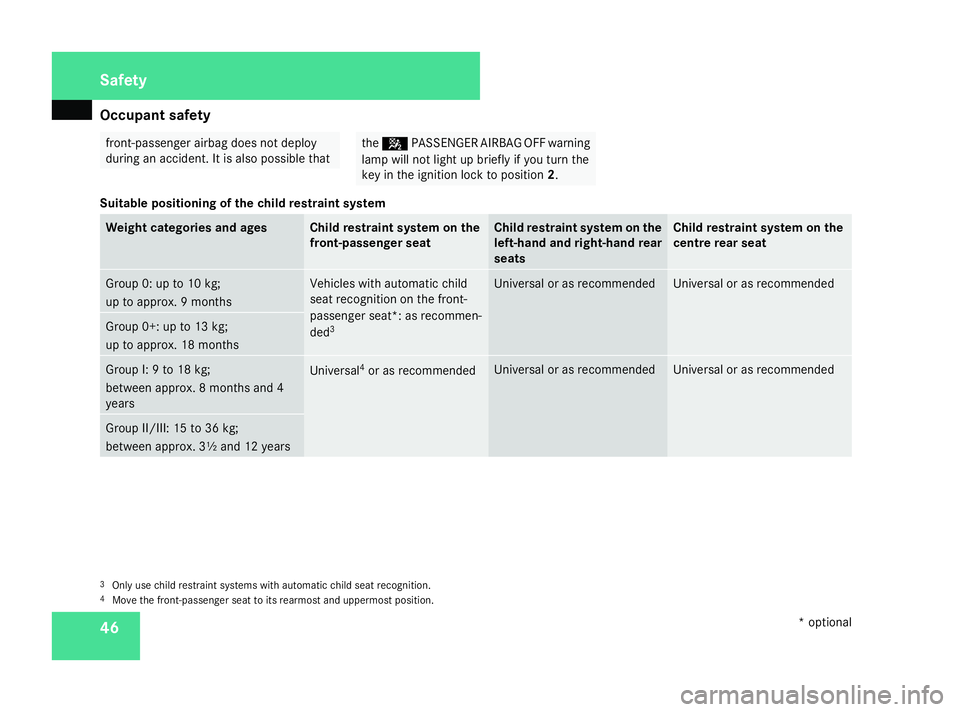
Suitable positioning of the child restraint system Weight categories and ages Child restraint system on the
front-passenger seat Child restraint system on the
left-hand and right-hand rear
seats Child restraint system on the
centre rear seat
Group 0: up to 10 kg;
up to approx. 9 months Vehicles with automatic child
seat recognition on the front-
passenger seat*: as recommen-
ded
3 Universal or as recommended Universal or as recommended
Group 0+: up to 13 kg;
up to approx. 18 months
Group I: 9 to 18 kg;
between approx. 8 months and 4
years Universal
4
or as recommended Universal or as recommended Universal or as recommended
Group II/III: 15 to 36 kg;
between approx. 3½ and 12 years
3
Only use child restraint systems with automatic child seat recognition.
4 Move the front-passenger seat to its rearmost and uppermost position. Safety
* optional
169_AKB; 2; 4, en-GB
wdomann
,V ersion: 2.10.6
2008-07-16T08:52:06+02:00 - Seite 46 Dateiname: 6515_0315_02_buchblock.pdf; preflight
Page 50 of 305
Occupant safety
47
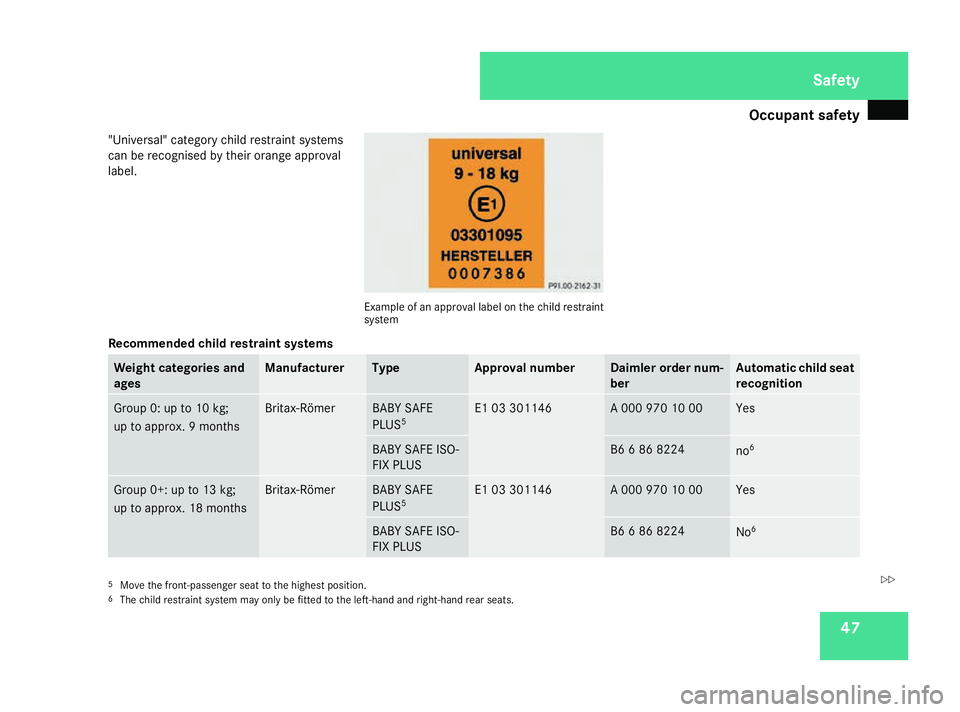
"Universal" category child restraint systems
can be recognised by their orange approval
label. Example of an approval label on the child restraint
system
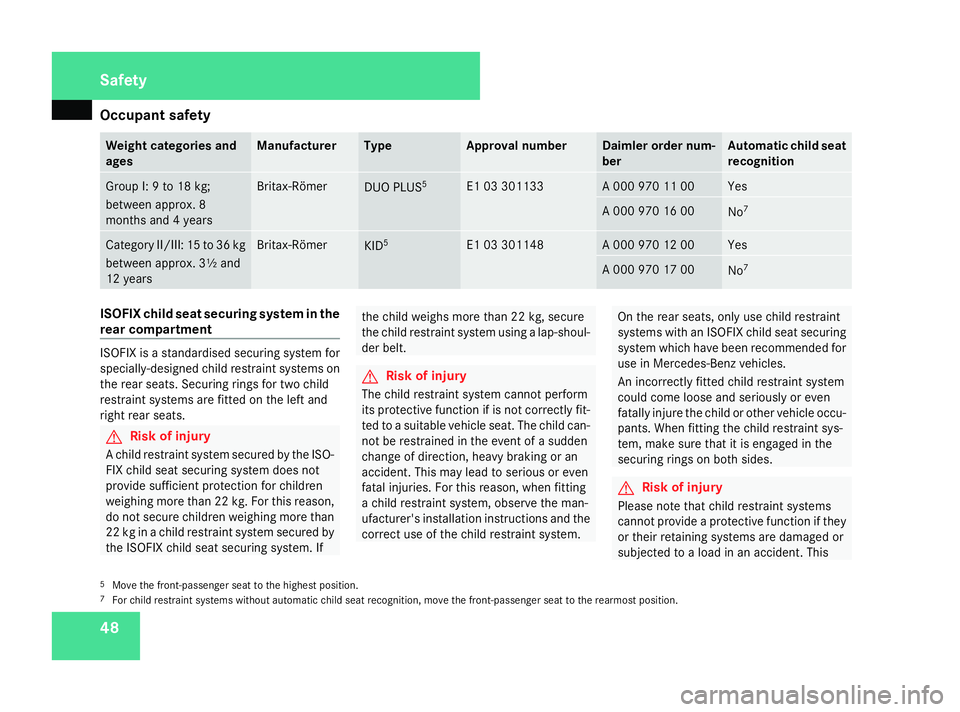
Recommended child restraint systems Weight categories and
ages Manufacturer Type Approval number Daimler order num-
ber Automatic child seat
recognition
Group 0: up to 10 kg;
up to approx. 9 months Britax-Römer BABY SAFE
PLUS
5 E1 03 301146 A 000 970 10 00 Yes
BABY SAFE ISO-
FIX PLUS B6 6 86 8224
no
6 Group 0+: up to 13 kg;
up to approx. 18 months Britax-Römer BABY SAFE
PLUS
5 E1 03 301146 A 000 970 10 00 Yes
BABY SAFE ISO-
FIX PLUS B6 6 86 8224
No
6 5
Move the front-passenger seat to the highest position.
6 The child restraint system may only be fitted to the left-hand and right-hand rear seats. Safety
169_AKB; 2; 4, en-GB
wdomann, Version: 2.10.6 2008-07-16T08:52:06+02:00 - Seite 47 ZDateiname: 6515_0315_02_buchblock.pdf; preflight
Page 51 of 305
Occupant safety
48 Weight categories and
ages Manufacturer Type Approval number Daimler order num-
ber Automatic child seat
recognition
Group I: 9 to 18 kg;
between approx. 8
months and 4 years Britax-Römer
DUO PLUS
5 E1 03 301133 A 000 970 11 00 Yes
A 000 970 16 00
No
7 Category II/III: 15 to 36 kg
between approx. 3½ and
12 years Britax-Römer
KID
5 E1 03 301148 A 000 970 12 00 Yes
A 000 970 17 00
No
7 ISOFIX child seat securing system in the
rear compartment
ISOFIX is a standardised securing system for
specially-designed child restraint systems on
the rear seats. Securing rings for two child
restraint systems are fitted on the left and
right rear seats. G
Risk of injury
A child restraint system secured by the ISO-
FIX child seat securing system does not
provide sufficient protection for children
weighing more than 22 kg. For this reason,
do not secure children weighing more than
22 kg in a child restraint system secured by
the ISOFIX child seat securing system. If the child weighs more than 22 kg, secure
the child restraint system using a lap-shoul-
der belt. G
Risk of injury
The child restraint system cannot perform
its protective function if is not correctly fit-
ted to a suitable vehicle seat. The child can-
not be restrained in the event of a sudden
change of direction, heavy braking or an
accident. This may lead to serious or even
fatal injuries. For this reason, when fitting
a child restraint system, observe the man-
ufacturer's installation instructions and the
correct use of the child restraint system. On the rear seats, only use child restraint
systems with an ISOFIX child seat securing
system which have been recommended for
use in Mercedes-Benz vehicles.
An incorrectly fitted child restraint system
could come loose and seriously or even
fatally injure the child or other vehicle occu-
pants. When fitting the child restraint sys-
tem, make sure that it is engaged in the
securing rings on both sides.
G
Risk of injury
Please note that child restraint systems
cannot provide a protective function if they
or their retaining systems are damaged or
subjected to a load in an accident. This
5 Move the front-passenger seat to the highest position.
7 For child restraint systems without automatic child seat recognition, move the front-passenger seat to the rearmost position. Safety
169_AKB; 2; 4, en-GB
wdomann
,V ersion: 2.10.6
2008-07-16T08:52:06+02:00 - Seite 48 Dateiname: 6515_0315_02_buchblock.pdf; preflight
Page 53 of 305
Occupant safety
50Vehicles with a luggage compartment
cover*: make sure you do not route the belt
across luggage compartment cover 3.
X Vehicles with a luggage compartment
cover*: swing back rear seat backrest 2
until it engages.
The red lock verification indicator is no lon-
ger visible (Y page 151). G
Risk of injury
Make sure that the rear seat backrest is
fully locked. The red lock verification indi-
cators on the left and right should no longer
be visible. If they are, the rear seat backr-
ests are not locked. If this is the case, occu-
pants could be injured in the event of an
accident, e.g. by objects being thrown for-
wards from the luggage compartment.
X All: move head restraints 1slightly down
again if necessary (Y page 66). Make sure
that you do not interfere with the correct
routing of TopTether belt* 6.
X Install the ISOFIX child restraint system
with TopTether*. Comply with the manu-
facturer's installation instructions. Integrated child seat* The child seats are integrated into the right
and left-hand sides of the seats of the rear
bench seat. They comply with the legal
requirements of ECE Regulation 44.03.
Mercedes-Benz recommends the integrated
child seat for children from approximately
two to twelve years of age or with a body
weight of 12.5 kg to 36 kg.
For children between approximately two and
four years of age or weighing between
approximately 12.5 kg and 22 kg, you must
also use a padded table* which has been spe-
cially approved for the integrated child seat
(Y
page 51). G
Risk of injury
To reduce the risk of serious or even fatal
injury to the child in the event of a sudden
change in direction, braking or an accident:
R Do not modify the integrated child seat.
R When the child seat is occupied, adjust
the head restraint to a position at which
the back of the child's head is supported
by the centre of the head restraint at
about eye level. R
Replace an integrated child seat that has
been damaged or subjected to a heavy
load as the result of an accident.
R Be aware that children under two years
of age require a different child restraint
system. Information about other child
restraint systems is available from any
Mercedes-Benz Service Centre.
R The rear seat backrest in the vehicle
must be securely locked in position.
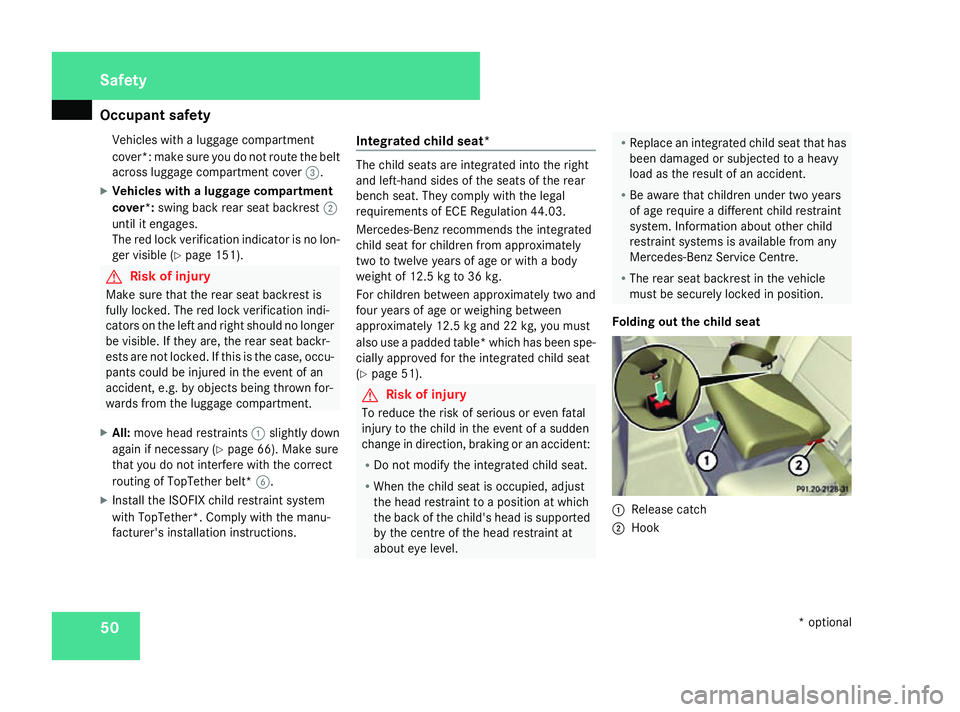
Folding out the child seat 1
Release catch
2 Hook Safety
* optional
169_AKB; 2; 4, en-GB
wdomann
,V ersion: 2.10.6
2008-07-16T08:52:06+02:00 - Seite 50 Dateiname: 6515_0315_02_buchblock.pdf; preflight
Page 55 of 305

Occupant safety
52
You must not use the integrated child seat
with padded table directly attached to a baby
car seat on which a body weight of up to
10 kg is permitted. G
Risk of injury
If the padded table is not installed and used
correctly on the integrated child seat, it
cannot provide the intended protection. It
would then not be possible to restrain the
child in the event of an accident, sudden
braking or abrupt change in direction and
this could result in serious or even fatal
injury to the child. For this reason, observe
the following description when fitting the
padded table:
The padded table is only suitable for use
together with the folded-out integrated
child seat.
On the rear seats, only use the padded table
which is recommended for Mercedes-Benz
vehicles.
An incorrectly fitted padded table could
come loose and seriously or even fatally
injure the child or other vehicle occupants.
Fit the padded table and ensure that it is
correctly secured. G
Risk of injury
If the padded table is damaged or subjected
to a load in an accident, it cannot provide
the intended protection. It would then not
be possible to restrain the child in the event
of an accident, sudden braking or abrupt
change in direction and this could result in
serious or even fatal injury to the child.
You must therefore have padded tables
that are damaged or have been subjected
to a heavy load in an accident checked
immediately along with their mountings at
a qualified specialist workshop and
replaced if necessary. G
Risk of injury
To reduce the risk of serious or even fatal
injury to the child in the event of a sudden
change in direction, braking or an accident:
R observe the following description when
fitting the padded table.
R do not modify the padded table.
R When the child seat is occupied, adjust
the head restraint to a position at which
the back of the child's head is supported
by the centre of the head restraint at
about eye level. R
replace a damaged padded table or one
that has been subjected to a load in an
accident.
R be aware that children under two years
of age or children weighing less than
12.5 kg require a different child restraint
system. Information about other child
restraint systems is available from any
Mercedes-Benz Service Centre. G
Risk of injury
Do not modify the padded table, integrated
child seat or seat belts. The padded table
must not be used without a cover. The
cover must not be removed from the pad-
ded table or replaced with a cover from
another manufacturer. Otherwise, the offi-
cial approval becomes invalid and its pro-
tective function could be restricted.
Do not subject the padded table to unnec-
essary heat nor expose it to direct sunlight.
Parts of the padded table could heat up and
the child could be burnt by the hot parts. Safety
169_AKB; 2; 4, en-GB
wdomann
,V ersion: 2.10.6
2008-07-16T08:52:06+02:00 - Seite 52 Dateiname: 6515_0315_02_buchblock.pdf; preflight
Page 148 of 305

Loading and stowing
145
Benz vehicles. This helps to prevent dam-
age to the vehicle.
Position the load on the roof rack in such a
way that the vehicle will not sustain dam-
age even when it is in motion.
Depending on the vehicle's equipment,
make sure that you can:
R open the panorama louvred sliding sun-
roof* fully
R open the tailgate fully 1
Covers
X Fold covers 1upwards.
X Only secure the roof rack to the anchorage
points under covers 1. Observe the manufacturer's installation
instructions. Luggage net
G
Risk of injury
Only place lightweight items in the luggage
net. Do not use it to transport heavy, bulky,
sharp-edged or fragile objects. In the event
of an accident, the luggage net will not
secure the transported goods. Loading guidelines
G
Risk of injury
Secure and position the load as described
in the loading guidelines.
Otherwise, vehicle occupants could
be injured by the load being thrown around
in the event of sharp braking, a sudden
change in direction or an accident. This also
applies to seats which have been removed.
You will find further information in the
"Securing a load" section.
Even if you follow all the loading guidelines,
the load will increase the risk of injury in the
event of an accident. G
Risk of poisoning
Keep the tailgate closed when the engine is
running. Otherwise, you could be poisoned
by exhaust fumes entering the vehicle.
The handling characteristics of a laden vehi-
cle depend on the distribution of the load
within the vehicle. You should therefore load
your vehicle as shown in the illustrations. Observe the following notes when transport-
ing a load:
R
When transporting a load, never exceed the
maximum permissible gross vehicle weight
or the permissible axle loads for the vehicle
(including occupants).
R Position heavy loads as far forwards and as
low down in the luggage compartment as
possible.
R The load must not protrude above the
upper edge of the backrests. Controls
169_AKB; 2; 4, en-GB
wdomann
, Version: 2.10.6
2008-07-16T08:52:06+02:00 - Seite 145 ZDateiname: 6515_0315_02_buchblock.pdf; preflight