tow MERCEDES-BENZ A-CLASS HATCHBACK 2012 Owners Manual
[x] Cancel search | Manufacturer: MERCEDES-BENZ, Model Year: 2012, Model line: A-CLASS HATCHBACK, Model: MERCEDES-BENZ A-CLASS HATCHBACK 2012Pages: 357, PDF Size: 11.61 MB
Page 345 of 357
!
Do not use the following:
R marine diesel
R heating oil
R bio-diesel
R vegetable oil
R petrol
R paraffin
R kerosene
Do not mix such fuels with diesel fuel and
do not use any special additives. This can
otherwise lead to engine damage.
! Vehicles with a diesel particle filter:
in
countries outside the EU, only refuel with
low-sulphur Euro diesel with a sulphur con- tent under 50 ppm; otherwise the emission
control system could be damaged.
! Vehicles without a diesel particle fil-
ter: in countries where only diesel fuel with
a high sulphur content is available, you will
need to carry out your vehicle's oil change
at shorter intervals. More information
about the interval for oil change can be
obtained from any qualified specialist
workshop.
Usually you will find information about the
fuel grade on the pump. If you cannot find the label on the petrol pump, ask the filling sta-
tion staff.
Information on refuelling (Y page 159).
Low outside temperatures
In winter months, diesel fuel with an improved cold flow quality is available. In Europe, the
EN 590 standard defines various climate-
dependent temperature categories. Malfunc- tions can be avoided by refuelling with diesel
fuel that corresponds to the climatic specifi-
cations outlined in EN 590. At unusually low
outside temperatures, it is possible that the
flow characteristics of the diesel fuel could be
insufficient. Accordingly, diesel fuel from
warmer areas may not be suitable for opera-
tion in colder climatic conditions. i
Further information on country-specific
fuel properties can be obtained from oil
companies, e.g. at filling stations.
Fuel consumption information H
Environmental note
CO 2(carbon dioxide) is the gas which scien-
tists believe to be principally responsible for
global warming (the greenhouse effect). Your vehicle's CO 2emissions are directly related to
fuel consumption and therefore depend on:
R efficient use of the fuel by the engine
R driving style
R other non-technical factors, such as envi-
ronmental influences or road conditions
You can minimise your vehicle's CO 2emis-
sions by driving carefully and having it serv-
iced regularly.
The vehicle will use more fuel than usual in the following situations:
R at very low outside temperatures
R in urban traffic
R on short journeys
R in mountainous terrain
R when towing a trailer
i Only for certain countries: you can find
the current consumption and emission val-
ues of your vehicle in the COC documents
(EU CERTIFICATE OF CONFORMITY). These documents are delivered with your vehicle.
The consumption figures were in each casebased on the currently applicable version:
R for vehicles that comply with standards
up to and including the EURO 4 standard,
in accordance with EU Directive
80/1268/EEC
R for vehicles that comply with or exceed
the EURO 5 standard, in accordance with
Regulation (EC) No. 715/2007
Deviations from these values may occur
under normal operating conditions. 342
Service products and capacitiesTechnical data
Page 351 of 357
Trailer tow hitch
Mounting dimensions
! If you have a trailer tow hitch retrofitted,
changes to the engine cooling system may
be necessary, depending on the vehicle
type.
If you have a trailer tow hitch retrofitted,
observe the anchorage points on the chas- sis.
Trailer towing is not permissible on the fol-
lowing models:
R A 45 AMG 4MATIC
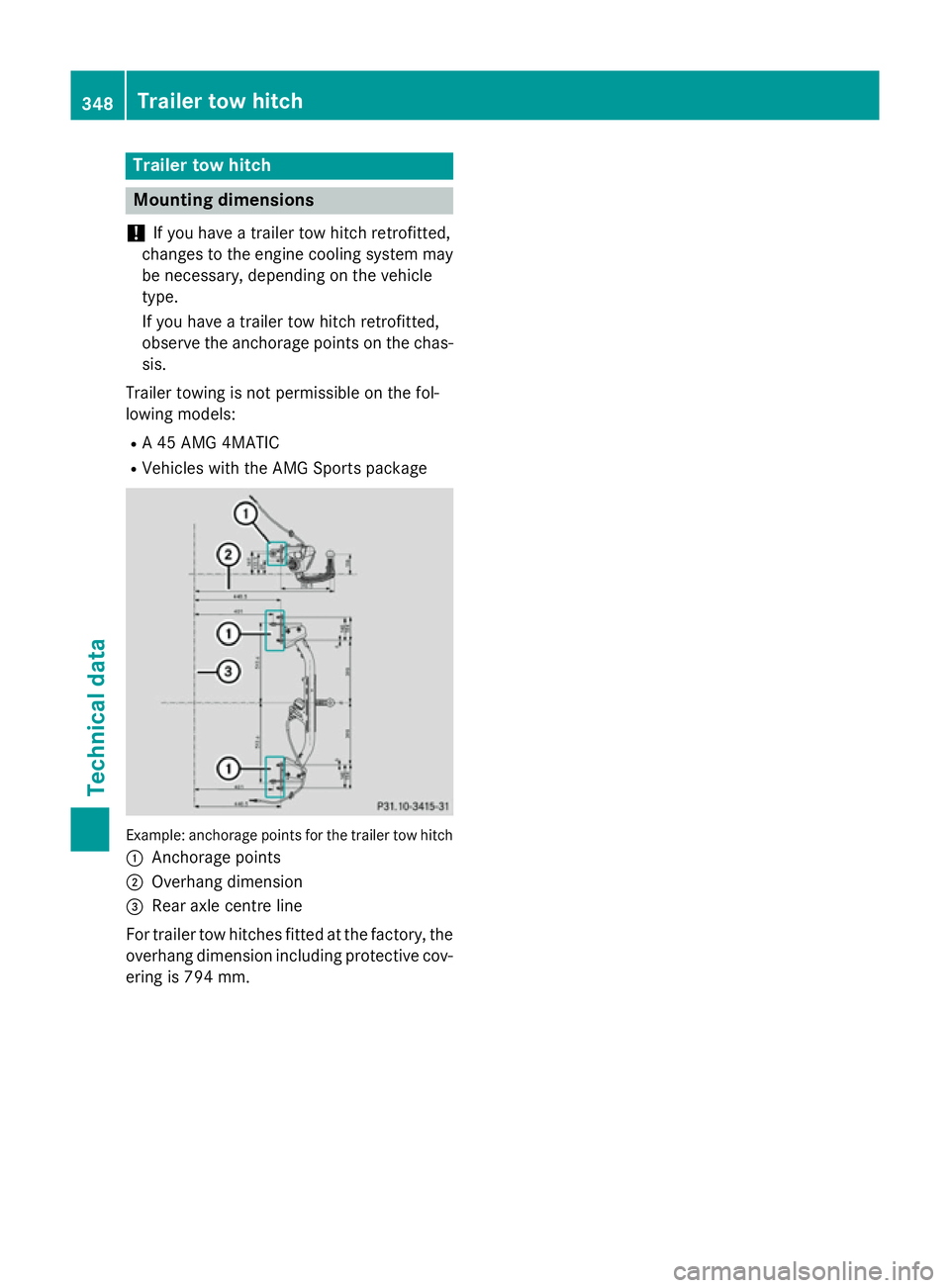
R Vehicles with the AMG Sports package Example: anchorage points for the trailer tow hitch
: Anchorage points
; Overhang dimension
= Rear axle centre line
For trailer tow hitches fitted at the factory, the
overhang dimension including protective cov- ering is 794 mm. 348
Trailer tow hitchTechnical data
Page 352 of 357
Trailer loads
Vehicles with manual transmission !
Use a drawbar noseweight as close as possible to the maximum permissible noseweight.
Do not use a noseweight of less than 50kg, otherwise the trailer may come loose.
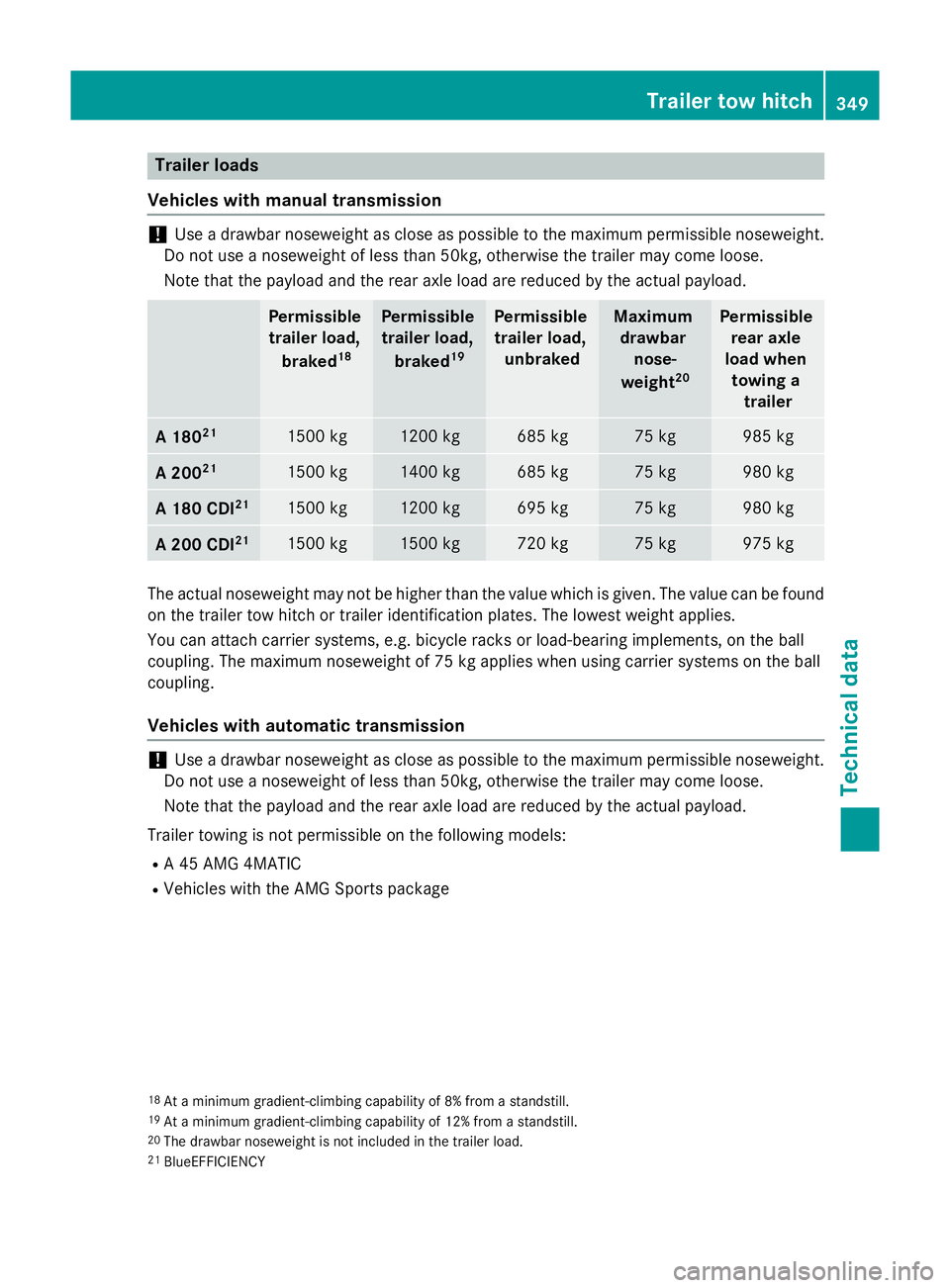
Note that the payload and the rear axle load are reduced by the actual payload. Permissible
trailer load,
braked 18 Permissible
trailer load,
braked 19 Permissible
trailer load, unbraked Maximum
drawbar nose-
weight 20 Permissible
rear axle
load when towing a trailer A 180
21 1500 kg 1200 kg 685 kg 75 kg 985 kg
A 200
21 1500 kg 1400 kg 685 kg 75 kg 980 kg
A 180 CDI
21 1500 kg 1200 kg 695 kg 75 kg 980 kg
A 200 CDI
21 1500 kg 1500 kg 720 kg 75 kg 975 kg
The actual noseweight may not be higher than the value which is given. The value can be found
on the trailer tow hitch or trailer identification plates. The lowest weight applies.
You can attach carrier systems, e.g. bicycle racks or load-bearing implements, on the ball
coupling. The maximum noseweight of 75 kg applies when using carrier systems on the ball
coupling.
Vehicles with automatic transmission !
Use a drawbar noseweight as close as possible to the maximum permissible noseweight.
Do not use a noseweight of less than 50kg, otherwise the trailer may come loose.
Note that the payload and the rear axle load are reduced by the actual payload.
Trailer towing is not permissible on the following models:
R A 45 AMG 4MATIC
R Vehicles with the AMG Sports package
18 At a minimum gradient-climbing capability of 8% from a standstill.
19 At a minimum gradient-climbing capability of 12% from a standstill.
20 The drawbar noseweight is not included in the trailer load.
21 BlueEFFICIENCY Trailer tow hitch
349Technical data Z
Page 353 of 357
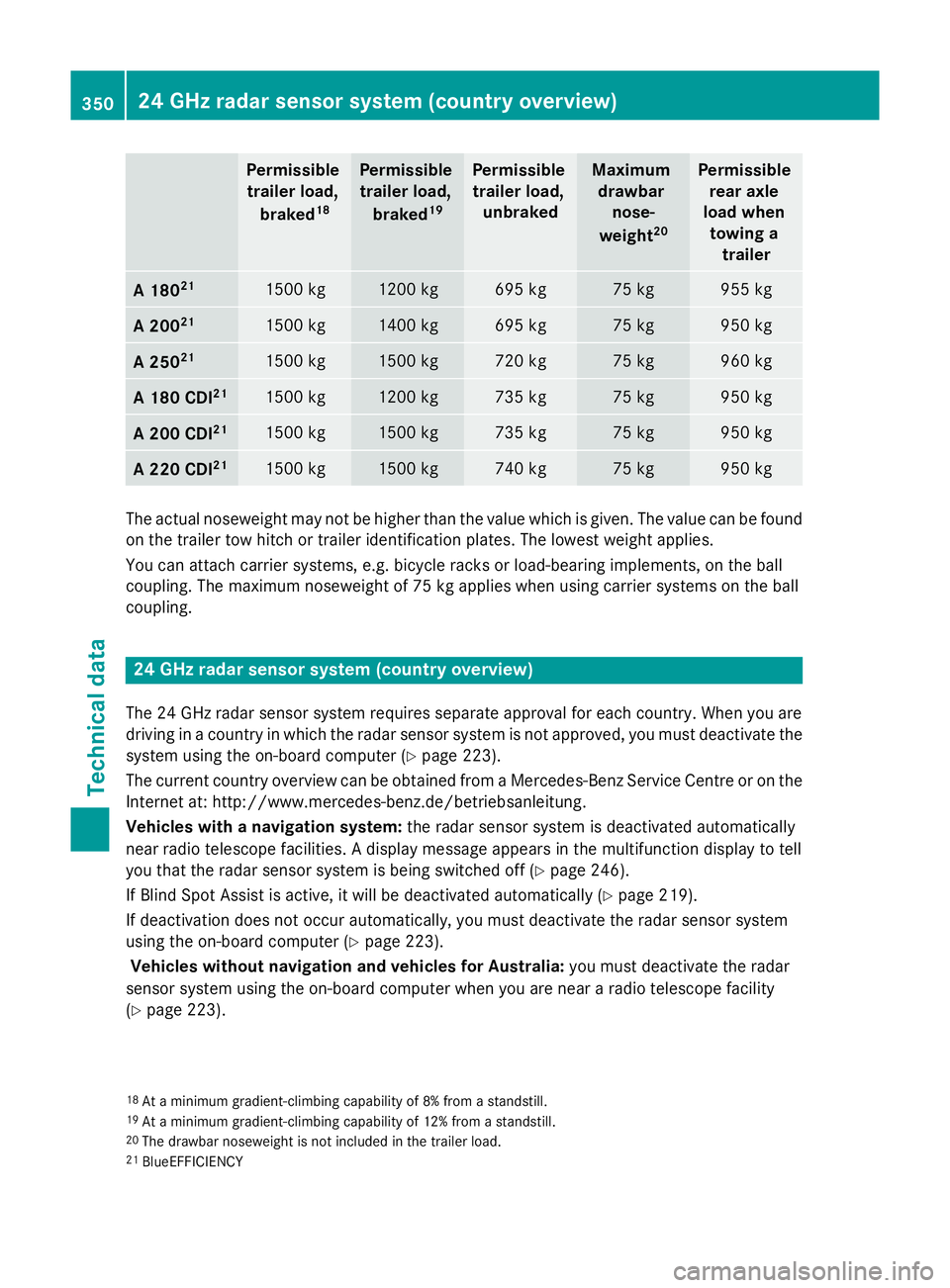
Permissible
trailer load,
braked 18 Permissible
trailer load,
braked 19 Permissible
trailer load, unbraked Maximum
drawbar nose-
weight 20 Permissible
rear axle
load when towing a trailer A 180
21 1500 kg 1200 kg 695 kg 75 kg 955 kg
A 200
21 1500 kg 1400 kg 695 kg 75 kg 950 kg
A 250
21 1500 kg 1500 kg 720 kg 75 kg 960 kg
A 180 CDI
21 1500 kg 1200 kg 735 kg 75 kg 950 kg
A 200 CDI
21 1500 kg 1500 kg 735 kg 75 kg 950 kg
A 220 CDI
21 1500 kg 1500 kg 740 kg 75 kg 950 kg
The actual noseweight may not be higher than the value which is given. The value can be found
on the trailer tow hitch or trailer identification plates. The lowest weight applies.
You can attach carrier systems, e.g. bicycle racks or load-bearing implements, on the ball
coupling. The maximum noseweight of 75 kg applies when using carrier systems on the ball
coupling. 24 GHz radar sensor system (country overview)
The 24 GHz radar sensor system requires separate approval for each country. When you are
driving in a country in which the radar sensor system is not approved, you must deactivate the
system using the on-board computer (Y page 223).
The current country overview can be obtained from a Mercedes-Benz Service Centre or on the
Internet at: http://www.mercedes-benz.de/betriebsanleitung.
Vehicles with a navigation system: the radar sensor system is deactivated automatically
near radio telescope facilities. A display message appears in the multifunction display to tell
you that the radar sensor system is being switched off (Y page 246).
If Blind Spot Assist is active, it will be deactivated automatically (Y page 219).
If deactivation does not occur automatically, you must deactivate the radar sensor system
using the on-board computer (Y page 223).
Vehicles without navigation and vehicles for Australia: you must deactivate the radar
sensor system using the on-board computer when you are near a radio telescope facility
(Y page 223).
18 At a minimum gradient-climbing capability of 8% from a standstill.
19 At a minimum gradient-climbing capability of 12% from a standstill.
20 The drawbar noseweight is not included in the trailer load.
21 BlueEFFICIENCY 350
24 GHz radar sensor system (country overview)Technical data