parking brake MERCEDES-BENZ AMG GT R-ROADSTER 2020 Owners Manual
[x] Cancel search | Manufacturer: MERCEDES-BENZ, Model Year: 2020, Model line: AMG GT R-ROADSTER, Model: MERCEDES-BENZ AMG GT R-ROADSTER 2020Pages: 441, PDF Size: 7.76 MB
Page 12 of 441

1
Õ Traction control →
391
2 #! Turn signal lights →
92
3 p Engine operating temp erature →
392
4 K High beam →
92
L Low beam →
91
T Standing lights →
91
5 R Rear fog light →
92
6 | Active ae rodynamics profile →
14 9
7 ÿ Coolant temp erature →
392
8 Coolant temp erature display →
16 3
9 L Distance warning →
397
A ü Seat belt →
389
B h Tyre pressure monitoring sy stem →
401
C Ù Electric po werst eering →
391
D ! Electric pa rking brake (yellow) →
395 E
! Electric parking brake (red) →
395
F 6 Restra int sy stem →
389
G J Brakes (red) →
395
H 8 Reser vefuel with fuel filler flap location
indicator →
392
I Fuel le vel →
16 3
J ä AMG RIDE CONTROL →
397
K J Brakes (yellow) →
395
L # Electrical fault →
392
M ; Engine diagnostics →
392
N Æ ESP®
SPORT →
398
¤ ESP®
OFF →
398
O ! ABS →
398
P å ESP®
OFF →
398
÷ ESP®
→
398 At
aglance – Indicator and warning lamps 9
Page 53 of 441

Obser
vewhen stopping or parking &
WARNING Risk of accident and inju ry
due tochildren left unat tended in the
ve hicle
If ch ildren are left unsupervised in theve hi‐
cle, they could, in part icular:
R open doors, thereby endangering other
persons or road users.
R get out and be stru ck byoncoming traf‐
fi c.
R ope rate ve hicle equipment and become
trapped, forex ample.
In addition, thech ildren could also set the
ve hicle in motion, forex ample by:
R releasing the parking brake.
R change the transmission position.
R start theve hicle. #
Never lea vechildren unat tended in the
ve hicle. #
When leaving theve hicle, alw aysta ke
th eke y with you and lock theve hicle. #
Keep theke y out of reach of children. &
WARNING Risk offata l injury due to
ex posure toextreme heat or cold in the
ve hicle
If people –particularly children – are exposed
to extreme temp eratures over an extended
pe riod of time, there is a risk of serious or
ev en fata l injury! #
Never lea veanyone – pa rticularly chil‐
dren – unat tended in theve hicle. #
Never lea veanimals in theve hicle unat‐
te nded. Overvi
ewofrecommended child restra int
sy stems %
Further information on the cor rect child
re stra int sy stem can be obtained at a quali‐
fi ed specialist workshop. Mercedes-Benz re
commends that you use a Mercedes-Benz
Service Centre forth is purpose.
Securing with theve hicle seat belt (vehicles
without AMG sport buc ket seats)
Category 0 (up to10 kgand appr ox.
6 months) and category 0+ (up to13 kgand
appr ox.15 months) Ty
pe 1
BABY SAFE plus II
App rova lE 1 04 30114 6
Order number 2
A 000970 38 02
1 Manu facturer: Britax Römer .2 With colour code 9H95. Category
I (9to18 kgand from appr ox‐
ima tely 9 months to4ye ars) Ty
pe 1
DUO plus
Appr oval E1 04 30113 3
Order number 2
A 000970 43 02
1 Manu facturer: Britax Römer .2 With colour code 9H95. 50
Occupant saf ety
Page 63 of 441

Key
Overview of
key functions &
WARNING Risk of accident and inju ry
due tochildren left unat tended in the
ve hicle
If ch ildren are left unsupervised in theve hi‐
cle, they could, in part icular:
R open doors, thereby endangering other
persons or road users.
R get out and be stru ck byoncoming traf‐
fi c.
R ope rate ve hicle equipment and become
trapped, forex ample.
In addition, thech ildren could also set the
ve hicle in motion, forex ample by:
R releasing the parking brake.
R change the transmission position.
R start theve hicle. #
Never lea vechildren unat tended in the
ve hicle. #
When leaving theve hicle, alw aysta ke
th eke y with you and lock theve hicle. #
Keep theke y out of reach of children. *
NO
TEDama getotheke y caused by
magnetic fields #
Keep theke yaw ay from strong mag‐
netic fields. 1
Indicator lamp
2 Locks
3 Opens theta ilgate
4 Unloc ks %
If indicator lamp 1does not light up af ter
pressing the% or& button, the bat‐
te ry is dischar ged.
Re placing theke y bat tery ( / page 62).
The key loc ksand unlo cksth efo llowing compo‐
nents:
R the doors
R the fuel filler flap
R theta ilgate
If th eve hicle is not opened within appr oximately
40 seconds af ter unlocking, it loc ksagain. Anti-
th eft pr otection is primed again.
Do not keep theke yto ge ther with electronic
devices or me tal objects. This can af fect the
ke y's functionalit y.60
Opening and closing
Page 107 of 441
Driving
Swit
ching on the po wer supp lyor the igni‐
tion (without engine start) &
WARNING Risk of accident and inju ry
due tochildren left unat tended in the
ve hicle
If ch ildren are left unsupervised in theve hi‐
cle, they could, in part icular:
R open doors, thereby endangering other
persons or road users.
R get out and be stru ck byoncoming traf‐
fi c.
R ope rate ve hicle equipment and become
trapped, forex ample.
In addition, thech ildren could also set the
ve hicle in motion, forex ample by:
R releasing the parking brake.
R change the transmission position.
R start theve hicle. #
Never lea vechildren unat tended in the
ve hicle. #
When leaving theve hicle, alw aysta ke
th eke y with you and lock theve hicle. #
Keep theke y out of reach of children. Also obser
vethe "No tes on pets in theve hicle".
Re quirements:
R theke y is located in theve hicle and thekey
battery is not dischar ged.
R the brake pedal is not depressed. #
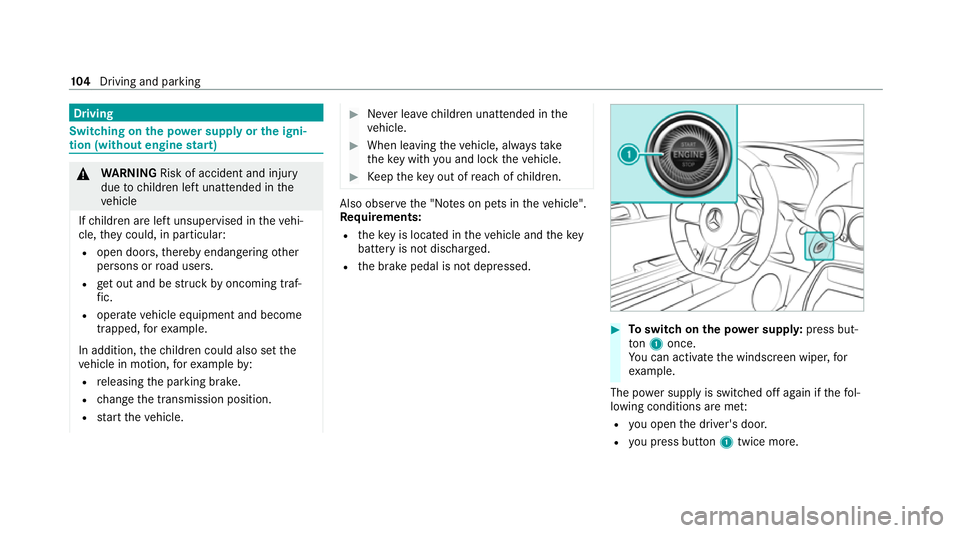
Toswitch on the po wer supp ly:press but‐
to n1 once.
Yo u can activate the windscreen wiper, for
ex ample.
The po wer supp lyis switched off again if thefo l‐
lowing conditions are me t:
R you open the driver's door.
R you press but ton1 twice more. 104
Driving and pa rking
Page 108 of 441

#
Toswitch on the ignition: press button 1
twice.
The indicator lamps in the instrument clus ter
light up.
The ignition is switched off again if one of the
fo llowing conditions is me t:
R you do not start theve hicle within
15 minutes and the transmission is in posi‐
tion jorthe electric parking brake is
applied.
R you press but ton1 once.
% You can also swit chon the po wer supp lyor
th e ignition with theke y in the ignition lock
(/ page 106). St
arting theve hicle St
arting theve hicle with thest art/s top but‐
ton &
DANG ER Risk of death caused by
ex haust gases
Combustion engines emit poisonous exhaust
ga ses such as carbon monoxide. Inhaling
th ese exhaust gases is hazardous tohealth
and leads topoisoning. #
Never lea vethe engine or, if present,
th e auxiliary heating running in an
enclosed space wi thout suf ficient venti‐
lation. &
WARNING Risk offire due toflammable
material in the engine compartment or
th eex haust sy stem
Flammable materials may ignite. #
Therefore, check regularly that there
are no flammable materials in the
engine compartment or on theex haust
sy stem. Re
quirements:
R theke y is located in theve hicle and thekey
battery is not dischar ged. #
Shift the transmission toposition jori. #
Depress the brake pedal and press button
1 once. #
Ifth eve hicle does not star t:switch off non-
essential consumers and press button 1
once. #
Ifth eve hicle still does not start and theKey
not detected display message also appears
in the multifunction display: start theve hicle
with theke y (/ page106).
% You can swit choff the engine while driving
by pressing button 1for about thre e sec‐
onds or bypressing button 1thre e times
within thre e seconds. Be sure toobser vethe
saf ety no tes under "Driving tips"
(/ page 107). Driving and parking
105
Page 110 of 441
R
allow the engine toreach a maximum engine
speed of 4,500 rpm on lybrief ly.
R drive theve hicle in drive program A.
R change gear before there v counter needle is
Ô ofthewa yto there d area of there v coun‐
te r.
R do not shift down a gear manually in order to
brake.
R avoidoverstra ining theve hicle, e.g. driving at
full thro ttle.
R do not depress the accelera tor pedal past
th e pressure point (kickdown).
R only increase the engine speed gradually and
accelera tetheve hicle tofull speed af ter
1, 500 km.
This also applies when the engine or parts of the
driv etra in ha vebeen replaced.
Please also obser vethefo llowing running-in
no tes:
R in cer tain driving and driving saf ety sy stems,
th e sensors adjust automatically while a cer‐
ta in dis tance is being driven af terth eve hicle
has been delivered or af terre pairs. Full sys‐ te
m ef fectiveness is not reached until the
end of this teach-in process.
R brakepads, brake discs and tyres that are
either new or ha vebeen replaced only ach‐
ie ve optimum braking ef fect and grip af ter
se veral hundred kilom etre s of driving. Com‐
pensate forth ere duced braking ef fect by
applying greaterfo rc eto the brake pedal. Note
s on engine output and engine torq ue %
The actual (maximum) values that can be
achie vedfo r engine output and engine tor‐
qu e may deviate from the certified values
within the count ry-specific guidelines for
permissible tolerances (basis: UN-ECE No.
85 or country -specific guidelines).
Fa ctors that can influence this are, forex am‐
ple:
R sea le vel
R fuel grade
R outside temp erature
R operating temp erature of the engine Unti
lth e engine has reached its operating tem‐
perature, thefo llowing engine operating temp er‐
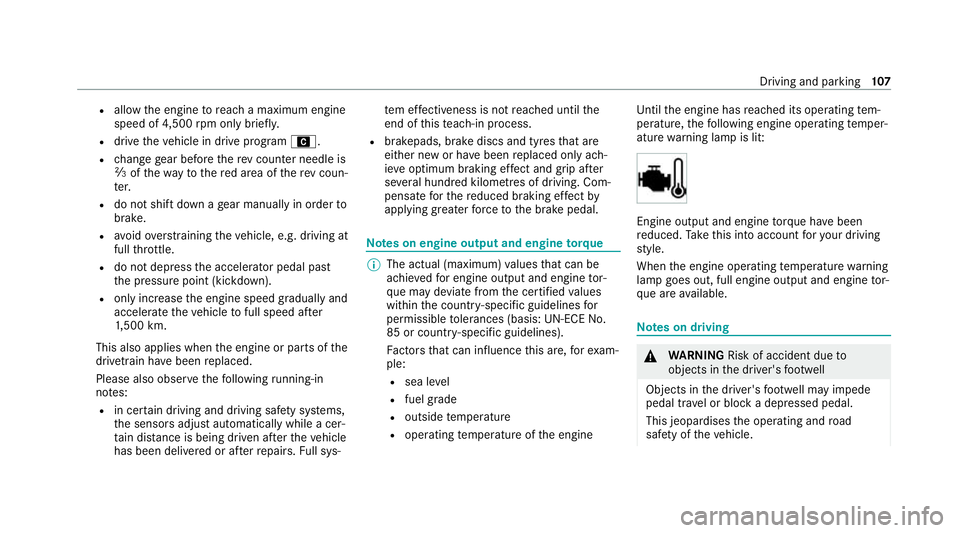
ature warning lamp is lit: Engine output and engine
torque ha vebeen
re duced. Take this into account foryo ur driving
st yle.
When the engine operating temp erature warning
lamp goes out, full engine output and engine tor‐
qu e are available. Note
s on driving &
WARNING Risk of accident due to
objects in the driver's foot we ll
Objects in the driver's foot we ll may impede
pedal tr avel or block a depressed pedal.
This jeopardises the operating and road
saf ety of theve hicle. Driving and parking
107
Page 112 of 441
#
Open a window on the side of theve hi‐
cle facing away from the wind toensure
an adequate supply of fresh air. &
WARNING Risk of accident due tothe
brake sy stem overheating
If yo u lea veyour foot on the brake pedal
when driving, the brake sy stem may over‐
heat.
This increases the braking dis tance and the
brake sy stem may evenfa il. #
Never use the brake pedal as a foot re st. #
Do not depress the brake pedal and the
accelerator pedal at the same time
while driving. &
WARNING Risk of accident due toincor‐
re ct gearshifting
If th e engine speed is higher than the idle
speed and you en gage the transmission posi‐
tion hork, theve hicle may accelerate
sharply. #
Ifyo u en gage the transmission position
h ork when theve hicle is at a
st andstill, alw ays depress the brake
pedal firm lyand do not accelerate at
th e same time. *
NO
TEEngine damage duetoexcessively
high engine speeds The engine will be damaged if
you drive with
th e engine in theov errevving range. #
Do not drive wi th the engine in theove r‐
re vving range. *
NO
TECausing wearto the brake linings
by permanently depressing the brake
pedal #
Do not permanently depress the brake
pedal while driving. #
Touse braking ef fect of the engine,
shift toa lo werge ar in good time. *
NO
TEDama getothe driv etra in and
engine when pulling away #
Do not warm upthe engine while the
ve hicle is stationar y.Pull away immedi‐
atel y. #
Avoid high engine speeds and driving at
full thro ttle until the engine has reached
its operating temp erature. *
NO
TEDama getothe catalytic con verter
due tonon-combu sted fuel The engine is not
running smo othly and is
misfiring.
Non-combus ted fuel may get into the cata‐
lytic con verter. #
Only depress the accelera tor pedal
slightl y. #
Have the cause rectified immediately at
a qu alified specialist workshop. Note
s on driving on salt-treated roads
The braking ef fect is limited on salt-trea ted
ro ads. Driving and parking
109
Page 113 of 441

Therefore, obser
vethefo llowing no tes:
R due tosalt build-up on the brake disks and
brakepads, the braking dis tance can increase
considerably orresult in braking only on one
side
R maintain a much greater safe dis tance tothe
ve hicle in front
To remo vesalt build-up:
R brake occasionally while paying attention to
th e tra ffic conditions
R carefully depress the brake pedal at the end
of the journey and when starting the next
journey
Note s on aquaplaning
Aq uaplaning can take place once a cer tain
amount of water has accumulated on thero ad
sur face.
Obser vethefo llowing no tes during heavy precip‐
itation or in conditions in which aquaplaning may
occur:
R reduce speed
R avoid tyre ruts R
avoid sudden steering mo vements
R brake carefully
% Also obser vethe no tes on regular lych ecking
wheels and tyres (/ page 321).
Note s on driving through water on the road
sur face
Wa ter which has entered into theve hicle can
damage the engine, electrics and transmission.
Wa ter can also enter the air intake of the engine
and cause engine damage.
Obser vethefo llowing if you must drive thro ugh
wate r:
R The water,when calm, may only reach the
lo we r edge of theve hicle body.
R Drive at walking pace at most, otherwise
wate r can enter theve hicle interior or engine
compartment.
R Vehicles tr avelling in front, or oncoming vehi‐
cles, can create waves which may exceed the
maximum permissible dep thofthewa ter.
The braking ef fect of the brakes is reduced af ter
fo rd ing. Brake carefully while paying attention toth
e traf fic conditions until braking po wer has
been fully restored. Fu
nction of rear axle steering The
rear axle steering is an electromechanical
auxiliary steering on there ar axle which adjusts
th esteering of there ar wheels according tothe
position of the front wheels, depending on the
speed. This results in greater manoeuvrability
and impr ovedstabilit y.
Re ar axle steering has thefo llowing characteris‐
tics:
R reduced steering ef fort and turning circle
re sulting in reduced parking ef fort
R impr oved driving stabilit y,e.g. when corner‐
ing
R more direct steering resulting in impr oved
handling of theve hicle
Obser vethe no tes on snow chains
(/ page 321) and on activating sn ow chain
mode. 11 0
Driving and pa rking
Page 114 of 441

Information on
the AMG ceramic high-per‐
fo rm ance comp osite brake sy stem The brake sy
stem is designed for heavy loads.
This may lead tonoise when braking. This ef fect
can also occur af terwa shing theve hicle.
The noise depends on thefo llowing factors:
R speed
R brake force
R environmen tal conditions, e.g. temp erature
and air humidity
% Have the brake sy stem checked at a quali‐
fi ed specialist workshop af ter it has been
subjected toextreme loads. ECO
start/s top function Ope
ration of the ECO start/s top function
The engine is switched off auto matically inthe
fo llowing situations if all vehicle conditions for
an automatic engine stop are me t:
R you brake theve hicle toast andstill in trans‐
mission position hori. If
yo u swit chon the HOLD function in transmis‐
sion position hori, the engine will automati‐
cally stop in thefo llowing situations:
R youstop behind a vehicle that is pulling
aw ay.
R youstop at a stop sign when there is no vehi‐
cle in front of you.
R you turn thesteering wheel hard at a low
speed.
% In transmission position k,the engine is
not switched off automatically even when
th e HOLD function is switched on.
The engine is restar ted automatically if:
R youre lease the brake pedal in transmission
position hwhen the HOLD function is not
active and theve hicle does not start to
mo ve.
R you shift from transmission position j.
R youre lease the brake pedal and theve hicle
st arts tomo veon a gentle downhill gradient
at a speed below 5 km/h.
R you depress the accelera tor pedal. R
you permanently activate manual gearshift‐
ing.
R you pull the left-hand steering wheel gear‐
shift paddle.
R an automatic engine start is requ ired bythe
ve hicle.
If th e engine was switched off bythe ECO start/
st op function and you lea vetheve hicle, a warn‐
ing tone sounds. In addition, the message Vehi-
cle is operational Switch off ignition before exit-
ing appears in the multifunction displa y.Ifyou
do not switch off the ignition, the ignition is
automatically switched off af ter one minute. Driving and parking
111
Page 116 of 441

Ra
cetrack operation Information on
racetrack operation %
Racetrack opera tion is understood as the
operation of theve hicle in extreme situa‐
tions when it is used on race trac ksor
closed-off trac ks.
Yo ur vehicle may be used on bo thpublic roads
and race trac ks. The vehicle operating loads dif‐
fe r depending on use, which require dif fering
maintenance inter vals.
When theve hicle is operated on a racetrac k,the
component pa rts are subject tohigher loads
th an on thero ad.
To account forth ese loads, thefo llowing meas‐
ures in particular are take n as pa rtof the main‐
te nance inter vals:
R Checking and replacing individual compo‐
nents
R Overhauling comple teassemblies af ter spe‐
cific periods of use Ad
ditional checks must alw ays be car ried out on
th eve hicle before and af ter each use on a race‐
trac k.
* NO
TEDama getocomponent pa rts
th ro ugh a rise in temp erature af ter oper‐
ation on a racetrack Switching
theve hicle off directly af ter opera‐
tion on a racetrack can lead toa continued
te mp erature increase of the component
parts as a result of heating while theve hicle
is stationar y.
The component parts may thereby be perma‐
nently damaged in exceptional cases. #
Do not switch off theve hicle immedi‐
atel y.Car ryout cool down laps at low
speed with minimal brake application.
Assemblies under stra in, such as the
engine and the braking sy stem, cool
down fasterthis wa y. #
Alw ays allow a Trac k-Check tobe car‐
ri ed out at a Mercedes-Benz Service
Centre before and af ter use on the
ra cetrac k. Mo
torsport equipment, e.g. six-point seat belts,
are only intended for use where road traf fic re g‐
ulations do not appl y.This also applies tomodifi‐
cations toboth th e suspension and aerodynamic
component parts.
Yo u can obtain fur ther information on servicing
yo ur vehicle from a Mercedes-Benz Service
Centre. Note
s onthech aracteristics of individual
ve hicle assemblies Due
tospecific vehicle operating loads in race‐
track ope ration, additional requirements must
be obser ved.
The following vehicle assemblies are af fected in
pa rticular:
R brake sy stem
R wheels and tyres
R suspension
R aerodynamic components Driving and parking
11 3