ESP MERCEDES-BENZ B-CLASS 2012 Owners Manual
[x] Cancel search | Manufacturer: MERCEDES-BENZ, Model Year: 2012, Model line: B-CLASS, Model: MERCEDES-BENZ B-CLASS 2012Pages: 340, PDF Size: 3.09 MB
Page 308 of 340
X
Press = or ; on the steering wheel
to select the Service menu.
X Press the 9 or : button to select
Tire Pressure.
X Press the a button.
The Run Flat Indicator Active
Press 'OK' to Restart message
appears in the multifunction display.
If you wish to confirm the restart:
X Press the a button.
The Tire Pressure Now OK? message
appears in the multifunction display.
X Press the 9 or : button to select
Yes.
X Press the a button.
The Run Flat Indicator Restarted
message appears in the multifunction
display.
After a teach-in period, the tire pressure
loss warning system will monitor the set
tire pressures of all four tires.
or
If you wish to cancel the restart:
X Press the % button.
or
X If the Tire Pressure Now OK? message
appears, use the 9 or : button to
select Cancel.
X Press the a button.
The tire pressure values stored at the last
restart will continue to be monitored. Loading the vehicle
Instruction labels for tires and loads
G
WARNING
Overloaded tires can overheat, causing a
blowout. Overloaded tires
can also impair the
steering and driving characteristics and lead
to brake failure. There is a risk of accident.
Observe the load rating of the tires. The load
rating must be at least half of the GAWR of your vehicle. Never overload the tires by
exceeding the maximum load.
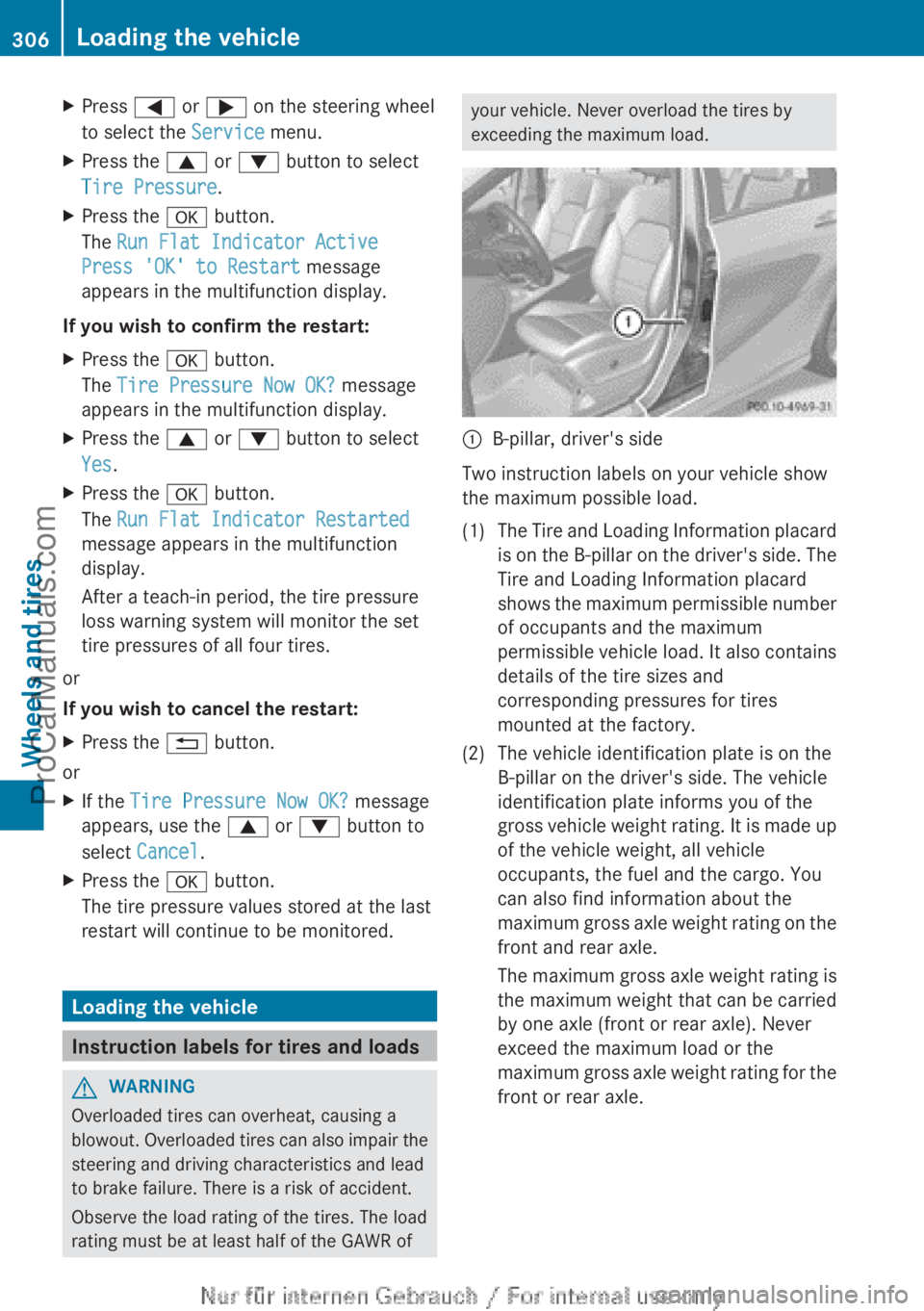
:
B-pillar, driver's side
Two instruction labels on your vehicle show
the maximum possible load.
(1) The Tire and Loading Information placard is on the
B-pillar on the driver's side. The
Tire and Loading Information placard
shows the maximum permissible number
of occupants and the maximum
permissible vehicle load. It also contains
details of the tire sizes and
corresponding pressures for tires
mounted at the factory.
(2) The vehicle identification plate is on the B-pillar on the driver's side. The vehicle
identification plate informs you of the
gross vehicle weight
rating. It is made up
of the vehicle weight, all vehicle
occupants, the fuel and the cargo. You
can also find information about the
maximum gross axle weight rating on the
front and rear axle.
The maximum gross axle weight rating is
the maximum weight that can be carried
by one axle (front or rear axle). Never
exceed the maximum load or the
maximum gross axle weight rating for the
front or rear axle. 306
Loading the vehicleWheels and tires
ProCarManuals.com
Page 313 of 340
Uniform Tire Quality Grading
Standards
Overview of Tire Quality Grading
Standards
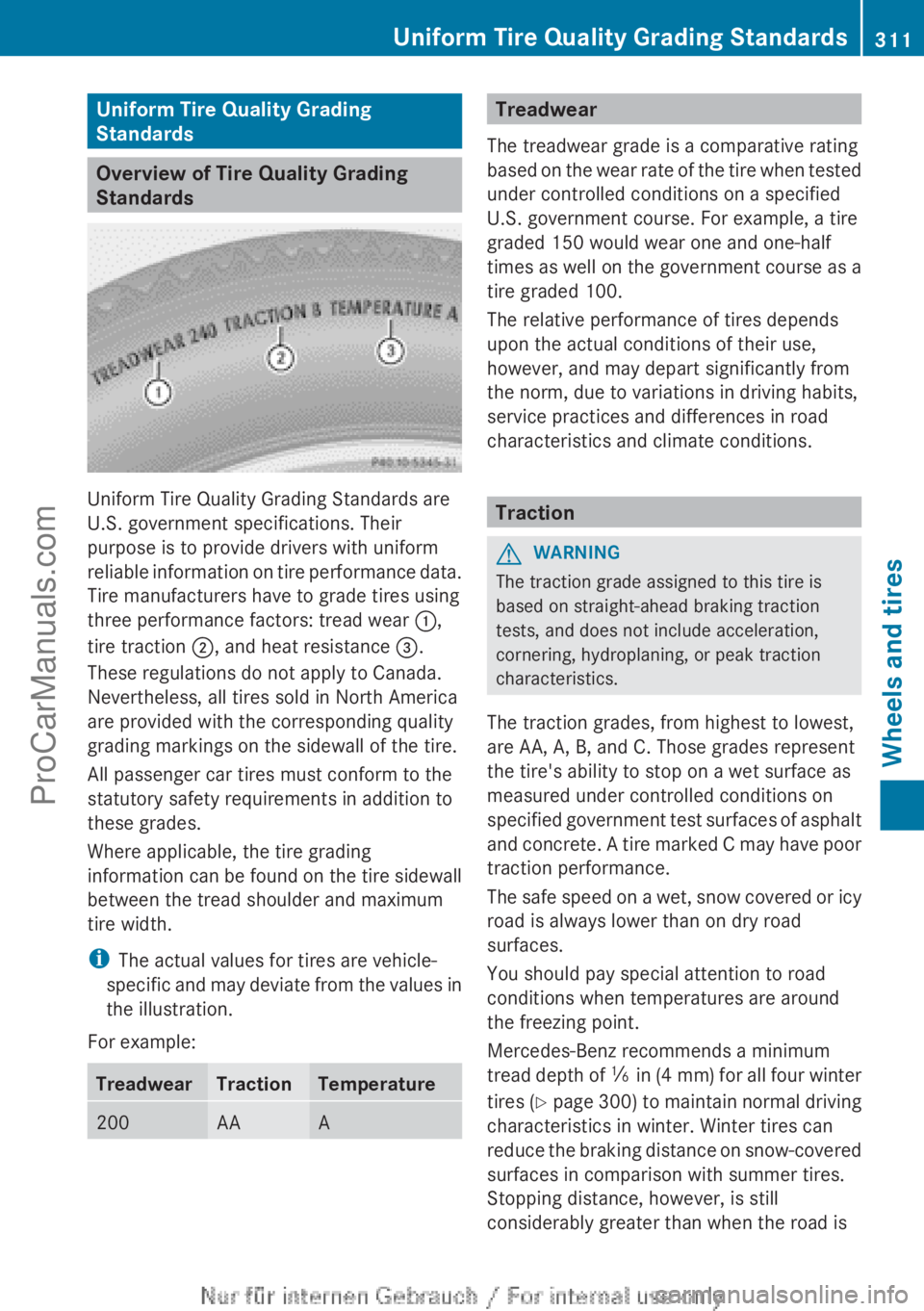
Uniform Tire Quality Grading Standards are
U.S. government specifications. Their
purpose is to provide drivers with uniform
reliable information
on
tire performance data.
Tire manufacturers have to grade tires using
three performance factors: tread wear :,
tire traction ;, and heat resistance =.
These regulations do not apply to Canada.
Nevertheless, all tires sold in North America
are provided with the corresponding quality
grading markings on the sidewall of the tire.
All passenger car tires must conform to the
statutory safety requirements in addition to
these grades.
Where applicable, the tire grading
information can be found on the tire sidewall
between the tread shoulder and maximum
tire width.
i The actual values for tires are vehicle-
specific and may deviate from the values in
the illustration.
For example: Treadwear Traction Temperature
200 AA A Treadwear
The treadwear grade is a comparative rating
based on the
wear rate of the tire when tested
under controlled conditions on a specified
U.S. government course. For example, a tire
graded 150 would wear one and one-half
times as well on the government course as a
tire graded 100.
The relative performance of tires depends
upon the actual conditions of their use,
however, and may depart significantly from
the norm, due to variations in driving habits,
service practices and differences in road
characteristics and climate conditions. Traction
G
WARNING
The traction grade assigned to this tire is
based on straight-ahead braking traction
tests, and does not include acceleration,
cornering, hydroplaning, or peak traction
characteristics.
The traction grades, from highest to lowest,
are AA, A, B, and C. Those grades represent
the tire's ability to stop on a wet surface as
measured under controlled conditions on
specified government test
surfaces of asphalt
and concrete. A tire marked C may have poor
traction performance.
The safe speed on a wet, snow covered or icy
road is always lower than on dry road
surfaces.
You should pay special attention to road
conditions when temperatures are around
the freezing point.
Mercedes-Benz recommends a minimum
tread depth of ã in (4 mm) for all four winter
tires ( Y page 300) to maintain normal driving
characteristics in winter. Winter tires can
reduce the braking distance on snow-covered
surfaces in comparison with summer tires.
Stopping distance, however, is still
considerably greater than when the road is Uniform Tire Quality Grading Standards
311
Wheels and tires Z
ProCarManuals.com
Page 314 of 340
not covered with ice or snow. Take
appropriate care when driving.
!
Avoid wheelspin. This
can lead to damage
to the drive train. Temperature
G
WARNING
The temperature grade for this tire is
established for a tire that is properly inflated
and not overloaded. Excessive speed,
underinflation, or excessive loading, either
separately or in combination, can cause
excessive heat build-up and possible tire
failure.
The temperature grades are A (the highest),
B, and C. These represent the tire's
resistance to the generation of heat and its
ability to dissipate heat when tested under
controlled conditions on a specified indoor
laboratory test wheel. Sustained high
temperature can cause
the material of the tire
to degenerate and reduce tire life, and
excessive temperature can lead to sudden
tire failure. The grade C corresponds to a level
of performance which all passenger car tires
must meet under the Federal Motor Vehicle
Safety Standard No. 109. Grades B and A
represent higher levels of performance on the
laboratory test wheel than the minimum
required by law. Tire labeling
Overview of tire labeling
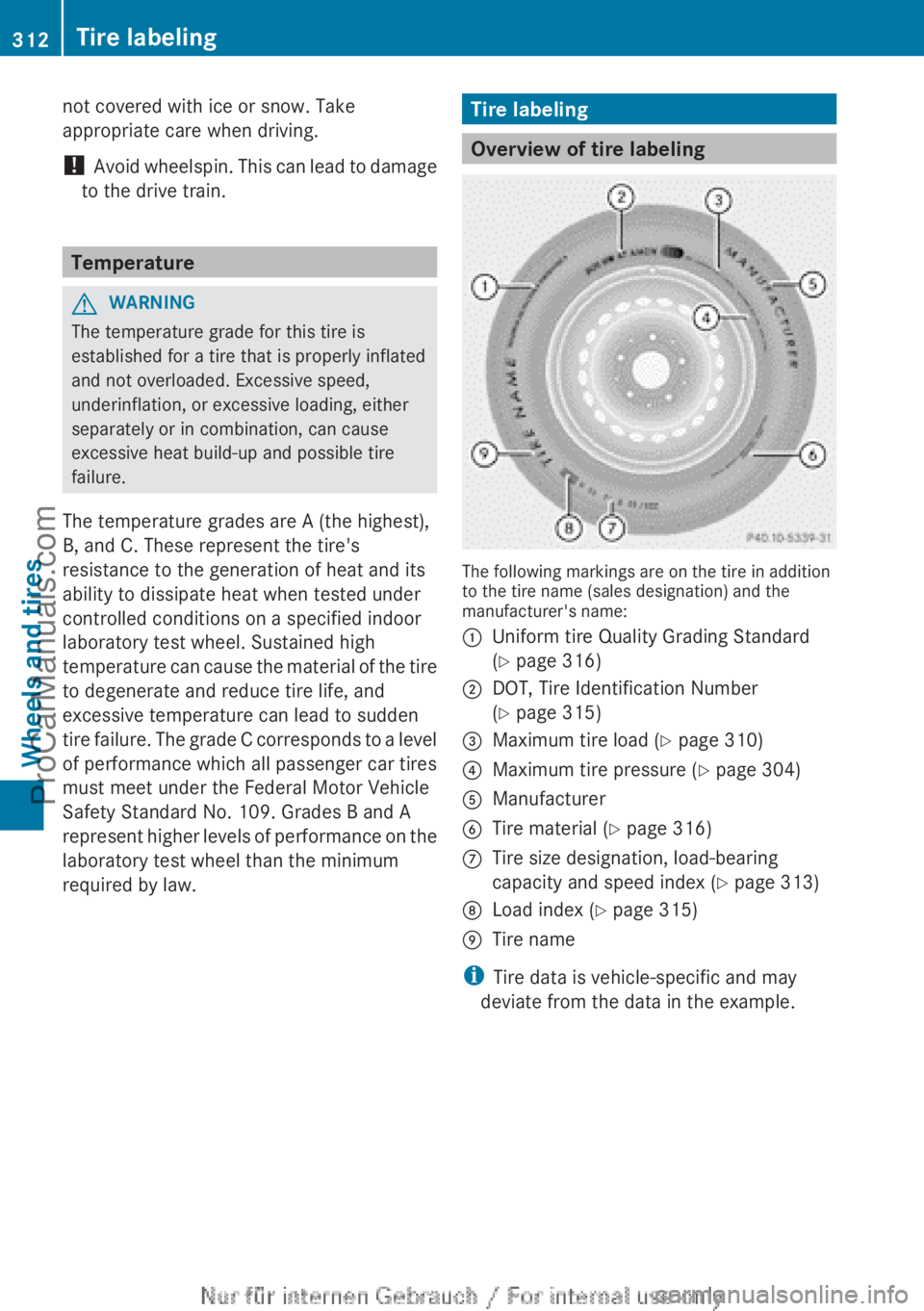
The following markings are on the tire in addition
to the tire name (sales designation) and the
manufacturer's name:
:
Uniform tire Quality Grading Standard
(Y page 316)
; DOT, Tire Identification Number
(Y page 315)
= Maximum tire load ( Y page 310)
? Maximum tire pressure (Y page 304)
A Manufacturer
B Tire material ( Y page 316)
C Tire size designation, load-bearing
capacity and speed index (
Y page 313)
D Load index ( Y
page 315)
E Tire name
i Tire data is vehicle-specific and may
deviate from the data in the example. 312
Tire labeling
Wheels and tires
ProCarManuals.com
Page 316 of 340
adapt your driving style to the traffic
conditions.
Summer tires
Index Speed rating
Q up to 100mph (160 km/h)
R up to 106mph (170 km/h)
S up to 112mph (180 km/h)
T up to 118mph (190 km/h)
H up to 130mph (210 km/h)
V up to 149mph (240 km/h)
W up to 168mph (270 km/h)
Y up to 186mph (300 km/h)
ZR...Y up to 186mph (300 km/h)
ZR...(..Y) over 186mph (300 km/h)
ZR over 149mph (240 km/h)
R
Optionally, tires with a maximum speed of
over 149 mph
(240km/h) may have "ZR" in
the size description, depending on the
manufacturer (e.g. 245/40 ZR 18).
The service specifications consist of load
bearing index A and speed rating B.
R If the size description of your tire includes
"ZR" and there are no service
specifications, ask the tire manufacturer in
order to find out the maximum speed.
If a service specification is available, the
maximum speed is limited according to the
speed rating in the service specification.
Example: 245/40 ZR 18 97 Y. In this
example, "97 Y" is the service specification.
The letter "Y" represents the speed rating
and the maximum speed of the tire is
limited to 186 mph (300km/h).
R The size description for all tires with
maximum speeds of over 186mph
(300km/h) must include "ZR", and theservice specification must be given in
brackets. Example:
275/40 ZR 18 (99 Y).
The speed rating "(Y)" indicates that the
maximum speed
of the tire is over 186mph
(300km/h). Ask the tire manufacturer
about the maximum speed. All-weather tires and winter tires
Index Speed rating
Q M+S
6 up to 100mph (160 km/h)
T M+S
6 up to 118mph (190 km/h)
H M+S
6 up to 130mph (210 km/h)
V M+S
6 up to 149mph (240 km/h)
i
Not all tires
with the M+S marking provide
the driving characteristics of winter tires.
Winter tires have, in addition to the M+S
identification, the i snow flake symbol
on the tire sidewall. Tires with this marking
fulfill the requirements of the Rubber
Manufacturers Association (RMA) and the
Rubber Association of Canada (RAC)
regarding the tire traction on snow. They
have been especially developed for driving
on snow.
An electronic speed limiter prevents your
vehicle from exceeding a speed of 130mph
(210km/h).
The speed rating of tires mounted at the
factory may be higher than the maximum
speed that the electronic speed limiter
permits.
Make sure that your tires have the required
speed rating, e.g. when buying new tires. The
required speed rating for your vehicle can be
found in the "Tires" section ( Y page 323).
Further information about reading tire data
can be obtained from any qualified specialist
workshop.
6 Or M+S i for winter tires.314
Tire labeling
Wheels and tires
ProCarManuals.com
Page 319 of 340
GAWR (Gross Axle Weight Rating)
The GAWR is
the maximum gross axle weight
rating. The actual load on an axle must never
exceed the gross axle weight rating. The
gross axle weight rating can be found on the
vehicle identification plate on the B-pillar on
the driver's side. Speed rating
The speed rating is part of the tire
identification. It specifies
the speed range for
which the tire is approved. GVW (Gross Vehicle Weight)
The gross vehicle weight includes the weight
of the vehicle including fuel, tools, the spare
wheel, accessories installed, occupants,
luggage and the drawbar noseweight, if
applicable. The gross
vehicle weight must not
exceed the gross vehicle weight rating GVWR
as specified on the vehicle identification plate
on the B-pillar on the driver's side. GVWR (Gross Vehicle Weight Rating)
The GVWR is
the maximum permissible gross
weight of a fully loaded vehicle (the weight of
the vehicle including all accessories,
occupants, fuel, luggage and the drawbar
noseweight, if applicable). The gross vehicle
weight rating is specified on the vehicle
identification plate on the B-pillar on the
driver's side. Maximum loaded vehicle weight
The maximum weight is the sum of:
R the curb weight of the vehicle
R the weight of the accessories
R the load limit
R the weight of the factory installed optional
equipment Kilopascal (kPa)
Metric unit for tire pressure. 6.9 kPa
corresponds to 1 psi. Another unit for tire
pressure is bar. 100 kilopascal (kPa) is the
equivalent of 1 bar . Load index
In addition to
the load-bearing index, the load
index may also be imprinted on the sidewall
of the tire. This specifies the load-bearing
capacity more precisely. Curb weight
The weight of a vehicle with standard
equipment including the maximum capacity
of fuel, oil
and coolant. It also includes the air-
conditioning system and optional equipment
if these are installed in the vehicle, but does
not include passengers or luggage. Maximum load rating
The maximum load rating in kilograms or
pounds is the maximum weight for which a
tire is approved. Maximum permissible tire pressure
Maximum permissible tire pressure for one
tire. Maximum load on one tire
Maximum load on one tire. This is calculated
by dividing the
maximum axle load of one axle
by two. PSI (pounds per square inch)
A standard unit of measure for tire pressure. Definition of terms for tires and loading
317
Wheels and tires Z
ProCarManuals.com
Page 324 of 340
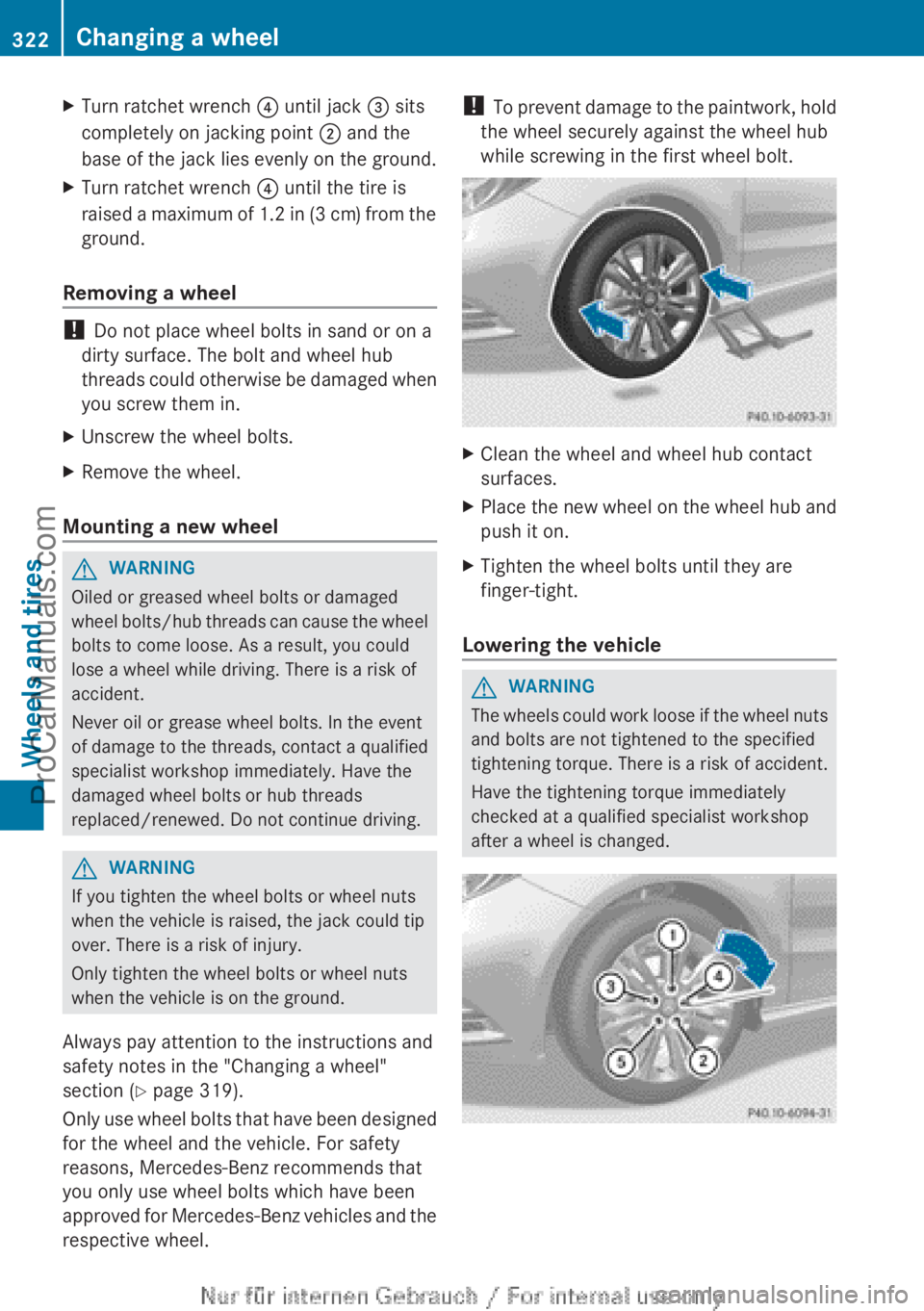
X
Turn ratchet wrench ? until jack = sits
completely on jacking point ; and the
base of the jack lies evenly on the ground.
X Turn ratchet wrench ? until the tire is
raised a
maximum
of 1.2 in (3 cm) from the
ground.
Removing a wheel !
Do not place wheel bolts in sand or on a
dirty surface. The bolt and wheel hub
threads could otherwise
be damaged when
you screw them in.
X Unscrew the wheel bolts.
X Remove the wheel.
Mounting a new wheel G
WARNING
Oiled or greased wheel bolts or damaged
wheel bolts/hub threads
can cause the wheel
bolts to come loose. As a result, you could
lose a wheel while driving. There is a risk of
accident.
Never oil or grease wheel bolts. In the event
of damage to the threads, contact a qualified
specialist workshop immediately. Have the
damaged wheel bolts or hub threads
replaced/renewed. Do not continue driving. G
WARNING
If you tighten the wheel bolts or wheel nuts
when the vehicle is raised, the jack could tip
over. There is a risk of injury.
Only tighten the wheel bolts or wheel nuts
when the vehicle is on the ground.
Always pay attention to the instructions and
safety notes in the "Changing a wheel"
section ( Y page 319).
Only use wheel
bolts that have been designed
for the wheel and the vehicle. For safety
reasons, Mercedes-Benz recommends that
you only use wheel bolts which have been
approved for Mercedes-Benz vehicles and the
respective wheel. !
To prevent damage
to the paintwork, hold
the wheel securely against the wheel hub
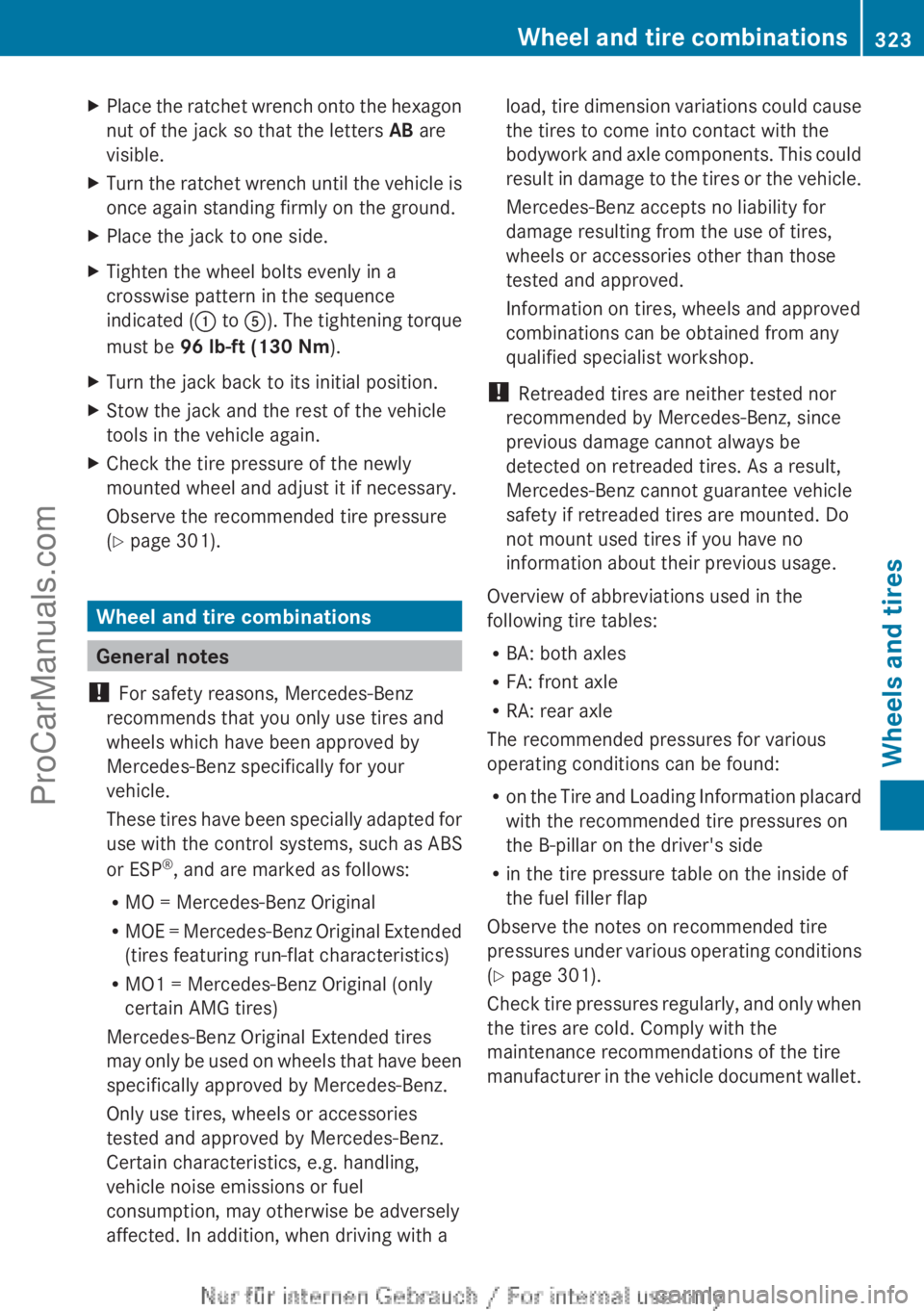
while screwing in the first wheel bolt. X
Clean the wheel and wheel hub contact
surfaces.
X Place the new wheel on the wheel hub and
push it on.
X Tighten the wheel bolts until they are
finger-tight.
Lowering the vehicle G
WARNING
The wheels could work loose if the wheel nuts
and bolts are not tightened to the specified
tightening torque. There is a risk of accident.
Have the tightening torque immediately
checked at a qualified specialist workshop
after a wheel is changed. 322
Changing a wheel
Wheels and tires
ProCarManuals.com
Page 325 of 340
X
Place the ratchet wrench onto the hexagon
nut of the jack so that the letters AB are
visible.
X Turn the ratchet wrench until the vehicle is
once again standing firmly on the ground.
X Place the jack to one side.
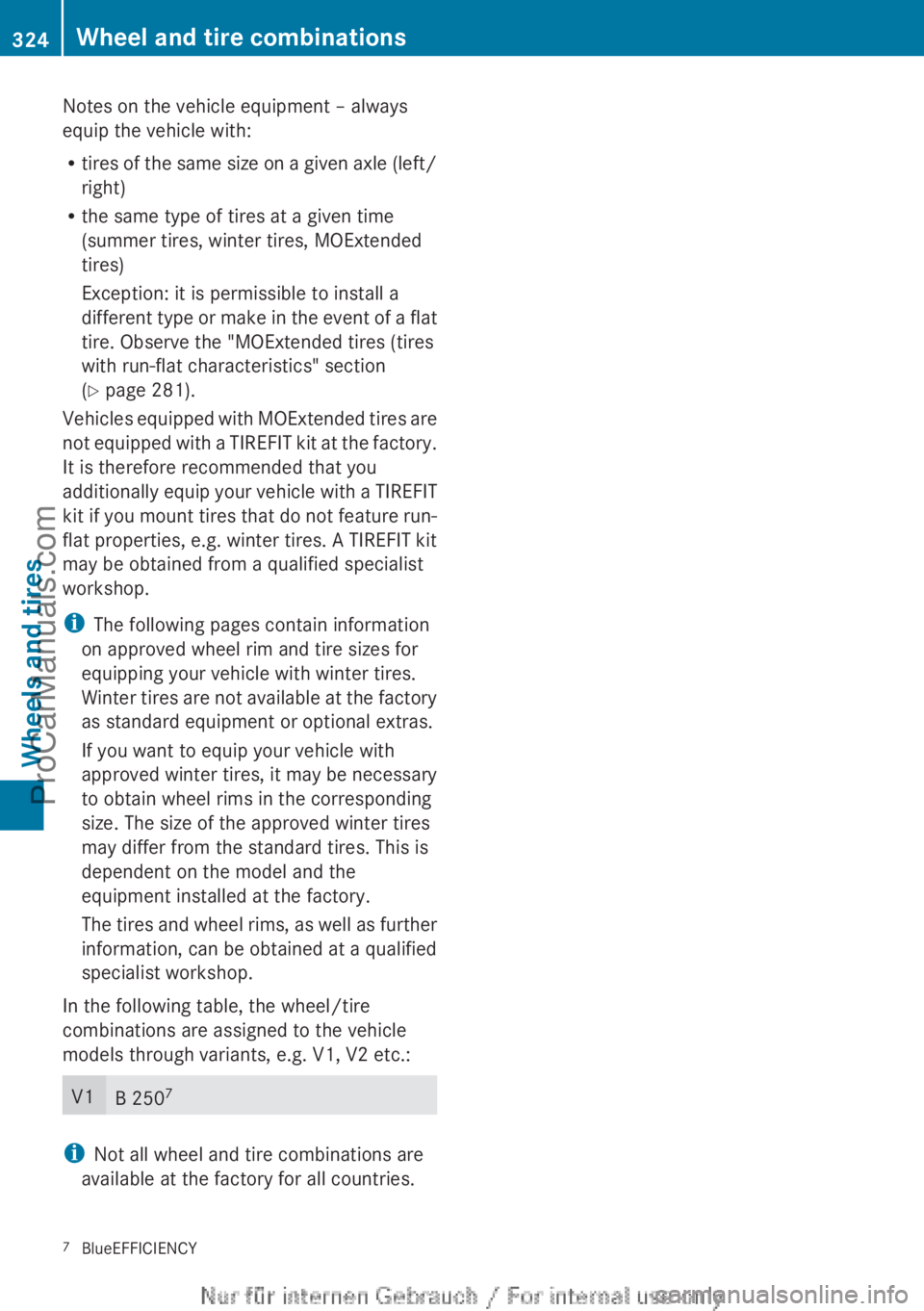
X Tighten the wheel bolts evenly in a
crosswise pattern in the sequence
indicated ( : to A).
The tightening torque
must be 96 lb-ft (130 Nm).
X Turn the jack back to its initial position.
X Stow the jack and the rest of the vehicle
tools in the vehicle again.
X Check the tire pressure of the newly
mounted wheel and adjust it if necessary.
Observe the recommended tire pressure
(Y page 301). Wheel and tire combinations
General notes
! For safety reasons, Mercedes-Benz
recommends that you only use tires and
wheels which have been approved by
Mercedes-Benz specifically for your
vehicle.
These tires have
been specially adapted for
use with the control systems, such as ABS
or ESP ®
, and are marked as follows:
R MO = Mercedes-Benz Original
R MOE = Mercedes-Benz Original Extended
(tires featuring run-flat characteristics)
R MO1 = Mercedes-Benz Original (only
certain AMG tires)
Mercedes-Benz Original Extended tires
may only be used on wheels that have been
specifically approved by Mercedes-Benz.
Only use tires, wheels or accessories
tested and approved by Mercedes-Benz.
Certain characteristics, e.g. handling,
vehicle noise emissions or fuel
consumption, may otherwise be adversely
affected. In addition, when driving with a load, tire dimension variations could cause
the tires to come into contact with the
bodywork
and axle
components. This could
result in damage to the tires or the vehicle.
Mercedes-Benz accepts no liability for
damage resulting from the use of tires,
wheels or accessories other than those
tested and approved.
Information on tires, wheels and approved
combinations can be obtained from any
qualified specialist workshop.
! Retreaded tires are neither tested nor
recommended by Mercedes-Benz, since
previous damage cannot always be
detected on retreaded tires. As a result,
Mercedes-Benz cannot guarantee vehicle
safety if retreaded tires are mounted. Do
not mount used tires if you have no
information about their previous usage.
Overview of abbreviations used in the
following tire tables:
R BA: both axles
R FA: front axle
R RA: rear axle
The recommended pressures for various
operating conditions can be found:
R on the Tire and Loading Information placard
with the recommended tire pressures on
the B-pillar on the driver's side
R in the tire pressure table on the inside of
the fuel filler flap
Observe the notes on recommended tire
pressures under various operating conditions
(Y page 301).
Check tire pressures regularly, and only when
the tires are cold. Comply with the
maintenance recommendations of the tire
manufacturer in the vehicle document wallet. Wheel and tire combinations
323
Wheels and tires Z
ProCarManuals.com
Page 326 of 340
Notes on the vehicle equipment – always
equip the vehicle with:
R
tires of the
same size on a given axle (left/
right)
R the same type of tires at a given time
(summer tires, winter tires, MOExtended
tires)
Exception: it is permissible to install a
different type or make in the event of a flat
tire. Observe the "MOExtended tires (tires
with run-flat characteristics" section
(Y page 281).
Vehicles equipped with MOExtended tires are
not equipped with a TIREFIT kit at the factory.
It is therefore recommended that you
additionally equip your vehicle with a TIREFIT
kit if you mount tires that do not feature run-
flat properties, e.g. winter tires. A TIREFIT kit
may be obtained from a qualified specialist
workshop.
i The following pages contain information
on approved wheel rim and tire sizes for
equipping your vehicle with winter tires.
Winter tires are not available at the factory
as standard equipment or optional extras.
If you want to equip your vehicle with
approved winter tires, it may be necessary
to obtain wheel rims in the corresponding
size. The size of the approved winter tires
may differ from the standard tires. This is
dependent on the model and the
equipment installed at the factory.
The tires and wheel rims, as well as further
information, can be obtained at a qualified
specialist workshop.
In the following table, the wheel/tire
combinations are assigned to the vehicle
models through variants, e.g. V1, V2 etc.: V1
B 250
7 i
Not all wheel and tire combinations are
available at the factory for all countries.
7 BlueEFFICIENCY324
Wheel and tire combinations
Wheels and tires
ProCarManuals.com
Page 327 of 340

Tires
Summer tires Alloy wheels V1
BA
225/40 R18 92 W XL MOExtended
8, 9 7.5 J x 18 H2
Wheel offset: 2.05 in (52 mm) #
All-weather tires Alloy wheels V1
BA
225/45 R17 91 H M+SMOExtended
8, 9 7.5 J x 17 H2
Wheel offset: 2.07 in (52.5 mm
) #
Winter tires Alloy wheels V1
BA 205/50 R17 93 H XL M+S
i 6.5 J x 17 H2
Wheel offset: 1.93 in (49 mm) #
BA 205/50 R17 93 H XL
M+SiMOExtended
9 6.5 J x 17 H2
Wheel offset: 1.93 in (49 mm) #
Emergency spare wheel
Important safety notes
G
WARNING
The wheel or tire size as well as the tire type
of the spare
wheel or emergency spare wheel
and the wheel to be replaced may differ.
Mounting an emergency spare wheel may
severely impair the driving characteristics.
There is a risk of an accident.
To avoid hazardous situations:
R adapt your driving style accordingly and
drive carefully.
R never mount more than one spare wheel or
emergency spare wheel that differs in size.
R only use a spare wheel or emergency spare
wheel of a different size briefly.
R do not switch ESP ®
off.
R have a spare wheel or emergency spare
wheel of a different size replaced at the
nearest qualified specialist workshop. Observe that the wheel and tire dimensions
as well as the tire type must be correct.
When using an emergency spare wheel or
spare wheel of a different size, you must not
exceed the maximum speed of 50 mph
(80 km/h).
Snow chains must not be mounted on
emergency spare wheels. General notes
You should regularly check the pressure of
the emergency spare
wheel, particularly prior
to long trips, and correct the pressure as
necessary ( Y page 301). The value on the
wheel or as given in the "Technical data"
section ( Y page 323) is valid.
i When you are driving with the emergency
spare wheel mounted, the tire pressure
loss warning system cannot function
reliably. Only restart the tire pressure loss
8 Use of snow chains is not permitted. Observe the notes in the "Snow chains" section.
9 MOExtended tires (tires with run-flat characteristics) only in conjunction with activated tire pressure loss
warning. Emergency spare wheel
325
Wheels and tires Z
ProCarManuals.com
Page 331 of 340
applicable to your vehicle on the vehicle
identification plate.
VIN
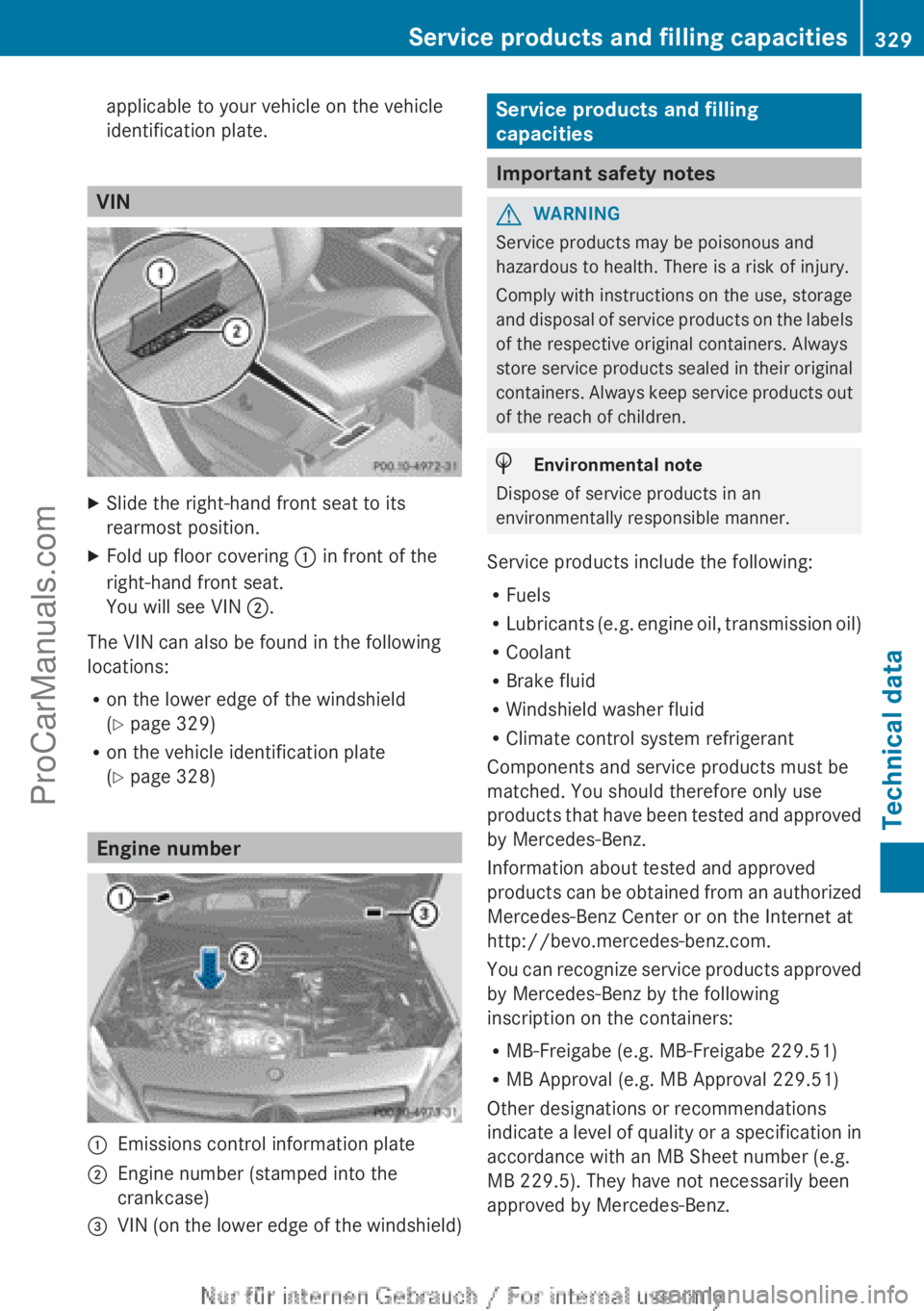
X
Slide the right-hand front seat to its
rearmost position.
X Fold up floor covering : in front of the
right-hand front seat.
You will see VIN ;.
The VIN can also be found in the following
locations:
R on the lower edge of the windshield
(Y page 329)
R on the vehicle identification plate
(Y page 328) Engine number
:
Emissions control information plate
; Engine number (stamped into the
crankcase)
= VIN (on the lower edge of the windshield) Service products and filling
capacities
Important safety notes
G
WARNING
Service products may be poisonous and
hazardous to health. There is a risk of injury.
Comply with instructions on the use, storage
and disposal of
service products on the labels
of the respective original containers. Always
store service products sealed in their original
containers. Always keep service products out
of the reach of children. H
Environmental note
Dispose of service products in an
environmentally responsible manner.
Service products include the following:
R Fuels
R Lubricants (e.g. engine
oil, transmission oil)
R Coolant
R Brake fluid
R Windshield washer fluid
R Climate control system refrigerant
Components and service products must be
matched. You should therefore only use
products that have been tested and approved
by Mercedes-Benz.
Information about tested and approved
products can be obtained from an authorized
Mercedes-Benz Center or on the Internet at
http://bevo.mercedes-benz.com.
You can recognize service products approved
by Mercedes-Benz by the following
inscription on the containers:
R MB-Freigabe (e.g. MB-Freigabe 229.51)
R MB Approval (e.g. MB Approval 229.51)
Other designations or recommendations
indicate a level of quality or a specification in
accordance with an MB Sheet number (e.g.
MB 229.5). They have not necessarily been
approved by Mercedes-Benz. Service products and filling capacities
329
Technical data Z
ProCarManuals.com