traction control MERCEDES-BENZ B-CLASS 2012 Owners Manual
[x] Cancel search | Manufacturer: MERCEDES-BENZ, Model Year: 2012, Model line: B-CLASS, Model: MERCEDES-BENZ B-CLASS 2012Pages: 340, PDF Size: 3.09 MB
Page 10 of 340
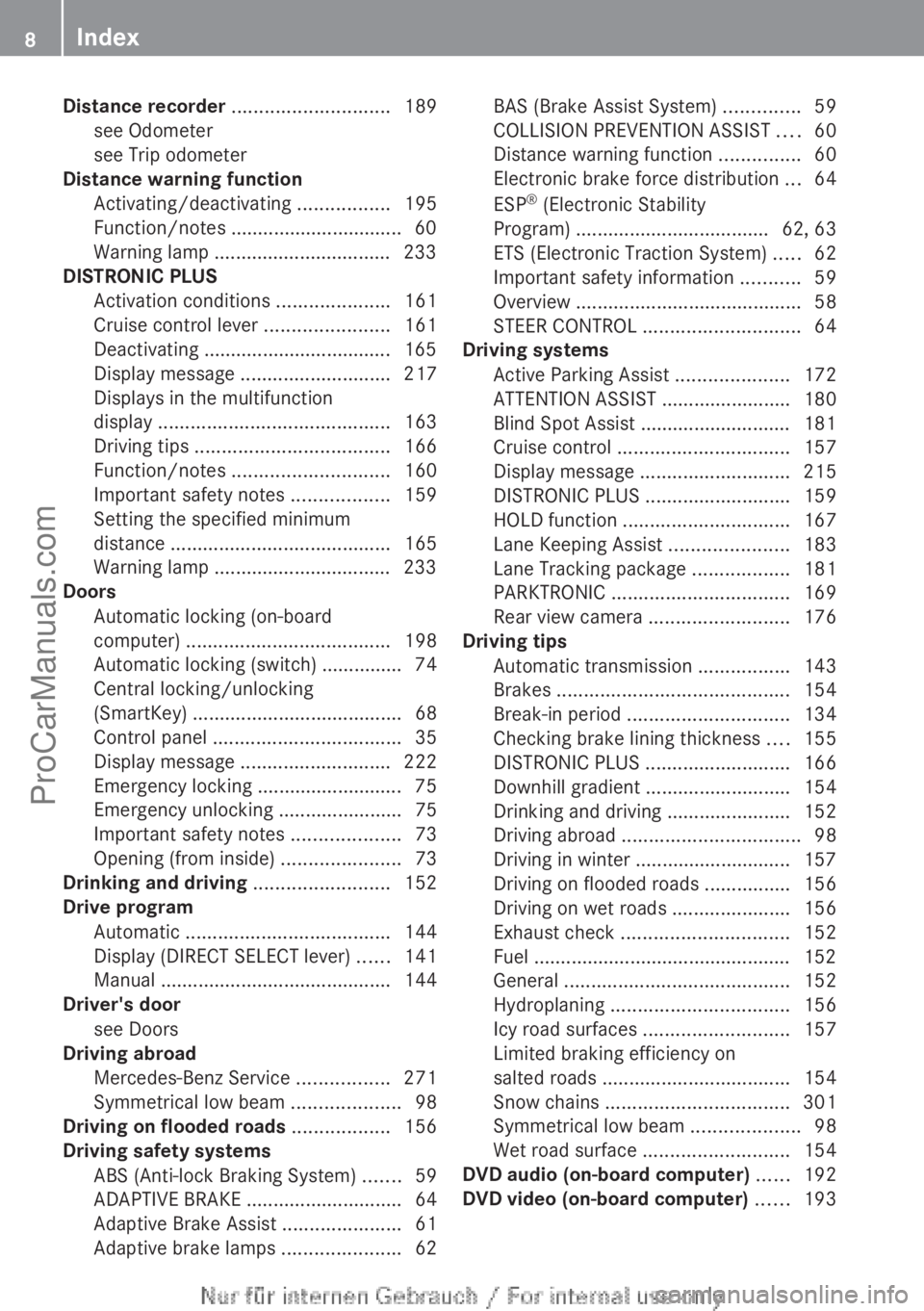
Distance recorder
............................. 189
see Odometer
see Trip odometer
Distance warning function
Activating/deactivating ................. 195
Function/notes ................................ 60
Warning lamp ................................. 233
DISTRONIC PLUS
Activation conditions .....................161
Cruise control lever .......................161
Deactivating ................................... 165
Display message ............................ 217
Displays in the multifunction
display ........................................... 163
Driving tips .................................... 166
Function/notes ............................. 160
Important safety notes .................. 159
Setting the specified minimum
distance ......................................... 165
Warning lamp ................................. 233
Doors
Automatic locking (on-board
computer) ...................................... 198
Automatic locking (switch) ............... 74
Central locking/unlocking
(SmartKey) ....................................... 68
Control panel ................................... 35
Display message ............................ 222
Emergency locking ........................... 75
Emergency unlocking .......................75
Important safety notes .................... 73
Opening (from inside) ......................73
Drinking and driving .........................152
Drive program Automatic ...................................... 144
Display (DIRECT SELECT lever) ...... 141
Manual ........................................... 144
Driver's door
see Doors
Driving abroad
Mercedes-Benz Service .................271
Symmetrical low beam .................... 98
Driving on flooded roads ..................156
Driving safety systems ABS (Anti-lock Braking System) ....... 59
ADAPTIVE BRAKE ............................. 64
Adaptive Brake Assist ......................61
Adaptive brake lamps ...................... 62BAS (Brake Assist System)
..............59
COLLISION PREVENTION ASSIST ....60
Distance warning function
............... 60
Electronic brake force distribution ... 64
ESP ®
(Electronic Stability
Program) .................................... 62, 63
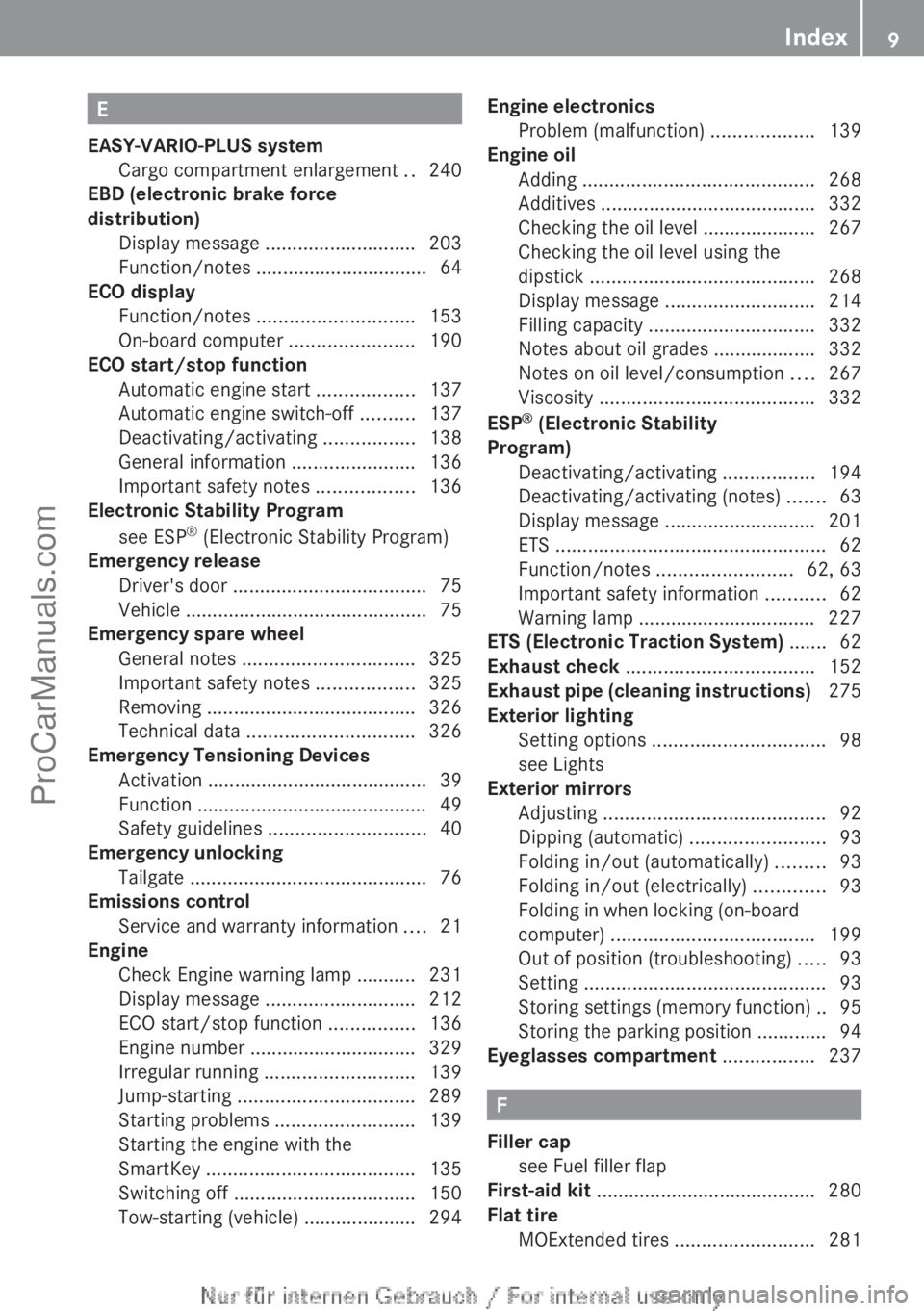
ETS (Electronic Traction System) ..... 62
Important safety information ........... 59
Overview .......................................... 58
STEER CONTROL ............................. 64
Driving systems
Active Parking Assist .....................172
ATTENTION ASSIST ........................ 180
Blind Spot Assist ............................ 181
Cruise control ................................ 157
Display message ............................ 215
DISTRONIC PLUS ........................... 159
HOLD function ............................... 167
Lane Keeping Assist ...................... 183
Lane Tracking package .................. 181
PARKTRONIC ................................. 169
Rear view camera .......................... 176
Driving tips
Automatic transmission ................. 143
Brakes ........................................... 154
Break-in period .............................. 134
Checking brake lining thickness ....155
DISTRONIC PLUS ........................... 166
Downhill gradient ........................... 154
Drinking and driving .......................152
Driving abroad ................................. 98
Driving in winter ............................. 157
Driving on flooded roads ................156
Driving on wet roads ...................... 156
Exhaust check ............................... 152
Fuel ................................................ 152
General .......................................... 152
Hydroplaning ................................. 156
Icy road surfaces ........................... 157
Limited braking efficiency on
salted roads ................................... 154
Snow chains .................................. 301
Symmetrical low beam .................... 98
Wet road surface ........................... 154
DVD audio (on-board computer) ...... 192
DVD video (on-board computer) ......1938
Index
ProCarManuals.com
Page 11 of 340
E
EASY-VARIO-PLUS system Cargo compartment enlargement ..240
EBD (electronic brake force
distribution)
Display message ............................ 203
Function/notes ................................
64
ECO display
Function/notes ............................. 153
On-board computer ....................... 190
ECO start/stop function
Automatic engine start .................. 137
Automatic engine switch-off .......... 137
Deactivating/activating ................. 138
General information ....................... 136
Important safety notes .................. 136
Electronic Stability Program
see ESP ®
(Electronic Stability Program)
Emergency release
Driver's door .................................... 75
Vehicle ............................................. 75
Emergency spare wheel
General notes ................................ 325
Important safety notes .................. 325
Removing ....................................... 326
Technical data ............................... 326
Emergency Tensioning Devices
Activation ......................................... 39
Function ........................................... 49
Safety guidelines ............................. 40
Emergency unlocking
Tailgate ............................................ 76
Emissions control
Service and warranty information .... 21
Engine
Check Engine warning lamp ........... 231
Display message ............................ 212
ECO start/stop function ................ 136
Engine number ............................... 329
Irregular running ............................ 139
Jump-starting ................................. 289
Starting problems .......................... 139
Starting the engine with the
SmartKey ....................................... 135
Switching off .................................. 150
Tow-starting (vehicle) ..................... 294 Engine electronics
Problem (malfunction) ...................139
Engine oil
Adding ........................................... 268
Additives ........................................ 332
Checking the oil level ..................... 267
Checking the oil level using the
dipstick
.......................................... 268
Display message ............................ 214
Filling capacity ............................... 332
Notes about oil grades ................... 332
Notes on oil level/consumption .... 267
Viscosity ........................................ 332
ESP ®
(Electronic Stability
Program) Deactivating/activating ................. 194
Deactivating/activating (notes) ....... 63
Display message ............................ 201
ETS .................................................. 62
Function/notes ......................... 62, 63
Important safety information ........... 62
Warning lamp ................................. 227
ETS (Electronic Traction System) ....... 62
Exhaust check ................................... 152
Exhaust pipe (cleaning instructions) 275
Exterior lighting Setting options ................................ 98
see Lights
Exterior mirrors
Adjusting ......................................... 92
Dipping (automatic) .........................93
Folding in/out (automatically) ......... 93
Folding in/out (electrically) ............. 93
Folding in when locking (on-board
computer) ...................................... 199
Out of position (troubleshooting) .....93
Setting ............................................. 93
Storing settings (memory function) .. 95
Storing the parking position ............. 94
Eyeglasses compartment ................. 237 F
Filler cap see Fuel filler flap
First-aid kit ......................................... 280
Flat tire MOExtended tires .......................... 281 Index
9
ProCarManuals.com
Page 19 of 340
Temperature
Coolant .......................................... 186
Outside temperature ...................... 187 Setting (climate control)
................125
Theft deterrent systems
ATA (Anti-Theft Alarm system) .........65
Immobilizer ...................................... 64
Through-loading ................................ 239
Time see separate operating instructions
TIREFIT kit .......................................... 282
Tire pressure Checking manually ........................305
Display message ............................ 219
Maximum ....................................... 304
Notes ............................................. 303
Not reached (TIREFIT) .................... 284
Reached (TIREFIT) .......................... 284
Recommended ............................... 301
Tire pressure loss warning
system
Important safety notes .................. 305
Restarting ...................................... 305
Tires
Aspect ratio (definition) ................. 318
Average weight of the vehicle
occupants (definition) .................... 316
Bar (definition) ............................... 316
Changing a wheel .......................... 319
Characteristics .............................. 316
Checking ........................................ 299
Definition of terms ......................... 316
Direction of rotation ......................319
Display message ............................ 219
Distribution of the vehicle
occupants (definition) .................... 318
DOT, Tire Identification Number
(TIN) ............................................... 315
DOT (Department of
Transportation) (definition) ............ 316
GAWR (Gross Axle Weight Rating)
(definition) ..................................... 317
GVW (Gross Vehicle Weight)
(definition) ..................................... 317
GVWR (Gross Vehicle Weight
Rating) (definition) .........................317
Important safety notes .................. 298Increased vehicle weight due to
optional equipment (definition)
......316
Kilopascal (kPa) (definition)
...........317
Labeling (overview) ........................ 312
Load bearing index (definition) ...... 318
Load index ..................................... 315
Load index (definition) ...................317
M+S tires ....................................... 300
Maximum loaded vehicle weight
(definition) ..................................... 317
Maximum load on a tire (definition) 317
Maximum permissible tire
pressure (definition) ....................... 317
Maximum tire load ......................... 310
Maximum tire load (definition) .......317
MOExtended tires .......................... 300
Optional equipment weight
(definition) ..................................... 318
PSI (pounds per square inch)
(definition) ..................................... 317
Replacing ....................................... 319
Service life ..................................... 300
Sidewall (definition) .......................318
Speed rating (definition) ................ 317
Storing ........................................... 319
Structure and characteristics
(definition) ..................................... 316
Summer tires ......................... 157, 300
Temperature .................................. 312
TIN (Tire Identification Number)
(definition) ..................................... 318
Tire bead (definition) ......................318
Tire pressure (definition) ................ 318
Tire pressures (recommended) ...... 316
Tire size (data) ............................... 323
Tire size designation, load-bearing
capacity, speed rating .................... 313
Tire tread ....................................... 299
Tire tread (definition) .....................318
Total load limit (definition) ............. 318
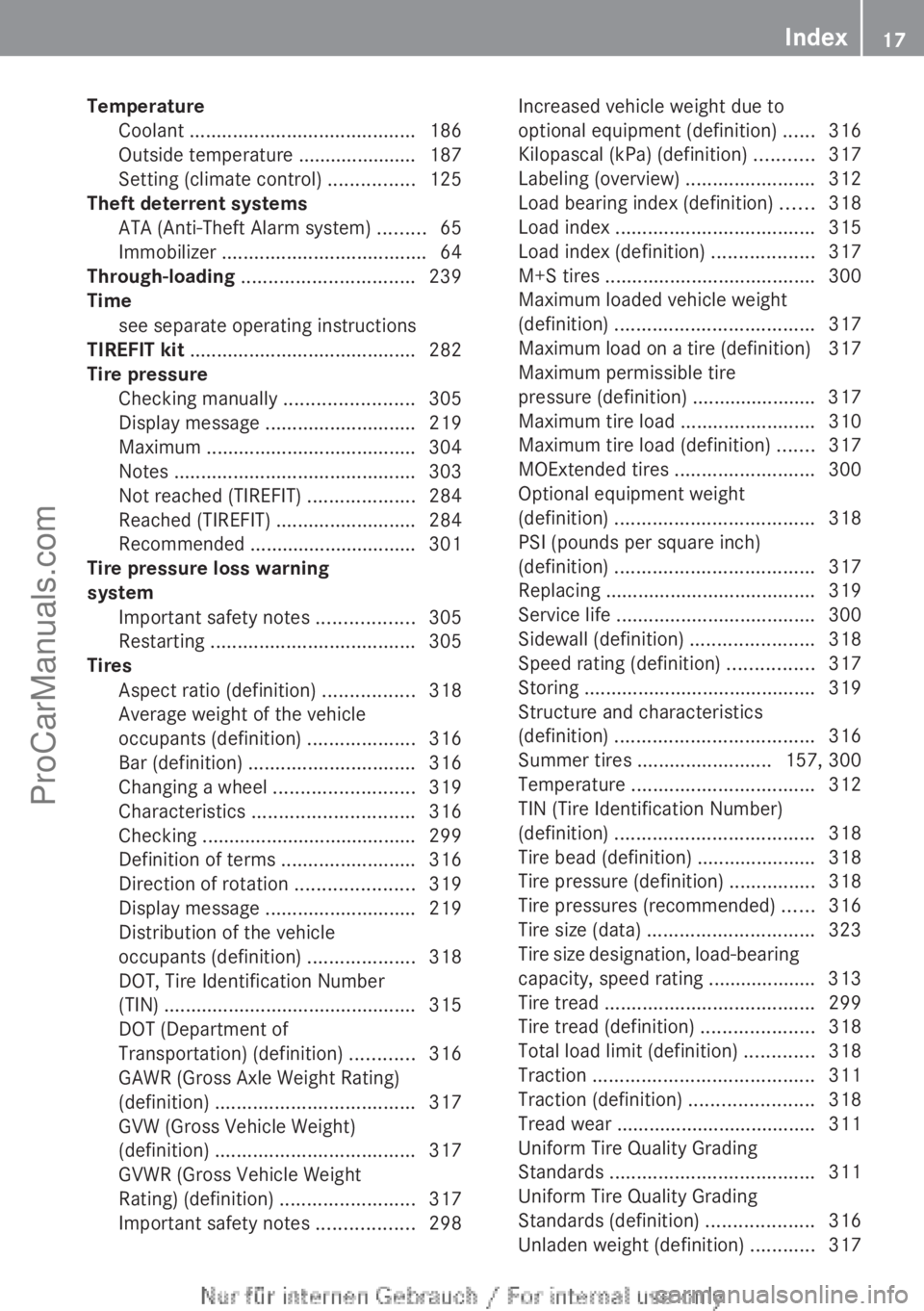
Traction ......................................... 311
Traction (definition) ....................... 318
Tread wear ..................................... 311
Uniform Tire Quality Grading
Standards ...................................... 311
Uniform Tire Quality Grading
Standards (definition) .................... 316
Unladen weight (definition) ............ 317 Index
17
ProCarManuals.com
Page 20 of 340
Wear indicator (definition)
.............318
Wheel rim (definition) ....................316
see Flat tire
Top Tether ............................................ 55
Towing Important safety guidelines ...........291
Installing the towing eye ................ 292
Removing the towing eye ...............292
Towing away
With both axles on the ground ....... 293
With front axle raised ..................... 293
Tow-starting
Emergency engine starting ............ 294
Important safety notes .................. 291
Installing the towing eye ................ 292
Removing the towing eye ...............292
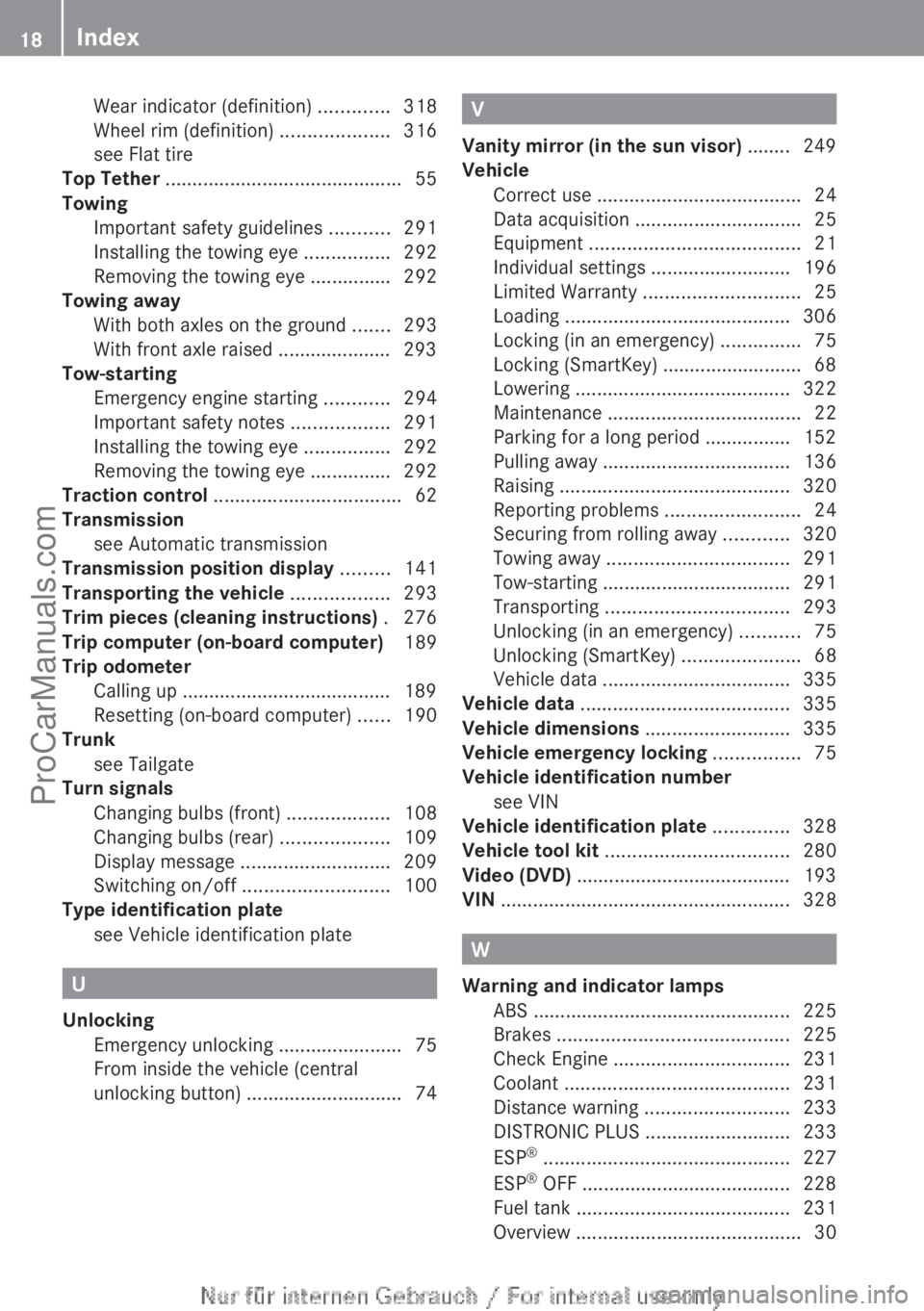
Traction control ................................... 62
Transmission see Automatic transmission
Transmission position display .........141
Transporting the vehicle .................. 293
Trim pieces (cleaning instructions) . 276
Trip computer (on-board computer) 189
Trip odometer Calling up ....................................... 189
Resetting (on-board computer) ...... 190
Trunk
see Tailgate
Turn signals
Changing bulbs (front) ................... 108
Changing bulbs (rear) .................... 109
Display message ............................ 209
Switching on/off ........................... 100
Type identification plate
see Vehicle identification plate U
Unlocking Emergency unlocking .......................75
From inside the vehicle (central
unlocking button) ............................. 74 V
Vanity mirror (in the sun visor) ........ 249
Vehicle Correct use ...................................... 24
Data acquisition ............................... 25
Equipment
....................................... 21
Individual settings ..........................196
Limited Warranty ............................. 25
Loading .......................................... 306
Locking (in an emergency) ............... 75
Locking (SmartKey) .......................... 68
Lowering ........................................ 322
Maintenance .................................... 22
Parking for a long period ................ 152
Pulling away ................................... 136
Raising ........................................... 320
Reporting problems .........................24
Securing from rolling away ............320
Towing away .................................. 291
Tow-starting ................................... 291
Transporting .................................. 293
Unlocking (in an emergency) ........... 75
Unlocking (SmartKey) ......................68
Vehicle data ................................... 335
Vehicle data ....................................... 335
Vehicle dimensions ...........................335
Vehicle emergency locking ................75
Vehicle identification number see VIN
Vehicle identification plate ..............328
Vehicle tool kit .................................. 280
Video (DVD) ........................................ 193
VIN ...................................................... 328 W
Warning and indicator lamps ABS ................................................ 225
Brakes
........................................... 225
Check Engine ................................. 231
Coolant .......................................... 231
Distance warning ........................... 233
DISTRONIC PLUS ........................... 233
ESP ®
.............................................. 227
ESP ®
OFF ....................................... 228
Fuel tank ........................................ 231
Overview .......................................... 3018
Index
ProCarManuals.com
Page 64 of 340
Up to vehicle speeds of around 155 mph
(250 km/h
),
adaptive Brake Assist is capable
of reacting to moving objects that have
already been recognized as such at least once
over the period of observation. Adaptive
Brake Assist does not react to stationary
obstacles.
If Adaptive Brake Assist is not available due
to a malfunction in the radar sensor system,
the brake system remains available with full
brake boosting effect and BAS.
In particular, the detection of obstacles can
be impaired if there is:
R dirt on the sensors or anything else
covering the sensors
R snow or heavy rain
R interference by other radar sources
R there are strong radar reflections, for
example in parking garages
R a narrow vehicle traveling in front, e.g. a
motorbike
R a vehicle traveling in front on a different line
relative to the center of your vehicle
Following damage to the front end of the
vehicle, have the configuration and operation
of the radar sensor checked at a qualified
specialist workshop. This also applies to
collisions at low speeds where there is no
visible damage to the front of the vehicle. Adaptive brake lights
If you brake sharply from a speed of more
than 50 km/h
or if braking is assisted by BAS
or Adaptive Brake Assist, the brake lamps
flash rapidly. In this way, traffic traveling
behind you is warned in an even more
noticeable manner.
If you brake sharply to a standstill from a
speed of more than 70 km/h, the hazard
warning lamps are activated automatically. If
the brakes are applied again, the brake lamps
light up continuously. The hazard warning
lamps switch off automatically if you travel
faster than 10 km/h. You can also switch off the hazard warning lamps using the hazard
warning button (Y page 101).
i
Adaptive brake lamps
are only available in
certain countries. ESP
®
(Electronic Stability Program)
General notes i
Observe the "Important safety notes"
section ( Y page 59).
ESP ®
monitors driving stability and traction,
i.e. power transmission
between the tires and
the road surface.
If ESP ®
detects that the vehicle is deviating
from the direction desired by the driver, one
or more wheels are braked to stabilize the
vehicle. The engine output is also modified to
keep the vehicle on the desired course within
physical limits. ESP ®
assists the driver when
pulling away on wet or slippery roads. ESP ®
can also stabilize the vehicle during braking.
ETS (Electronic Traction System) i
Observe the "Important safety notes"
section for driving safety systems
(Y page 59).
ETS traction control is part of ESP ®
.
ETS brakes the drive wheels individually if
they spin. This enables you to pull away and
accelerate on slippery surfaces, for example
if the road surface is slippery on one side.
ETS remains active when you deactivate
ESP ®
.
Important safety notes G
WARNING
If ESP ®
is malfunctioning, ESP ®
is unable to
stabilize the vehicle. Additionally, further
driving safety systems are deactivated. This
increases the risk
of skidding and an accident.
Drive on carefully. Have ESP ®
checked at a
qualified specialist workshop. 62
Driving safety systems
Safety
ProCarManuals.com
Page 160 of 340
to lose traction and the vehicle could then
skid
R when there is
poor visibility, e.g. due to fog,
heavy rain or snow
If there is a change of drivers, advise the new
driver of the speed stored.
General notes Cruise control maintains a constant road
speed for
you.
It brakes automatically in order
to avoid exceeding the set speed. On long and
steep downhill gradients, especially if the
vehicle is laden, you must select a low gear in
good time. For this, you will need to have
selected manual drive program
M(Y page 144). By doing so, you will make
use of the braking effect of the engine, This
relieves the load on the brake system and
prevents the brakes from overheating and
wearing too quickly.
Use cruise control only if road and traffic
conditions make it appropriate to maintain a
steady speed for a prolonged period. You can
store any road speed above 20 mph
(30 km/h).
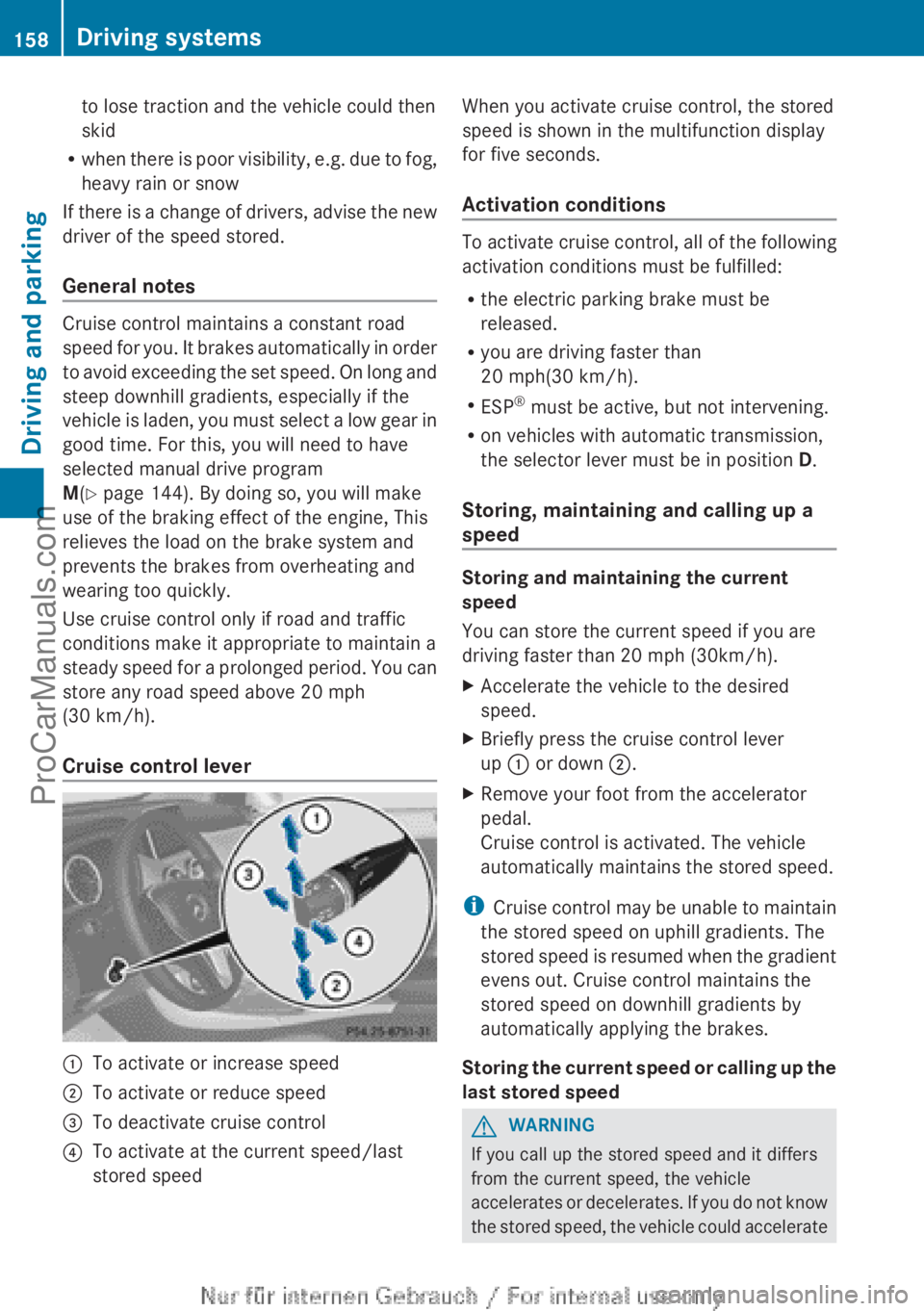
Cruise control lever :
To activate or increase speed
; To activate or reduce speed
= To deactivate cruise control
? To activate at the current speed/last
stored speed When you activate cruise control, the stored
speed is shown in the multifunction display
for five seconds.
Activation conditions
To activate cruise control, all of the following
activation conditions must be fulfilled:
R
the electric parking brake must be
released.
R you are driving faster than
20 mph(30 km/h).
R ESP ®
must be active, but not intervening.
R on vehicles with automatic transmission,
the selector lever must be in position D.
Storing, maintaining and calling up a
speed Storing and maintaining the current
speed
You can store the current speed if you are
driving faster than 20 mph (30km/h).
X
Accelerate the vehicle to the desired
speed.
X Briefly press the cruise control lever
up : or down ;.
X Remove your foot from the accelerator
pedal.
Cruise control is activated. The vehicle
automatically maintains the stored speed.
i Cruise control may
be unable to maintain
the stored speed on uphill gradients. The
stored speed is resumed when the gradient
evens out. Cruise control maintains the
stored speed on downhill gradients by
automatically applying the brakes.
Storing the current speed or calling up the
last stored speed G
WARNING
If you call up the stored speed and it differs
from the current speed, the vehicle
accelerates or decelerates.
If you do not know
the stored speed, the vehicle could accelerate 158
Driving systems
Driving and parking
ProCarManuals.com
Page 230 of 340
Problem Possible causes/consequences and
M Solutions÷
The yellow ESP
®
warning lamp flashes
while the vehicle is in
motion. ESP
®
or traction control has intervened because there is a risk of
skidding or at least one wheel has started to spin.
Cruise control or DISTRONIC PLUS is deactivated.
X When pulling
away, only depress the accelerator pedal as far as
necessary.
X Ease off the accelerator pedal while the vehicle is in motion.
X Adapt your driving style to suit the road and weather conditions.
X Do not deactivate ESP ®
.
For exceptions, see: ( Y page 62).å
The yellow ESP
®
OFF
warning lamp is
lit while
the engine is running. ESP
®
and ESP ®
trailer stabilization are deactivated. ESP ®
will not
stabilize the vehicle if it starts to skid or if a wheel starts to spin.
G WARNING
If ESP ®
is switched off, ESP ®
is unable to stabilize the vehicle.
There is an increased risk of skidding and an accident.
X Reactivate ESP ®
.
For exceptions, see: ( Y page 62).
X Adapt your driving style to suit the road and weather conditions.
If ESP ®
cannot be activated:
X Have ESP ®
checked at a qualified specialist workshop. ֌
The yellow ESP
®
and
ESP ®
OFF warning
lamps are lit while the
engine is running. ESP
®
, BAS, COLLISION PREVENTION ASSIST, the HOLD function
and hill start assist are unavailable due to a malfunction.
ATTENTION ASSIST is deactivated.
G WARNING
The brake system continues to function normally, but without the
functions listed above.
The braking distance in an emergency braking situation can thus
increase.
If ESP ®
is not
operational, ESP ®
is unable to stabilize the vehicle.
There is an increased risk of skidding and an accident.
X Observe the additional display messages in the multifunction
display.
X Drive on carefully.
X Visit a qualified specialist workshop.228
Warning and indicator lamps in the instrument cluster
On-board computer and displays
ProCarManuals.com
Page 301 of 340
the unusual handling characteristics. If you
find no signs of damage, have the wheels
and tires checked at a qualified specialist
workshop.
R When parking your
vehicle, make sure that
the tires do not get deformed by the curb
or other obstacles. If it is necessary to drive
over curbs, speed humps or similar
elevations, try to do so slowly and at an
obtuse angle. Otherwise, the tires,
particularly the sidewalls, may be
damaged. Regular checking of wheels and tires
G
WARNING
Damaged tires can cause tire inflation
pressure loss. As a result, you could lose
control of your vehicle. There is a risk of
accident.
Check the tires regularly for signs of damage
and replace any damaged tires immediately.
Regularly check the wheels and tires of your
vehicle for damage
at least once a month, as
well as after driving off-road or on rough
roads. Damaged wheels can cause a loss of
tire pressure. Pay particular attention to
damage such as:
R cuts in the tires
R punctures
R tears in the tires
R bulges on tires
R deformation or severe corrosion on wheels
Regularly check the tire tread depth and the
condition of the tread across the whole width
of the tire (Y page 299). If necessary, turn
the front wheels to full lock in order to inspect
the inner side of the tire surface.
All wheels must have a valve cap to protect
the valve against dirt and moisture. Do not
mount anything onto the valve other than the
standard valve cap or other valve caps
approved by Mercedes-Benz for your vehicle. Do not use any other valve caps or systems,
e.g. tire pressure monitoring systems.
Regularly check the pressure of all the tires
particularly prior
to
long trips. Adjust the tire
pressure as necessary ( Y page 301).
The service life of tires depends, among other
things, on the following factors:
R Driving style
R Tire pressure
R Distance covered Tire tread
G
WARNING
Insufficient tire tread will reduce tire traction.
The tire is no longer able to dissipate water.
This means that
on wet road surfaces, the risk
of hydroplaning increases, in particular where
speed is not adapted to suit the driving
conditions. There is a risk of accident.
If the tire pressure is too high or too low, tires
may exhibit different levels of wear at
different locations on the tire tread. Thus, you
should regularly check the tread depth and
the condition of the tread across the entire
width of all tires.
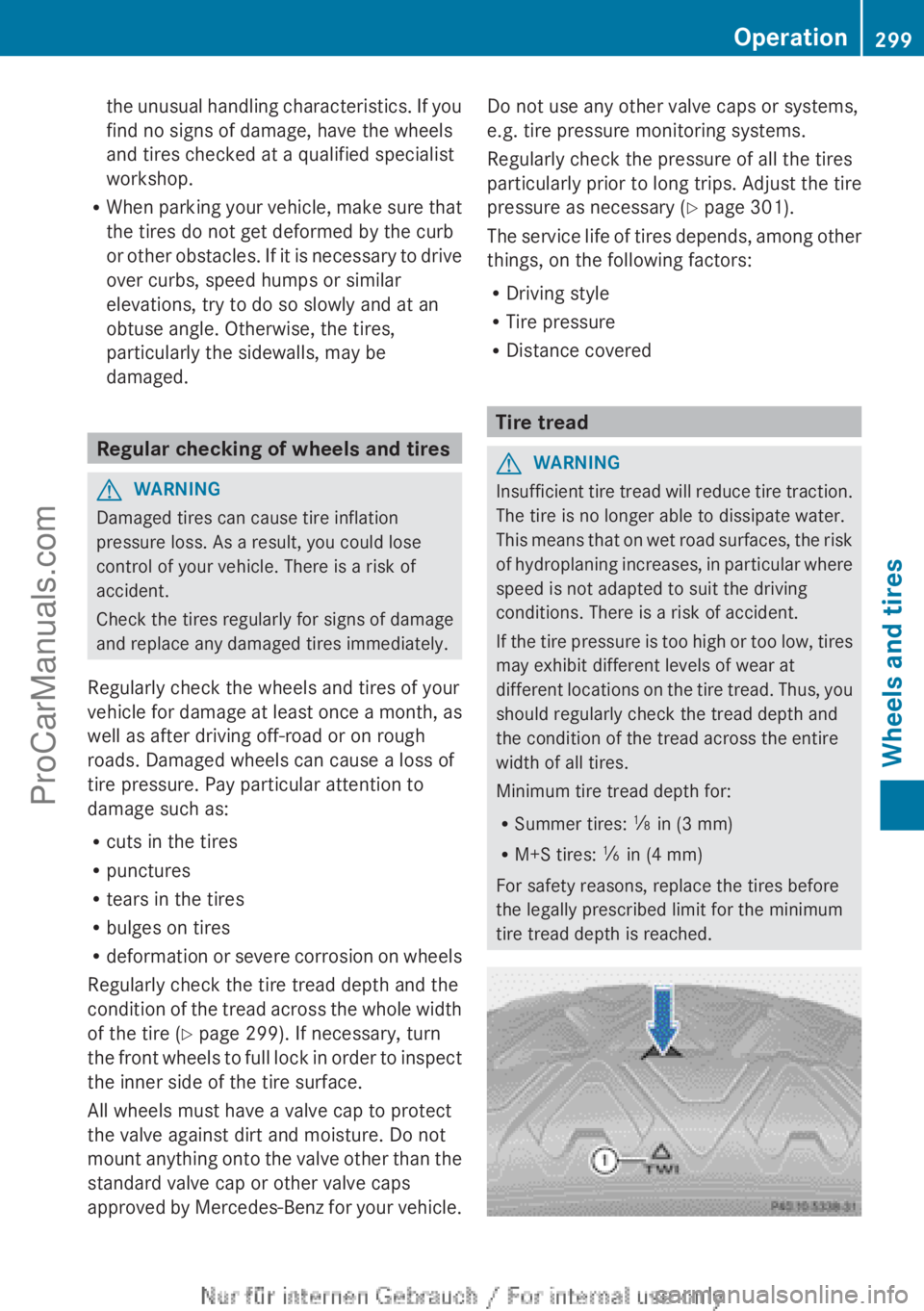
Minimum tire tread depth for:
R Summer tires: â in (3 mm)
R M+S tires: ã in (4 mm)
For safety reasons, replace the tires before
the legally prescribed limit for the minimum
tire tread depth is reached. Operation
299
Wheels and tires Z
ProCarManuals.com
Page 303 of 340
safety systems such as ABS and ESP
®
to
function optimally in
winter. These tires have
been developed specifically for driving in
snow.
Use M+S tires of the same make and tread on
all wheels to maintain safe handling
characteristics.
Always observe the maximum permissible
speed specified for the M+S tires you have
mounted.
Once the winter tires are mounted:
X Check the tire pressures (Y page 305).
X Restart the tire pressure loss warning
system (Y page 305).
For more information on driving with the
emergency spare wheel, see ( Y page 325).Snow chains
G
WARNING
If snow chains are mounted on the rear
wheels, the snow
chains could cause abrasion
to the vehicle body or to chassis components.
This could cause damage to the vehicle or the
tires. There is a risk of an accident.
To avoid hazardous situations:
R never mount snow chains on the rear
wheels
R only mount snow chains in pairs on the
front wheels.
! On some tire sizes there is not enough
space for snow chains. To avoid damage to
the vehicle or tires, observe the "Wheel and
tire combinations" section under "Tires and
wheels".
For safety reasons, Mercedes-Benz
recommends that you only use snow chains
that have been specially approved for your
vehicle by Mercedes-Benz, or are of a
corresponding standard of quality. If you intend to mount snow chains, please
bear the following points in mind:
R
Snow chains may not be mounted on all
wheel/tire combinations. Permissible
wheel-tire combinations (Y page 323).
R Only use snow chains when driving on
roads completely covered by snow.
Remove the snow chains as soon as
possible when you come to a road that is
not snow-covered.
R Local regulations may restrict the use of
snow chains. Observe the appropriate
regulations if you wish to mount snow
chains.
R Do not exceed the maximum permissible
speed of 30 mph (50 km/h).
R When snow chains
are installed, never use
Active Parking Assist (Y page 172).
i You may wish to deactivate
ESP ®
(Y page 62) when pulling away with
snow chains installed. You can thereby
allow the wheels to spin in a controlled
manner, achieving an increased driving
force (cutting action).
For more information on driving with the
emergency spare wheel, see ( Y page 325). Tire pressure
Tire pressure specifications
G
WARNING
Tires with tire pressures that are too low or
too high are associated with the following
hazards:
R they can burst,
in particular if the vehicle is
heavily laden or when driven at high
speeds.
R the tires can wear excessively and/or
unevenly, which can severely impair tire
traction.
R the driving, steering and braking
characteristics may be severely impaired.
There is a risk of accident. Tire pressure
301
Wheels and tires
ZProCarManuals.com
Page 313 of 340
Uniform Tire Quality Grading
Standards
Overview of Tire Quality Grading
Standards
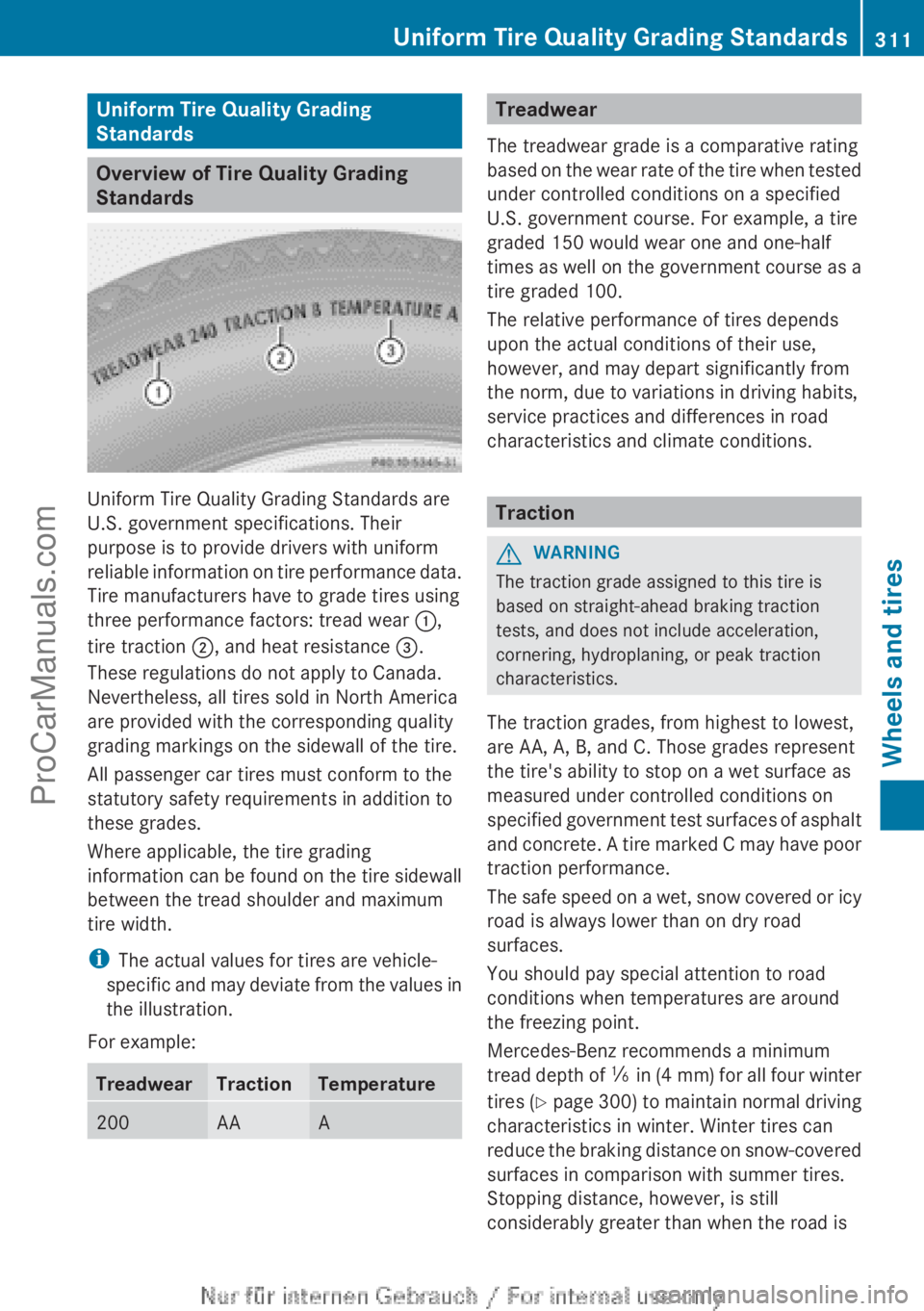
Uniform Tire Quality Grading Standards are
U.S. government specifications. Their
purpose is to provide drivers with uniform
reliable information
on
tire performance data.
Tire manufacturers have to grade tires using
three performance factors: tread wear :,
tire traction ;, and heat resistance =.
These regulations do not apply to Canada.
Nevertheless, all tires sold in North America
are provided with the corresponding quality
grading markings on the sidewall of the tire.
All passenger car tires must conform to the
statutory safety requirements in addition to
these grades.
Where applicable, the tire grading
information can be found on the tire sidewall
between the tread shoulder and maximum
tire width.
i The actual values for tires are vehicle-
specific and may deviate from the values in
the illustration.
For example: Treadwear Traction Temperature
200 AA A Treadwear
The treadwear grade is a comparative rating
based on the
wear rate of the tire when tested
under controlled conditions on a specified
U.S. government course. For example, a tire
graded 150 would wear one and one-half
times as well on the government course as a
tire graded 100.
The relative performance of tires depends
upon the actual conditions of their use,
however, and may depart significantly from
the norm, due to variations in driving habits,
service practices and differences in road
characteristics and climate conditions. Traction
G
WARNING
The traction grade assigned to this tire is
based on straight-ahead braking traction
tests, and does not include acceleration,
cornering, hydroplaning, or peak traction
characteristics.
The traction grades, from highest to lowest,
are AA, A, B, and C. Those grades represent
the tire's ability to stop on a wet surface as
measured under controlled conditions on
specified government test
surfaces of asphalt
and concrete. A tire marked C may have poor
traction performance.
The safe speed on a wet, snow covered or icy
road is always lower than on dry road
surfaces.
You should pay special attention to road
conditions when temperatures are around
the freezing point.
Mercedes-Benz recommends a minimum
tread depth of ã in (4 mm) for all four winter
tires ( Y page 300) to maintain normal driving
characteristics in winter. Winter tires can
reduce the braking distance on snow-covered
surfaces in comparison with summer tires.
Stopping distance, however, is still
considerably greater than when the road is Uniform Tire Quality Grading Standards
311
Wheels and tires Z
ProCarManuals.com