brake MERCEDES-BENZ B-CLASS 2012 User Guide
[x] Cancel search | Manufacturer: MERCEDES-BENZ, Model Year: 2012, Model line: B-CLASS, Model: MERCEDES-BENZ B-CLASS 2012Pages: 340, PDF Size: 3.09 MB
Page 23 of 340
Have aftermarket accessories installed at
a qualified specialist workshop.
You could jeopardize the operating safety of
your vehicle if
you use parts, tires and wheels
as well as accessories relevant to safety
which have not been approved by Mercedes.
This could lead to malfunctions in safety-
relevant systems, e.g. the brake system. Use
only genuine Mercedes-Benz parts or parts of
equal quality. Only use tires, wheels and
accessories that have been specifically
approved for your vehicle.
Genuine Mercedes-Benz parts are subject to
strict quality control. Every part has been
specifically developed, manufactured or
selected for and adapted to Mercedes-Benz
vehicles. Only genuine Mercedes-Benz parts
should therefore be used.
More than 300,000 different genuine
Mercedes-Benz parts are available for
Mercedes-Benz models.
All authorized Mercedes-Benz Centers
maintain a supply of genuine Mercedes-Benz
parts for necessary service and repair work.
In addition, strategically located parts
delivery centers provide quick and reliable
parts service.
Always specify the vehicle identification
number (VIN) ( Y page 328) and the engine
number (Y page 329) when ordering genuine
Mercedes-Benz parts. Operator's Manual
General notes
Before you first
drive off, read this Operator's
Manual carefully and familiarize yourself with
your vehicle.
For your own safety and a longer vehicle life,
follow the instructions and warning notices in
this manual. Disregarding them may lead to
damage to the vehicle or personal injury.
Vehicle damage resulting from the disregard
of the instructions is not covered by the
Mercedes-Benz Limited Warranty. Vehicle equipment
This Operator's Manual describes all models
and all standard and optional equipment of
your vehicle available at the time of going to
print. Country-specific differences are
possible. Please note that your vehicle may
not be equipped with all features described.
This also applies to safety-related systems
and functions. The
equipment in your vehicle
may therefore differ from some of the
descriptions or illustrations.
The original purchase agreement lists all
systems installed in your vehicle.
Contact an authorized Mercedes-Benz Center
if you have any questions about equipment or
operation.
The Operator's Manual and Maintenance
Booklet are important documents and should
be kept in the vehicle. Service and vehicle operation
Service and literature
Your vehicle is
covered under the terms of the
warranties printed in the Service and
Warranty Information booklet. Your
authorized Mercedes-Benz Center will
exchange or repair any defective parts
originally installed in the vehicle in
accordance with the terms of the following
warranties:
R New Vehicle Limited Warranty
R Emission Systems Warranty
R Emission Performance Warranty
R California, Connecticut, Maine,
Massachusetts, New York, Pennsylvania,
Rhode Island and Vermont Emission
Control Systems Warranty
R State warranty enforcement laws (lemon
laws) Introduction
21 Z
ProCarManuals.com
Page 25 of 340
Operating safety
Important safety notes
G
WARNING
If you do not have the prescribed service/
maintenance work or any required repairs
carried out, this
can result in malfunctions or
system failures. There is a risk of an accident.
Always have the prescribed service/
maintenance work as well as any required
repairs carried out at a qualified specialist
workshop. G
WARNING
If you switch off the ignition while driving,
safety-relevant functions are only available
with limitations, or
not at all. This could affect,
for example, the power steering and the brake
boosting effect. You will require considerably
more effort to steer and brake. There is a risk
of an accident.
Do not switch off the ignition while driving. G
WARNING
Modifications to electronic components, their
software as well as wiring can impair their
function and/or the function of other
networked components. In particular,
systems relevant to safety could also be
affected. As a result, these may no longer
function as intended and/or jeopardize the
operating safety of the vehicle. There is an
increased risk of an accident and injury.
Never tamper with the wiring as well as
electronic components or
their software. You
should have all work to electrical and
electronic equipment carried out at a qualified
specialist workshop.
There is a risk of damage to the vehicle if:
R the vehicle becomes stuck, e.g. on a high
curb or an unpaved road
R you drive too fast over an obstacle, e.g. a
curb or a hole in the road
R a heavy object strikes the undercarriage or
parts of the chassis. In situations like this, the body, the
undercarriage, chassis parts, wheels or tires
could be
damaged
without the damage being
visible. Components damaged in this way can
unexpectedly fail or, in the case of an
accident, no longer withstand the strain they
are designed to.
If the underbody paneling is damaged,
combustible materials such as leaves, grass
or twigs can gather between the underbody
and the underbody paneling. If these
materials come in contact with hot parts of
the exhaust system for an extended period,
they can catch fire.
Have the vehicle checked and repaired
immediately at a qualified specialist
workshop. If on continuing your journey you
notice that driving safety is impaired, pull over
and stop the vehicle immediately, paying
attention to road and traffic conditions. In
such cases, visit a qualified specialist
workshop. Declarations of conformity
Vehicle components which receive
and/or transmit radio waves USA: "The wireless devices of this vehicle
comply with Part 15 of the FCC Rules.
Operation is subject to the following two
conditions: 1) These devices may not cause
harmful interference, and 2) These devices
must accept any interference received,
including interference that may cause
undesired operation. Changes or
modifications not expressly approved by the
party responsible for compliance could void
the user’s authority to operate the
equipment."
Canada:
"The wireless
devices of this vehicle
comply with Industry Canada license-exempt
RSS standard(s). Operation is subject to the
following two conditions: (1) These devices
may not cause interference, and (2) These
devices must accept any interference, Introduction
23 Z
ProCarManuals.com
Page 30 of 340
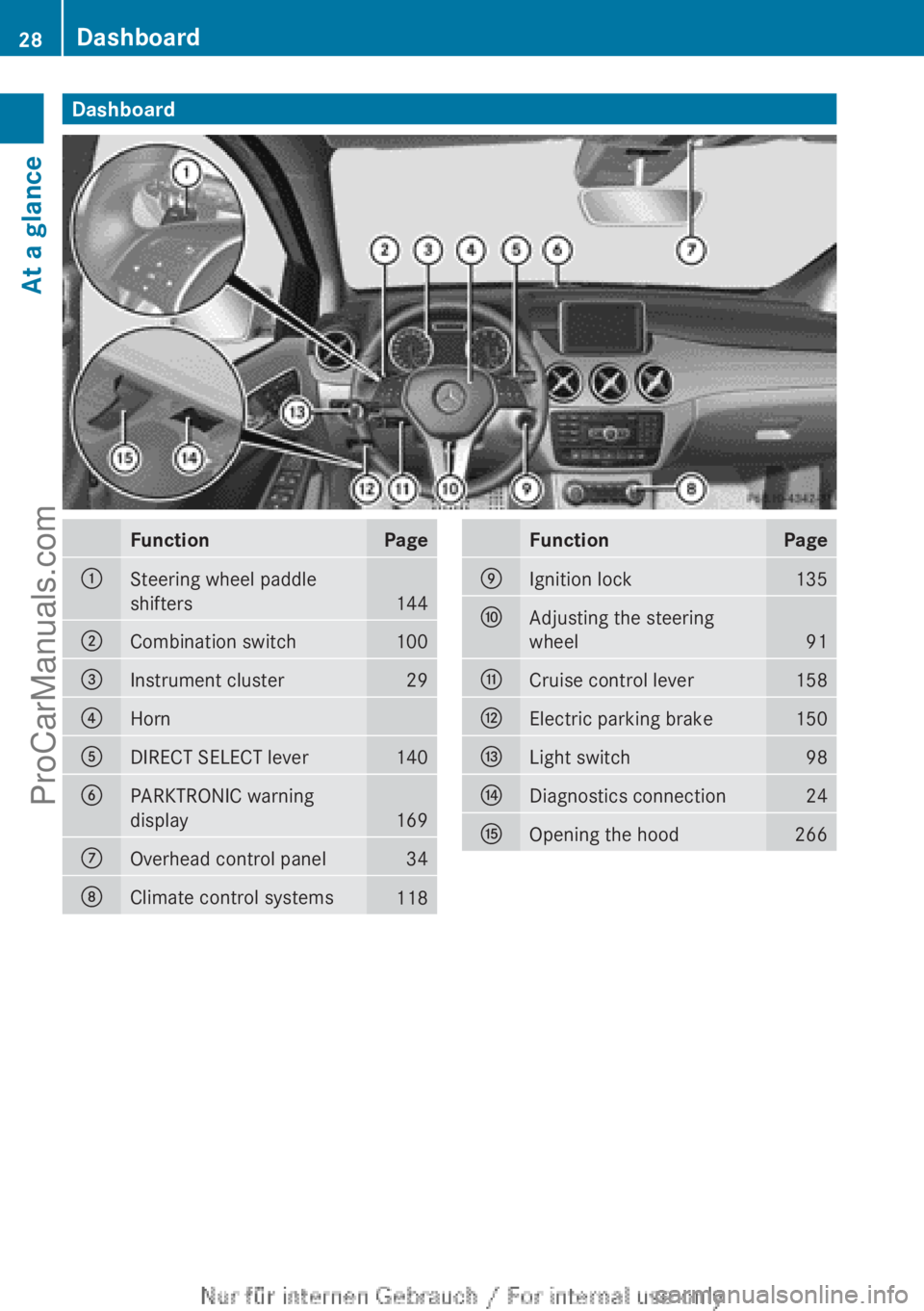
Dashboard
Function Page
:
Steering wheel paddle
shifters
144
;
Combination switch 100
=
Instrument cluster 29
?
Horn
A
DIRECT SELECT lever 140
B
PARKTRONIC warning
display
169
C
Overhead control panel 34
D
Climate control systems
118 Function Page
E
Ignition lock 135
F
Adjusting the steering
wheel
91
G
Cruise control lever 158
H
Electric parking brake 150
I
Light switch 98
J
Diagnostics connection 24
K
Opening the hood 26628
DashboardAt a glance
ProCarManuals.com
Page 32 of 340
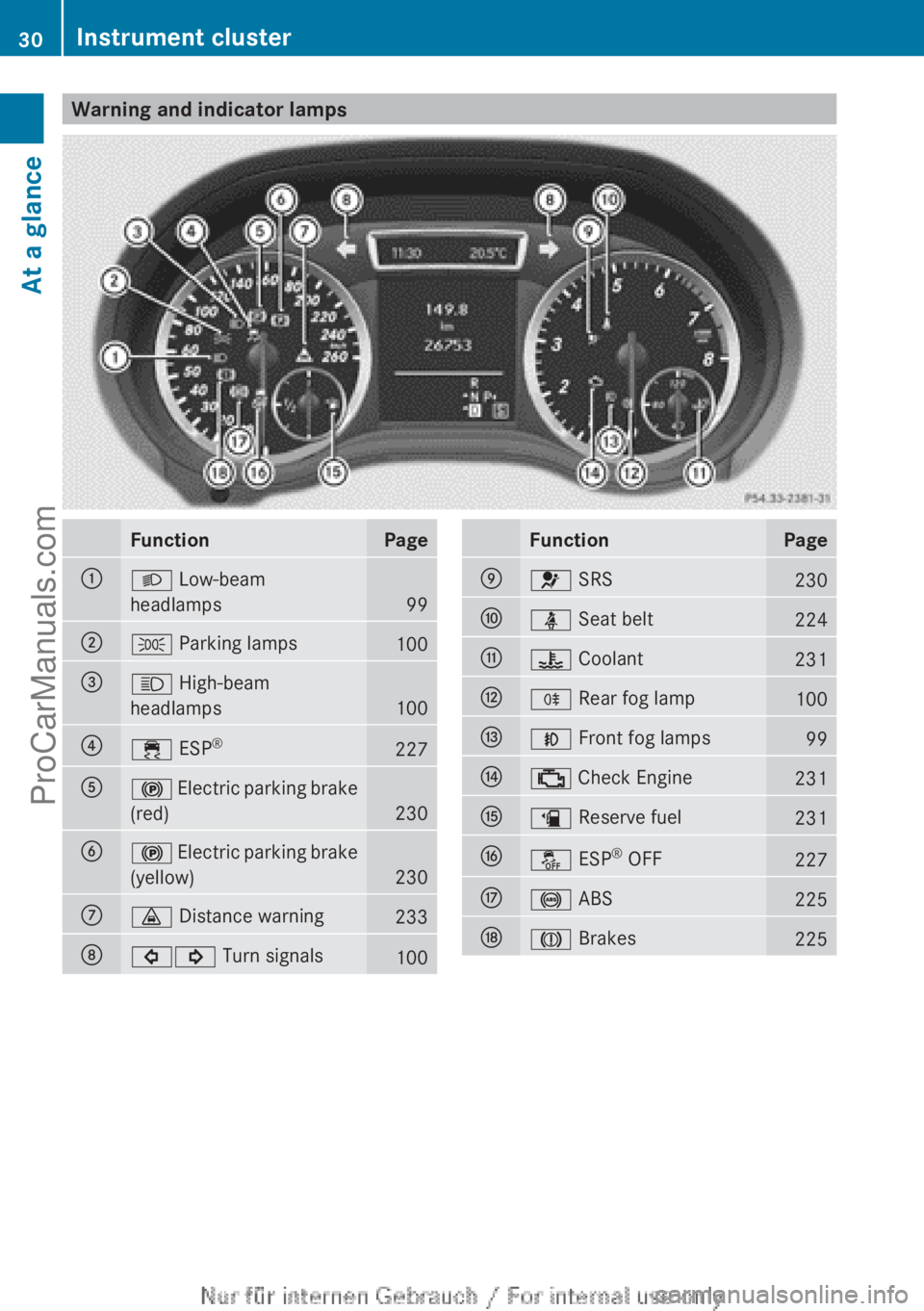
Warning and indicator lamps
Function Page
:
L Low-beam
headlamps
99
;
T Parking lamps
100
=
K High-beam
headlamps
100
?
÷ ESP
® 227
A
! Electric parking brake
(red)
230
B
!
Electric parking brake
(yellow) 230
C
· Distance warning
233
D
#! Turn signals
100 Function Page
E
6 SRS
230
F
ü Seat belt
224
G
? Coolant
231
H
R Rear fog lamp
100
I
N Front fog lamps
99
J
; Check Engine
231
K
æ Reserve fuel
231
L
å ESP
®
OFF 227
M
! ABS
225
N
J Brakes
22530
Instrument clusterAt a glance
ProCarManuals.com
Page 45 of 340
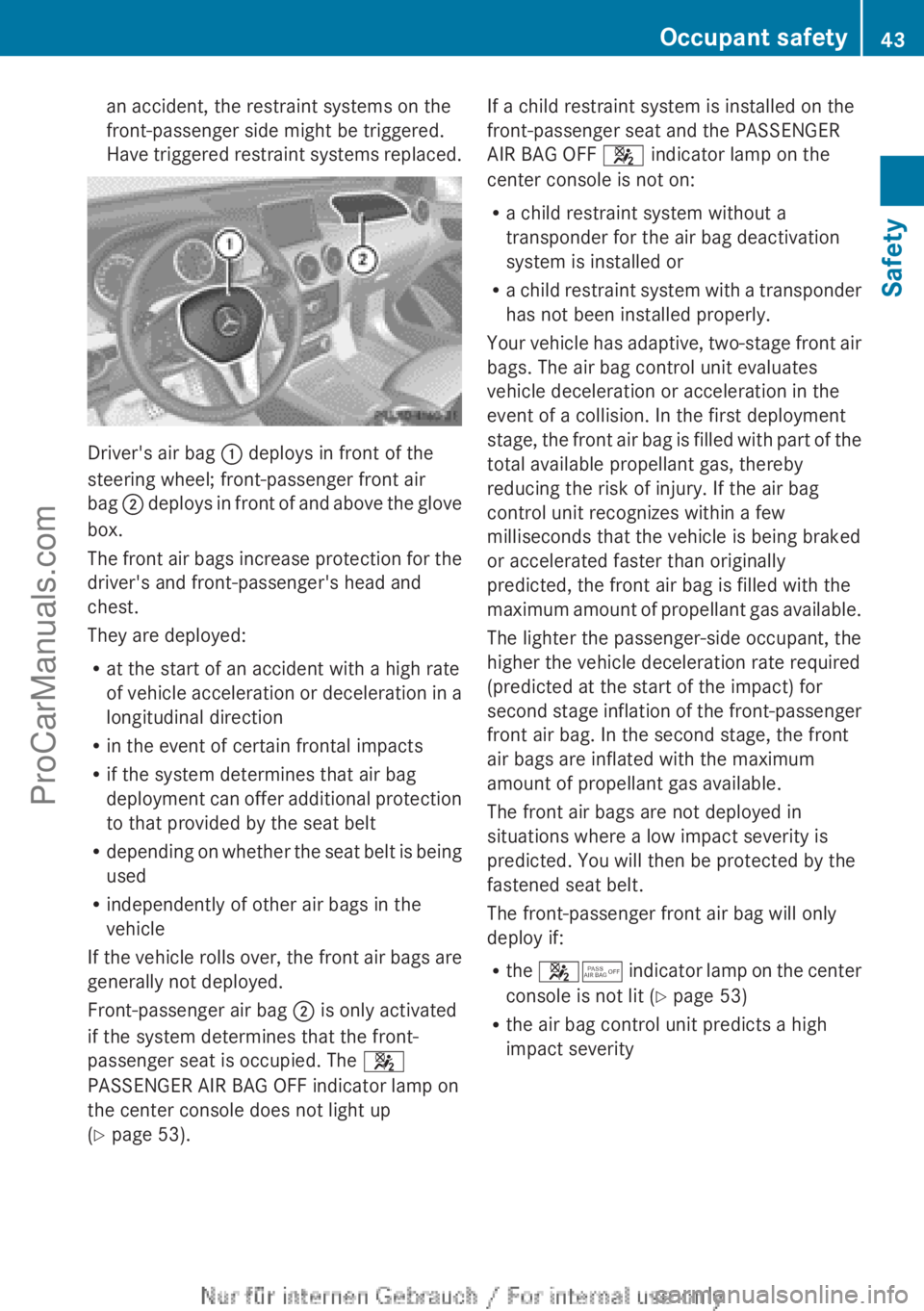
an accident, the restraint systems on the
front-passenger side might be triggered.
Have triggered
restraint
systems replaced.Driver's air bag
: deploys in front of the
steering wheel; front-passenger front air
bag ; deploys in
front of and above the glove
box.
The front air bags increase protection for the
driver's and front-passenger's head and
chest.
They are deployed:
R at the start of an accident with a high rate
of vehicle acceleration or deceleration in a
longitudinal direction
R in the event of certain frontal impacts
R if the system determines that air bag
deployment can offer additional protection
to that provided by the seat belt
R depending on whether the seat belt is being
used
R independently of other air bags in the
vehicle
If the vehicle rolls over, the front air bags are
generally not deployed.
Front-passenger air bag ; is only activated
if the system determines that the front-
passenger seat is occupied. The 4
PASSENGER AIR BAG OFF indicator lamp on
the center console does not light up
(Y page 53). If a child restraint system is installed on the
front-passenger seat and the PASSENGER
AIR BAG OFF
4 indicator lamp on the
center console is not on:
R a child restraint system without a
transponder for the air bag deactivation
system is installed or
R a child
restraint
system with a transponder
has not been installed properly.
Your vehicle has adaptive, two-stage front air
bags. The air bag control unit evaluates
vehicle deceleration or acceleration in the
event of a collision. In the first deployment
stage, the front air bag is filled with part of the
total available propellant gas, thereby
reducing the risk of injury. If the air bag
control unit recognizes within a few
milliseconds that the vehicle is being braked
or accelerated faster than originally
predicted, the front air bag is filled with the
maximum amount of propellant gas available.
The lighter the passenger-side occupant, the
higher the vehicle deceleration rate required
(predicted at the start of the impact) for
second stage inflation of the front-passenger
front air bag. In the second stage, the front
air bags are inflated with the maximum
amount of propellant gas available.
The front air bags are not deployed in
situations where a low impact severity is
predicted. You will then be protected by the
fastened seat belt.
The front-passenger front air bag will only
deploy if:
R the 45 indicator lamp on the center
console is not lit (Y page 53)
R the air bag control unit predicts a high
impact severity Occupant safety
43
Safety Z
ProCarManuals.com
Page 60 of 340
such as seat adjustment, steering wheel
adjustment, or the memory function
If children open
a door, they could injure other
persons or get out of the vehicle and injure
themselves or be injured by following traffic.
Do not expose the child restraint system to
direct sunlight. The child restraint system's
metal parts, for example, could become very
hot, and the child could be burned on these
parts.
Child-proof locks for the rear doors G
WARNING
Children could open a rear door from inside
the vehicle. This could result in serious
injuries or an accident. Therefore, when
children ride in
the rear always secure the rear
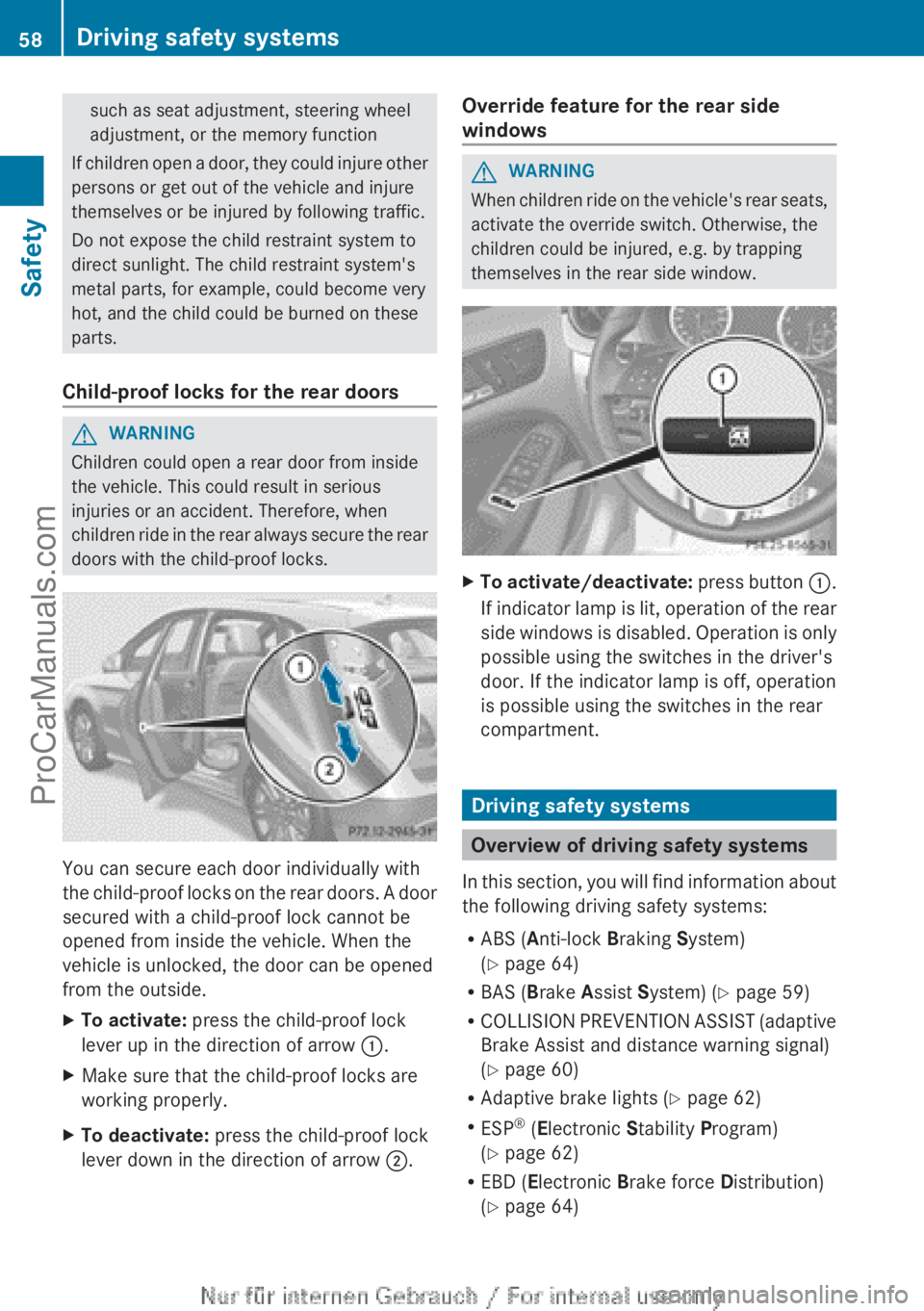
doors with the child-proof locks. You can secure each door individually with
the child-proof
locks
on the rear doors. A door
secured with a child-proof lock cannot be
opened from inside the vehicle. When the
vehicle is unlocked, the door can be opened
from the outside.
X To activate: press the child-proof lock
lever up in the direction of arrow :.
X Make sure that the child-proof locks are
working properly.
X To deactivate: press the child-proof lock
lever down in the direction of arrow ;. Override feature for the rear side
windows G
WARNING
When children ride on the vehicle's rear seats,
activate the override switch. Otherwise, the
children could be injured, e.g. by trapping
themselves in the rear side window. X
To activate/deactivate: press button :.
If
indicator lamp is lit, operation of the rear
side windows is disabled. Operation is only
possible using the switches in the driver's
door. If the indicator lamp is off, operation
is possible using the switches in the rear
compartment. Driving safety systems
Overview of driving safety systems
In this section,
you will find information about
the following driving safety systems:
R ABS ( Anti-lock Braking System)
(Y page 64)
R BAS ( Brake Assist System) ( Y page 59)
R COLLISION PREVENTION ASSIST (adaptive
Brake Assist and distance warning signal)
(Y page 60)
R Adaptive brake lights ( Y page 62)
R ESP ®
(Electronic Stability Program)
(Y page 62)
R EBD ( Electronic Brake force Distribution)
(Y page 64) 58
Driving safety systems
Safety
ProCarManuals.com
Page 61 of 340
R
ADAPTIVE BRAKE ( Y
page 64)
(Y page 64)
R STEER CONTROL ( Y page 64)Important safety notes
If you fail to adapt your driving style or
become distracted, the driving safety
systems can neither reduce the risk of
accident nor override the laws of physics.
Driving safety systems are merely aids
designed to assist driving. You are
responsible for the distance to the vehicle in
front, for vehicle speed and for braking in
good time. Always
adapt your driving style to
suit the prevailing road, weather and traffic
conditions and maintain a safe distance from
the vehicle in front. Drive carefully.
i The driving safety systems described only
work as effectively as possible when there
is adequate contact between the tires and
the road surface. Pay particular attention
to the information regarding tires,
recommended minimum tire tread depths
etc. in the "Wheels and tires" section
(Y page 298).
In wintry driving conditions, always use
winter tires (M+S tires) and if necessary,
snow chains. Only in this way will the
driving safety systems described in this
section work as effectively as possible. ABS (Anti-lock Braking System)
Important safety notes i
Observe the "Important safety notes"
section for driving safety systems
(Y page 59). G
WARNING
If ABS is faulty, the wheels could lock when
braking. The steerability and braking
characteristics may be severely impaired.
Additionally, further driving safety systems are deactivated. There is an increased danger
of skidding and accidents.
Drive on carefully. Have ABS checked
immediately at a qualified specialist
workshop.
When ABS is malfunctioning, other systems,
including driving safety systems, will also
become inoperative. Observe
the information
on the ABS warning lamp ( Y page 225) and
display messages which may be shown in the
instrument cluster (Y page 201).
ABS regulates brake pressure in such a way
that the wheels do not lock when you brake.
This allows you to continue steering the
vehicle when braking.
ABS works from a speed of about 5 mph
(8 km/h) upwards, regardless of road-surface
conditions. ABS works on slippery roads,
even if you only brake gently.
The ! ABS warning lamp in the instrument
cluster lights up when the ignition is switched
on. It goes out when the engine is running.
Braking X
If ABS intervenes: continue to
depress the
brake pedal vigorously until the braking
situation is over.
X To make a full brake application:
depress the brake pedal with full force.
If ABS intervenes when braking, you will feel
a pulsing in the brake pedal.
The pulsating brake pedal can be an
indication of hazardous road conditions, and
functions as a reminder to take extra care
while driving. BAS (Brake Assist System)
i Observe the "Important safety notes"
section ( Y page 59). Driving safety systems
59
Safety Z
ProCarManuals.com
Page 62 of 340
G
WARNING
If BAS is malfunctioning, the braking distance
in an emergency braking situation is
increased. There is a risk of an accident.
In an emergency braking situation, depress
the brake pedal with full force. ABS prevents
the wheels from locking.
BAS operates in emergency braking
situations. If you depress the brake pedal
quickly, BAS automatically
boosts the braking
force, thus shortening the stopping distance.
The brakes will function as usual once you
release the brake pedal. BAS is deactivated. COLLISION PREVENTION ASSIST
General notes COLLISION PREVENTION ASSIST consists of
the Adaptive Brake Assist and the distance
warning function, which are described in the
following.
Distance warning function
Important safety notes
i
Observe the "Important safety notes"
section for driving safety systems
(Y page 59). G
WARNING
The distance warning function does not react:
R to people or animals
R to oncoming vehicles
R to crossing traffic
R when cornering
Thus, the distance warning function cannot
provide a warning in all critical situations.
There is a risk of an accident.
Always pay careful attention to the traffic
situation and be ready to brake.
The distance warning
function cannot always
clearly identify objects and complex traffic
situations. In such cases, the distance warning function
may:
R
give an unnecessary warning
R not give a warning
Always pay careful attention to the traffic
situation and do not rely solely on the
distance warning function.
Function
X To activate/deactivate: activate or
deactivate the distance
warning function in
the on-board computer (Y page 195).
If the distance warning function is activated,
the Ä symbol appears
in the multifunction
display unless the HOLD function is active
(Y page 168).
On vehicles with Active Parking Assist, the
Ä symbol is displayed when P is engaged
or you are driving faster than 22 mph
(35 km/h).
The distance warning function can help you
to minimize the risk of a front-end collision
with a vehicle ahead or reduce the effects of
such a collision. If the distance warning
function detects that there is a risk of a
collision, you will be warned visually and
acoustically. The distance warning function
cannot prevent a collision without your
intervention.
Starting at a speed of around 20 mph
(30 km/h), this function warns you if you
rapidly approach a vehicle in front. An
intermittent warning tone will then sound and
the · distance warning lamp will light up
in the instrument cluster.
X Brake immediately in order to increase the
distance from the vehicle in front.
or
X Take evasive action provided it is safe to do
so.
For the distance warning function to assist
you when driving, the function must be
activated in the on-board computer and be
operational ( Y page 195).60
Driving safety systems
Safety
ProCarManuals.com
Page 63 of 340
Due to the nature of the system, particularly
complicated driving
conditions
may cause the
system to display unnecessary warnings.
With the help of the radar sensor system, the
distance warning function can detect
obstacles that are in the path of your vehicle
for an extended period of time.
At speeds up to 40 mph (70 km/h), the
distance warning function may also detect
stationary obstacles, for example stopped or
parked vehicles.
If you approach an obstacle and the distance
warning function detects a risk of a collision,
the system will initially alert you both visually
and acoustically.
In particular, the detection of obstacles can
be impaired if:
R dirt on the sensors or anything else
covering the sensors
R snow or heavy rain
R interference by other radar sources
R there are strong radar reflections, for
example in parking garages
R a narrow vehicle traveling in front, e.g. a
motorbike
R a vehicle traveling in front on a different line
relative to the center of your vehicle
Following damage to the front end of the
vehicle, have the configuration and operation
of the radar sensor checked at a qualified
specialist workshop. This also applies to
collisions at low speeds where there is no
visible damage to the front of the vehicle.
Adaptive Brake Assist i
Observe the "Important safety notes"
section for driving safety systems
(Y page 59). G
WARNING
Adaptive Brake Assist cannot always clearly
identify objects and complex traffic
situations. In these cases, Adaptive Brake
Assist may not
intervene. There is a risk of an
accident. Always pay careful attention to the traffic
situation and be ready to brake.
G
WARNING
Adaptive Brake Assist does not react:
R to people or animals
R to oncoming vehicles
R to crossing traffic
R to stationary obstacles
R when cornering
As a result, Adaptive Brake Assist may not
intervene in all critical conditions. There is a
risk of an accident.
Always pay careful attention to the traffic
situation and be ready to brake.
Adaptive Brake Assist provides braking
assistance in hazardous situations at speeds
greater than 20 mph (30 km/h ) and uses
radar sensor technology to assess the traffic
situation.
With the help of a sensor system, adaptive
Brake Assist
can detect obstacles that are in
the path of your vehicle for an extended
period of time.
Should you approach an obstacle and
Adaptive Brake Assist has detected a risk of
collision, Adaptive Brake Assist calculates the
braking force necessary to avoid a rear-end
collision. Should you apply the brakes
vigorously, Adaptive Brake Assist will
automatically increase the braking force to a
level suitable for the traffic conditions.
X Keep the brake pedal depressed until the
emergency braking situation is over.
ABS prevents the wheels from locking.
The brakes will work normally again if:
R you release the brake pedal.
R there is no
longer any danger of a rear-end
collision.
R no obstacle is detected in front of your
vehicle.
Adaptive Brake Assist is then deactivated. Driving safety systems
61
Safety Z
ProCarManuals.com
Page 64 of 340
Up to vehicle speeds of around 155 mph
(250 km/h
),
adaptive Brake Assist is capable
of reacting to moving objects that have
already been recognized as such at least once
over the period of observation. Adaptive
Brake Assist does not react to stationary
obstacles.
If Adaptive Brake Assist is not available due
to a malfunction in the radar sensor system,
the brake system remains available with full
brake boosting effect and BAS.
In particular, the detection of obstacles can
be impaired if there is:
R dirt on the sensors or anything else
covering the sensors
R snow or heavy rain
R interference by other radar sources
R there are strong radar reflections, for
example in parking garages
R a narrow vehicle traveling in front, e.g. a
motorbike
R a vehicle traveling in front on a different line
relative to the center of your vehicle
Following damage to the front end of the
vehicle, have the configuration and operation
of the radar sensor checked at a qualified
specialist workshop. This also applies to
collisions at low speeds where there is no
visible damage to the front of the vehicle. Adaptive brake lights
If you brake sharply from a speed of more
than 50 km/h
or if braking is assisted by BAS
or Adaptive Brake Assist, the brake lamps
flash rapidly. In this way, traffic traveling
behind you is warned in an even more
noticeable manner.
If you brake sharply to a standstill from a
speed of more than 70 km/h, the hazard
warning lamps are activated automatically. If
the brakes are applied again, the brake lamps
light up continuously. The hazard warning
lamps switch off automatically if you travel
faster than 10 km/h. You can also switch off the hazard warning lamps using the hazard
warning button (Y page 101).
i
Adaptive brake lamps
are only available in
certain countries. ESP
®
(Electronic Stability Program)
General notes i
Observe the "Important safety notes"
section ( Y page 59).
ESP ®
monitors driving stability and traction,
i.e. power transmission
between the tires and
the road surface.
If ESP ®
detects that the vehicle is deviating
from the direction desired by the driver, one
or more wheels are braked to stabilize the
vehicle. The engine output is also modified to
keep the vehicle on the desired course within
physical limits. ESP ®
assists the driver when
pulling away on wet or slippery roads. ESP ®
can also stabilize the vehicle during braking.
ETS (Electronic Traction System) i
Observe the "Important safety notes"
section for driving safety systems
(Y page 59).
ETS traction control is part of ESP ®
.
ETS brakes the drive wheels individually if
they spin. This enables you to pull away and
accelerate on slippery surfaces, for example
if the road surface is slippery on one side.
ETS remains active when you deactivate
ESP ®
.
Important safety notes G
WARNING
If ESP ®
is malfunctioning, ESP ®
is unable to
stabilize the vehicle. Additionally, further
driving safety systems are deactivated. This
increases the risk
of skidding and an accident.
Drive on carefully. Have ESP ®
checked at a
qualified specialist workshop. 62
Driving safety systems
Safety
ProCarManuals.com