seats MERCEDES-BENZ B-CLASS HATCHBACK 2008 User Guide
[x] Cancel search | Manufacturer: MERCEDES-BENZ, Model Year: 2008, Model line: B-CLASS HATCHBACK, Model: MERCEDES-BENZ B-CLASS HATCHBACK 2008Pages: 305, PDF Size: 5.1 MB
Page 66 of 305
Seats
63Seats
Points to remember
You can find information about enlarging the
luggage compartment (folding forwards/
removing the rear seats) on (Y page 149).
Depending on the vehicle's equipment, the
seats can be adjusted either manually or elec-
trically. G
Risk of injury
The seats can be adjusted when the key is
removed and the door is open. For this rea-
son, children should never be left unsuper-
vised in the vehicle. They could become
trapped when adjusting a seat. G
Risk of accident
Only adjust the driver's seat when the vehi-
cle is stationary. You will otherwise be dis-
tracted from the road and traffic conditions
and you could lose control of the vehicle as
a result of the seat moving. This could
cause an accident. G
Risk of injury
Make sure that nobody can become trap-
ped when you adjust the seat. Observe the notes concerning the airbag
system.
Secure children as recommended; see
"Children in the vehicle" section.
! When you move the seats, make sure that
there are no objects in the footwell or
behind the seats. Otherwise, you could
damage the seats and the objects.
i The front seats are fitted with active head
restraints (Y page 42). For this reason, it is
not possible to remove the head restraints
from the front seats.
The rear-compartment head restraints can
be removed (Y page 66).
Please contact a Mercedes-Benz Service
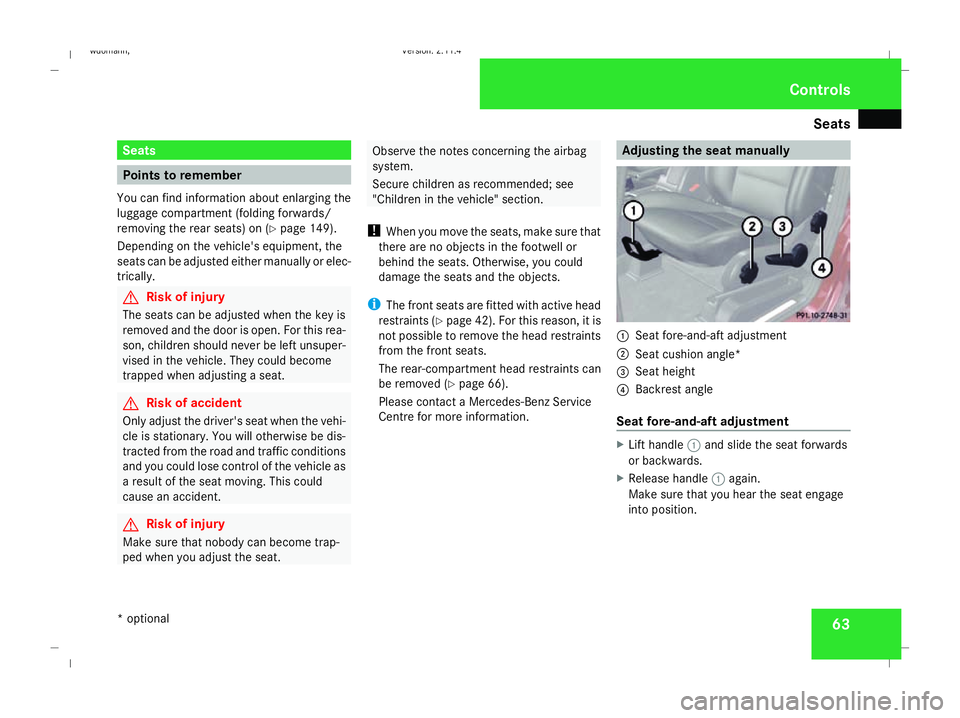
Centre for more information. Adjusting the seat manually
1
Seat fore-and-aft adjustment
2 Seat cushion angle*
3 Seat height
4 Backrest angle
Seat fore-and-aft adjustment X
Lift handle 1and slide the seat forwards
or backwards.
X Release handle 1again.
Make sure that you hear the seat engage
into position. Controls
* optional
245_AKB; 2; 7, en-GB
wdomann,
Version: 2.11.4 2008-10-17T11:22:31+02:00 - Seite 63 ZDateiname: 6515_1640_02_buchblock.pdf; preflight
Page 67 of 305
Seats
64
Backrest angle X
Relieve the pressure on the backrest.
X Turn handwheel 4forwards or backwards.
Seat height X
Pull up or push down handle 3repeatedly
until the seat has reached the desired
height.
Seat cushion angle* Adjust the angle so that your thighs are lightly
supported.
X Turn handwheel 2forwards or backwards.
Head restraint height G
Risk of injury
Make sure that the central area of the head
restraint supports the back of your head at
about eye level. You could seriously injure
your neck if your head is not correctly sup-
ported by the head restraint in the event of
an accident. Never travel without a cor-
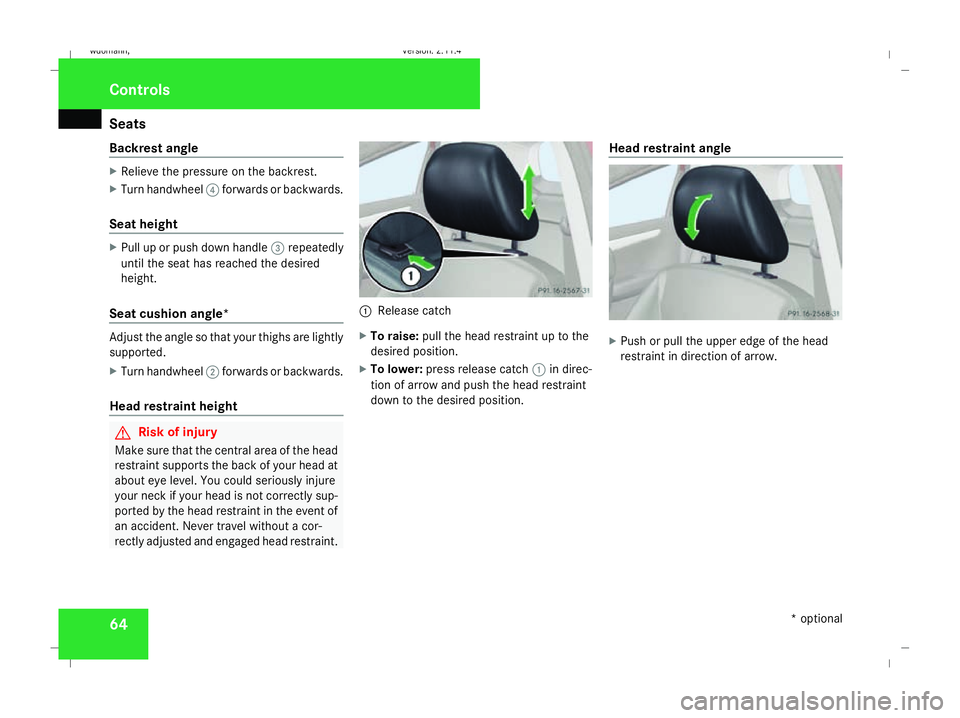
rectly adjusted and engaged head restraint. 1
Release catch
X To raise: pull the head restraint up to the
desired position.
X To lower: press release catch 1in direc-
tion of arrow and push the head restraint
down to the desired position. Head restraint angle X
Push or pull the upper edge of the head
restraint in direction of arrow. Controls
* optional
245_AKB; 2; 7, en-GB
wdomann,
Version: 2.11.4 2008-10-17T11:22:31+02:00 - Seite 64Dateiname: 6515_1640_02_buchblock.pdf; preflight
Page 68 of 305
Seats
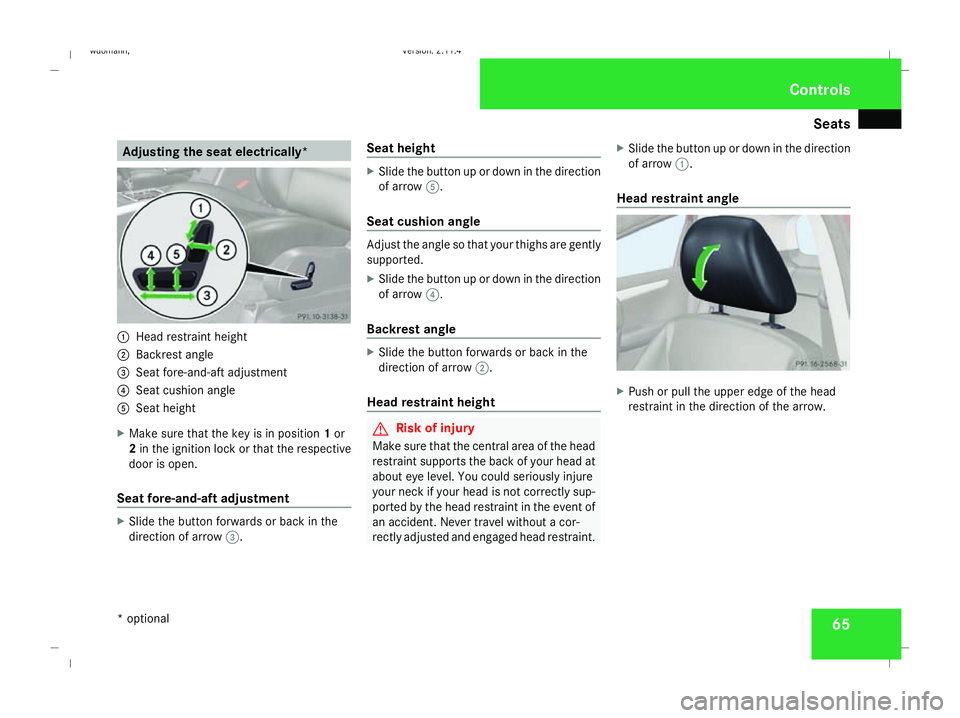
65Adjusting the seat electrically*
1
Head restraint height
2 Backrest angle
3 Seat fore-and-aft adjustment
4 Seat cushion angle
5 Seat height
X Make sure that the key is in position 1or
2 in the ignition lock or that the respective
door is open.
Seat fore-and-aft adjustment X
Slide the button forwards or back in the
direction of arrow 3. Seat height X
Slide the button up or down in the direction
of arrow 5.
Seat cushion angle Adjust the angle so that your thighs are gently
supported.
X
Slide the button up or down in the direction
of arrow 4.
Backrest angle X
Slide the button forwards or back in the
direction of arrow 2.
Head restraint height G
Risk of injury
Make sure that the central area of the head
restraint supports the back of your head at
about eye level. You could seriously injure
your neck if your head is not correctly sup-
ported by the head restraint in the event of
an accident. Never travel without a cor-
rectly adjusted and engaged head restraint. X
Slide the button up or down in the direction
of arrow 1.
Head restraint angle X
Push or pull the upper edge of the head
restraint in the direction of the arrow. Controls
* optional
245_AKB; 2; 7, en-GB
wdomann,
Version: 2.11.4 2008-10-17T11:22:31+02:00 - Seite 65 ZDateiname: 6515_1640_02_buchblock.pdf; preflight
Page 69 of 305
Seats
66 Rear seat head restraints
Adjusting the head restraint height G
Risk of injury
Make sure that the central area of the head
restraint supports the back of your head at
about eye level. You could seriously injure
your neck if your head is not correctly sup-
ported by the head restraint in the event of
an accident. Never travel without a cor-
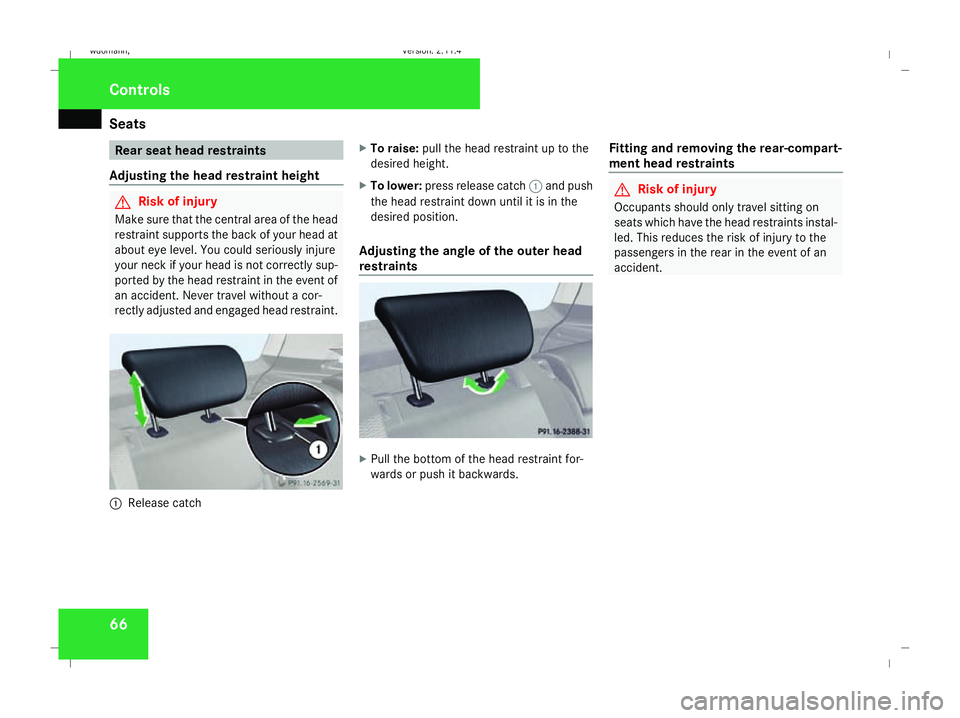
rectly adjusted and engaged head restraint. 1
Release catch X
To raise: pull the head restraint up to the
desired height.
X To lower: press release catch 1and push
the head restraint down until it is in the
desired position.
Adjusting the angle of the outer head
restraints X
Pull the bottom of the head restraint for-
wards or push it backwards. Fitting and removing the rear-compart-
ment head restraints G
Risk of injury
Occupants should only travel sitting on
seats which have the head restraints instal-
led. This reduces the risk of injury to the
passengers in the rear in the event of an
accident. Controls
245_AKB; 2; 7, en-GB
wdomann,
Version: 2.11.4 2008-10-17T11:22:31+02:00 - Seite 66Dateiname: 6515_1640_02_buchblock.pdf; preflight
Page 70 of 305
Seats
671
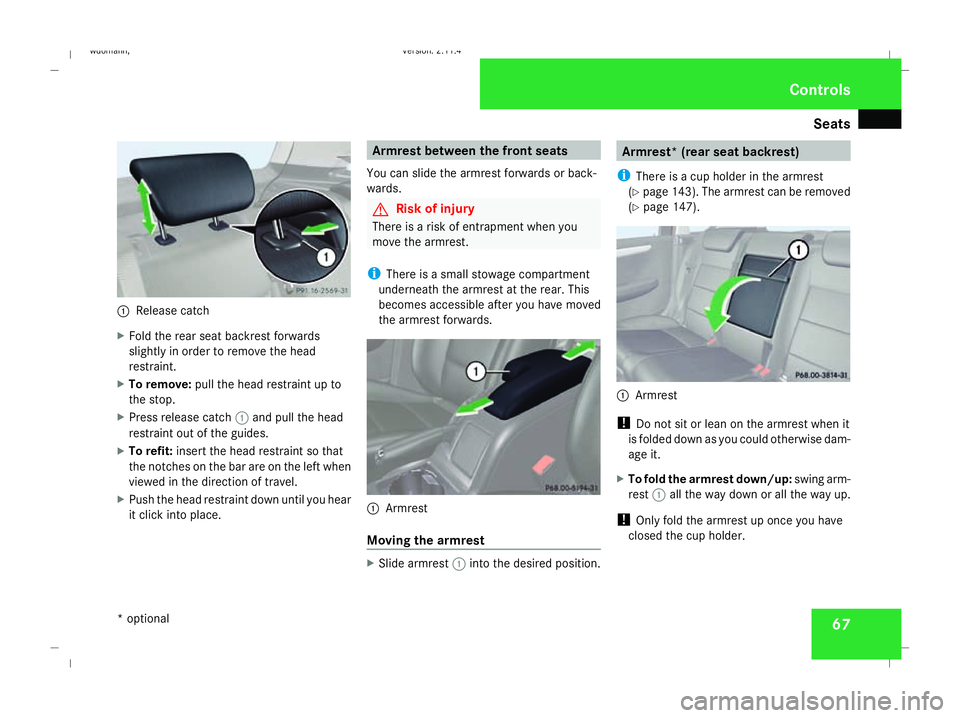
Release catch
X Fold the rear seat backrest forwards
slightly in order to remove the head
restraint.
X To remove: pull the head restraint up to
the stop.
X Press release catch 1and pull the head
restraint out of the guides.
X To refit: insert the head restraint so that
the notches on the bar are on the left when
viewed in the direction of travel.
X Push the head restraint down until you hear
it click into place. Armrest between the front seats
You can slide the armrest forwards or back-
wards. G
Risk of injury
There is a risk of entrapment when you
move the armrest.
i There is a small stowage compartment
underneath the armrest at the rear. This
becomes accessible after you have moved
the armrest forwards. 1
Armrest
Moving the armrest X
Slide armrest 1into the desired position. Armrest* (rear seat backrest)
i There is a cup holder in the armrest
(Y page 143). The armrest can be removed
(Y page 147). 1
Armrest
! Do not sit or lean on the armrest when it
is folded down as you could otherwise dam-
age it.
X To fold the armrest down/up: swing arm-
rest 1all the way down or all the way up.
! Only fold the armrest up once you have
closed the cup holder. Controls
* optional
245_AKB; 2; 7, en-GB
wdomann,
Version: 2.11.4 2008-10-17T11:22:31+02:00 - Seite 67 ZDateiname: 6515_1640_02_buchblock.pdf; preflight
Page 71 of 305
Seats
68 Lumbar support*
The lumbar support for the front seats can be
adjusted to provide optimum support for your
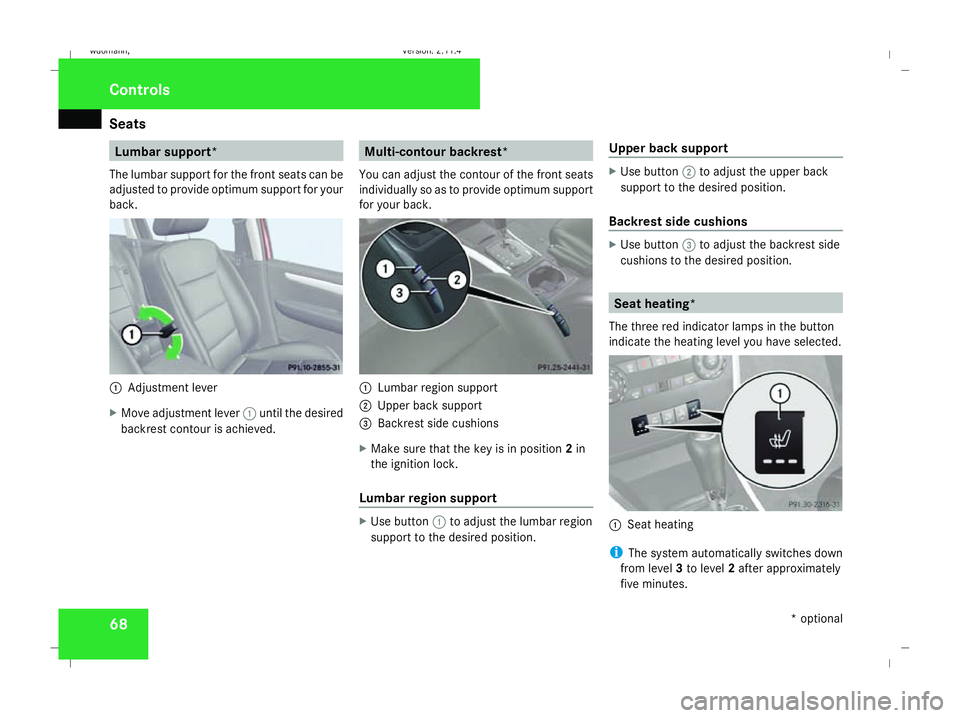
back. 1
Adjustment lever
X Move adjustment lever 1until the desired
backrest contour is achieved. Multi-contour backrest*
You can adjust the contour of the front seats
individually so as to provide optimum support
for your back. 1
Lumbar region support
2 Upper back support
3 Backrest side cushions
X Make sure that the key is in position 2in
the ignition lock.
Lumbar region support X
Use button 1to adjust the lumbar region
support to the desired position. Upper back support X
Use button 2to adjust the upper back
support to the desired position.
Backrest side cushions X
Use button 3to adjust the backrest side
cushions to the desired position. Seat heating*
The three red indicator lamps in the button
indicate the heating level you have selected. 1
Seat heating
i The system automatically switches down
from level 3to level 2after approximately
five minutes. Controls
* optional
245_AKB; 2; 7, en-GB
wdomann,
Version: 2.11.4
2008-10-17T11:22:31+02:00 - Seite 68 Dateiname: 6515_1640_02_buchblock.pdf; preflight
Page 76 of 305
Seat belts
73systems on suitable vehicle seats. You
can find more information under "Chil-
dren in the vehicle" in the "Safety" sec-
tion of the Owner's Manual. Follow the
manufacturer's installation instructions
when fitting the child restraint system.
R Do not secure any objects with a seat belt
if the seat belt is also being used by one
of the vehicle's occupants. G
Risk of injury
The seat belt does not offer the intended
level of protection unless the backrest is
almost vertical. Under certain circumstan-
ces, this could cause severe or even fatal
injuries.
Before starting a journey, make sure that
the seat is properly adjusted and that the
backrest is almost vertical. G
Risk of injury
A dirty or damaged seat belt or a seat belt
that has been subjected to a load in an
accident or modified no longer offers the
intended level of protection. Under certain
circumstances, this could cause severe or
even fatal injuries. For this reason, check regularly that the
seat belts are not damaged or dirty.
Always have damaged seat belts or seat
belts that have been subjected to a load in
an accident replaced at a qualified special-
ist workshop. Consult a qualified specialist
workshop which has the necessary special-
ist knowledge and tools to carry out the
work required. Mercedes-Benz recom-
mends that you use a Mercedes-Benz
Service Centre for this purpose.
For safety reasons, Mercedes-Benz recom-
mends that you only use seat belts which
have been approved by Mercedes-Benz for
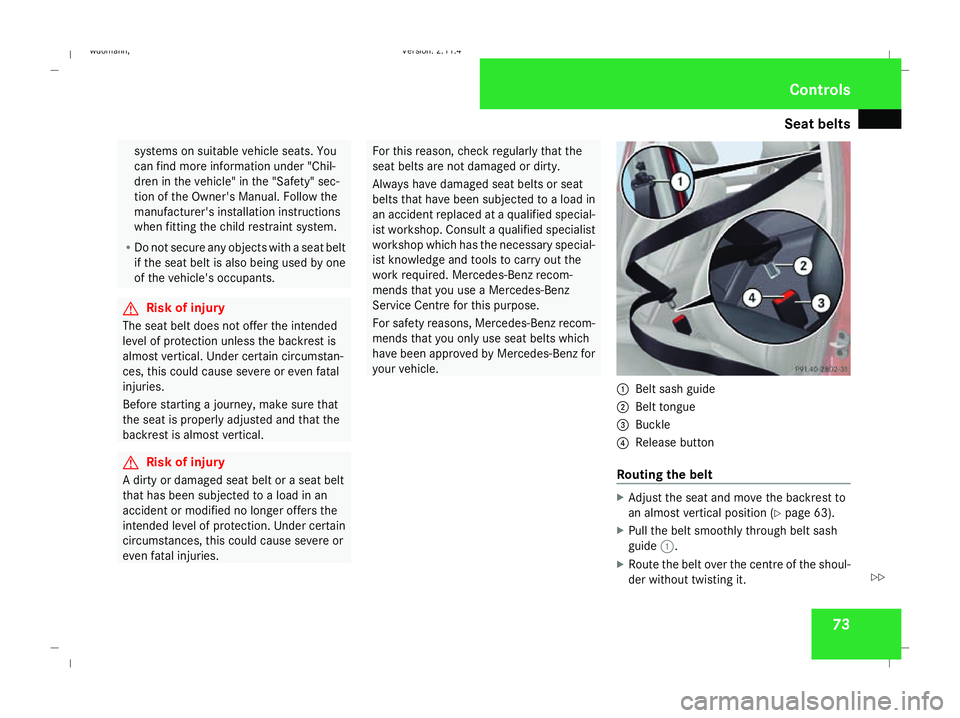
your vehicle. 1
Belt sash guide
2 Belt tongue
3 Buckle
4 Release button
Routing the belt X
Adjust the seat and move the backrest to
an almost vertical position (Y page 63).
X Pull the belt smoothly through belt sash
guide 1.
X Route the belt over the centre of the shoul-
der without twisting it. Controls
245_AKB; 2; 7, en-GB
wdomann,
Version: 2.11.4 2008-10-17T11:22:31+02:00 - Seite 73 ZDateiname: 6515_1640_02_buchblock.pdf; preflight
Page 82 of 305
Lights
79Hazard warning lamps
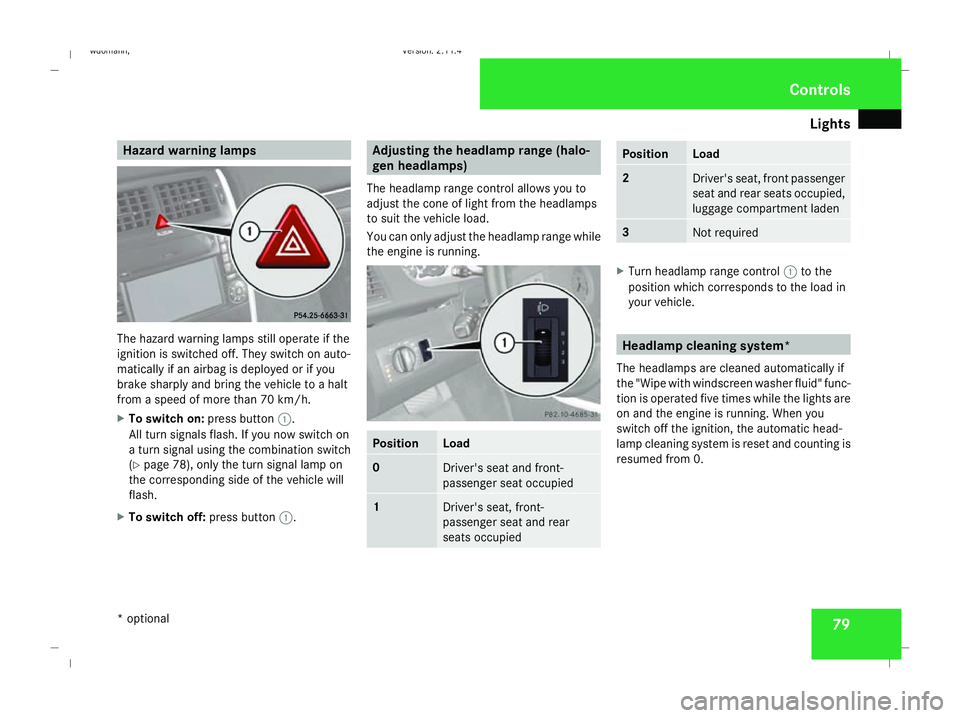
The hazard warning lamps still operate if the
ignition is switched off. They switch on auto-
matically if an airbag is deployed or if you
brake sharply and bring the vehicle to a halt
from a speed of more than 70 km/h.
X To switch on: press button1.
All turn signals flash. If you now switch on
a turn signal using the combination switch
(Y page 78), only the turn signal lamp on
the corresponding side of the vehicle will
flash.
X To switch off: press button1. Adjusting the headlamp range (halo-
gen headlamps)
The headlamp range control allows you to
adjust the cone of light from the headlamps
to suit the vehicle load.
You can only adjust the headlamp range while
the engine is running. Position Load
0
Driver's seat and front-
passenger seat occupied
1
Driver's seat, front-
passenger seat and rear
seats occupied Position Load
2
Driver's seat, front passenger
seat and rear seats occupied,
luggage compartment laden
3
Not required
X
Turn headlamp range control 1to the
position which corresponds to the load in
your vehicle. Headlamp cleaning system*
The headlamps are cleaned automatically if
the "Wipe with windscreen washer fluid" func-
tion is operated five times while the lights are
on and the engine is running. When you
switch off the ignition, the automatic head-
lamp cleaning system is reset and counting is
resumed from 0. Controls
* optional
245_AKB; 2; 7, en-GB
wdomann,
Version: 2.11.4 2008-10-17T11:22:31+02:00 - Seite 79 ZDateiname: 6515_1640_02_buchblock.pdf; preflight
Page 147 of 305
Loading and stowing
144Benz vehicles. This helps to prevent dam-
age to the vehicle.
Position the load on the roof rack in such a
way that the vehicle will not sustain dam-
age even when it is in motion.
Depending on the vehicle's equipment,
make sure that you can:
R open the panorama louvred sliding sun-
roof* fully
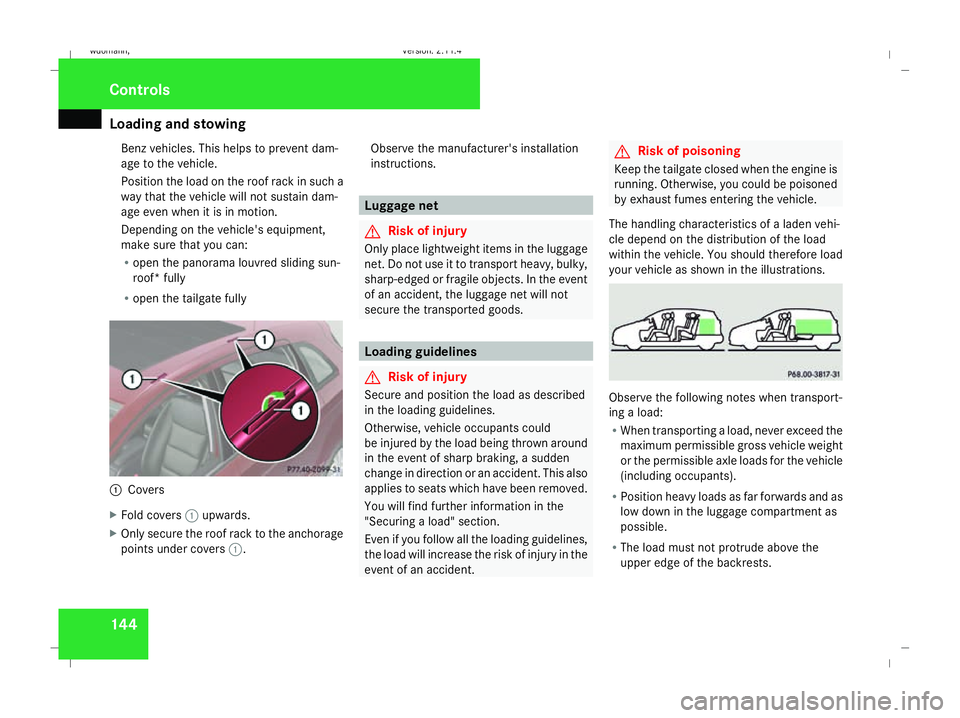
R open the tailgate fully 1
Covers
X Fold covers 1upwards.
X Only secure the roof rack to the anchorage
points under covers 1. Observe the manufacturer's installation
instructions. Luggage net
G
Risk of injury
Only place lightweight items in the luggage
net. Do not use it to transport heavy, bulky,
sharp-edged or fragile objects. In the event
of an accident, the luggage net will not
secure the transported goods. Loading guidelines
G
Risk of injury
Secure and position the load as described
in the loading guidelines.
Otherwise, vehicle occupants could
be injured by the load being thrown around
in the event of sharp braking, a sudden
change in direction or an accident. This also
applies to seats which have been removed.
You will find further information in the
"Securing a load" section.
Even if you follow all the loading guidelines,
the load will increase the risk of injury in the
event of an accident. G
Risk of poisoning
Keep the tailgate closed when the engine is
running. Otherwise, you could be poisoned
by exhaust fumes entering the vehicle.
The handling characteristics of a laden vehi-
cle depend on the distribution of the load
within the vehicle. You should therefore load
your vehicle as shown in the illustrations. Observe the following notes when transport-
ing a load:
R
When transporting a load, never exceed the
maximum permissible gross vehicle weight
or the permissible axle loads for the vehicle
(including occupants).
R Position heavy loads as far forwards and as
low down in the luggage compartment as
possible.
R The load must not protrude above the
upper edge of the backrests. Controls
245_AKB; 2; 7, en-GB
wdomann,
Version: 2.11.4
2008-10-17T11:22:31+02:00 - Seite 144 Dateiname: 6515_1640_02_buchblock.pdf; preflight
Page 148 of 305
Loading and stowing
145
R
Always place the load against the rear seat
backrests or the seat cushions if these
have been folded forwards.
R The maximum load capacity of the stowage
well under the luggage compartment floor
is 25 kg.
R Always place the load behind unoccupied
seats if possible.
R Secure the load with sufficiently strong and
wear-resistant load restraints. Pad sharp
edges for protection.
i Load restraints are available at any quali-
fied specialist workshop, e.g. a Mercedes-
Benz Service Centre. R
If the rear seats are not occupied, insert the
belt tongue on the outer seat belts into the
buckle of the opposite seat belt. This
increases the restraining effect of the rear
seat backrests.
! Do not position the load on one part of the
folding luggage compartment floor only.
The maximum load capacity of the folding
luggage compartment floor is 100 kg.
Spread the weight evenly to avoid damag-
ing the luggage compartment floor. If nec-
essary, place a solid board under the load.
Please note that the load on the luggage compartment floor will be increased when
the load is lashed down.
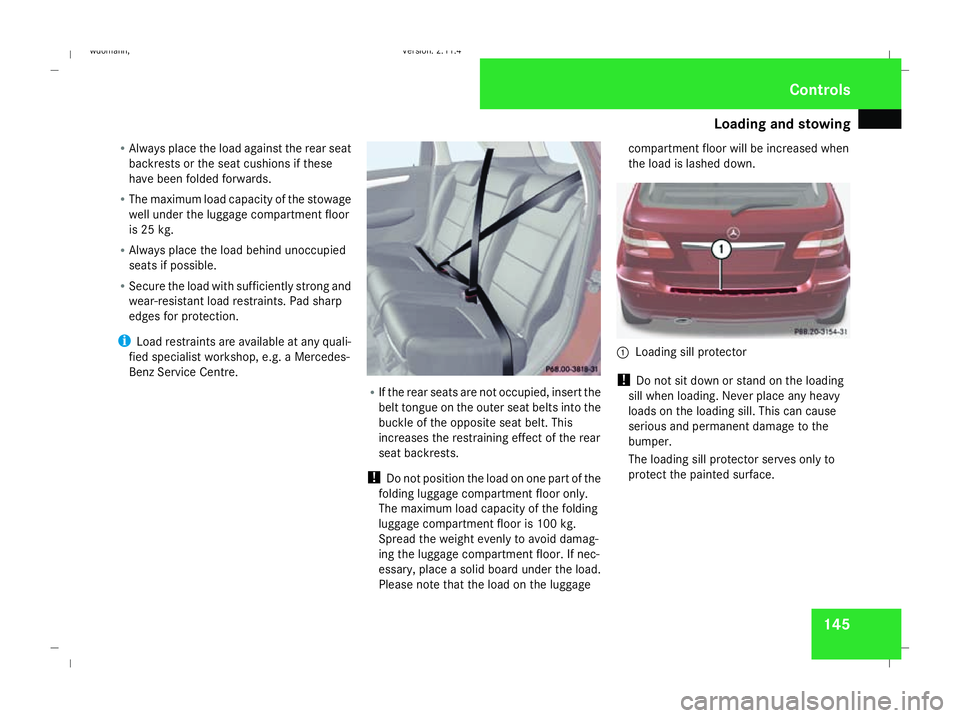
1
Loading sill protector
! Do not sit down or stand on the loading
sill when loading. Never place any heavy
loads on the loading sill. This can cause
serious and permanent damage to the
bumper.
The loading sill protector serves only to
protect the painted surface. Controls
245_AKB; 2; 7, en-GB
wdomann
,V ersion: 2.11.4
2008-10-17T11:22:31+02:00 - Seite 145 ZDateiname: 6515_1640_02_buchblock.pdf; preflight