light MERCEDES-BENZ B-CLASS HATCHBACK 2011 User Guide
[x] Cancel search | Manufacturer: MERCEDES-BENZ, Model Year: 2011, Model line: B-CLASS HATCHBACK, Model: MERCEDES-BENZ B-CLASS HATCHBACK 2011Pages: 329, PDF Size: 7.91 MB
Page 21 of 329
Important safety notes
..................181
Lights displa ymessage .................. 216
Mounting dimensions ....................318
Parktroni c...................................... 165
Power supply ................................. 185
Shift range ..................................... 137
Trailer loads ................................... 320
Transmission
see Automatic transmission
see Manual transmission
Transmission position display
(DIRECT SELECTl ever)...................... 135
Transporting the vehicle ..................287
Trim pieces (cleaning instructions) .272
Trip computer (on-board com-
puter) ................................................. .193
Trip meter Calling up ....................................... 193
Resetting (on-board computer) ......194
Trip odometer
see Trip meter
Turn signals
Changing bulbs (front) ...................106
Changing bulbs (rear) ....................107
Switching on/off .............................. 98
Two-way radio
Frequencies ................................... 309
Installatio n..................................... 309
Transmission output (maximum) .... 309
Type identification plate
see Vehicle identification plate
Tyre pressure
Display message ............................ 228
Not reached (TIREFIT) ....................279
Reached (TIREFIT) ..........................279
Recommended ............................... 295
Tyre pressure loss warning
Important safety notes ..................296
Restarting ...................................... 297
Tyre pressure loss warning sys-
tem ..................................................... 296
Tyres Changing awheel .......................... 298
Checking ........................................ 293
Direction of rotatio n...................... 298
Display message ............................ 228
Grip ................................................ 148
Important safety notes ..................292M+S tyres
...................................... 294
MOExtended tyres .........................294
Replacing ....................................... 298
Service life ..................................... 293
Storing ........................................... 298
Tyr esize (data) .............................. 302
Tyr etread ...................................... 293
see Flat tyre U
Unladen weight ................................. 317
Unlocking Emergency unlocking .......................77
From inside the vehicle (central
unlocking button) ............................. 77 V
Vanity mirror (in sun visor) ..............256
Variable SPEEDTRONIC see SPEEDTRONIC
Vehicle
Correct use ...................................... 22
Data acquisition ............................... 23
Electronics ..................................... 309
Equipment ....................................... 20
Implied warranty .............................. 23
Individua lsettings .......................... 200
Leaving parked up .........................146
Locking (in an emergency) ...............78
Locking (key )................................... 72
Lowering ........................................ 302
Pulling away ................................... 128
Raising ........................................... 299
Registration ..................................... 22
Securing from rolling away ............299
Towing away .................................. 284
Tow-starting ................................... 284
Transporting .................................. 287
Unlocking (in an emergency) ...........77
Unlocking (key )................................ 72
Vehicle data ................................... 317
Vehicle battery
see Battery (vehicle)
Vehicle data ....................................... 317
Vehicle dimensions ...........................317
Vehicle emergency locking ................7818
Index
Page 31 of 329
Instrumen
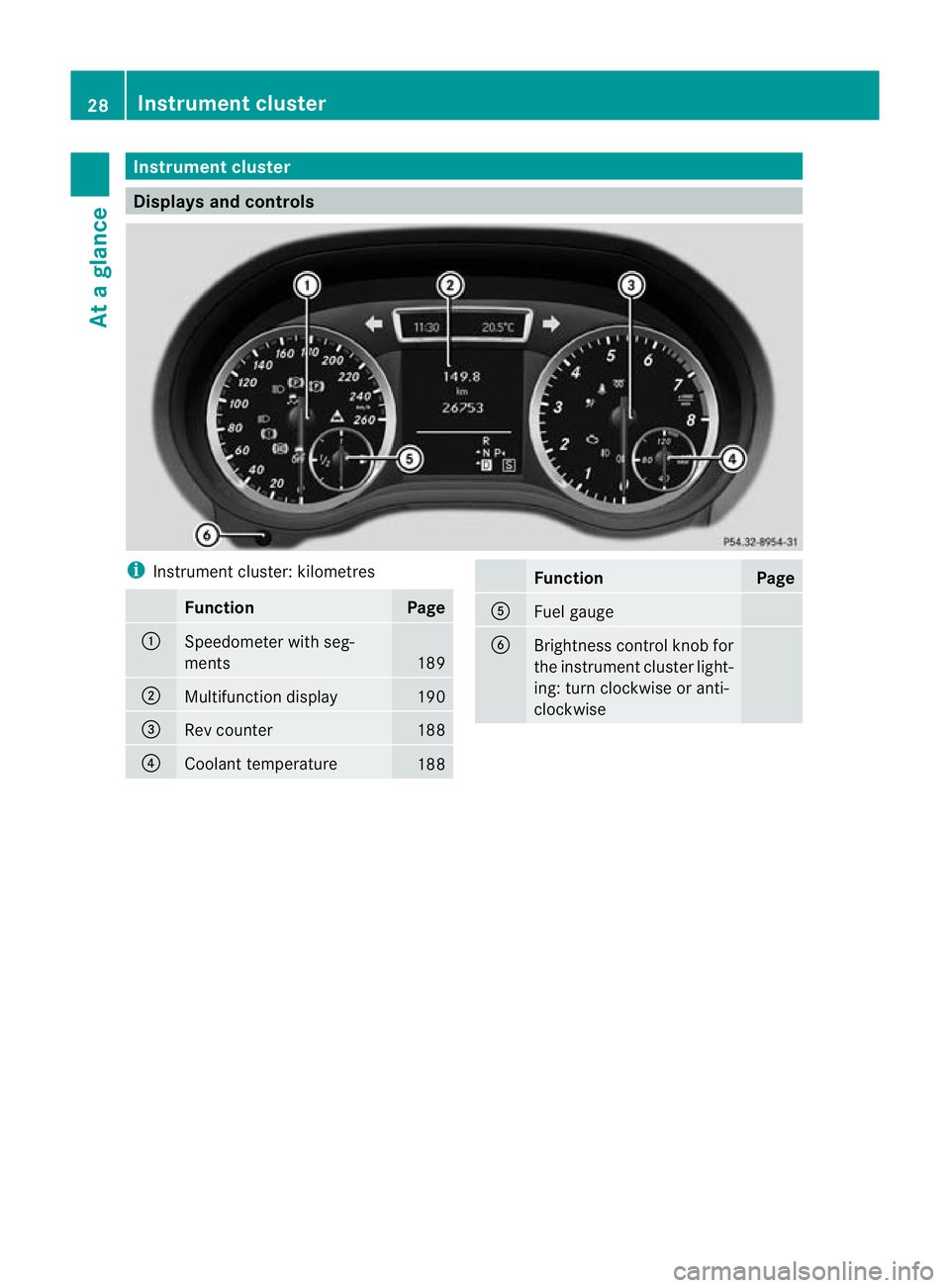
tcluster Displays and controls
i
Instrument cluster: kilometres Function Page
:
Speedometer with seg-
ments
189
;
Multifunction display 190
=
Rev counter 188
?
Coolant temperature
188 Function Page
A
Fuel gauge
B
Brightness control knob for
the instrumen
tcluster light-
ing: turn clockwise or anti-
clockwise 28
Instrument clusterAt a glance
Page 32 of 329
i
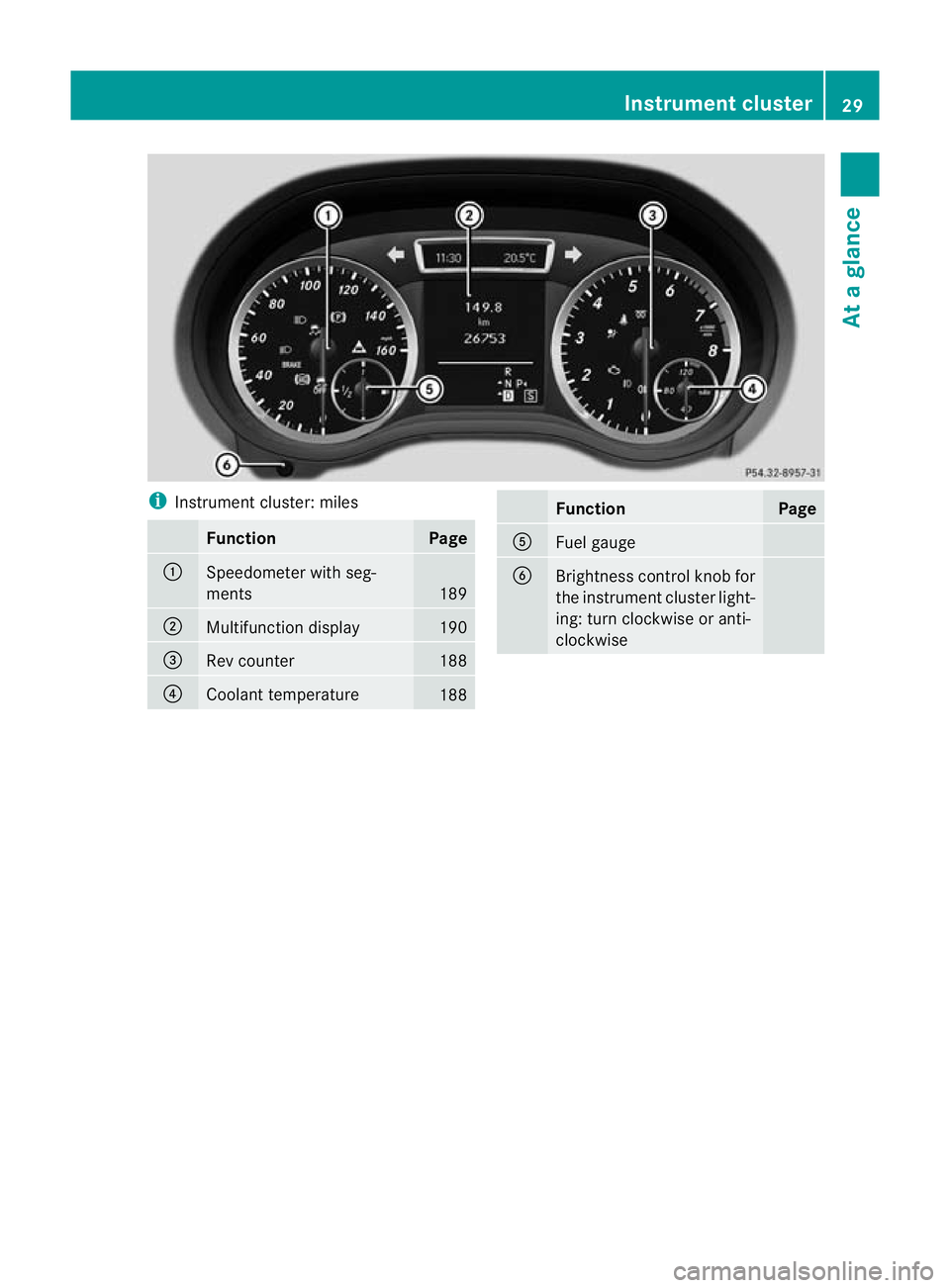
Instrument cluster: miles Function Page
:
Speedometer with seg-
ments
189
;
Multifunction display 190
=
Rev counter 188
?
Coolant temperature
188 Function Page
A
Fuel gauge
B
Brightness control knob for
the instrument cluster light-
ing: turn clockwise or anti-
clockwise Instrument cluster
29At a glance
Page 36 of 329
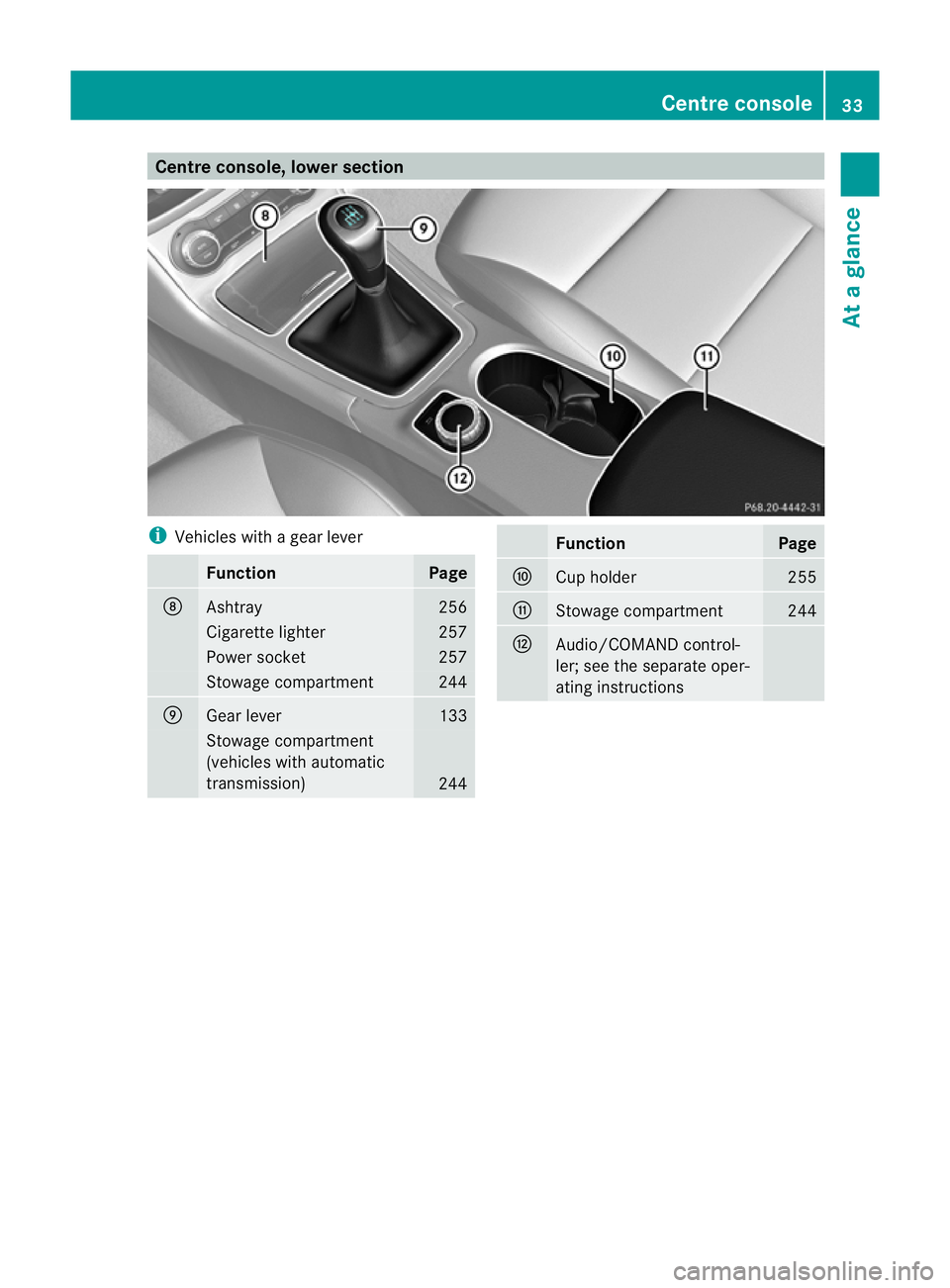
Centre console, lower section
i
Vehicles with a gear lever Function Page
D
Ashtray 256
Cigarette lighter 257
Power socket 257
Stowage compartment 244
E
Gear lever 133
Stowage compartment
(vehicles with automatic
transmission)
244 Function Page
F
Cup holder 255
G
Stowage compartment 244
H
Audio/COMAND control-
ler; see the separate oper-
ating instructions Centre console
33At a glance
Page 37 of 329
Overhea
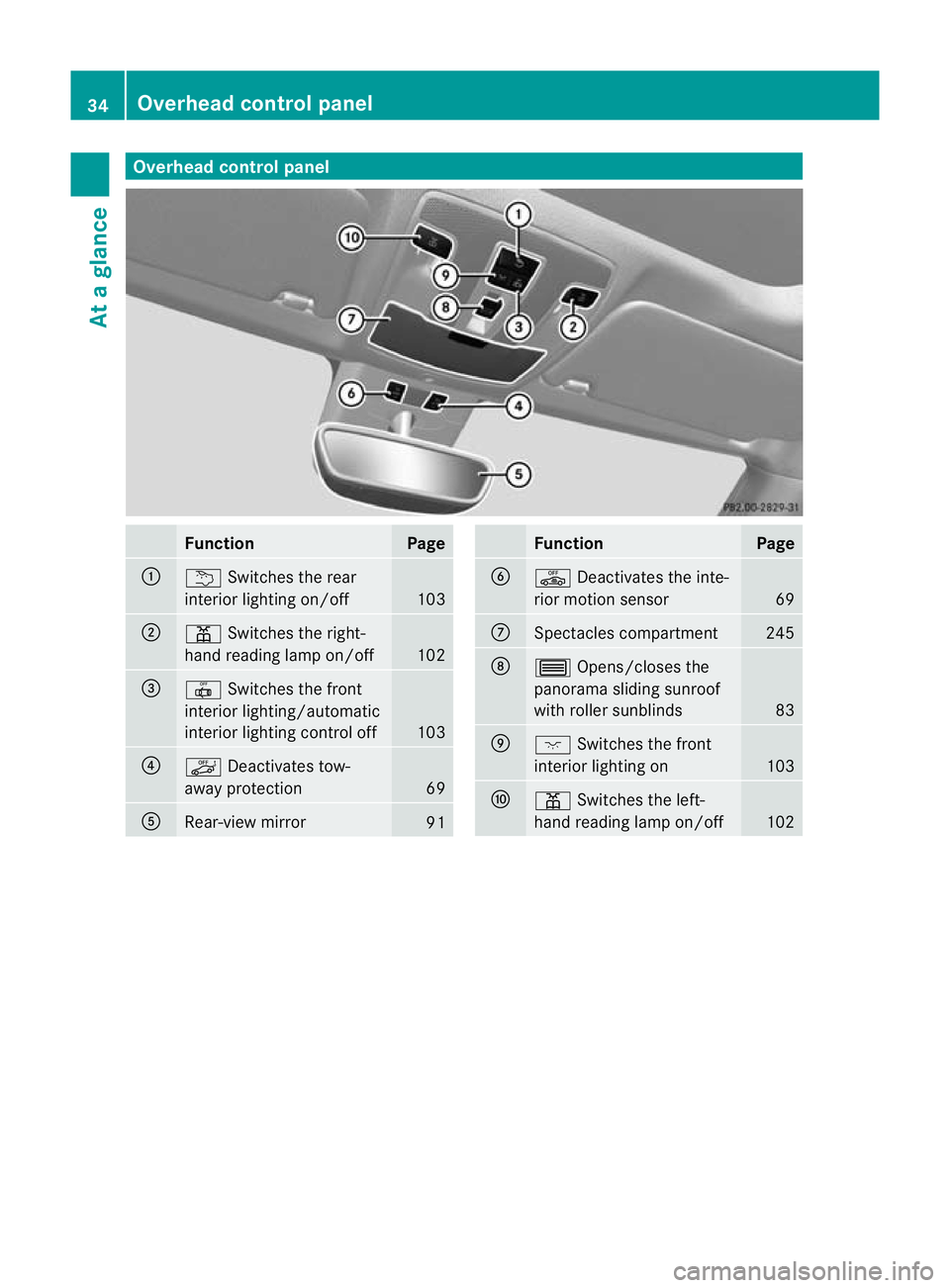
dcontrol panel Function Page
:
u
Switches the rear
interio rlighting on/off 103
;
p
Switches the right-
hand reading lamp on/off 102
=
|
Switches the front
interior lighting/automatic
interior lighting control off 103
?
ë
Deactivates tow-
away protection 69
A
Rear-view mirror
91 Function Page
B
ê
Deactivates the inte-
rior motion sensor 69
C
Spectacles compartment 245
D
3
Opens/closes the
panorama sliding sunroof
with roller sunblinds 83
E
c
Switches the front
interior lighting on 103
F
p
Switches the left-
hand reading lamp on/off 10234
Overhead control panelAt a glance
Page 42 of 329
SRS (Supplemental Restraint System)
Introduction SRS consists of:
R
the 6 SRS warning lamp
R airbags
R airbag control unit (with crash sensors)
R belt tensioners for the front seat belts and
the outer seat belts in the rear
R seat belt force limiters for the front seat
belts and the outer seat belts in the rear
SRS reduces the risk of occupants coming
into contact with the vehicle's interior in the
event of an accident. It can also reduce the
forces to which occupants are subjected dur-
ing an accident.
SRS warning lamp G
WARNING
If SRS is malfunctioning, individual systems
may be triggered unintentionally or might not
be triggered in the event of an accident with
a high rate of vehicle deceleration.
A malfunction has occurred if:
R the 6 SRS warning lamp does not light
up when the ignition is switched on.
R the engine is running and the 6SRS
warning lamp does not go out after a few
seconds.
R the engine is running and the 6SRS
warning lamp lights up again.
In this case, have SRS checked immediately
at a qualified specialist workshop.
SRS functions are checked regularly when
you switch on the ignition and when the
engine is running. Therefore, malfunctions
can be detected in good time.
The 6 SRS warning lamp in the instrument
cluster lights up when the ignition is switched
on. It goes out no later than a few seconds
after the engine is started. Triggering of belt tensioners, belt force
limiters and airbags During the first stage of a collision, the airbag
control unit evaluates important physical
data relating to vehicle deceleration or accel-
eration, such as:
R
duration
R direction
R magnitude
Based on the evaluation of this data, the air-
bag control unit pre-emptively triggers the
belt tensioners in the first stage.
i The front belt tensioners can only be trig-
gered if the seat belt tongues on the front
seats are correctly engaged in the seat belt
buckles.
If there is an even higher rate of vehicle decel-
eration or acceleration in a longitudinal direc-
tion, the front airbags are also deployed.
Your vehicle has adaptive, two-stage front air-
bags. The airbag control unit evaluates vehi-
cle deceleration or acceleration in the event
of a collision. In the first deployment stage,
the front airbag is filled with a portion of the
available propellant gas in order to reduce the
risk of injuries. If, within a few milliseconds,
the airbag control unit detects that the vehi-
cle is accelerating or decelerating at a greater
rate than originally anticipated, the front air-
bag is then filled with the maximum amount
of propellant gas.
The belt tensioner and airbag triggering
thresholds are variable and are adapted to the
detected rate of deceleration or acceleration
of the vehicle. This process is pre-emptive in
nature. The triggering process must take
place in good time at the start of the collision.
i Not all airbags are deployed in an acci-
dent. The different airbag systems work
independently of each other. Occupant safety
39Safety Z
Page 44 of 329
suitable seat in the rear. If you secure a
forward-facing child restraint system to the
front-passenger seat, you must move the
front-passenger seat as far back as possi-
ble.
R make sure there are no heavy or sharp-
edged objects in the pockets of clothing.
R do not lean forwards, e.g. over the cover of
the driver's/front-passenger front airbag,
particularly when the vehicle is in motion.
R do not put your feet on the dashboard.
R only hold the steering wheel on the outside.
This allows the airbag to be fully deployed.
You could be injured if the airbag is
deployed and you are holding the inside of
the steering wheel.
R do not lean on the doors from inside the
vehicle.
R make sure that there are no people, ani-
mals or objects between the vehicle occu-
pants and the area where the airbags are
deployed.
R do not place any objects between the seat
backrest and the door.
R do not hang any hard objects, for example,
coat hangers, on the grab handles or coat
hooks.
R do not attach accessories, e.g. cup holders,
to the doors.
It is not possible to rule out a risk of injury
being caused by an airbag, due to the high
speed at which the airbag must be deployed. G
WARNING
Airbag functionality can only be assured if the
following parts are not covered and no badges
or stickers are attached to them:
R padded steering wheel boss
R kneebag cover below the steering column
R front-passenger airbag cover
R outer side of front seat bolsters
R side trim next to the rear seat backrest
R roof frame cover between the front A-pillar
and the C-pillar in the rear compartment G
WARNING
As mall amount of powder is released when
an airbag is deployed. The powder could
cause short-term breathing difficulties in peo-
ple with asthma or other respiratory prob-
lems.
In order to prevent breathing difficulties, you
should leave the vehicle as soon as it is safe
to do so. You can also open the window to
allow fresh air to enter the interior. The pow-
der does not constitute ahealth hazard and
does not indicate that there is a fire in the
vehicle. G
WARNING
The airbag parts are hot after the airbag has
been deployed. Do not touch them as you
could burn yourself.
Have the airbags replaced at a qualified spe-
cialist workshop. Otherwise, occupants are
not protected by the airbags in the event of
another accident.
Airbag deployment slows down and restricts
the movement of the vehicle occupant, com-
plementing the restraint of the seat belt.
If the airbags are deployed, you will hear a
bang and a small amount of powder may also
be released. Only in rare cases will the bang
affect your hearing. The powder that is
released generally does not constitute a
health hazard. The 6SRS warning lamp
lights up.
The airbag installation locations are identified
by the AIRBAG symbol.
Front airbags !
Do not place heavy objects on the front-
passenger seat. The system may then
detec tthat the seat is occupied and if there
is an accident, the restraint systems on the
front-passenger side could be deployed.
Have restraint systems that have been trig-
gered replaced. Occupant safety
41Safety Z
Page 47 of 329
the belt pretensioning
.All settings made by
PRE-SAFE ®
can then be reversed.
If the seat belts are not released:
X Move the backrest or seat back slightly, but
only when the vehicle is stationary.
The belt pretensioning is reduced and the
locking mechanis mis released.
More information abouts eat-belt adjust-
ment ,aconvenience function integrated into
PRE-SAFE ®
, can be found in the "Seat-belt
adjustment" section (Y page 45).Seat belts
Important safety notes G
WARNING
A seat belt which is not worn correctly, or
which has not been engaged in the seat belt
buckle correctly, cannot provide the intended
level of protection. Under certain circumstan-
ces, this could cause severe or even fatal inju-
ries in the event of an accident.
Therefore, make sure that all occupants —in
particular, pregnan twomen —wear their seat
belts correctly at all times.
R The seat belt must fit snugly on your body
and must not be twisted.Therefore, avoid
wearing bulky clothing, e.g. a winter coat.
The shoulder section of the belt must be
routed across the centre of your shoulder
—onn o account across your neck or under
your arm —and pulled tight against your
uppe rbody. The lap belt must always pass
across your lap as low down as possible, i.e.
over your hip joints —not across your abdo-
men. If necessary, push the seat belt
slightly downwards and adjust it by pulling
it in the direction the seat belt retracts.
R Do not route the seat belt strap over sharp
or fragile objects. Please make sure that
such objects are not on or in your clothing,
e.g. spectacles, pens or keys etc. The seat
belt strap could become damaged and tear during an accident and you or other vehicle
occupants could be injured.
R Only one person should use each seat belt
at any one time. Children must never travel
sitting on the lap of another occupant. The
child will not be secured in the event of an
accident, heavy braking or sudden change
of direction .This may result in the child or
other occupants being seriously or fatally
injured.
R Persons under 1.50 mtall cannot wear the
seat belts correctly. For this reason secure
persons less than 1.50 m tall in specially
designed, suitable restraint systems.
R Children unde r1.50 mtall and younger
than twelve years of age canno twear the
seat belts correctly. For this reason secure
them in special suitable child restraint sys-
tems installed on a suitable seat. Additional
information can be found in the Operating
Instructions in the chapter "Safety", "Chil-
dren in the Vehicle". Observe the installa-
tion instructions of the child restraint sys-
tem manufacturer.
R Do not secure an object with a seat belt if
the seat belt is also being used by one of
the vehicle's occupants. G
WARNING
The seat belt does not offer the intended level
of protection unless the backrest is almost
vertical. Under certain circumstances, this
could cause severe or even fatal injuries in the
event of an accident.
Before starting a journey, make sure that the
seat is properly adjusted and that the back-
rest is almost vertical. G
WARNING
Ad irty or damaged seat belt or one that has
been modified or subjected to a load in an
accident no longer offers the intended level of
protection. Under certain circumstances, this
could cause severe or even fatal injuries in the
event of an accident. 44
Occupant safetySafety
Page 48 of 329
For this reason, check regularly that the seat
belts are not damaged or dirty.
Always have damaged sea
tbelts or seat belts
that have been subjected to a load in an acci-
dent replaced at a qualified specialist work-
shop.
For safety reasons, Mercedes-Benz recom-
mends that you only use seat belts which have
been approved by Mercedes-Benz for your
vehicle.
Seat belts are the most effective means of
restraining the movement of vehicle occu-
pants in the event of an accident. This
reduces the risk of vehicle occupants coming
into contact with parts of the vehicle interior.
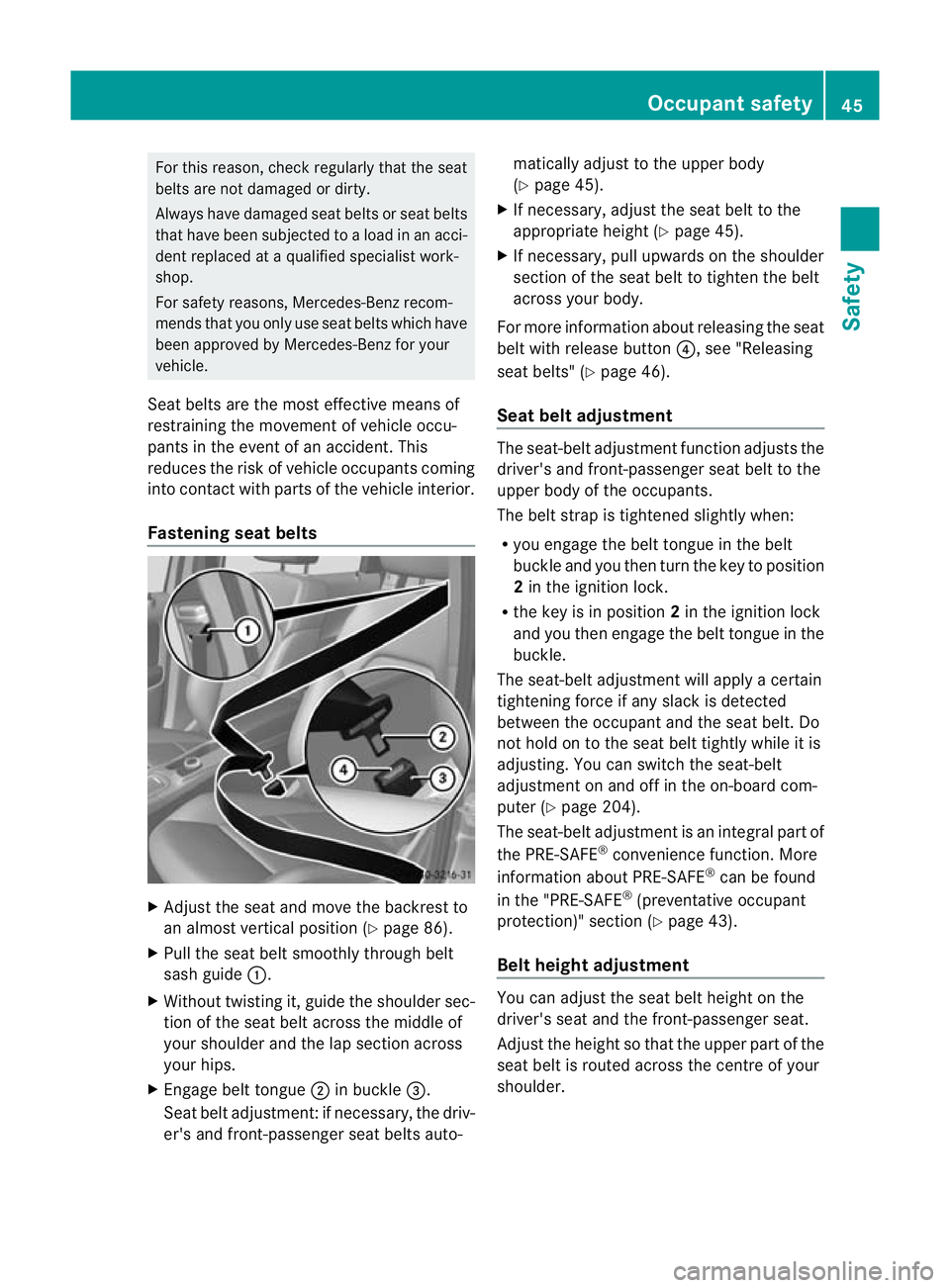
Fastening seat belts X
Adjust the seat and move the backrest to
an almost vertical position (Y page 86).
X Pull the seat belt smoothly through belt
sash guide :.
X Without twisting it, guide the shoulder sec-
tion of the seat belt across the middle of
your shoulder and the lap section across
your hips.
X Engage belt tongue ;in buckle =.
Seat belt adjustment:ifn ecessary, the driv-
er's and front-passenger seat belts auto- matically adjust to the upper body
(Y
page 45).
X If necessary, adjust the seat belt to the
appropriate height (Y page 45).
X If necessary, pull upwards on the shoulder
section of the seat belt to tighten the belt
across your body.
For more information about releasing the seat
belt with release button ?, see "Releasing
seat belts" (Y page 46).
Seat belt adjustment The seat-belt adjustment function adjusts the
driver's and front-passenger seat belt to the
upper body of the occupants.
The belt strap is tightened slightly when:
R
you engage the belt tongue in the belt
buckle and you then turn the key to position
2in the ignition lock.
R the key is in position 2in the ignition lock
and you then engage the belt tongue in the
buckle.
The seat-belt adjustment will apply a certain
tightening force if any slack is detected
between the occupant and the seat belt. Do
not hold on to the seat belt tightly while it is
adjusting. You can switch the seat-belt
adjustment on and off in the on-board com-
puter (Y page 204).
The seat-belt adjustment is an integral part of
the PRE-SAFE ®
convenience function. More
information about PRE-SAFE ®
can be found
in the "PRE-SAFE ®
(preventative occupant
protection)" section (Y page 43).
Belt height adjustment You can adjust the seat belt height on the
driver's seat and the front-passenger seat.
Adjust the height so that the upper part of the
seat belt is routed across the centre of your
shoulder. Occupant safety
45Safety Z
Page 49 of 329
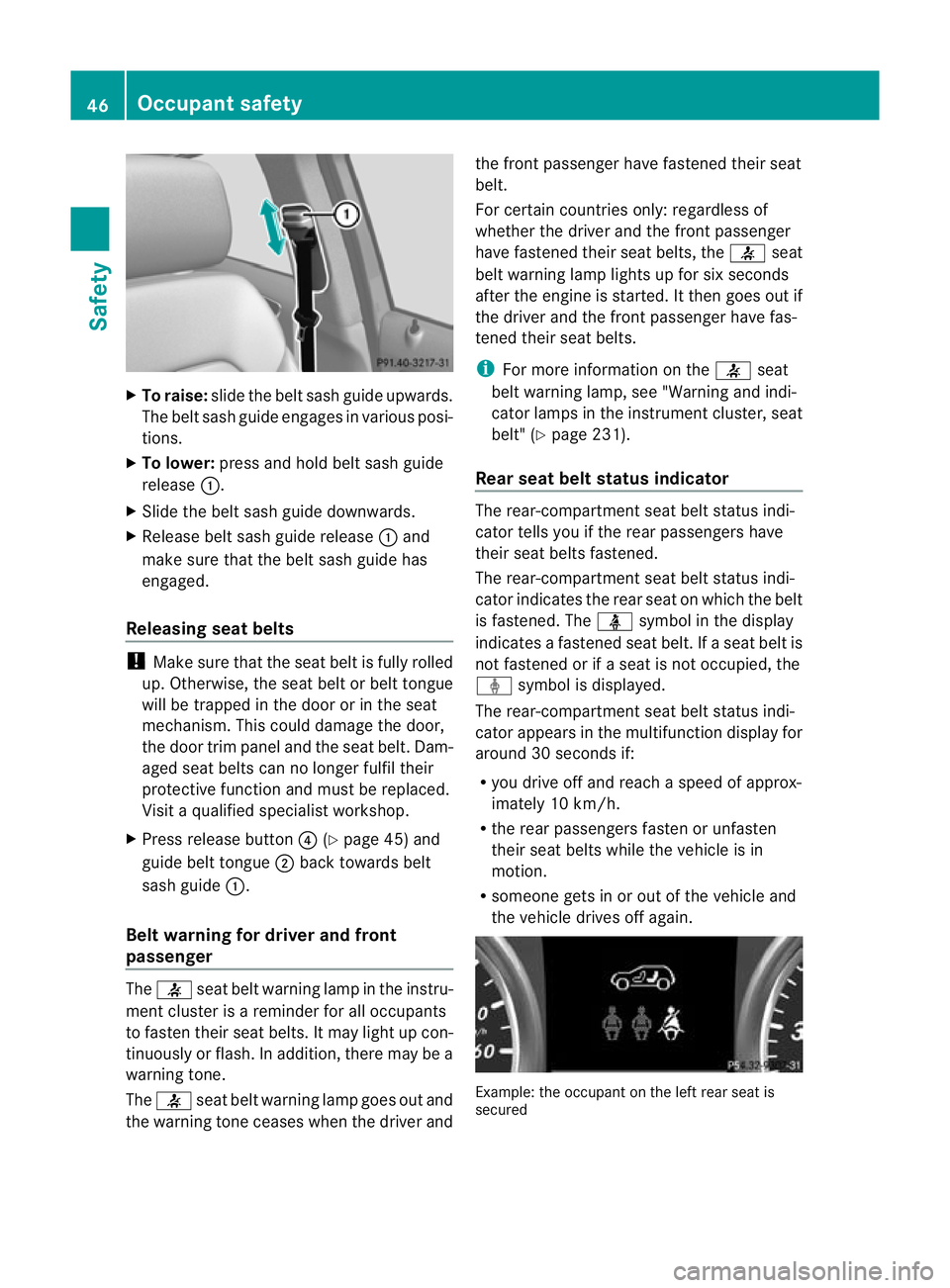
X
To raise: slide the belt sash guide upwards.
The belt sash guide engages in various posi-
tions.
X To lower: press and hold belt sash guide
release :.
X Slide the belt sash guide downwards.
X Release belt sash guide release :and
make sure tha tthe belt sash guide has
engaged.
Releasing seat belts !
Make sure that the seat belt is fully rolled
up. Otherwise, the seat belt or belt tongue
will be trapped in the door or in the seat
mechanism. This could damage the door,
the door trim panel and the seat belt. Dam-
aged seat belts can no longer fulfil their
protective function and must be replaced.
Visit a qualified specialist workshop.
X Press release button ?(Ypage 45) and
guide belt tongue ;back towards belt
sash guide :.
Belt warning for driver and front
passenger The
7 seat belt warning lamp in the instru-
ment cluster is a reminder for all occupants
to fasten their seat belts. It may light up con-
tinuously or flash. In addition, there may be a
warning tone.
The 7 seat belt warning lamp goes out and
the warning tone ceases when the driver and the front passenger have fastened their seat
belt.
For certain countries only: regardless of
whether the driver and the front passenger
have fastened their seat belts, the
7seat
belt warning lamp lights up for six seconds
after the engine is started. It then goes out if
the driver and the front passenger have fas-
tened their seat belts.
i For more information on the 7seat
belt warning lamp, see "Warning and indi-
cator lamps in the instrumentc luster, seat
belt" (Y page 231).
Rear seat belt status indicator The rear-compartmen
tseat belt status indi-
cator tells you if the rear passengers have
their seat belts fastened.
The rear-compartment seat belt status indi-
cator indicates the rear seat on which the belt
is fastened. The üsymbol in the display
indicates a fastened seat belt. If a seat belt is
not fastened or if a seat is not occupied, the
ý symbol is displayed.
The rear-compartment seat belt status indi-
cator appears in the multifunction display for
around 30 seconds if:
R you drive off and reach a speed of approx-
imately 10 km/h.
R the rear passengers fasten or unfasten
their seat belts while the vehicle is in
motion.
R someone gets in or out of the vehicle and
the vehicle drives off again. Example: the occupant on the left rear seat is
secured46
Occupant safetySafety