ESP MERCEDES-BENZ B-CLASS HATCHBACK 2014 Owners Manual
[x] Cancel search | Manufacturer: MERCEDES-BENZ, Model Year: 2014, Model line: B-CLASS HATCHBACK, Model: MERCEDES-BENZ B-CLASS HATCHBACK 2014Pages: 405, PDF Size: 12.24 MB
Page 394 of 405
Petrol engines:
in certain countries, differ-
ent engine oils can be used, provided that the
maintenance intervals are reduced. For more
information, please contact a qualified spe-
cialist workshop. Petrol engines MB Approval
All models
229.5
Diesel engines with a
diesel particle filter MB Approval
B 160 CDI
B 180 CDI (246.212)
B 180 CDI BlueEFFI-
CIENCY Edition
226.51,
229.31,
229.51, 229.52 All other models
228.51,
229.31,
229.51, 229.52 Diesel engines without
a diesel particle filter MB Approval
All models
228.3, 228.5,
228.51, 229.3,
229.31, 229.5,
229.51, 229.52 i
If the engine oils listed in the table are not
available, you may add the following engine
oils until the next oil change:
R vehicles with a petrol engine: MB
Approval 229.1, 229.3 or ACEA A3
R vehicles with a diesel engine: MB
Approval 229.1, 229.3, 229.5 or ACEA
C3
This must only be added once and the
amount must not be greater than 1.0 l.
Ca pacities The following values refer to an oil change,
including the oil filter. Model Replacement
amount B 160 CDI
B 180 CDI (246.212)
B 180 CDI BlueEFFI-
CIENCY Edition
4.5 l
B 180
B 180 BlueEFFICIENCY
Edition
B 200 5.8 l
B 180 CDI (246.207)
B 200 CDI (246.201)
7.0 l
B 220 4MATIC
B 250
B 250 4MATIC
5.6 l
All other models
6.5 l
Additives
!
Do not use any additives with the engine
oil. This could damage the engine.
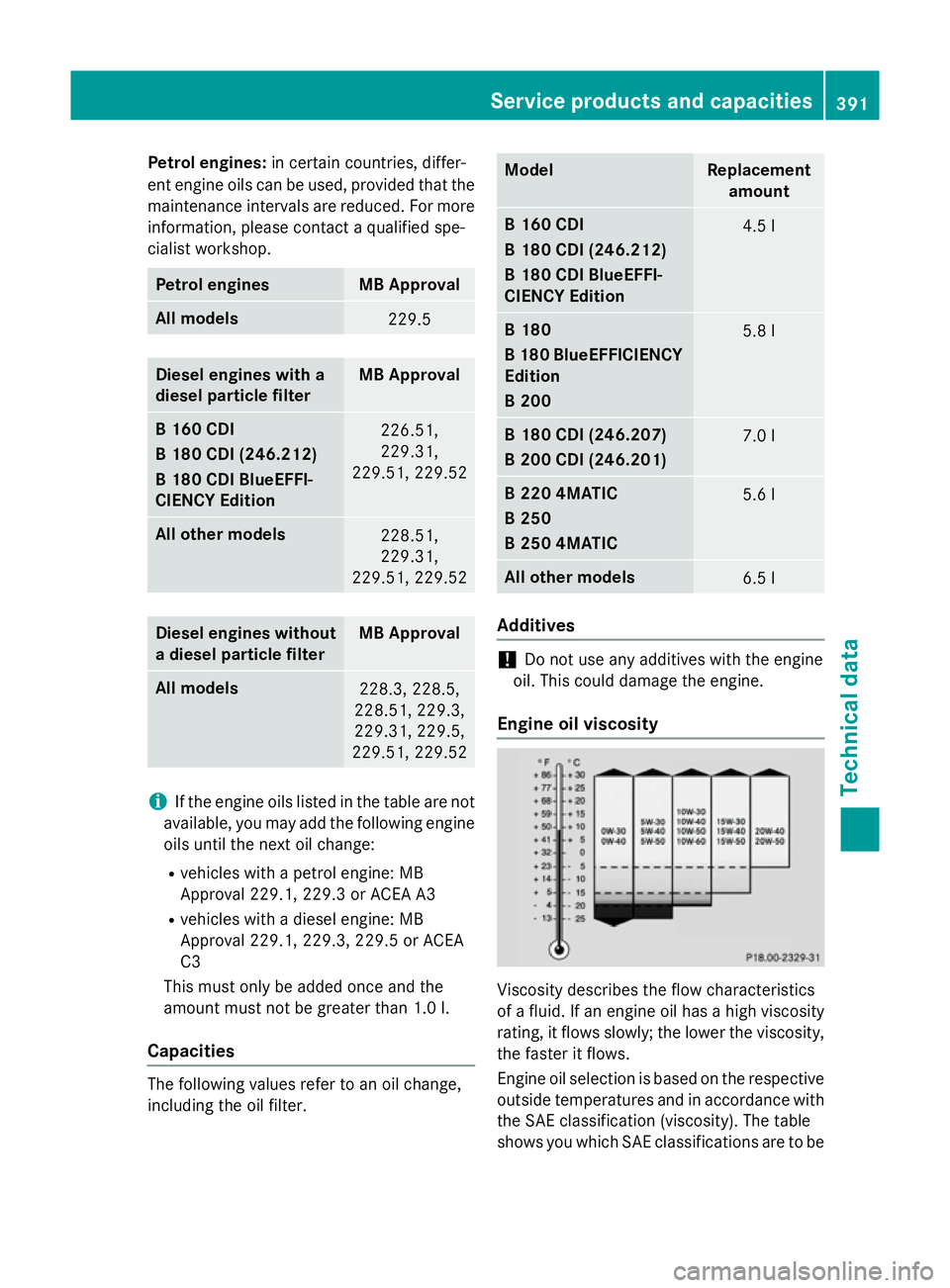
Engine oil viscosity Viscosity describes the flow characteristics
of a fluid. If an engine oil has a high viscosity
rating, it flows slowly; the lower the viscosity,
the faster it flows.
Engine oil selection is based on the respective outside temperatures and in accordance with
the SAE classification (viscosity). The table
shows you which SAE classifications are to be Service products and capacities
391Technical data Z
Page 395 of 405
used. The low-temperature properties of
engine oils can be significantly impaired dur-
ing operation due to, for example, ageing or
soot and fuel accretion. It is therefore
strongly recommended to observe regular oil changes using an approved engine oil with the
appropriate SAE classification. Brake fluid
G
WARNING
The brake fluid continuously absorbs mois-
ture from the air. This results in the boiling
point of the brake fluid lowering. If the boiling
point of the brake fluid is too low, vapour
pockets may form when the brakes are sub-
jected to a heavy load. This would impair brak- ing efficiency. There is a risk of an accident.
Have the brake fluid renewed at the prescri-
bed intervals.
When handling brake fluid, observe the
important safety notes on service products
(Y page 386).
The brake fluid change intervals can be found in the Service Booklet.
Only use brake fluid approved by Mercedes-
Benz according to MB Approval 331.0.
Information about approved brake fluid can
be obtained at any qualified specialist work-
shop or on the Internet at
http://bevo.mercedes-benz.co m.
i Have the brake fluid regularly replaced at
a qualified specialist workshop and the
replacement confirmed in the Service
Booklet. Coolant
Important safety notes G
WARNING
If antifreeze comes into contact with hot com- ponents in the engine compartment, it may
ignite. There is a risk of fire and injury. Let the engine cool down before you top up
the antifreeze. Make sure that antifreeze is
not spilled next to the filler neck. Thoroughly
clean the antifreeze from components before starting the engine.
! Only add coolant that has been premixed
with the desired antifreeze protection. You
could otherwise damage the engine.
Further information on coolants can be
found in the Mercedes-Benz Specifications for Service Products, MB Specifications for
Service Products 310.1, e.g. on the Inter-
net at http://bevo.mercedes-benz.com.
Or contact a qualified specialist workshop.
! Always use a suitable coolant mixture,
even in countries where high temperatures prevail.
Otherwise, the engine cooling system is not
sufficiently protected from corrosion and
overheating.
i Have the coolant regularly replaced at a
qualified specialist workshop and the
replacement confirmed in the Service
Booklet.
Comply with the important safety precautions for service products when handling coolant
(Y page 386).
The coolant is a mixture of water and anti-
freeze/corrosion inhibitor. It is responsible
for the following:
R anti-corrosion protection
R antifreeze protection
R raising the boiling point
If antifreeze/corrosion inhibitor is present in
the correct concentration, the boiling point of
the coolant during operation will be approx-
imately 130 †. 392
Service products and capacitiesTechnical data