dashboard MERCEDES-BENZ B-CLASS SPORTS 2014 Owners Manual
[x] Cancel search | Manufacturer: MERCEDES-BENZ, Model Year: 2014, Model line: B-CLASS SPORTS, Model: MERCEDES-BENZ B-CLASS SPORTS 2014Pages: 360, PDF Size: 39.45 MB
Page 9 of 360
Switching the rea
rwindow
defroster on/off ............................ 130
Switching the ZONE function on/
off .................................................. 129
Cockpit
Overview .......................................... 30
see Instrument cluster
COLLISIO NPREVENTION ASSIST
Activating/deactivating the
distance warning function .............. 200
Displa ymessage ............................ 208
Operation/notes .............................. 64
COLLISIO NPREVENTION ASSIST
PLUS Activating/deactivating .................201
Display message ............................ 215
Operation/notes .............................. 66
COMAND
see separate operating instructions
Combination switch ..........................106
Compass Calibrating ..................................... 277
Calling up ....................................... 276
Setting ........................................... 276
Consumptio nstatistic s(on -board
computer) .......................................... 194
Convenience closing feature ..............84
Convenience opening feature ............84
Coolan t(engine)
Checkin gthe level ......................... 283
Display message ............................ 224
Filling capacity ............................... 352
Important safety notes ..................351
Temperature gauge ........................ 190
Warning lamp ................................. 245
Cooling
see Climate control
Copyright ............................................. 27
Cornerin glight function
Changing bulbs .............................. 114
Display message ............................ 220
Function/notes ............................. 107
Crash-responsive emergency
lighting ............................................... 110
Cruis econtrol
Activatio ncondition s..................... 161
Cruise control leve r....................... 161Deactivating ................................... 162
Display message ............................ 230
Driving system ............................... 160
Function/notes ............................. 160
Important safety notes ..................161
Setting aspeed .............................. 162
Storing and maintaining current
speed ............................................. 161
Cup holder
Cente rconsole .............................. 262
Important safety notes ..................261
Rea rcompartmen t......................... 262
Customer Assistanc eCenter (CAC) ...25
Customer Relations Department .......25 D
Dashboard see Instrument cluster
Dashboard lighting
see Instrument cluster lighting
Data
see Technical data
Daytime runnin glamps
Display message ............................ 223
Switching on/off (on-board
computer) ...................................... 203
Switching on/off (switch) ..............105
Dealerships
see Qualified specialist workshop
Declarations of conformity ................. 24
Delaye dswitch-off
Exterio rlighting (on-board
computer )...................................... 204
Interior lighting .............................. 204
Diagnostic sconnection ...................... 24
Digital speedometer .........................195
DIRECT SELECTl ever
see Automatic transmission
Displa y(cleaning instructions) ........290
Display messages ASSYST PLUS ................................ 284
Calling up (on-board computer) .....207
Driving systems ............................. 226
Engine ............................................ 224
General notes ................................ 207
Hiding (on-board computer) ...........207
Lights ............................................ .220 Index
7
Page 31 of 360
Dashboard
........................................... 30
Instrument cluster ..............................31
Multifunction steering wheel .............33
Center console .................................... 34
Overhea dcontrol panel ...................... 36
Door control panel .............................. 37 29At
ag lance
Page 32 of 360
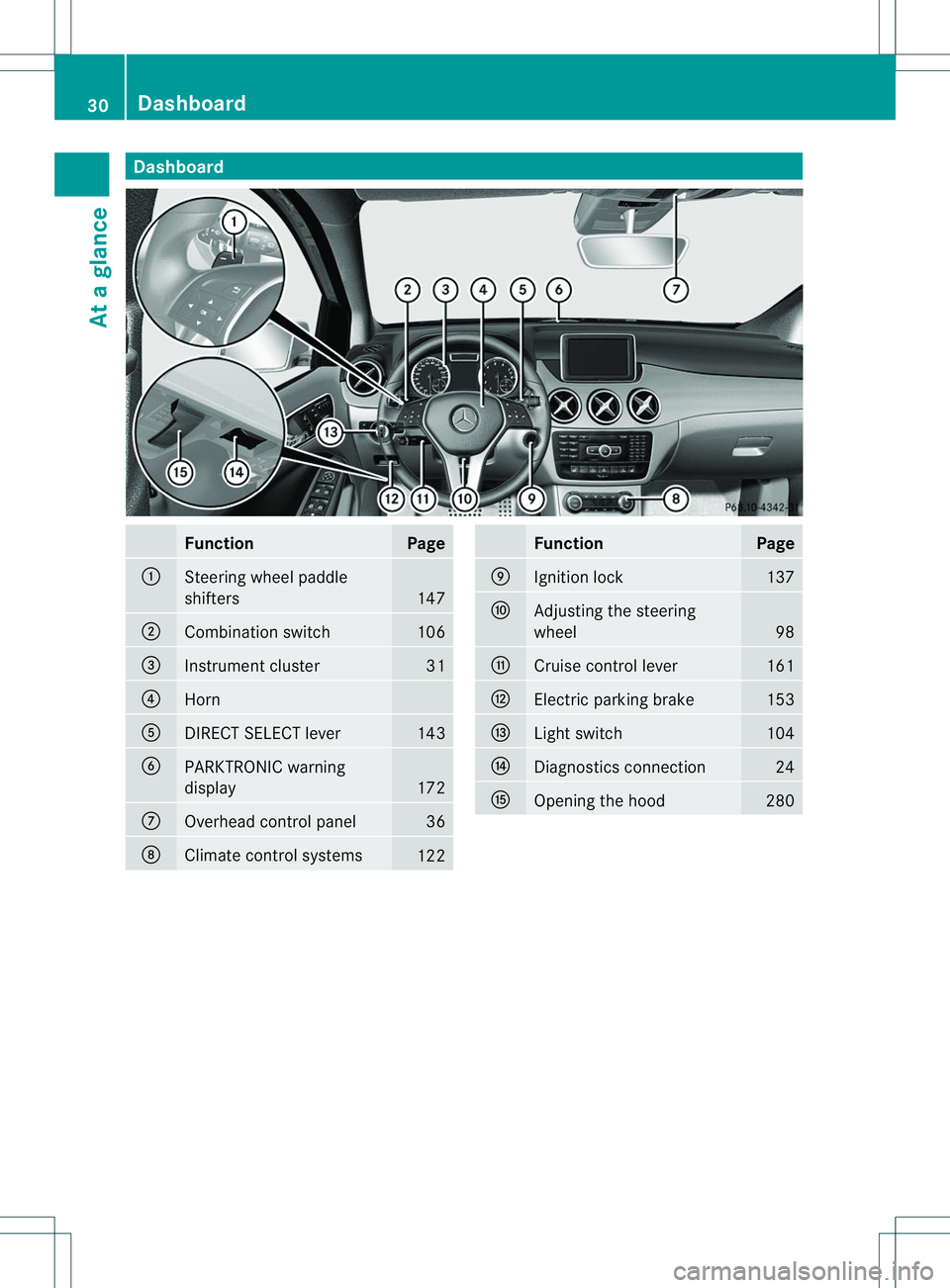
Dashboard
Function Page
001A
Steerin
gwhee lpaddle
shifters 147
0010
Combination switch 106
0023
Instrumen
tcluster 31
0021
Horn
001E
DIREC
TSELEC Tlever 143
0024
PARKTRONIC warning
display
172
0007
Overhead contro
lpanel 36
0008
Climat
econtrol systems 122 Function Page
0009
Ignition lock 137
0016
Adjustin
gthe steering
wheel 98
001D
Cruis
econtrol lever 161
0004
Electric parking brake 153
000B
Light switch 104
001C
Diagnostic
sconnection 24
000E
Opening th
ehood 28030
Dashboa
rdAtag lance
Page 44 of 360
decisive role in the deployment of an air bag,
nor do they provide an indication of air bag
deployment.
The vehicle may be deformed significantly,
e.g. the hood or the fender ,without an air bag
being deployed. This is the case if only parts
which are relatively easily deformed are
affected and the rate of deceleration is not
high. Conversely, air bags may be deployed
even though the vehicle suffers only minor
deformation. This is the case if, for example,
very rigid vehicle parts such as longitudinal
body members are hit, and sufficient
deceleration occurs as aresult.
i The fron tEmergenc yTensioning Devices
can only be triggered if the seat belt
tongues on the fron tseats are correctly
engaged in the seat belt buckles.
i Not all air bags are deployed in an
accident. The differen tair bag systems
work independently of each other.
How the air bag system work sis
determined by predictin gthe severity of
the accident ,especially vehicle
deceleration or acceleration, and the type
of accident:
R head-on collision
R side impact
R rollover
Safety guidelines for seat belts,
Emergency Tensioning Devices (ETDs)
and air bags G
WARNING
R Damaged seat belts or seat belts that have
been subjected to stress in an accident
must be replaced. Their anchorin gpoints
must also be checked. Only use seat belts
installed or supplied by an authorized
Mercedes-Ben zCenter.
R Air bags and pyrotechnic Emergency
Tensionin gDevices (ETDs) contain
perchlorat ematerial, which may require
special handlin gand regar dfor the environment. Check your national disposal
guidelines. In California, see
www.dtsc.ca.gov/HazardousWaste/
Perchlorate/index.cfm.
R Air bags and ETD sare designed to function
on aone-time-only basis. An air bag or ETD
that has deployed must be replaced.
R Do not pass seat belts over sharp edges.
They could tear.
R Do not make any modification that could
change the effectiveness of the seat belts.
R Do not bleach or dye seat belts ,asthis may
severely weaken them. In acrash, the ymay
not be able to provide adequate protection.
R Do not make any modifications to the SRS
wirin gorc omponents.
R Do not modif yorremove any components
or part softhe SRS.
R Do not install additional trim material, seat
covers, badges, etc .tothe:
- padded steering wheel boss
- knee bag covers
- front-passenger air bag cover
- outer side of front seat bolsters
- outer seat bolsters of the rear bench seat
backrest
- roof frame trim
R Do not install additional electrical/
electronic equipment on or near SRS
components and wiring.
R Keep the area between the air bags and
occupant sfree of object s(e.g. packages,
handbags, umbrellas etc.).
R Do not hang any objects such as coat
hangers on the coat hooks or the grab
handle above the door. These items may be
thrown around in the vehicle and cause
head and other injuries when the window
curtain air bag is deployed.
R Air bag system componentsw ill be hot after
an air bag has inflated. Do not touch them.
R Never rest your feet on the dashboard or
the seat. Always keep both feet on the floor
in fron tofthe seat. 42
Occupant safetySafety
Page 46 of 360
As the ai
rbag inflate swith considerable
spee dand force, aproper seating position
and correc tpositioning of th ehands on the
steering wheel will help to keep you at asafe
distanc efromt heair bag. Occupants who are
no tw earing their seat belt, are not seated
properly or are too close to the air bag can be
seriously injured or killed by an air bag, as it
inflates with great forc einstantaneously:
R sit with the seat belt fastened correctly and
in ap osition that is as upright as possible
with your back against the backrest.
R move the driver's seat as far back as
possible, still permitting proper operation
of vehicle controls. The distanc efrom the
center of the driver's chest to the center of
the air bag cover on the steerin gwheel
must be at least 10 inches (25 cm). You
should be able to accomplish this by
adjustin gthe seat and steerin gwheel. If
you have any difficulties, please contact an
authorized Mercedes-Benz Center.
R do not lean your head or chest close to the
steerin gwheel or dashboard.
R only hold the steerin gwheel on the outside.
Placing hands and arms inside the rim can
increase the risk and potential severit yof
hand/arm injury if the driver fron tair bag
inflates.
R adjust the front-passenger seat as far back
as possible from the dashboard when the
seat is occupied.
R occupants, especially children ,should
never place their bodies or lean their heads
in the area of the door where the side
impact air bag inflates .This could result in
serious or fatal injuries should the side
impact air bag be deployed. Always sit as
upright as possible, wear the seat belt
properly and use an appropriately sized
infant restraint,t oddler restraint or booster
seat recommended for the size and weight
of the child.
Failure to follow these instructions can result
in severe injuries to you or other occupants. If you sell your vehicle, it is important that you
make the buyer aware of this safety
information. Be sure to give the buyer this
Operator's Manual.
If the air bags are deployed, you will hear a
bang, and asmall amount of powder may also
be released. Only in rare cases will the bang
affect your hearing. The powder that is
released generally does not constitute a
health hazard and does not indicate that there
is af ire in the vehicle. The dust might cause
some temporary breathing difficulty for
people with asthma or other breathing
trouble. To avoid this, you may wish to get out
of the vehicle as soon as it is safe to do so.
You can also open the window to allow fresh
air to enter the vehicle interior. The 0021SRS
warning lamp lights up.
The air bag installation locations are
identified by the AIR BAG symbol.
The air bags are deployed if the air bag control
unit detects the need for deployment.O nly in
the event of such asituatio nwill the air bags
provide their supplemental protection.
If the drive rand front passenge rdonot wear
their seat belts, it is not possible for the air
bags to provide their supplemental
protection.
In the event of other types of impacts and
impacts below air bag deployment
thresholds, the air bags will not deploy. The
driver and passenger will then be protected
to the extentp ossible byaproperly fastened
seat belt. Aproperl yfastened seat beltisa lso
needed to provide the best possible
protection in arollover.
Air bags provide additional protection; they
are not, however, asubstitute for seat belts.
All vehicle occupants must fasten their seat
belts regardless of whether your vehicle is
equipped with air bags or not.
It is important for your safety and that of your
passenger to have deployed air bags replaced
and to have any malfunctioning air bags
repaired. This will help to make sure the air
bags continue to perform their protective 44
Occupant safetySafety
Page 55 of 360
bags, and ETDs) impact
swhich exceed
preset deployment thresholds and in
certain rollovers (window curtain air bags
and ETDs).
R Never wear the shoulder belt under your
arm, across your nec koroff yourshoulder.
In af rontal crash, your body would move
too far forward. That would increase the
chance of head and neck injuries. The seat
belt would also apply too much force to the
ribs or abdomen, which could severely
injure internal organs such as your liver or
spleen.
Adjust the seat belt so that the shoulder
section is located as close as possible to
the middle of the shoulder. It should not
touch the neck.N ever pass the shoulder
portion of the seat belt under your arm. For
this purpose, you can adjust the height of
the seat belt outlet.
R Position the lap belt as low as possible on
your hips and not across the abdomen. If
the lap belt is positioned across your
abdomen, it could cause serious injuries in
ac rash.
R Never wear seat belts over rigid or
breakable objects in or on your clothing,
such as eyeglasses, pens, keys etc., as
these might cause injuries.
R Make sure the seat belt is alway sfitted
snugly. Take special care of this when
wearing loose clothing.
R Never use aseat belt for more than one
person at atime. Do not fasten aseat belt
around aperson and another person or
other objects at the same time.
R Seat belts should not be worn twisted. In a
crash, you would not have the full width of
the seat belt to distribut eimpact forces.
The twisted seat belt against yourb ody
could cause injuries.
R Pregnant women should also alwaysu se a
lap-shoulder belt. The lap belt portion
should be positioned as low as possible on
the hips to avoid any possible pressure on
the abdomen. R
Place the seat backrest in aposition that is
as upright as possible.
R Check your seat belt during travel to make
sure it is properly positioned.
R Never place your feet on the instrument
panel, dashboard, or on the seat. Always
keep both feet on the floor in front of the
seat.
R When using aseat belt to secure infant
restraints, toddler restraints, or children in
booster seats, alwaysf ollow the child seat
manufacturer' sinstructions. G
WARNING
Do not pass seat belts over sharp edges. They
could tear.
Do not allow the seat belt to get caught in the
door or in the seat adjustment mechanism.
This could damage the seat belt.
Never attempt to make modifications to seat
belts. This could impair the effectiveness of
the seat belts.
Fastening seat belts G
WARNING
According to accident statistics, children are
safer when properly restrained on the rear
seats than on the front-passenger seat. Thus,
we strongly recommen dthat children be
placed in the rear seat whenever possible.
Regardless of seating position, children 12
years old and under must be seated and
properly secured in an appropriately sized
child restraint system or booster seat
recommended for the size and weight of the
child. For additional information, see the
"Children in the vehicle" section.
Ac hild's risk of serious or fatal injuries is
significantly increased if the child restraints
are not properly secured in the vehicle and/
or the child is not properly secured in the child
restraint. Occupant safety
53Safety Z
Page 61 of 360
If an infant or child is traveling in the vehicle:
R
Secure the child with achild or infant seat
restraint system appropriate to the age and
weight of the child.
R Make sure that the infant or child is
properl ysecured at all times whilet he
vehicle is in motion.
Mercedes-Benz recommends that you always
properl ysecure all infants and childre nwith
ac hild or infant seat restraint system for the
trip.
The use of seat belts and infant and child
restraint systems is require dbylaw in:
R all 50 states
R the U.S .territories
R the Distric tofColumbia
R all Canadia nprovinces
Infants and children must alwaysbes eated in
an appropriate infant or child restraint system
recommende dfor the size and weight of the
child .The infant or child restraint system
must be properly secured in accordance with
the manufacturer's instructions.
All infant or child restraint systems must meet
the following standards:
R U.S. Federal Motor Vehicle Safety
Standards 213 and 225
R CanadianM otor Vehicle Safety Standards
213 and 210.2
Confirmation that the child restraint system
corresponds to the standards can be found
on an instruction label on the child restraint
system. This confirmation can also be found
in the installation instructions that are
included with the child restraint system.
Always read and follow the manufacturer's
instructions when using an infant or child
restraint system or booster seat.
Observe the warning labels in the vehicle
interior or on the infant or child restraint. Child restraint system on the front-
passenger seat G
WARNING
If the front-passenger air bag is not disabled:
R ac hild secured in achild restraint system
on the front-passenger seat could be
seriously or even fatally injured by the front-
passenger air bag deploying. This is
especially arisk if the child is in the
immediate vicinit yofthe front-passenger
air bag when it deploys.
R never secure achild on the front-passenger
seat in arearward-facing child restraint
system. Only secure arearward-facing
child restraint system on asuitable rear
seat.
R alway smove the front-passenger seat to
the rearmost position if you secure achild
in af orward-facin gchild restraint system
on the front-passenger seat.
The front-passenger air bag is not disabled:
R on vehicles without an air bag deactivation
system on the front-passenger seat.
R on vehicles with an air bag deactivation
system on the front-passenger seat, unless
ac hild restraint system with transponders
for an air bag deactivation system is
installed on the front-passenger seat
R on vehicles with an air bag deactivation
system on the front-passenger seat, if the
PASSENGER AIR BAG OFF indicator lamp
000E is not lit.
To make you aware of this danger, a
corresponding warning sticker has been
affixed on the dashboard and on both sides of
the sun visor on the front-passenger side.
Information about recommended child
restraint systems is available at any
authorized Mercedes-Benz Center. Children in the vehicle
59Safety Z
Page 176 of 360
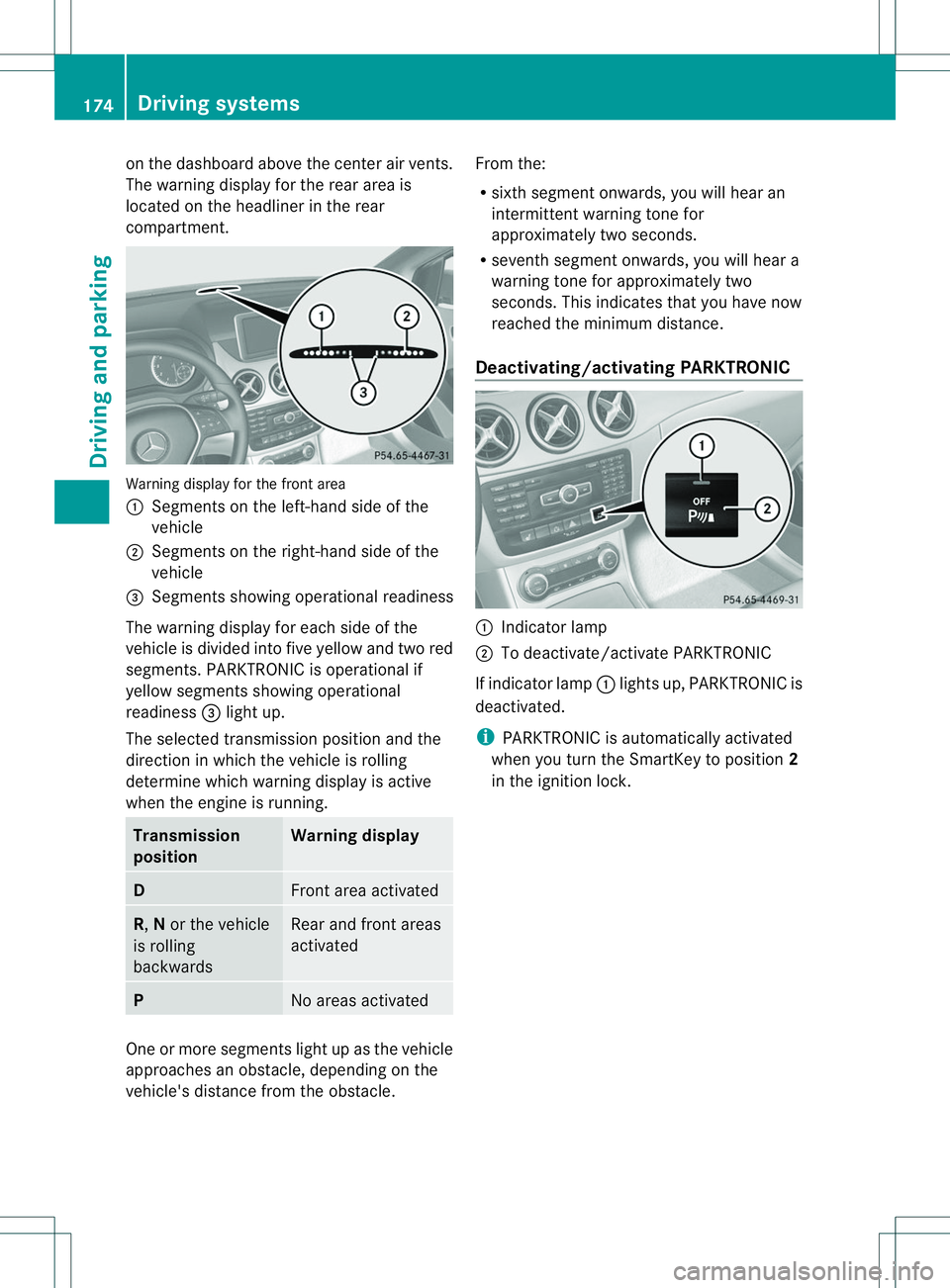
on the dashboard above the center air vents.
The warning display for the rear area is
located on the headliner in the rear
compartment. Warning display for the front area
001A
Segments on the left-hand side of the
vehicle
0010 Segments on the right-hand side of the
vehicle
0023 Segments showing operational readiness
The warning display for each side of the
vehicle is divided into five yellow and two red
segments. PARKTRONIC is operational if
yellow segment sshowing operational
readiness 0023light up.
The selected transmission position and the
direction in which the vehicle is rolling
determin ewhich warning display is active
when the engine is running. Transmission
position Warning display
D
Fronta
rea activated R,
Nor the vehicle
is rolling
backwards Rear and front areas
activated
P
No areas activated
One or more segment
slight up as the vehicle
approaches an obstacle, depending on the
vehicle's distance from the obstacle. From the:
R
sixth segment onwards, you will hear an
intermittentw arning tonefor
approximately two seconds.
R sevent hsegment onwards, you will hear a
warning tonef or approximately two
seconds. This indicates that you have now
reached the minimum distance.
Deactivating/activating PARKTRONIC 001A
Indicator lamp
0010 To deactivate/activate PARKTRONIC
If indicator lamp 001Alights up, PARKTRONIC is
deactivated.
i PARKTRONIC is automatically activated
when you turn the SmartKey to position 2
in the ignition lock. 174
Driving systemsDriving and parking