Head MERCEDES-BENZ C-Class 2000 W202 User Guide
[x] Cancel search | Manufacturer: MERCEDES-BENZ, Model Year: 2000, Model line: C-Class, Model: MERCEDES-BENZ C-Class 2000 W202Pages: 130, PDF Size: 2.43 MB
Page 75 of 130

Low Engine Coolant Level Warning Lamp
With the electronic key in steering lock position 2, the warning lamp comes on.
It should go out when the engine is running. If the warning la mp does not go out after starting the engine, or if it
comes on while driving, then the coolant level has dropped below the required level. If no leaks are noticeable and
the engine temperature does not increase, continue to driv e to the nearest service station and have coolant added to
the coolant system (see Index).
The low engine coolant level warning light should not be ignored. Extended driving with the light illuminated may
cause serious engine damage not covered by the Mercedes-Benz Limited Warranty.
In cases of major or frequent minor coolant loss, have t he cooling system checked at your authorized Mercedes-Benz
dealer as soon as possible.
Note:
Do not drive without coolant in the cooling system. T he engine will overheat causing major engine damage. Monitor
the coolant temperature gauge while driving.
Warning !
Do not spill antifreeze on hot engine parts. Antifreeze contains ethylene glycol which may burn if it comes into contact
with hot engine parts. You can be seriously burned.
Low Windshield and Headlamp Washer System Fluid Level Warning Lamp
With the electronic key in steering lock position 2, the warning lamp comes on. It should go out when the engine is
running. If the warning lamp does not go out after starting the engine, or if it comes on while driving, the level of the
reservoir has dropped to approx.1/4 of the total volume. T he reservoir should be refilled with MB Windshield Washer
Concentrate "S" and water (or commercially available premixed windshield washer solvent/antifreeze, depending on
ambient temperature - see Index) at the next opportunity. The reservoir fo r the windshield and headlamp washer
systems is located in the engine compartment.
Page 76 of 130

Exterior Lamp Failure indicator Lamp
With the electronic key in steering lock position 2, an exterior lamp comes on. It should go out when the engine is
running. If the warning lamp does not go out after starting the engine, or if it comes on while driving, this lamp
indicates a failure in the parking lamp, taillamp, stop la mp, or low beam headlamp. If an exterior lamp fails, the
indicator lamp will come on only when that lamp is switched on. If a brake lamp fails, the lamp failure indicator will
come on when applying the brake and stay on until the engine is turned off.
Note:
If additional lighting equipment is installed (e.g. auxiliary headl amps etc.) be certain to connect into the fuse before
the failure indicator monitoring unit in order to avoid damaging the system.
Brake Pad Wear Indicator Lamp
With the electronic key in steering lock position 2, the brake pad wear indicator lamp comes on .
It goes out when the engine is running.
If the indicator lamp lights up during braking, this indica tes that the brake pads are worn down. Have the brake
system checked at your authorized Mercedes- Benz dealer as soon as possible.
Brake Warning Lamp
With the electronic key in steering lock position 2, the brake warning lamp will come on. It should go out when the
engine is running. The brake warning lamp will come on:
• when there is insufficient brake fluid in the rese rvoir (engine running and parking brake released), or
• when the parking brake is set (engine running).
Warning !
Driving with the brake warning lamp illuminated can result in an accident. Have your brake system checked
immediately if the brake warning lamp stays on. Don't add brake fluid before checking the brake system.
Overfilling the brake fluid reservoir can result in sp illing brake fluid on hot engine parts and the brake fluid
catching fire. You can be seriously burned.
If you find that the minimum mark on the brake fluid reserv oir is reached, have the brake system checked for brake
pad thickness and leaks. To test the brake warning lamp, turn electronic key in steering lock to position 2. The brake
warning lamp comes on, and should go out when the engine is running.
Page 84 of 130

Winter Driving
Have your car winterized at your authorized Mercedes-Benz dealer before the onset of winter.
• Change the engine oil if the engine contains an oil which is not approved for winter operation.
For viscosity (SAE/CCMC class) and filling quantity, see Capacities: Fuels, Coolants,
Lubricants etc. in Index.
• Check engine coolant anticorr osion/antifreeze concentration.
• Additive for the windshield washer and headl amp cleaning system: Add MB Concentrate "S"
to a premixed windshield washer solvent/ant ifreeze which is formulated for below freezing
temperatures (see Index).
• Test battery: Battery capacity drops with dec reasing ambient temperature. A well charged
battery helps to ensure that the engine can be started, even at low ambient temperatures.
• Tires: We recommend M+S rated radial-ply tires on all four wheels for the winter season.
Observe permissible maximum speed for M+S rated radial-ply tires and the legal speed limit.
Note:
In winter operation, the maximum effectiveness of the Antilock Brake System (ABS), Acceleration Slip Regulation
(ASR) or the Electronic Stab ility Program (ESP) can only be achieved with M+S rated radial-ply tires and/or snow
chains recommended by Mercedes-Benz. Snow chains maximize performance.
Snow Chains
Use only snow chains that are tested and recommended by Mercedes-Benz. Your authorized Mercedes-Benz
dealer will be glad to advise you on this subject. Ch ains should only be used on the rear wheels.
Follow the manufacturer's mounting instructions. Snow ch ains should only be driven on snow covered roads at
speeds not to exceed 30 mph (50 km/h). Remove chains as soon as possible when driving on roads without snow.
For tips on driving on slippery winter roads, refer to In dex. Vehicles with Acceleration Slip Regulation (ASR) or
Electronic Stability Program (ESP): When driving with snow chains, press the ASR or ESP control switch, refer to
Index.
Model C 43 AMG
Important !
Use of snow chains is permissible only on winter tire size 215/45 R 17 H M+S. Refer to "Rims - Tires" in section
"Technical Data" (see Index).
Travelling Abroad
Abroad, there is a widely-spread Mercedes-Benz service network at your disposal. If you plan to travel into areas
which are not listed in the index of your dealer directory, you should request pertinent information from your
authorized Mercedes-Benz dealer.
Page 96 of 130
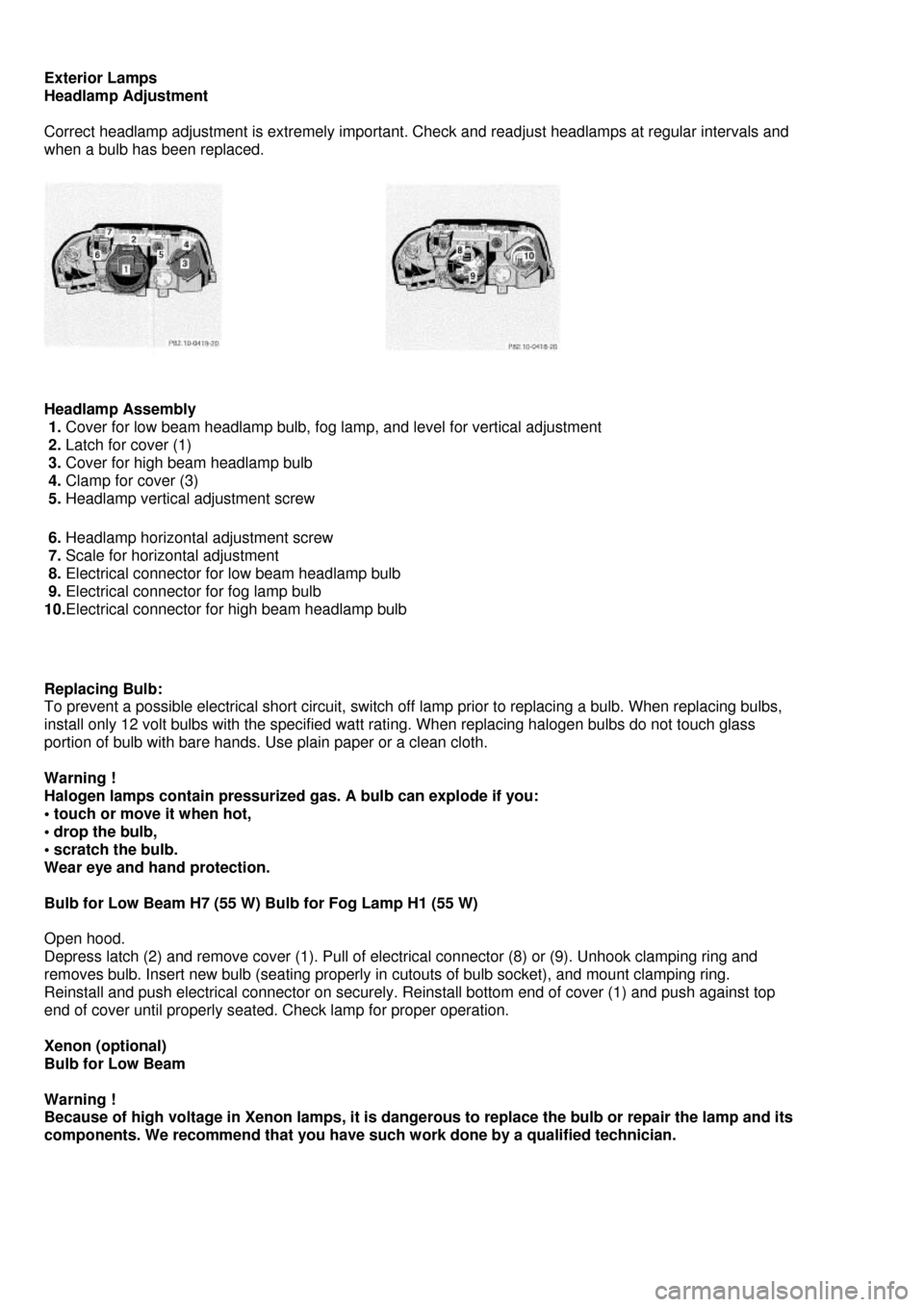
Exterior Lamps
Headlamp Adjustment
Correct headlamp adjustment is extremely important. Check and readjust headlamps at regular intervals and
when a bulb has been replaced.
Headlamp Assembly
1. Cover for low beam headlamp bulb, fog lamp, and level for vertical adjustment
2. Latch for cover (1)
3. Cover for high beam headlamp bulb
4. Clamp for cover (3)
5. Headlamp vertical adjustment screw
6. Headlamp horizontal adjustment screw
7. Scale for horizontal adjustment
8. Electrical connector for low beam headlamp bulb
9. Electrical connector for fog lamp bulb
10.Electrical connector for high beam headlamp bulb
Replacing Bulb:
To prevent a possible electrical short circuit, switch off lamp prior to replacing a bulb. When replacing bulbs,
install only 12 volt bulbs with the specified watt rating. When replacing halogen bulbs do not touch glass
portion of bulb with bare hands. Use plain paper or a clean cloth.
Warning !
Halogen lamps contain pressurized gas. A bulb can explode if you:
• touch or move it when hot,
• drop the bulb,
• scratch the bulb.
Wear eye and hand protection.
Bulb for Low Beam H7 (55 W) Bulb for Fog Lamp H1 (55 W)
Open hood.
Depress latch (2) and remove cover (1). Pull of electrical connector (8) or (9). Unhook clamping ring and
removes bulb. Insert new bulb (seating properly in cutouts of bulb socket), and mount clamping ring.
Reinstall and push electrical connector on securely. Reinstall bottom end of cover (1) and push against top
end of cover until properly seated. Check lamp for proper operation.
Xenon (optional)
Bulb for Low Beam
Warning !
Because of high voltage in Xenon lamps, it is dangerous to replace the bulb or repair the lamp and its
components. We recommend that you have such work done by a qualified technician.
Page 98 of 130
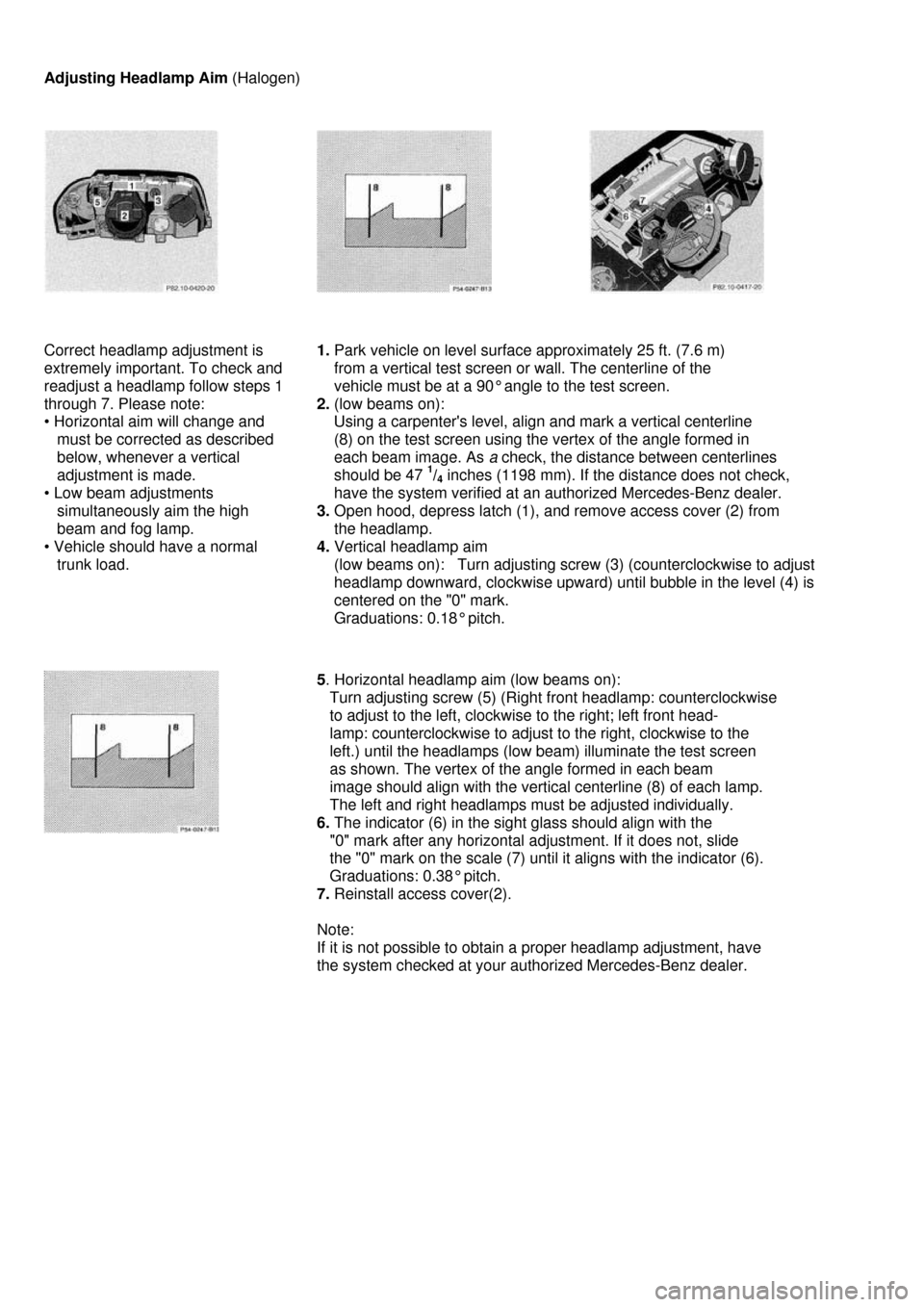
Adjusting Headlamp Aim (Halogen)
Correct headlamp adjustment is
extremely important. To check and
readjust a headlamp follow steps 1
through 7. Please note:
• Horizontal aim will change and
must be corrected as described
below, whenever a vertical
adjustment is made.
• Low beam adjustments
simultaneously aim the high
beam and fog lamp.
• Vehicle should have a normal
trunk load.
1. Park vehicle on level surface approximately 25 ft. (7.6 m)
from a vertical test screen or wall. The centerline of the
vehicle must be at a 90° angle to the test screen.
2. (low beams on):
Using a carpenter's level, align and mark a vertical centerline
(8) on the test screen using the vertex of the angle formed in
each beam image. As a check, the distance between centerlines
should be 47 1/4 inches (1198 mm). If the distance does not check,
have the system verified at an authorized Mercedes-Benz dealer.
3. Open hood, depress latch (1), and remove access cover (2) from
the headlamp.
4. Vertical headlamp aim
(low beams on): Turn adjusting screw (3) (counterclockwise to adjust
headlamp downward, clockwise upward) until bubble in the level (4) is
centered on the "0" mark.
Graduations: 0.18° pitch.
5. Horizontal headlamp aim (low beams on):
Turn adjusting screw (5) (Right front headlamp: counterclockwise
to adjust to the left, clockwise to the right; left front head-
lamp: counterclockwise to adjust to the right, clockwise to the
left.) until the headlamps (low beam) illuminate the test screen
as shown. The vertex of the angle formed in each beam
image should align with the vertical centerline (8) of each lamp.
The left and right headlamps must be adjusted individually.
6. The indicator (6) in the sight glass should align with the
"0" mark after any horizontal adjustment. If it does not, slide
the "0" mark on the scale (7) until it aligns with the indicator (6).
Graduations: 0.38° pitch.
7. Reinstall access cover(2).
Note:
If it is not possible to obtain a proper headlamp adjustment, have
the system checked at your authorized Mercedes-Benz dealer.
Page 99 of 130
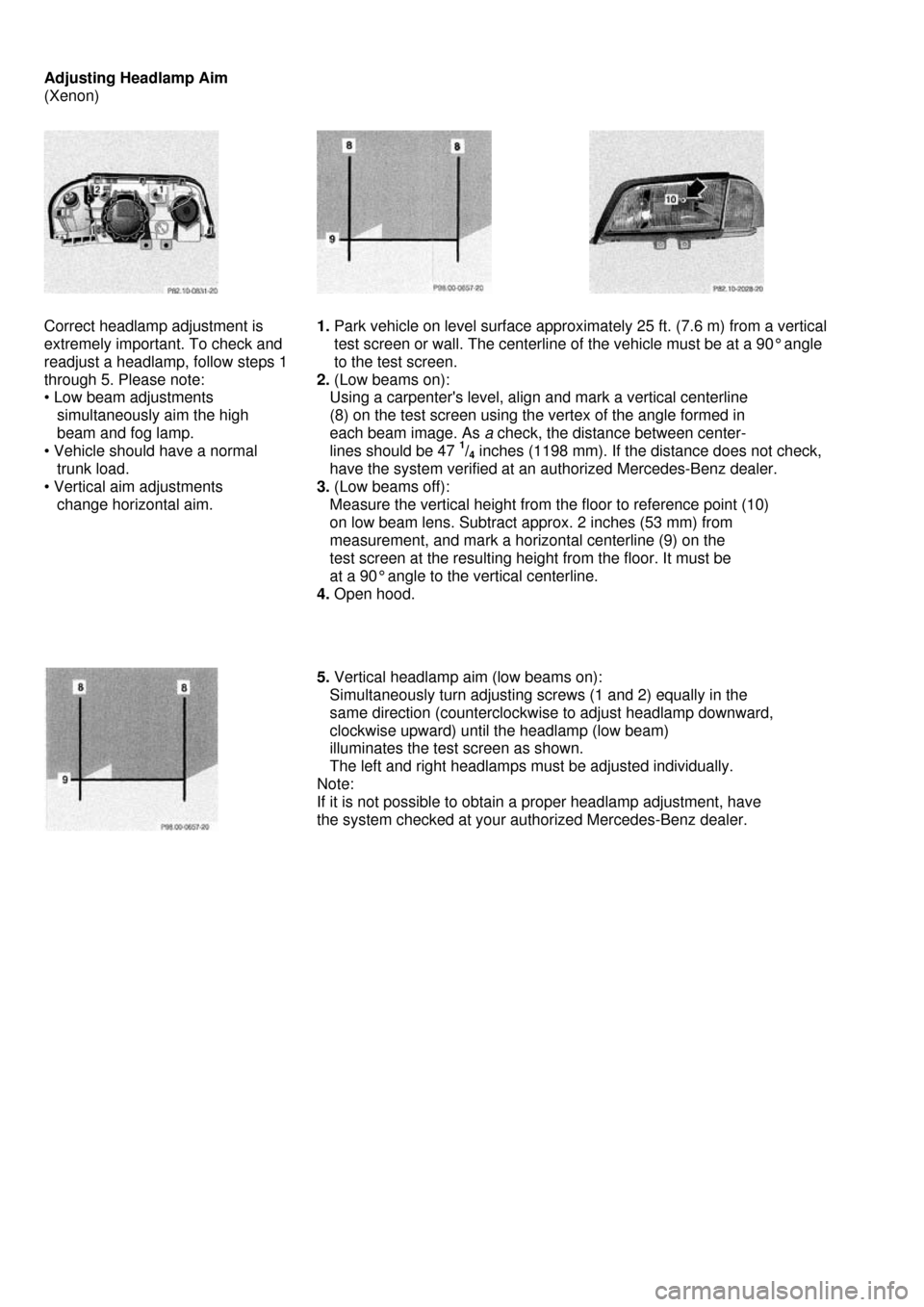
Adjusting Headlamp Aim
(Xenon)
Correct headlamp adjustment is
extremely important. To check and
readjust a headlamp, follow steps 1
through 5. Please note:
• Low beam adjustments
simultaneously aim the high
beam and fog lamp.
• Vehicle should have a normal
trunk load.
• Vertical aim adjustments
change horizontal aim.
1. Park vehicle on level surface approximately 25 ft. (7.6 m) from a vertical
test screen or wall. The centerline of the vehicle must be at a 90° angle
to the test screen.
2. (Low beams on):
Using a carpenter's level, align and mark a vertical centerline
(8) on the test screen using the vertex of the angle formed in
each beam image. As a check, the distance between center-
lines should be 47 1/4 inches (1198 mm). If the distance does not check,
have the system verified at an authorized Mercedes-Benz dealer.
3. (Low beams off):
Measure the vertical height from the floor to reference point (10)
on low beam lens. Subtract approx. 2 inches (53 mm) from
measurement, and mark a horizontal centerline (9) on the
test screen at the resulting height from the floor. It must be
at a 90° angle to the vertical centerline.
4. Open hood.
5. Vertical headlamp aim (low beams on):
Simultaneously turn adjusting screws (1 and 2) equally in the
same direction (counterclockwise to adjust headlamp downward,
clockwise upward) until the headlamp (low beam)
illuminates the test screen as shown.
The left and right headlamps must be adjusted individually.
Note:
If it is not possible to obtain a proper headlamp adjustment, have
the system checked at your authorized Mercedes-Benz dealer.
Page 101 of 130

Battery
Warning !
Failure to follow these instructions can result in severe injury or death. Never lean over batteries while
connecting, you might get injured. Battery fluid contains sulfuric acid. Do not allow this fluid to come in
contact with eyes, skin or clothing. In case it does, immediately flush affected area with water and seek
medical help if necessary. A battery will also produ ce hydrogen gas, which is flammable and explosive.
Keep flames or sparks away from battery, avoid im proper connection of jumper cables, smoking etc..
Important !
Battery maintenance information:
The battery is located in the trunk under the trunk floor. The fluid level must be checked at every A and B service.
Always insure that the fluid level is at the specified maximum level and that only distilled water is used. Failure to
maintain proper fluid level may result in cell deterioration and possible battery rupture. The service life of the battery is
dependent on its condition of charge. The battery should alwa ys be kept sufficiently charged, in order to last an
optimum length of time.
Therefore, we strongly recommend that you have the battery charge checked frequently, and corrected if
necessary, especially if you use the vehicle less than approximately 200 miles (300 km) per month, mostly for
short distance trips, or if it is not used for long periods of time.
Only charge a battery with a battery charger after the battery has been disconnected from the vehicle electrical circuit.
Always disconnect the battery negative lead first and connect last. When removing and connecting the battery,
always make sure that all electrical consumers are off and the electronic key is in steering lock position 0. The battery
and its vent tube must always be securely installed when the car is in operation. While the engine is running the
battery terminal clamps must not be loosened or detached, otherwise the generator and other electronic components
would be damaged.
Note:
After reconnecting the battery also resynchronize the Express feature of the power windows, the
sliding/pop-up roof, and the Electronic Stability Program (ESP) (see Power seats, front, Head
restraints, Power windows, Sliding/pop-up roof, and Electronic stability program in Index).
Battery Recycling
Batteries contain materials that can harm the environment with improper disposal. Large 12 Volt storage batteries
contain lead. Recycling of batteries is the preferred method of disposal. Many states require sellers of batteries to
accept old batteries for recycling.
Page 107 of 130

Wiper Blade
Clean the wiper blade rubber with a clean cloth and detergent solution. Replace blade twice a year;
once before and once after winter.
Headlamp Cleaning System
The condition of the wiper blades is important fo r satisfactory cleaning of the headlamp lenses.
We therefore recommend that the blades be insp ected regularly. Replace damaged wiper blades.
Paintwork. Painted Body Components
Mercedes-Benz approved Paint Care should be a pplied when water drops on the paint surface do
not "bead up"; normally in 3 to 5 months, depending on climate and washing detergent used.
Mercedes-Benz approved Paint Cleaner should be ap plied if paint surface shows signs of dirt
embedding
(i.e. loss of gloss).
Do not apply any of these products or wax if your car is parked in the sun or if the hood is still hot.
Use the appropriate MB-Touch-Up Stick for quick and provisional repairs of minor paint damage
(i.e. chips from stones, car doors etc.).
Seat Belts
The webbing must not be treated with chemical cleaning agents. Use only clear, lukewarm water
and soap. Do not dry the webbing at temperatures above 176°F (80°C) or in direct sunlight.
Warning !
Do not bleach or dye seat belts as this may severely weaken them. In a crash they
may not be able to provide adequate protection.
Hard Plastic Trim Items
Pour Mercedes-Benz approved Interior Care onto so ft lint-free cloth and apply with light pressure.
Headliner and Shelf below Rear Window
Clean with soft bristle brush, or use a dry- shampoo cleaner in case of excessive dirt.
Plastic and Rubber Parts
Do not use oil or wax on these parts.
Steering Wheel and Gear Selector Lever
Wipe with a damp cloth and dry thoroughly or clean with Mercedes-Benz approved Leather Care.
Light Alloy Wheels
Mercedes-Benz approved Wheel Care should be used for regular cleaning of the light alloy wheels.
If possible, clean wheels once a week with Merc edes-Benz approved Wheel Care, using a soft
bristle brush and a strong spray of water. Follow instructions on container.
Note:
Use only acid-free cleaning materials. The acid could lead to corrosion.
Ornamental Moldings
For regular cleaning and care of very dirty chrome-plated parts, use a chrome cleaner.
Page 110 of 130
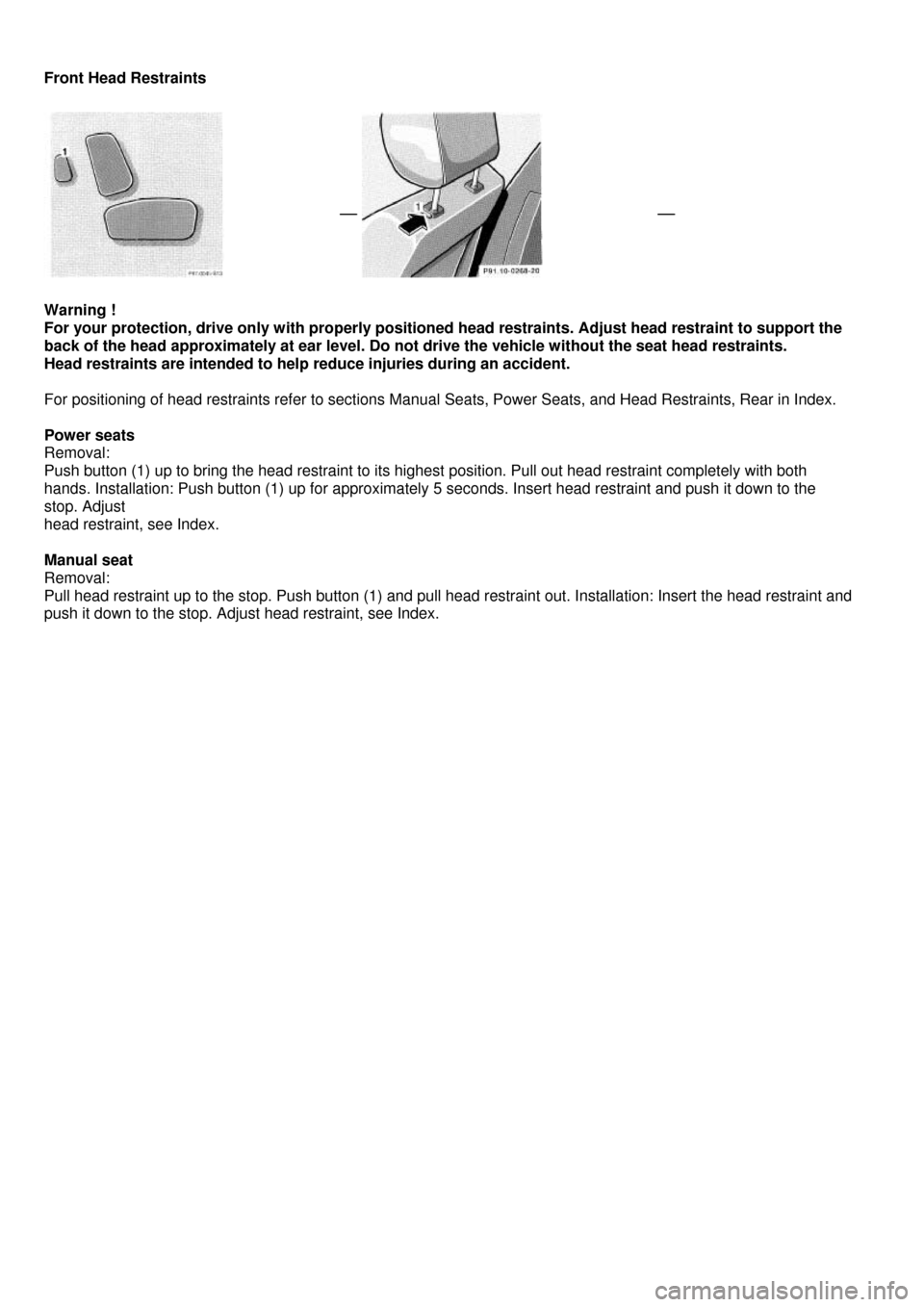
Front Head Restraints
Warning !
For your protection, drive only with properly positioned head restraints. Adjust head restraint to support the
back of the head approximately at ear level. Do not drive the vehicle without the seat head restraints.
Head restraints are intended to help reduce injuries during an accident.
For positioning of head restraints refer to sections Manual Seats, Power Seats, and Head Restraints, Rear in Index.
Power seats
Removal:
Push button (1) up to bring the head restraint to its highest position. Pull out head restraint completely with both
hands. Installation: Push button (1) up for approximately 5 seconds. Insert head restraint and push it down to the
stop. Adjust
head restraint, see Index.
Manual seat
Removal:
Pull head restraint up to the stop. Push button (1) and pull head restraint out. Installation: Insert the head restraint and
push it down to the stop. Adjust head restraint, see Index.
Page 112 of 130
Replacing Wiper Blade Insert
For safety reasons, remove electronic key from steering lock before replacing the wiper blade, otherwise the motor
can suddenly turn on and cause injury.
Notes:
Do not open engine hood with wiper arm folded forward. Do not allow the wiper arm to contact the windshield glass
without a wiper blade inserted. The glass may be scratched or broken. Make certain that the wiper blade is properly
installed. An improperly installed blade may cause windshield damage.
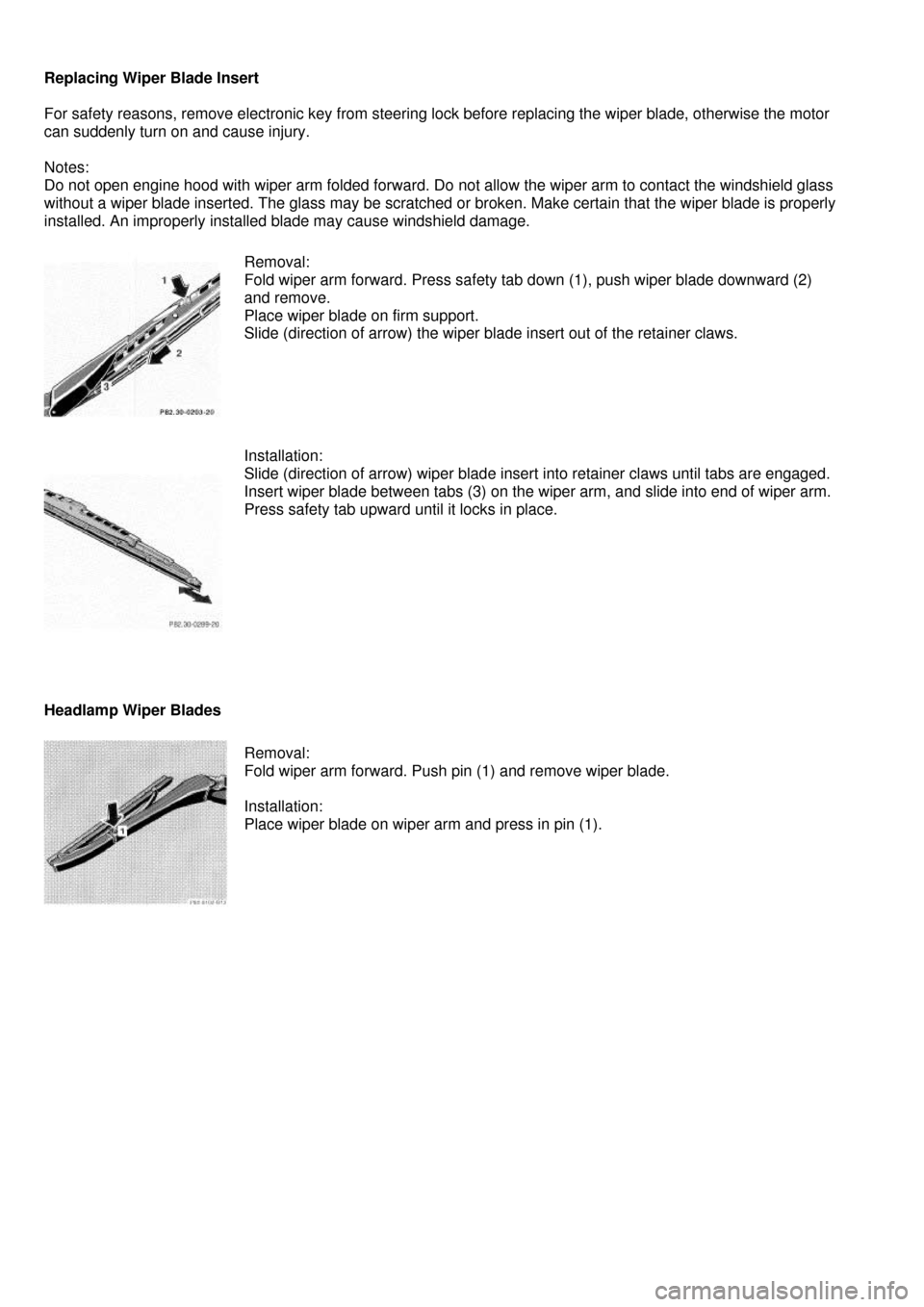
Removal:
Fold wiper arm forward. Press safety tab down (1), push wiper blade downward (2)
and remove.
Place wiper blade on firm support.
Slide (direction of arrow) the wiper blade insert out of the retainer claws.
Installation:
Slide (direction of arrow) wiper blade insert into retainer claws until tabs are engaged.
Insert wiper blade between tabs (3) on the wiper arm, and slide into end of wiper arm.
Press safety tab upward until it locks in place.
Headlamp Wiper Blades
Removal:
Fold wiper arm forward. Push pin (1) and remove wiper blade.
Installation:
Place wiper blade on wiper arm and press in pin (1).