Head MERCEDES-BENZ C-Class 2000 W202 Owner's Guide
[x] Cancel search | Manufacturer: MERCEDES-BENZ, Model Year: 2000, Model line: C-Class, Model: MERCEDES-BENZ C-Class 2000 W202Pages: 130, PDF Size: 2.43 MB
Page 122 of 130
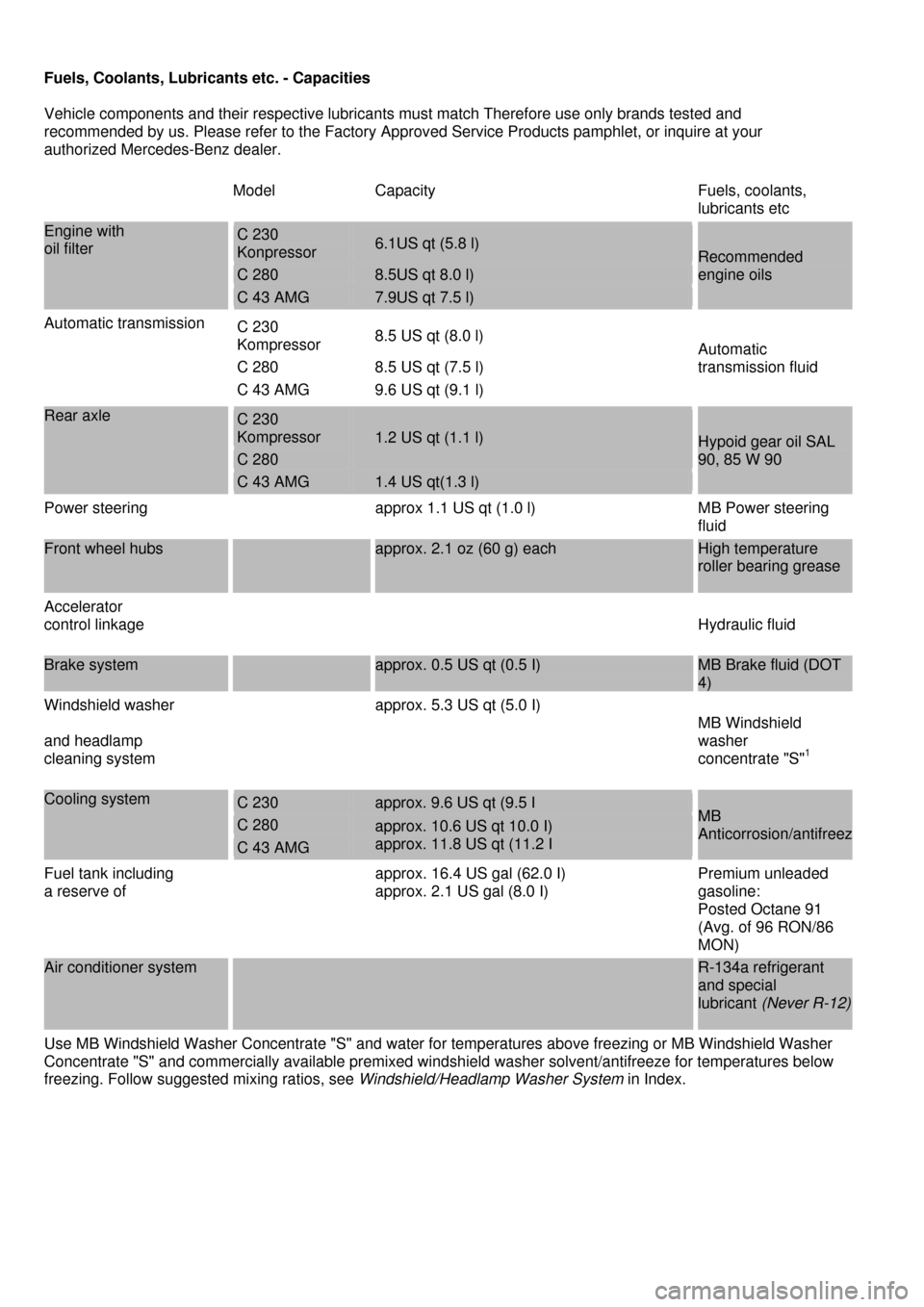
Fuels, Coolants, Lubricants etc. - Capacities
Vehicle components and their respective lubricants must match Therefore use only brands tested and
recommended by us. Please refer to the Factory Approv ed Service Products pamphlet, or inquire at your
authorized Mercedes-Benz dealer.
Model Capacity Fuels, coolants,
lubricants etc
Engine with
oil filter C 230
Konpressor 6.1US qt (5.8 l)
C 280 8.5US qt 8.0 l)
C 43 AMG 7.9US qt 7.5 l)
Recommended
engine oils
Automatic transmission C 230
Kompressor 8.5 US qt (8.0 l)
C 280 8.5 US qt (7.5 l)
C 43 AMG 9.6 US qt (9.1 l)
Automatic
transmission fluid
Rear axle C 230
Kompressor
C 280
1.2 US qt (1.1 l)
C 43 AMG 1.4 US qt(1.3 l)
Hypoid gear oil SAL
90, 85 W 90
Power steering approx 1.1 US qt (1.0 l) MB Power steering
fluid
Front wheel hubs
approx. 2.1 oz (60 g) each High temperature
roller bearing grease
Accelerator
control linkage
Hydraulic fluid
Brake system approx. 0.5 US qt (0.5 I) MB Brake fluid (DOT
4)
Windshield washer
and headlamp
cleaning system
approx. 5.3 US qt (5.0 I)
MB Windshield
washer
concentrate "S"
1
Cooling system C 230 approx. 9.6 US qt (9.5 I
C 280
C 43 AMG
approx. 10.6 US qt 10.0 I)
approx. 11.8 US qt (11.2 I
MB
Anticorrosion/antifreez
Fuel tank including
a reserve of
approx. 16.4 US gal (62.0 I)
approx. 2.1 US gal (8.0 I) Premium unleaded
gasoline:
Posted Octane 91
(Avg. of 96 RON/86
MON)
Air conditioner system
R-134a refrigerant
and special
lubricant (Never R-12)
Use MB Windshield Washer Concentrate "S" and water for temperatures above freezing or MB Windshield Washer
Concentrate "S" and commercially available premixed windsh ield washer solvent/antifreeze for temperatures below
freezing. Follow suggested mixing ratios, see Windshield/Headlamp Washer System in Index.
Page 126 of 130

Consumer Information
This has been prepared as required of all manufacturers of passenger cars under Title 49, Code of U.S. Federal
Regulations, Part 575 pursuant to the "National Traffic and Motor Vehicle Safety Act of 1966".
Uniform Tire Quality Grading
Refer to the tire sidewall for the specific tire grades for t he tires with which this vehicle is equipped. All passenger car
tires must conform to federal safety requirements in addition to these grades.
Treadwear
The treadwear grade is a comparative rating based on t he wear rate of the tire when tested under controlled
conditions on a specified government test course. For ex ample, a tire graded 150 would wear one and one-half (11/2)
times as well on the government course as a tire grad ed 100. The relative performance of tires depends upon the
actual conditions of their use, however, and may depart signi ficantly from the norm due to variations in driving habits,
service practices and differences in road characteristics and climate.
Traction
The traction grades, from highest to lowest, are AA, A, B, and C, Those grade represent the tire's ability to stop on
wet pavement as measured under controlled conditions on specified government test surfaces of asphalt and
concrete. A tire marked "C" ma y have poor traction performance.
Warning !
The traction grade assigned to this tire is based on straight-ahead braking traction tests and does not
include cornering, hydroplaning or peak traction characteristics.
Temperature
The temperature grades are A (the highest), B, and C, representing the tire's resistance to the generation of heat and
its ability to dissipate heat when tested under controlled conditions on a specified indoor laboratory test wheel.
Sustained high temperature can cause the material of the tire to degenerate and reduce tire life, and excessive
temperature can lead to sudden tire failure. The grade C co rresponds to a level of performance which all passenger
car tires must meet under the Federal Motor Vehicle Safety Standard No.109. Grades B and A represent higher
levels of performance on the laboratory test wheel than the minimum required by law.
Warning !
The temperature grade for this tire is established for a tire that is properly inflated and not overloaded.
Excessive speed, underinflation, or excessive loading, either separately or in combination, can cause
excessive heat build up and possible tire failure.
Page 130 of 130
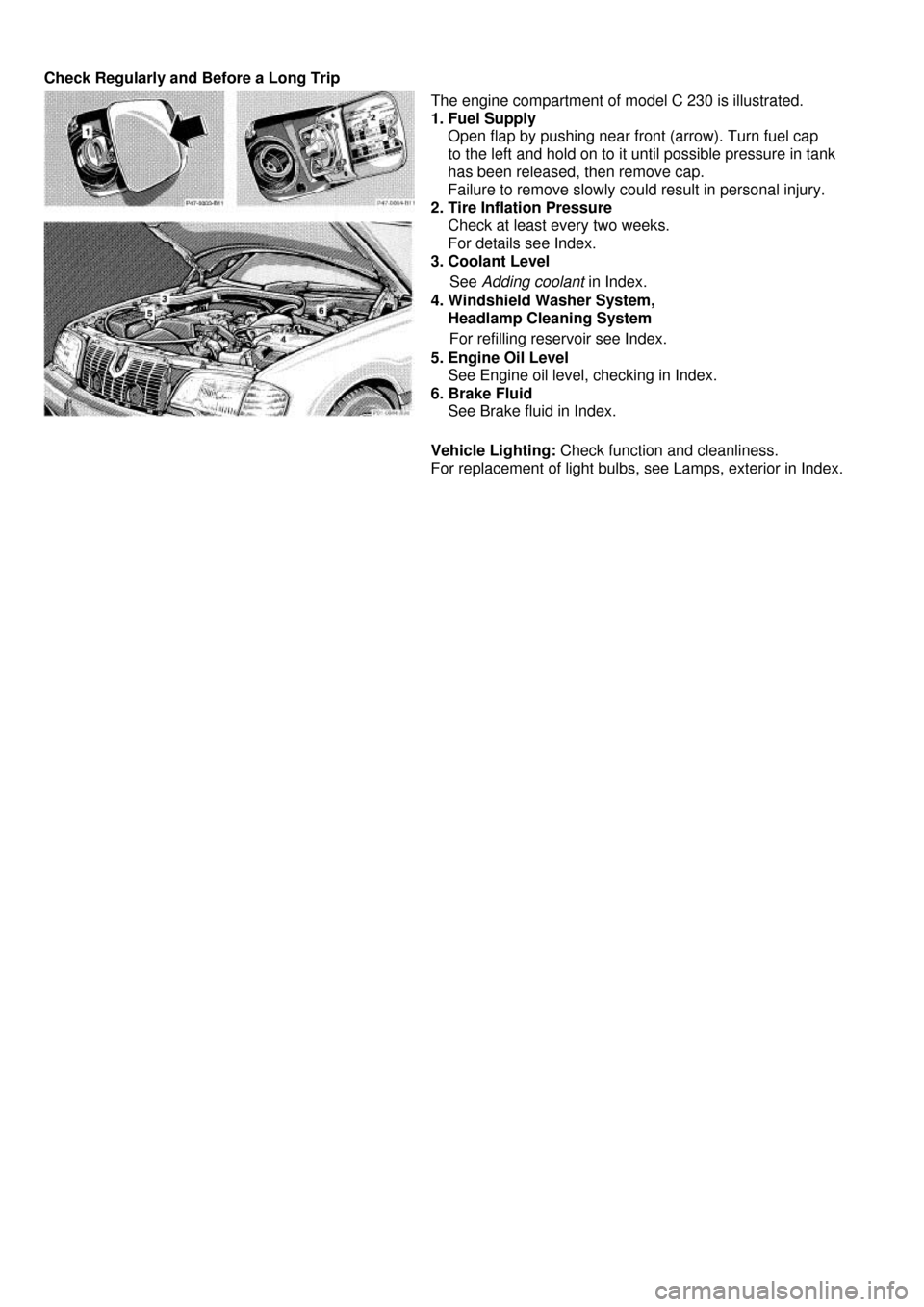
Check Regularly and Before a Long Trip
The engine compartment of model C 230 is illustrated.
1. Fuel Supply
Open flap by pushing near front (arrow). Turn fuel cap
to the left and hold on to it until possible pressure in tank
has been released, then remove cap.
Failure to remove slowly could result in personal injury.
2. Tire Inflation Pressure
Check at least every two weeks.
For details see Index.
3. Coolant Level
See Adding coolant in Index.
4. Windshield Washer System,
Headlamp Cleaning System
For refilling reservoir see Index.
5. Engine Oil Level
See Engine oil level, checking in Index.
6. Brake Fluid
See Brake fluid in Index.
Vehicle Lighting: Check function and cleanliness.
For replacement of light bulbs, see Lamps, exterior in Index.