light MERCEDES-BENZ C-CLASS 2002 Repair Manual
[x] Cancel search | Manufacturer: MERCEDES-BENZ, Model Year: 2002, Model line: C-CLASS, Model: MERCEDES-BENZ C-CLASS 2002Pages: 399, PDF Size: 16.95 MB
Page 309 of 399
306
Malfunction and warning messages
Te ch n i c a l
data
Instruments
and controls Operation Driving
Instrument
cluster display Practical hints Car care Index
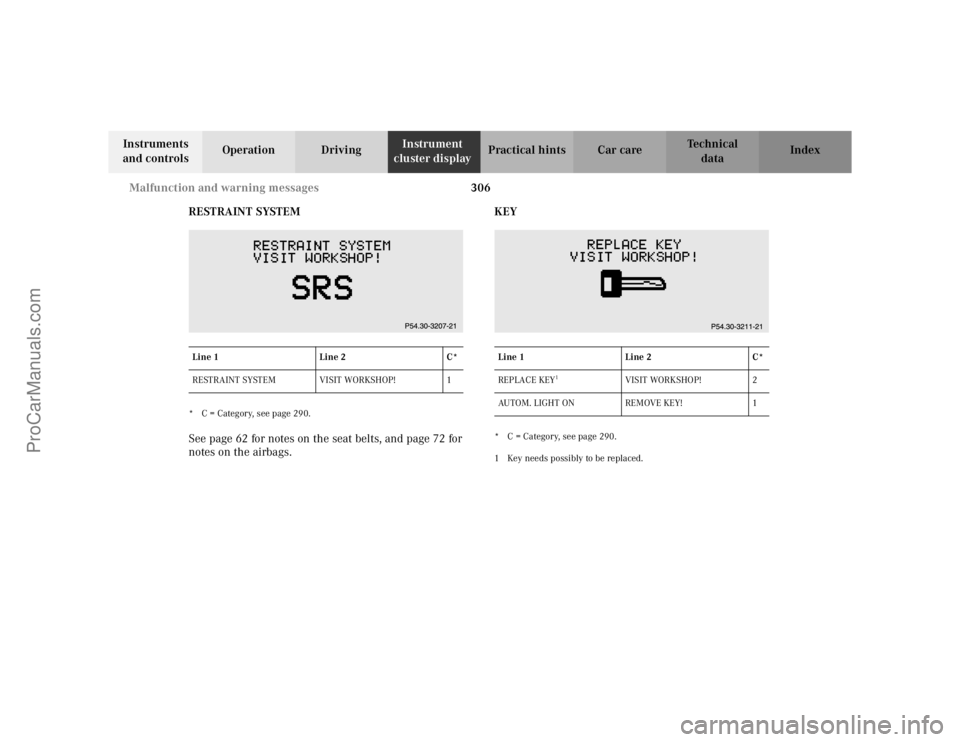
RESTRAINT SYSTEM
* C = Category, see page 290.See page 62 for notes on the seat belts, and page 72 for
notes on the airbags. KEY
* C = Category, see page 290.
1 Key needs possibly to be replaced.
Line 1 Line 2 C*
RESTRAINT SYSTEM VISIT WORKSHOP! 1Line 1
Line 2C*
REPLACE KEY
1
VISIT WORKSHOP! 2
AUTOM. LIGHT ON REMOVE KEY! 1
ProCarManuals.com
Page 314 of 399

311
Fuses
Te ch n i c a l
data
Instruments
and controls Operation Driving
Instrument
cluster display Practical hints
Car care Index
Stowing things in the vehicle Fuses
Most of your vehicle’s electrical components are fused
with safety fuses. With the exception of the brake lights,
all individual lighting system components are
electronically fused. Before replacing a blown safety
fuse, determine the cause of the short circuit. Always
observe amperage and color of fuse.
The circuit for components is protected by a cycled
circuit breaker interrupted if too much current is being
drawn. The circuit closes automatically after a short
time; the circuit is broken again if the malfunction
reoccurs.
Always use a new fuse for replacement. Never attempt to
repair or bridge a blown fuse.
A fuse chart is located in fuse box (1).
A special fuse puller is located in the auxiliary fuse box
in the trunk, see page 314.
Wa r n i n g !
To help avoid personal injury during a collision or
sudden maneuver, exercise care when stowing
things. Put luggage or cargo in the trunk if
possible. Do not pile luggage or cargo higher than
the seat backs. Do not place anything on the shelf
below the rear window.
ProCarManuals.com
Page 332 of 399
329
Tires, Wheels
Te ch n i c a l
data
Instruments
and controls Operation Driving
Instrument
cluster display Practical hints
Car care Index
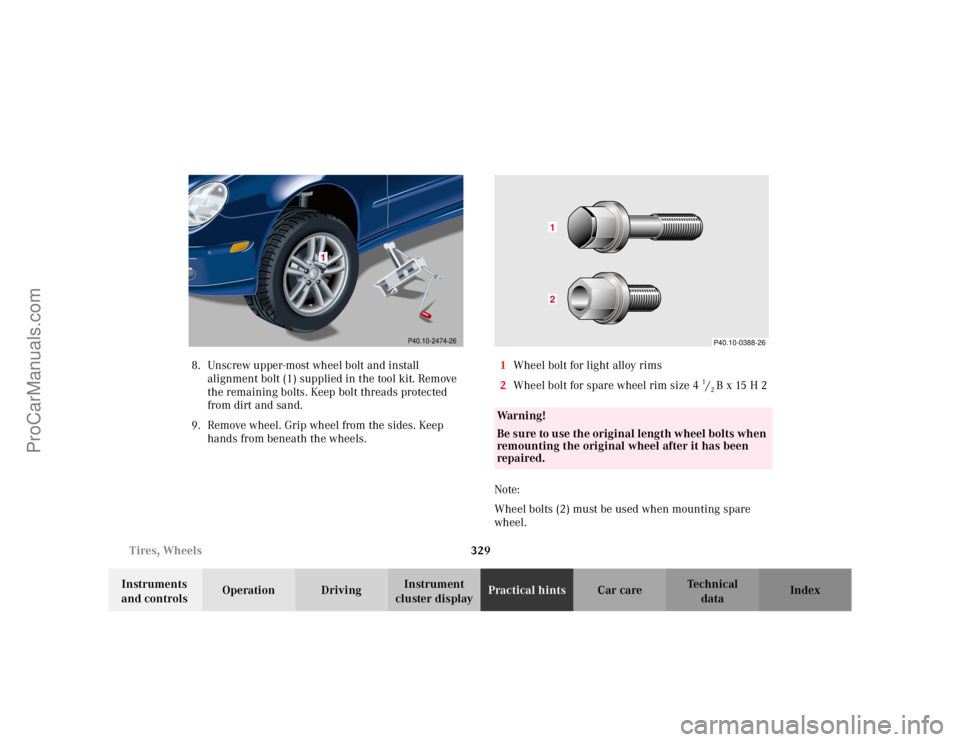
8. Unscrew upper-most wheel bolt and install
alignment bolt (1) supplied in the tool kit. Remove
the remaining bolts. Keep bolt threads protected
from dirt and sand.
9. Remove wheel. Grip wheel from the sides. Keep hands from beneath the wheels. 1
Wheel bolt for light alloy rims
2 Wheel bolt for spare wheel rim size 4
1/2 Bx15H2
Note:
Wheel bolts (2) must be used when mounting spare
wheel.
P40.10-2474-26
Wa r n i n g !
Be sure to use the original length wheel bolts when
remounting the original wheel after it has been
repaired.
P40.10-0388-26
12
ProCarManuals.com
Page 333 of 399
330
Tires, Wheels
Te ch n i c a l
data
Instruments
and controls Operation Driving
Instrument
cluster display Practical hints
Car care Index
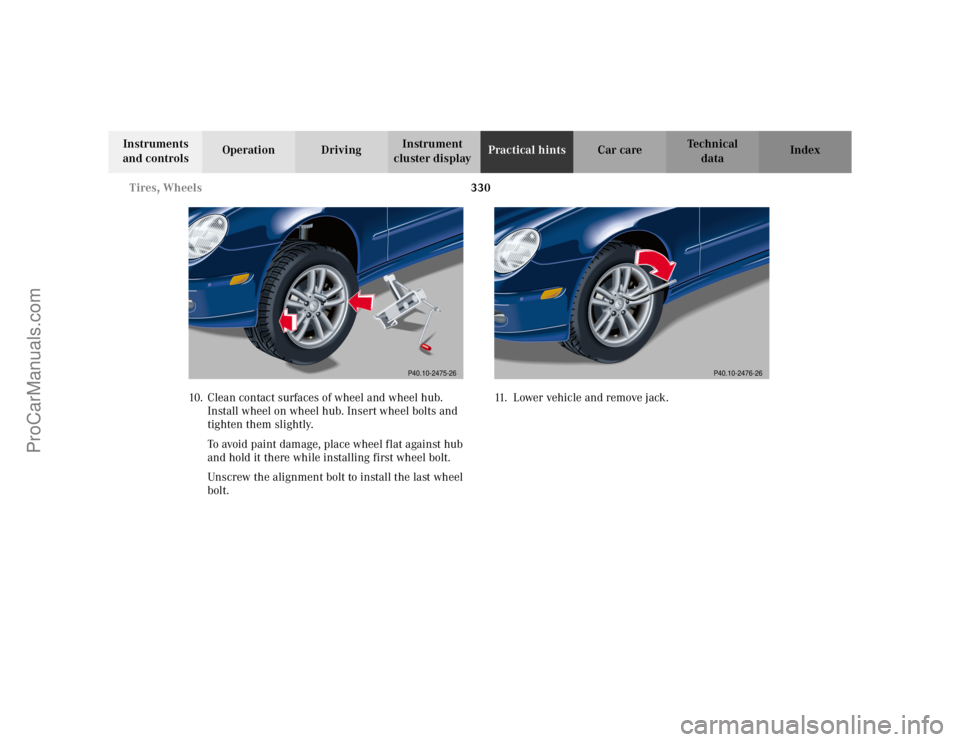
10. Clean contact surfaces of wheel and wheel hub. Install wheel on wheel hub. Insert wheel bolts and
tighten them slightly.
To avoid paint damage, place wheel flat against hub
and hold it there while installing first wheel bolt.
Unscrew the alignment bolt to install the last wheel
bolt. 11. Lower vehicle and remove jack.
P40.10-2475-26
P40.10-2476-26
ProCarManuals.com
Page 335 of 399
332
Tires, Wheels
Te ch n i c a l
data
Instruments
and controls Operation Driving
Instrument
cluster display Practical hints
Car care Index
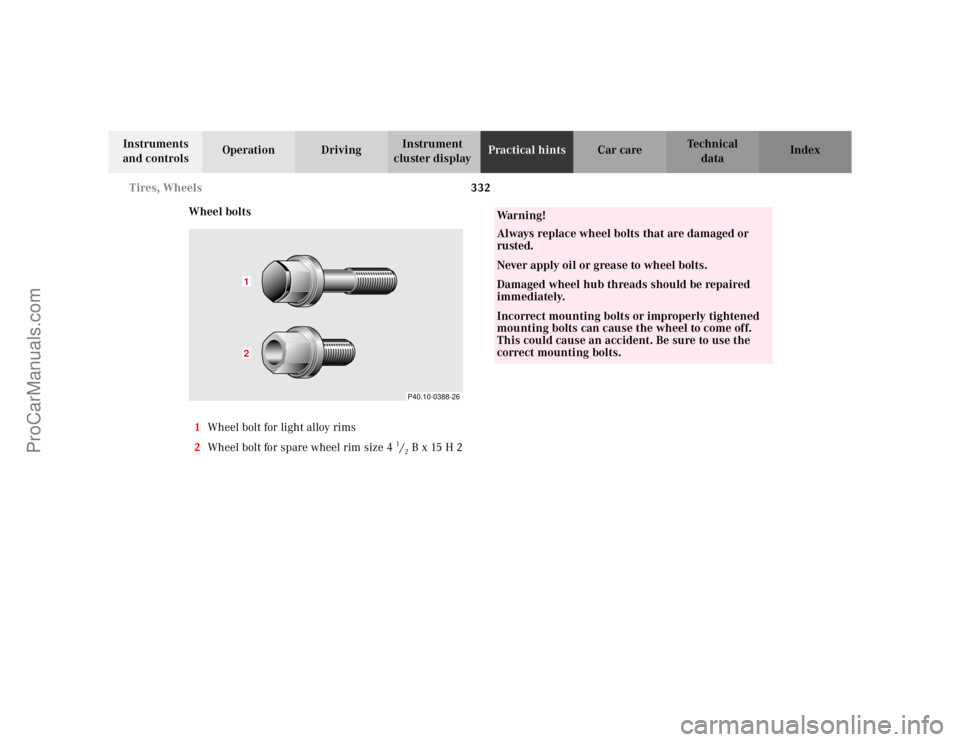
Wheel bolts
1 Wheel bolt for light alloy rims
2 Wheel bolt for spare wheel rim size 4
1/2 Bx15H2P40.10-0388-26
12
Wa r n i n g !
Always replace wheel bolts that are damaged or
rusted.Never apply oil or grease to wheel bolts.Damaged wheel hub threads should be repaired
immediately.Incorrect mounting bolts or improperly tightened
mounting bolts can cause the wheel to come off.
This could cause an accident. Be sure to use the
correct mounting bolts.
ProCarManuals.com
Page 336 of 399
333
Tires, Wheels
Te ch n i c a l
data
Instruments
and controls Operation Driving
Instrument
cluster display Practical hints
Car care Index
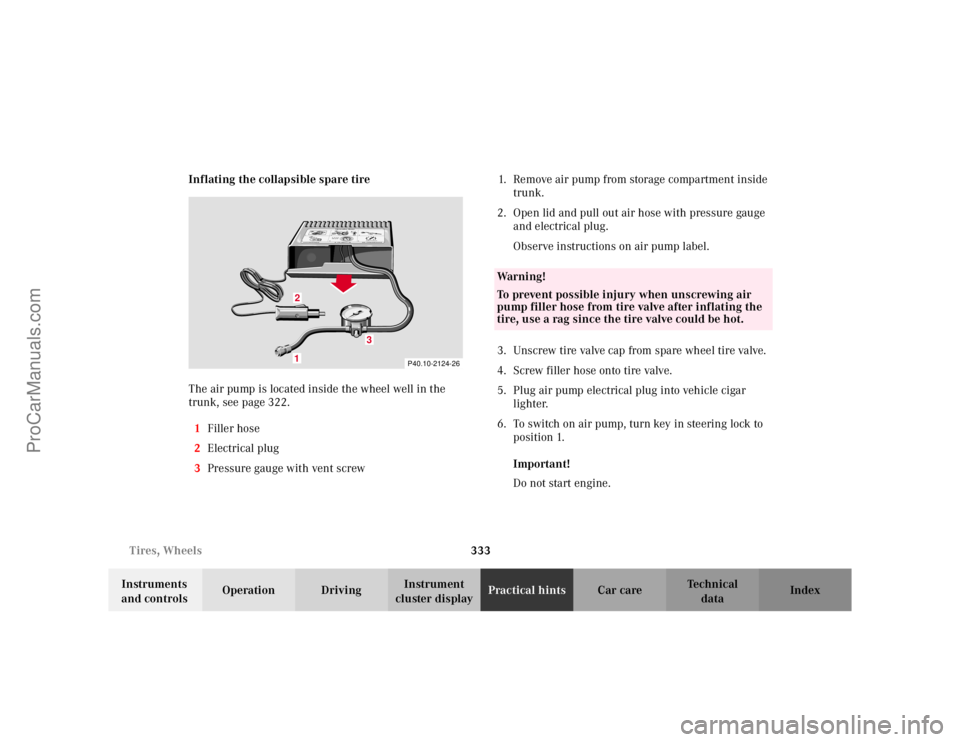
Inflating the collapsible spare tire
The air pump is located inside the wheel well in the
trunk, see page 322.
1 Filler hose
2 Electrical plug
3 Pressure gauge with vent screw 1. Remove air pump from storage compartment inside
trunk.
2. Open lid and pull out air hose with pressure gauge and electrical plug.
Observe instructions on air pump label.
3. Unscrew tire valve cap from spare wheel tire valve.
4. Screw filler hose onto tire valve.
5. Plug air pump electrical plug into vehicle cigar lighter.
6. To switch on air pump, turn key in steering lock to position 1.
Important!
Do not start engine.
P40.10-2124-26
1
0
45 6 max. 6 min
A 170 584 01 38 AIR COMPRESSOR
23
Mercedes-Benz
2
3
2 1
1
2,5 bar
36 psi1 0
2
3
4
5
620PSI
BAR40 60
80
LUFTPRESSER12
12
3
Wa r n i n g !
To prevent possible injury when unscrewing air
pump filler hose from tire valve after inflating the
tire, use a rag since the tire valve could be hot.
ProCarManuals.com
Page 337 of 399

334
Tires, Wheels
Te ch n i c a l
data
Instruments
and controls Operation Driving
Instrument
cluster display Practical hints
Car care Index
7. Operate air pump (approximately 5 minutes) until pressure gauge displays 36 psi (2.5 bar).
8. To switch off air pump, turn key in steering lock to position 0.
9. Unscrew filler hose from tire. Reinstall tire valve cap.
Note:
Excessive tire air pressure should be released using the
vent screw. Storing spare wheel in wheel well
Deflate spare tire:
1. Unscrew valve stem removal tool, which is a part of the valve cap, from tire valve.
2. Using the valve stem removal tool, open tire valve slightly by turning the tire valve insert
counterclockwise to release air pressure.
3. When the tire air pressure has been released, remove tire valve insert (protect it from dirt and
sand) using the previously removed tire valve cap.
4. Once all air is out of the tire, and the tire has collapsed to its original shape, reinstall the tire
valve insert and valve cap.
Place air pump and spare wheel in wheel well and
secure them.
ProCarManuals.com
Page 338 of 399
335
Tires, Wheels
Te ch n i c a l
data
Instruments
and controls Operation Driving
Instrument
cluster display Practical hints
Car care Index
Tire inflation pressure
A table (see fuel filler flap) lists the tire inflation
pressures specified for Mercedes-Benz recommended
tires as well as for the varying operating conditions.
Important!
Tire pressure changes by approximately 1.5 psi (0.1 bar)
per 18
°F (10
°C) of air temperature change. Keep this in
mind when checking tire pressure inside a garage –
especially in the winter.
Example:
If garage temperature = approximately +68
°F (+20
°C)
and ambient temperature = approximately +32
°F (0
°C)
then the adjusted air pressure = specified air pressure
+3 psi (+0.2 bar).
Tire pressures listed for light loads are minimum values
offering high driving comfort. Increased inflation
pressures for heavy loads produce favorable handling
characteristics with lighter loads and are perfectly
permissible. The ride of the vehicle, however, will
become somewhat harder.
Tire temperature and pressure increase with the vehicle
speed. Tire pressure should therefore only be checked
and corrected on cold tires. Correct tire pressure in warm tires only if pressure has dropped below the
pressure listed in the table and the respective operating
conditions are taken into consideration.
An underinflated tire due to a slow leak (e.g. due to a
nail in the tire) may cause damage such as tread
separation, bulging etc. Regular tire pressure checks
(including the spare tire) at intervals of no more than
14 days are therefore essential.
If a tire constantly loses air, it should be inspected for
damage.
The spare tire should be checked periodically for
condition and inflation. Spare tire will age and become
worn over time even if never used, and thus should be
inspected and replaced when necessary.
Wa r n i n g !
Do not overinflate tires. Overinflating tires can
result in sudden deflation (blowout) because they
are more likely to become punctured or damaged
by road debris, potholes etc. Follow recommended
inflation pressures.Do not overload the tires by exceeding the specified
vehicle capacity weight as indicated by the label on
the driver’s door latch post). Overloading the tires
can overheat them, possibly causing a blowout.
ProCarManuals.com
Page 342 of 399
339
Jump starting
Te ch n i c a l
data
Instruments
and controls Operation Driving
Instrument
cluster display Practical hints
Car care Index
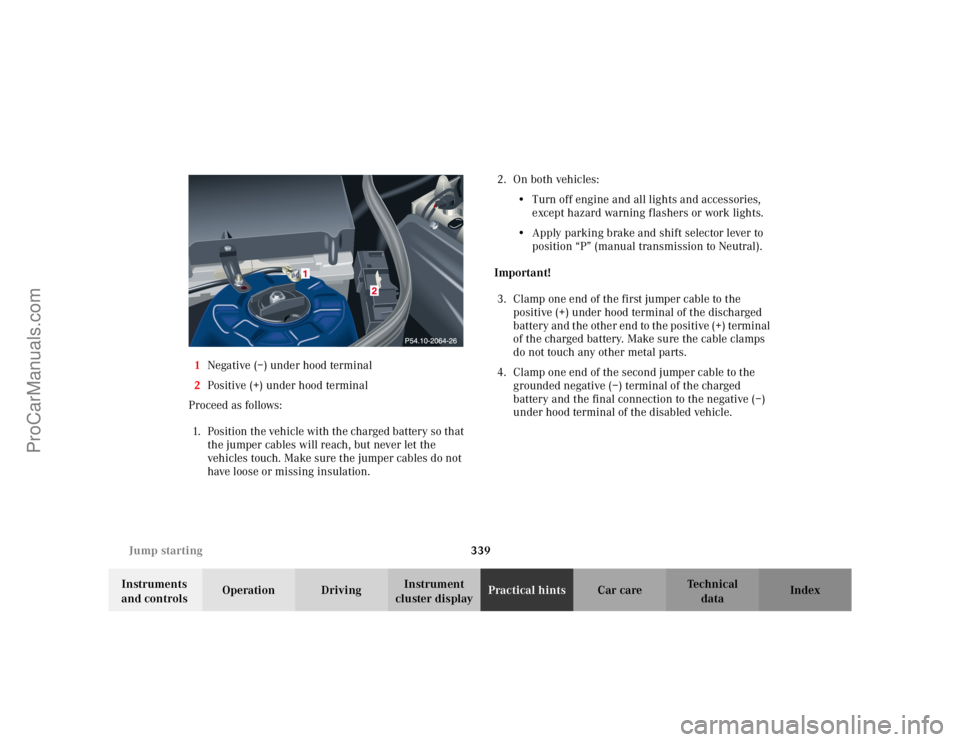
1
Negative (–) under hood terminal
2 Positive (+) under hood terminal
Proceed as follows:
1. Position the vehicle with the charged battery so that the jumper cables will reach, but never let the
vehicles touch. Make sure the jumper cables do not
have loose or missing insulation. 2. On both vehicles:
•Turn off engine and all lights and accessories,
except hazard warning flashers or work lights.
• Apply parking brake and shift selector lever to
position “P” (manual transmission to Neutral).
Important! 3. Clamp one end of the first jumper cable to the positive (+) under hood terminal of the discharged
battery and the other end to the positive (+) terminal
of the charged battery. Make sure the cable clamps
do not touch any other metal parts.
4. Clamp one end of the second jumper cable to the grounded negative (–) terminal of the charged
battery and the final connection to the negative (–)
under hood terminal of the disabled vehicle.
ProCarManuals.com
Page 348 of 399
345
Exterior lamps
Te ch n i c a l
data
Instruments
and controls Operation Driving
Instrument
cluster display Practical hints
Car care Index
Exterior lamps
Headlamp adjustment
Correct headlamp adjustment is extremely important.
Check and readjust headlamps at regular intervals and
when a bulb has been replaced.
Replacing bulbs
Notes:
To prevent a possible electrical short circuit, switch off
lamp prior to replacing a bulb.
When replacing bulbs, install only 12 volt bulbs with
the specified watt rating.
When replacing halogen bulbs do not touch glass
portion of bulb with bare hands. Use plain paper or a
clean cloth.
If the newly installed bulb does not light up, switch the
lamp off and on again. If the bulb still does not light up,
have the system checked at an authorized
Mercedes-Benz Center.
Wa r n i n g !
Bulbs and bulb holders can be very hot. Allow the
lamp to cool down before changing a bulb.
Halogen lamps contain pressurized gas. A bulb can
explode if you:
• touch or move it when hot,
•drop the bulb,
• scratch the bulb.Wear eye and hand protection.
ProCarManuals.com