display MERCEDES-BENZ C CLASS 2018 Owner's Manual
[x] Cancel search | Manufacturer: MERCEDES-BENZ, Model Year: 2018, Model line: C CLASS, Model: MERCEDES-BENZ C CLASS 2018Pages: 370, PDF Size: 6.25 MB
Page 26 of 370
Traction systemsee ETS/4ETS (Electronic Trac-
tion System)
Traffic reports
see also Digital Operator's Man-
ual .................................................. 270
Traffic Sign Assist
Activating/deactivating the warn-
ing function .................................... 222
Display message ............................ 249
Function/notes ............................. 200
Important safety notes .................. 200
Instrument cluster display ............. 200
Transfer case ..................................... 155
Transmission
Display message ............................ 255
see Automatic transmission
Transmission oil
Temperature (on-board computer,
Mercedes-AMG vehicles) ............... 226
Transmission position display ......... 148
Transporting the vehicle .................. 329
Trim pieces (cleaning instruc-
tions) .................................................. 314
Trip computer (on-board com-
puter) .................................................. 215
Trip odometer
Calling up ....................................... 214
Resetting (on-board computer) ...... 216
Trunk
Important safety notes .................... 86
Locking separately ........................... 90
Opening/closing (automatically
from inside) ...................................... 89
Opening/closing (automatically
from outside) ................................... 87
Opening/closing (from outside,
HANDS-FREE ACCESS) .................... 88
Opening/closing (manually from
outside) ............................................ 86
Trunk lid
Display message ............................ 256
Object detection .............................. 86
Opening dimensions ...................... 367
Reversing feature ............................. 86
Turn signals
Display message ............................ 242 Replacing bulbs (front) ................... 119
Switching on/off ........................... 114
Two-way radio
Frequencies ................................... 359
Installation ..................................... 359
Transmission output (maximum) .... 359
Type identification plate
see Vehicle identification plate
U
UnlockingEmergency unlocking ....................... 85
From inside the vehicle (central
unlocking button) ............................. 84
USB devices
Connecting to the Media Inter-
face ............................................... 279
V
Vanity mirror (in the sun visor) ........ 290
Vehicle
Correct use ...................................... 32
Data acquisition ............................... 33
Display message ............................ 254
Electronics ..................................... 359
Equipment ....................................... 29
Individual settings .......................... 222
Limited Warranty ............................. 33
Loading .......................................... 343
Locking (in an emergency) ............... 85
Locking (SmartKey) .......................... 78
Lowering ........................................ 357
Maintenance .................................... 30
Operating safety .............................. 31
Operation outside the USA/
Canada ............................................ 30
Parking .......................................... 161
Parking for a long period ................ 164
Pulling away ................................... 139
Raising ........................................... 354
Reporting problems ......................... 32
Securing from rolling away ............ 353
Technical data ............................... 359
Towing away .................................. 327
Transporting .................................. 329
Unlocking (in an emergency) ........... 85
Unlocking (SmartKey) ...................... 78
24Index
Page 27 of 370
Vehicle data ................................... 367
Vehicle battery
see Battery (vehicle)
Vehicle data
Roof load (maximum) .....................3 67
Vehicle dimensions ........................... 367
Vehicle emergency locking ................ 85
Vehicle identification number
see VIN
Vehicle identification plate .............. 360
Vehicle level
AIRMATIC ...................................... 182
Display message ............................ 247
Video
Operating the DVD ......................... 219
see also Digital Operator's Man-
ual ..................................................2 70
VIN
Seat ............................................... 361
Type plate ...................................... 360
W
Warning and indicator lampsABS ................................................ 261
Active Brake Assist ........................ 267
Airbag ............................................ 264
Brakes ...........................................2 60
Coolant .......................................... 265
Distance warning ........................... 267
Engine diagnostics ......................... 265
ESP
®.............................................. 261
ESP®OFF ....................................... 263
Fuel tank ........................................ 265
General notes ................................ 258
Overview .......................................... 37
Parking brake ................................ 264
PASSENGER AIR BAG ......................4 5
Reserv efuel .................................. .265
Restraint system ............................ 264
Seat belt ........................................ 259
SPORT handling mode ................... 263
Steering ......................................... 269
Tire pressure monitor .................... 268
Warranty .............................................. 29
Washer fluid
Display message ............................ 257 Weather display (COMAND)
see also Digital Operator's Man-
ual .................................................. 270
Wheel and tire combinations
Tires ............................................... 357
Wheel bolt tightening torque ........... 357
Wheel chock ...................................... 353
Wheels
Changing a wheel .......................... 352
Checking ........................................ 334
Cleaning ......................................... 311
Important safety notes .................. 333
Information on driving .................... 333
Interchanging/changing ................ 352
Mounting a new wheel ................... 356
Mounting a wheel .......................... 353
Removing a wheel .......................... 356
Snow chains .................................. 336
Storing ........................................... 353
Tightening torque ........................... 357
Wheel size/tire size ....................... 357
Window curtain air bag
Display message ............................ 239
Operation ......................................... 51
Windows
see Side windows
Windshield
Defrosting ...................................... 129
Win dshie
ld washer fluid
see Windshield washer system
Windshield washer system
Adding washer fluid ....................... 307
Important safety notes .................. 366
Windshield wipers
Problem (malfunction) ................... 123
Replacing the wiper blades ............ 121
Switching on/off ........................... 120
Winter driving
Important safety notes .................. 335
Slippery road surfaces ................... 169
Snow chains .................................. 336
Winter operation
Radiator cover ............................... 304
Summer tires ................................. 335
Winter tires
M+S tires ....................................... 335
Wiper arm
Moving to a vertical position .......... 121
Index25
Page 28 of 370
Wiper bladesCleaning ......................................... 312
Important safety notes .................. 121
Replacing ....................................... 121
Without changing gears
Display message ............................ 255
Wooden trim (cleaning instruc-
tions) .................................................. 314
Workshop
see Qualified specialist workshop
26Index
Page 38 of 370
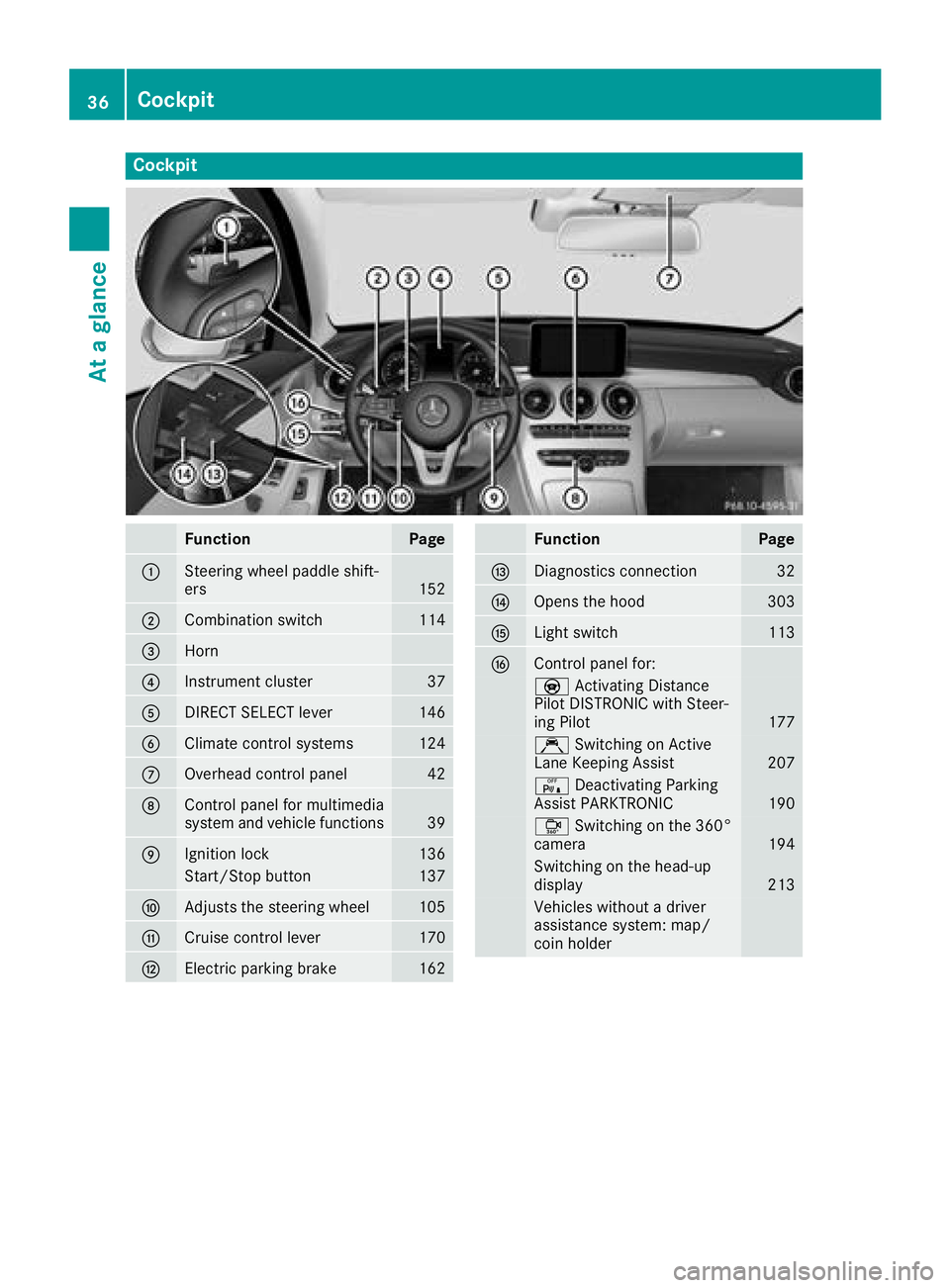
Cockpit
FunctionPage
:Steering wheel paddle shift-
ers152
;Combination switch114
=Horn
?Instrument cluster37
ADIRECT SELECT lever146
BClimate control systems124
COverhead control panel42
DControl panel for multimedia
system and vehicle functions39
EIgnition lock136
Start/Stop button137
FAdjusts the steering wheel105
GCruise control lever170
HElectric parking brake162
FunctionPage
IDiagnostics connection32
JOpens the hood303
KLight switch113
LControl panel for:
YActivating Distance
Pilot DISTRONIC with Steer-
ing Pilot
177
Ç Switching on Active
Lane Keeping Assist207
c Deactivating Parking
Assist PARKTRONIC190
Ô Switching on the 360°
camera194
Switching on the head-up
display213
Vehicles without a driver
assistance system: map/
coin holder
36Cockpit
At a glance
Page 39 of 370
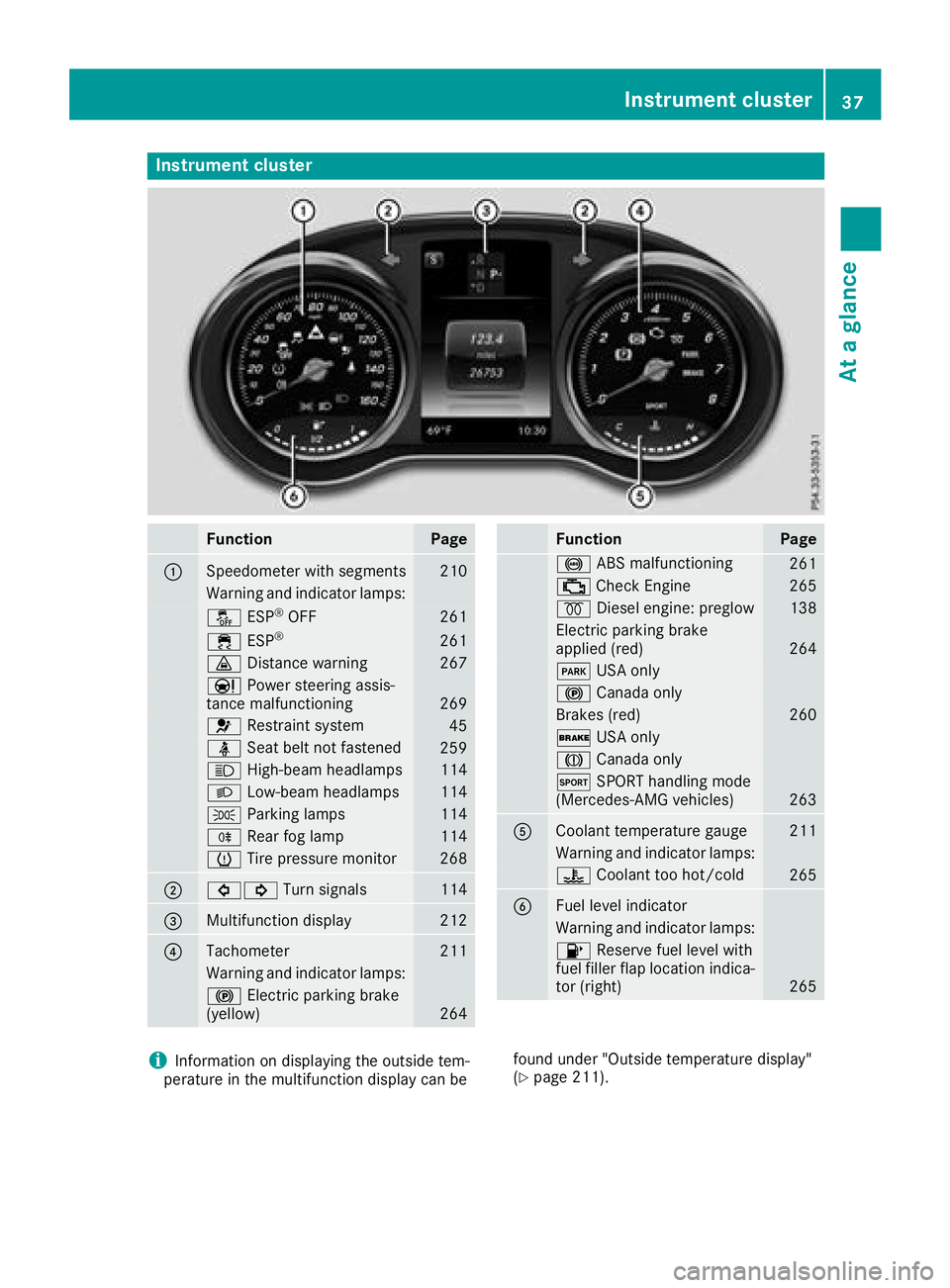
Instrument cluster
FunctionPage
:Speedometer wit hsegments21 0
Warning and indicator lamps:
å ESP®OF F261
÷ ESP®26 1
· Distanc ewarning26 7
Ð Powersteering assis-
tance malfunctioning26 9
6 Restrain tsystem45
ü Seat belt no tfastene d259
K High-beam headlamps114
L Low-beam headlamps114
T Parking lamp s114
R Rear fog lamp114
h Tirepressur emonitor26 8
;#! Turn signals114
=Multifunction display212
?Tachometer211
Warning and indicator lamps:
! Electric parking brak e
(yellow)26 4
FunctionPag e
! ABSmalfunctioning26 1
; CheckEngin e265
% Diesel engine: preglow138
Electric parking brak e
applie d(red)26 4
F USAonly
! Canad aonly
Brake s(red)26 0
$ USAonly
J Canad aonly
M SPORT handlin gmod e
(Mercedes-AM Gvehicles)26 3
ACoolan ttemperature gauge21 1
Warning and indicator lamps:
? Coolan tto ohot/cold26 5
BFue llevel indicator
Warning and indicator lamps:
8 Reserve fuel level wit h
fuel filler flap location indica-
to r(right )
265
iInformation on displayin gth eoutside tem-
peratur ein th emultifunction display can be foun
dunder "Outside temperature display"
(Ypage 211).
Instrument cluster37
At a glance
Page 40 of 370
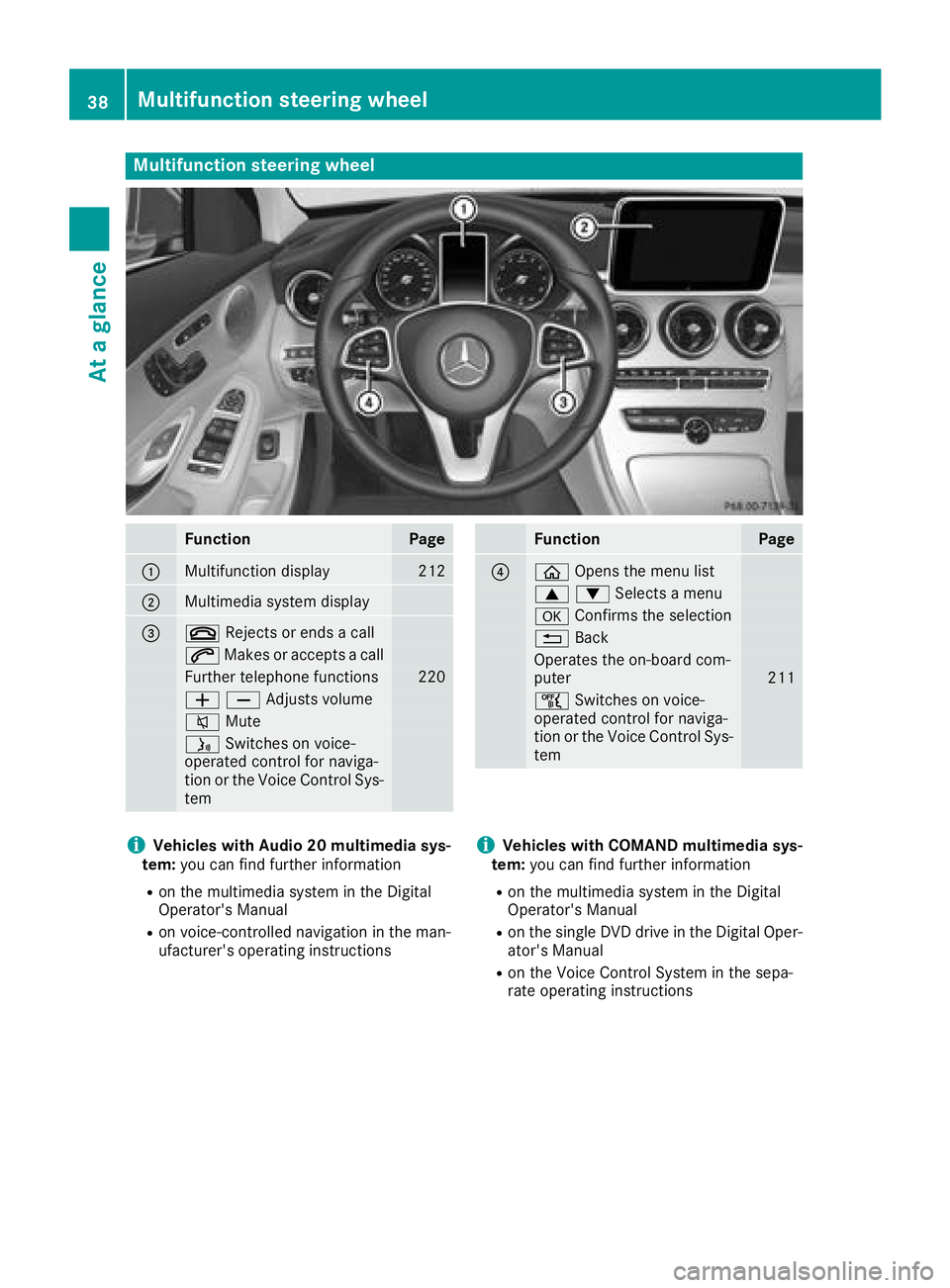
Multifunction steering wheel
FunctionPage
:Multifunction display212
;Multimedia system display
=~Rejects or ends a call
6Makes or accepts a call
Further telephone functions220
WXAdjusts volume
8 Mute
óSwitches on voice-
operated control for naviga-
tion or the Voice Control Sys-
tem
FunctionPage
?ò Opens the menu list
9:Selects a menu
aConfirms the selection
%Back
Operates the on-board com-
puter211
ñSwitches on voice-
operated control for naviga-
tion or the Voice Control Sys-
tem
iVehicles with Audio 20 multimedia sys-
tem: you can find further information
Ron the multimedia system in the Digital
Operator's Manual
Ron voice-controlled navigation in the man-
ufacturer's operating instructions
iVehicles with COMAND multimedia sys-
tem: you can find further information
Ron the multimedia system in the Digital
Operator's Manual
Ron the single DVD drive in the Digital Oper-
ator's Manual
Ron the Voice Control System in the sepa-
rate operating instructions
38Multifunction steering wheel
At a glance
Page 47 of 370
Restraint system warning lamp
The functions of the restraint system are
checked after the ignition is switched on and at
regular intervals while the engine is running.
Therefore, malfunctions can be detected in
good time.
The6 restraint system warning lamp on the
instrument cluster lights up when the ignition is
switched on. It goes out no later than a few sec-
onds after the vehicle is started. The compo-
nents of the restraint system are in operational
readiness.
A malfunction has occurred if the 6restraint
system warning lamp:
Rdoes not light up after the ignition is switched
on
Rdoes not go out after a few seconds with the
engine running
Rlights up again while the engine is running
GWARNING
If the restraint system is malfunctioning,
restraint system components may be trig-
gered unintentionally or may not deploy as
intended during an accident. This can affect
for example the Emergency Tensioning
Device or the air bag. This poses an increased
risk of injury or even fatal injury.
Have the restraint system checked and
repaired in a qualified specialist workshop as
soon as possible.
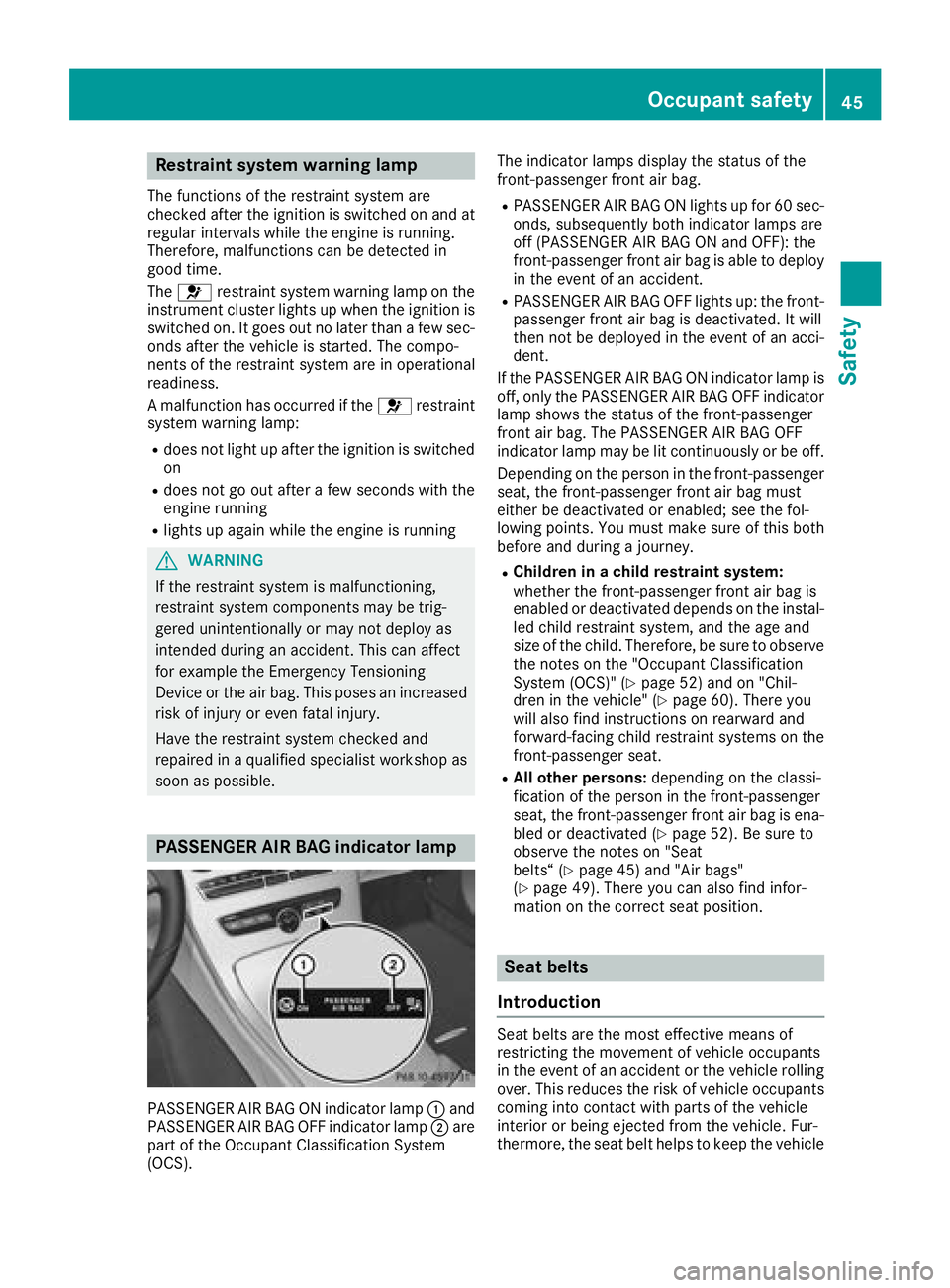
PASSENGER AIR BAG indicator lamp
PASSENGER AIR BAG ON indicator lamp :and
PASSENGER AIR BAG OFF indicator lamp ;are
part of the Occupant Classification System
(OCS). The indicator lamps display the status of the
front-passenger front air bag.
RPASSENGER AIR BAG ON lights up for 60 sec-
onds, subsequently both indicator lamps are
off (PASSENGER AIR BAG ON and OFF): the
front-passenger front air bag is able to deploy
in the event of an accident.
RPASSENGER AIR BAG OFF lights up: the front-
passenger front air bag is deactivated. It will
then not be deployed in the event of an acci-
dent.
If the PASSENGER AIR BAG ON indicator lamp is
off, only the PASSENGER AIR BAG OFF indicator lamp shows the status of the front-passenger
front air bag. The PASSENGER AIR BAG OFF
indicator lamp may be lit continuously or be off.
Depending on the person in the front-passenger
seat, the front-passenger front air bag must
either be deactivated or enabled; see the fol-
lowing points. You must make sure of this both
before and during a journey.
RChildren in a child restraint system:
whether the front-passenger front air bag is
enabled or deactivated depends on the instal-led child restraint system, and the age and
size of the child. Therefore, be sure to observe
the notes on the "Occupant Classification
System (OCS)" (
Ypage 52) and on "Chil-
dren in the vehicle" (Ypage 60). There you
will also find instructions on rearward and
forward-facing child restraint systems on the
front-passenger seat.
RAll other persons: depending on the classi-
fication of the person in the front-passenger
seat, the front-passenger front air bag is ena-
bled or deactivated (
Ypage 52). Be sure to
observe the notes on "Seat
belts“ (
Ypage 45) and "Air bags"
(Ypage 49). There you can also find infor-
mation on the correct seat position.
Seat belts
Introduction
Seat belts are the most effective means of
restricting the movement of vehicle occupants
in the event of an accident or the vehicle rolling over. This reduces the risk of vehicle occupants
coming into contact with parts of the vehicle
interior or being ejected from the vehicle. Fur-
thermore, the seat belt helps to keep the vehicle
Occupant safety45
Safety
Z
Page 54 of 370
Window curtain air bags:are integrated into
the side of the roof frame and deployed in the
area from the A-pillar to the C-pillar.
When deployed, the window curtain air bag
enhances the level of protection for the head.
However, it does not protect the chest or arms.
If the restraint system control unit detects a side
impact, the window curtain air bag is deployed
on the side on which the impact occurs.
If the system determines that they can offer
additional protection to that provided by the
seat belt, a window curtain air bag may be
deployed in other accident situations
(
Ypage 56).
Occupant Classification System
(OCS)
Introduction
The Occupant Classification System (OCS) cat-
egorizes the person in the front-passenger seat.
Depending on that result, the front-passenger
front air bag is either enabled or deactivated.
The system does not deactivate:
Rthe side impact air bag
Rthe window curtain air bag
Rthe Emergency Tensioning Devices
Requirements
To be classified correctly, the front passenger
must sit:
Rwith the seat belt fastened correctly
Rin an almost upright position with their back
against the seat backrest
Rwith their feet resting on the floor, if possible
If the front passenger does not observe these
conditions, OCS may produce a false classifica-
tion, e.g. because the front passenger:
Rtransfers their weight by supporting them-
selves on a vehicle armrest
Rsits in such a way that their weight is raised
from the seat cushion
If it is absolutely necessary to install a child
restraint system on the front-passenger seat, be
sure to observe the correct positioning of the
child restraint system. Never place objects
under or behind the child restraint system, e.g. a
cushion. Fully retract the seat cushion length.
The entire base of the child restraint system must always rest on the seat cushion of the
front-passenger seat. The backrest of the
forward-facing child restraint system must lie as
flat as possible against the backrest of the front-
passenger seat.
The child restraint system must not touch the
roof or be subjected to a load by the head
restraint. Adjust the angle of the seat backrest
and the head restraint position accordingly.
Only then can OCS be guaranteed to function
correctly. Always observe the child restraint sys-
tem manufacturer's installation and operating
instructions.
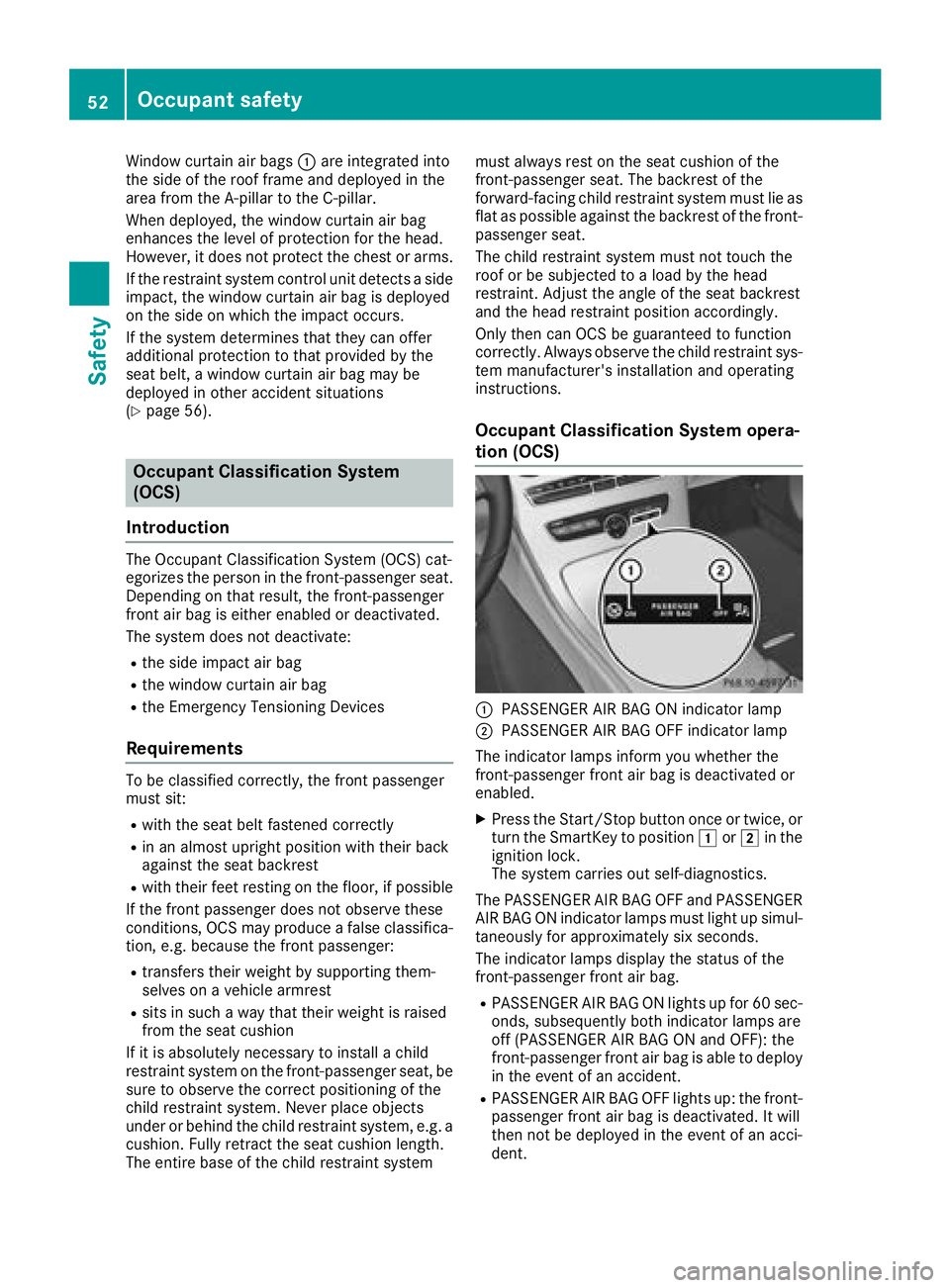
Occupant Classification System opera-
tion (OCS)
:PASSENGER AIR BAG ON indicator lamp
;PASSENGER AIR BAG OFF indicator lamp
The indicator lamps inform you whether the
front-passenger front air bag is deactivated or
enabled.
XPress the Start/Stop button once or twice, or turn the SmartKey to position 1or2 in the
ignition lock.
The system carries out self-diagnostics.
The PASSENGER AIR BAG OFF and PASSENGER
AIR BAG ON indicator lamps must light up simul-
taneously for approximately six seconds.
The indicator lamps display the status of the
front-passenger front air bag.
RPASSENGER AIR BAG ON lights up for 60 sec-
onds, subsequently both indicator lamps are
off (PASSENGER AIR BAG ON and OFF): the
front-passenger front air bag is able to deploy
in the event of an accident.
RPASSENGER AIR BAG OFF lights up: the front-
passenger front air bag is deactivated. It will
then not be deployed in the event of an acci-
dent.
52Occupant safety
Safety
Page 55 of 370
If the PASSENGER AIR BAG ON indicator lamp is
off, only the PASSENGER AIR BAG OFF indicatorlamp shows the status of the front-passenger
front air bag. The PASSENGER AIR BAG OFF
indicator lamp may be lit continuously or be off.
If the status of the front-passenger front air bag
changes while the vehicle is in motion, an air bag
display message appears in the instrument clus-
ter (
Ypage 240). When the front-passenger
seat is occupied, always pay attention to the
PASSENGER AIR BAG OFF indicator lamp. Be
aware of the status of the front-passenger front
air bag both before and during the journey.
GWARNING
If the PASSENGER AIR BAG OFF indicator
lamp is lit, the front-passenger front air bag is
disabled. It will not be deployed in the event of
an accident and cannot perform its intended
protective function. A person in the front-
passenger seat could then, for example, come
into contact with the vehicle's interior, espe-
cially if the person is sitting too close to the
dashboard. This poses an increased risk of
injury or even fatal injury.
When the front-passenger seat is occupied,
always ensure that:
Rthe classification of the person in the front- passenger seat is correct and the front-
passenger front air bag is enabled or disa-
bled in accordance with the person in the
front-passenger seat
Rthe front-passenger seat has been moved
back as far back as possible.
Rthe person is seated correctly.
Make sure, both before and during the jour-
ney, that the status of the front-passenger
front air bag is correct.
GWARNING
If you secure a child in a rearward-facing child
restraint system on the front-passenger seat
and the PASSENGER AIR BAG OFF indicator
lamp is off, the front-passenger front air bag
may deploy in the event of an accident. The
child could be struck by the air bag. This poses an increased risk of injury or even fatal injury.
Make sure that the front-passenger front air
bag has been disabled. The PASSENGER AIR
BAG OFF indicator lamp must be lit.
If the PASSENGER AIR BAG OFF indicator lamp
stays off, do not install a rearward-facing child
restraint system on the front-passenger seat.
You can find more information on OCS under
"Problems with the Occupant Classification Sys-
tem" (
Ypage 55).
GWARNING
If you secure a child in a forward-facing child
restraint system on the front-passenger seat
and you position the front-passenger seat too close to the dashboard, in the event of an
accident, the child could:
Rcome into contact with the vehicle's inte-
rior if the PASSENGER AIR BAG OFF indi-
cator lamp is lit, for example
Rbe struck by the air bag if the PASSENGER
AIR BAG OFF indicator lamp is off
This poses an increased risk of injury or even fatal injury.
Always move the front-passenger seat as far
back as possible and fully retract the seat
cushion length. Always make sure that the
shoulder belt strap is correctly routed from
the vehicle belt sash guide to the shoulder
belt guide on the child restraint system. The
shoulder belt strap must be routed forwards
and downwards from the vehicle belt sash
guide. If necessary, adjust the vehicle belt
sash guide and the front-passenger seat
accordingly. Always observe the child
restraint system manufacturer's installation
instructions.
If OCS determines that:
Rthe front-passenger seat is unoccupied, the
PASSENGER AIR BAG OFF indicator lamp
lights up after the system self-test and
remains lit. This indicates that the front-
passenger front air bag is deactivated.
Rthe front-passenger seat is occupied by a
child of up to twelve months old, in a standard
child restraint system, the PASSENGER AIR
BAG OFF indicator lamp lights up after the
system self-test and remains lit. This indi-
Occupant safety53
Safety
Z
Page 57 of 370
When the front-passenger seat is occupied,
always ensure that:
Rthe classification of the person in the front-passenger seat is correct and the front-
passenger front air bag is enabled or disa-
bled in accordance with the person in the
front-passenger seat
Rthe person is seated properly with a cor-
rectly fastened seatbelt
Rthe front-passenger seat has been moved
as far back as possible
If the PASSENGER AIR BAG OFF indicator
lamp remains lit when it should not, the front-
passenger seat may not be used. Do not
install a child restraint system on the front-
passenger seat. Have the Occupant Classifi-
cation System (OCS) checked and repaired
immediately at a qualified specialist work-
shop.
GWARNING
Objects between the seat surface and the
child restraint system could affect OCS oper- ation. This could result in the front-passenger
air bag not functioning as intended during an
accident. This poses an increased risk of
injury or even fatal injury.
Do not place any objects between the seat
surface and the child restraint system. The
entire base of the child restraint system must
always rest on the seat cushion of the front-
passenger seat. The backrest of the forward-
facing child restraint system must, as far as
possible, be resting on the backrest of the
front-passenger seat. Always comply with the
child restraint system manufacturer's instal-
lation instructions.
After the system self-test, the PASSENGER AIR
BAG OFF or PASSENGER AIR BAG ON indicator
lamp displays the status of the front-passenger
front air bag (
Ypage 52). If the front-passenger
front air bag is enabled, the PASSENGER AIR
BAG ON indicator lamp lights up for 60 seconds
and then goes out.
If the PASSENGER AIR BAG ON indicator lamp is off, only the PASSENGER AIR BAG OFF indicator
lamp shows the status of the front-passenger
front air bag. The PASSENGER AIR BAG OFF
indicator lamp may be lit continuously or be off.
For more information about the OCS, see "Prob-
lems with the Occupant Classification System"
(
Ypage 55).
Problems with the Occupant Classification System (OCS)
Be sure to observe the notes on "System self-test" (Ypage 54).
Occupant safety55
Safety
Z