lock MERCEDES-BENZ C-CLASS CABRIOLET 2016 User Guide
[x] Cancel search | Manufacturer: MERCEDES-BENZ, Model Year: 2016, Model line: C-CLASS CABRIOLET, Model: MERCEDES-BENZ C-CLASS CABRIOLET 2016Pages: 377, PDF Size: 6.9 MB
Page 26 of 377
Blind Spot Assist ............................ 206
Cleaning the trailer tow hitch ......... 320
Coupling up a traile
r...................... 215
Decoupling a trailer ....................... 216
Driving tips .................................... 214
Folding in the ball coupling ............ 215
Folding out the ball coupling .......... 214
Important safety notes .................. 213
Lights display message .................. 253
Parktronic ...................................... 185
Power supply ................................. 216
Problem (fault) ............................... 217
Trailer load s................................... 369
Transfer case ..................................... 153
Transmission
see Automatic transmission
see Manual transmission
Transmission position display ......... 146
Transporting the vehicle .................. 338
Trim pieces (cleaning instruc-
tions) .................................................. 321
Trip computer (on-board com-
puter) .................................................. 225
Trip meter
Calling up ....................................... 224
Resetting (on-board computer) ...... 226
Turn signals
Replacing bulbs (front) ................... 120
Switching on/of f........................... 116
TV
Operating (on-board computer) ..... 230
Two-way radio
Frequencies ................................... 358
Installation ..................................... 358
Transmission output (maximum) .... 358
Type identification plate
see Vehicle identification plate
Tyre changing tool kit ....................... 325
Tyre pressure
Calling up (on-board computer) ..... 348
Display message ............................ 265
Not reached (TIREFIT) .................... 329
Reached (TIREFIT) .......................... 329
Recommended ............................... 345
Tyre pressure loss warning
General notes ................................ 347
Important safety notes .................. 347 Restarting ...................................... 347
Tyre pressure monitor
Checking the tyre pressure elec-
tronically ........................................ 349
Function/note s............................. 348
General notes ................................ 348
Important safety notes .................. 348
Radio type approval for the tyre
pressure monitor ........................... 350
Restarting ...................................... 349
Warning lamp ................................. 282
Warning message .......................... 349
Tyres
Changing a whee l.......................... 350
Checking ........................................ 343
Direction of rotation ...................... 351
Display message ............................ 265
Important safety notes .................. 342
Information on driving .................... 342
MOExtended tyre s......................... 344
Replacing ....................................... 350
Service life ..................................... 343
Snow chains .................................. 345
Storing ........................................... 351
Summer tyres in winter ................. 344
Tyre size (data ).............................. 355
Tyre tread ...................................... 343
Wheel and tyre combinations ........ 355
see Flat tyre U
Unlocking Emergency unlocking ....................... 89
From inside the vehicle (central
unlocking button) ............................. 88
USB devices
Connecting to the Media Inter-
face ............................................... 295
Using the TIREFIT
tyre pressure kit ............................ 328 V
Vanity mirror (in sun visor) .............. 302
Variable SPEEDTRONIC
see SPEEDTRONIC
Vehicle
Correct use ...................................... 31 Index
23
Page 27 of 377
Data acquisition ............................... 31
Display message ............................ 267
Electronics ....................................
.358
Equipment ....................................... 28
Implied warranty .............................. 31
Individual settings .......................... 232
Leaving parked up ......................... 163
Locking (in an emergency) .............. .89
Locking (key) ................................... 82
Lowering ........................................ 355
Operating safety .............................. 28
Parking .......................................... 159
Pulling away ................................... 135
Raising ........................................... 352
Registration ..................................... 31
Securing from rolling away ............ 352
Technical data ............................... 358
Towing away .................................. 336
Transporting .................................. 338
Unlocking (in an emergency) ........... 89
Unlocking (key) ................................ 82
Vehicle data ................................... 367
Vehicle data
Boot load (maximum) ..................... 367
Vehicle dimensions ........................... 367
Vehicle emergency locking ................ 89
Vehicle identification number
see VIN
Vehicle identification plate .............. 359
Vehicle level
AIRMATIC ...................................... 182
Display message ............................ 258
Vehicle tool kit .................................. 325
Video
Operating the DVD ......................... 229
See also Digital Owner's Manua l... 284
VIN
Seat ............................................... 360
Type plate ...................................... 359 W
Warning and indicator lamps ABS ................................................ 275
Brakes ........................................... 274
Distance warning signal ................. 281
ESP ®
.............................................. 275
ESP ®
OFF ....................................... 277 Fuel tank ........................................ 278
General notes ................................ 273
LIM (cruise control) ........................ 168
LIM (DISTRONIC PLUS) .................. 172
LIM (variable SPEEDTRONIC) ......... 170
Overview .......................................... 35
Parking brake ................................ 278
PASSENGER AIR BAG ...................... 43
Reserve fue
l................................... 278
Seat belt ........................................ 273
Steering ......................................... 283
Tyre pressure monitor ................... 282
Warning triangle ................................ 324
Washer fluid
Display message ............................ 271
Weather display (COMAND Online)
See also Digital Owner's Manua l... 284
Wheel and tyre combinations
Tyres .............................................. 355
Wheel bolt tightening torque ........... 355
Wheel chock ...................................... 352
Wheels
Changing a whee l.......................... 350
Changing/replacing ....................... 350
Checking ........................................ 343
Cleaning ......................................... 318
Emergency spare whee l................. 356
Fitting a new wheel ........................ 354
Fitting a wheel ............................... 351
Important safety notes .................. 342
Information on driving .................... 342
Removing a whee l.......................... 354
Snow chains .................................. 345
Storing ........................................... 351
Tightening torque ........................... 355
Wheel size/tyre size ...................... 355
Wind deflector (cleaning instruc-
tions) .................................................. 317
Windows
Cleaning ......................................... 318
see Side windows
Windscreen
Demisting ...................................... 128
Windscreen washer fluid
see Windscreen washer system
Windscreen washer system
Important safety notes .................. 367
Topping up ..................................... 312 24
Index
Page 33 of 377
TIREFIT kit
Copy and translation of the original declaration of conformity:
EC declaration of conformity
In accordance with EC directive 2006/42/EC
We hereby declare that the product
Product designation: Daimler electric air pump
Model designation: 0855, DT/UW 200036
MB part no.: A 000 583 21 02
complies with the following relevant regulations:
EMC 2004/104/EC (2009/19/EC)
Applied harmonised standards, in particular:
ISO 7637-2: 2004-06 / ISO 7637-2AMD 1:2008:02
Manufacturer :D unlop Tech GmbH
Address: Birkenhainerstrasse 77, 63450
Hanau, Germany
Authorised representative: IMS department
Date: June 2013
Signature: IMS-AM, IMS-AE-LDiagnostics connection
The diagnostics connection is used for connect- ing diagnostic equipment at a qualified special-
ist workshop. G
WARNING
If you connect equipment to a diagnostics
connection in the vehicle, it may affect the
operation of vehicle systems. As a result, the operating safety of the vehicle could be affec-
ted. There is a risk of an accident.
Only connect equipment to a diagnostics con-
nection in the vehicle, which is approved for
your vehicle by Mercedes-Benz. G
WARNING
Objects in the driver's footwell may restrict
the clearance around the pedals or block a
depressed pedal. This jeopardises the oper-
ating and road safety of the vehicle. There is a risk of an accident.
Stow all objects securely in the vehicle so that
they do not get into the driver's footwell.
Always fit the floormats securely and as pre-
scribed in order to ensure that there is always sufficient room for the pedals. Do not use loose floormats and do not place several floor-
mats on top of one another.
! If the engine is switched off and equipment
on the diagnostics connection is used, the
starter battery may discharge.
Connecting equipment to the diagnostics con-
nection can lead to emissions monitoring infor-
mation being reset, for example. This may lead
to the vehicle failing to meet the requirements of the next emissions test during the main inspec-
tion. Qualified specialist workshop
A qualified specialist workshop has the neces-
sary special skills, tools and qualifications to
correctly carry out any necessary work on your
vehicle. This particularly applies to work rele-
vant to safety.
Observe the notes in the Service Booklet.
Always have the following work carried out at a
qualified specialist workshop:
R work relevant to safety
R service and maintenance work
R repair work 30
Operating safetyIntroduction
Page 36 of 377
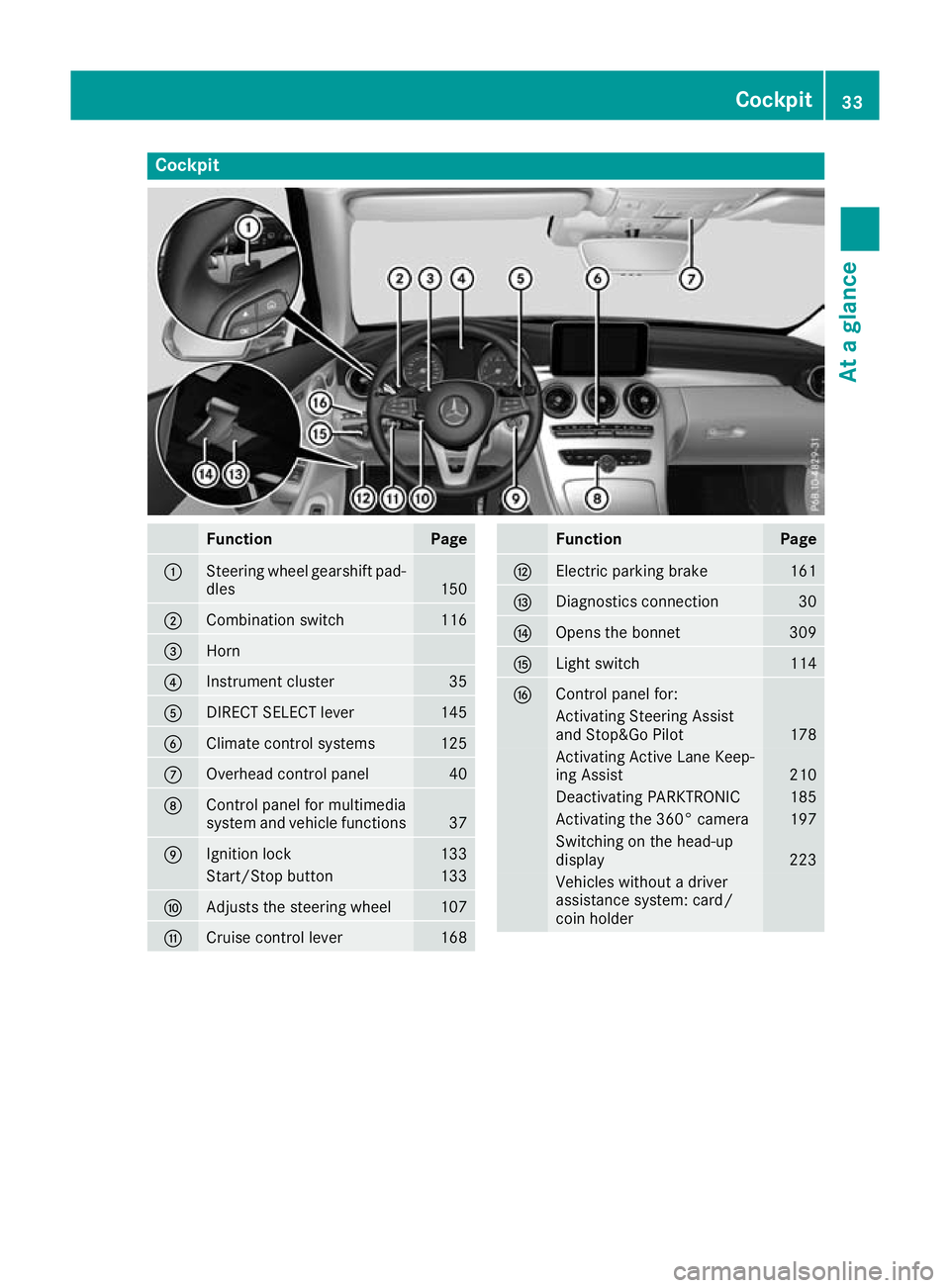
Cockpit
Function Page
:
Steering wheel gearshift pad-
dles 150
;
Combination switch 116
=
Horn
?
Instrument cluster 35
A
DIRECT SELECT lever 145
B
Climate control systems 125
C
Overhead control panel 40
D
Control panel for multimedia
system and vehicle functions 37
E
Ignition lock 133
Start/Stop button 133
F
Adjusts the steering wheel 107
G
Cruise control lever 168 Function Page
H
Electric parking brake 161
I
Diagnostics connection 30
J
Opens the bonnet 309
K
Light switch 114
L
Control panel for:
Activating Steering Assist
and Stop&Go Pilot
178
Activating Active Lane Keep-
ing Assist
210
Deactivating PARKTRONIC 185
Activating the 360° camera 197
Switching on the head-up
display
223
Vehicles without a driver
assistance system: card/
coin holder Cockpit
33At a glance
Page 37 of 377
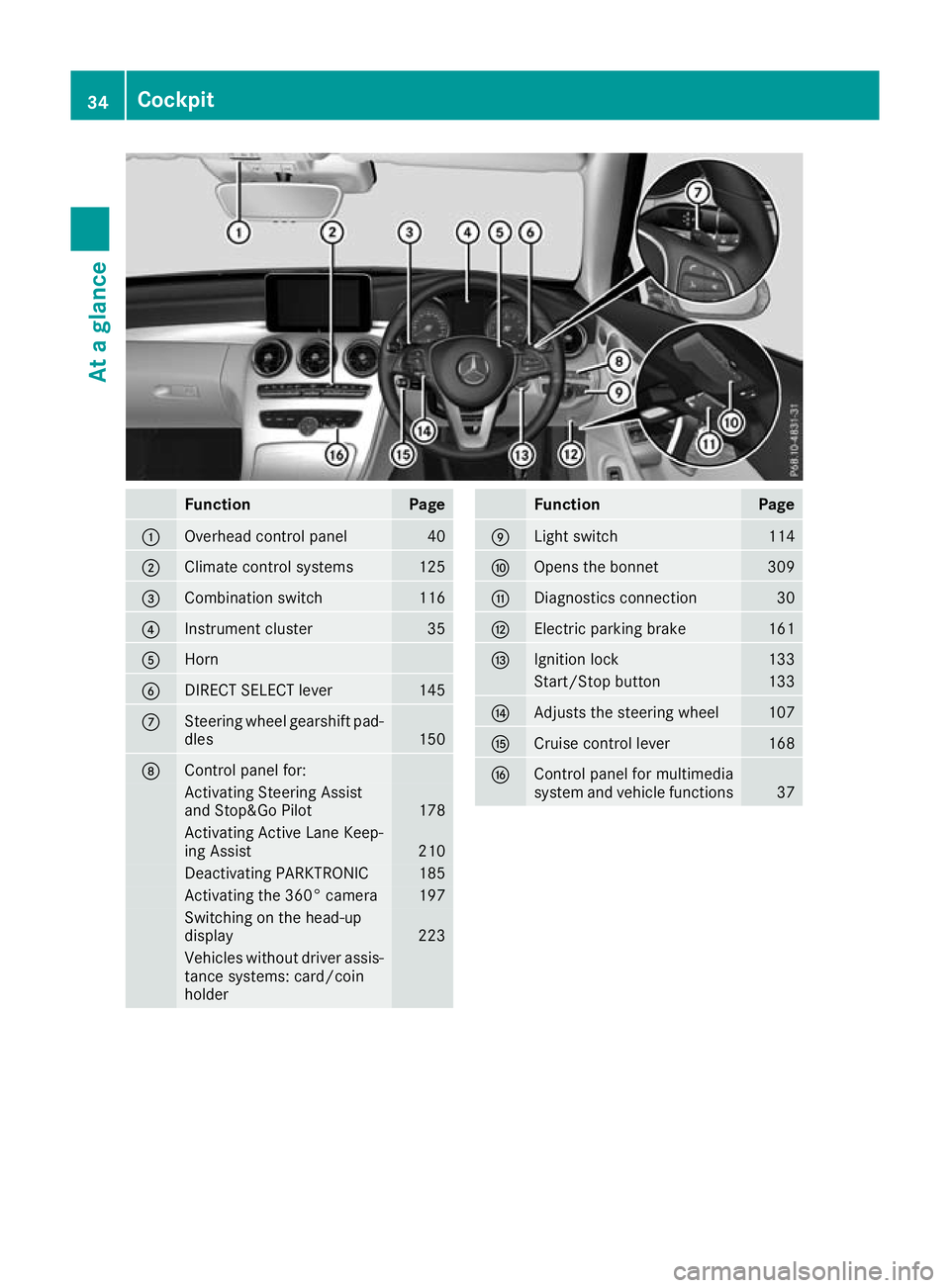
Function Page
:
Overhead control panel 40
;
Climate control systems 125
=
Combination switch 116
?
Instrument cluster 35
A
Horn
B
DIRECT SELECT lever 145
C
Steering wheel gearshift pad-
dles 150
D
Control panel for:
Activating Steering Assist
and Stop&Go Pilot
178
Activating Active Lane Keep-
ing Assist
210
Deactivating PARKTRONIC 185
Activating the 360° camera 197
Switching on the head-up
display 223
Vehicles without driver assis-
tance systems: card/coin
holder Function Page
E
Light switch 114
F
Opens the bonnet 309
G
Diagnostics connection 30
H
Electric parking brake 161
I
Ignition lock 133
Start/Stop button 133
J
Adjusts the steering wheel 107
K
Cruise control lever 168
L
Control panel for multimedia
system and vehicle functions
3734
CockpitAt a glance
Page 40 of 377
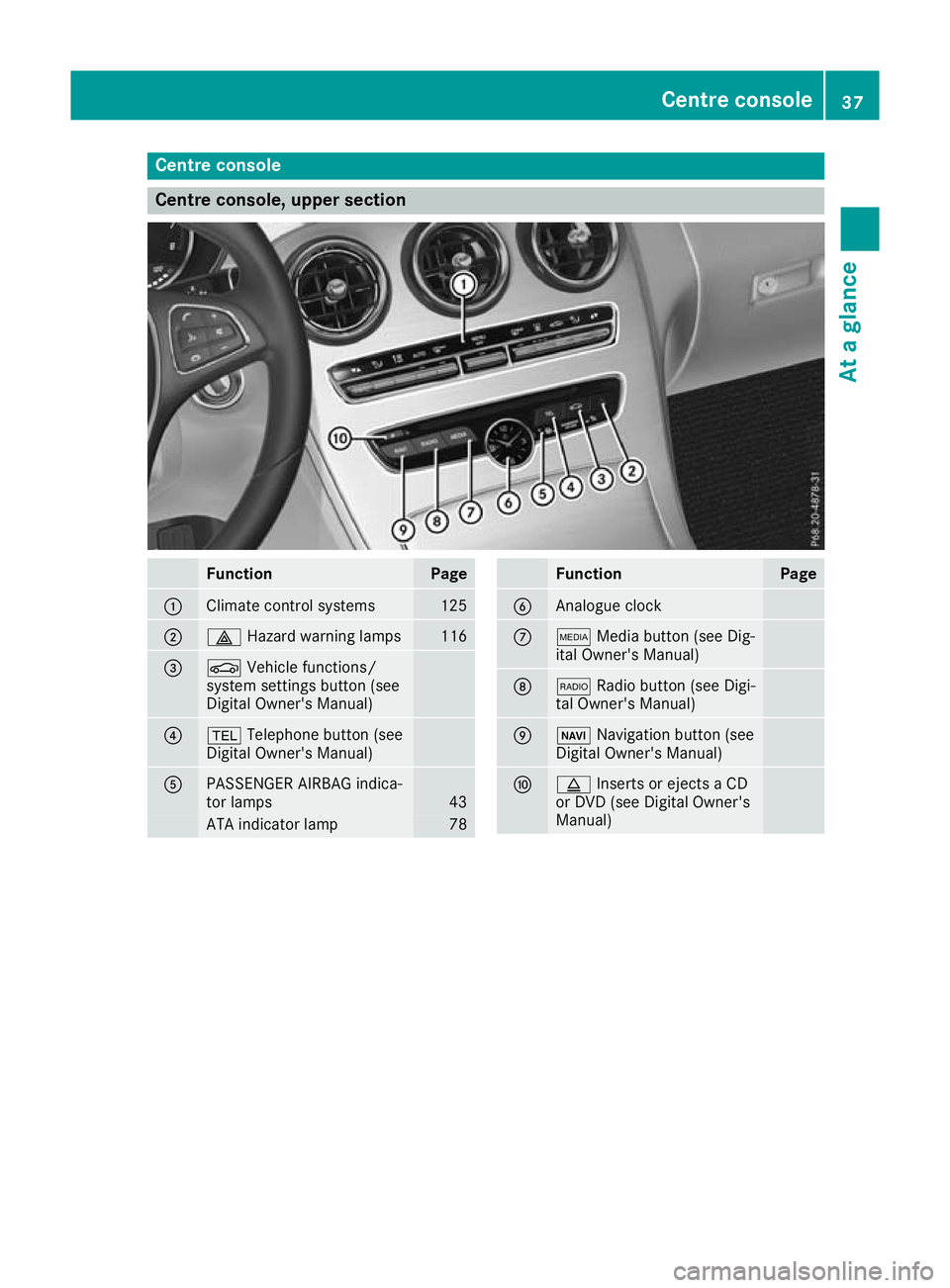
Centre console
Centre console, upper section
Function Page
:
Climate control systems 125
;
£
Hazard warning lamps 116
=
Ø
Vehicle functions/
system settings button (see
Digital Owner's Manual) ?
%
Telephone button (see
Digital Owner's Manual) A
PASSENGER AIRBAG indica-
tor lamps 43
ATA indicator lamp 78 Function Page
B
Analogue clock
C
Õ
Media button (see Dig-
ital Owner's Manual) D
$
Radio button (see Digi-
tal Owner's Manual) E
Ø
Navigation button (see
Digital Owner's Manual) F
þ
Inserts or ejects a CD
or DVD (see Digital Owner's
Manual) Centre console
37At a glance
Page 44 of 377
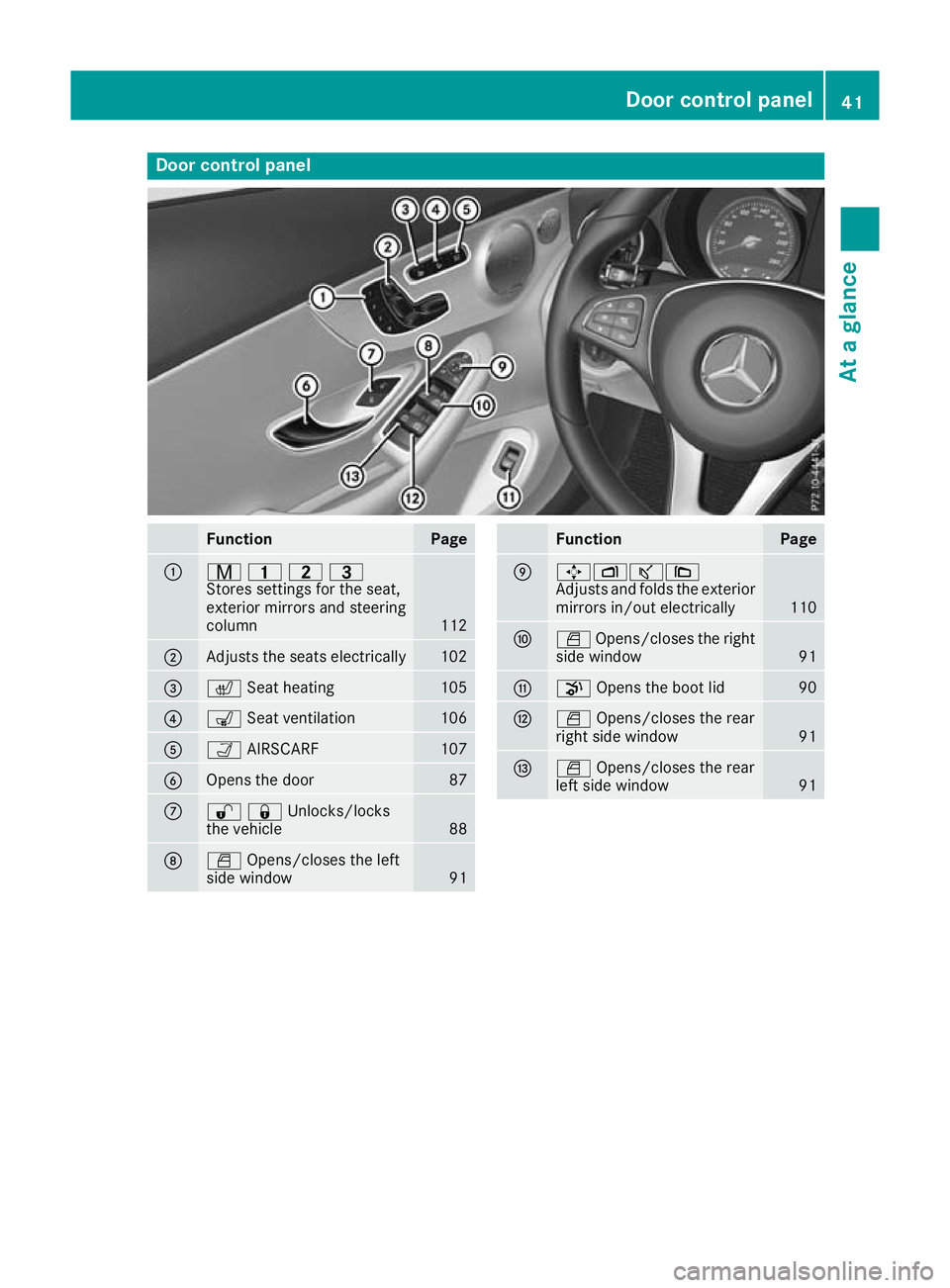
Door control panel
Function Page
:
r
45=
Stores settings for the seat,
exterior mirrors and steering
column 112
;
Adjusts the seats electrically 102
=
c
Seat heating 105
?
s
Seat ventilation 106
A
Ò
AIRSCARF 107
B
Opens the door 87
C
%&Unlocks/locks
the vehicle
88
D
W
Opens/closes the left
side window 91 Function Page
E
7Zª\
Adjusts and folds the exterior
mirrors in/out electrically 110
F
W
Opens/closes the right
side window 91
G
p
Opens the boot lid 90
H
W
Opens/closes the rear
right side window 91
I
W
Opens/closes the rear
left side window 91Door control panel
41At a glance
Page 45 of 377

Panic alarm
X
To activate: press and hold the !but-
ton :for approximately one second.
A visual and audible alarm is triggered if the
alarm system is activated.
X To deactivate: press the!button :
again.
or X Insert the key into the ignition lock.
or X Vehicles with KEYLESS-GO start function
or KEYLESS-GO: press the Start/Stop but-
ton.
The key must be in the vehicle.
The panic alarm function is available only in cer-
tain countries. Occupant safety
Introduction to the restraint system
The restraint system can reduce the risk of vehi-
cle occupants coming into contact with parts of
the vehicle's interior in the event of an accident. Furthermore, the restraint system can also
reduce the forces to which vehicle occupants
are subjected during an accident.
The restraint system includes:
R Seat belt system
R Airbags
R Child restraint system
R Child seat securing system The various components of the restraint system
work complementary to one another. They can
only perform their intended protective function
if all vehicle occupants:
R have correctly fastened their seat belt
(Y page 45)
R have correctly adjusted their seat and head
restraint (Y page 100).
As the driver, you must also ensure that the
steering wheel is correctly adjusted. Observe
the information relating to the correct driver's
seat position (Y page 100).
Additionally, you must ensure that an airbag can
deploy freely (Y page 48).
The airbag is supplementary to a correctly fas-
tened seat belt. As an additional safety device,
the airbag increases the level of protection for
vehicle occupants in the event of an accident. If the protection provided by the seat belt is suf-
ficient, the airbags do not deploy. Furthermore,
in the event of an accident, only airbags which
provide greater protection in the given accident situation deploy. However, seat belts and air-
bags generally do not protect against objects
penetrating the vehicle from the outside.
Information on how the restraint system oper-
ates can be found in "Deployment of the seat
belt tensioner and airbags" (Y page 56).
See "Children in the vehicle" for information on
infants and children traveling with you in the
vehicle restraint systems for infants and chil-
dren(Y page 59). Important safety notes
G
WARNING
If the restraint system is modified, it may no
longer work as intended. The restraint system
may then not perform its intended protective function by failing in an accident or triggering
unexpectedly, for example. There is an
increased risk of injury, possibly even fatal.
Never modify parts of the restraint system. Do not attempt to modify the wiring as well as
electronic components or their software.
If the vehicle needs to be adapted to accommo- date a person with disabilities, please contact a
specialist workshop. 42
Occupant safetySafety
Page 47 of 377

tion system" (Y
page 50) and on "Children in
the vehicle" (Y page 59).
R All other persons: the PASSENGER AIR BAG
OFF indicator lamp must be off. The front-
passenger front airbag is enabled. Depending
on the stature of the person on the front-
passenger seat, the PASSENGER AIR BAG
OFF indicator lamp may light up. The front-
passenger front airbag is disabled. It will then
not be deployed in the event of an accident. In this case, the front-passenger seat should not
be used.
It is imperative to observe the notes on the
"Automatic front-passenger front airbag
deactivation system" (Y page 50) as well as
on "Seat belts" (Y page 44) and "Airbags"
(Y page 47). There, you can also find infor-
mation on the correct seat position. Seat belts
Introduction A correctly worn seat belt is the most effective
means of restraining the movement of vehicle
occupants in the event of a collision or if the
vehicle overturns. This reduces the risk of vehi-
cle occupants coming into contact with parts of
the vehicle interior or being ejected from it. The seat belt also helps to keep the vehicle occu-
pants in the best position in relation to the air-
bag being deployed.
The seat belt system consists of:
R seat belts
R belt tensioners and belt force limiters
If the seat belt is pulled quickly or sharply from
the belt outlet, the inertia reel locks. The belt
strap cannot be pulled out any further.
The belt tensioner tightens the seat belt in the
event of a collision so that it fits tightly across
your body. However, it does not pull the vehicle occupants back in the direction of the seat
backrest.
The belt tensioner does not, however, correct an
incorrect seat position or correct the routing of
a seat belt that is worn incorrectly.
If the seat belt is also fitted with a belt force
limiter and this is triggered, the force exerted by the seat belt on the vehicle occupant is reduced.
The belt force limiters on the front seats are
synchronised with the front airbags, which take
on a part of the deceleration force. This can reduce the forces to which the vehicle occu-
pants are subjected during an accident.
! If the co-driver's seat is not occupied, do not
engage the seat belt tongue in the buckle on
the co-driver's seat. Otherwise, the belt ten-
sioner could be triggered in the event of an
accident and would have to be replaced.
Important safety notes G
WARNING
If the seat belt is worn incorrectly, it cannot
perform its intended protective function. Fur- thermore, an incorrectly worn seat belt can
cause additional injuries, e.g. in the event of
an accident, heavy braking or sudden
changes of direction. There is an increased
risk of injury, possibly even fatal.
Always ensure that all vehicle occupants havetheir seat belts fastened correctly and are sit-
ting properly. G
WARNING
The seat belt does not offer the intended level of protection if you have not moved the back-
rest to an almost vertical position. When brak-
ing or in the event of an accident, you could
slide underneath the seat belt and sustain
abdomen or neck injuries, for example. This
poses an increased risk of injury or even fatal injury.
Adjust the seat properly before beginning
your journey. Always ensure that the backrest
is in an almost vertical position and that the
shoulder section of your seatbelt is routed
across the centre of your shoulder. G
WARNING
Persons under 1.50 mtall cannot wear the
seat belts correctly without an additional suit- able restraint system. If the seat belt is worn
incorrectly, it cannot perform its intended
protective function. Furthermore, an incor-
rectly worn seat belt can cause additional
injuries, e.g. in the event of an accident, heavy braking or sudden changes of direction. There 44
Occupant safetySafety
Page 49 of 377

If such objects are located on or in your cloth-
ing, e.g. pens, keys, spectacles, etc. stow
these in a suitable location.
R Only one person should use each seat belt at
any one time.
Babies and children must never travel sitting
on the lap of another vehicle occupant. In the event of an accident, they could be crushed
between the vehicle occupant and seat belt.
R Do not secure any objects with a seat belt if
the seat belt is being used by one of the vehi- cle's occupants.
You must also make sure that objects, e.g.
cushions, are never placed between a person
and the seat.
Seat belts are solely intended to secure and
restrain persons. To secure objects, luggage or
loads, always observe the "Loading guidelines"
(Y page 296).
Fastening the seat belts Observe the safety notes on the seat belt
(Y
page 44) and the information on the correct
use of the seat belt (Y page 45).G
WARNING
If the seat-belt extender extends during the
journey, the seat belt is not sitting correctly
across your body. The seat belt then cannot
perform its intended protective function.
There is an increased risk of injury, possibly
even fatal.
During a journey, make sure that the seat-belt extender is retracted.
If the seat-belt extender does not retract auto-
matically, you can return it manually. Press the
seat-belt extender back to the stop before start-
ing the vehicle to do so. Returning the seat-belt
extender requires force. The seat-belt extender for the driver and front
passenger helps you fasten your seat belt. Seat- belt extender =is extended when the respec-
tive door is closed. You can also extend seat-belt extender
=with
seat-belt extender button ?.
X Turn the key to position 1or 2in the ignition
lock.
X Press seat-belt extender button ?.
Seat-belt extender =extends.
Seat-belt extender =is retracted again if:
R the belt tongue is engaged in the seat belt
buckle
R the belt tongue is not engaged in the seat belt
buckle within 60 seconds
In this case, you can extend seat-belt
extender =again. Press seat-belt extender
button ?again.
R the respective door is opened
R you release the seat backrest and fold it for-
wards
R the front-passenger seat remains unoccupied
If you then press seat-belt extender but-
ton ?, seat-belt extender =will not extend. 46
Occupant safetySafety