jump start MERCEDES-BENZ C-CLASS CABRIOLET 2016 Owners Manual
[x] Cancel search | Manufacturer: MERCEDES-BENZ, Model Year: 2016, Model line: C-CLASS CABRIOLET, Model: MERCEDES-BENZ C-CLASS CABRIOLET 2016Pages: 377, PDF Size: 6.9 MB
Page 6 of 377
ASSYST PLUS ...................................... 313
Care ..................................................... 314 Breakdown assistance
.....................323
Where will I find...? .............................. 323
Flat tyre ............................................... 326
Battery (vehicle) .................................. 330
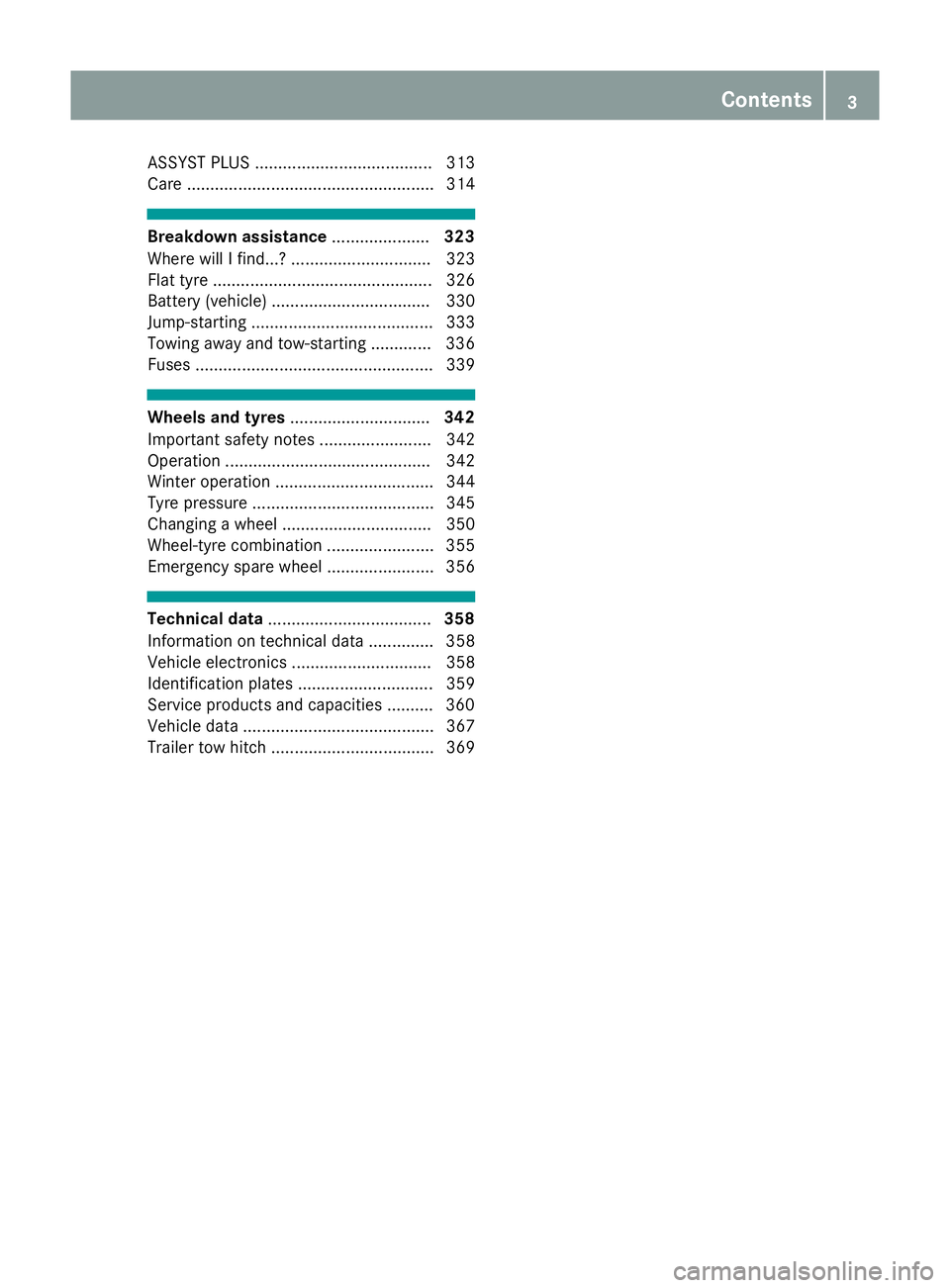
Jump-starting ....................................... 333
Towing away and tow-starting ............. 336
Fuses ................................................... 339 Wheels and tyres
.............................. 342
Important safety notes ........................ 342
Operation ............................................ 342
Winter operation .................................. 344
Tyre pressure ....................................... 345
Changing a wheel ................................ 350
Wheel-tyre combination ....................... 355
Emergency spare wheel ....................... 356 Technical data
................................... 358
Information on technical data .............. 358
Vehicle electronics .............................. 358
Identification plates ............................. 359
Service products and capacities .......... 360
Vehicle data ......................................... 367
Trailer tow hitch ................................... 369 Contents
3
Page 9 of 377
Driving tips .................................... 147
DYNAMIC SELECT switch .............. 141
Emergency running mod
e.............. 153
Engaging drive position .................. 146
Engaging neutral ............................ 145
Engaging park position automati-
cally ............................................... 145
Engaging reverse gear ................... 145
Engaging the park position ............ 145
Gearshift recommendation ............ 152
Gliding mod e................................. 148
Kickdown ....................................... 148
Manual shifting .............................. 150
Oil temperature (on-board com-
puter, Mercedes-AMG vehicles) ..... 237
oil temperature (on-board com-
puter, Mercedes-Benz C 450 AMG 4MATIC) ......................................... 237
Overview ........................................ 144
Problem (fault) ............................... 153
Pulling away ................................... 135
Starting the engine ........................ 135
Steering wheel gearshift paddle s... 150
Trailer towing ................................. 148
Transmission position display
(DIRECT SELECT lever) ................... 146
Transmission positions .................. 147
Automatic transmission emer-
gency running mode ......................... 153
Axle load, permissible (trailer tow-
ing) ...................................................... 369 B
Back button ....................................... 285
Ball coupling
Folding in ....................................... 215
Folding in/out ................................ 214
Folding ou t..................................... 214
BAS (Brake Assist System) ................. 67
BAS PLUS with Cross-Traffic Assist
(Brake Assist PLUS with Cross-
Traffic Assist)
Function/note s................................ 68
Important safety notes .................... 68
Battery (key)
Checking .......................................... 84
Important safety notes .................... 84 Replacing ......................................... 84
Battery (vehicle)
Charging ........................................ 332
Display message ............................ 255
Important safety notes .................. 330
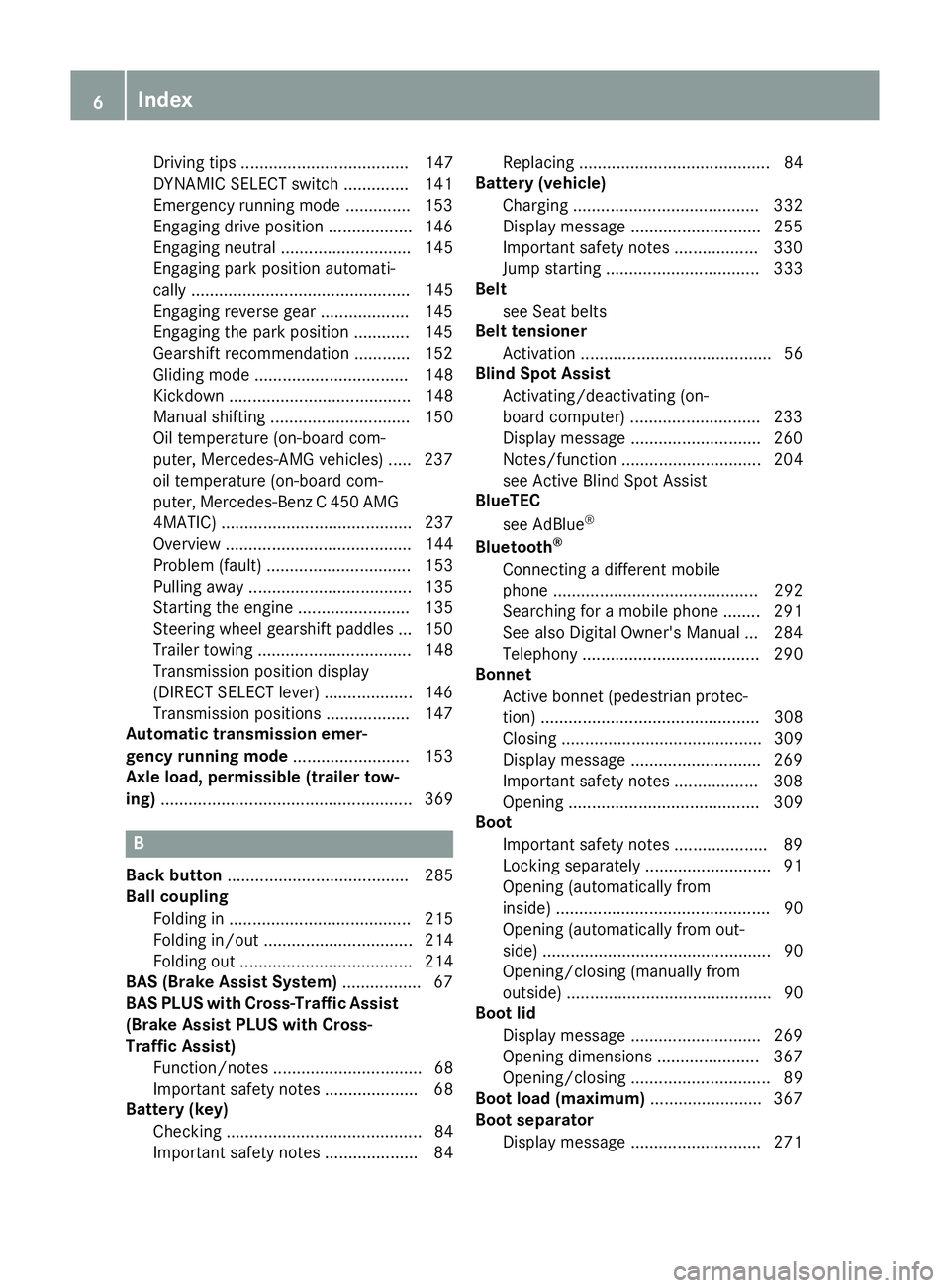
Jump starting ................................. 333
Belt
see Seat belts
Belt tensioner
Activation ......................................... 56
Blind Spot Assist
Activating/deactivating (on-
board computer) ............................ 233
Display message ............................ 260
Notes/function .............................. 204
see Active Blind Spot Assist
BlueTEC
see AdBlue ®
Bluetooth ®
Connecting a different mobile
phone ............................................ 292
Searching for a mobile phone ........ 291
See also Digital Owner's Manua l... 284
Telephony ...................................... 290
Bonnet
Active bonnet (pedestrian protec-tion) ............................................... 308
Closing ........................................... 309
Display message ............................ 269
Important safety notes .................. 308
Opening ......................................... 309
Boot
Important safety notes .................... 89
Locking separately ........................... 91
Opening (automatically from
inside) .............................................. 90
Opening (automatically from out-
side) ................................................. 90
Opening/closing (manually from
outside) ............................................ 90
Boot lid
Display message ............................ 269
Opening dimensions ...................... 367
Opening/closing .............................. 89
Boot load (maximum) ........................ 367
Boot separator
Display message ............................ 271 6
Index
Page 14 of 377
DYNAMIC SELECT switch
Automatic transmission ................ .141
Climate control (THERMATIC 2-
zone) .............................................. 126
Manual transmission ..................... .141 E
EASY-ENTRY feature Function/notes ............................ .108
EASY-ENTRY system ......................... 104
EASY-EXIT feature
Function/notes ............................ .108
EBD (electronic brake force distri-
bution)
Display message ............................ 244
Function/notes ................................ 75
ECO display
Function/notes ............................ .163
On-board computer ....................... 225
ECO start/stop function
Automatic engine start .................. 138
Automatic engine switch-off .......... 137
Climate control .............................. 126
Deactivating/activating ................. 139
General information ....................... 137
Important safety notes .................. 137
Introduction ................................... 137
Electromagnetic compatibility
Declaration of conformity ................ 29
Electronic Stability Program
see ESP ®
(Electronic Stability Program)
Emergency
Automatic measures after an acci-
dent ................................................. 59
Emergency key
Unlocking the driver's door .............. 89
Emergency key element
Function/notes ................................ 83
General notes .................................. 83
Inserting .......................................... 84
Locking vehicle ................................ 89
Removing ......................................... 84
Emergency release
Driver's door ................................... .89
Emergency spare wheel
General note s ................................ 357
Im portant safety notes .................. 356 Removing .......................................3
57
Technical data ............................... 357
Emergency unlocking
Vehicle ............................................. 89
Engine
Display message ............................ 254
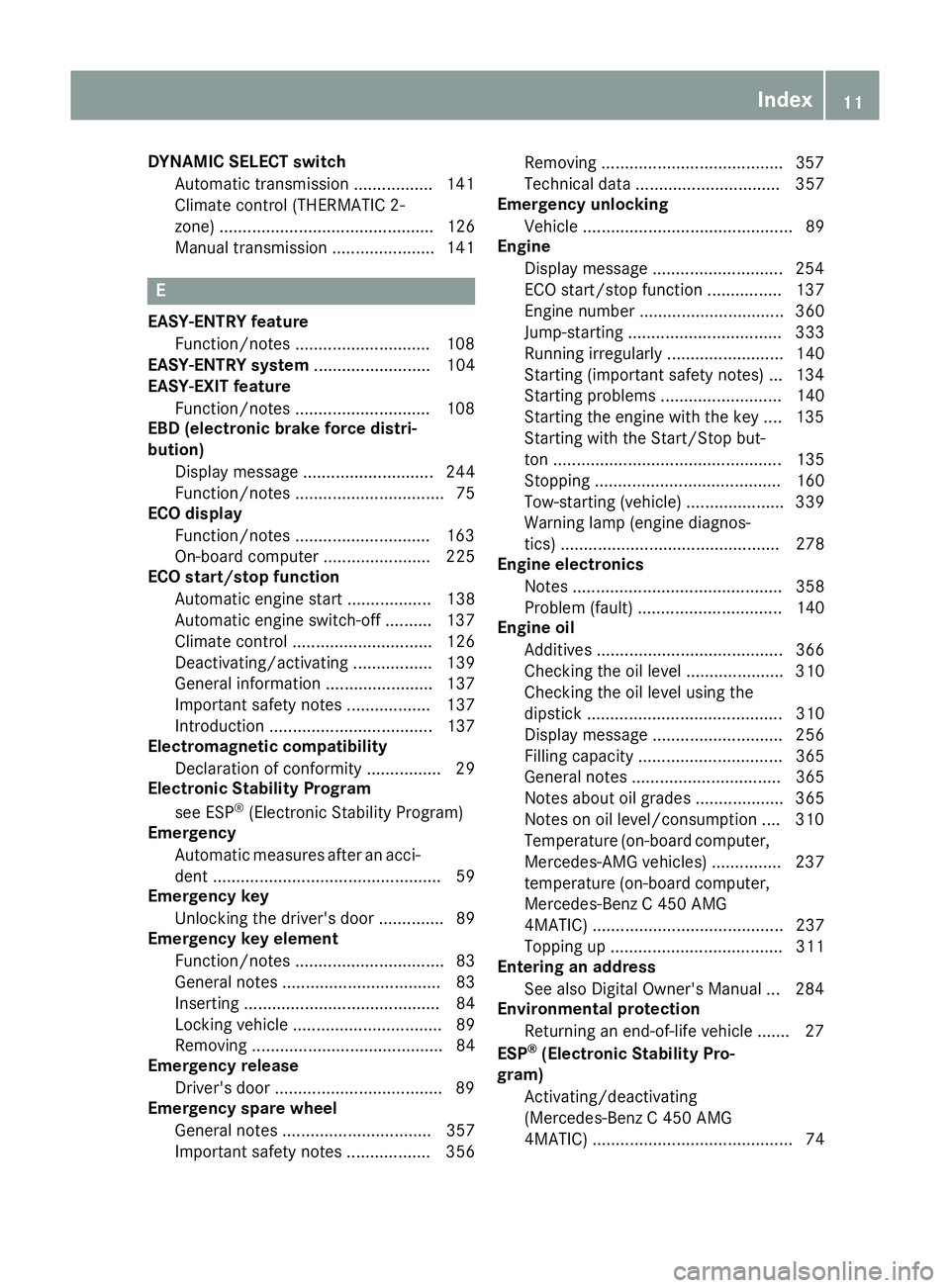
ECO start/stop function ................ 137
Engine number ............................... 360
Jump-starting ................................. 333
Running irregularl y......................... 140
Starting (important safety notes )... 134
Starting problems .......................... 140
Starting the engine with the key .... 135
Starting with the Start/Stop but-
ton ................................................. 135
Stopping ........................................ 160
Tow-starting (vehicle) ..................... 339
Warning lamp (engine diagnos-
tics) ............................................... 278
Engine electronics
Notes ............................................. 358
Problem (fault) ............................... 140
Engine oil
Additives ........................................ 366
Checking the oil level ..................... 310
Checking the oil level using the
dipstick .......................................... 310
Display message ............................ 256
Filling capacity ............................... 365
General notes ................................ 365
Notes about oil grade s................... 365
Notes on oil level/consumption .... 310
Temperature (on-board computer,
Mercedes-AMG vehicles) ............... 237
temperature (on-board computer, Mercedes-Benz C 450 AMG
4MATIC) ......................................... 237
Topping up ..................................... 311
Entering an address
See also Digital Owner's Manua l... 284
Environmental protection
Returning an end-of-life vehicle ....... 27
ESP ®
(Electronic Stability Pro-
gram)
Activating/deactivating
(Mercedes-Benz C 450 AMG
4MATIC) ........................................... 74 Index
11
Page 17 of 377
HUD
see Head-up display I
Ignition lock see Key positions
Immobiliser .......................................... 78
Indicator and warning lamp
Restraint system ............................ 278
Indicator and warning lamps
COLLISION PREVENTION ASSIST
PLUS ............................................. .281
Coolant .......................................... 279
Engine diagnostics ......................... 278
SPORT handling mode ................... 277
Indicator lamps
Display message ............................ 253
see Warning and indicator lamps
Indicators
see Turn signals
Insect protection on the radiator .... 309
Instrument cluster
Overview .......................................... 35
Warning and indicator lamps ........... 35
Instrument cluster lighting .............. 220
Intelligent Light System
Activating/deactivating ................. 235
Display message ............................ 253
Overview ........................................ 117
Setting the dipped-beam head-
lamps for driving on the right/left .. 236
Interior lighting
Automatic control system .............. 119
Control .......................................... .119
Overview ........................................ 119
Reading lamp ................................. 119
Interior motion sensor
Deactivating ..................................... 79
Function .......................................... .79
iPod ®
See also Digital Owner's Manual .. .284
ISOFIX child seat securing system .... 60J
Jack Declaration of conformity ................ 29 Storage location ............................ 325
Using ............................................. 352
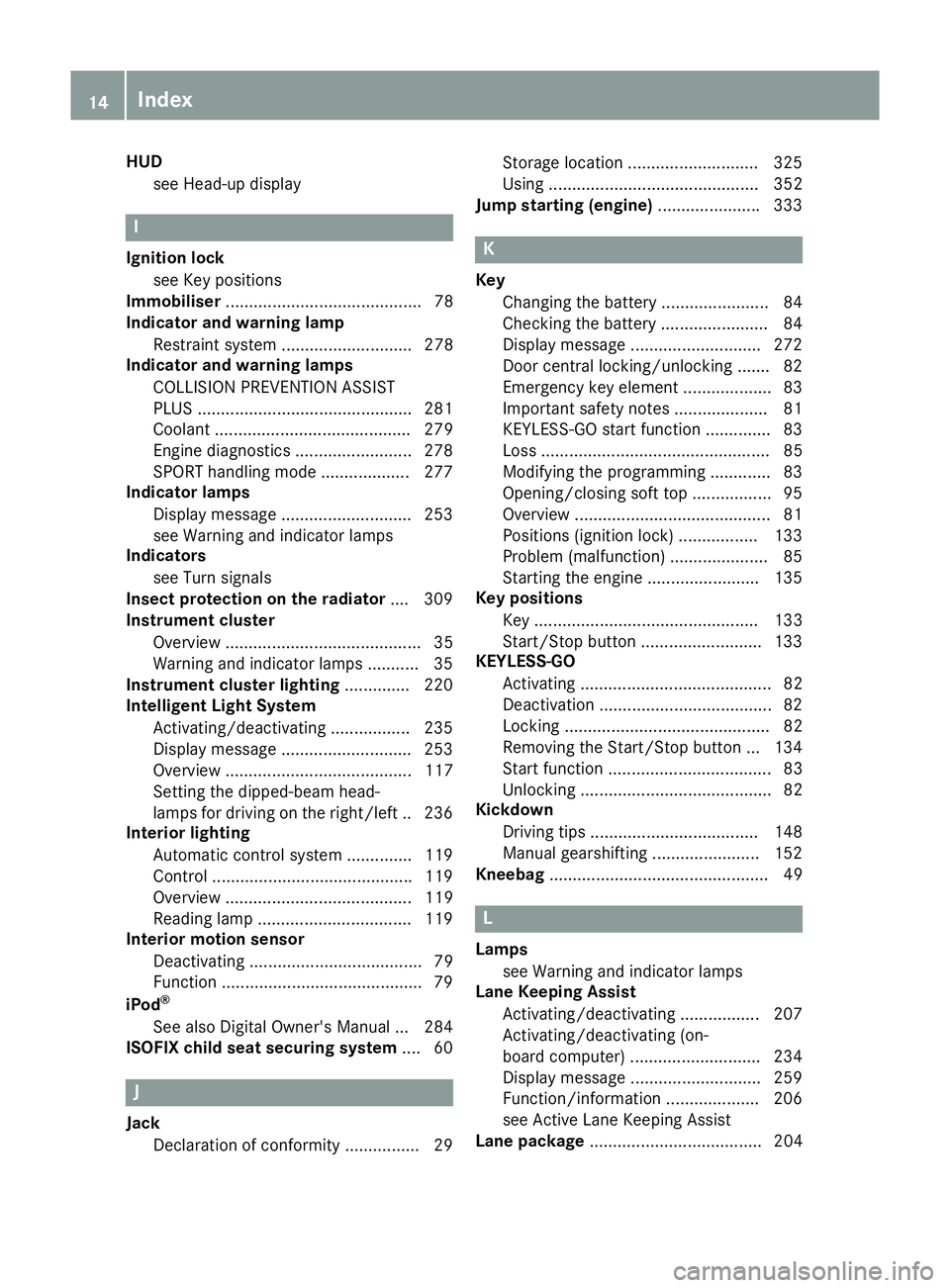
Jump starting (engine) ......................333 K
Key Changing the battery ....................... 84
Checking the battery ....................... 84
Display message ............................ 272
Door central locking/unlocking ....... 82
Emergency key element ................... 83
Important safety notes .................... 81
KEYLESS-GO start function .............. 83
Loss ................................................. 85
Modifying the programming ............. 83
Opening/closing soft top ................. 95
Overview .......................................... 81
Positions (ignition lock) ................. 133
Problem (malfunction) ..................... 85
Starting the engine ........................ 135
Key positions
Key ................................................ 133
Start/Stop button .......................... 133
KEYLESS-GO
Activating ......................................... 82
Deactivation ..................................... 82
Locking ............................................ 82
Removing the Start/Stop button ... 134
Start function ................................... 83
Unlocking ......................................... 82
Kickdown
Driving tips ................................... .148
Manual gearshifting ....................... 152
Kneebag ............................................... 49 L
Lamps see Warning and indicator lamps
Lane Keeping Assist
Activating/deactivating ................. 207
Activating/deactivating (on-
board computer) ............................ 234
Display message ............................ 259
Function/informatio n.................... 206
see Active Lane Keeping Assist
Lane package ..................................... 20414
Index
Page 89 of 377
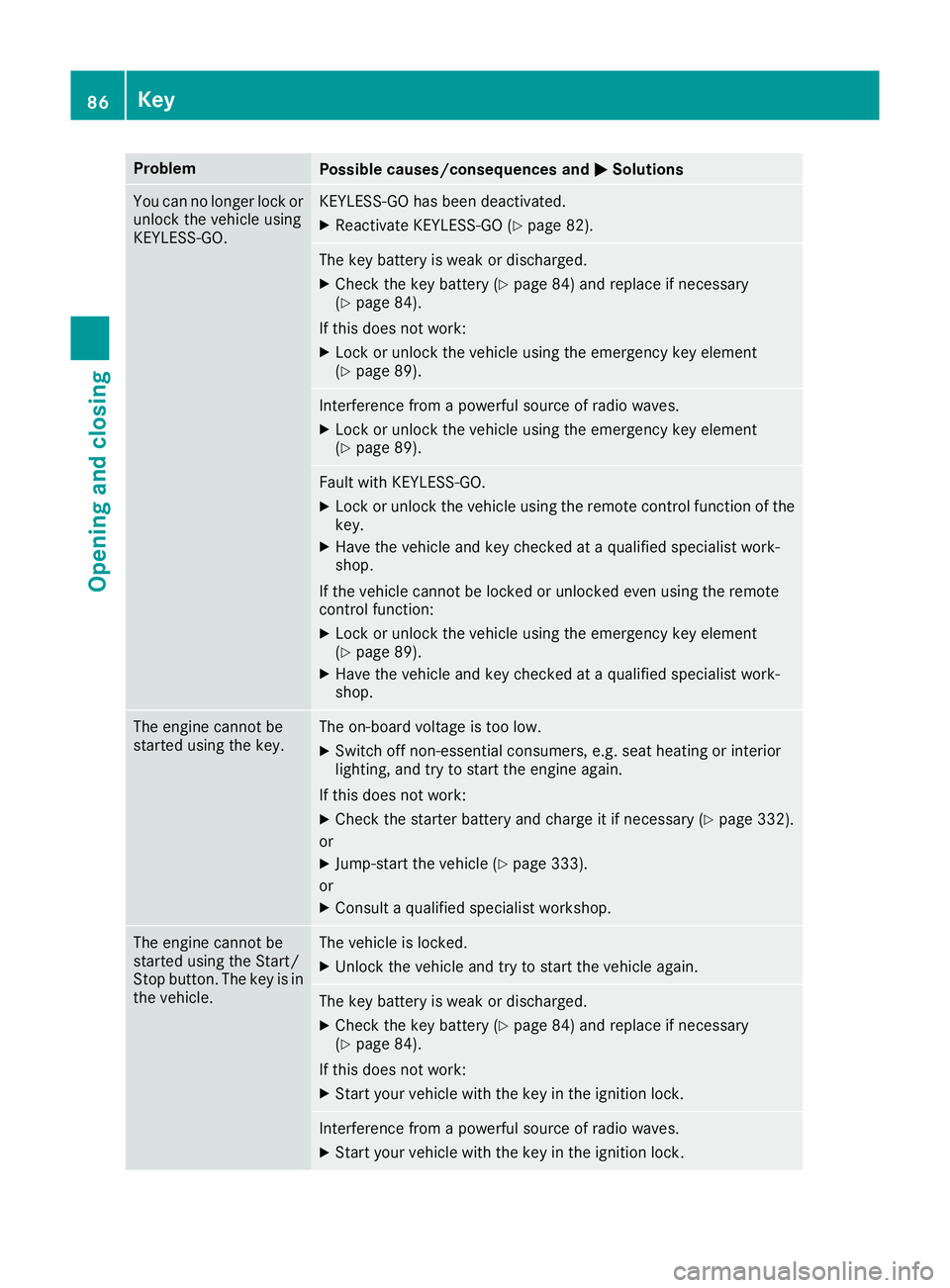
Problem
Possible causes/consequences and
M
MSolutions You can no longer lock or
unlock the vehicle using
KEYLESS-GO. KEYLESS-GO has been deactivated.
X Reactivate KEYLESS-GO (Y page 82). The key battery is weak or discharged.
X Check the key battery (Y page 84) and replace if necessary
(Y page 84).
If this does not work: X Lock or unlock the vehicle using the emergency key element
(Y page 89). Interference from a powerful source of radio waves.
X Lock or unlock the vehicle using the emergency key element
(Y page 89). Fault with KEYLESS-GO.
X Lock or unlock the vehicle using the remote control function of the
key.
X Have the vehicle and key checked at a qualified specialist work-
shop.
If the vehicle cannot be locked or unlocked even using the remote
control function:
X Lock or unlock the vehicle using the emergency key element
(Y page 89).
X Have the vehicle and key checked at a qualified specialist work-
shop. The engine cannot be
started using the key. The on-board voltage is too low.
X Switch off non-essential consumers, e.g. seat heating or interior
lighting, and try to start the engine again.
If this does not work:
X Check the starter battery and charge it if necessary (Y page 332).
or X Jump-start the vehicle (Y page 333).
or X Consult a qualified specialist workshop. The engine cannot be
started using the Start/
Stop button. The key is in
the vehicle. The vehicle is locked.
X Unlock the vehicle and try to start the vehicle again. The key battery is weak or discharged.
X Check the key battery (Y page 84) and replace if necessary
(Y page 84).
If this does not work: X Start your vehicle with the key in the ignition lock. Interference from a powerful source of radio waves.
X Start your vehicle with the key in the ignition lock. 86
KeyOpening and closing
Page 143 of 377
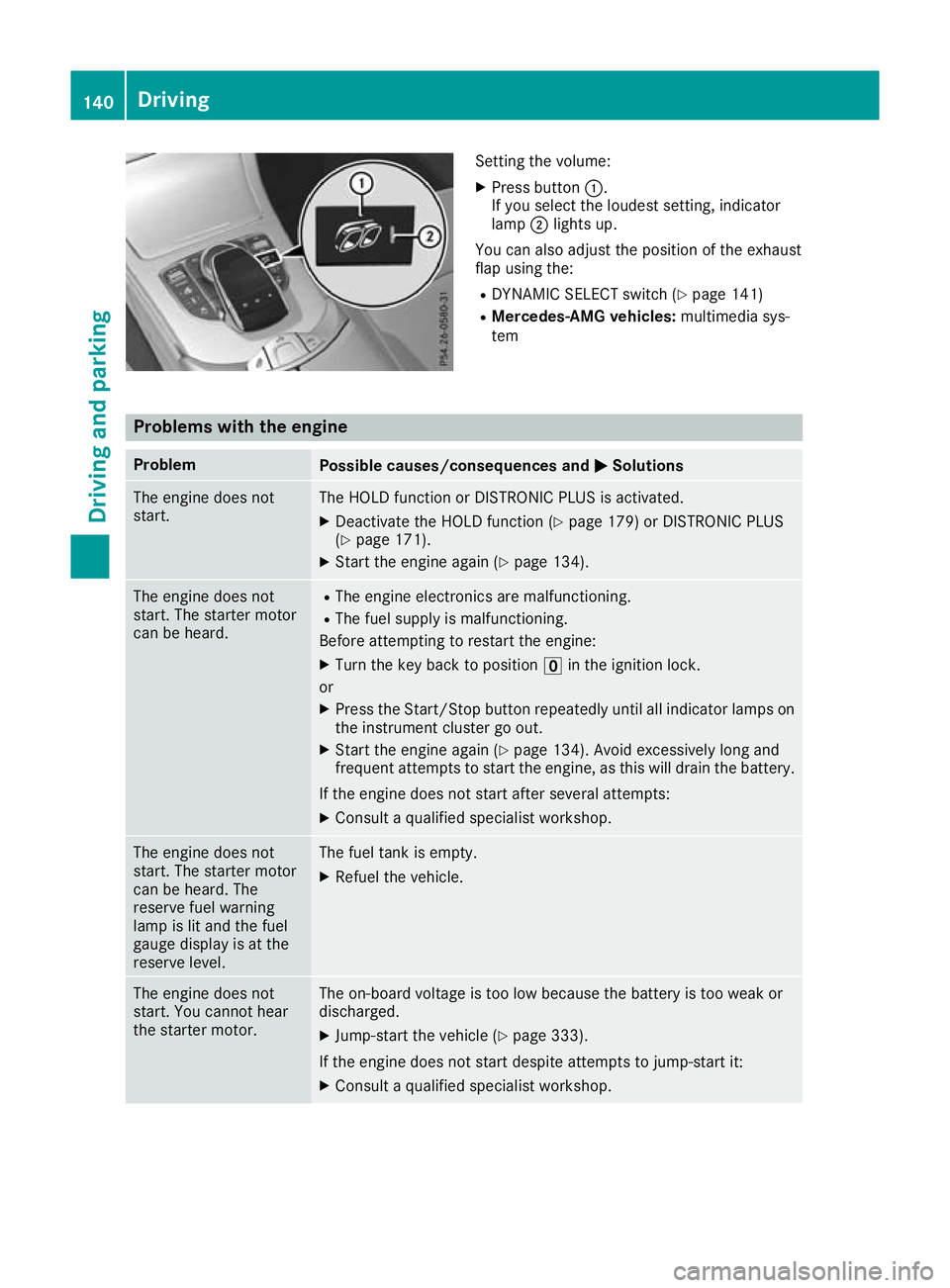
Setting the volume:
X Press button :.
If you select the loudest setting, indicator
lamp ;lights up.
You can also adjust the position of the exhaust
flap using the: R DYNAMIC SELECT switch (Y page 141)
R Mercedes-AMG vehicles: multimedia sys-
tem Problems with the engine
Problem
Possible causes/consequences and
M MSolutions The engine does not
start. The HOLD function or DISTRONIC PLUS is activated.
X Deactivate the HOLD function (Y page 179) or DISTRONIC PLUS
(Y page 171).
X Start the engine again (Y page 134).The engine does not
start. The starter motor
can be heard. R
The engine electronics are malfunctioning.
R The fuel supply is malfunctioning.
Before attempting to restart the engine:
X Turn the key back to position uin the ignition lock.
or X Press the Start/Stop button repeatedly until all indicator lamps on
the instrument cluster go out.
X Start the engine again (Y page 134). Avoid excessively long and
frequent attempts to start the engine, as this will drain the battery.
If the engine does not start after several attempts: X Consult a qualified specialist workshop. The engine does not
start. The starter motor
can be heard. The
reserve fuel warning
lamp is lit and the fuel
gauge display is at the
reserve level. The fuel tank is empty.
X Refuel the vehicle. The engine does not
start. You cannot hear
the starter motor. The on-board voltage is too low because the battery is too weak or
discharged.
X Jump-start the vehicle (Y page 333).
If the engine does not start despite attempts to jump-start it:
X Consult a qualified specialist workshop. 140
DrivingDriving and parking
Page 334 of 377
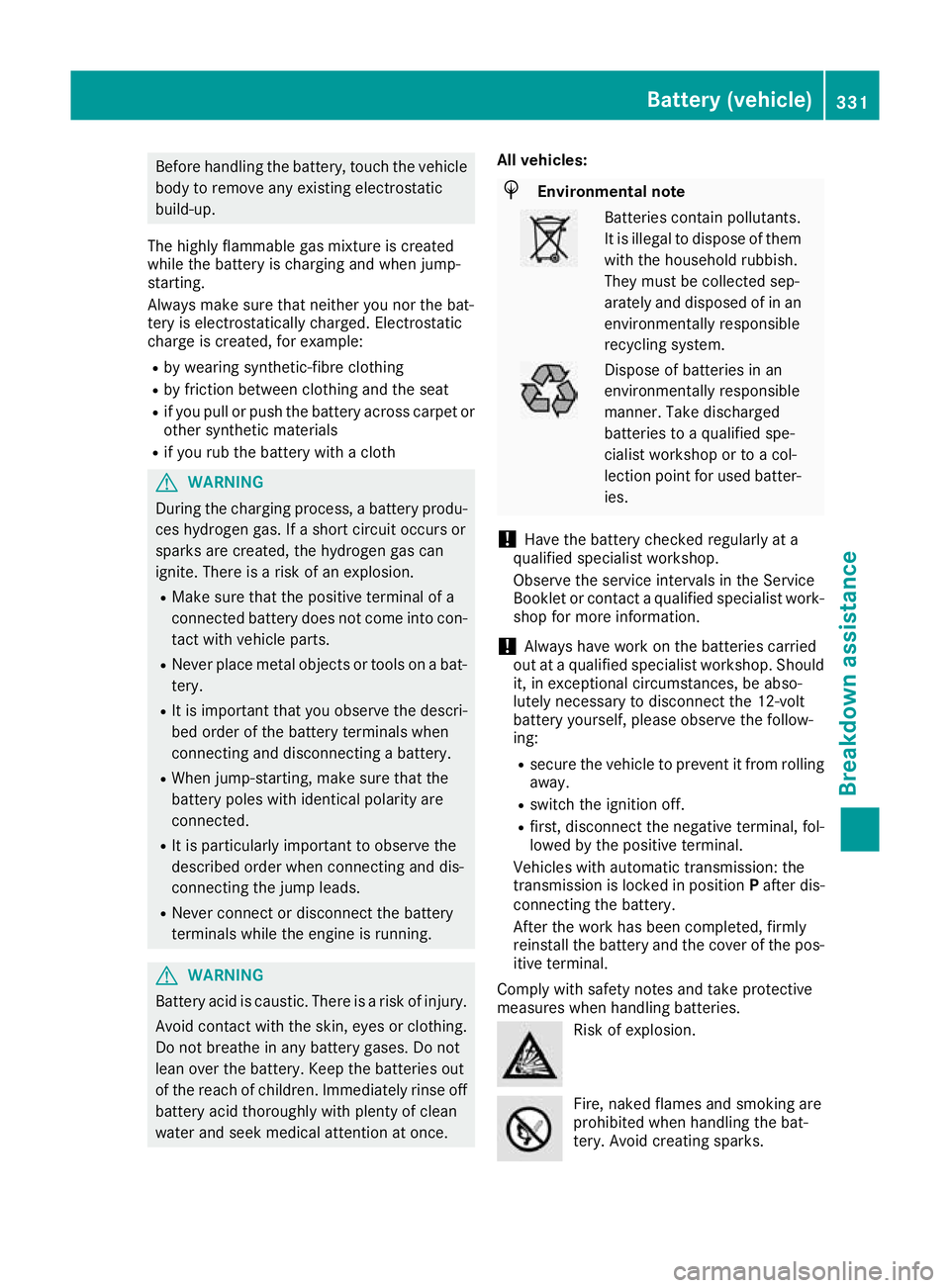
Before handling the battery, touch the vehicle
body to remove any existing electrostatic
build-up.
The highly flammable gas mixture is created
while the battery is charging and when jump-
starting.
Always make sure that neither you nor the bat-
tery is electrostatically charged. Electrostatic
charge is created, for example:
R by wearing synthetic-fibre clothing
R by friction between clothing and the seat
R if you pull or push the battery across carpet or
other synthetic materials
R if you rub the battery with a cloth G
WARNING
During the charging process, a battery produ- ces hydrogen gas. If a short circuit occurs or
sparks are created, the hydrogen gas can
ignite. There is a risk of an explosion.
R Make sure that the positive terminal of a
connected battery does not come into con- tact with vehicle parts.
R Never place metal objects or tools on a bat-
tery.
R It is important that you observe the descri-
bed order of the battery terminals when
connecting and disconnecting a battery.
R When jump-starting, make sure that the
battery poles with identical polarity are
connected.
R It is particularly important to observe the
described order when connecting and dis-
connecting the jump leads.
R Never connect or disconnect the battery
terminals while the engine is running. G
WARNING
Battery acid is caustic. There is a risk of injury. Avoid contact with the skin, eyes or clothing.
Do not breathe in any battery gases. Do not
lean over the battery. Keep the batteries out
of the reach of children. Immediately rinse off
battery acid thoroughly with plenty of clean
water and seek medical attention at once. All vehicles: H
Environmental note Batteries contain pollutants.
It is illegal to dispose of them
with the household rubbish.
They must be collected sep-
arately and disposed of in an environmentally responsible
recycling system. Dispose of batteries in an
environmentally responsible
manner. Take discharged
batteries to a qualified spe-
cialist workshop or to a col-
lection point for used batter-
ies.
! Have the battery checked regularly at a
qualified specialist workshop.
Observe the service intervals in the Service
Booklet or contact a qualified specialist work- shop for more information.
! Always have work on the batteries carried
out at a qualified specialist workshop. Should
it, in exceptional circumstances, be abso-
lutely necessary to disconnect the 12-volt
battery yourself, please observe the follow-
ing:
R secure the vehicle to prevent it from rolling
away.
R switch the ignition off.
R first, disconnect the negative terminal, fol-
lowed by the positive terminal.
Vehicles with automatic transmission: the
transmission is locked in position Pafter dis-
connecting the battery.
After the work has been completed, firmly
reinstall the battery and the cover of the pos- itive terminal.
Comply with safety notes and take protective
measures when handling batteries. Risk of explosion.
Fire, naked flames and smoking are
prohibited when handling the bat-
tery. Avoid creating sparks. Battery (vehicle)
331Breakdown assistance Z
Page 335 of 377
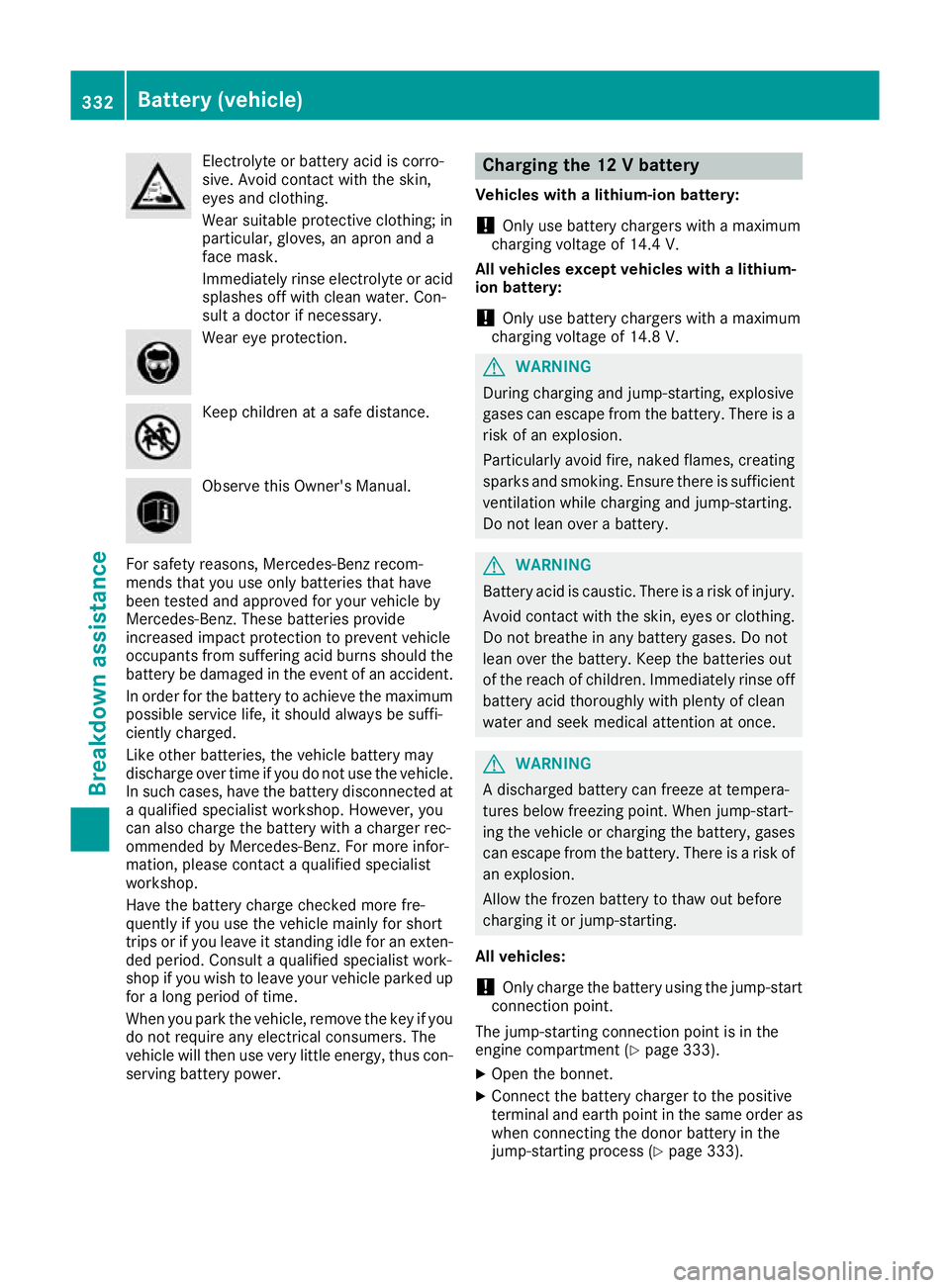
Electrolyte or battery acid is corro-
sive. Avoid contact with the skin,
eyes and clothing.
Wear suitable protective clothing; in
particular, gloves, an apron and a
face mask.
Immediately rinse electrolyte or acid
splashes off with clean water. Con-
sult a doctor if necessary. Wear eye protection.
Keep children at a safe distance.
Observe this Owner's Manual.
For safety reasons, Mercedes-Benz recom-
mends that you use only batteries that have
been tested and approved for your vehicle by
Mercedes-Benz. These batteries provide
increased impact protection to prevent vehicle
occupants from suffering acid burns should the battery be damaged in the event of an accident.
In order for the battery to achieve the maximum possible service life, it should always be suffi-
ciently charged.
Like other batteries, the vehicle battery may
discharge over time if you do not use the vehicle.In such cases, have the battery disconnected ata qualified specialist workshop. However, you
can also charge the battery with a charger rec-
ommended by Mercedes-Benz. For more infor-
mation, please contact a qualified specialist
workshop.
Have the battery charge checked more fre-
quently if you use the vehicle mainly for short
trips or if you leave it standing idle for an exten-
ded period. Consult a qualified specialist work-
shop if you wish to leave your vehicle parked up for a long period of time.
When you park the vehicle, remove the key if you
do not require any electrical consumers. The
vehicle will then use very little energy, thus con- serving battery power. Charging the 12 V battery
Vehicles with a lithium-ion battery:
! Only use battery chargers with a maximum
charging voltage of 14.4 V.
All ve hicles except vehicles with a lithium-
ion battery:
! Only use battery chargers with a maximum
charging voltage of 14.8 V. G
WARNING
During charging and jump-starting, explosive
gases can escape from the battery. There is a risk of an explosion.
Particularly avoid fire, naked flames, creating
sparks and smoking. Ensure there is sufficient
ventilation while charging and jump-starting.
Do not lean over a battery. G
WARNING
Battery acid is caustic. There is a risk of injury. Avoid contact with the skin, eyes or clothing.
Do not breathe in any battery gases. Do not
lean over the battery. Keep the batteries out
of the reach of children. Immediately rinse off
battery acid thoroughly with plenty of clean
water and seek medical attention at once. G
WARNING
A discharged battery can freeze at tempera-
tures below freezing point. When jump-start-
ing the vehicle or charging the battery, gases can escape from the battery. There is a risk of
an explosion.
Allow the frozen battery to thaw out before
charging it or jump-starting.
All vehicles: ! Only charge the battery using the jump-start
connection point.
The jump-starting connection point is in the
engine compartment (Y page 333).
X Open the bonnet.
X Connect the battery charger to the positive
terminal and earth point in the same order as
when connecting the donor battery in the
jump-starting process (Y page 333).332
Battery (vehicle)Breakdown assistance
Page 336 of 377
Keep away from fire and naked flames. Do not
lean over the battery. Never charge the battery
if it is still fitted to the vehicle, unless you are
using a battery charger that has been tested and
approved by Mercedes-Benz. A battery charger
unit specially adapted for Mercedes-Benz vehi-
cles and tested and approved by Mercedes-
Benz is available as an accessory. This device
permits charging of the battery while it is instal- led. Contact a Mercedes-Benz Service Centre
for information and availability. Read the battery charger's operating instructions before charg-
ing the battery.
All vehicles except vehicles with a lithium-
ion battery: if the warning and indicator lamps
on the instrument cluster do not light up at low temperatures, it is very likely that the dis-
charged battery has frozen. In this case, you
may neither jump-start the vehicle nor charge
the battery. The service life of a battery that has
been thawed may be reduced. The starting char-
acteristics may be impaired, especially at low
temperatures. Have the thawed battery
checked at a qualified specialist workshop.
Vehicles with a lithium-ion battery: at low
temperatures, do not use a battery charger to
charge a battery that has been removed. Allow
the battery to warm up gently first, if necessary. Otherwise, the service life may be reduced and
the starting characteristics impaired, especially
at low temperatures. Jump-starting
For the jump-starting procedure, use only the jump-starting connection point, consisting of a pos- itive terminal and an earth point, in the engine compartment.
All vehicles except vehicles with a lithium-ion battery: G
WARNING
Battery acid is caustic. There is a risk of injury.
Avoid contact with the skin, eyes or clothing. Do not breathe in any battery gases. Do not lean over the battery. Keep the batteries out of the reach of children. Immediately rinse off battery acid
thoroughly with plenty of clean water and seek medical attention at once. G
WARNING
During charging and jump-starting, explosive gases can escape from the battery. There is a risk of an explosion.
Particularly avoid fire, naked flames, creating sparks and smoking. Ensure there is sufficient
ventilation while charging and jump-starting. Do not lean over a battery. G
WARNING
During the charging process, a battery produces hydrogen gas. If a short circuit occurs or sparks
are created, the hydrogen gas can ignite. There is a risk of an explosion.
R Make sure that the positive terminal of a connected battery does not come into contact with
vehicle parts.
R Never place metal objects or tools on a battery.
R It is important that you observe the described order of the battery terminals when connecting
and disconnecting a battery.
R When jump-starting, make sure that the battery poles with identical polarity are connected.
R It is particularly important to observe the described order when connecting and disconnecting
the jump leads.
R Never connect or disconnect the battery terminals while the engine is running. Jump-starting
333Breakdown assistance Z
Page 337 of 377
G
WARNING
A discharged battery can freeze at temperatures below freezing point. When jump-starting the
vehicle or charging the battery, gases can escape from the battery. There is a risk of an explosion.
Allow the frozen battery to thaw out before charging it or jump-starting.
If the warning and indicator lamps do not light up on the instrument cluster when temperatures are low, it is probably because the discharged battery has frozen. In this case, you may neither jump-
start the vehicle nor charge the battery. The service life of a battery that has been thawed may be
reduced. The starting characteristics may be impaired, especially at low temperatures. Have the
thawed battery checked at a qualified specialist workshop.
All vehicles:
! Vehicles with a petrol engine:
avoid repeated and lengthy starting attempts. Otherwise, the
non-combusted fuel may damage the catalytic converter.
Do not use a rapid charging device to start the vehicle. If your vehicle's battery is discharged, the
engine can be jump-started from another vehicle or from a second battery using jump leads.
Observe the following points:
R The battery is not accessible in all vehicles. If the other vehicle's battery is not accessible, jump-
start the vehicle using a donor battery or a jump-starting device.
R Vehicles with a petrol engine: jump-start the vehicle only when the engine and exhaust system
are cold.
R All vehicles except vehicles with a lithium-ion battery: do not start the engine if the battery
is frozen. Let the battery thaw first.
R Jump-starting may be performed only using batteries with a nominal voltage of 12 V.
R Use only jump leads that have a sufficient cross-section and insulated terminal clamps.
R If the battery is fully discharged, leave the battery that is being used to jump-start connected for
a few minutes before attempting to start. This charges the empty battery a little.
R Make sure that the two vehicles do not touch.
Make sure that:
R The jump leads are not damaged.
R Non-insulated parts of the terminal clamps do not come into contact with other metal parts while
the jump leads are connected to the battery.
R The jump leads cannot come into contact with parts that can move when the engine is running,
such as the V-belt pulley or the fan.
X Secure the vehicle by applying the electric parking brake.
X Automatic transmission: shift the transmission to position P.
X Manual transmission: depress the clutch pedal fully and engage neutral.
X Make sure that the ignition is switched off . All indicator lamps on the instrument cluster must be
off. When using the key, turn the key to position 0in the ignition lock and remove it (Y page 133).
X Switch off all electrical consumers, e.g. rear window heating, lighting etc.
X Open the bonnet. 334
Jump-startingBreakdown assistance