roof MERCEDES-BENZ C CLASS COUPE 2002 User Guide
[x] Cancel search | Manufacturer: MERCEDES-BENZ, Model Year: 2002, Model line: C CLASS COUPE, Model: MERCEDES-BENZ C CLASS COUPE 2002Pages: 399, PDF Size: 16.59 MB
Page 204 of 399

201
Interior equipment
Te ch n i c a l
data
Instruments
and controls Operation
DrivingInstrument
cluster display Practical hints Car care Index
Opening the panorama sliding / pop-up roof
automatically
Move the switch past resistance point in direction (1)
and release. The roof will not open completely. Press
switch again to open it completely.
Stopping the sliding / pop-up roof:
Move the switch in any direction.
If the movement of the panorama sliding / pop-up roof is
blocked during the closing procedure, the roof will stop
and reopen slightly.
The panorama sliding/pop-up
roof can also be opened
and closed using the summer opening / convenience
feature, see page 34.
Notes:
The panorama sliding/pop-up roof can be opened or
closed manually should an electrical malfunction occur,
see page 354.
Wa r n i n g !
When closing the panorama sliding / pop-up roof,
be sure that there is no danger of anyone being
harmed by the closing procedure.The closing procedure of the panorama sliding/
pop- up roof can be immediately reversed by either
pressing or pulling the switch, or pressing
button Œon the electronic key and holding it.When leaving the vehicle, always remove the
electronic key from starter switch, and lock your
vehicle. Do not leave children unattended in the
vehicle, or with access to an unlocked vehicle.
Unsupervised use of vehicle equipment can cause
serious personal injury.
Page 205 of 399
202
Interior equipment
Te ch n i c a l
data
Instruments
and controls Operation
DrivingInstrument
cluster display Practical hints Car care Index
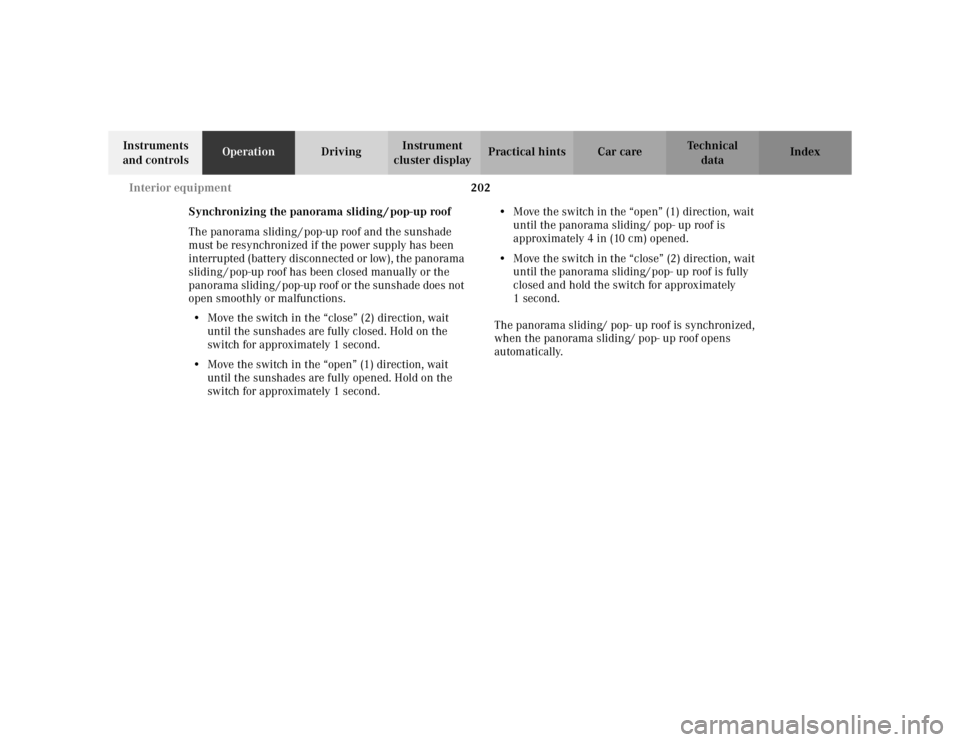
Synchronizing the panorama sliding / pop-up roof
The panorama sliding / pop-up roof and the sunshade
must be resynchronized if the power supply has been
interrupted (battery disconnected or low), the panorama
sliding / pop-up roof has been closed manually or the
panorama sliding / pop-up roof or the sunshade does not
open smoothly or malfunctions. • Move the switch in the “close” (2) direction, wait
until the sunshades are fully closed. Hold on the
switch for approximately 1 second.
• Move the switch in the “open” (1) direction, wait
until the sunshades are fu lly opened. Hold on the
switch for approximately 1 second. •
Move the switch in the “open” (1) direction, wait
until the panorama sliding/ pop- up roof is
approximately 4 in (10 cm) opened.
• Move the switch in the “close” (2) direction, wait
until the panorama sliding/ pop- up roof is fully
closed and hold the switch for approximately
1second.
The panorama sliding/ pop- up roof is synchronized,
when the panorama sliding/ pop- up roof opens
automatically.
Page 260 of 399
257
Driving instructions
Te ch n i c a l
data
Instruments
and controls Operation
DrivingInstrument
cluster display Practical hints Car care Index
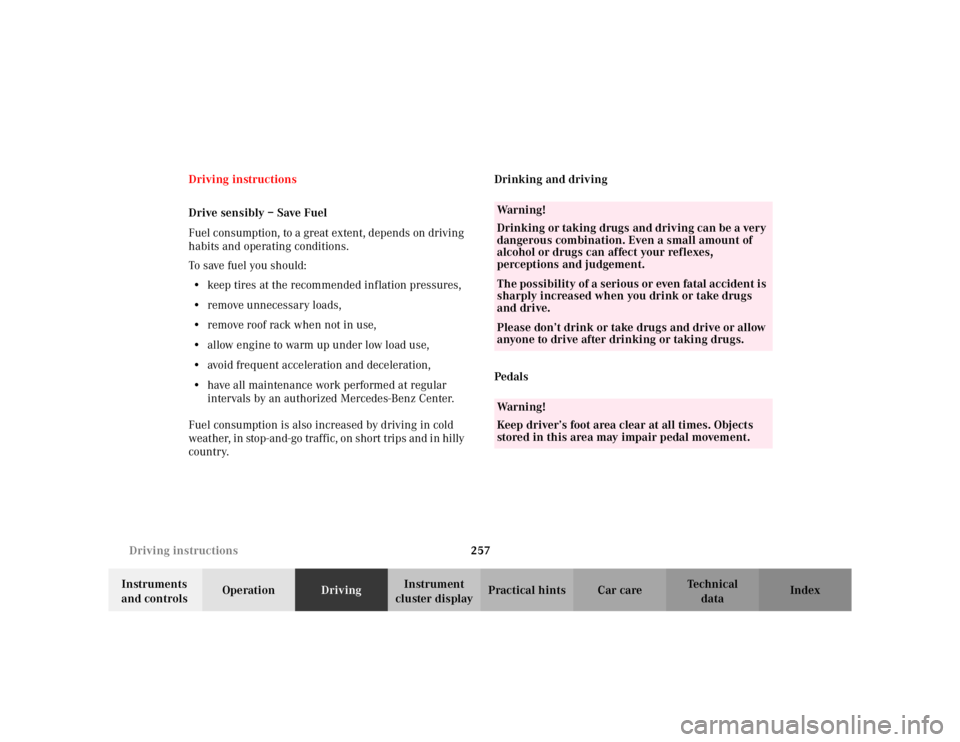
Driving instructions
Drive sensibly – Save Fuel
Fuel consumption, to a great extent, depends on driving
habits and operating conditions.
To save fuel you should:
• keep tires at the recommended inflation pressures,
• remove unnecessary loads,
• remove roof rack when not in use,
• allow engine to warm up under low load use,
• avoid frequent acceleration and deceleration,
• have all maintenance work performed at regular
intervals by an authorized Mercedes-Benz Center.
Fuel consumption is also increased by driving in cold
weather, in stop-and-go traffic, on short trips and in hilly
country. Drinking and driving
Ped al s
Wa r n i n g !
Drinking or taking drugs and driving can be a very
dangerous combination. Even a small amount of
alcohol or drugs can affect your reflexes,
perceptions and judgement.The possibility of a serious or even fatal accident is
sharply increased when you drink or take drugs
and drive.Please don’t drink or take drugs and drive or allow
anyone to drive after drinking or taking drugs.Wa r n i n g !
Keep driver’s foot area clear at all times. Objects
stored in this area may impair pedal movement.
Page 312 of 399

309
Contents - Practical hints
Te ch n i c a l
data
Instruments
and controls Operation Driving
Instrument
cluster display Practical hints
Car care Index
Practical hintsFirst aid kit...................................... 310
Stowing things in the vehicle ...... 311
Fuses ................................................ 311
Hood ................................................. 315
Automatic transmission
fluid level ................................... 317
Adding engine oil........................... 318
Coolant level ................................... 319 Adding coolant............................ 319
Windshield and headlamp washer system ........................... 320
Spare wheel, storage compartment.............................. 321 Vehicle tools and air pump .......... 322
Vehicle jack .................................... 323
Wheels ............................................ 324
Tire replacement........................ 324
Rotating wheels ......................... 325
Spare wheel .................................... 326
Changing wheels ........................... 327
Inflating the collapsible
spare tire ..................................... 333
Storing spare wheel in
wheel well ................................... 334
Tire inflation pressure ................. 335
Battery............................................. 336
Jump starting.................................. 338 Towing the vehicle......................... 341
Transmission selector lever,
manually unlocking ................... 344
Exterior lamps ................................ 345
Replacing bulbs .......................... 345
Changing batteries in the electronic main key .................. 351
Synchronizing remote
control .......................................... 353
Emergency engine shut-down ..... 353
Fuel filler flap, manual release ... 354
Replacing wiper blade insert ....... 356
Roof rack ......................................... 357
Page 340 of 399

337
Battery
Te ch n i c a l
data
Instruments
and controls Operation Driving
Instrument
cluster display Practical hints
Car care Index
Removal of filter box:
Release three clamps (1) and remove filter box.
Installation of filter box:
Install filter box properly and secure with
three clamps (1). Notes:
The gear selector lever will remain locked in
position “P” and the electronic key can not be turned in
the starter switch, if the vehicle battery is disconnected
or discharged.
After reconnecting the battery also set the clock
(vehicles with COMAND: see COMAND operator’s
manual) resynchronize the front seat head restraints,
the express feature of the power windows, the
panorama sliding / pop-up roof, and the electronic
stability program (see individual settings on page 121,
head restraints on page 54, power windows on page 197,
synchronizing the sliding / pop-up roof on page 202 and
electronic stability program on page 274).
Battery recycling
Batteries contain materials that can harm the
environment with improper disposal.
Large 12 Volt storage batteries contain lead.
Recycling of batteries is the preferred method of
disposal.
Many states require sellers of batteries to accept old
batteries for recycling.
Page 357 of 399

354
Fuel filler flap, manual release
Te ch n i c a l
data
Instruments
and controls Operation Driving
Instrument
cluster display Practical hints
Car care Index
Fuel filler flap, manual release
Open the trunk lid and fold right-side taillamp trim
aside. Reach inside and turn the release knob (arrow)
clockwise. Open the fuel filler flap. Emergency operation of sliding / pop-up roof
The panorama sliding / pop-up roof can be opened or
closed manually should an electrical malfunction occur.
The panorama sliding / pop-up roof drive is located
behind the lens (1) of the interior overhead light.
Pry off the lens (1) using a screwdriver.
P47.25-2031-26
Page 358 of 399

355
Emergency operation of sliding / pop-up roof
Te ch n i c a l
data
Instruments
and controls Operation Driving
Instrument
cluster display Practical hints
Car care Index
Slide both locking tabs (2) in direction of arrow, lower
rear of cover and remove.
Note:
Do not disconnect electrical connectors.
Obtain crank (3) (supplied with vehicle) and insert
through left hand side motor hole (4).
To slide roof closed or to raise the roof at the rear:
turn crank clockwise.
To slide the roof open or to lower the roof at the rear:
turn crank counterclockwise.
See page 202 for instructions on synchronizing the
panorama sliding / pop-up roof after closing manually.
Page 360 of 399

357
Replacing wiper blade insert
Te ch n i c a l
data
Instruments
and controls Operation Driving
Instrument
cluster display Practical hints
Car care Index
Place wiper blade on firm support. Press down both tabs
and slide (direction of arrow) the wiper blade insert out
of the retainer claws.
Installation:
Slide (direction of arrow) wiper blade insert into
retainer claws until tabs are engaged.
Slide wiper blade onto wiper arm until it locks in place. Roof rack
Mount roof racks only between the fastening points (1)
(see arrows) and in the recess of the rubber strip (2).
Use only those roof racks approved by Mercedes-Benz to
avoid damage to the vehicle. Follow manufacturer’s
installation instructions.
Page 363 of 399
360
Cleaning and care of the vehicle
Te ch n i c a l
data
Instruments
and controls Operation Driving
Instrument
cluster display Practical hints
Car care Index
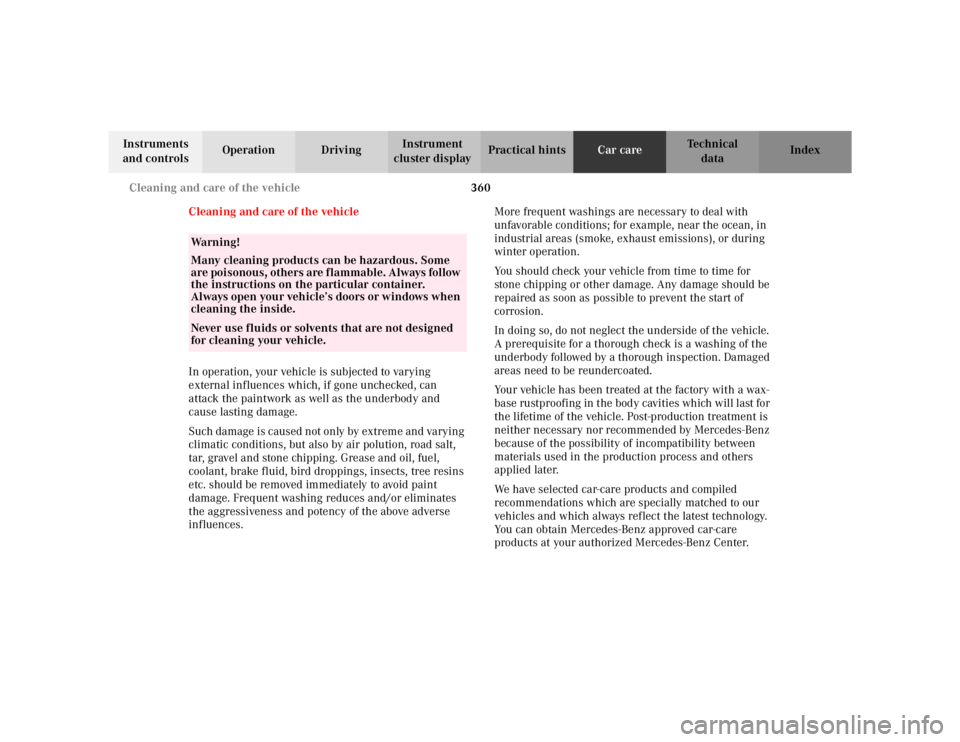
Cleaning and care of the vehicle
In operation, your vehicle is subjected to varying
external influences which, if gone unchecked, can
attack the paintwork as well as the underbody and
cause lasting damage.
Such damage is caused not only by extreme and varying
climatic conditions, but also by air polution, road salt,
tar, gravel and stone chipping. Grease and oil, fuel,
coolant, brake fluid, bird droppings, insects, tree resins
etc. should be removed immediately to avoid paint
damage. Frequent washing reduces and/or eliminates
the aggressiveness and potency of the above adverse
influences. More frequent washings are necessary to deal with
unfavorable conditions; for example, near the ocean, in
industrial areas (smoke, exhaust emissions), or during
winter operation.
You should check your vehicle from time to time for
stone chipping or other damage. Any damage should be
repaired as soon as possible to prevent the start of
corrosion.
In doing so, do not neglect the underside of the vehicle.
A prerequisite for a thorough check is a washing of the
underbody followed by a thorough inspection. Damaged
areas need to be reundercoated.
Your vehicle has been treated at the factory with a wax-
base rustproofing in the body cavities which will last for
the lifetime of the vehicle. Post-production treatment is
neither necessary nor recommended by Mercedes-Benz
because of the possibility of
incompatibility between
materials used in the production process and others
applied later.
We have selected car-care products and compiled
recommendations which are specially matched to our
vehicles and which always reflect the latest technology.
You can obtain Mercedes-Benz approved car-care
products at your authorized Mercedes-Benz Center.
Wa r n i n g !
Many cleaning products can be hazardous. Some
are poisonous, others are flammable. Always follow
the instructions on the particular container.
Always open your vehicle’s doors or windows when
cleaning the inside.Never use fluids or solvents that are not designed
for cleaning your vehicle.
Page 379 of 399
376
Technical data
Te ch n i c a l
data
Instruments
and controls Operation Driving
Instrument
cluster display Practical hints Car care Index
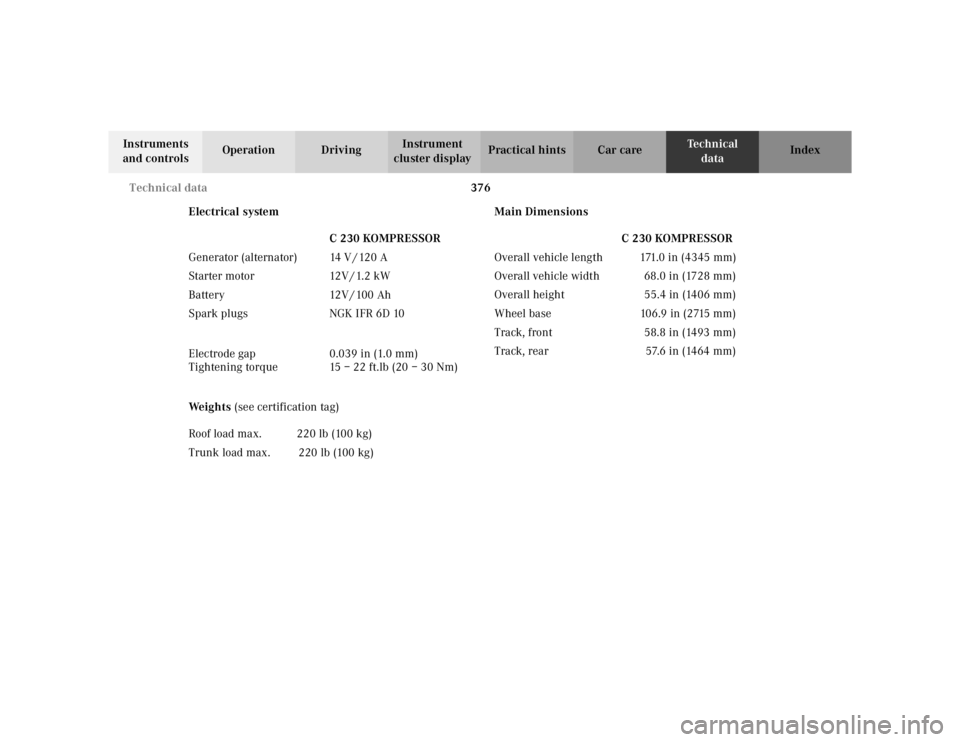
Electrical system
We i g h t s (see certification tag) Main Dimensions
C 230 KOMPRESSOR
Generator (alternator) 14 V / 120 A
Starter motor 12V / 1.2 kW
Battery 12V / 100 Ah
Spark plugs
Electrode gap
Tightening torque NGK IFR 6D 10
0.039 in (1.0 mm)
15 – 22 ft.lb (20 – 30 Nm)
Roof load max. 220 lb (100 kg)
Trunk load max. 220 lb (100 kg) C 230 KOMPRESSOR
Overall vehicle length 171.0 in (4345 mm)
Overall vehicle width 68.0 in (1728 mm)
Overall height 55.4 in (1406 mm)
Wheel base 106.9 in (2715 mm)
Track, front 58.8 in (1493 mm)
Track, rear 57.6 in (1464 mm)