lock MERCEDES-BENZ C-CLASS COUPE 2015 Owners Manual
[x] Cancel search | Manufacturer: MERCEDES-BENZ, Model Year: 2015, Model line: C-CLASS COUPE, Model: MERCEDES-BENZ C-CLASS COUPE 2015Pages: 385, PDF Size: 13.12 MB
Page 351 of 385
hitch. You could otherwise damage the vehi-
cle.
! Observe the following points when towing
with atow rope:
R Secure the tow rope on the same side on
both vehicles.
R Make sure that the tow rope is not longer
than legallyp ermitted. Mark the tow rope in
the middle, e.g. with awhite cloth
(30 x30c m).This will make other road
users aware that avehicle is being towed.
R Only secure the tow cable to the towing
eyes or, if available, to the trailer tow hitch.
R Observe the brake lamps of the towing
vehicle while driving. Always maintain adis-
tance adistance so that the tow rope does
not sag.
R Do not use steel cables or chains to tow
your vehicle. You could otherwise damage
the vehicle.
! Do not use the trailer tow hitch for recovery
or towing. Do not use the towing eye for
recovery. This could damage the vehicle. If in doubt, have the vehicle recovered using a
crane.
! Pull away smoothly when towing away or
tow-starting avehicle. If the tractive power is
too high, the vehicles could be damaged.
! Shift the automatic transmission to
Nand
do not open the driver's or front passenger's
door during towing. The automatic transmis-
sion may otherwise shift to position P,which
could damage the transmission.
! You may tow the vehicle for
amaximum of
50km.At owing speed of 50 km/h must not
be exceeded.
For towing distances over 50 km, the entire
vehicle must be lifted up and transported.
Observe the legal requirements for the relevant countries when towing.
It is better to have the vehicle transported than
to have it towed.
If the vehicle has suffered transmission damage,
have it transported on atransporter or trailer.
Vehicles with automatic transmission: when
towing avehicle, the automatic transmission
must be in position N.Ifthe automatic trans-
mission cannot be shifted to position N,have the vehicle transported on
atransporter or
trailer.
The battery must be connected and charged.
Otherwise, you:
R cannot turn the key to position 2in the igni-
tion lock
R cannot release the electric parking brake
R cannot shift the transmission to position Non
vehicles with automatic transmission
Deactivate the automatic locking feature before towing the vehicle (Y page 88). You could oth-
erwise be locked out when pushing or towing
the vehicle.
Deactivate tow-away protection before the vehi- cle is towed away (Y page 79). Fitting/removing the towing eye
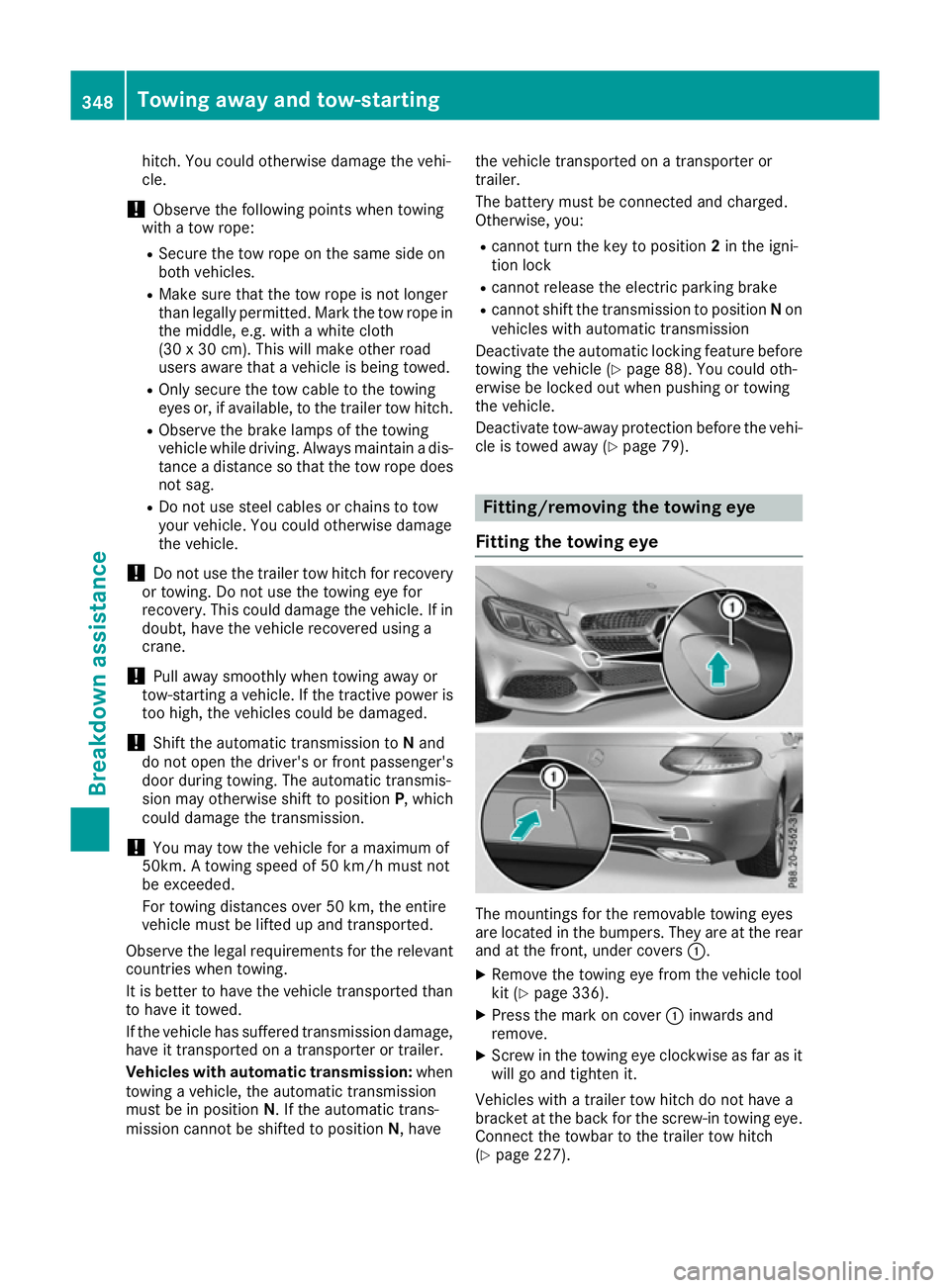
Fitting the towing eye The mountings for the removable towing eyes
are located in the bumpers. They are at the rear
and at the front,u nder covers:.
X Remove the towing eye from the vehicle tool
kit (Y page 336).
X Press the mark on cover :inwards and
remove.
X Screw in the towing eye clockwise as far as it
will go and tighten it.
Vehicles with atrailer tow hitch do not have a
bracket at the back for the screw-in towing eye. Connect the towbar to the trailer tow hitch
(Y page 227). 348
Towing away and tow-startingBreakdown assistance
Page 352 of 385
Removin
gthe towin geye X
Loosen the towing ey eand unscrew it.
X Attach cover :to the bumpe rand press until
it engages.
X Pu tthe towing ey ebacki nto the vehicl etool
kit. Towin
gthe vehicle awa ywitht he rear
axl eraised
Whe ntowing your vehicl ewitht he rea raxle
raised ,itisimportant that yo uobserve the
safety instructions (Y page 347).
! Vehicles with automatic transmissio
nmust
not be towe dwitht he rea raxler aised .The
car/traile rcombination may otherwise
swerve or eve noverturn.
! The ignition mus
tbes witched off if yo uare
towing the vehicl ewitht he rea raxler aised.
Intervention by ESP ®
could otherwise dam-
ag et he brake system.
X Switch on the hazard warning lamps
(Y page 120).
X Move the front wheel stothe straight-ahead
position.
X If necessary, turn the key in the ignition lock
to position 0and remove the key from the
ignition lock.
X Whe nleaving the vehicle, take the key with
you. Towin
gthe vehicle with both axles on
the ground
Vehicles with automati ctransmission: the
automatic transmissio nautomaticall yshifts to
position Pwhen yo uopent he driver' sorfront-
passenger doo rorwheny ou remove the key
from the ignition lock. In order to ensure that the automatic transmissio nstay sinp osition N
when towing away the vehicle, yo umustd othe
following:
X Make sure that the vehicl eisstationary.
X Turn the key to position 2in the ignition lock. X
Depress the brake pedal and keep it
depressed.
X Shif tthe automatic transmissio ntoposition
N.
Vehicles with manual transmission: X Turn the key to position 2in the ignition lock.
X Depress the brake pedal and keep it
depressed.
X Depress the clutch pedal fully and shift to
neutral.
Vehicles with manual or automati ctrans-
mission:
X Leave the key in position 2in the ignition lock.
X Releas ethe brake pedal.
X Releas ethe electri cparking brake.
X Switch on the hazard warning lamps
(Y page 120).
In order to signal achange of direction when
towing the vehicl ewitht he hazard warning
lamps switched on, us ethe combination switch
as usual. In this case, only the turn signal sfor
the desire ddirection flash. Whe nyou reset the
combination switch, the hazard warning lamps
star tflashing again. Transporting the vehicle
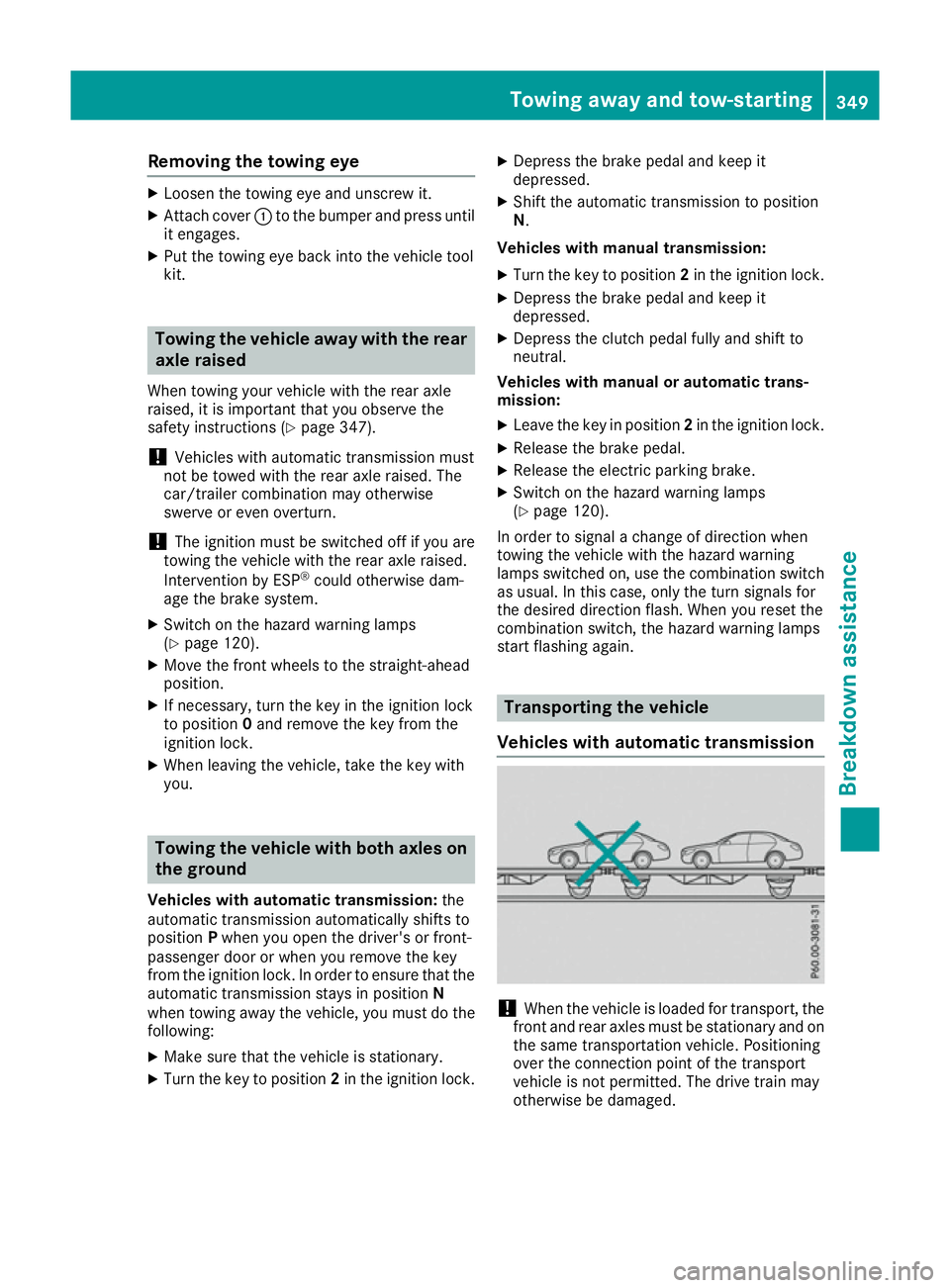
Vehicles with automati ctransmission !
Whe
nthe vehicl eisloaded for transport, the
front and rea raxles mus tbes tationary and on
the same transportation vehicle. Positioning
ove rthe connection point of the transport
vehicl eisnot permitted. The drive trai nmay
otherwise be damaged. Towin
gawayand tow-starting
349Breakdown assistance Z
Page 353 of 385
All vehicles
!
You may only secure th
evehicl ebyt he
wheels, no tbypartsoft hevehicl esuchas
axl eors teering components. Otherwise ,the
vehicl ecould be damaged.
The towin geyes or trailer to whitch can be used
to pull th evehicl eontoa trailer or transporte rif
you wish to transpor tit.
X Vehicles wit
hmanua ltra nsmission:
depress th eclutch pedal fully and engage
neutral.
X Vehicles wit
hautomatic transmission:
tur nthe keyt op osition 2in th eignition lock.
X Shift th eautomatic transmission to position
N.
As soon as th evehicle is loaded:
X Preven tthe vehicl efromr ollin gaway by
applyin gthe electric parking brake.
X Vehicles wit
hmanua ltra nsmission:
depress th eclutch pedal fully and engage first
or revers egear.
X Vehicles wit
hautomatic transmission:
shif tthe automatic transmission to position
P.
X Turn th ekeyto position 0in th eignition lock
and remove it.
X Secur ethe vehicle. Tow-starting (emergency engine
starting)
! Do no
ttow -star tvehicles wit hautomatic
transmission .You could otherwise damage
th ea utomatic transmission.
i You can fin
dinformation on "Jump-starting"
under (Y page 345).
Befor etow -starting ,the followin gconditi ons
mus tbef ulfilled:
R theb attery is connected
R thee ngineh as cooled down
R thee xhaust system has cooled down
When tow-starting ,itisimportant that you
observ ethe safet ynotes ( Ypage 347) and the
legal requirements in eac hrespective country.
X Switc hont hehazard warning lamps
(Y page 120).
X Fit th etow inge ye (Y page 348). X
Secur ethe rigid towin gbar or th etow ing
rope.
X Depress th ebrak epedal and keep it
depressed.
X Turn th ekeyto position 2in th eignition lock.
X Depress th eclutch pedal fully, engage 2nd
gear and continu etokeept he clutch pedal
fully depressed.
X Releas ethe brak epedal.
X Tow-start th evehicle.
X Releas ethe clutch pedal slowly; do not
depress th eaccelerato rpedal while doin gso.
X When th eengineh as been started, immedi-
ately depress th eclutch pedal fully and shift
to neutral.
X Pull ove ratasuitable plac eand stop th evehi-
cle safely, payin gattention to road and traffic
conditions.
X Use th eelectric parking brak etosecure the
vehicl eand preven titfromr ollin gaway.
X Remove th erigid towin gbar or towin grope.
X Remove th etow inge ye (Y page 349).
X Switc hoff th ehazard warning lamps. Electrical fuses
Important safety notes
G
WARNING
If you manipulate, bridge or replace afaulty
fus ew ithaf useofah igher amperage ,the
electric cables could be overloaded. This may result in afire. There is ariskofana ccident
and injury.
Always replace fault yfuses wit hspecifie dnew
fuses of th ecorrect amperage.
Blown fuses mus tbereplace dwithf uses of the
sam erating ,whic hy ou can recognise by the
colour and fus erating .The fus erating sare listed
in th efusea llocation chart.
The fus eallocation chart is on th efus eb ox in the
boot (Y page 352).
If th enewly inserted fus ealso blows ,havet he
caus etrace da nd rectifie dataqualified special-
ist workshop ,e.g.a Mercedes-Benz Service
Centre.
! Only use fuses that hav
ebeen approve dfor
Mercedes-Benz vehicles and whic hhavet he 350
Electrical fusesBreakdown assistance
Page 354 of 385
correct fus
erating for the system concerned.
Otherwise, components or systems could be
damaged.
! Make sure that no moistur
ecan enter the
fus eb ox whe nthe cover is open.
! Whe
nclosing the cover ,make sure that it is
lying correctly on the fus ebox. Moistur eseep-
ing in or dirt could otherwise impai rthe oper-
ation of the fuses.
The fuses in your vehicle disconnect faulty cir-
cuits. If afuseb lows ,allthe components on the
circuit and thei rfunctions will fail. Before replacing
afuse
Observe the important safety notes
(Y page 350)
X Switch off the engine.
X Switch off al lelectrical consumers.
X Safeguard the vehicle against rolling away
(Y page 172).
X Remove the key from the ignition lock.
or, on vehicle swithK EYLESS-G Ostartfunction
or KEYLESS ‑GO:
X Ope nthe driver' sdoor.
The on-board electronics now have status 0.
Thi sist he sam easthe key having been
removed.
The driver' sdoorc an be closed again.
All indicator lamps in the instrument cluster
mus tbeo ff.
The fuses are located in variou sfuseb oxes:
R fus ebox on the driver' ssideoft he dashboard
R fus eb ox in the front-passenger footwell
R fus eb ox in the engine compartment on the
driver' sside
R fus eb ox under the boo tfloor on the right-
hand sid eofthe vehicle ,whenv iewe dint he
direction of travel Dashboard fuse box
! Do not us
eapointed object such as ascrew-
driver to ope nthe cover in the dashboard. You
could damag ethe dashboard or the cover. X
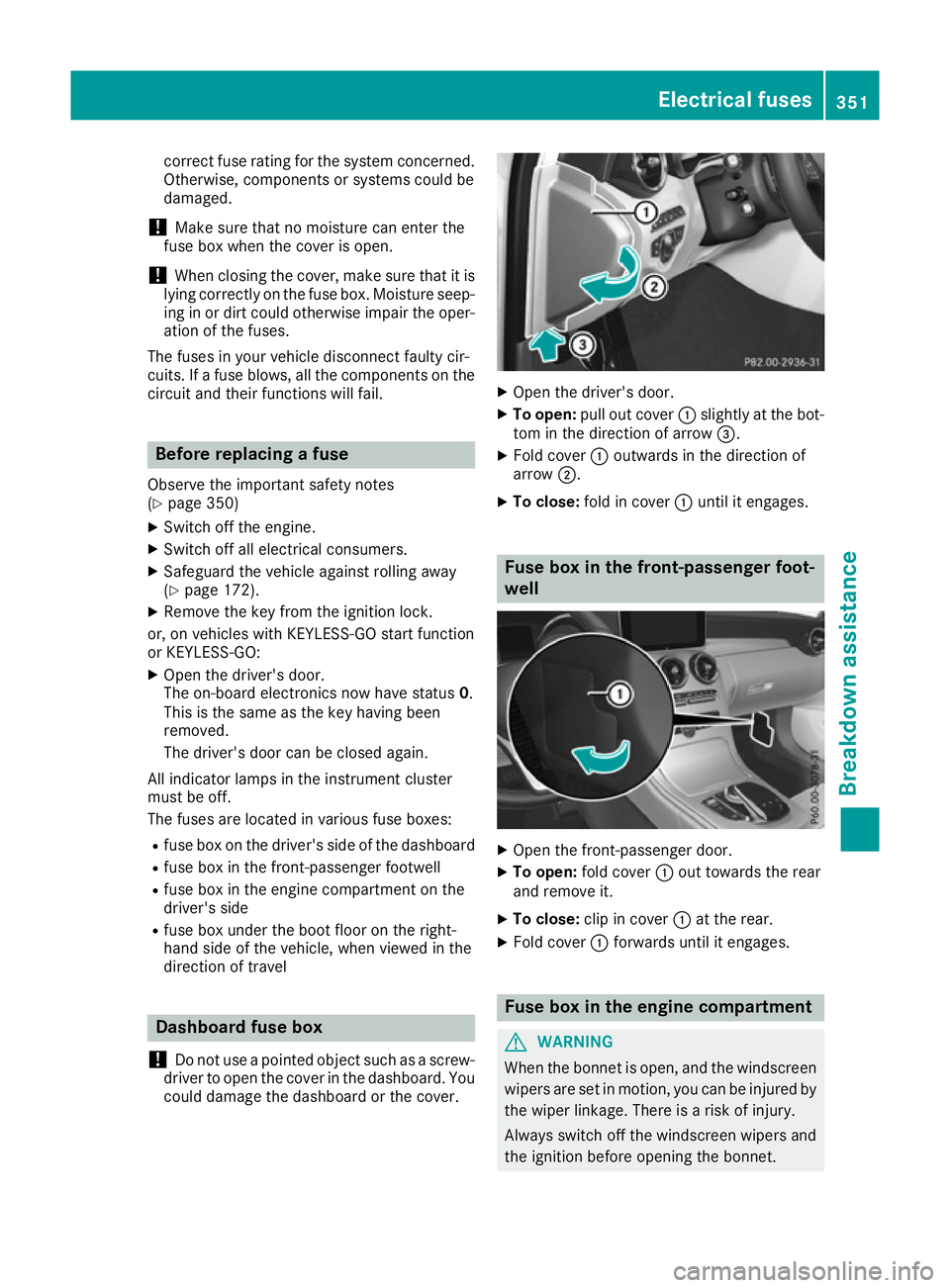
Ope nthe driver' sdoor.
X To open: pull outcover :slightl yatthe bot-
tom in the direction of arrow =.
X Fold cover :outwards in the direction of
arrow ;.
X To close: foldinc over:unti lite ngages. Fus
eboxin the front-passenge rfoot-
well X
Ope nthe front-passenger door.
X To open: foldc over :outtowards the rear
and remove it.
X To close: clipinc over:at the rear.
X Fold cover :forward suntilite ngages. Fus
eboxin the engine compartment G
WARNING
Whe nthe bonne tiso pen, and the windscreen
wiper sare set in motion, yo ucan be injured by
the wiper linkage .There is ariskofi njury.
Alway sswitch off the windscreen wiper sand
the ignition before opening the bonnet. Electrical fuses
351Breakdown assistance Z
Page 357 of 385
peratures and low tyre operatin
gtempera-
tures. There is arisk of an accident.
Turn on ESP ®
and adapt your driving style
accordingly. When the outside temperature
falls below 10 †, use M+S tyres.
i Different driving styles may lead to higher
levels of tyre wear, meanin gthe tyres may
wear down to the minimum tyre tread depth
after less mileage. Regular checking of wheels and tyres
G
WARNING
Damaged tyres can cause tyre inflation pres-
sure loss. As aresult, you could lose control of
your vehicle. There is arisk of accident.
Check the tyres regularly for signs of damage and replace any damaged tyres immediately.
Check wheels and tyres for damage at least
onc eam onth. Check wheels and tyres after
driving off-road or on rough roads. Damaged
wheels can cause aloss of tyre pressure. Pay
particular attention to damage such as:
R cuts in the tyres
R punctures
R tears in the tyres
R bulges on the tyres
R deformation or severe corrosion on wheels
Regularly chec kthe tyre tread depth and the
condition of the tread across the whole width of
the tyre (Y page 354).Ifnecessary, turn the
fron twheels to full lock in order to inspec tthe
inne rside of the tyre surface.
All wheels must have avalve cap to protect the
valve against dirt and moisture. Do not fit any-
thin gontot he valve other than the standard
valve cap or other valve caps approved for your vehicle by Mercedes-Benz.Don ot fit any other
valve caps or systems ,e.g. tyre pressure moni-
torin gsystems.
Regularly chec kthe pressure of all the tyres,
particularly prior to long trips. Adjust the tyre
pressure as necessary (Y page 356).
Observe the notes on the emergency spare
wheel (Y page 367). The servic
elife of tyres depends on various fac-
tors ,includin gthe following:
R driving style
R tyre pressure
R mileage Notes on the tyr
etread G
WARNING
Insufficien ttyre tread will reduce tyre trac-
tion .The tyre is no longer able to dissipate
water. This means that on wet road surfaces, the risk of aquaplaning increases, in particularwhere speed is not adapted to suit the driving
conditions. There is arisk of accident.
If the tyre pressure is too high or too low, tyres may exhibit differen tlevels of wear at differ-
ent location sonthe tyre tread. Thus, you
should regularly chec kthe tread depth and
the condition of the tread across the entire
width of all tyres.
Minimum tyre tread depth for:
R summer tyres: 3mm
R M+S tyres: 4mm
For safety reasons ,replace the tyres before
the legally prescribed limit for the minimum
tyre tread depth is reached. Selecting, fitting and replacing tyres
G
WARNING
Exceeding the stated tyre load-bearing capa-
city and the approved maximum speed could
lead to tyre damage or the tyre bursting. There is ar isk of accident.
Therefore, only use tyre types and sizes
approved for your vehicle model. Observe the
tyre load ratin gand speed ratin grequired for
your vehicle.
Pay special attention to country-specific
requirements for tyre approval. These require-
ment scan stipulate aspecific tyre type for your
vehicle. Furthermore, the use of certain tyre
types in certain regions and areas of operation
can be highly beneficial. You can find further 354
OperationWheels and tyres
Page 361 of 385
This improves the ride comfor
tofyour vehicle;
however, fuel consumption may increase
slightly. Tyrep
ressure loss warning system
General notes While the vehicle is in motion
,the tyre pressure
loss warning system monitors the set tyre pres-
sure using the rotational speed of the wheels.
This enables the system to detect significant
pressure loss in atyre. If the speed of rotation of
aw heel changes as aresult of aloss of pressure,
ac orresponding warning message will appear in
the multifunction display.
You can recognise the tyre pressure loss warn-
ing by the Run Flat Indicator active
Run Flat Indicator active
Restart with OK Restart with OK message which appears in
the Service
Service menu of the multifunction display.
Information on the message display can be
found in the "Restarting the tyre pressure loss
warning system" section (Y page 358).
Important safety notes The tyre pressure warning system does not warn
you of an incorrectly set tyre pressure. Observe the notes on the recommended tyre pressure
(Y page 356).
The tyre pressure loss warning does not replace the need to regularly check the tyre pressures.
An even loss of pressure on several tyres at the
same time cannot be detected by the tyre pres-
sure loss warning system.
The tyre pressure monitor is not able to warn
you of asudden loss of pressure, e.g. if the tyre
is penetrated by aforeign object .Inthe event of
as udden loss of pressure, bring the vehicle to a
halt by braking carefully. Avoid abrupt steering
manoeuvres.
The function of the tyre pressure loss warning
system is limited or delayed if:
R snow chains are fitted to your vehicle's tyres.
R road conditions are wintry.
R you are driving on sand or gravel.
R you adopt avery sporty driving style (corner-
ing at high speeds or driving with high rates of
acceleration).
R you are towing avery heavy or large trailer. R
you are driving with aheavy load (in the vehi-
cle or on the roof).
R
Restarting the tyrep ressureloss warn-
ing system Restart the tyre pressure loss warning system if
you have:
R changed the tyre pressure
R changed the wheels or tyres
R fitted new wheels or tyres
X Before restarting, make sure that the tyre
pressures are set properly on all four tyres for
the respective operating conditions. The rec-
ommended tyre pressures can be found in the
tyre pressure table on the fuel filler flap.
The tyre pressure loss warning system can
only give reliable warnings if you have set the correc ttyre pressure. If an incorrect tyre
pressure is set, these incorrect values will be
monitored.
X Observe the notes in the section on tyre pres-
sures (Y page 356).
X Make sure that the key is in position 2in the
ignition lock (Y page 145).
X Press òon the steerin gwheel to call up
the menu list.
X Press 9or: on the steerin gwheel to
select the Service Servicemenu.
X Confirm by pressing aon the steering
wheel.
X Select Tyre pressure
Tyre pressure with9 or:.
X Press ato confirm.
The Run
Run Flat
Flat Indicator
Indicator active
activeRestart
Restart
with OK
with OK message is shown in the multifunc-
tion display.
If you wish to confirm the restart: X Press the abutton.
The Tyre pressure now OK?
Tyre pressure now OK? message is
shown in the multifunction display.
X Select Yes
Yeswith 9 or:.
X Press ato confirm.
The Run Flat Indicator restarted
Run Flat Indicator restarted mes-
sage is shown in the multifunction display.
After ateach-in period, the tyre pressure loss
warning system will monitor the set tyre pres- sures of all four tyres. 358
Tyrep
ressureWheels and tyres
Page 363 of 385
radios) that may be being operated in or near the
vehicle.
Checking the tyre pressure electroni-
cally X
Make sure that the key is in position 2in the
ignitio nlock (Y page145).
X Press òon the steering whee ltocall up
the menu list.
X Press 9or: on the steering whee lto
select the Service
Servicemenu.
X Confirm by pressing aon the steering
wheel.
X Select Tyre pressure
Tyre pressure with9 or:.
X Press ato confirm.
The multifunction display shows the current
tyre pressure of each wheel.
If the vehicl ewas parked for longer than
20 minutes ,the following message appears:
Tyre pressure swill be displayed
Tyre pressure swill be displayed
after afew minutes of driving
after afew minutes of driving.
After ateach-in period, the tyre pressure moni-
tor automatically detects new wheels or new
sensors. As long as acleara llocation of the tyre
pressure values to the individualw heels is not
possible, the Tyre Tyrepressure
pressure monitor
monitoractive
active
message is shown instead of the tyre pressure
display.T he tyre pressures are already being
monitored.
If an emergency spare whee lisfitted, for afew
minutes the system may continue to show the
tyre pressure of the whee lthat has been
removed .Ifthis occurs, note that the valu edis-
played for the position where the spare whee lis
fitted is not the same as the current tyre pres-
sure of the emergency spare wheel.
Warning message softhe tyre pressure
monitor If the tyre pressure monitor detects
apressure
loss in one or more tyres, awarning message is
shown in the multifunction display.T he yellow
tyre pressure warning lamp then lights up.
R If the Please correct tyre pressure
Please correct tyre pressure
message appears in the multifunction display,
the tyre pressure in at least one tyre is too
low.T he tyre pressure must be corrected
when the opportunity arises.
R If the Check Check tyre(s)
tyre(s) message appears in the
multifunction display,t he tyre pressure in at least one tyre has dropped significantly. The
tyres must be checked.
R If the Warning tyre defect Warning tyre defect message
appears in the multifunction display,t he tyre
pressure in at least one tyre has dropped sud- denly .The tyres must be checked.
Observe the instructions and safety notes in the display messages in the "Tyres" section
(Y page2 77).
If the whee lpositions on the vehicl eare inter-
changed ,the tyre pressures may be displayed
for the wrong positions for ashort time. After a
few minutes of driving, this is rectified and the
tyre pressures are displayed for the correct
positions.
Restarting the tyre pressure monitor When you restart the tyre pressure monitor, all
existing warning messages are deleted and the
warning lamp sgoout. The monitor uses the cur-
rently set tyre pressures as the reference values
for monitoring. In most cases, the tyre pressure monitor willa utomatically detect the new refer-
ence values after you have changed the tyre
pressure. However, you can alsos et reference
values manually as described here. The tyre
pressure monitor then monitors the new tyre
pressure values.
X Use the table on the insid eofthe fuel filler flap
to ensure that the tyre pressure is set cor-
rectly in all four tyres for the current operating
conditions.
Also observe the notes in the section on tyre
pressures (Y page356).
X Make sure that the key is in position 2in the
ignitio nlock (Y page145).
X Press òon the steering whee ltocall up
the menu list.
X Press 9or: on the steering whee lto
select the Service Servicemenu.
X Confirm by pressing aon the steering
wheel.
X Select Tyre pressure
Tyre pressure with9 or:.
X Press ato confirm.
The multifunction display shows the current
tyre pressure of each whee lortheTyre Tyre 360
Tyre pressureWheels and tyres
Page 365 of 385
Fitting
awheel
Preparing th evehicle X
Stop th evehicl eons olid, non-slippery and
leve lground.
X Apply th eelectric parking brak emanually.
X Mov ethe fron twheels to th estraight-ahead
position.
X Vehicles with manua
ltra nsmission:
depress th eclutch pedal fully and engage first
or revers egear.
X Vehicles with automatic transmission:
shif tthe automatic transmission to position
P.
X Mak esure that th evehicl eleve liss et to "Nor-
mal" on vehicles wit hAIRMATIC (Y page 195).
X Switc hoff th eengine.
X Vehicles without KEYLESS-GO: remove the
ke yf romt heignition lock.
X Vehicles with KEYLESS-GO start-function
or KEYLESS-GO: open thedriver' sdoor.
The on-board electronics no whave status 0.
This is th esam east hekeyh aving been
removed.
X Vehicles with KEYLESS-GO start-function
or KEYLESS-GO: remove theStart/Sto pbut-
to nf romt heignition loc k(Ypage 145).
X If included in th evehicl eequipment, remove
th et yre-chang etoolkit from th evehicle.
X Safeguar dthe vehicl eagainst rollin gaway.
i Apart from som
ecountry-specific variants,
vehicles are no tequipped wit htyre-changing
tools. Some tools for changing awhee lare
specific to th evehicle. Fo rmorei nformation
on whic htools are require dtoperforma
whee lcha ng eony our vehicle, consult aquali-
fie ds pecialist workshop.
Necessary tyre-changing tools may include,
for example:
R Jack
R Whee lchock
R Whee lwrench
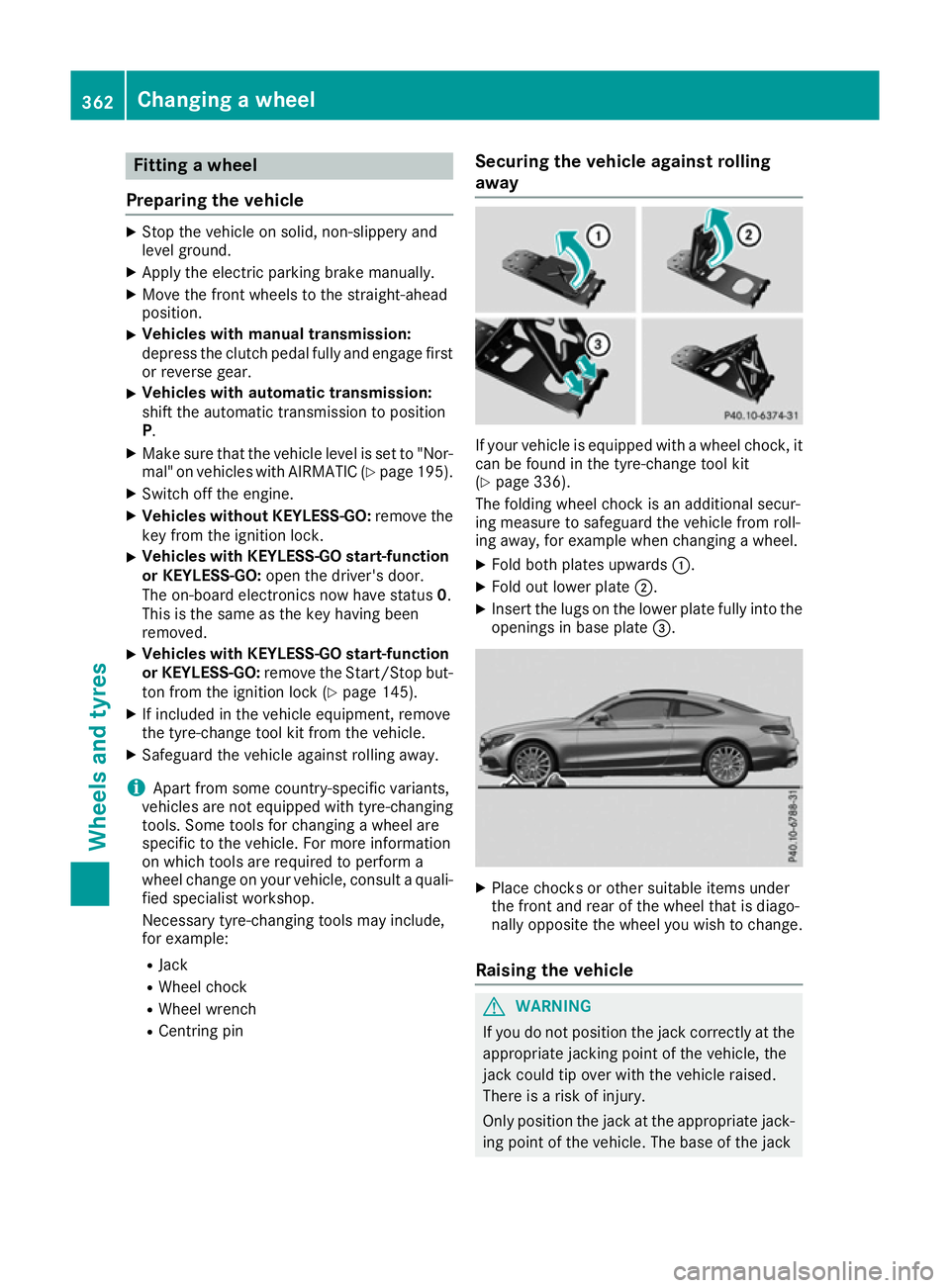
R Centring pin Securing th
evehicle against rolling
away If your vehicl
eisequipped wit hawheelchock ,it
can be foun dinthetyre-chang etoolkit
(Y page 336).
The foldin gwhee lchock is an additional secur-
ing measure to safeguar dthe vehicl efromr oll-
ing away, for exampl ewhen changing awheel.
X Fold bot hplates upwards :.
X Fold out lower plate ;.
X Inser tthe lugs on th elower plat efully int othe
opening sinbase plate =. X
Plac echock soro ther suitable items under
th ef ront and rear of th ewhee ltha tisd iago-
nally opposit ethe whee lyou wish to change.
Raising th evehicle G
WARNING
If you do no tposition th ejackc orre ctly at the
appropriat ejackin gpointoft hevehicle, the
jac kc ould ti poverw itht he vehicl eraised.
Ther eisar iskofi njury.
Only position th ejac katt heappropriat ejack-
ing poin tofthevehicle. The base of th ejack 362
Changing
awheelWheels and ty res
Page 366 of 385
must be positioned vertically, directly under
the jacking point of the vehicle.
Observe the following when raising the vehi- cle:
R only use the vehicle-specifi cjack that has
been tested and approved by Mercedes-Benz
to rais ethe vehicle. If the jack is used incor-
rectly, it could tip over while the vehicl eis
raised.
R the jack is designed only to rais eand hold the
vehicl efor as hort time while awhee lisb eing
changed. It is not permissibl etouse it to per-
form maintenance work under the vehicle.
R avoi dchanging the whee lonuphill and down-
hill slopes.
R before raising the vehicle, safeguard it from
rolling awaybya pplying the parking brake and
positioning whee lchocks. Do not release the
parking brake while the vehicl eisraised.
R the jack must be placed on afirm, flat and
non-slip surface. On aloose surface, alarge,
flat load-bearing underlay must be used .Ona
slippery surface, anon-slip underlay must be
used ,e.g. rubber mats.
R do not use wooden blocks or similar objects
as ajack underlay.O therwise, the jack willn ot
be abletoa chieve its load-bearing capacity
due to the restricted height.
R make sure that the distance betwee nthe
underside of the tyres and the ground does
not exceed 3cm.
R never place yourh ands or feet under the
raised vehicle.
R do not lie under the vehicle.
R do not start the engine when the vehicl eis
raised.
R do not open or close adoor or the boot lid
when the vehicl eisraised.
R make sure that no persons are present in the
vehicl ewhen the vehicl eisraised.
Vehicles with light-alloy wheels and hub
caps: the whee lbolts are covered by ahub cap.
Before you can unscrew the whee lbolts, you
must remove the hub cap. Two different variants
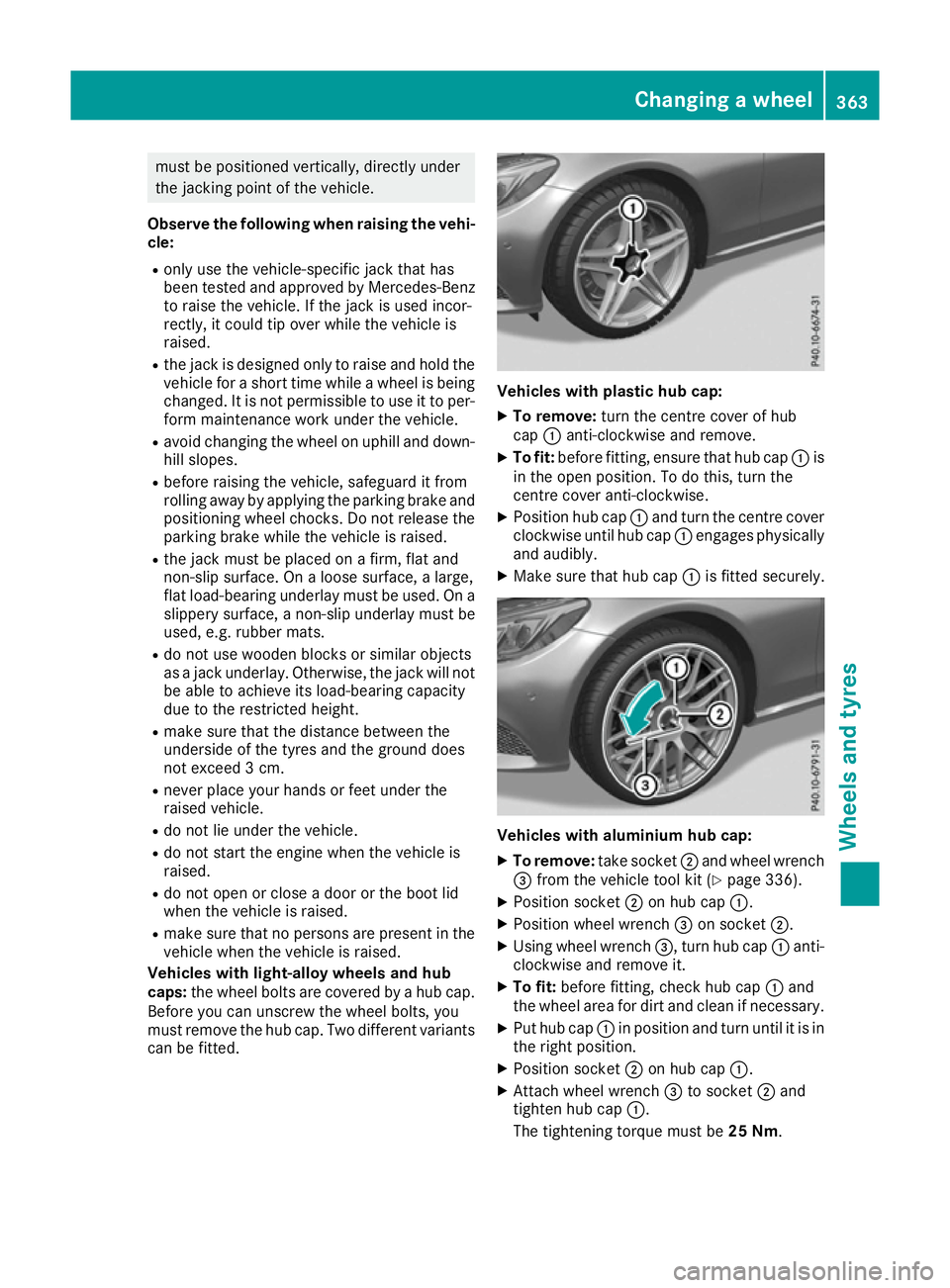
can be fitted. Vehicles with plastic hub cap:
X To remove: turn the centre cover of hub
cap :anti-clockwis eand remove.
X To fit: before fitting, ensure that hub cap :is
in the open position. To do this, turn the
centre cover anti-clockwise.
X Position hub cap :and turn the centre cover
clockwise until hub cap :engage sphysically
and audibly.
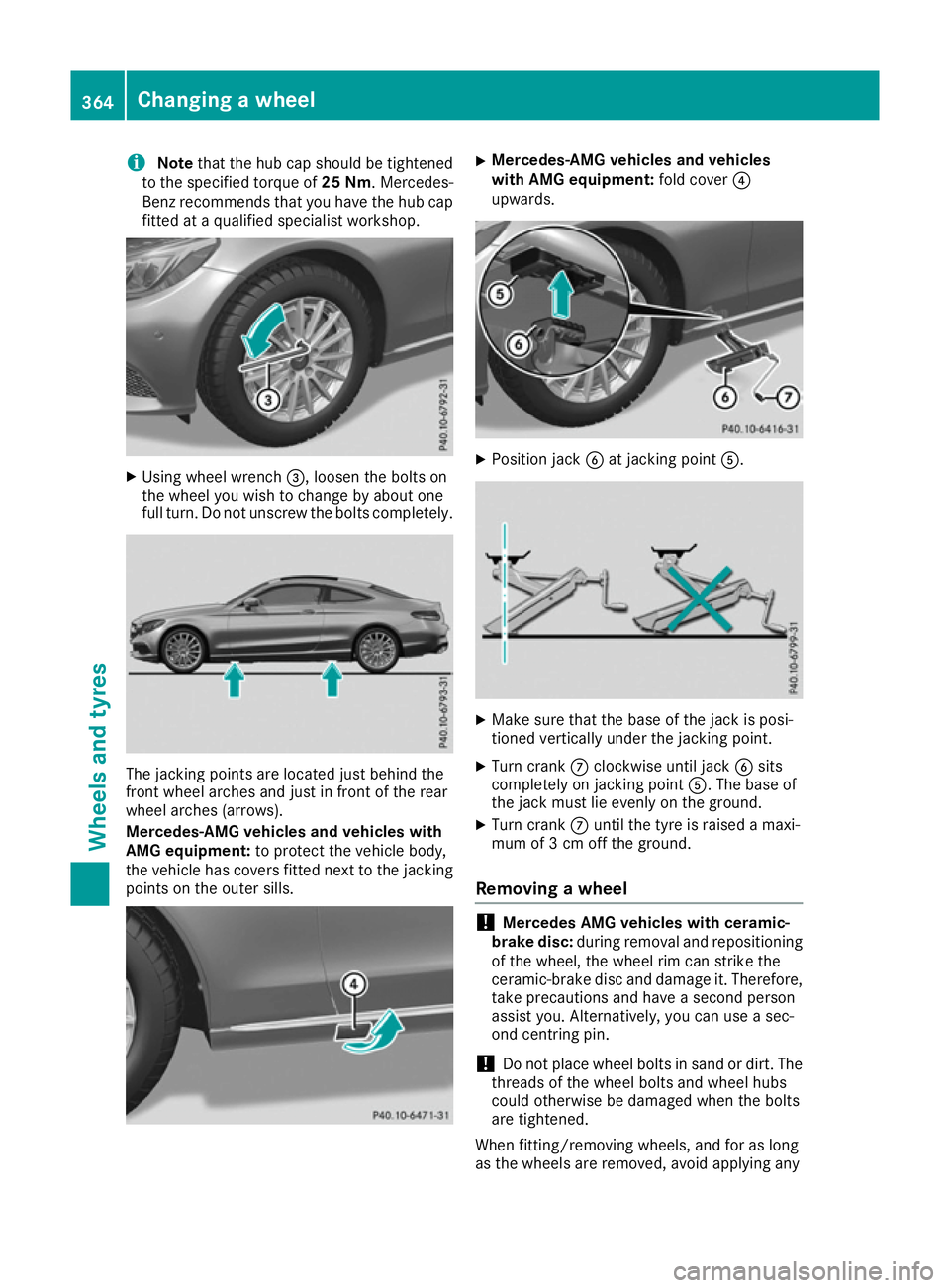
X Make sure that hub cap :is fitted securely. Vehicles with aluminium hub cap:
X To remove: take socket;and whee lwrench
= from the vehicl etool kit (Y page 336).
X Position socket ;on hub cap :.
X Position whee lwrench =on socket ;.
X Using whee lwrench =,turn hub cap :anti-
clockwise and remove it.
X To fit: before fitting, check hub cap :and
the whee larea for dirt and clean if necessary.
X Put hub cap :in position and turn until it is in
the right position.
X Position socket ;on hub cap :.
X Attach whee lwrench =to socket ;and
tighten hub cap :.
The tightening torque must be 25 Nm. Changing
awheel
363Wheelsa nd tyres Z
Page 367 of 385
i
Note
thatthe hu bcap shoul dbetightened
to the specifie dtorque of 25 Nm.Mercedes-
Benz recommends tha tyou have the hu bcap
fitte dataq ualified specialist workshop. X
Using whee lwrench =,l oosent he bolts on
the whee lyou wish to change by abou tone
full turn. Do not unscrew the bolts completely. The jacking points ar
eloc ate djustb ehin dthe
front whee larche sa nd jus tinfront of the rear
whee larche s(arrows).
Mercedes-AMG vehicle sand vehicle swith
AM Gequipment: to protect the vehicl ebody,
the vehicl ehascovers fitte dnext to the jacking
points on the outer sills. X
Mercedes-AMG vehicle
sand vehicles
with AM Gequipment: foldc over ?
upwards. X
Positio njack Bat jacking point A. X
Make sure tha tthe base of the jack is posi-
tioned verticall yunder the jacking point.
X Turn crank Cclockwise unti ljack Bsits
completel yonjacking point A.The base of
the jack must li eevenly on the ground.
X Turn crank Cunti lthe tyr eisraisedam axi-
mu mof3c moff the ground.
Removing awheel !
Mercede
sAMG vehicle swithc eramic-
brak edisc: during remova land repositioning
of the wheel, the whee lrim can strike the
ceramic-brake disc and damage it. Therefore,
take precautions and have asecond person
assist you. Alternatively ,you can us easec-
ond centring pin.
! Do not place whee
lbolts in sand or dirt. The
thread softhe whee lbolts and whee lhubs
could otherwis ebedamaged when the bolts
ar et ightened.
Whe nfitting/removing wheels ,and for as long
as the wheels ar eremoved, avoi dapplyin gany 364
Changin
gawheelWheel sand tyres