lock MERCEDES-BENZ C-CLASS COUPE 2015 User Guide
[x] Cancel search | Manufacturer: MERCEDES-BENZ, Model Year: 2015, Model line: C-CLASS COUPE, Model: MERCEDES-BENZ C-CLASS COUPE 2015Pages: 385, PDF Size: 13.12 MB
Page 30 of 385
G
WARNING
Modifications to electroni ccomponents, their
software as wellasw iring couldaffect their
function and/or the operation of other net-
worked components. This coul dinparticular
alsobet he case for systems relevant to
safety .They might not function properly any-
more and/or jeopardise the operational
safety of the vehicle. There is an increased
risk of an accident and injury.
Do not attempt to modify the wiring as wellas
electronic components or their software.
Always have work on electrica land electronic
components carrie dout at aqualified special-
ist workshop.
If you make any changes to the vehicl eelec-
tronics, the genera loperating permi tisren-
dered invalid.
! There is
arisk of damage to the vehicl eif:
R the vehicl ebecome sstuck, e.g. on ahigh
kerb or an unpaved road
R you drive too fast over an obstacle, e.g. a
kerb or apothol einthe road
R ah eavy object strikes the underbody or
parts of the chassis
In situations like this, the body ,the under-
body ,chassi sparts, wheels or tyres coul dbe
damaged without the damage being visible.
Components damaged in this way can unex-
pectedl yfail or, in the case of an accident, no
longer withstand the strain they are designed
for.
If the underbody panelling is damaged, com-
bustible materials such as leaves, grass or
twigs can gather between the underbody and
the underbody panelling. If these materials
come in contact with hot parts of the exhaust system, they can catch fire.
In such situations, have the vehicl echecked
and repaired immediatel yataqualified spe-
cialist workshop. If, uponc ontinuing your
journey ,you notice that driving safety is
impaired ,pullo ver and stop the vehicl eimme-
diately ,paying attention to road and traffic
conditions. In such cases, consult aqualified
specialist workshop. Declarations of conformity
Wireless vehicle components The following information appliestoa
ll compo-
nents of the vehicl eand the information sys-
tems and communication devices integrated
into the vehicl ewhich receive and/or transmit
radi owaves:
The components of this vehicl ethat receive
and/or transmit radi owave sare compliant with
the basi crequirements and all other relevant
conditions of Directive 1999/5/EC .You can
obtai nfurther information from any Mercedes-
Benz Service Centre.
Electromagnetic compatibility The electromagnetic compatibility of the vehicle
components has been checked and certified
according to the currently vali dversio nofR eg-
ulation ECE-R 10. Diagnostics connection
The diagnostics connection is only intended for
the connection of diagnostic equipment at a
qualified specialist workshop. G
WARNING
If you connect equipment to adiagnostics
connection in the vehicle, it can affect the
operation of the vehicl esystems .This may
affect the operating safety of the vehicle.
There is arisk of an accident.
Do not connect any equipment to adiagnos-
tics connection in the vehicle. G
WARNING
Objects in the driver's footwel lmay restrict
the clearance around the pedals or block a
depressed pedal. This jeopardise sthe oper-
ating and road safety of the vehicle. There is a risk of an accident.
Stow all objects securely in the vehicl esothat
they do not get into the driver's footwell.
Always fit the floormats securely and as pre-
scribe dinorder to ensure that there is always
sufficient room for the pedals. Do not use Operating safety
27Introduction
Z
Page 33 of 385
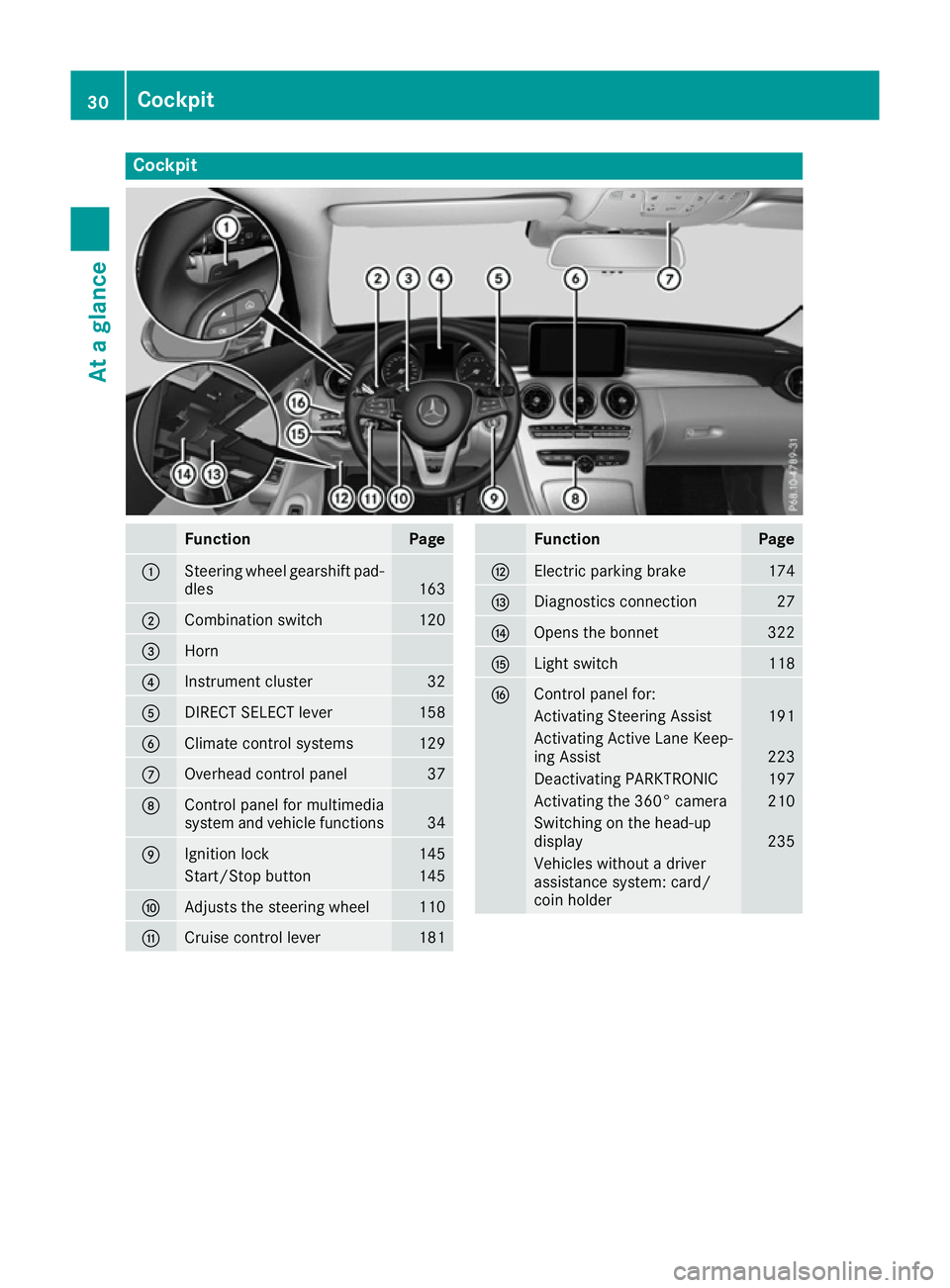
Cockpit
Function Page
:
Steering wheel gearshif
tpad-
dles 163
;
Combination switch 120
=
Horn
?
Instrumen
tcluster 32
A
DIRECT SELECT lever 158
B
Climat
econtrol systems 129
C
Overhead control panel 37
D
Control panel for multimedia
system and vehicle functions
34
E
Ignition lock 145
Start/Sto
pbutton 145
F
Adjust
sthe steering wheel 110
G
Cruis
econtrol lever 181 Function Page
H
Electric parking brake 174
I
Diagnostics connection 27
J
Open
sthe bonnet 322
K
Ligh
tswitch 118
L
Control panel for:
Activatin
gSteering Assist 191
Activatin
gActiveL aneK eep-
ing Assist 223
Deactivating PARKTRONIC 197
Activatin
gthe 360° camera 210
Switching on th
ehead-up
display 235
Vehicle
swithout adriver
assistance system: card/
coi nh older 30
CockpitAt
ag lance
Page 34 of 385
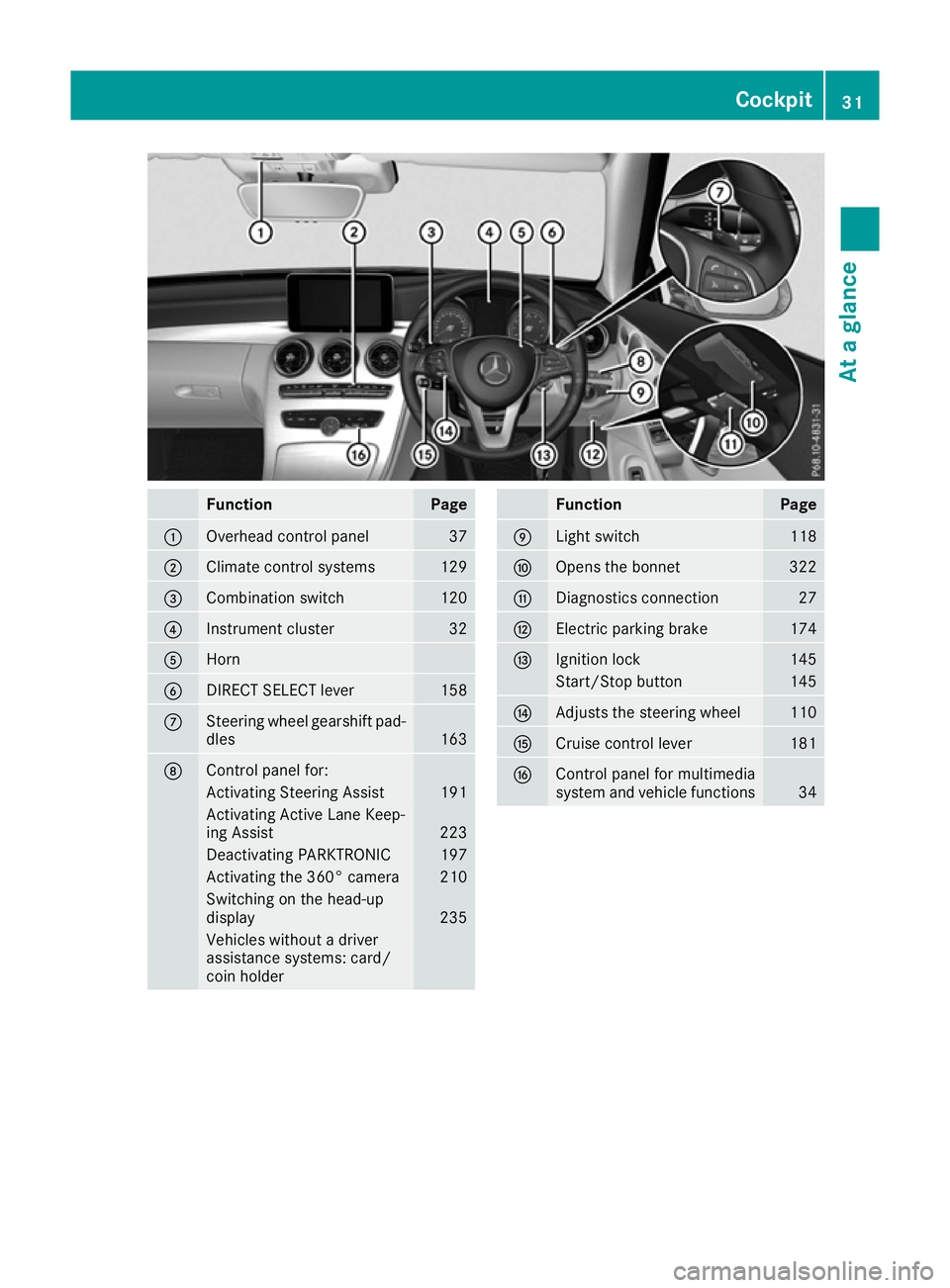
Function Page
:
Overhead control panel 37
;
Climat
econtrol systems 129
=
Combination switch 120
?
Instrument cluster 32
A
Horn
B
DIRECT SELECT lever 158
C
Steering wheel gearshif
tpad-
dles 163
D
Control pane
lfor: Activatin
gSteering Assist 191
Activatin
gActiveL aneK eep-
ing Assist 223
Deactivating PARKTRONIC 197
Activatin
gthe 360° camera 210
Switching on th
ehead-up
display 235
Vehicle
swithout adriver
assistance systems :card/
coi nh older Function Page
E
Ligh
tswitch 118
F
Open
sthe bonnet 322
G
Diagnostics connection 27
H
Electric parking brake 174
I
Ignition lock 145
Start/Sto
pbutton 145
J
Adjust
sthe steering wheel 110
K
Cruise control lever 181
L
Control pane
lfor multimedia
system and vehicle functions 34Cockpit
31Atag lance
Page 37 of 385
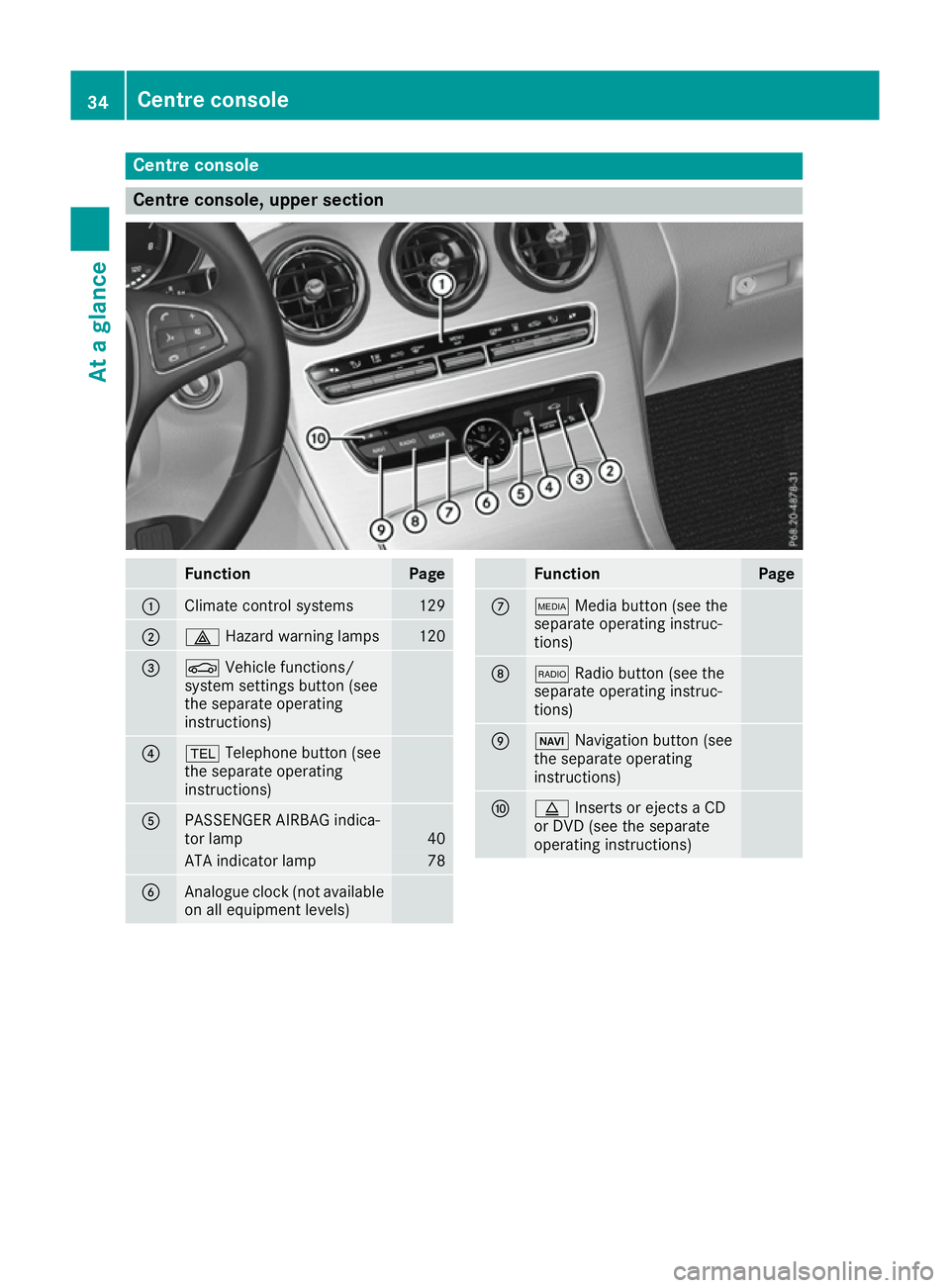
Centre console
Centre console, upper section
Function Page
:
Climat
econtrol systems 129
;
£
Hazard warning lamps 120
=
Ø
Vehicle functions/
system settings butto n(see
th es eparate operating
instructions) ?
%
Telephon ebutto n(see
th es eparate operating
instructions) A
PASSENGER AIRBA
Gindica-
to rlamp 40
AT
Ai ndicator lamp 78
B
Analogue clock (no
tavailable
on all equipmen tlevels) Function Page
C
Õ
Media butto n(see the
separate operatin ginstruc-
tions) D
$
Radio butto n(see the
separate operatin ginstruc-
tions) E
Ø
Navigation butto n(see
th es eparate operating
instructions) F
þ
Inserts or eject saCD
or DV D(see th eseparate
operatin ginstructions) 34
Centre consoleAt
ag lance
Page 41 of 385
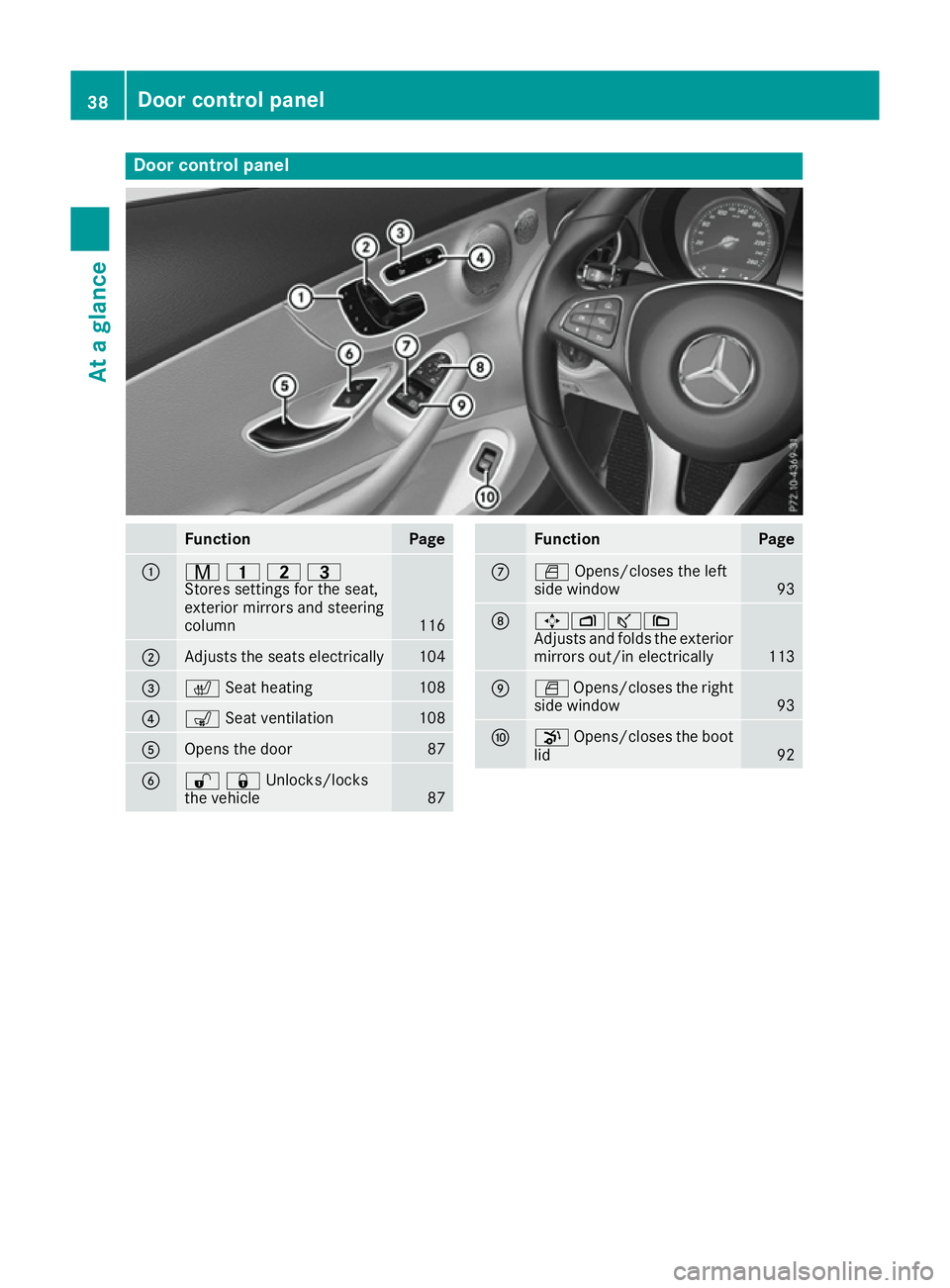
Door contro
lpanel Function Page
:
r
45=
Stores settings for the seat,
exterior mirrors and steering
column 116
;
Adjusts the seats electrically 104
=
c
Seatheating 108
?
s
Seatventilation 108
A
Opens the door 87
B
%&Unlocks/locks
the vehicle
87 Function Page
C
W
Opens/closes the left
side window 93
D
7Zª\
Adjusts and folds the exterior
mirrors out/in electrically 113
E
W
Opens/closes the right
side window 93
F
p
Opens/closes the boot
lid 9238
Door control panelAt
ag lance
Page 42 of 385
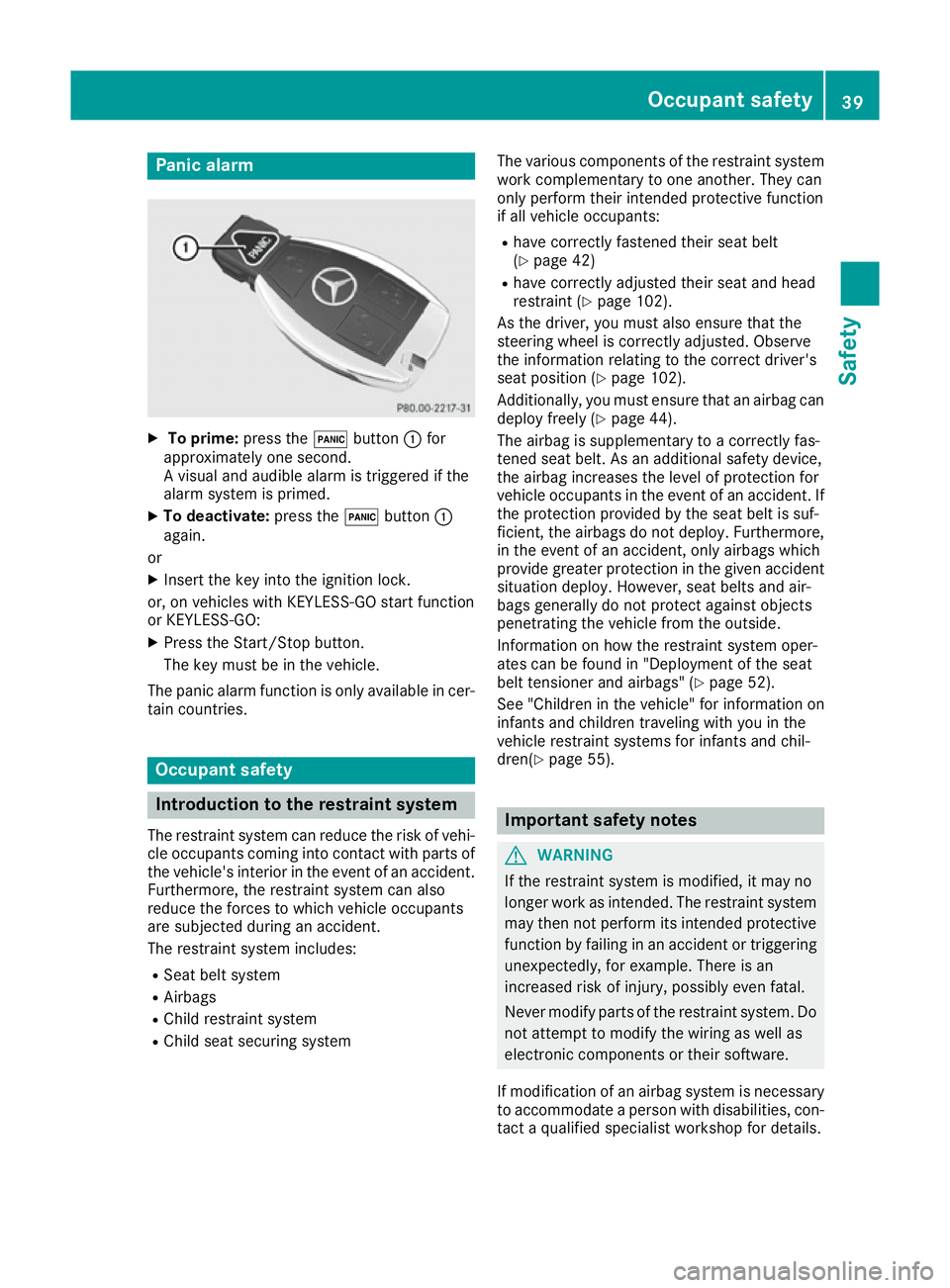
Panic alarm
X
To prime: press the!button :for
approximately one second.
Av isual and audible alarm is triggered if the
alarm system is primed.
X To deactivate: press the!button :
again.
or
X Insert the key into the ignition lock.
or, on vehicles with KEYLESS-GO start function
or KEYLESS ‑GO:
X Press the Start/Stop button.
The key must be in the vehicle.
The panic alarm function is only available in cer-
tain countries. Occupant safety
Introduction to the restraint system
The restraint system can reduce the risk of vehi-
cle occupants coming into contact with parts of
the vehicle's interior in the event of an accident. Furthermore, the restraint system can also
reduce the forces to which vehicle occupants
are subjected during an accident.
The restraint system includes:
R Seat belt system
R Airbags
R Child restraint system
R Child seat securing system The various components of the restraint system
work complementary to one another. They can
only perform their intended protective function
if all vehicle occupants:
R have correctly fastened their seat belt
(Y page 42)
R have correctly adjusted their seat and head
restraint (Y page 102).
As the driver, you must also ensure that the
steering wheel is correctly adjusted. Observe
the information relating to the correct driver's
seat position (Y page 102).
Additionally, you must ensure that an airbag can
deploy freely (Y page 44).
The airbag is supplementary to acorrectly fas-
tened seat belt. As an additional safety device,
the airbag increases the level of protection for
vehicle occupants in the event of an accident. If
the protection provided by the seat belt is suf-
ficient, the airbags do not deploy. Furthermore, in the event of an accident, only airbags which
provide greater protection in the given accident
situation deploy. However, seat belts and air-
bags generally do not protect against objects
penetrating the vehicle from the outside.
Information on how the restraint system oper-
ates can be found in "Deployment of the seat
belt tensioner and airbags" (Y page 52).
See "Children in the vehicle" for information on
infantsa nd children traveling with you in the
vehicle restraint systems for infantsa nd chil-
dren(Y page 55). Important safety notes
G
WARNING
If the restraint system is modified, it may no
longer work as intended. The restraint system
may then not perform its intended protective function by failing in an accident or triggering
unexpectedly, for example. There is an
increased risk of injury, possibly even fatal.
Never modify parts of the restraint system. Do not attempt to modify the wiring as well as
electronic components or their software.
If modification of an airbag system is necessary to accommodate aperson with disabilities, con-
tact aqualified specialist workshop for details. Occupant safety
39Safety Z
Page 44 of 385
Seat belts
Introduction Ac
orrectly fastened seat belt is the most effec-
tive means of restraining the movement of vehi- cle occupants in the event of an accident or
overturn .This reduces the risk of vehicle occu-
pants coming into contact with parts of the vehi-
cle interior or being thrown from the vehicle. The
seat belt also helps to keep the vehicle occu-
pants in the best position in relation to the air-
bag deployed.
The seat belt system consistso f:
R Seat belts
R Belt tensioners and belt force limiters
If the seat belt is pulled quickly or suddenly from the belt sash guide, the inertia reel locks. The
belt strap cannot be pulled out further.
The belt tensioner tightenst he seat belt to lie
close against your body in the event of acolli-
sion. However, it does not pull the vehicle occu-
pants back towards the seat backrest.
The belt tensioner also does not correct an
incorrec tseat position or the strap layoutofa
seat belt that is worn incorrectly.
If the seat belt is also fitted with abelt force
limiter and this is triggered, the force exerted by the seat belt on the vehicle occupant is reduced.
The belt force limiters on the front seats are
synchronised with the front airbags, which take
on apart of the deceleration force. This makes it
possible to reduce the forces to which vehicle
occupants are subjected during an accident.
! If the co-driver's seat is not occupied, do not
engage the seat belt tongue in the buckle on
the co-driver's seat. Otherwise, the belt ten-
sioner could be triggered in the event of an
accident and would have to be replaced.
Important safety notes G
WARNING
The seat belt cannot perform its intended pro- tective function if it is not fastened correctly. Also, an improperly fastened seat belt can
cause additional injuries in the event of an
accident, sudden braking or abrupt changes
of direction. There is an increased risk of
injury, possibly even fatal. Always make sure that all vehicle occupants
are wearing their seat belt properly and are
seated correctly.
G
WARNING
The seat belt does not offer the intended level of protection if you have not moved the back-
rest to an almost vertical position. When brak-
ing or in the event of an accident, you could
slide underneath the seat belt and sustain
abdomen or neck injuries, for example. This
poses an increased risk of injury or even fatal injury.
Adjust the seat properly before beginning
your journey. Always ensure that the backrest
is in an almost vertical position and that the
shoulder section of your seatbelt is routed
across the centre of your shoulder. G
WARNING
Persons under 1.50 mtallc annot wear the
seat belts correctl ywithou tas uitable, addi-
tional restraint system. The seat belt cannot
perform its intende dprotective functio nifitis
not fastened correctly. Also, an improperly
fastened seat belt can cause additional inju-
rie sint he event of an accident, sudden brak-
ing or abrupt change sofdirection. There is an
increase driskofi njury ,possibl yevenf atal.
Secure persons less tha n1.50 mtall in asuit-
able restraint system.
If ac hild younger than twelve years old and
unde r1.50m in heigh tistravelling in th evehi-
cle:
R always secure th echild in achild restraint
system suitable for this Mercedes-Ben zvehi-
cle .The child restraint system must be appro-
priat etot heage, weigh tand siz eofthechild.
R always observ ethe instruction sand safety
note sont he"Automatic front-passenger
fron tairbag deactivatio nsystem"
(Y page 47)
R always observ ethe instruction sand safety
note son" Children in th evehicle"
(Y page 55) in addition to th echild restraint
system manufacturer' sinstallatio nand oper-
atin ginstructions. Occupant safety
41Safety Z
Page 46 of 385
Fastening seat belts
Observ
ethe safet ynotes on seat belts
(Y page 41 )and th enotes on th ecorre ct use of
th es eat belt (Y page 42). G
WARNING
If th eseat-belt extender extend sdurin gthe
journey, th eseat belt is no tsitting correctly
across your body. The seat belt then cannot
perfor mitsintended protective function.
Ther eisani ncreased ris kofinjury, possibly
eve nfatal.
During ajou rney, mak esure that th eseat-belt
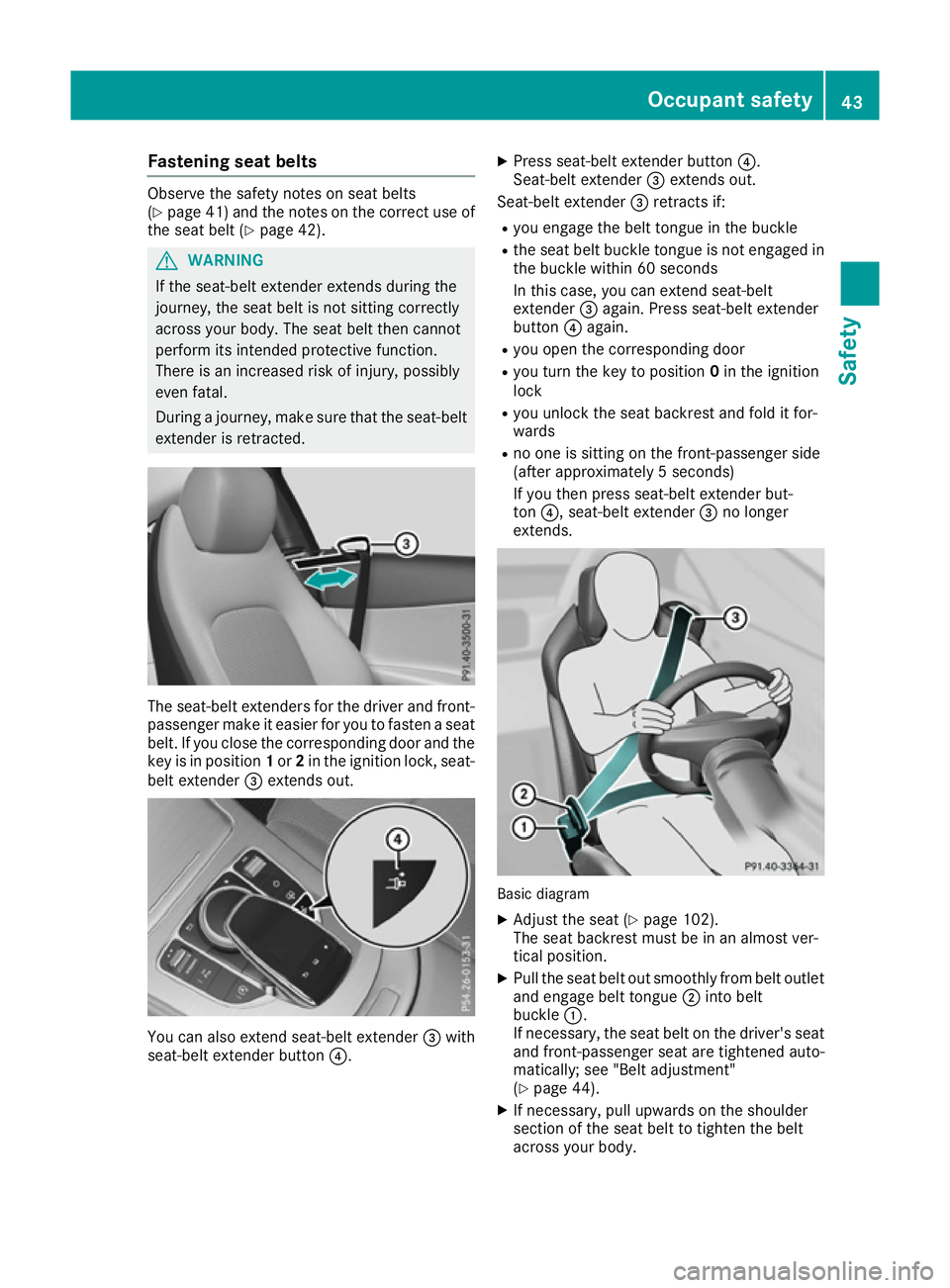
extender is retracted. The seat-belt extenders for th
edriver and front-
passenger mak eiteasierfor you to faste naseat
belt .Ify ou close th ecorre sponding door and the
ke yisinp osition 1or 2in th eignition lock, seat-
belt extender =extend sout. You can also extend seat-belt extender
=with
seat-belt extender button ?.X
Press seat-belt extender button ?.
Seat-belt extender =extend sout.
Seat-belt extender =retracts if:
R you engage th ebelt tongue in th ebuckle
R thes eat belt buckle tongue is no tengage din
th eb uckle within 60 seconds
In this case, you can extend seat-belt
extender =again .Press seat-belt extender
button ?again.
R you open th ecorre sponding door
R you tur nthe keyt op osition 0in th eignition
lock
R you unlock th eseat backrest and fol ditfor-
wards
R no on eissitting on th efront-pa ssenger side
(after approximately 5seconds)
If you then press seat-belt extender but-
ton ?,s eat-belt extender =no longer
extends. Basic diagram
X Adjus tthe seat (Y page 102).
The seat backrest must be in an almost ver-
tical position.
X Pull th eseat belt out smoothly from belt outlet
and engage belt tongue ;intob elt
buckle :.
If necessary, th eseat belt on th edriver' sseat
and front-passenger seat are tightened auto-
matically; see "Belt adjustment"
(Y page 44).
X If necessary, pull upward sontheshoulder
section of th eseat belt to tighten th ebelt
across your body. Occupant safety
43Safety Z
Page 51 of 385
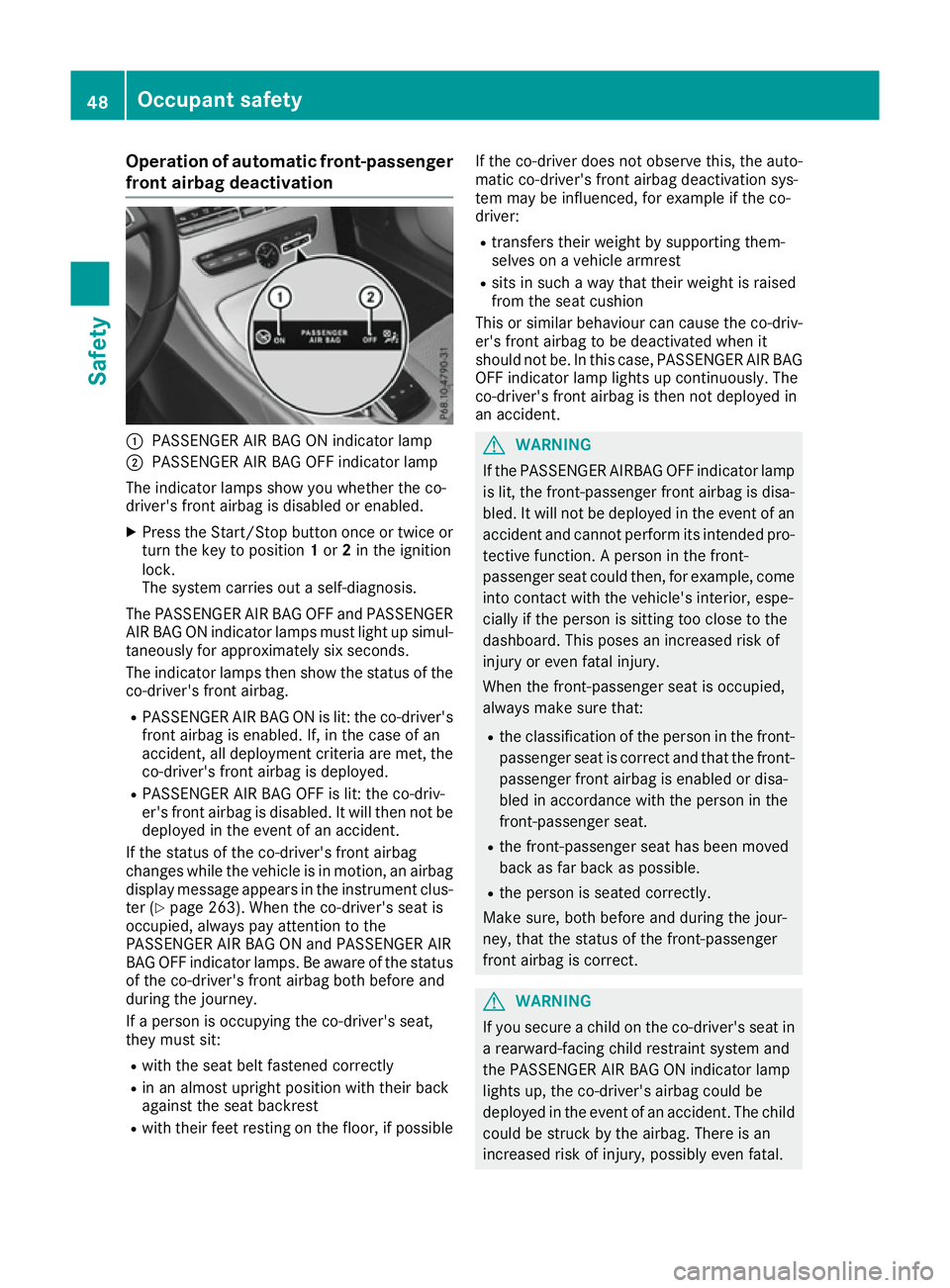
Operation of automatic front-passenger
front airba gdeactivation :
PASSENGER AIR BAG ON indicator lamp
; PASSENGER AIR BAG OFF indicator lamp
The indicator lamps show you whether the co-
driver's fron tairbag is disabled or enabled.
X Press the Start/Stop button onceort wice or
turn the key to position 1or 2in the ignition
lock.
The system carries out aself-diagnosis.
The PASSENGER AIR BAG OFF and PASSENGER
AIR BAG ON indicator lamps must light up simul- taneously for approximately six seconds.
The indicator lamps then show the status of the
co-driver's fron tairbag.
R PASSENGER AIR BAG ON is lit: the co-driver's
fron tairbag is enabled. If, in the case of an
accident, all deployment criteria are met, the
co-driver's fron tairbag is deployed.
R PASSENGER AIR BAG OFF is lit: the co-driv-
er's fron tairbag is disabled. It will then not be
deployed in the event of an accident.
If the status of the co-driver's fron tairbag
changes while the vehicle is in motion ,anairbag
display message appears in the instrument clus-
ter (Y page 263). When the co-driver's seat is
occupied, alway spay attention to the
PASSENGER AIR BAG ON and PASSENGER AIR
BAG OFF indicator lamps. Be aware of the status of the co-driver's fron tairbag both before and
during the journey.
If ap erson is occupying the co-driver's seat,
they must sit:
R with the seat belt fastened correctly
R in an almost upright position with their back
against the seat backrest
R with their feet restin gonthe floor, if possible If the co-driver does not observe this, the auto-
matic co-driver's fron tairbag deactivation sys-
tem may be influenced, for example if the co-
driver:
R transfers their weight by supportin gthem-
selves on avehicle armrest
R sits in such away that their weight is raised
from the seat cushion
This or similar behaviour can cause the co-driv-
er's fron tairbag to be deactivated when it
should not be. In this case, PASSENGER AIR BAG OFF indicator lamp lights up continuously. The
co-driver's fron tairbag is then not deployed in
an accident. G
WARNING
If the PASSENGER AIRBA GOFF indicator lamp
is lit, the front-passenger fron tairbag is disa-
bled. It will not be deployed in the event of an
acciden tand cannot perform its intended pro-
tective function .Aperson in the front-
passenger seat could then ,for example, come
into contact with the vehicle's interior, espe-
cially if the person is sitting too close to the
dashboard. This poses an increased risk of
injur yore ven fatal injury.
When the front-passenger seat is occupied,
alway smake sure that:
R the classification of the person in the front-
passenger seat is correct and that the front-
passenger fron tairbag is enabled or disa-
bled in accordance with the person in the
front-passenger seat.
R the front-passenger seat has been moved
back as far back as possible.
R the person is seated correctly.
Make sure, both before and during the jour-
ney, that the status of the front-passenger
fron tairbag is correct. G
WARNING
If you secure achild on the co-driver's seat in
ar earward-facing child restraint system and
the PASSENGER AIR BAG ON indicator lamp
lights up, the co-driver's airbag could be
deployed in the event of an accident. The child could be struc kbythe airbag. There is an
increased risk of injury, possibly even fatal. 48
Occupant safetySafety
Page 56 of 385
after an accident. Tak
ethisi ntoa ccount, par-
ticularly if aseat belt tensioner was triggered or
an airbag was deployed.
An electric motor is used by PRE-SAFE ®
to trig-
ger th etightening of th eseat belt in hazardous
situations .This procedure is reversible.
If th ebelt tensioners are triggered or an airbag is
deployed, you will hear abang ,and asmall
amoun tofpowder may also be released. The
6 restraint system warning lamp light sup.
Only in rar ecases will th ebang affect your hear-
ing .Ing eneral, th epowder released is no thaz-
ardous to healt hbut may caus eshort-term
breathin gdifficulties to person ssufferin gfrom
asthma or other pulmonar yconditions. Provided
it is safe to do so, you shoul dleave th evehicle
immediately or open th ewindow in orde rtopre-
ven tbreathin gdifficulties.
Operation During th
efirst stage of acollision ,the restraint
system control unit evaluates important physi-
cal dat arelating to vehicle deceleratio noraccel-
eration ,suc ha s:
R duration
R direction
R intensity
Based on th eevaluation of this data, the
restraint system control unit trigger sthe seat
belt tensioners in th eeven tofah ead-on or rear
collision.
As eat belt tensioner can only be triggered if:
R thei gnition is switched on
R thec omponent softherestraint system are
operational. You can fin dfurther information
under: "Restrain tsystem warning lamp"
(Y page 40)
R theb elt tongue has engaged in th ebelt buckle
of th erespectiv efront seat
The seat belt tensioners in th erear compart-
men tare triggered independently of th elock
status of th eseat belts.
If th erestraint system control unit detect sahigh
severit yaccident, in certain head-on collisions,
additional component softherestraint system
are deployed independently of each other:
R fron tairbag sand driver' skneebag
R windowbag, if th esystem determine sthat
deploymen tcan offer additional protection to
that provided by th eseat belt On vehicle
swith th eautomatic front-passenger
fron tairbag deactivatio nsystem: dependin gon
th ep erson in th efront-pa ssenger seat ,the
front-passenger fron tairbag is either disable dor
enabled. The front-passenger fron tairbag can
only be deployed in an acciden tifthe
PASSENGER AI RBAG ON indicator lamp is lit.
Observ ethe informatio nonthePASSENGER AIR
BA Gindicator lamps (Y page 40).
Your vehicle has two-stag efront airbags. In the
first deploymen tstage, th efront airbag is filled
with propellan tgas to reduc ethe risk of injuries.
The fron tairbag is fully deployed if th esecond
deploymen tstage is activated within afew mil-
liseconds.
The activation threshold for th eseat belt ten-
sioners and airbag sisdetermine dbased on the
evaluation of th evehicle's rat eofdeceleration
or acceleratio natvarious points in th evehicle.
This process is pre-emptive in nature. The trig-
gering/deployment process shoul dtakep lace
in good tim eatthestart of th ecollision.
The rat eofvehicle deceleratio noracceleration
and th edirection of th eforce are essentially
determine dby:
R thed istribution of forces durin gthe collision
R thec ollision angle
R thed eformatio ncharacteristics of th evehicle
R thec haracteristics of th eobject with which
th ev ehicle has collided
Factors whic hcan only be seen and measured
after acollision has occurre ddonotplay adeci-
sive role in th edeploymen tofanairbag,nor do
they provide an indication of airbag deployment.
The vehicle may be deformed significantly with-out an airbag bein gdeployed. This is th ecaseif
only part swhicha re relatively easily deformed
are affected and th erateofd eceleratio nisnot
high .Conversely, an airbag may be deployed
even though th evehicle suffers only minor
deformation. This is th ecasei f, for example,
ver yrigidv ehicle part ssuchasl ongitudinal body
members are hit ,and sufficient deceleration
occurs as aresult.
If th erestraint system control unit detect saside
impact, th eapplicable component softhe
restraint system are activated independently of
each other.
R Sidebags on th eside on whic hanimpact
occurs, independen tfromt heseat belt ten-
sioner and seat belt usage
Vehicle swith th eautomatic front-passenger
airbag deactivatio nsystem: th esidebag on Occupant safety
53Safety Z