lock MERCEDES-BENZ C-CLASS COUPE 2015 Owner's Manual
[x] Cancel search | Manufacturer: MERCEDES-BENZ, Model Year: 2015, Model line: C-CLASS COUPE, Model: MERCEDES-BENZ C-CLASS COUPE 2015Pages: 385, PDF Size: 13.12 MB
Page 57 of 385
the front-passenge
rsided eploys under the
following conditions:
- an occupant is detecte donthe front-
passenge rseator
- the belt tongue is engaged in the belt
buckle of the front-passenge rseat
R Windowbag on the side on which an impact
occurs, independent of seat belt usag eand
regardles sofwhether the front-passenger
seat is occupied
R Fron tseatb eltt ensioners ,ifthe system
determine sthatd eployme nt can offer addi-
tional protection for the vehicl eoccupants in
thi ss ituation
i Not al
lairbags ar edeployed in an accident.
The different airba gsystems work independ-
entl yofe acho ther.
How the airba gsystemw orks is determined
by the severity of the accident detected,
especiall ythe vehicl edeceleratio noraccel-
eration, and the apparent typ eofaccident:
R frontal collision
R side impact PRE-SAFE
®
(anticipatory occupant
protection)
Introduction PRE-SAFE
®
take spre-emptive measures to pro-
tect occupants in certain hazardous situations.
Important safety notes !
Make sure tha
tthere ar enoobjects in the
footwell or behind the seats .There is arisk
tha tthe seats and/or the objects could be
damage dwhenP RE-SAFE ®
is activated.
Although your vehicl eisequippe dwithaP RE-
SAFE ®
system, the possibility of injury in the
event of an accident cannot be rule dout.A lways
adap tyou rd rivin gstyle to suit the prevailing
roa dand weather conditions and maintain a
safe distance fro mthe vehicl einfront. Drive
carefully. Function PRE-SAFE
®
intervenes:
R in emergency braking situations, e.g .when
BAS is activated
R in critica ldrivin gsituations, e.g .whenp hysi-
cal limits ar eexceeded and the vehicl eunder-
steers or oversteers severely
R vehicles with the Drivin gAssistance package:
when adriver assistance syste mintervenes
powerfull yorthe rada rsen sorsystemd etects
an imminent dange rofcollision in certai nsit-
uations
PRE-SAFE ®
take sthe following measures
depending on the hazardous situatio ndetected:
R the front seat belts ar epre-tensioned.
R if the vehicl eskids ,the side windows and the
panorama sliding sunroo fare closed.
R vehicles with the memory functio nfor the
front-passenge rseat: the front-passenger
seat is adjusted if it is in an unfavourable
position.
If the hazardous situatio npasse sw ithou tresult-
ing in an accident, PRE-SAFE ®
slackens the belt
pre-tensioning .All setting smadebyP RE-SAFE ®
can the nbereversed.
If the seat belt pre-tensioning is not reduced:
X Mov ethe seat backrest or seat back slightly
when the vehicl eisstationary.
Sea tbeltp re-tensioning is reduce dand the
locking mechanis misreleased.
The seat-bel tadjustment is an integra lpartof
the PRE-SAFE ®
convenience function. Informa-
tio na bout the convenience functio ncan be
found under "Belt adjustment" (Y page 44). PRE-SAFE
®
PLUS (anticipatory occu-
pant protection PLUS)
Introduction PRE-SAFE
®
PLU Siso nlya vailable in vehicles
with the Drivin gAssistance package.
Using the rada rsensors ystem, PRE-SAFE ®
PLU Sisa bletod etect tha tahead-o norrear-end
collision is imminent. In certai nhazardous sit-
uations, PRE-SAFE ®
PLU Stake spre-emptive
measures to protect the vehicl eoccupants. 54
Occupant safetySafety
Page 58 of 385
Important safety notes
The intervention of PRE-SAFE
®
PLU Scannot
preven tanimminent collision.
The driver is no twarned before th eintervention
of PRE-SAFE ®
PLUS.
PRE-SAFE ®
PLU Sdoes no tintervene:
R if th evehicl eisr eversing
R when th evehicl eist owingat railer and there
is ar iskofar ear-end collision
When driving ,orwhen parking or exiting apark-
ing spac ewitha ssistanc efromA ctiveParking
Assist ,PRE-SAFE ®
PLU Swill no tapply the
brakes.
Function PRE-SAFE
®
PLU Sintervenes in certain situa-
tion sift heradar sensor system detects an
imminent head-on or rear-end collision.
PRE-SAFE ®
PLU Stakes th efollowin gmeasures
depending on th ehazardous situation detected:
R if th eradar sensor system detects that a
head-on collision is imminent ,the seat belts
are pre-tensioned
R if th eradar sensor system detects that arear-
en dc ollision is imminent:
- ther ear hazard warning lamp sare activa-
te da nd flas hatah igher frequency
- theb rak epressur eisincreased if th edriver
applie sthe brakes when th evehicl eiss ta-
tionary
- thes eat belt sare pre-tensioned
The PRE-SAFE ®
PLU Sbraking application is can-
celled:
R if th eaccelerato rpedal is depressed when a
gear is engaged
R if th eriskofac ollision passes or is no longer
detected
R if DISTRONI CPLUSindicates an intention to
pull away
If th ehazardous situation passes without result-
ing in an accident, th eoriginal setting sare
restored. Automati
cmeasures after an acci-
dent
Immediately after an accident, th efollowing
measures are implemented, depending on the
typ eand severity of th eimpact:
R theh azard warning lamp sare activated
R thee mergenc ylighting is activated
R thev ehicl edoor sare unlocked
R thef ront side windows are lowered
R vehicles wit hamemory function :the electri-
call yadjustable steering whee lisraised
R thee ngineiss witched off and th efuel supply
is cut off
R vehicles wit hthe Mercedes-Ben zemergency
call system: automatic emergenc ycall Children in th
evehicle Important safety notes
Acciden tstatistics sho wthatc hildren secured
in th erear seat sare safer than children secured
in th efront seats. Fo rthisr eason ,Mercedes-
Ben zstrongly advises that you fit achild
restrain tsystem on arear seat .Children are
generally bette rprotected there.
If ac hild younger than twelve years old and
under 1.50 minh eight is travellin ginthe vehi-
cle:
R always secur ethe child in achild restraint
system suitable for Mercedes-Ben zvehicles.
The child restraint system must be appropri-
ate to the age, weight and size of the child.
R be sure to observe the instructions and safety
notes in this section in addition to the child
restraint system manufacturer' sinstallation
instructions.
R always pay attention to the instructions and
safet ynotes on the automatic co-driver's
front airbag deactivation system (Y page 47). Children in thev
ehicle
55Safety Z
Page 59 of 385
G
WARNING
If you leave children unattended in the vehi-
cle, they may be abletos et the vehiclein
motion if, for example, they:
R release the parking brake
R shift the automatic transmission out of park
position Por shift manua ltransmission into
neutral
R start the engine
In addition, they may operate vehicl eequip-
ment and become trapped. There is arisk of
an accident and injury.
When leaving the vehicle, alwayst ake the key
with you and lock the vehicle. Never leave
children unattended in the vehicle. G
WARNING
If persons (particularly children) are exposed
to heatorc old foraprolonged period, there is
ar isk of serious or even fatal injuries. Never
leave persons (particularly children) unatten-
ded in the vehicle. G
WARNING
If the child restraint system is placed in direct sunlight, the parts coul dbecome very hot.
Childre ncouldbes uffer burns by touching
these parts, in particular on the metallic parts
of the child restraint system. There is arisk of
injury.
If you and yourc hild leave the vehicle, always
make sure that the child restraint system is
not in direct sunlight. Cove ritwithablanket,
for example. If the child restraint system has
been expose dtodirect sunlight, leave it to
cool downb efore securing the child in it.
Never leave children unattended in the vehi-
cle.
Always ensure that all vehicl eoccupants have
their seat belts fastened correctly and are sitting
properly.P articular attention must be paidto
children.
Observe the safety notes on the seat belt
(Y page4 1) and the notes on how to use the seat
beltp roperly (Y page42). Chil
drestraint system
Observe the instructions for correct use of the
child restraint system (Y page60).
For safety reasons, Mercedes-Benz recom-
mends that you only use achild restraint system
recommende dbyMercedes-Benz
(Y page6 4). G
WARNING
If the child restraint system is incorrectly fit-
ted on the seat position suitable for this pur-
pose, it cannot perform its intended protec-
tive function. In the event of an accident,
sharp braking or asudden change in direction,
the child may not be held securely.T here is an
increased risk of serious or even fatal injuries.
Observe the manufacturer's installation
instructions and the correct use for the child
restraint system. Make sure that the entire
surface of the child restraint system is resting
on the seat surface. Never place objects
under or behind the child restraint system,
e.g. cushions. Only use child restraint sys-
tems with the original cover designed for
them. Only replace damaged covers with gen- uine covers. G
WARNING
If the child restraint system is fitted incor-
rectly or is not secured, it can come loos ein
the event of an accident, heav ybraking or a
sudden change in direction. The child
restraint system coul dbethrown about, strik-
ing vehicl eoccupants. There is an increased
risk of injury ,possibly even fatal.
Always fit child restraint systems properly,
even if they are not being used .Make sure
that you observe the child restraint system
manufacturer's installation instructions.
You willf ind further information on stowing
objects, luggage and loads securely under
"Loading guidelines" (Y page308). G
WARNING
Child restraint systems or their securing sys-
tems that have been damaged or subjected to al oa dinana ccident cannot perform their 56
Children in the vehicleSafety
Page 61 of 385
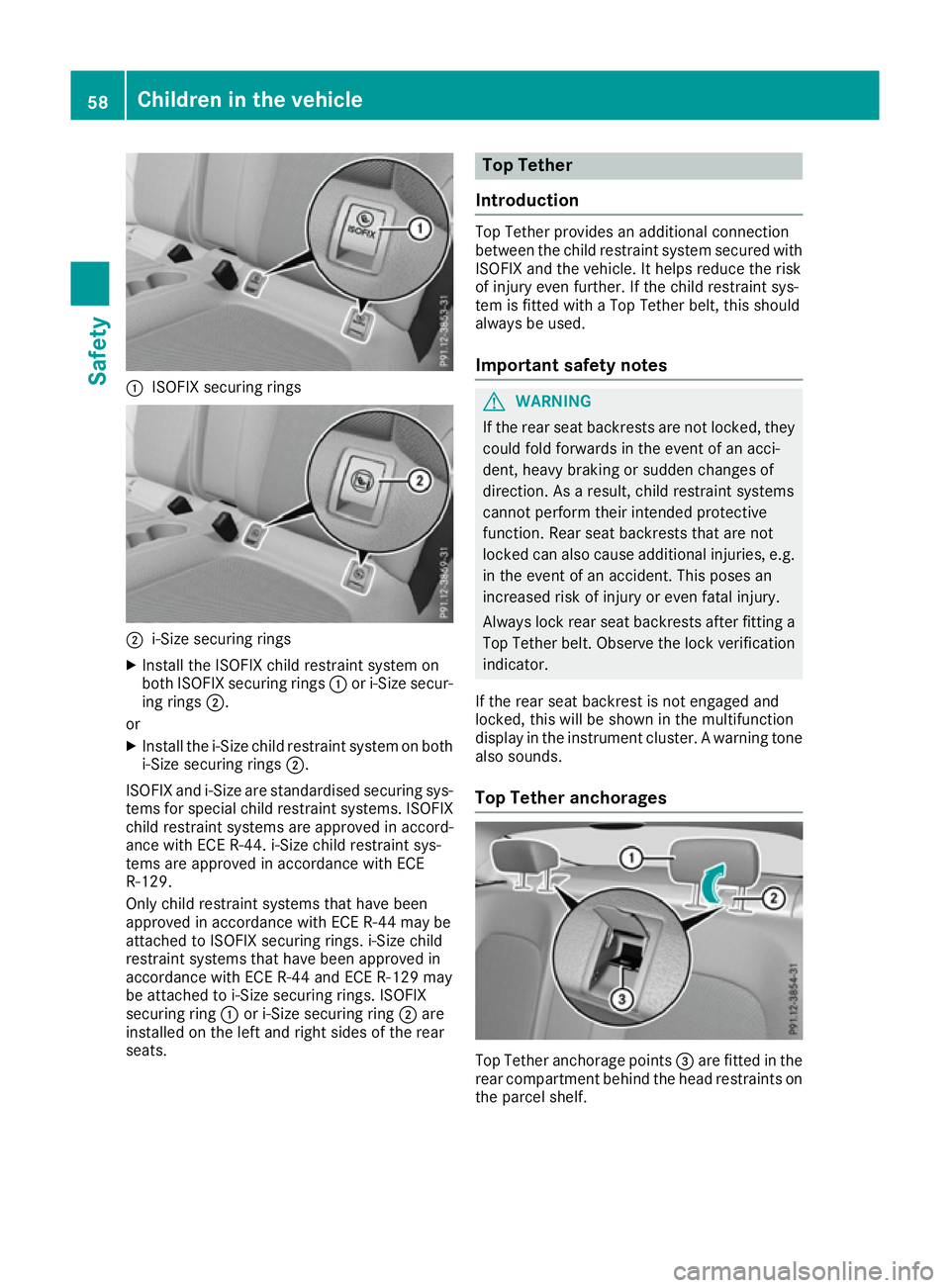
:
ISOFIX securing rings ;
i-Size securing rings
X Install the ISOFIX child restraint system on
both ISOFIX securing rings :or i-Size secur-
ing rings ;.
or
X Install the i-Size child restraint system on both
i-Size securing rings ;.
ISOFIX and i-Size are standardised securing sys-
tems for specia lchild restraint systems. ISOFIX
child restraint systems are approved in accord-
ance with ECE R-44. i-Size child restraint sys-
tems are approved in accordance with ECE
R-129.
Only child restraint systems that have been
approved in accordance with ECE R-44 may be
attached to ISOFIX securing rings. i-Size child
restraint systems that have been approved in
accordance with ECE R-44 and ECE R-129 may
be attached to i-Size securing rings. ISOFIX
securing ring :or i-Size securing ring ;are
installe donthe left and right sides of the rear
seats. Top Tether
Introduction Top Tether provide
sanadditional connection
between the child restraint system secured with
ISOFIX and the vehicle .Ithelps reduce the risk
of injury even further. If the child restraint sys-
tem is fitted with aTop Tether belt, this should
always be used.
Important safety notes G
WARNING
If the rear seat backrests are not locked, they
could fold forward sinthe event of an acci-
dent, heavy braking or sudden changes of
direction. As aresult, child restraint systems
cannot perform their intended protective
function. Rears eat backrests that are not
locked can also cause additional injuries, e.g. in the event of an accident. This poses an
increased risk of injury or even fatal injury.
Alwaysl ock rear seat backrests after fitting a
Top Tether belt. Observe the lock verification indicator.
If the rear seat backrest is not engaged and
locked, this willbes hown in the multifunction
display in the instrument cluster. Awarning tone
also sounds.
Top Tether anchorages Top Tether anchorage points
=are fitted in the
rear compartment behind the head restraints on
the parcel shelf. 58
Children in the vehicleSafety
Page 69 of 385
Pets in the vehicle
G
WARNING
If you leave animals unsupervised or unse-
cured in the vehicle, they may push abutton
or as witch, for example.
They could:
R activate vehicle equipment and become
trapped, for example
R switch vehicle systems on or off, thus
endangering other road users
In the event of an accident, sudden braking or
abrupt changes of direction, unsecured ani-
mals could be flung around the vehicle, injur-
ing the vehicle occupants. There is arisk of an
accident and injury.
Never leave animals unattended in the vehi-
cle. Always secure animals correctly during a
journey, e.g. in an animal transport box. Driving safety systems
Driving safety systems overview
In this section,y ou will find information about
the following driving safety systems:
R ABS (Anti-lock BrakingSystem)
(Y page 66)
R BAS ( Brake Assist System) (Y page 67)
R BAS PLUS with Cross-Traffic Assist ( Brake
Assist System PLUS with Cross-Traffic Assist)
(Y page 67)
R COLLISION PREVENTION ASSIST PLUS
(Y page 69)
R Adaptive brake lights (Y page 71)
R ESP ®
(Electronic StabilityProgram)
(Y page 71)
R EBD ( electronic brakeforce distribution)
(Y page 75)
R ADAPTIVE BRAKE (Y page 75)
R PRE-SAFE ®
Brake (Y page 75)
R STEERC ONTROL (Y page 77) Important safety notes
If you fail to adapt your driving style or if you are
inattentive, the driving safety systems can nei-
ther reduce the risk of an accident nor override the laws of physics. Driving safety systems are
merely aids designed to assist driving. You are
responsible for maintaining the distance to the
vehicle in front,f or vehicle speed, for braking in
good time, and for staying in lane. Always adapt your driving style to suit the prevailing road and
weather condition sand maintain asafe distance
from the vehicle in front.D rive carefully.
The driving safety systems described only work
as effectively as possible when there is ade-
quate contact between the tyres and the road
surface. Pay particular attention to the informa- tion regarding tyres, recommended minimum
tyre tread depths etc. in the "Wheels and tyres" section (Y page 353).
In wintry driving conditions, always use winter
tyres (M+S tyres) and, if necessary, snow
chains. Only in this way will the driving safety
systems described in this section work as effec-
tively as possible. ABS (Anti-loc
kBraking System)
General notes ABS regulates brake pressure in such
away that
the wheels do not lock when you brake. This
allowsy ou to continue steering the vehicle when
braking.
The ! ABS warning lamp in the instrument
cluster lights up when the ignition is switched
on. It goes out when the engine is running.
ABS works from aspeed of about 8km/h,
regardless of road-surface conditions. ABS
works on slippery surfaces, even when you only brake gently.
Important safety notes i
Observe the "Important safety notes" sec-
tion (Y page 66). G
WARNING
If ABS is faulty, the wheels could lock when
braking. The steerability and braking charac-
teristic smay be severely impaired. Addition-
ally,f urther driving safety systems are deac- 66
Driving safety systemsSafety
Page 70 of 385
tivated
.There is an increase ddangerofs kid-
ding and accidents.
Drive on carefully. Hav eABS checked imme-
diately at aquali fied specialis tworkshop.
If ABS is malfunctioning ,othe rsystems, includ-
ing drivin gsafety systems, will also become
inoperative .Obser ve the information on the ABS
warning lamp (Y page 287)and displa ymes-
sage swhich ma ybeshown in the instrument
cluste r(Ypage 254).
Brakes X
If ABS intervenes: continue to depress the
brake peda lwithf orce unti lthe braking sit-
uatio niso ver.
X To make afullb rak eapplication: depress
the brake peda lwithf ullf orce.
If ABS intervenes when braking ,you will fee la
pulsing in the brake pedal.
The pulsating brake peda lcan be an indication
of hazardous roa dconditions ;thiss erve sasa
reminder to take extra car ewhile driving. BAS (Brak
eAssis t)
General notes BAS operates in emergency braking situations.
If yo udepress the brake peda lquickly, BAS
automaticall yboosts the braking force, thus
shortening the stopping distance.
Important safety notes i
Observe the "Important safety notes" sec-
tio n(Ypage 66). G
WARNING
If BAS is malfunctioning ,the braking distance
in an emergency braking situatio nis
increased. There is ariskofa ccident.
In an emergency braking situation, depress
the brake peda lwithf ullf orce. ABS prevents
the wheels fro mlocking. Braking X
Kee pthe brake peda ldep resse dfirml yuntil
the emergency braking situatio niso ver.
ABS prevents the wheels fro mlocking.
Th eb rakes will functio nasusual once you
release the brake pedal. BAS is deactivated. BAS PLUS (Brake Assist System
PLUS
)withC ross-Traffic Assist
General notes BAS PLU
Scan help yo utominimise th eriskofa
collision with avehicl eorap edestrian and
reduce the effects of such acollision. If BAS
PLU Sdetects adangerofc ollision, yo uare
assiste dwhenb raking.
i Pa
ya ttentio ntothe important safety notes
in the "Driving safety systems" section
(Y page 66).
BAS PLU Siso nlya vailable on vehicles with the
Drivin gAssistance package.
For BAS PLU Stoassistyou when driving, the
rada rsensors ystema nd the camera system
must be operational.
With the help of asensors ystema ndacamera
system, BAS PLU Scan detect obstacles:
R tha tare in the path of your vehicl efor an
extende dperiodoft ime
R tha tcros sthe path of your vehicle
In addition, pedestrians in the path of your vehi-
cle can be detected.
BAS PLU Sdetects pedestrians using typical
characteristics such as the body contour sand
posture of aperso ns tanding upright.
If the rada rsen sorsystemort he camera system
is malfunctioning ,BAS PLU Sfunctions are
restricted or no longe ravailable. The brake sys-
tem is still availabl ewithc omplete brake boost-
ing effect and BAS.
i Observe the restrictions describe
dinthe
"Important safety notes" section
(Y page 68). Driving safet
ysystems
67Safety Z
Page 72 of 385
At speed
sofuptoa pproximatel y70km/h,BAS
PLU Scan react to:
R stationar yobjects in the path of your vehicle,
e.g .stoppe dorp arked vehicles
R pedestrians in the path of your vehicle
R obstacle scrossing your path, which move in
the detection range of the sensors and are
detected
i If BAS PLU
Sdeman ds particularly high brak-
ing force, preventative passenge rprotection
measures (PRE-SAFE ®
)a re activated simulta-
neously (Y page 54).
X Kee pthe brake peda ldep resse duntilthe
emergency braking situatio niso ver.
ABS prevents the wheels from locking.
BAS PLU Sisdeactivated and the brakes func-
tio na susual againif:
R your elease the brake pedal
R ther eisnol ongerar iskofc ollision
R no obstacle is detecte dinfront of your vehicle
R youd epress the accelerator pedal
R youa ctivate kickdown COLLISIO
NPREVENTION ASSIST
PLUS
General notes i
Observ
ethe "Important safety notes "sec-
tio n(Ypage 66).
COLLISION PREVENTION ASSIST PLU Sconsists
of ad istance warning functio nwithana utono-
mou sbraking functio nand Adaptive Brake
Assist.
COLLISION PREVENTION ASSIST PLU Scan help
yo utom inimisethe ris kofa collision with the
vehicl einfront or reduce the effects of such a
collision.
If COLLISION PREVENTION ASSIST PLUS
detects tha tther eisar iskofa collision, yo uwill
be warned visuall yand acoustically. If yo udonot
react to the visua land audibl ecollision warning,
autonomou sbraking can be initiated in critical
situations. If yo uapply the brake yoursel fina
critical situation, the COLLISION PREVENTION
ASSIST PLU SAdaptive Brake Assist assists you. Important safety notes In particular, the detection of obstacle
scan be
impaired in the cas eof:
R dirt on the sensors or obscured sensors
R snow or heavy rain
R interference by othe rradar sources
R strong rada rreflections, for example, in multi-
storey car parks
R an arrow vehicl etravelling in front, e.g .a
motorcycle
R av ehicl etravelling in front on adifferent line
R new vehicles or afte raservice on the COLLI-
SION PREVENTION ASSIST PLU Ssystem
Observ ethe important safety notes in the
"Running-i nnotes "sectio n(Ypage 144).
Following damage to the front end of the vehicle,
have the configuratio nand operatio nofthe
rada rsensor checked at aquali fied specialist
workshop .Thisa lsoa pplies to collisions at slow
speed swhere ther eisnov isible damage to the
front of the vehicle.
Activating/deactivating The COLLISION PREVENTION ASSIST PLU
Sis
automaticall yactive afte rswitching on the igni-
tion.
Yo uc an activate or deactivate COLLISION PRE-
VENTION ASSIST PLU Sinthe on-board com-
puter (Y page 245). Whe ndeactivated ,the dis-
tance warning functio nand the autonomous
braking functio narealso deactivated.
If COLLISION PREVENTION ASSIST PLU Sis
deactivated ,the æ symbo lappears in the
assistance graphics display.
Distance warning function General notes
The distance warning functio ncan hel pyou to
minimis ethe ris kofa collision with the vehicl ein
front or reduce the effects of such acollision. If
the distance warning functio ndetects tha tthere
is ar iskofa collision, yo uwillbew arned visually
and acoustically.
Important safety notes
i Observ
ethe "Important safety notes "sec-
tio nfor driving safety system s(Ypage 66). Driving safety systems
69Safety Z
Page 74 of 385
brakin
gforc enecessary to avoid acollision. If
you apply the brakes forcefully, Adaptiv eBrake
Assist will automatically increase the braking
forc etoal evel suitable for the traffic conditions.
Adaptiv eBrakeA ssist provides brakin gassis-
tanc einh azardous situation satspeeds above
7k m/h. It uses radar sensor technology to
assess the traffic situation.
Up to aspeed of approximately 250 km/h,
Adaptiv eBrakeA ssist is capable of reacting to
movin gobjects that have already been detected
as such at least onc eover the period of obser-
vation.
Up to aspeed of approximately 70 km/h, Adap-
tive Brak eAssist react stostationary obstacles.
If Adaptiv eBrakeA ssist demands particularly
high brakin gforce, preventativ epassenger pro-
tection measures (PRE-SAFE ®
)a re activated
simultaneously (Y page 54).
X Keep the brake pedal depressed until the
emergency brakin gsituation is over.
ABSp revents the wheels from locking.
The brakes will work normally again if: R you release the brake pedal
R ther eisnol onger any danger of acollision
R no obstacle is detected in fron tofyour vehicle
Adaptiv eBrakeA ssist is then deactivated.
Important safet ynotes
i Observe the "Important safety notes" sec-
tion for driving safety systems (Y page 66).G
WARNING
Adaptiv eBrakeA ssist cannot always clearly
identify objects and complex traffic situa-
tions.
In such cases, Adaptiv eBrakeA ssist can:
R interven eunnecessarily
R not intervene
There is arisk of an accident.
Always pay careful attention to the traffic sit- uation and be ready to brake. Terminate the
intervention in anon-critical driving situation. G
WARNING
Adaptiv eBrakeA ssist does not react:
R to people or animals
R to oncoming vehicles
R to crossing traffic
R when cornering
As aresult, the Adaptiv eBrak eAssist may not
interven einall critical conditions. There is a
risk of an accident.
Always pay careful attention to the traffic sit- uation and be ready to brake.
Due to the natur eofthe system, particularly
complicated but non-critical driving conditions
may also cause Brak eAssist to intervene.
If Adaptiv eBrak eAssist is not available due to a
malfunction in the radar sensor system, the
brake system remains available with full brake
boostin geffec tand BAS. Adaptive brake lights
The adaptive brake lights warn following traffic
in an emergency brakin gsituation:
R by flashing brake lamps
R by activating the hazard warning lamps
If you brake sharply from aspeed of more than
50 km/ horifb raking is assisted by BAS or BAS
PLUS, the brake lamp sflashr apidly.Int his way,
traffic travelling behind you is warned in an even more noticeable manner.
If you brake sharply from aspee dofm ore than
70 km/h to astandstill, the hazard warning
lamp sare activated automatically. If the brakes
are applieda gain, the brake lamp slight up con-
tinuously.T he hazard warning lamp sswitch off
automatically if you travel faster than 10 km/h. You can alsos witch off the hazard warning
lamp susing the hazard warning button
(Y page1 20). ESP
®
(Electronic Stability Program)
General notes i
Observe the "Important safety notes" sec-
tion (Y page66). Driving safety systems
71Safety Z
Page 78 of 385
If yourv
ehicle/trailer combination begins to
lurch, you can only stabilise the vehicle/trailer
combination by depressing the brake firmly.
ESP ®
trailer stabilisatio nisactive above speeds
of approximately 65 km/h.
ESP ®
trailer stabilisatio ndoes not work if ESP ®
is deactivated or disabled because of amalfunc-
tion.
Crosswind Assist General notes
Strong crosswind gusts can impair the road-
holding of yourv ehicle when driving straight
ahead. The crosswind driving assistance func-
tion integrated in ESP ®
noticeably reduces
these impairments.
Depending on the direction and intensity of the
side wind, ESP ®
is activated automatically.
ESP ®
intervenes with stabilising braking to
assisty ou in keeping the vehicle in the lane.
Crosswind Assist is active at vehicle speeds
above 80 km/h when driving straight aheador
cornering gently.
Important safety notes Crosswind Assist does not work if ESP ®
is deac-
tivated or disabled because of amalfunction. EBD (electroni
cbrake force distribu-
tion)
General notes EBD monitors and controls the brake pressure
on the rear wheelstoi
mprove driving stability
whileb raking.
Important safety notes i
Observe the "Important safety notes" sec-
tion (Y page 66). G
WARNING
If EBD is malfunctioning, the rear wheelsc an
lock, e.g. under full braking. This increases the risk of skidding and an accident.
You shouldt herefore adapt yourd riving style
to the different handling characteristics. Have the brake system checked at
aqualifieds pe-
cialist workshop.
Observe information regarding indicator and
warning lamps( Ypage 287) as well as display
messages (Y page 256). ADAPTIVE BRAKE
ADAPTIVE BRAKE enhances braking safety and
offers increased braking comfort. In addition to
the braking function, ADAPTIVE BRAKE also has
the HOLD function (Y page 192) and hill start
assist (Y page 149). PRE-SAFE
®
Brake
General notes PRE-SAFE
®
Brake can help you to minimise the
risk of acollision with avehicle aheadora
pedestrian, and reduce the effects of such a
collision. If PRE-SAFE ®
Brake has detected arisk
of ac ollision, you willbew arned visually and
acoustically as well as by automatic braking.
i Pay attention to the important safety notes
in the "Driving safety systems" section
(Y page 66).
PRE‑SAFE ®
Brake is only available in vehicles
with the Driving Assistance Plusp ackage.
For PRE-SAFE ®
Brake to assist you when driving,
the radars ensor system and the camera system
must be switched on and operational.
With the help of the radars ensor system and the
camera system, PRE-SAFE ®
Brake can detect
obstacle sthat are in front of yourv ehicle for an
extended period of time.
In addition, pedestrians in the path of yourv ehi-
cle can be detected.
PRE-SAFE ®
Brake detects pedestrians using
typica lcharacteristics such as the body con-
tours and posture of aperson standing upright.
i Observe the restrictions describe
dinthe
"Important safety notes" section
(Y page 76). Driving safety systems
75Safety Z
Page 81 of 385
X
To activate with the key: remove the key
from the ignition lock.
X To activate with KEYLESS-GO start-func-
tio norK EYLESS -GO:switch the ignition off
and open the driver's door.
X To deactivate: switch on the ignition.
Whe nleaving the vehicle, always take the key
with yo uand lock the vehicle. Anyone can start
the engine if avalid key ha sbeenleftinsid ethe
vehicle.
i The immobiliser is always deactivate
dwhen
yo us tart the engine. ATA (Anti-Theft Alarm system)
X
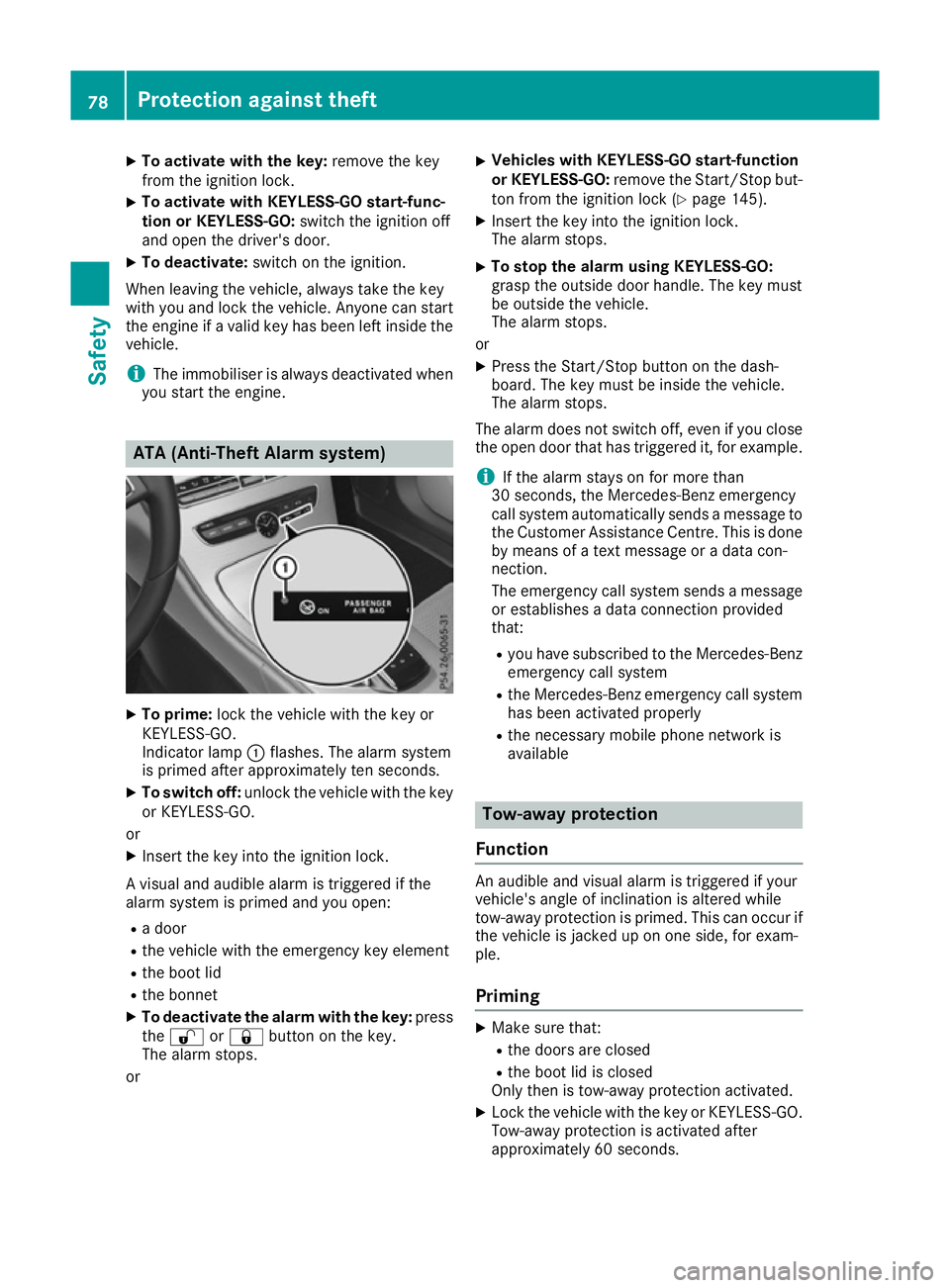
To prime: lock the vehicl ewitht he key or
KEYLESS-GO.
Indicato rlamp :flashes. The alarm system
is primed afte rapproximatel yten seconds.
X To switc hoff:unlock the vehicl ewitht he key
or KEYLESS-GO.
or X Insert the key into the ignition lock.
Av isua land audibl ealarm is triggered if the
alarm system is primed and yo uopen:
R ad oor
R the vehicl ewitht he emergency key element
R the boot lid
R the bonnet
X To deactivate the alarm with the key: press
the % or& button on the key.
The alarm stops.
or X
Vehicles with KEYLESS-GO start-function
or KEYLESS-GO: remove the Start/Stop but-
ton from the ignition lock (Y page 145).
X Insert the key into the ignition lock.
The alarm stops.
X To sto
pthe alarm using KEYLESS-GO:
grasp the outsid edoorh andle. The key must
be outsid ethe vehicle.
The alarm stops.
or X Press the Start/Stop button on the dash-
board .The key must be insid ethe vehicle.
The alarm stops.
The alarm does not switch off, eve nifyouclose
the open door tha thas triggered it, for example.
i If the alarm stays on for more than
30 seconds ,the Mercedes‑Be nz emergency
cal lsys tem automaticall ysend sam essage to
the Customer Assistance Centre. Thi sisdone
by means of atext message or adatac on-
nection.
The emergency cal lsystem send samessage
or establishes adatac onnectio nprovided
that:
R youh aves ubscribed to the Mercedes ‑Benz
emergency cal lsystem
R the Mercedes‑Be nz emergency cal lsys tem
ha sb eena ctivate dproperly
R the necessary mobil ephone network is
available Tow-away protection
Function An audibl
eand visua lalarm is triggered if your
vehicle's angle of inclinatio nisa ltere dw hile
tow-away protection is primed .Thisc an occu rif
the vehicl eisjacke dupono ne side,for exam-
ple.
Priming X
Make sure that:
R the doors are closed
R the boot li disclosed
Onl ythen is tow-away protection activated.
X Lock the vehicl ewitht he key or KEYLESS-GO.
Tow-away protection is activate dafter
approximatel y60s econds. 78
Protectio
nagains ttheftSafety