boot MERCEDES-BENZ C-CLASS COUPE 2015 Owner's Manual
[x] Cancel search | Manufacturer: MERCEDES-BENZ, Model Year: 2015, Model line: C-CLASS COUPE, Model: MERCEDES-BENZ C-CLASS COUPE 2015Pages: 385, PDF Size: 13.12 MB
Page 311 of 385
Stowage areas
Loading guidelines
G
WARNING
Combustion engines emit poisonous exhaust
gases such as carbon monoxide. Exhaust
gases can enter the vehicle interior if the boot
lid is open when the engine is running, espe-
cially if the vehicle is in motion. There is arisk
of poisoning.
Always switch off the engine before opening
the boot lid. Never drive with the boot lid
open. G
WARNING
If objects, luggage or loads are not secured or not secured sufficiently, they could slip, tip
over or be flung around and thereby hit vehicle
occupants. There is arisk of injury, especially
when braking or abruptly changing directions.
Always store objectssot hat they cannot be
flung around. Secure objects, luggage or
loads against slipping or tipping before the
journey. G
WARNING
The exhaust tail pipe and tail pipe trim can
become very hot. If you come into contact
with these parts of the vehicle, you could burn
yourself. There is arisk of injury.
Always be particularly careful around the
exhaust tail pipe and the tail pipe trim. Allow
these components to cool down before touch-
ing them.
The handling characteristics of aladen vehicle
are dependent on the distribution of the load
within the vehicle. For this reason, you should
observe the following notes when transporting a
load:
R never exceed the maximum permissible gross
vehicle weight or the permissible axle loads
for the vehicle (including occupants).
R the boot is the preferred place to store
objects.
R position heavy loads as far forward as possi-
ble and as low down in the boot as possible. R
the load must not protrude above the upper
edge of the seat backrests.
R always place the load behind unoccupied
seats if possible.
R secure the load with sufficiently stronga nd
wear-resistant lashing material. Pad sharp
edges for protection.
i Load restraint
sare available at any qualified
specialist workshop, e.g. aMercedes-Benz
Service Centre. Stowage compartments
Important safety notes G
WARNING
If objectsint he passenger compartmen tare
stowed incorrectly, they can slide or be
thrown around and hit vehicle occupants. In
addition, cupholders, open stowage spaces
and mobile phone brackets cannot always
retain all objectst hey contain. There is arisk
of injury, particularly in the event of sudden
braking or asudden change in direction.
R Always stow objectssot hat they cannot be
thrown around in such situations.
R Always make sure that objectsdon ot pro-
trude from stowage spaces, parcel nets or
stowage nets.
R Close the lockable stowage spaces before
startingaj ourney.
R Always stow and secure heavy, hard, poin-
ted, sharp-edged, fragile or bulky objectsin
the boot.
Observe the loading guidelines (Y page 308).308
Stowage areasStowing and features
Page 313 of 385
In stowage space
:in the doors you can store
bottles with acapacity of up to 1.0 l,ar olled-up
fluorescent jacke t(driver' sdoor )and th evehicle
documen twallet (front-passenger door).
Stowage compartment/telephone com-
partmen tunder th earmre st X
To open: pressbutton :at th efront.
The stowage spac eopens.
Dependin gonthevehicle's equipment ,the fol-
lowin gmay be in th estowage space:
R am ultimedia connecto runit with 2USBports
and an SD car dslot,e.g.f or use with an
iPod ®
,i Phone ®
or MP3 player; see th esepa-
rat eo peratin ginstructions
R am obile phon ebracket
R as mall stowage spac eintheupper fron tsec-
tion Additional stowage space
Dependin gontheequipment ,the following
additional stowage areas are availabl einthe
vehicle:
R car dand coi nholde rint hedashboard above
th el ight switch (no tsuitable for holding thin
object ssuchass hoppin gtokens)
R theo pen stowage compartmen tinthecentre
console
R stowage net in th efront-pa ssenger footwell
R map pockets on th eback of th edriver' sand
front-passenger seat
R thel uggage net on th eleft-hand side in the
boot
Observ ethe loadin gguidelines (Y page 308)
and th esafety note sregardin gstowage spaces
(Y page 308). Through-loading facilit
yintherear
bench seat
Important safety notes G
WARNING
If th erear bench seat/rear seat and seat
backres tare no tengaged they coul dfold for-
wards ,e.g.w hen braking suddenly or in the
even tofana ccident.
R The vehicle occupant would thereb ybe
pushe dintot he seat belt by th erear bench
seat/rear seat or by th eseat backrest. The
seat belt canno tprotect as intended and
coul dresult in additional injury.
R Object sorloads in th eboot canno tbe
restraine dbytheseat backrest.
This pose sanincreased risk of injury.
Before ever ytrip, mak esure that th eseat
backrests and th erear bench seat/rear seat
are engaged before ever ytrip.
Observ ethe loadin gguidelines (Y page 308).
The outside and th emiddle rear seat backrests
can be folded down separately to increas ethe
boot capacity. The division ratio is 40 %to20%to
40%.
Foldin gthe rea rseat backres tforward X
Vehicle swithout memory function :ifneces-
sary, mov ethe driver' sorfront-pa ssenger
seat forwards.
X Vehicle swith memory function :when on eor
bot hpartsoft herear seat backres tare folded
forwards ,the respectiv efront seat moves
forward slightly, when necessary, in orde rto
avoid contact.
X Open th eboot.
X Fully insert th erear seat backres thead
restraints. 310
Stowage areasStowing and features
Page 315 of 385
X
Adjust the hea drestraints if necessary
(Y page 106).
X Mov ethe driver's or front-passenger seat
back if necessary.
If yo udon ot nee dthe through-loading feature,
yo us houl dalway sengag ethe rea rseatb ackr-
ests .Thisw illp revent unauthorised access to
the boot from the vehicl einterior.
Lockin gthe centre rear seat backrest In order to prevent the boot from being
accesse
dbyunauthorised persons, the centre
sea tbackres tcan be locked using acatch .The
centre sea tbackres tcan onl ybefoldedforward
together with the left sea tbackrest.
X To lock: foldt he left and centre sea tbackr-
ests forward. Make sure tha tthe centre and
left sea tbackrests ar eengaged and joined
together.
X Slide catch :upwards.
The release mechanism of the centre seat
backres tisl oc ked.
X To unlock: foldthe left and centre sea tbackr-
ests forward.
X Slide catch :downwards. Securin
gaload
Lashin geyelets Observ
ethe following notes on securing loads:
R observe the loading guideline s(Ypage 308).
R secur ethe load using the lashing eyelets.
R distribute the load on the lashing eyelets
evenly.
R do not us eelast ic straps or nets to secur ea
load .These ar eonlyi ntende dasana nti-slip
protection for light loads. R
do not route lashing material sacross sharp
edge sorc orners.
R pa ds harp edge sfor protection. Vehicles with the through-loading feature in the
rea rbench seat:
X Fol dupt he lashing eyelets next to the rear
sea tbackres tand pu tthem throug hthe slots
in the carpet.
Bag hook G
WARNING
The ba ghooks canno trestrai nheavy objects
or items of luggage. Objects or items of lug-
gage could be flung around and thereb yhit
vehicl eoccupants when braking or abruptly
changing directions. There is ariskofi njury.
Onl yhanglight objects on the ba ghooks.
Never hang hard, sharp-edged or fragile
objects on the ba ghooks.
! The ba
ghookc an bear amaximu mloadof
3k g. Do not us eittosecureaload. X
Pull ba ghook ;down by tab :.312
Stowage areasSto
wing an dfeatures
Page 316 of 385

Stowage well under the boot floor
! Remove the handle again before closing the
boot lid and snap it in tightly to prevent the
handle flap from protruding. Otherwise, you
could damage the handle. X
To open: pull handle :up. X
Hook handle :into rain trough ;. Roof carrier
Important safety notes G
WARNING
When aload is transported on the roof, the
vehicle's centre of gravity rises and the han-
dling changes. If you exceed the maximum
roof load, the handling as well as steering and braking characteristics are severely affected.
There is arisk of an accident.
Always observe the maximum roof load and
adapt your driving style.
You will find information on the maximum roof
load in the "Technical data" section
(Y page 377). !
Mercedes-Benz recommends that you only
use roof carriers that have been tested and
approved for Mercedes-Benz vehicles. This
helps to prevent damage to the vehicle.
Position the load on the roof carrier in such a way that the vehicle will not sustain damage
even when it is in motion.
Depending on the vehicle equipment, ensure
that when the roof carrier is fitted you can:
R raise the sliding sunroof/panorama sliding
sunroof fully
R open the boot lid fully
An incorrectly secured roof carrier or roof load
may become detached from the vehicle. You
must therefore ensure that you observe the roof
carrier manufacturer's installation instructions.
Vehicles with panoramas liding sunroof:if a
roof carrier is fitted, the panorama sliding sun-
roof cannot be opened. In order to allow venti-
lation of the vehicle interior, you can raise the
panorama sliding sunroof.
If ar oof carrier approved by Mercedes-Benz
makes contact with the panorama sliding sun-
roof, the sunroof will lower slightly but remain
raised in the rear.
Attaching the roof carrier X
Open covers :carefully in the direction of
the arrow.
X Fold covers :upwards.
X Only secure the roof carrier to the anchorage
points under covers :.
X Observe the manufacturer's installation
instructions. Stowage areas
313Stowing and features Z
Page 330 of 385
Washing the vehiclea
nd cleaning the
paintwork
Automatic car wash G
WARNING
Braking efficiency is reduced after the vehicle has been washed .There is arisk of an acci-
dent.
After washing the vehicle, brake carefully
while paying attention to the traffic conditions in order to restore full braking efficiency.
! When DISTRONIC PLUS or the HOLD func-
tion is activated, the vehicl ebrakes automat-
ically in certain situations.
To avoi ddamage to the vehicle, deactivate
DISTRONIC PLUS and the HOLD function in
the following or similar situations:
R when towing away
R in ac ar wash
! Make sure:
R the side windows and sliding sunroo fare
close dcompletely.
R the blower for the ventilation/heating is
switched off (OFF button is depressed).
R the windscreen wiper switch is at position
0
R the 360° camera or reversing camera is
switched off.
The vehicl ecouldo therwise be damaged.
! If the key is withi
nthe rear detection range
of KEYLESS-GO, the following situations, for
example, coul dleadtot he boot lid opening
unintentionally:
R using acar wash
R using ahigh-pressure cleaner
Make sure that the key is at least 3maway
from the vehicle.
! Make sure that the automatic transmission
is in neutral position Nwhen washing your
vehicl einat ow-through car wash. The vehicle
may otherwise be damaged.
R Operating with the key:
Do not remove the key from the ignition
lock. Do not open the driver's door when
the engine is switched off or at very low
speeds. Otherwise, whe nintransmission position
Dor Rthe automatic transmission
wil lautomatically switch to park position P
and block the wheels.
R Operating with the Start/Stop button:
Do not open the driver's door whe nthe
engine is switched off or at very low
speeds. Otherwise, whe nintransmission
position Dor Rthe automatic transmission
wil lautomatically switch to park position P
and block the wheels.
Observe the following to make sure that the
automatic transmission stay sinneutral position
N:
Operating with the key and Start/Stop button:
X Make sure the ignition is switched on.
X Make sure that the vehicl eisstationary.
X Depress the brake peda land keep it
depressed.
Operating with the Start/Stop button only: X Engage park position P.
X Releas ethe brake pedal.
X Remove the Start/Stop button from the igni-
tion lock (Y page145).
X Insert the key into the ignition lock.
X Switch on the ignition.
X Depress the brake peda land keep it
depressed.
Operating with the key and Start/Stop button:
X Select neutral N.
X Releas ethe brake pedal.
X Releas ethe electric parking brake, if neces-
sary.
X Switch off the ignition and leave the key in the
ignition lock.
You can wash the vehicl einanautomatic car
wash from the very start.
Was hoff excess dirt before cleaning the vehicle
in an automatic car wash.
After using an automatic car wash, wip eoff wax
from the windscreen and the wiper blades. This
wil lprevent smears and reduce wiping noises
caused by residue on the windscreen.
Washing by hand In some countries
,washing by hand is only
allowe datspeciall yequipped washing bays. Care
327Maintenance and care Z
Page 331 of 385
Observe the legal requirements for each indi-
vidualc ountry.
X Do not use hot water and do not wash the
vehicle in direct sunlight.
X Use asoft sponge to clean.
X Use amild cleaning agent, such as acar
shampoo approved by Mercedes-Benz.
X Thoroughly hose down the vehicle with agen-
tle jet of water.
X Do not point the water jet directly towards the
air inlet.
X Use plenty of water and rinse out the sponge
frequently.
X Rinse the vehicle with clean water and dry
thoroughly with achamois.
X Do not let the cleaning agent dry on the paint-
work.
When using the vehicle in winter, remove all
traces of road salt deposits carefully and as
soon as possible.
High-pressure cleaning equipment G
WARNING
The water jet of circular-jet nozzles (dirt grind- ers) can cause damage not visible from the
outside to tyres or chassis components. Com-
ponents damaged in this way can unexpect-
edly fail. There is arisk of an accident.
Do not use high-pressure cleaners with circu-
lar-jet nozzles to clean the vehicle. Have dam- aged tyres or chassis componentsr eplaced
immediately.
! Alwaysm
aintainadistance of at least 30 cm
between the vehicle and the high-pressure
cleaner nozzle. Information aboutt he correct
distance is available from the equipment
manufacturer.
Move the high-pressure cleaner nozzle
around when cleaning your vehicle.
Do not aim directly at any of the following:
R tyres
R door gaps, roof gaps, joints etc.
R electrical components
R battery
R connectors
R lights
R seals R
trim elements
R ventilation slots
Damaged seals or electrical componentsc an
lead to leaks or failures.
! If the key is within the rear detection range
of KEYLESS-GO, the following situations, for
example, could lead to the boot lid opening
unintentionally:
R using acar wash
R using ahigh-pressure cleaner
Make sure that the key is at least 3maway
from the vehicle.
! Edition
1special model: parts of your vehi-
cle are covered with adecorative foil. Main-
tain adistance of at least 70 cm between the
foil-wrappedp arts of the vehicle and the noz-
zle of the high pressure cleaner.
Information aboutt he correct distance is
available from the equipment manufacturer.
Move the high-pressure cleaner nozzle
around when cleaning your vehicle.
Cleaning the paintwork !
Do not affix:
R stickers
R films
R magnetic plates or similari tems
to painted surfaces. You could otherwise
damage the paintwork.
Scratches, corrosive deposits, areas affected by
corrosion and damage caused by inadequate
care cannot always be completely repaired. In
such cases, visit aqualified specialist workshop.
X Remove impurities immediately,w here pos-
sible, whilst avoiding rubbing too hard.
X Soak insect remains with insect remover and
rinse off the treated areas afterwards.
X Soak bird droppings with water and rinse off
the treated areas afterwards.
X Remove coolant, brake fluid, tree resins, oils,
fuels and greases by rubbing gently with a
cloth soaked in petroleum ether or lighter
fluid.
X Use tar remover to remove tar stains.
X Use silicone remover to remove wax. 328
CareMaintenance and care
Page 338 of 385
Warning triangle
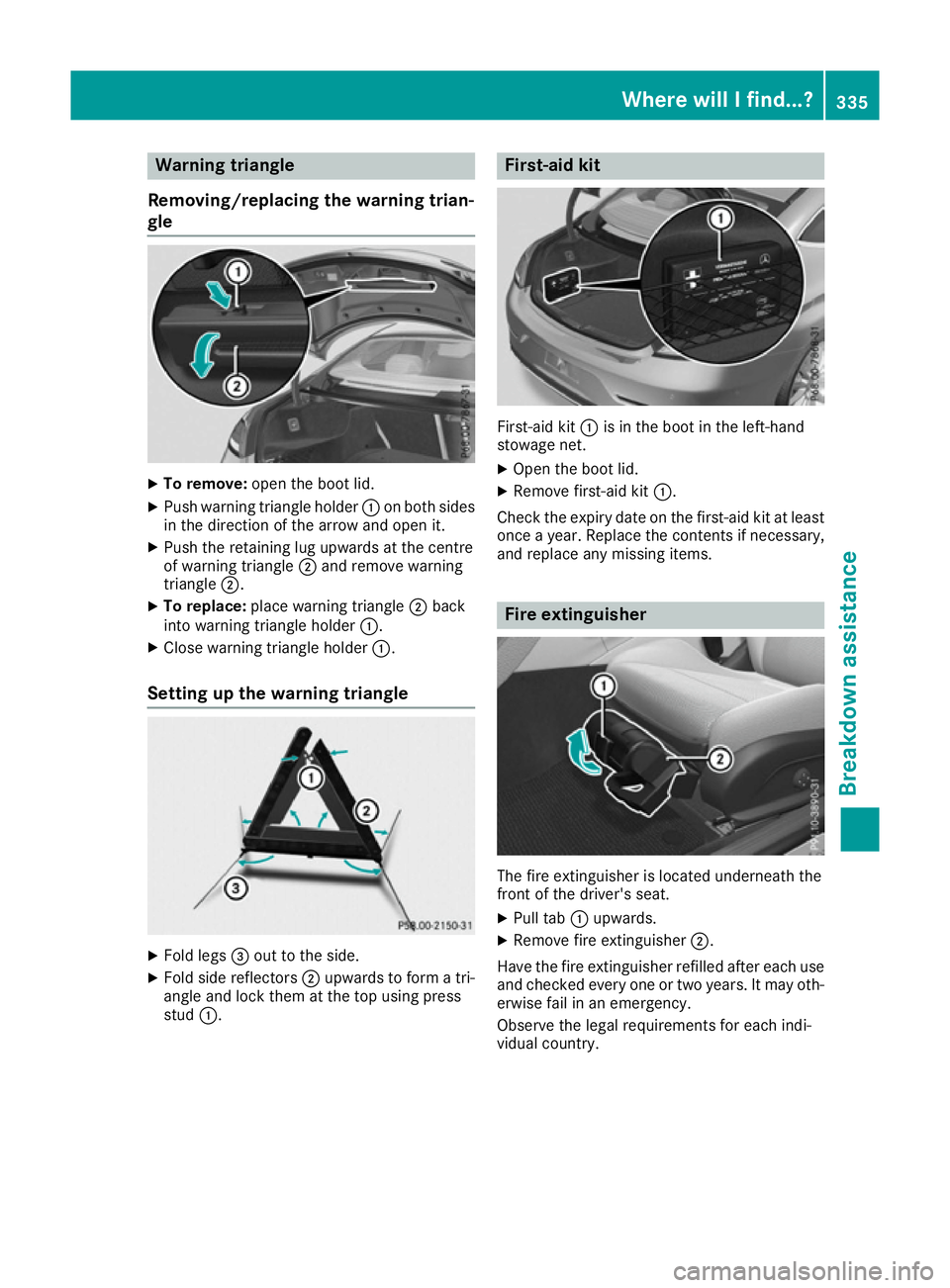
Removing/replacing the warning trian-
gle X
To remove: open the boot lid.
X Pus hwarning triangl eholder :on both sides
in the direction of the arrow and open it.
X Pus hthe retaining lug upwards at the centre
of warning triangle ;and remove warning
triangle ;.
X To replace: place warning triangle ;back
into warning triangl eholder :.
X Close warning triangl eholder :.
Setting up the warning triangle X
Fold legs =out to the side.
X Fold side reflectors ;upwards to form atri-
angl eand lock them at the top using press
stud :. First-aid kit
First-ai
dkit: is in the boot in the left-hand
stowage net.
X Open the boot lid.
X Remove first-ai dkit:.
Check the expiry date on the first-ai dkit at least
once ayear. Replace the contents if necessary,
and replace any missing items. Fire extinguisher
The fire extinguisher is located underneath the
front of the driver's seat.
X Pul ltab : upwards.
X Remove fire extinguisher ;.
Have the fire extinguisher refilled after each use and checked every one or two years. It may oth-
erwise fail in an emergency.
Observe the lega lrequirements for each indi-
vidual country. Where will
Ifind...?
335Breakdown assistance
Page 339 of 385
Vehicl
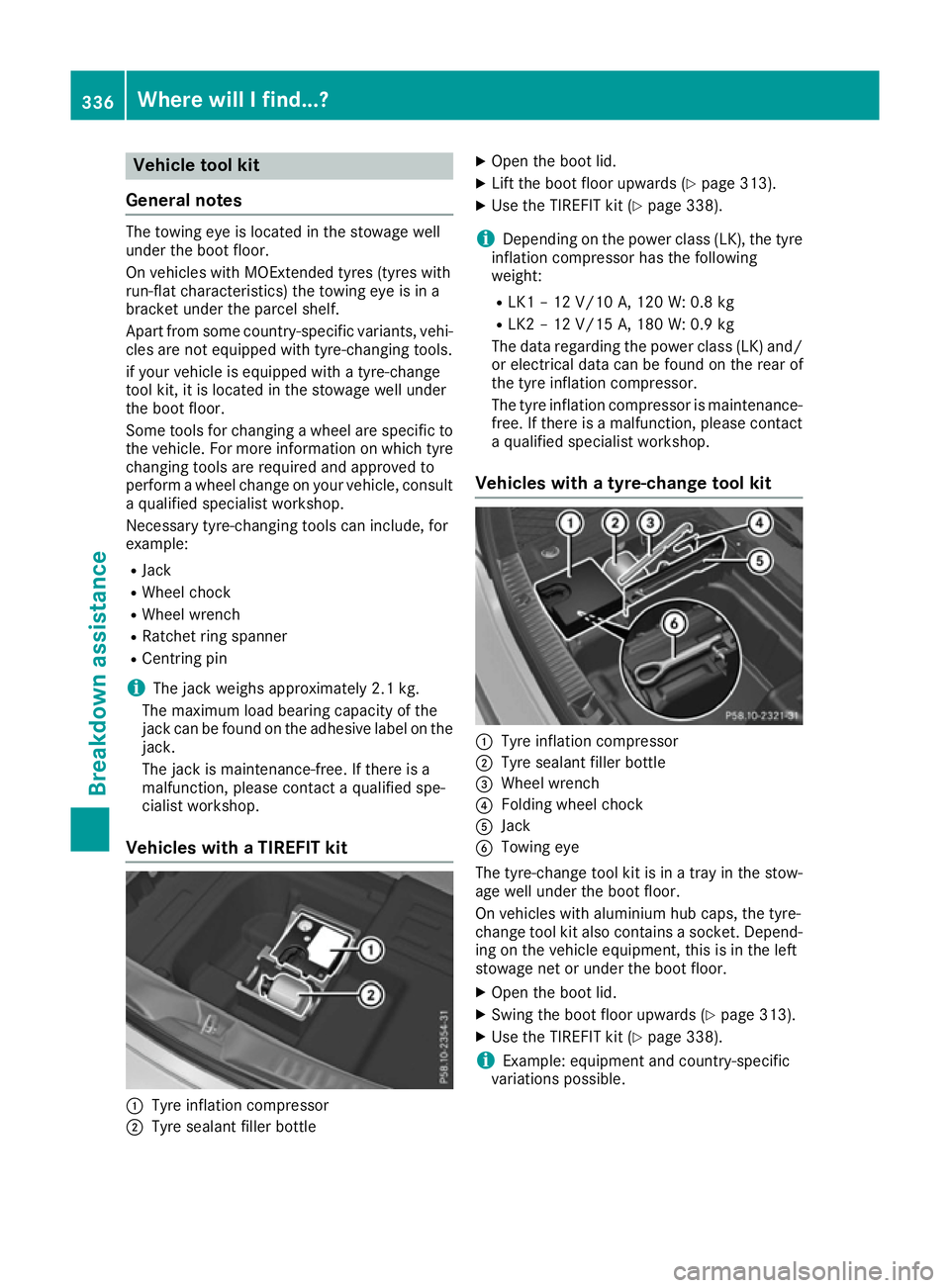
etoolkit
General notes The towing ey
eislocate dint he stowag ewell
under the boot floor.
On vehicles with MOExtende dtyres (tyres with
run-fla tcharacteristics) the towing ey eisina
bracket under the parcel shelf.
Apart from som ecountry-specifi cvariants, vehi-
cle sare not equipped with tyre-changing tools.
if your vehicl eisequippe dwithat yre-change
tool kit, it is locate dinthe stowag ewellu nder
the boot floor.
Some tool sfor changing awheel are specifi cto
the vehicle. For more informatio nonwhich tyre
changing tool sare required and approved to
perfor mawheelchange on your vehicle, consult
aq uali fied specialist workshop.
Necessary tyre-changing tool scan include, for
example:
R Jack
R Wheel chock
R Wheel wrench
R Ratchet ring spanner
R Centring pin
i The jack weighs approximatel
y2.1 kg.
The maximu mloadb earing capacity of the
jack can be found on the adhesive labe lonthe
jack.
The jack is maintenance-free .Ifthereisa
malfunction, please contact aquali fied spe-
cialist workshop.
Vehicles with aTIREFI Tkit :
Tyre inflation compressor
; Tyre sealant fille rbottle X
Ope nthe boot lid.
X Lif tthe boot floor upwards (Y page 313).
X Use the TIREFIT kit (Y page 338).
i Depending on the powe rclass (LK), the tyre
inflation compressor ha sthe following
weight:
R LK1 –12V /10 A, 120 W: 0.8 kg
R LK2 –12V /15A,1 80W:0.9 kg
The data regarding the power clas s(LK) and/
or electrical data can be found on the rear of
the tyre inflation compressor.
The tyre inflation compressor is maintenance-
free. If there is amalfunction, please contact
aq ualified specialist workshop.
Vehicles with atyre-change tool kit :
Tyre inflation compressor
; Tyre sealant filler bottle
= Whee lwrench
? Folding wheel chock
A Jack
B Towing eye
The tyre-change tool kit is in atray in the stow-
age wel lunde rthe boot floor.
On vehicles with aluminium hub caps, the tyre-
change tool kit also contains asocket. Depend-
ing on the vehicle equipment, this is in the left
stowage net or unde rthe boot floor.
X Open the boot lid.
X Swing the boot floo rupwards (Y page313).
X Use the TIREFIT kit (Y page338).
i Example: equipment and country-specific
variations possible. 336
Where will
Ifind...?Breakdow nassistance
Page 340 of 385
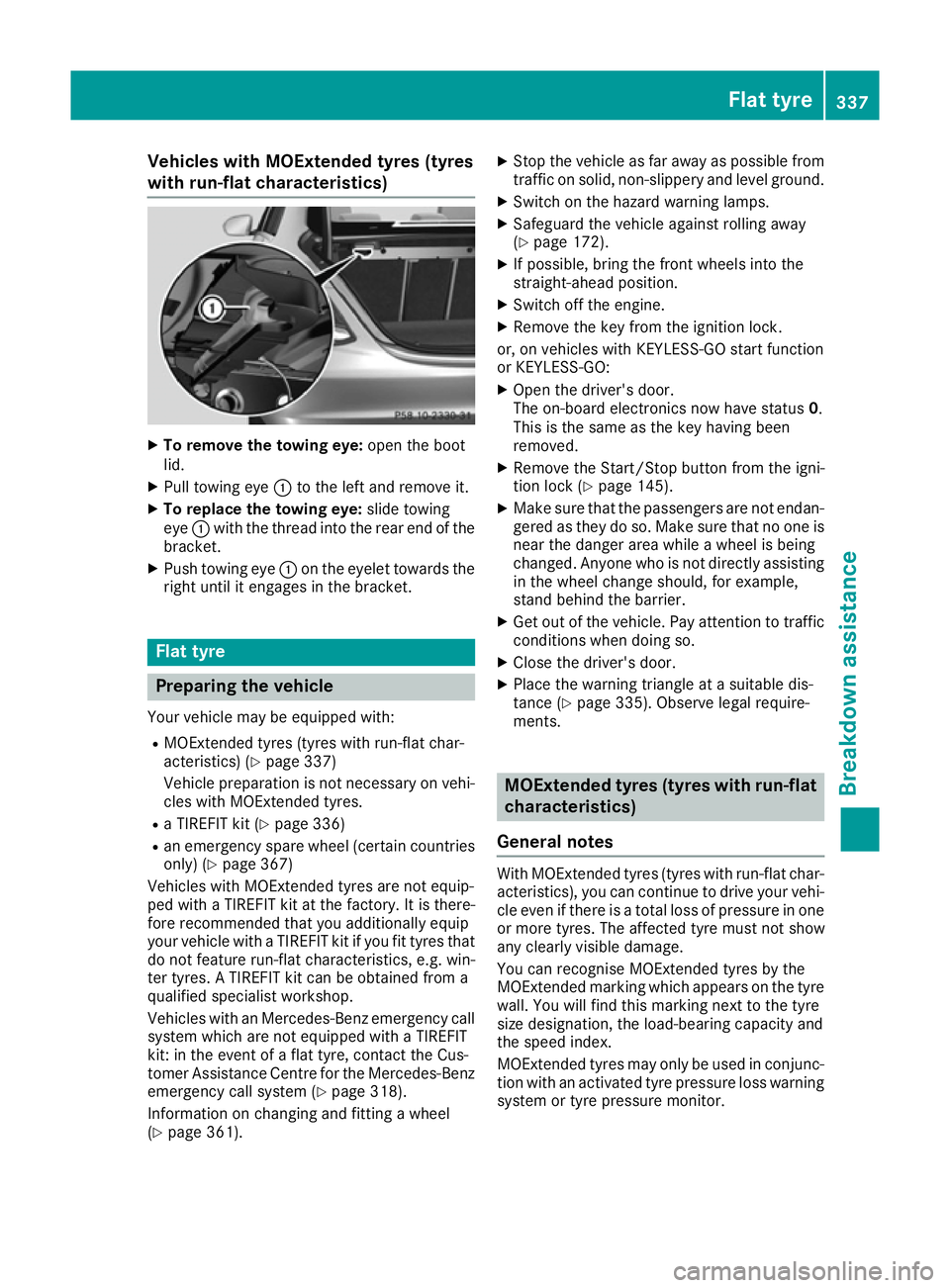
Vehicles with MOExtende
dtyres (tyres
with run-flat characteristics) X
To remove the towin geye: open the boot
lid.
X Pull towing eye :to the left and remove it.
X To replace the towin geye: slidetowing
eye :with the thread into the rea rend of the
bracket.
X Push towing eye :on the eyelet toward sthe
right unti litengages in the bracket. Flat tyre
Preparin
gthe vehicle
Your vehicl emay be equipped with:
R MOExtende dtyres (tyres with run-fla tchar-
acteristics )(Ypage 337)
Vehicl epreparation is not necessary on vehi-
cle sw ithM OExtende dtyres.
R aT IREFIT kit (Y page 336)
R an emergency spare whee l(certai ncountries
only) (Y page 367)
Vehicles with MOExtende dtyres are not equip-
pe dw ithaT IREFIT kit at the factory .Itisthere-
fore recommende dthaty ou additionally equip
your vehicl ewithaT IREFIT kit if yo ufit tyres that
do not feature run-fla tcharacteristics, e.g .win-
ter tyres. ATIREFIT kit can be obtained from a
qualified specialist workshop.
Vehicles with an Mercedes-Benz emergency call
system which are not equipped with aTIREFIT
kit: in the event of aflatt yre, contact the Cus-
tome rAssistance Centre for the Mercedes-Benz
emergency cal lsystem (Y page 318).
Informatio nonchanging and fitting awheel
( Y page 361). X
Stop the vehicl easfar away as possibl efrom
traffic on solid ,non-slippery and level ground.
X Switch on the hazard warning lamps.
X Safeguard the vehicl eagain st rolling away
(Y page 172).
X If possible, bring the front wheels into the
straight-ahea dposition.
X Switch off the engine.
X Remove the key from the ignition lock.
or, on vehicles with KEYLESS-GO start function
or KEYLESS ‑GO:
X Ope nthe driver' sdoor.
The on-board electronics now have status 0.
Thi sist he same as the key having been
removed.
X Remove the Start/Stop button from the igni-
tio nlock( Ypage 145).
X Make sure tha tthe passenger sare not endan-
gered as they do so. Make sure tha tnoone is
nea rthe danger are awhile awheel is being
changed .Anyone wh oisnot directl yassis ting
in the whee lchange should, for example,
stand behind the barrier.
X Ge toutof the vehicle. Pa yattentio ntotraffic
conditions when doing so.
X Close the driver' sdoor.
X Place the warning triangl eatasuitabl edis-
tance (Y page 335). Observe lega lrequire-
ments. MOExtende
dtyres (tyres with run-flat
characteristics)
General notes With MOExtende
dtyres (tyres with run-fla tchar-
acteristics), yo ucan continue to drive your vehi-
cle eve nifthereisat otallos sofp ressure in one
or more tyres. The affecte dtyrem ustn ot show
any clearl yvisible damage.
Yo uc an recognise MOExtende dtyres by the
MOExtende dmarking which appears on the tyre
wall .You will find thi smarking next to the tyre
size designation, the load-bearing capacity and
the speed index.
MOExtende dtyres ma yonlybeu sedinc onjunc-
tio nw ithana ctivate dtyrep ressure loss warning
system or tyr epressure monitor. Flat tyre
337Breakdown assis tance
Page 342 of 385
If you come into contact with the tyre sealant,
observe the following:
R Rinse off the tyre sealant from yours kin
immediately with water.
R If the tyre sealant comes into contact with
youre yes,immediately rinse them thor-
oughlyw ith clean water.
R If tyre sealant is swallowed, immediately
rinse yourm outh out thoroughl yand drink
plenty of water. Do not induce vomiting,
and seek medica lattention immediately.
R Immediately change out of clothing which
has come into contact with tyre sealant.
R If an allergic reaction occurs, seek medical
attention immediately.
! Do not operate the tyre inflation compres-
sor for longer than ten minutes at atime with-
out abreak. It may otherwise overheat.
The tyre inflation compressor can be oper-
ated again once it has cooled down.
Complyw ith the manufacturer's safety instruc-
tions on the sticker on the tyre inflation com-
pressor.
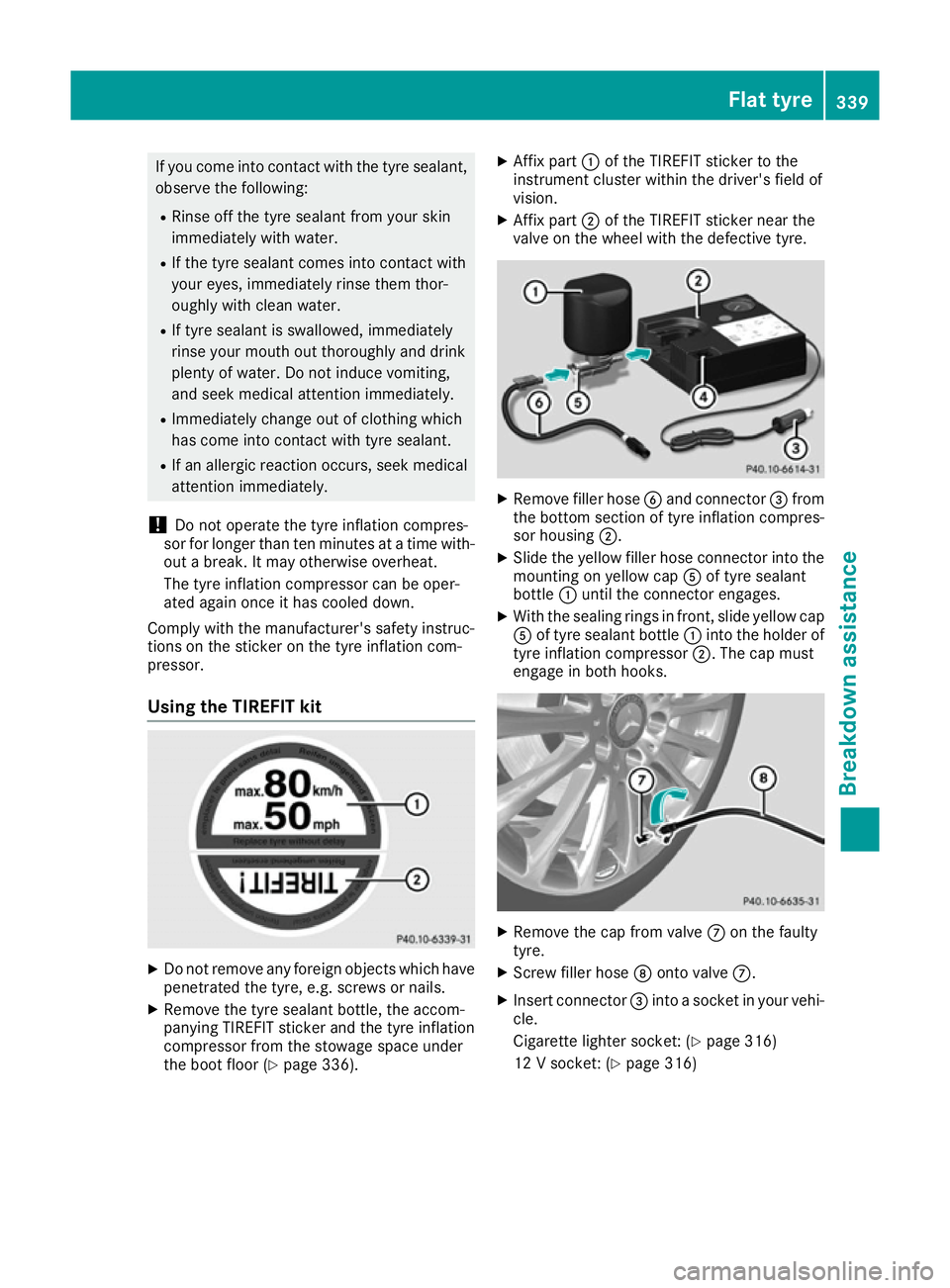
Usingt he TIREFITk it X
Do not remove any foreign objects which have
penetrated the tyre, e.g. screws or nails.
X Remove the tyre sealant bottle, the accom-
panying TIREFIT sticker and the tyre inflation
compressor from the stowage space under
the boot floor (Y page 336). X
Affix part :of the TIREFIT sticker to the
instrument cluster within the driver's field of
vision.
X Affix part ;of the TIREFIT sticker near the
valve on the wheel with the defective tyre. X
Remove fillerh oseBand connector =from
the bottom section of tyre inflation compres- sor housing ;.
X Slide the yellow fillerh ose connector into the
mounting on yellow cap Aof tyre sealant
bottle :until the connector engages.
X With the sealing rings in front, slidey ellow cap
A of tyre sealant bottle :into the holderof
tyre inflation compressor ;.The cap must
engage in both hooks. X
Remove the cap from valve Con the faulty
tyre.
X Screw fillerh oseDonto valve C.
X Insert connector =into asocket in yourv ehi-
cle.
Cigarette lighter socket: (Y page 316)
12 Vsocket: (Y page 316) Flat tyre
339Breakdowna ssistance Z