warning MERCEDES-BENZ C-Class COUPE 2017 CL205 Owner's Guide
[x] Cancel search | Manufacturer: MERCEDES-BENZ, Model Year: 2017, Model line: C-Class COUPE, Model: MERCEDES-BENZ C-Class COUPE 2017 CL205Pages: 354, PDF Size: 8.66 MB
Page 31 of 354
must accept any interference, including inter-
ference that may cause undesired operation of
the device."
Diagnostics connection
The diagnostics connection is only intended forthe connection of diagnostic equipment at a
qualified specialist workshop.
GWARNING
If you connect equipment to the diagnostics
connection in the vehicle, it may affect the
operation of the vehicles ystems. Asaresult,
the operating safety of the vehiclec ould be
affected. There is arisk of an accident.
Do not connect any equipment to adiagnos-
tics connection in the vehicle.
GWARNING
Objects in the driver'sf ootwellcan restrict the
pedalt ravel or obstruct adepressed pedal.
The operating and road safety of the vehiclei s
jeopardized. There is arisk of an accident.
Make sure that all objects in the vehiclea re
stowed correctly, and that they cannot enter
the driver' sfootwell. Install the floormats
securely and as specified in order to ensure
sufficient clearance for the pedals. Do not use
loose floormats and do not place floormats on
top of one another.
!If the engine is switched off and equipment
on the diagnostics connection is used ,the
starter battery may discharge.
Connecting equipment to the diagnostics con-
nection can leadtoe missions monitoring infor-
mation being reset, for example. This may lead
to the vehiclef ailing to meet the requirements of
the next emissions test during the main inspec-
tion.
Qualified specialist workshop
An authorized Mercedes-Benz Center is aquali-
fied specialist workshop .Ithas the necessary
specialist knowledge, tools and qualifications to
correctly carry out the work required on your vehicle. This is especiall
ythe case for work rel-
evant to safety.
Observe the notes in the Maintenance Booklet.
Always have the following work carried out at an
authorized Mercedes-Benz Center:
Rwork relevant to safety
Rservice and maintenance work
Rrepair work
Ralterations, installation work and modifica-
tions
Rwork on electronic components
Correc tuse
If you remove any warning stickers, you or oth-
ers could fail to recognize certain dangers.
Leave warning stickers in position.
Observe the following informatio nwhen driving
you rvehicle:
Rthe safety notes in this manual
Rthe vehiclet echnical data
Rtraffic rulesand regulations
Rlaw sand safety standard spertaining to motor
vehicles
Problems with your vehicle
If you should experience aproblem with your
vehicle, particularl yone that you believe may
affect its safe operation, we urge you to contact
an authorized Mercedes-Benz Center immedi-
ately to have the problem diagnosed and recti-
fied. If the problem is not resolvedtoy ours at-
isfaction, please discuss the problem again with
aM ercedes-Benz Center or contact us at one of
the following addresses.
In the USA
Customer Assistance Center
Mercedes-Benz USA, LLC
One MercedesD rive
Montvale, NJ 07645-0350
In Canada
Customer Relations Department
Mercedes-Benz Canada ,Inc.
98 Vanderhoof Avenue
Toronto, Ontario M4G 4C9
Operating safety29
Introduction
Z
Page 33 of 354
Services include, for example:
Rrepairservices
Rservice processes
Rwarranties
Rquality assurance
The vehicl eisreado utby employees of the ser-
vice network (including the manufacturer) using
specia ldiagn ostictesters. More detailed infor-
mation is obtaine dfrom it, if required.
After amalfunction hasb eenr ectified, the infor-
mation is deleted from the malfunction memory or is continually overwritten.
Whe noperating the vehicle, situations are con-
ceivable in which this technical data, in connec-
tion with othe rinformation (i fnecessary, under
consultation with an authorized expert), could
be trace dtoaperson.
Example sinclude:
Raccident reports
Rdamag etothe vehicle
Rwitness statements
Further additiona lfunctions that have bee ncon-
tractually agree duponw itht he customer allow
certain vehicl edatatobec onveyedbythe vehi-
cle as well .The additiona lfunctions include, for
example, vehicl eloc ation in cas eofanemer-
gency.
COMAND/mbrace
If the vehicl eisequipped with COMAND or
mbrace, additiona ldataa bout the vehicle's
operation, the us eofthe vehicl eincertain sit-
uations ,and the location of the vehicl emay be
compiled through COMAND or the mbrace sys-
tem.
For additiona linformation please refe rtothe
COMAND UserM anualort he Digital Operator's
Manua land/or the mbrace Terms and Condi-
tions.
Even tdata recorders
Thi svehicl eise quipped with an event data
recorde r(EDR). Thi svehicl eise quipped with an
event data recorde r(EDR). The mai npurpose of
an EDR is to record, in certain cras hornear
crash-like situations, such as an ai rbag deploy-
ment or hitting aroado bstacle, data that will
assis tinunderstanding how avehicle's systems performed. The EDR is designed to record data
relate
dtovehicledynamics and safety systems
for ashort perio doftime,typicall y30seconds
or less.
The EDR in this vehicl eisdesigned to record
such data as:
RHow various systems in your vehicl ewere
operating
RWhether or not the driver and passenger
safety belts were buckled/fastened
RHow far (i fatall)t he driver wa sdepressing the
accelerato rand/or brake pedal and
RHow fas tthe vehicl ewastraveling.
These data can hel pprovid eabetterunder-
standing of the circumstances in which acci-
dents and injurie soccur. NOTE: EDR data are
recorde dbyyourv ehicl eonly if anon-trivial
cras hsituation occurs; no data is recorde dby
the EDR under normald riving conditions and no
personald ata(e.g. name ,gender, ag eand acci-
dent location) are recorded. However, othe rpar-
ties ,suc hasl awenforcement could combine
EDR data with the typ eofpersonal
l
yide ntifying
data routinel yacquired during acras hinvesti-
gation.
Access to the vehicl eand/or the EDR is needed
to rea ddatat hat is recorde dbythe EDR, and
specia lequipment is required .Inaddition to the
vehicl emanufacturer, othe rpartie sthat have
the specia lequipment, such as la wenforce-
ment, can rea dthe information by accessing the
vehicl eorthe EDR.
EDR data may be used in civi land crimina lmat-
ters as atool in accident reconstruction, acci-
dent claims and vehicl esafety .Since the Crash
Data Retrieval CDR tool that is used to extract
data from the EDR is commerciall yavailable,
Mercedes-Benz USA, LLC ("MBUSA")e xpressly
disclaims any and al lliabili ty arising from the
extraction of this information by unauthorized
Mercedes-Benz personnel.
MBUSA will not share EDR data with others
withou tthe consent of the vehicl eowners or, if
the vehicl eislease d, withou tthe consent of the
lessee. Exceptions to this representation
includ eresponse stosubpoenasbyl awenforce-
ment; by federal, state or local government; in
connection with or arising outofl itigation involv-
ing MBUSA or its subsidiaries and affiliates; or,
as required by law.
Warning :The EDR is acomponent of the
Restraint System Module. Tampering with, alter-
ing, modifying or removing the EDR component
Data stored in the vehicle31
Introduction
Z
Page 36 of 354
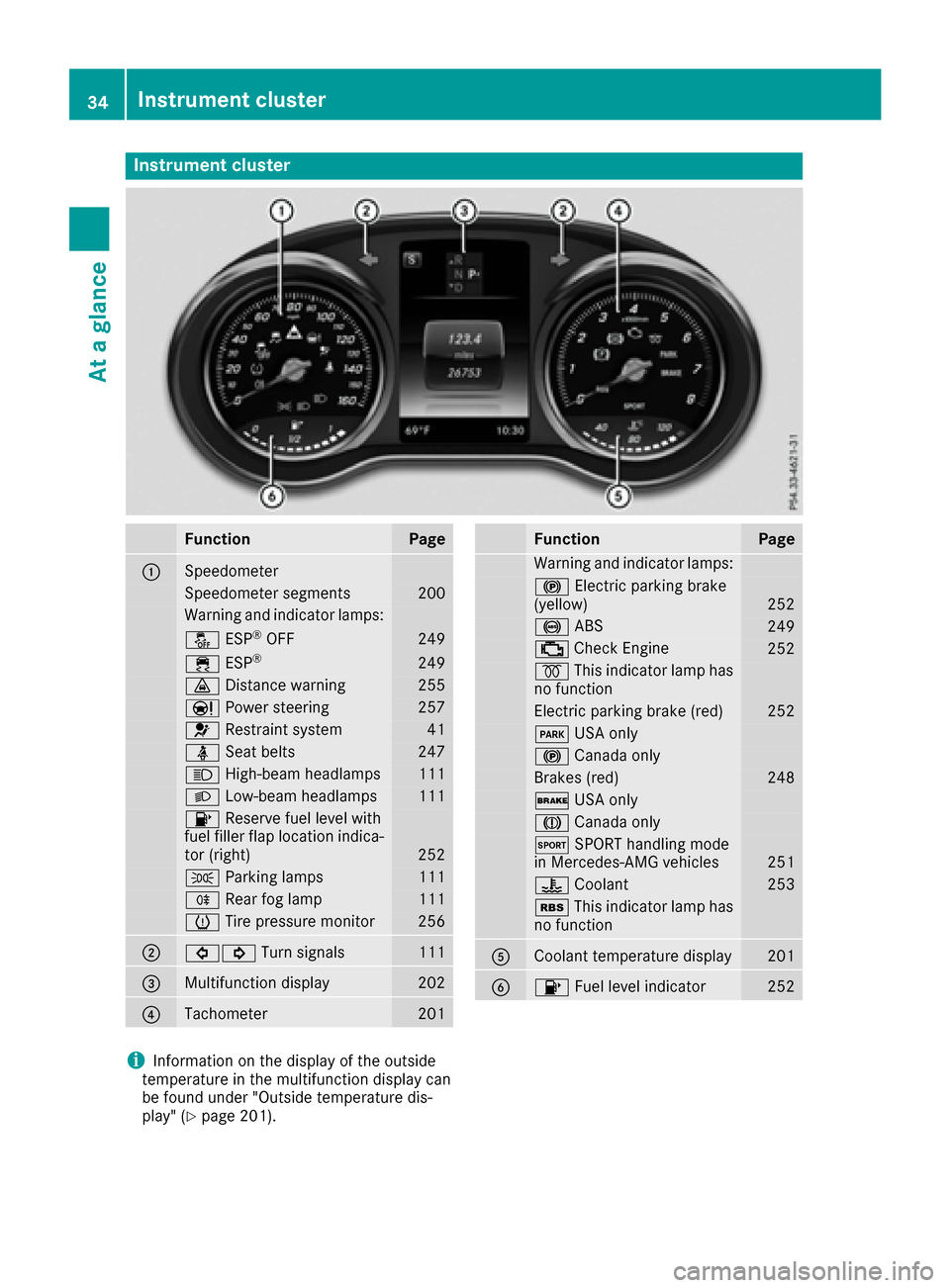
Instrumentcluster
FunctionPag e
:Speedometer
Speedometer segments200
Warning and indicator lamps:
å ESP®OF F249
÷ ESP®24 9
· Distanc ewarning255
Ð Powersteering25 7
6 Restrain tsystem41
ü Seat belt s247
K High-beam headlamps111
L Low-beam headlamps111
8 Reserve fuel level wit h
fuel filler flap location indica-
to r( right )
252
T Parking lamp s111
R Rear fog lamp111
h Tirep ressur emonitor256
;#! Turn signals111
=Multifunction display202
?Tachometer201
FunctionPag e
Warning and indicator lamps:
! Electric parking brak e
(yellow)25 2
! ABS249
; CheckEngine25 2
% This indicator lamp has
no function
Electric parking brak e(red)25 2
F USAo nly
! Canad aonly
Brake s(red)24 8
$ USAo nly
J Canad aonly
M SPORT handlin gmode
in Mercedes-AM Gvehicles251
? Coolan t253
é This indicator lamp has
no function
ACoolan ttem perature display201
B8 Fuellevel indicator25 2
iInformation on th edisplay of th eoutside
temperature in th emultifunction display can
be foun dunder "Outside temperature dis-
play" (
Ypage 201).
34Instrumen tcluster
At ag lance
Page 38 of 354
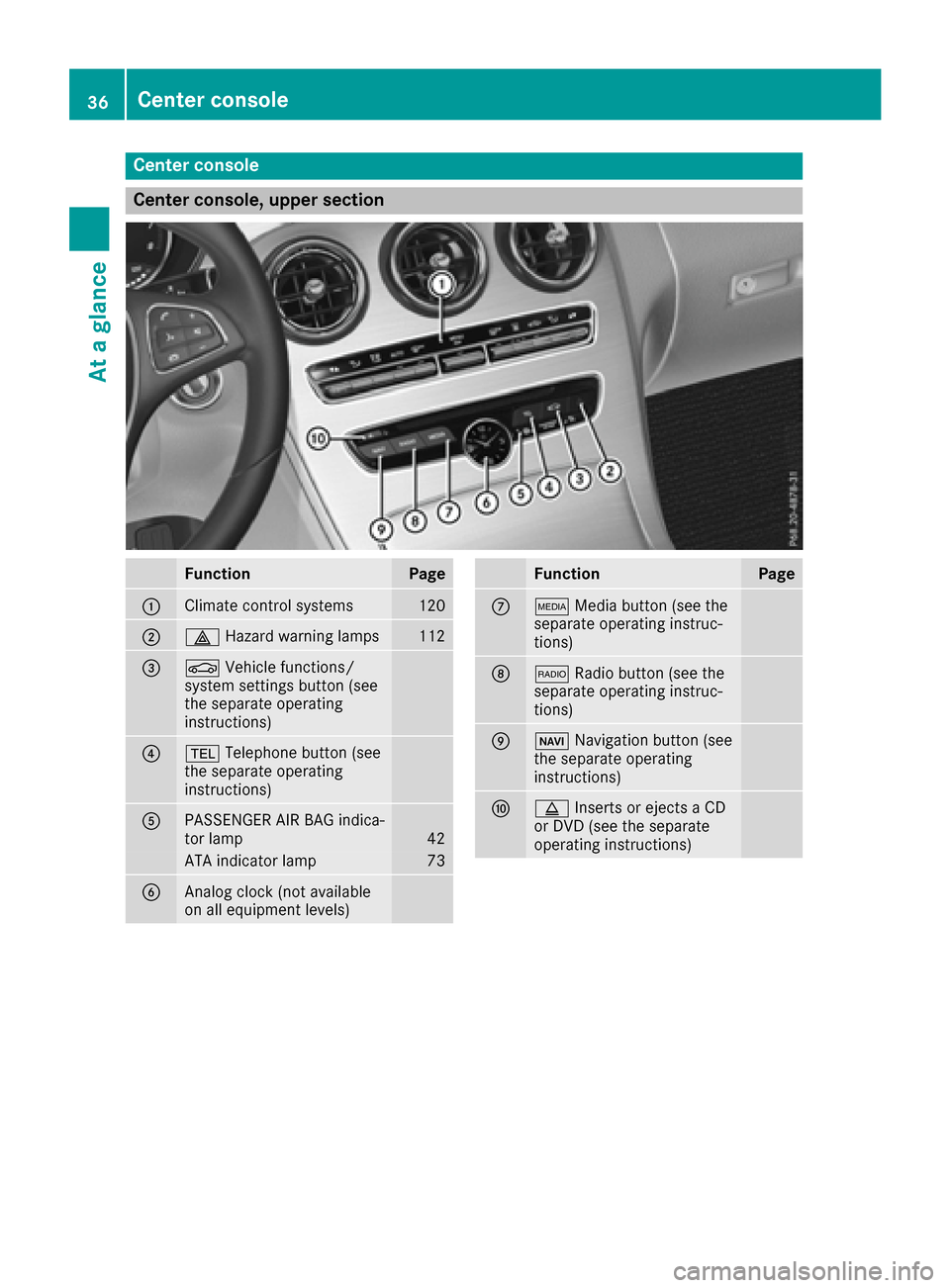
Center console
Center console, upper section
FunctionPage
:Climatecontrol systems120
;£ Hazard warning lamps112
=ØVehicle functions/
system settings butto n(see
th es eparate operating
instructions)
?% Telephoneb utton(see
th es eparate operating
instructions)
APASSENGER AI RBAG indica-
to rlamp42
AT Ai ndicator lamp73
BAnalog clock (no tavailable
on all equipmentl evels)
FunctionPage
CÕMedia butto n(see the
separate operatin ginstruc-
tions)
D$ Radio butto n(see the
separate operatin ginstruc-
tions)
EØ Navigation butto n(see
th es eparate operating
instructions)
Fþ Inserts or eject saCD
or DV D(see th eseparate
operatin ginstructions)
36Center console
At ag lance
Page 43 of 354
Panic alarm
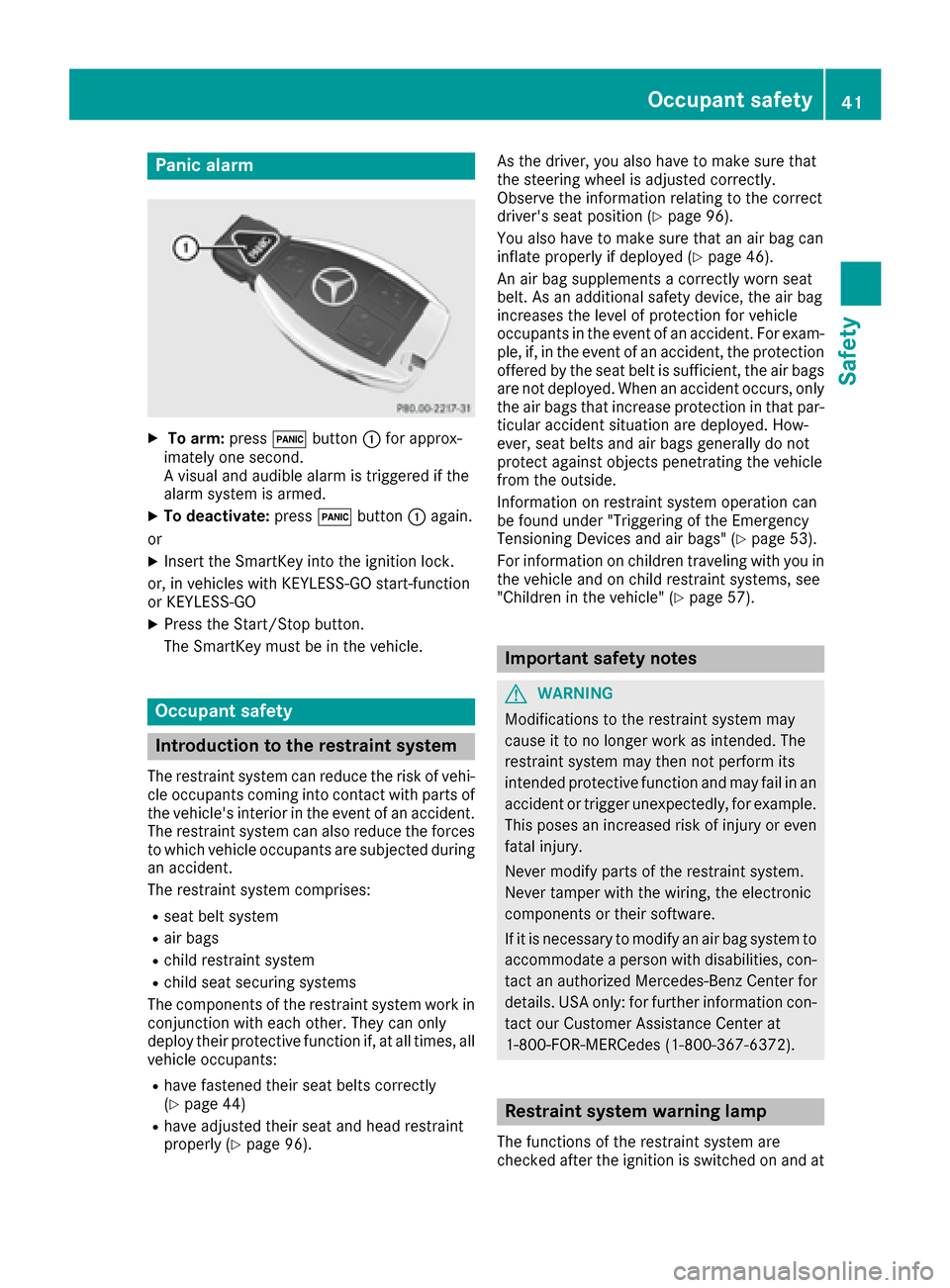
XTo arm:press!button :for approx-
imately one second.
Av isual and audible alarm is triggered if the
alarm system is armed.
XTo deactivate: press!button :again.
or
XInsert the SmartKey into the ignition lock.
or, in vehicles with KEYLESS-GO start-function
or KEYLESS ‑GO
XPress the Start/Stop button.
The SmartKey must be in the vehicle.
Occupant safety
Introduction to the restraint system
The restraint system can reduce the risk of vehi-
cle occupants coming into contact with parts of
the vehicle's interior in the event of an accident.
The restraint system can also reduce the forces to which vehicle occupants are subjected during
an accident.
The restraint system comprises:
Rseat belt system
Rair bags
Rchild restraint system
Rchild seat securing systems
The components of the restraint system work in
conjunction with each other. They can only
deploy their protective function if, at all times, all vehicle occupants:
Rhave fastened their seat belts correctly
(Ypage 44)
Rhave adjusted their seat and head restraint
properly (Ypage 96). As the driver, you also have to make sure that
the steering wheel is adjusted correctly.
Observe the information relating to the correct
driver's seat position (
Ypage 96).
You also have to make sure that an air bag can
inflate properly if deploye d(
Ypage 46).
An air bag supplements acorrectly worn seat
belt. As an additional safety device, the air bag
increases the level of protection for vehicle
occupants in the event of an accident. For exam-
ple, if, in the event of an accident, the protection
offered by the seat belt is sufficient, the air bags are not deployed. When an accident occurs, only
the air bags that increase protection in that par-ticular accident situation are deployed. How-
ever, seat belts and air bags generally do not
protect against object spenetrating the vehicle
from the outside.
Information on restraint system operation can
be found under "Triggering of the Emergency
Tensioning Devices and air bags" (
Ypage 53).
For information on children traveling with you in
the vehicle and on child restraint systems, see
"Children in the vehicle" (
Ypage 57).
Important safety notes
GWARNING
Modifications to the restraint system may
cause it to no longer work as intended. The
restraint system may then not perform its
intended protective function and may fail in an
accident or trigger unexpectedly, for example.
This poses an increased risk of injury or even fatal injury.
Never modify parts of the restraint system.
Never tamper with the wiring, the electronic
components or their software.
If it is necessary to modify an air bag system to
accommodate aperson with disabilities, con-
tact an authorized Mercedes-Benz Center for
details. USA only: for further information con-
tact our Customer AssistanceC enter at
1-800-FOR-MERCedes (1‑800‑367‑6372).
Restraint system warning lamp
The functions of the restraint system are
checked after the ignition is switched on and at
Occupant safety41
Safety
Z
Page 44 of 354
regular intervalswhile the engine is running.
Therefore, malfunctions can be detected in
good time.
The 6 restraint system warning lamp in the
instrument cluster lights up when the ignitio nis
switched on. It goes out no later than afew sec-
onds after the vehicl eisstarted. The compo-
nents of the restraint system are in operational
readiness.
Am alfunction has occurred if the 6restraint
system warning lamp:
Rdoes not light up after the ignitio nisswitched
on
Rdoes not go out after afew seconds with the
engine running
Rlights up again while the engine is running
GWARNING
If restraint system is malfunctioning, restraint
system components may be triggeredu nin-
tentionall yormight not be triggeredata ll in
the event of an accident with ahigh rate of
vehicl edeceleration. This can affect the Emer-
gency Tensioning Device or air bag ,for exam-
ple. This poses an increase drisk of injury or
even fatal injury.
Have the restraint system checked and
repaired in aqualified specialist workshop as
soon as possible.
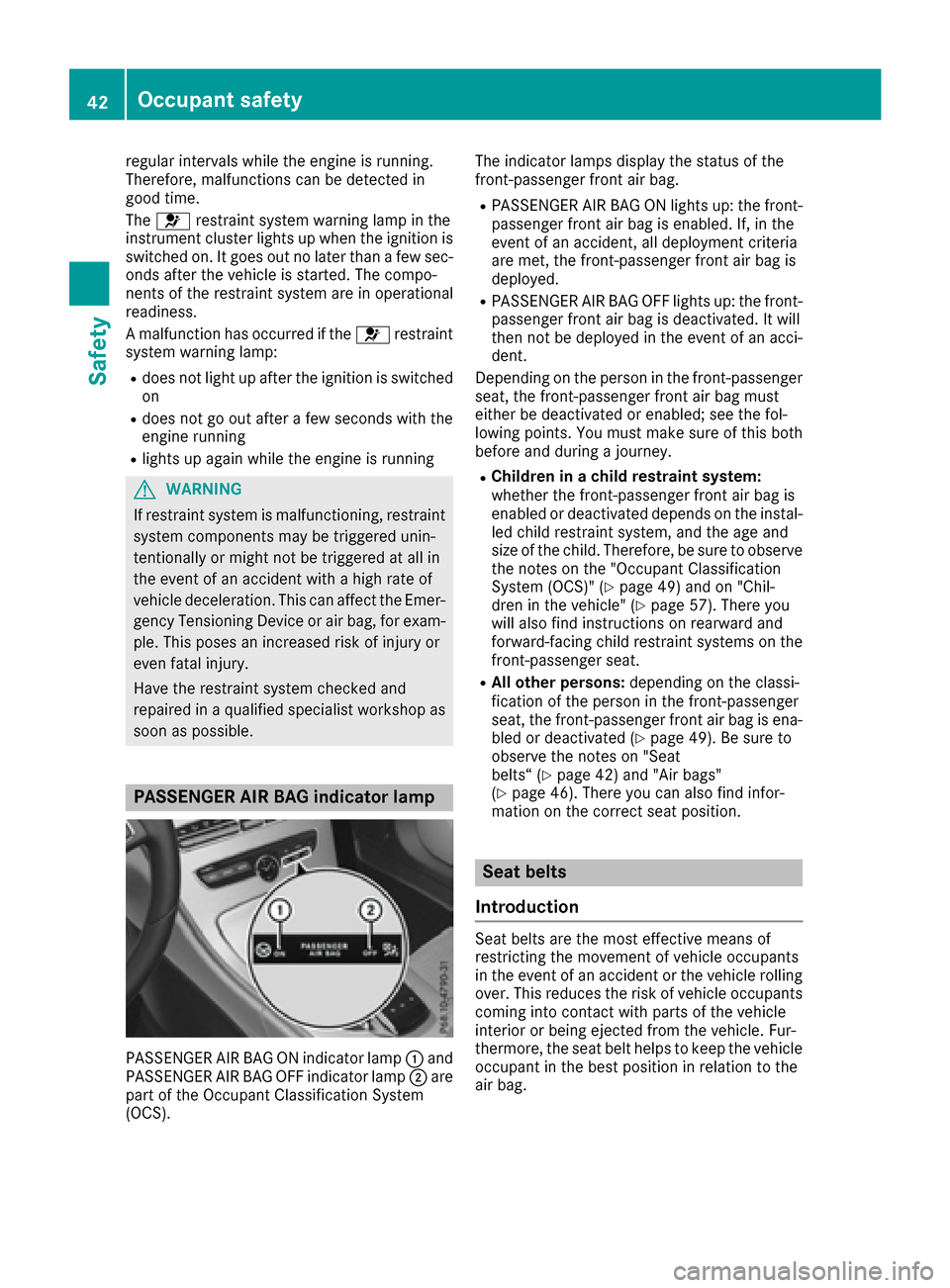
PASSENGER AI RBAG indicator lamp
PASSENGER AIR BAG ON indicator lamp :and
PASSENGER AIR BAG OFF indicator lamp ;are
part of the Occupant Classification System
(OCS). The indicator lamp
sdisplay the status of the
front-passenge rfront air bag.
RPASSENGER AIR BAG ON lights up: the front-
passenger front air bag is enabled. If, in the
event of an accident, all deployment criteria
are met, the front-passenge rfront air bag is
deployed.
RPASSENGER AIR BAG OFF lights up: the front-
passenger front air bag is deactivated. It will
then not be deploye dinthe event of an acci-
dent.
Depending on the person in the front-passenger
seat, the front-passenge rfront air bag must
either be deactivated or enabled; see the fol-
lowing points. You must make sure of this both
before and during ajourney.
RChildren in achildr estraint system:
whethe rthe front-passenge rfront air bag is
enabled or deactivated depends on the instal-
led child restraint system, and the age and
size of the child .Therefore, be sure to observe
the notes on the "Occupant Classification
System (OCS)" (
Ypag e49) and on "Chil-
dren in the vehicle" (Ypag e57). There you
wil lalsof ind instructions on rearward and
forward-facing child restraint systems on the
front-passenge rseat.
RAll other persons: depending on the classi-
ficatio nofthe person in the front-passenger
seat, the front-passenge rfront air bag is ena-
bled or deactivated (
Ypag e49). Be sure to
observe the notes on "Seat
belts“ (
Ypag e42) and "Air bags"
(Ypag e46). There you can als ofind infor-
mation on the correct seat position.
Seat belts
Introduction
Seat belts are the most effective means of
restricting the movement of vehicl eoccupants
in the event of an accident or the vehicl erolling
over. This reduces the risk of vehicl eoccupants
coming into contact with parts of the vehicle
interior or being ejected from the vehicle. Fur-
thermore, the seat belt help stokeep the vehicle
occupant in the best position in relation to the
air bag.
42Occupant safety
Safety
Page 45 of 354
The seat belt system comprises:
RSeat belts
REmergency TensioningDevices and seat belt
force limiters
If the seat belt is pulled out of the belt outlet
quickly or with ajerk ym ovement, the belt
retractor locks. The belt strap cannot be extrac-
ted any further.
The Emergency TensioningD evice tightensthe
seat belt in an accident ,pulling the belt close
against the body. However it does not pull the
vehicle occupant back in the direction of the
backrest.
The Emergency TensioningD evice does not cor-
rect an incorrect seat position or the routing of
an incorrectly fastened seat belt.
When triggered, aseat belt force limiter helps to
reduce the force exerted by the seat belt on the
vehicle occupant.
The seat belt force limiters for the front seats are
synchronized with the front air bags, which
absorb part of the deceleration force. This can
reduce the force exerted on the vehicle occu-
pants during an accident.
!If the front-passenger seat is unoccupied,
do not insert the belt tongue into the buckle of
the front-passenger seat. This may otherwise
lead to the triggerin gofthe Emergency Ten-
sioning Device in the event of an accident,
which will then need to be replaced.
Important safety notes
The use of seat belts and child restraint systems
is required by law in:
Rall 50 states
Rthe U.S. territories
Rthe District of Columbia
Rall Canadian provinces
Even where this is not required by law, all vehicle
occupantss hould correctly fasten their seat
belts before starting the journey.
GWARNING
If the seat belt is incorrectly fastened, it can-
not protec tasintended. Furthermore, an
incorrectly fastened seat belt can cause addi-
tional injury, for example, in an accident ,dur-
ing braking or when abruptly changing direc-
tion. This poses an increased risk of injury or
even fatal injury.
Make sure that all vehicle occupantsa re
seated properly with acorrectly fastened seat
belt.
GWARNING
The seat belt does not offer the intended level of protection if you have not moved the back-
rest to an almost vertical position. When brak-
ing or in the event of an accident ,you could
slide underneath the seat belt and sustain
abdomen or neck injuries, for example. This
poses an increased risk of injury or even fatal injury.
Adjust the seat properly before beginning
your journey. Always ensure that the backrest
is in an almost vertical position and that the
shoulder section of your seat belt is routed
across the center of your shoulder.
GWARNING
Persons under 5ft(1.50 m) in height cannot
fasten the seat belt correctly without an addi- tional suitable restraint system. If the seat
belt is incorrectly fastened, it cannot protect
as intended. Furthermore, an incorrectly fas-
tened seat belt can cause additional injury, for
example, in an accident ,during braking or an
abrupt change of direction .This poses an
increased risk of injury or even fatal injury.
For this reason, alwayss ecure persons under
5ft( 1.50 m) in height in suitable restraint
systems.
If ac hild younger than twelve years old and
under 5ft(1.50 m)in height is travelingint he
vehicle:
Ralways secur ethe child in achild restraint
system suitable for this Mercedes-Ben zvehi-
cle. The child restraint system must be appro-
priatetot he age, weight and size of the child
Ralways observe the instructions and safety
notes on "Children in the vehicle"
(
Ypage 57) in addition to the child restraint
Occupant safety43
Safety
Z
Page 46 of 354
system manufacturer's installation and oper-
ating instructions
Rbe sure to observe the instructions and safety
notes on the "Occupant classification system(OCS)" (
Ypage 49)
GWARNING
The seat belts may not perform their intended protective function if:
Rthey are damaged,m odified, extremely
dirty, bleach or dyed
Rthe seat belt buckle is damaged or
extremely dirty
Rthe EmergencyT ensioning Devices, belt
anchorages or inertia reels have been modi-
fied
Seat belts may sustain non-visible damage in an accident, e.g. due to glass splinters. Modi-
fied or damaged seat belts may tear or fail,
e.g. in an accident. Modified EmergencyT en-
sioning Devices could accidentally trigger or
fail to deploy when necessary. This poses an
increased risk of injury or even fatal injury.
Never modify the seat belts, EmergencyT en-
sioning Devices, belt anchorages or inertia
reels. Make sure that the seat belts are
undamaged,n ot worn out and clean. Follow-
ing an accident, have the seat belts checked
immediately at aqualified specialist work-
shop.
Only use seat belts that have been approved for
your vehicle by Mercedes-Benz.
AMG Performance seat: this seat is designed
for the standard three-point seat belt. If you
install another multi-point seat belt, e.g. sport or
racing seat belts, the restraint system cannot
provide the best level of protection.
GWARNING
If you feed seat belts through the opening in
the seat backrest, the seat backrest may be
damaged or may even break in the event of an accident. This poses an increased risk of
injury or even fatal injury.
Only use the standard three-point seat belt.
Never modify the seat belt system.
Proper use of the seat belts
Observe the safety notes on the seat belt
(Ypage 43).
All vehicle occupants must be wearing the seat
belt correctly before beginning the journey. Also
make sure that all vehicle occupants are always
wearing the seat belt correctly while the vehicle
is in motion.
When fastening the seat belt, always make sure
that:
Rthe seat belt tongue is only inserted to the belt buckle belonging to that seat.
Rthe seat belt is tight across your body.
Avoid wearing bulky clothing, e.g. awinter
coat.
Rthe seat belt is not twisted.
Only then can the forces which occur be dis-
tributed over the area of the belt.
Rthe shoulders ection of the belt is always
routed across the center of your shoulder.
The shoulders ection of the belt must not
come into contact with your neck or be routed
under your arm.
Rthe lap belt passes tightly and as low down as
possible across your lap.
The lap belt must always be routed across
your hip joints and not across your abdomen.
This applies particularl ytopregnant women.
If necessary, push the lap belt down to your
hip joint and pull it tight using the shoulder
section of the belt.
Rthe seat belt is not routed across sharp, poin-
ted or fragile objects.
If you have such items located on or in your
clothing, e.g. pens, keys or eyeglasses, store
these in asuitable place.
Ronly one person is using aseat belt at atime.
Infantsa nd children must never travel sitting
on the lap of avehicle occupant. In the event
of an accident, they could be crushed
between the vehicle occupant and seat belt.
Robjects are never secured with aseat belt if
the seat belt is also being used by one of the
vehicle's occupants.
Also ensure that there are never objects
between aperson and the seat, e.g. cushions.
Seat belts are only intended to secure and
restrain vehicle occupants. Always observe the
"Loading guidelines" for securing objects, lug-
gage or loads (
Ypage 268).
44Occupant safety
Safety
Page 47 of 354
Fastening seat belts
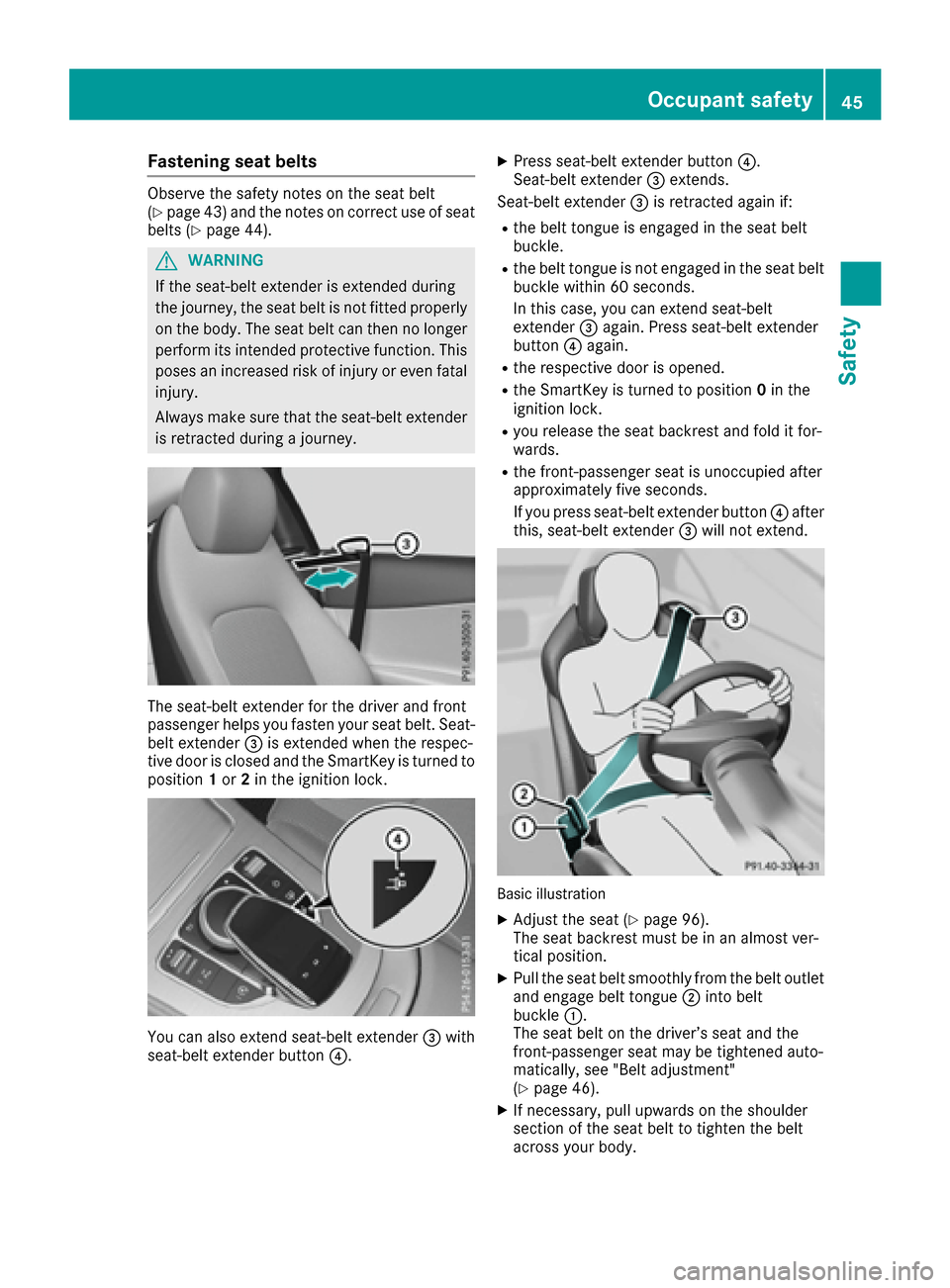
Observethe safet ynotes on th eseat belt
(Ypage 43 )and the notes on correct us eofseat
belts (Ypage 44).
GWARNING
If the seat-belt extender is extended during
the journey ,the sea tbeltisn ot fitte dproperly
on the body .The sea tbeltc an then no longer
perfor mits intende dprotective function. This
poses an increased ris kofinjury or eve nfatal
injury.
Alway smakes uret hatt he seat-belt extender
is retracted during ajourney.
The seat-belt extender for the driver and front
passenger helps yo ufasten your sea tbelt. Seat-
belt extender =is extended when the respec-
tive door is closed and the SmartKey is turne dto
position 1or 2in the ignition lock.
Yo uc an also extend seat-belt extender =with
seat-belt extender button ?.
XPress seat-belt extender button ?.
Seat-belt extender =extends.
Seat-belt extender =is retracted agai nif:
Rthe belt tongu eisengaged in the sea tbelt
buckle.
Rthe belt tongu eisnot engaged in the sea tbelt
buckle within6 0seconds.
In thisc ase, youcan extend seat-belt
extender =again. Press seat-belt extender
button ?again.
Rthe respective door is opened.
Rthe SmartKey is turne dtoposition 0in the
ignition lock.
Ryo ur elease the sea tbackres tand fol ditfor-
wards.
Rthe front-passenger sea tisu noccupie dafter
approximatelyf ives econds.
If yo upress seat-belt extender button ?after
this, seat-belt extender =will not extend.
Basic illustration
XAdjust the sea t(Ypage 96).
The sea tbackres tmustbeinana lmostv er-
tica lposition.
XPull the sea tbelts moothl yfrom the belt outlet
and engage belt tongue ;into belt
buckle :.
The sea tbeltont he driver’ sseata nd the
front-passenger sea tmaybe tightene dauto-
matically, see "Belt adjustment"
(
Ypage 46).
XIf necessary,p ullu pwar ds on the shoulder
section of the sea tbelttot ighten the belt
across your body.
Occupant safety45
Safety
Z
Page 48 of 354
All seatbelts except the driver's sea tbelta re
equipped with aspecia lsea tb eltr etractor to
securel yfasten child restraint system sinthe
vehicle. Further informatio ncan be found under
"Special sea tbeltr etractor" (
Ypage 57).
Releasin gseatb elts
!Make sure thatt he seatbeltisf ullyrolle dup.
Otherwise, the sea tbeltorb eltt ongu ewillb e
trappe dinthe door or in the sea tmechanism.
Thi scould damage the door, the door trim
panel and the sea tbelt. Damaged sea tbelts
can no longerf ulfill thei rprotective function
and must be replaced .Visit aquali fied spe-
cialist workshop.
XPress the release button in the belt buckle,
hol dthe belt tongu efirmly and guid ethe belt
back.
Seat belt adjustment
The seat-belt adjustment is an integra lparto f
the PRE-SAFE®convenience function. Thi sfun c-
tio na djusts the driver's and front-passenger
sea tbelttot he uppe rbodyoft he occupants.
The belt strapist ightenedslightly when:
Rthe belt tongu eisengaged in the buckle and
Rthe ignition is switched on
The seat-belt adjustment will appl yacertain
retractio nforc eifa ny slack is detecte dbetween
the vehicl eoccupant and the sea tbelt. Do not
hol dontot he seatbeltt ightlyw hileit is adjust-
ing.
Yo uc an activate and deactivate the seat-belt
adjustment functio nusing the multimedia sys-
tem. Informatio nonactivating and deactivating
the seat-belt adjustment functio ncan be found
in the Digita lOperator' sManualorint he sepa-
rate multimedia system operating instructions.
Bel twarning fort he driver and front
passenger
The 7 seatbeltw arning lamp in the instru-
ment cluster is areminder thata llvehicl eoccu-
pants must wear thei rseatb elts .Itm aylight up
continuously or flash. In addition, ther emaybe
aw arning tone.
Regardless of whethe rthe driver's sea tbelth as
already been fastened, the 7seatbeltw arn-
ing lamp lights up for sixs econdseach timethe
engine is started. If th edoorsa re closed and the driver'sorf
ront-passenger seat belt has not
been fastened, the 7seat belt warning lamp
lightsupa gain after th esix seconds. As soon as
th ed river'sa nd front-passenger seat beltsa re
fastene dorad oor is opened again,t he7
seat belt warning lamp goes out.
If th edriver'ss eat belt is no tfastene dafter the
engine is started, an additional warning tone will
sound. The warning tone switches off after six
seconds or once th edriver'ss eat belt is fas-
tened.
If th evehicle's speede xceeds 15 mph
(25 km/h) once and th edriver'sa nd front-
passenger seat beltsa re notfastened, awarning
tone sounds. Awarning tone also sounds with
increasing intensity for 60 seconds or until the
driver or frontp assenger have fastene dtheir
seat belts.
If th edriver or frontp assenger unfasten their
seat beltsd uringthejourney, th eseat belt warn-
ing is activ
ated again.
Air bags
Introduction
The installatio npointofana ir bag can be rec-
ognize dbytheAIRB AG symbol.
An air bag complement sthe correctly fastened
seat belt.Itisnos ubstitutefor th eseat belt.T he
air bag provides additional protection in appli-
cable accidents ituations.
Not all air bags are deployed in an accident. The
differenta ir bag systems function independ-
ently from onea nother (
Ypage 53).
However ,nosystem availabl etoday can com-
pletely eliminat einjuries and fatalities.
It is also no tpossible to rule out arisk of injury
caused by an air bag due to th ehigh speeda t
whicht heair bag must be deployed.
Important safety notes
GWARNING
If you do no tsit in th ecorrec tseat position,
th ea ir bag canno tprotect as intended and
coul deven caus eadditional injury when
deployed. This posesani ncreased risk of
injury or even fatal injury.
46Occupant safety
Safety