battery MERCEDES-BENZ C-Class COUPE 2017 CL205 Owner's Guide
[x] Cancel search | Manufacturer: MERCEDES-BENZ, Model Year: 2017, Model line: C-Class COUPE, Model: MERCEDES-BENZ C-Class COUPE 2017 CL205Pages: 354, PDF Size: 8.66 MB
Page 247 of 354
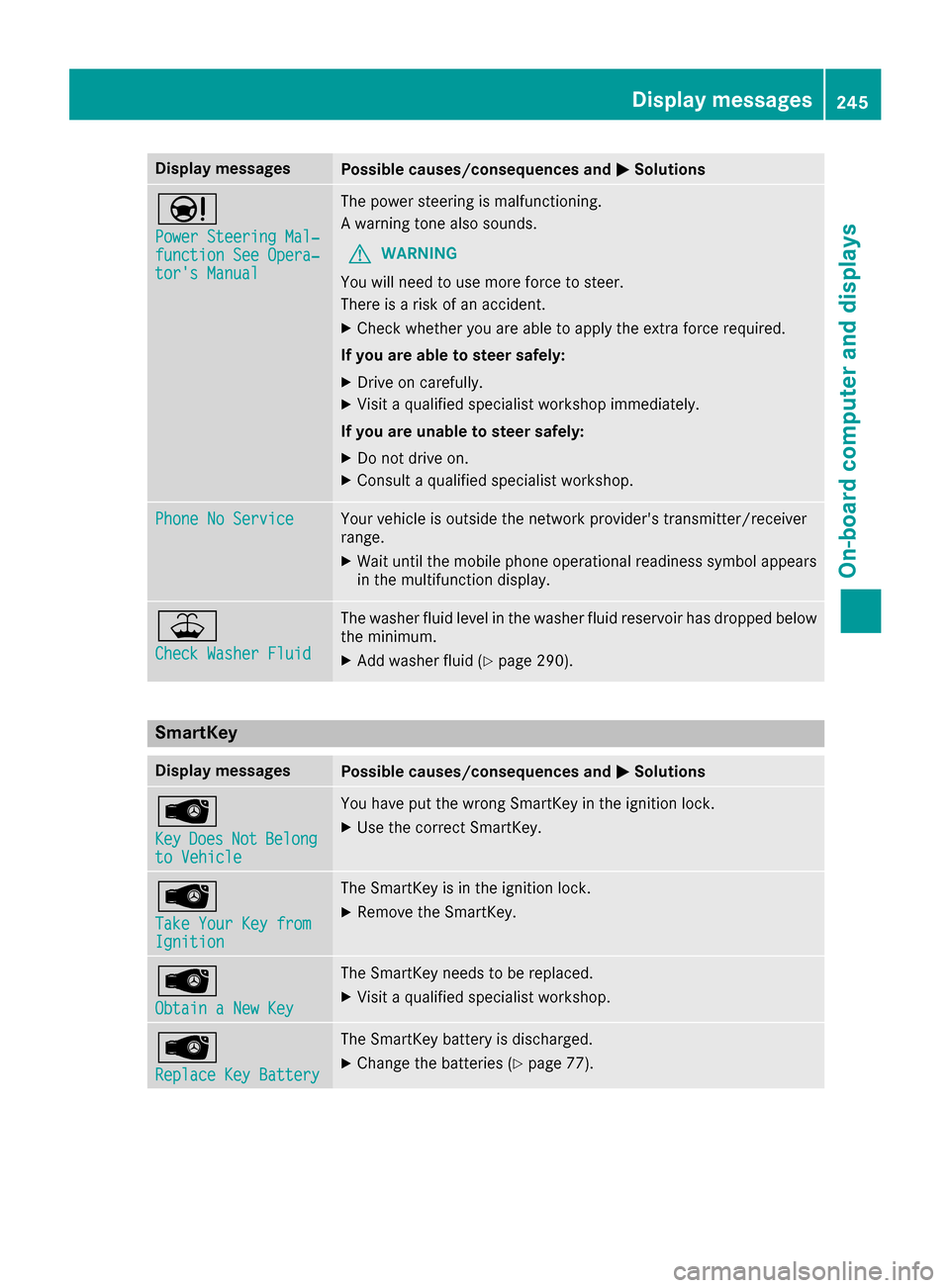
Display messagesPossible causes/consequences andMSolutions
Ð
Power Steering Mal‐function See Opera‐tor's Manual
The powersteering is malfunctioning .
Aw arning tone also sounds.
GWARNIN G
You will need to use mor eforce to steer .
There is ariskofana ccident.
XCheckwhether you are able to apply th eextra force required.
If you ar eabletos teer safely:
XDrive on carefully.
XVisit aqualified specialist workshop immediately.
If you ar eunable to steer safely:
XDo no tdrive on .
XConsult aqualified specialist workshop .
Phone No ServiceYour vehicleisoutside th enetwork provider' stransmitter/receiver
range.
XWait until th emobile phone operational readiness symbol appear s
in th emultifunction display.
¥
Check Washer Fluid
The washer flui dlevel in th ewasher flui dreservoir has dropped belo w
th em inimum .
XAddw asher flui d(Ypage 290).
SmartKey
Display messagesPossible causes/consequences and MSolutions
Â
KeyDoesNotBelongto Vehicl e
You haveput th ewrong SmartKey in th eignition lock.
XUse th ecorrect SmartKey.
Â
TakeYourK ey fro mIgnition
The SmartKey is in th eignition lock.
XRemove th eSmartKey.
Â
Obtain aNew Key
The SmartKey needs to be replaced.
XVisit aqualified specialist workshop .
Â
ReplaceKey Batter y
The SmartKey battery is discharged.
XChange thebatterie s(Ypage 77) .
Display messages245
On-boardc omputer andd isplays
Z
Page 278 of 354

There isarisk of fire and injury.
Always hold the cigarettel ighter by the knob.
Always make sure that the cigarettel ighter is
out of reach of children. Never leave children
unsupervised in the vehicle.
Your attention must alwaysbef ocused on the
traffic conditions. Only use the cigarettel ighter
when road and traffic conditions permit.
Example
XTurn the SmartKey to position 2in the ignition
lock (Ypage 131).
XTo open: open the stowage compartment
(Ypage 269).
XPress in cigarettel ighter;.
Cigarette lighter ;will pop out automatically
when the heating element is red-hot.
XTo close: push cover :of the stowage com-
partmen tclosed.
12 Vsockets
General notes
XTurn the SmartKey to position 1in the ignition
lock (Ypage 131).
The socket scan be used for accessories with a
maximum draw of 180 W(15 A). Accessories
include such items as chargers for mobile
phones.
If you use the socketsf or long periods when the
engine is switched off, the battery may dis-
charge.
An emergencyc ut-out ensures that the on-
board voltage does not drop too low. If the on-
board voltage is too low, the power to the sock-
ets is automatically cut. This ensures that there is sufficient power to start the engine. If you have connected
adevice to the 12 V
socket,l eave the cover of the stowage com-
partmen topen. This prevent sthe cover from
being blocked.
Socket in the front center console
XTo open: open the stowage compartment
(Ypage 269).
XLift up the cover of the socket.
XTo close: push the cover of the stowage com-
partmen tclosed.
Socket in the rear compartment center
console
XPull the cover out by the top of the handle
edge.
XLift up the cover of the socket.
mbrace
General notes
The mbrace system is only availableint he USA.
You must have alicense agreement to activate
the mbrace service. Make sure that your system
is activated and operational. To log in, press the
ï MB Info call button .Ifany of the steps
mentioned are not carried out, the system may
not be activated.
If you have questions about the activation ,con-
tact one of the following telephone hotlines:
Mercedes-Benz Customer Assistance Center at
1-800-FOR-MERCedes (1-800-367-6372)o r
1-866-990-9007
Shortly after successfully registerin gwith the
mbrace service, auser ID and password will be
sent to you by mail. You can use this password
to log ontot he mbrace area under "Owners
Online" at http://www.mbusa.com.
The system is availablei f:
Rit has been activated and is operational
Rthe corresponding mobile phone network is
available for transmitting data to the Cus-
tomer Center
Raservice subscription is available
276Features
Stowage and features
Page 293 of 354
Information on the type of service and service
intervals (see the separate Maintenance Book-
let).
You can obtain further information from an
authorized Mercedes-Benz Center or at
http://www.mbusa.com (USA only).
iThe ASSYST PLUS service interval display
does not show any information on the engine
oil level.O bserve the notes on the engine oil
level (
Ypage 288).
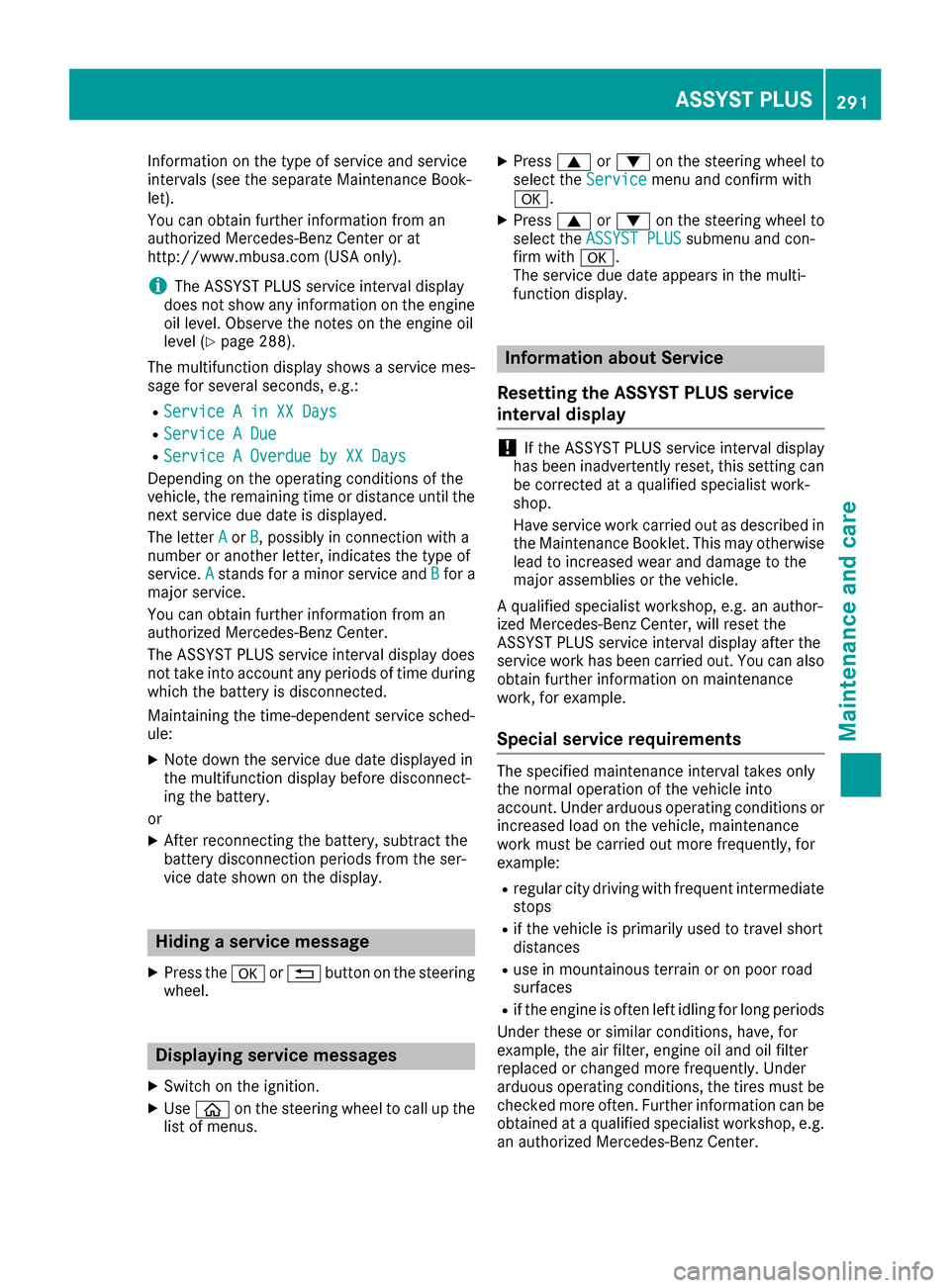
The multifunction display shows aservice mes-
sage for several seconds, e.g.:
RService AinXXD ays
RServiceADue
RService AOverdue by XX Days
Depending on the operating conditions of the
vehicle,t he remaining time or distance until the
next service due date is displayed.
The letter A
orB,possibly in connection with a
number or another letter, indicates the type of
service. A
stands for aminor service and Bfor a
major service.
You can obtain further information from an
authorized Mercedes-Benz Center.
The ASSYST PLUS service interval display does
not take into account any periodsoft ime during
which the battery is disconnected.
Maintaining the time-dependent service sched-
ule:
XNote down the service due date displaye din
the multifunction display before disconnect-
ing the battery.
or
XAfter reconnecting the battery, subtract the
battery disconnection periodsf rom the ser-
vice date shown on the display.
Hiding aservicem essage
XPress the aor% button on the steering
wheel.
Displaying servic emessages
XSwitch on the ignition.
XUse ò on the steering wheel to call up the
list of menus.
XPress 9or: on the steering wheel to
select the Servicemenu and confirm with
a.
XPress 9or: on the steering wheel to
select the ASSYST PLUSsubmenu and con-
firm with a.
The service due date appears in the multi-
function display.
Information about Service
Resetting the ASSYST PLUS service
interval display
!If the ASSYST PLUS service interval display
has been inadvertently reset, this setting can
be corrected at aqualifieds pecialist work-
shop.
Have service work carried out as describedi n
the Maintenance Booklet. This may otherwise
leadtoi ncreased weara nd damage to the
major assemblies or the vehicle.
Aq ualifieds pecialist workshop, e.g. an author-
ized Mercedes-Benz Center, wil lreset the
ASSYST PLUS service interval display after the
service work has been carried out. You can also
obtain further information on maintenance
work, for example.
Special servic erequirements
The specifiedm aintenance interval takes only
the normal operation of the vehicle into
account. Under arduous operating conditions or
increased load on the vehicle,m aintenance
work must be carried out more frequently, for
example:
Rregular city driving with frequent intermediate
stops
Rif the vehicle is primarily used to travel short
distances
Ruse in mountainou sterrain or on poor road
surfaces
Rif the engine is often left idling for long periods
Under these or similar conditions, have, for
example ,the air filter, engine oil and oil filter
replaced or changed more frequently. Under
arduous operating conditions, the tires must be
checked more often. Further information can be obtained at aqualifieds pecialist workshop, e.g.
an authorized Mercedes-Benz Center.
ASSYST PLUS291
Maintenancea nd care
Z
Page 295 of 354
when theengine is switche doff or at very
low speeds.O therwise, when in transmis-
sion position Dor Rthea utomatic trans-
mission will automatically switch to park
position Pand blockt hewheels.
ROperatin gwith th eStart/Stop button:
Do not open th edriver's door when the
engine is switche doff or at veryl ow
speeds.O therwise, when in transmission
position Dor Rth ea utomatic transmission
will automatically switch to park position P
and blockt hewheels.
Observe th efollowing to makes ure that the
automatic transmission stays in position Nneu-
tral:
Operatin gwith th eSmartKey and th eStart/
Stop button:
XMake sure that th eignitio nisswitche don.
XMake sure that th evehicle is stationary.
XDepress and hold th ebrakep edal.
Operatin gwith th eStart/Stop button only:
XEngage park position P.
XRelease thebrakep edal.
XRemoveS tart/Stop button fromi gnitionlock
(Ypage 131).
XInsert th eSmartKey int othe ignitio nlock.
XSwitch on th eignition.
XDepress and hold th ebrakep edal.
Operatin gwith th eSmartKey and th eStart/
Stop button:
XShif tton eutral N.
XRelease th ebrakep edal.
XRelease th eelectric parking brake, if neces-
sary.
XSwitch off th eignitio nand leave th eSma rtKey
in th eignitio nlock.
You can wash th evehicle in an automatic car
wash fromt heverys tart.
If th evehicle is veryd irty, pre-wash it bef
ore
cleaning it in an automatic car wash.
After using an automatic car wash, wipe off wax
fromt hewindshield and th ewiper blades. This
will prevent smearsa nd reducewiping noises
caused by residue on th ewindshield.
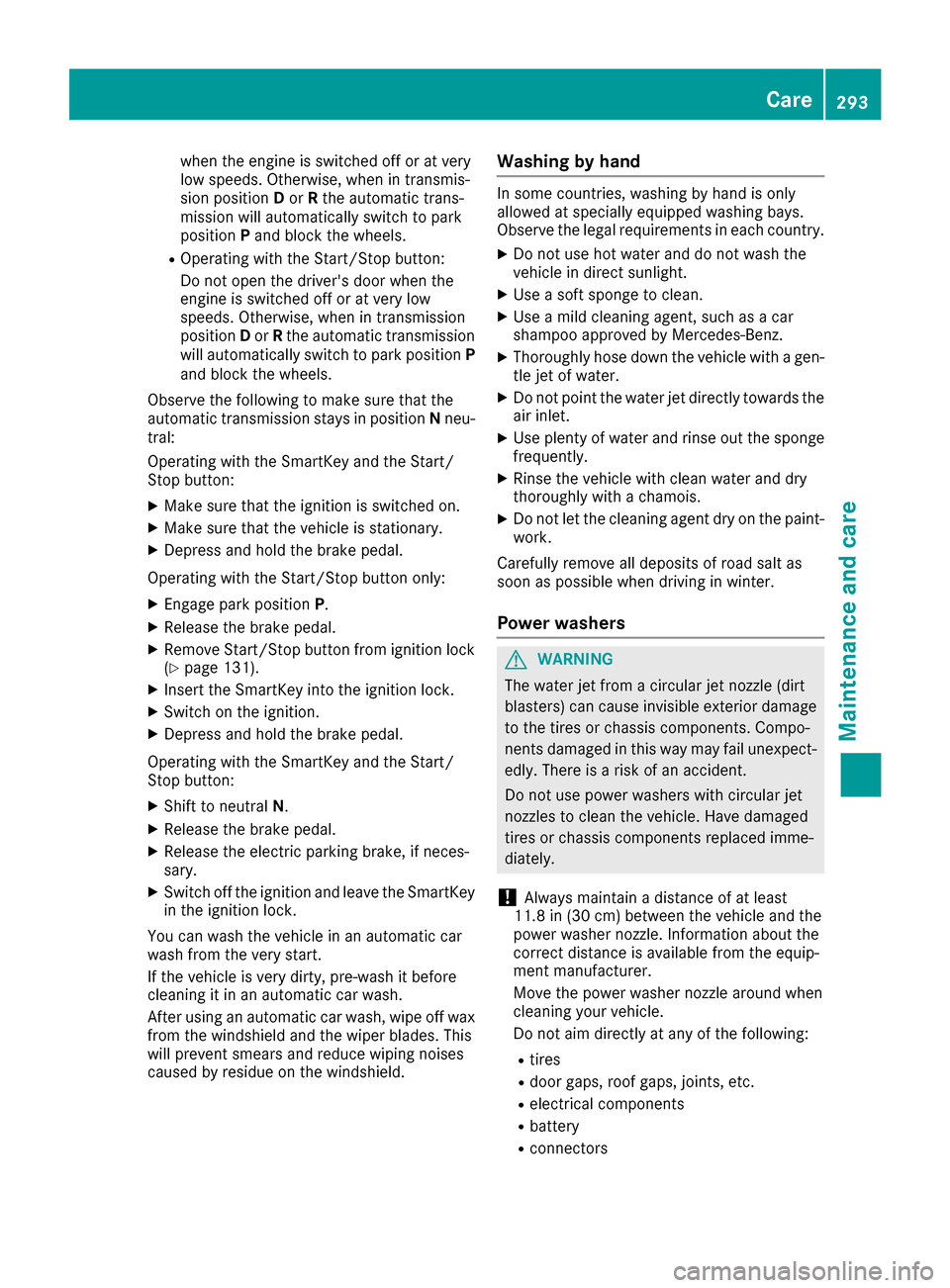
Washing by hand
In some countries, washingbyh and is only
allowed at specially equipped washingb ays.
Observe th elegal requirements in each country.
XDo not use hot water and do not wash the
vehicle in directs unlight.
XUseasofts ponge to clean.
XUse amild cleaning agent, such as acar
shampoo approved by Mercedes-Benz.
XThoroughly hose down th evehicle with agen-
tle jet of water.
XDo not pointt hewater jet directly towards the
air inlet.
XUse plenty of water and rinse out th esponge
frequently.
XRinse th evehicle with clean water and dry
thoroughly with achamois.
XDo not let th ecleaning agentd ry on thepaint-
work.
Carefull yremove all deposits of road salt as
soon as possible when driving in winter.
Power washers
GWARNING
The water jet fromac ircular jet nozzle (dirt
blasters) can cause invisible exterior damage
to th etires or chassis components. Compo-
nents damaged in this way may fail unexpect-
edly. Thereisar isk of an accident.
Do not use power washersw ith circular jet
nozzles to clean th evehicle. Have damaged
tires or chassis component sreplaced imme-
diately.
!Always maintain adistanc eofatl east
11.8 in (30 cm) between th evehicle and the
power washer nozzle. Information about the
correctd istanceisavailable fromt heequip-
mentm anufacturer.
Move th epower washer nozzle aroundw hen
cleaning your vehicle.
Do not aim directly at any of th efollowing:
Rtires
Rdoor gaps, roof gaps, joints, etc.
Relectrical components
Rbattery
Rconnectors
Care293
Maintenance and care
Z
Page 307 of 354
XPull the tire sealant bottle out of the tire infla-
tion compressor.
The filler hose remains attached to the tire
sealant bottle.
XDrive to the nearest qualified specialist work-
shop and have the tire changed there.
XHave the tire sealant bottle and the filler hosereplaced as soon as possible at aqualified
specialist workshop.
XHave the tire sealant bottle replaced every
four years at aqualified specialist workshop.
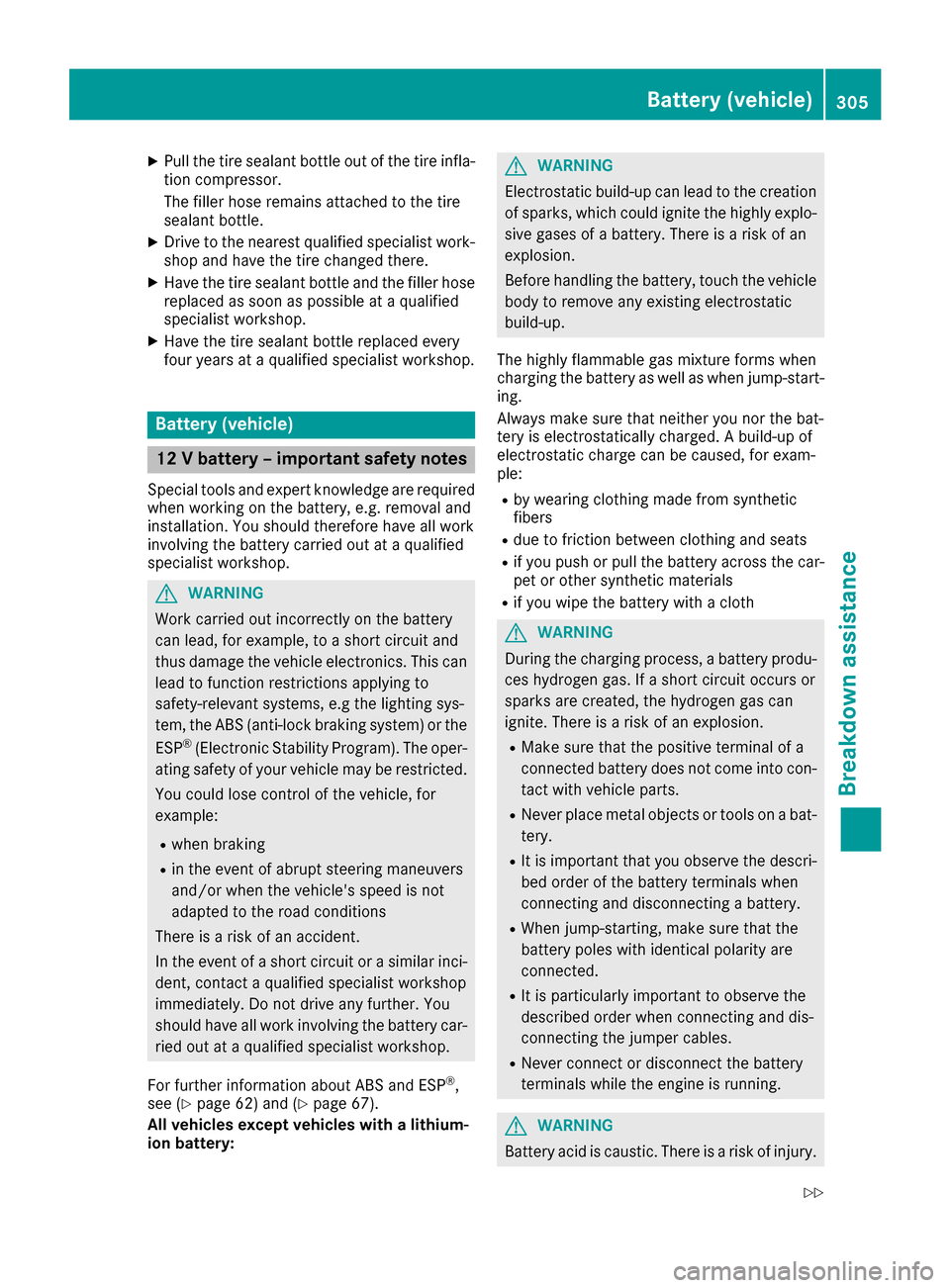
Battery (vehicle)
12 Vb attery –important safety notes
Special tools and expert knowledge are required
when working on the battery, e.g. removal and
installation .You should therefore have all work
involvin gthe battery carried out at aqualified
specialist workshop.
GWARNING
Work carried out incorrectly on the battery
can lead, for example, to ashort circuit and
thus damage the vehicle electronics. This can
lead to function restriction sapplying to
safety-relevant systems, e.g the lighting sys-
tem, the ABS (anti-loc kbraking system) or the
ESP
®(Electronic Stability Program). The oper-
ating safety of your vehicle may be restricted.
You could lose control of the vehicle, for
example:
Rwhen braking
Rin the event of abrupt steerin gmaneuvers
and/or when the vehicle's speed is not
adapted to the road conditions
There is arisk of an accident.
In the event of ashort circuit or asimilar inci-
dent, contact aqualified specialist workshop
immediately. Do not drive any further .You
should have all work involvin gthe battery car-
ried out at aqualified specialist workshop.
For further information about ABS and ESP
®,
see (Ypage 62) and (Ypage 67).
All vehicles except vehicles with alithium-
ion battery:
GWARNING
Electrostatic build-up can lead to the creation of sparks, which could ignite the highly explo-
sive gases of abattery. There is arisk of an
explosion.
Before handling the battery, touch the vehicle
body to remove any existin gelectrostatic
build-up.
The highly flammable gas mixture forms when
charging the battery as well as when jump-start-
ing.
Always make sure that neither you nor the bat-
tery is electrostatically charged. Abuild-up of
electrostatic charge can be caused, for exam-
ple:
Rby wearing clothin gmade from synthetic
fibers
Rdue to friction between clothin gand seats
Rif you push or pull the battery across the car-
pet or other synthetic materials
Rif you wipe the battery with acloth
GWARNING
During the charging process, abattery produ-
ces hydrogen gas. If ashort circuit occurs or
sparks are created, the hydrogen gas can
ignite. There is arisk of an explosion.
RMake sure that the positive terminal of a
connected battery does not come into con-
tact with vehicle parts.
RNever place metal object sortools on abat-
tery.
RIt is importan tthat you observe the descri-
bed order of the battery terminals when
connectin gand disconnectin gabattery.
RWhen jump-starting, make sure that the
battery poles with identical polarity are
connected.
RIt is particularly importan ttoobserve the
described order when connectin gand dis-
connectin gthe jumper cables.
RNever connect or disconnect the battery
terminals while the engine is running.
GWARNING
Battery acid is caustic. There is arisk of injury.
Battery (vehicle)305
Breakdown assistance
Z
Page 308 of 354
Avoidcontact with skin, eyes or clothing. Do
not inhal eany battery gases .Donot lean over
the battery .Keepc hildren away from batter-
ies. Wash away battery aci dimmediatelyw ith
plenty of clean water and see kmedica latten-
tion.
Al lv eh icles:
HEnvironmental note
Batterie scontain dangerous
substances .Itisagainst the
la wtod ispose of them with
the householdr ubbish.They
must be collected separately and recycle dtoprotect the
environment.
Dispose of batteries in an
environmentally friendly
manner. Take discharged
batteries to aquali fied spe-
cialist workshop or aspecial
collectio npoint for used bat-
teries.
!Hav ethe battery checked regularly at a
qualified specialist workshop.
Observ ethe service intervals in the Mainte-
nance Bookle torcontact aquali fied specialist
workshop for more information.
!Alway shavew orkonb atteries carrie doutat
aq uali fied specialist workshop.S hould it, in
exceptionalc ircumstances ,beabsolutely
necessary to disconnect the 12-volt battery
yourself, observe the following:
Rsecur ethe vehicl etoprevent it from rolling
away.
Rswitch off the ignition.
Ralways disconnect the negative terminal
clamp first, followe dbythe positive termi-
nal clamp.
After the battery hasb eend isconnected ,the
transmission is locked in position P.
After the work hasb eend one, instal lthe bat-
tery and replace the cove rofthe positive ter-
mina lclamp firmly.
Compl ywiths afety precautions and take pro-
tective measures when handling batteries.
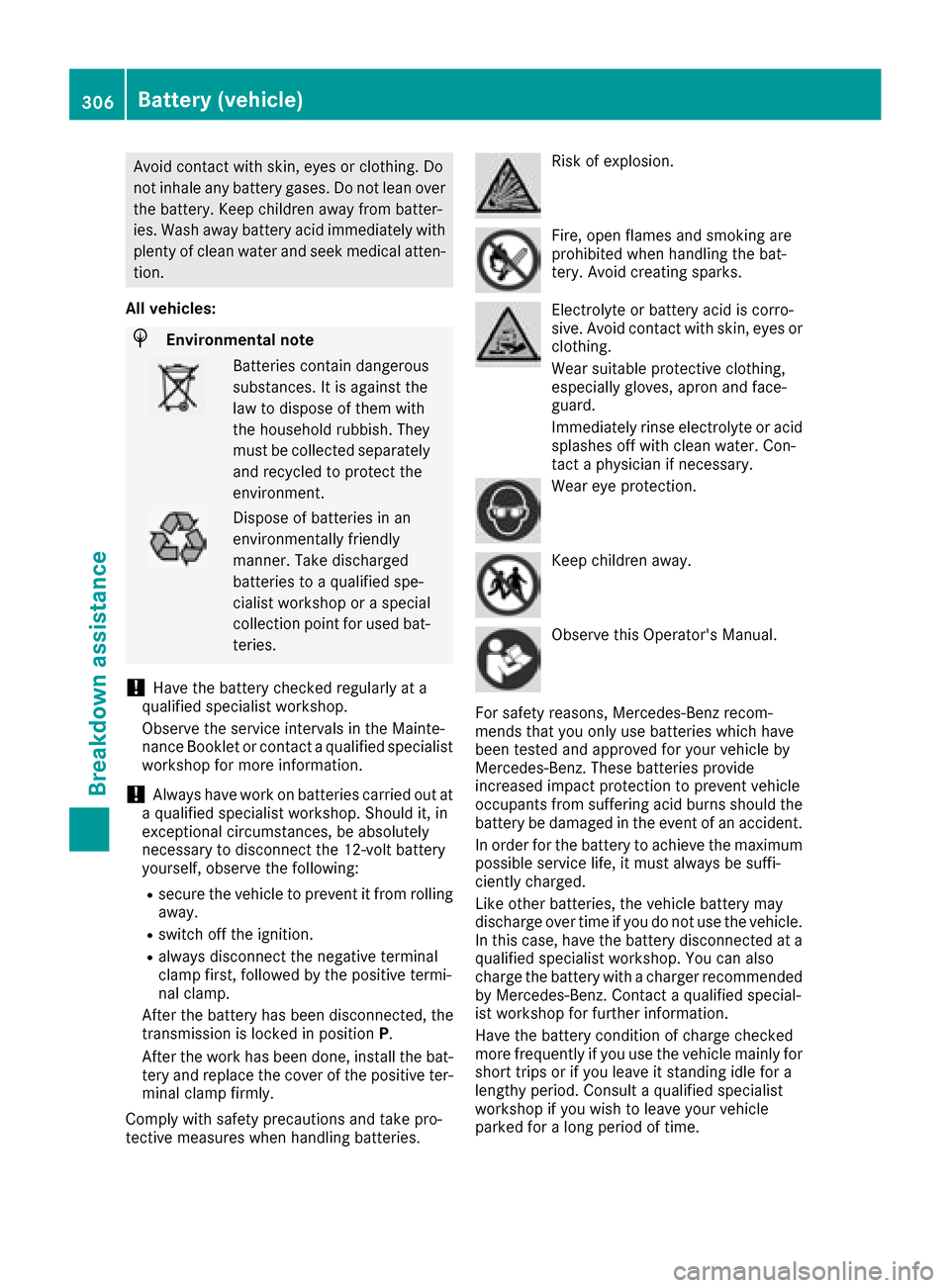
Risk of explosion.
Fire, open flames and smoking are
prohibited when handling the bat-
tery .Avoi dc reating sparks.
Electrolyte or battery aci discorro-
sive. Avoi dcontact with skin, eyes or
clothing.
Wear suitabl eprotective clothing,
especially gloves, apron and face-
guard.
Immediately rins eelectrolyte or acid
splashes off with clean water. Con-
tact aphysicia nifnecessary.
Wear ey eprotection.
Kee pchildren away.
Observ ethisO perator' sManual.
For safety reasons ,Mercedes-Benz recom-
mend sthaty ouonlyu sebatteries which have
been teste dand approved for your vehicl eby
Mercedes-Benz. These batteries provide
increased impact protection to prevent vehicle
occupants from suffering aci dburns shoul dthe
battery be damagedint he event of an accident.
In order for the battery to achieve the maximum
possibl eservice life, it must always be suffi-
ciently charged.
Like othe rbatteries, the vehicl ebattery may
discharge ove rtime if yo udonot usethe vehicle.
In thisc ase, have the battery disconnected at a
qualified specialist workshop.Y oucan also
charge the battery with acharge rrecommended
by Mercedes-Benz. Contact aquali fied special-
is tw orkshop for furthe rinformation.
Hav ethe battery condition of charge checked
more frequentlyify ouuset he vehicl emainl yf or
short trip sorifyouleav eits tanding idle for a
lengthy period. Consult aquali fied specialist
workshop if yo uwishtol eave your vehicle
parked for alon gp eriodoft ime.
306Battery (vehicle)
Breakdo wn assis tance
Page 309 of 354
Remove theSmartKey if you park th evehicl e
and do no trequire any electrical consumers.
The vehicl ewill then use ver ylittl ee nergy, thus
conserving battery power .
Charging the12Vbattery
Vehicles with alithium-ion battery:
!Only use battery chargers wit hamaximum
charging voltag eof14.4V .
All other vehicles:
GWARNIN G
During charging and jump-starting ,explosive
gase scan escape from th ebattery. There is a
ris kofane xplosion .
Particularly avoi dfire, open flames, creating
sparks and smoking. Ensur ethe re is sufficien t
ventilation while charging and jump-starting .
Do no tlean ove rabattery.
GWARNIN G
Battery acid is caustic. There is ariskofi njury.
Avoid contact wit hskin, eyes or clothing .Do
no tinhale any battery gases. Do no tlean ove r
th eb attery. Kee pchildren away from batter-
ies. Wash away battery acid immediately wit h
plenty of clean water and seek medical atten -
tion .
GWARNIN G
Ad ischarged battery can freez eattempera-
tures belo wfreezing point. When jump-start -
ing th evehicl eorc harging th ebattery, gase s
can escape from th ebattery. There is arisko f
an explosion .
Allow th efroze nbattery to thaw out before
charging it or jump-starting .
!Only use battery chargers wit hamaximum
charging voltag eof14.8V .
All vehicles:
!Only charge th ebattery usin gthe jump-
starting connection point.
The jump-starting connection poin tisinthe
engin ecom partmen t(
Ypage 308).
XOpen thehood.
XConnect th ebattery charge rtothepositive
termina land ground poin tinthesam eorder
as when connecting th edonor battery in th e
jump-starting procedure (
Ypage 308).
Kee paway from fir eand open flames. Do no t
lean ove rabattery. Never charge th ebattery if it
is still installed in th evehicle, unless you use a
battery charge rwhichh as been tested and
approve dbyMercedes-Benz .Abattery charge r
uni tspecially adapted for Mercedes-Benz vehi-
cle sand tested and approve dbyMercedes-
Benz is available as an accessory. It permit sthe
charging of th ebattery in it sinstalled position .
Contac tanauthorize dMercedes-Be nz C
ente
r
for further information and availability. Read th e
battery charger's operating instruction sbefore
charging th ebattery.
All vehicles excep tvehicles with alithium-
ion battery: if theindicator/warning lamp sin
th ei nstrumen tcluste rdon otligh tupatl ow
temperatures ,itisveryl ikely that th edis-
charge dbattery has frozen .Inthisc asey ou may
neither jump-start th evehicl enorcharge th e
battery. The servic elife of athawed-out battery
may be shorter. The starting characteristics can be impaired, particularly at low temperatures .
Hav ethe thawed-out battery checke dataquali-
fie ds pecialist workshop.
Vehicles with alithium-ion battery: at low
temperatures ,donotcharge abattery whic hhas
been remove dusingab attery charger. Allow th e
battery to warm up gentl yfirst ,ifn eces sary.
Otherwise, th eservic elife can be shortened and
th es tarting characteristics impaired, especially
at low temperatures .
Battery (vehicle)307
Breakdown assistance
Z
Page 310 of 354
Jump-starting
For the jump-starting procedure, use only the jump-starting connection point in the engine com-
partment,consisting of apositive terminal and aground point.
All vehiclese xcept vehiclesw ithalithium-ion battery:
GWARNING
Battery acid is caustic. There is arisk of injury.
Avoid contact with skin, eyes or clothing. Do not inhale any battery gases. Do not lean over the
battery. Keep children away from batteries. Wash away battery acid immediately with plenty of
clean water and seek medical attention.
GWARNING
During charging and jump-starting, explosive gases can escape from the battery. There is arisk
of an explosion.
Particularly avoid fire, open flames, creating sparks and smoking. Ensure there is sufficient ven-
tilation while charging and jump-starting. Do not lean over abattery.
GWARNING
During the charging process, abattery produces hydrogen gas. If ashort circuit occurs or sparks
are created, the hydrogen gas can ignite. There is arisk of an explosion.
RMake sure that the positive terminal of aconnected battery does not come into contact with
vehicle parts.
RNever place metal objects or tools on abattery.
RIt is important that you observe the described order of the battery terminals when connecting
and disconnecting abattery.
RWhen jump-starting, make sure that the battery poles with identical polarity are connected.
RIt is particularly important to observe the described order when connecting and disconnecting
the jumper cables.
RNever connect or disconnectt he battery terminals while the engine is running.
GWARNING
Ad ischarged battery can freeze at temperatures below freezing point. When jump-starting the
vehicle or charging the battery, gases can escape from the battery. There is arisk of an explosion.
Allow the frozen battery to thaw out before charging it or jump-starting.
If, at low temperatures, the indicator lamps/warning lamps in the instrument cluster do not light up,
it is highly likely that the discharged battery has frozen.Int his case, you may neither charge the
battery nor jump-start the vehicle. The service life of athawed-out battery may be shorter. The
starting characteristicsc an be impaired, particularly at low temperatures. Have the thawed-out
battery checked at aqualified specialist workshop.
All vehicles:
!Avoid repeated and lengthy starting attempts. Otherwise, the catalytic converter could be
damaged by the non-combusted fuel.
308Jump-starting
Breakdown assistance
Page 311 of 354
Do not start the vehicleusing arapid charging device. If your vehicle's battery is discharged, the
engine can be jump-started froma nothervehicleorf romas econd battery using jumpe rcables.
Observe the following points:
RThe battery is not accessible in al lvehicles. If the othe rvehicle's battery is not accessible ,jump-
start the vehicl eusing asecond battery or ajump-starting device.
RYo um ayonl yjump-star tthe vehicl ewhent he engine and exhaust system ar ecold.
RAllv eh icle sexcept vehicle swithal ithium-io nbattery: do not start the engine if the battery
is frozen. Let the battery thawf irst.
ROnlyjump-star tfromb atteries with a12Vvoltagerating.
ROnlyu sejumpe rcable swhich have asufficient cross-sectio nand insulate dtermina lclamps.
RIf the battery is full ydischarged, leav ethe battery thati sbeing used to jump-star tconnected for
af ew minute sbefor ea ttempting to start. Thi scharge sthe battery slightly.
RMake sure thatt he two vehicles do not touch.
Make sure that:
Rthe jumpe rcable sarenot damaged.
Rwhen the jumpe rcable sareconnected to the battery ,uninsulated sections of the termina lclamp
do not come into contact with othe rmetalsections.
Rthe jumpe rcable scanno tcome into contact with parts which can mov ewhent he engine is
running ,suc hast he V-bel tpulle yort he fan.
XSecure the vehicl ebyapplyingthe electri cparkin gb rake.
XShift the transmission to position P.
XMake sure thatt he ignition is switched off .All indicator lamps in the instrument cluster must be
off .W henu sing the SmartKey, tur nthe SmartKeytop osition0in the ignition lock and remove it
(
Ypage 131).
XSwitch off al lelectrical consumers ,e.g.r ea rw indo wd efroster ,lighting, etc.
XOpen the hood.
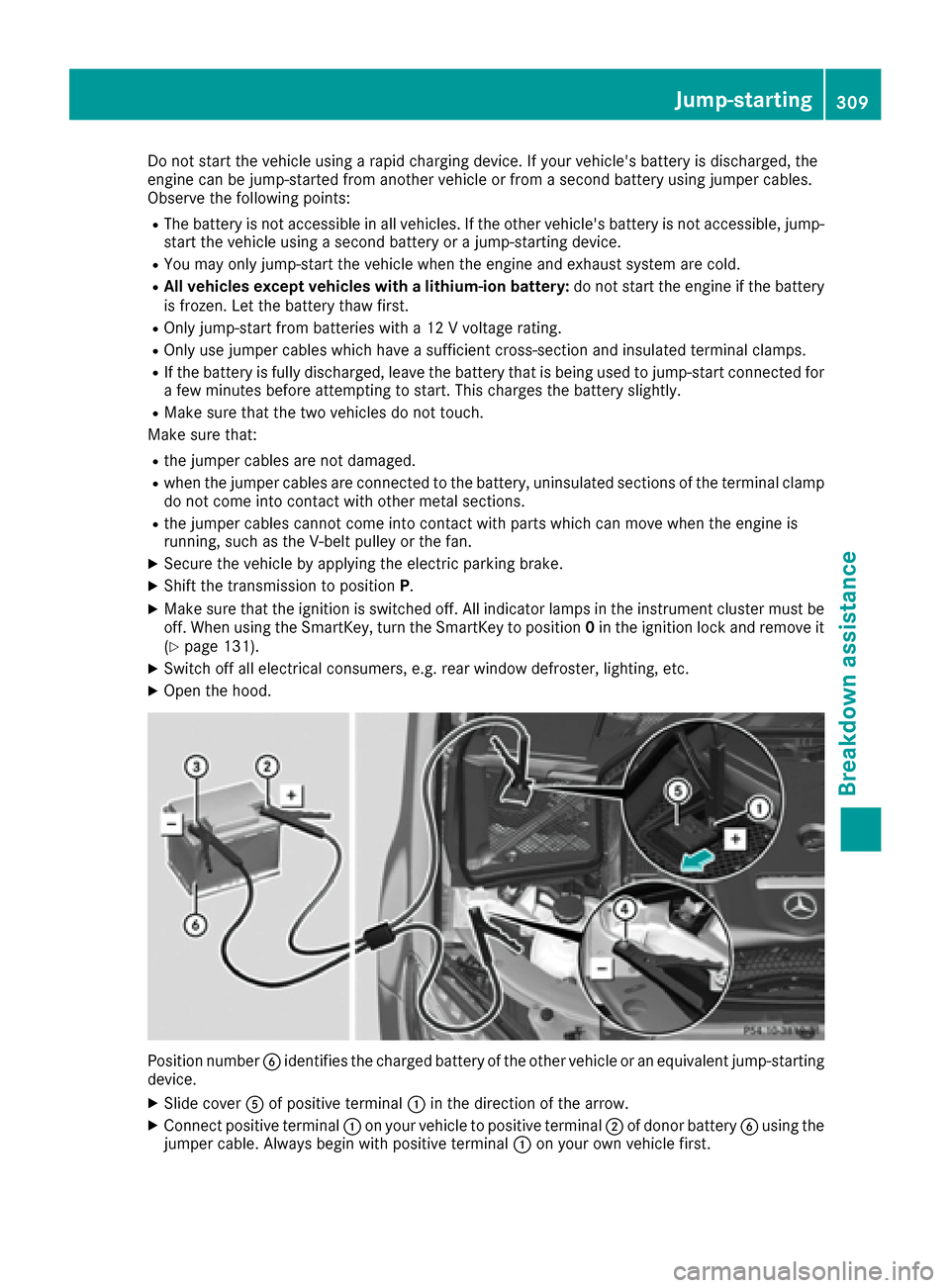
Positio nnumber Bidentifie sthe charge dbattery of the othe rvehicl eorane quivalen tjump-starting
device.
XSlide cover Aof positive terminal :in the direction of the arrow.
XConnect positive terminal :on your vehicl etopositive terminal ;of donor battery Busing the
jumpe rcable .Alway sbegin with positive terminal :on your ow nvehicl efirst.
Jump-starting309
Breakdow nassistance
Z
Page 312 of 354
XStart the engine of the donorvehicl eand run it at idling speed.
XConnect negative terminal =of dono rbattery Bto ground point ?of your vehicl eusing the
jumper cable ,connecting the jumper cable to dono rbattery Bfirst.
XStart the engine.
XBefore disconnecting the jumper cables, le tthe engine run for several minutes.
XFirst, remove the jumper cable sfrom ground point ?and negative terminal =,then from pos-
itive clamp :and positive terminal ;.Begineacht ime at the contacts on your ownv ehiclefirst.
XClose cover Aof positive terminal :afte rremoving jumper cables.
XHave the battery checke dataqualified specialist workshop.
Jump-starting is not considered to be anorma loperating condition.
iJumpe rcable sand further information regarding jump-starting can be obtaine datany qualified
specialist workshop.
Towin gand tow-starting
Important safety notes
GWARNING
Functions relevant to safety are restricted or
no longer available if:
Rthe engine is not running.
Rthe brake system or the power steering is
malfunctioning.
Rthere is amalfunction in the voltag esupply
or the vehicle's electrical system.
If your vehicl eisbeing towed, much more
force may be necessary to stee rorbrake.
There is ariskofana ccident.
In such cases, us eatow bar. Before towing,
make sure that the steering move sfreely.
GWARNING
You can no longer stee rthe vehicl eifthe
steering wheel lock hasb eene ngaged .There
is ar iskofana ccident.
Alway sswitch off the ignition when towing the
vehicl ewithat ow cable or atow bar.
GWARNING
Whe ntowing or tow-starting another vehicle
and its weight is greate rthan the permissible
gross weigh tofyourv ehicle, the:
Rthe towing eyec ould detach itself
Rthe vehicle/trailer combination could roll-
over.
There is ariskofana ccident.
Whe ntowing or tow-starting another vehicle,
its weight shoul dnot be greate rthan the per-
missible gross weight of your vehicle.
Details on the permissible gross vehicl eweight
of your vehicl ecan be found on the vehicl eide n-
tification plate (
Ypage 343).
!Whe nCOLLISIONP REVENTION ASSIST
PLUS, DISTRONIC PLU Sorthe HOLD function
is activated, the vehicl ebrakes automatically
in certain situations.
To avoid damag etothe vehicle, deactivate
thes esystems in the following or similar sit-
uations:
Rwhen towing the vehicle
Rin the car wash
!Make sure that the electri cparking brake is
released .Ifthe electri cparking brake is faulty,
visit aquali fied specialist workshop.
!Secure the tow rop eortow ba rtothe towing
eyeo nly.Otherwise, the vehicl ecould
become damaged.
310Towinga nd tow-starting
Breakdown assistance