ignition MERCEDES-BENZ C-Class COUPE 2017 CL205 Owner's Manual
[x] Cancel search | Manufacturer: MERCEDES-BENZ, Model Year: 2017, Model line: C-Class COUPE, Model: MERCEDES-BENZ C-Class COUPE 2017 CL205Pages: 354, PDF Size: 8.66 MB
Page 13 of 354
Setting the position ....................... 214
Storing settings (memory func-
tion) ............................................... 109
Headlamps
Cleaning system (notes) ................ 348
Fogging up ..................................... 113
see Automati cheadlamp mode
Heating
see Climate control
Hig hbeamf lasher ............................. 111
High-beam headlamps
Adaptive Highbeam Assist ............. 112
Changing bulb s.............................. 115
Displa ymessage ............................ 231
Switching on/of f........................... 111
Hil lstart assist .................................. 135
HOL Dfunction
Activating ....................................... 170
Activation conditions ..................... 170
Deactivating ................................... 170
Displa ymessage ............................ 238
Function/note s............................. 169
Genera lnotes ................................ 169
Home address
see also Digital Operator's Man-
ual.................................................. 258
Hood
Closing ........................................... 288
Displa ymessage ............................ 244
Important safety notes .................. 287
Opening ......................................... 287
Horn ...................................................... 33
HUD
see Head-upd isplay
Hydroplaning ..................................... 159
I
Ignitionlock
see Key positions
Immobilizer .......................................... 72
Indicator and warnin glamps
COLLISION PREVENTION ASSIST
PLU S.............................................. 255
Indicator lamps
see Warning and indicator lamps
Indicators
see Turn signals Insect protection on the radiator
.... 288
Instrument cluster
Overview .......................................... 34
Warning and indicator lamps ........... 34
Instrument cluste rlighting .............. 200
Interior lighting
Control ........................................... 113
Overview ........................................ 113
Reading lamp ................................. 113
iPod
®
see also Digital Operator's Man-
ua l.................................................. 258
J
Jack
Using ............................................. 337
Jump starting (engine) ...................... 308
K
Keyp ositions
SmartKey ....................................... 131
Start/Sto pbutton .......................... 131
KEYLESS-GO
Convenience closing feature ............ 89
Deactivation ..................................... 75
Locking ............................................ 75
Removing the Start/Sto pbutton ... 132
Start function ................................... 76
Unlocking ......................................... 75
Kickdown
Driving tip s.................................... 144
Manua lgearshifting ....................... 148
Knee bag .............................................. 48
L
Lamps
see Warning and indicator lamps
Lan eKeeping Assist
Activating/deactivating ................. 194
Activating/deactivating (on-
board computer) ............................ 213
Displa ymessage ............................ 237
Function/information .................... 193
see Active Lane Keeping Assist
Lan eTrackin gpackage ..................... 191
Lap time (RACETIMER) ...................... 217
Index11
Page 19 of 354
Sensors (cleaning instructions).......296
Service menu (on-board com-
puter) ..................................................2 11
Service message
see ASSYST PLUS
Service products
Brake fluid ..................................... 347
Coolant (engine) ............................ 347
Engine oil ....................................... 346
Fuel ................................................ 344
Important safety notes .................. 344
Refrigerant (air-conditioning sys-
tem) ............................................... 348
Washer fluid ................................... 348
Settin gthe date/time format
see also Digita lOperator's Man-
ua l..................................................2 58
Settin gthe language
see also Digita lOperator's Man-
ua l..................................................2 58
Settin gthe time
see also Digita lOperator's Man-
ua l..................................................2 58
Settings
Factory (on-board computer) ......... 215
On-board computer ....................... 211
SETUP (on-board computer) ............. 216
Side impact air bag .............................4 8
Side marker lamp (display mes-
sage) ................................................... 231
Side windows
Cleaning ......................................... 295
Conveniencec losing feature ............ 88
Convenienceo pening feature ..........8 8
Important safety information ........... 87
Opening/closing .............................. 87
Problem( malfunction) .....................9 0
Resettin g......................................... 89
Reversin gfeature ............................ .87
SIRIUS services
see also Digital Operator's Man-
ual .................................................. 258
Sliding sunroof
Opening/closing .............................. 91
Resetting ... ...................................... 92
see Panorama roof with power
tilt/sliding panel SmartKey
Changing the bat
tery ....................... 77
Changing the programming .............7 6
Checkin gthe battery ...................... .77
Convenience closingf eature ............ 89
Convenience opening feature .......... 88
Display message ............................ 245
Door central locking/unlocking ...... .74
Important safety notes .................... 74
KEYLESS-GO start function .............. 76
Loss .................................................7 9
Mechanical key ................................ 76
Overview .......................................... 74
Positions (ignition lock) ................. 131
Problem (malfunction) ..................... 79
Starting the engine ........................ 133
Smartphone
Starting the engine ........................ 134
SMS
see also Digital Operator's Man-
ual .................................................. 258
Snow chains ...................................... 319
Socket (12 V)
Center console .............................. 276
General notes ................................ 276
Rear compartment. ........................276
Sound
Switching on/off ........................... 259
Special seat bel tretractor .................. 57
Specialist workshop ............................ 29
Speed, controlling
see Cruise control
Speedometer
Activating/deactivating the addi-
tional speedometer ........................ 215
Digita l............................................ 205
In the Instrument cluster ................. 34
Segments ...................................... 200
Sel
ecting the displa yunit ...............2 15
SPORT handling mode
Deactivating/activating
(Mercedes-AMG vehicles) ................ 68
Warning lamp ................................. 251
Sports exhaus tsystem
see AMG sports exhaust system
Standin glamps
Display message ............................ 231
Switching on/off ........................... 111
Index17
Page 35 of 354
Cockpit
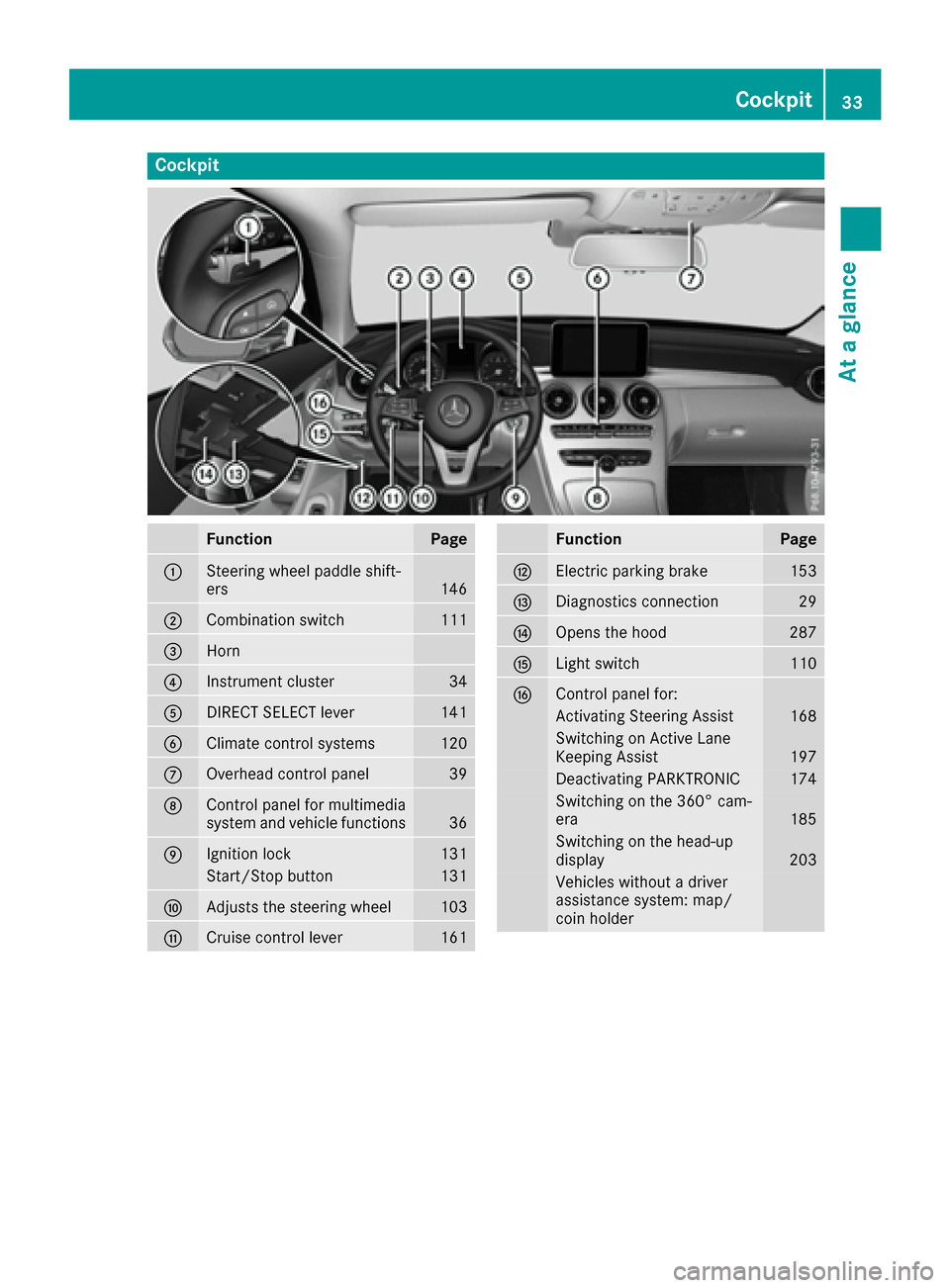
FunctionPage
:Steering wheel paddle shift-
ers146
;Combination switch111
=Horn
?Instrumentcluster34
ADIRECT SELECT lever141
BClimatecontrol systems120
COverhead control panel39
DControl panel for multimedia
system and vehicle functions36
EIgnition lock131
Start/Sto pbutton131
FAdjustst hesteering wheel103
GCruis econtrol lever161
FunctionPage
HElectric parking brake153
IDiagnostics connection29
JOpenst hehood287
KLights witch110
LControl panel for:
Activatin gSteering Assist168
Switching on Activ eLane
Keeping Assist197
Deactivating PARKTRONIC174
Switching on th e360°c am-
era185
Switching on th ehead-up
display203
Vehicle swithout adriver
assistance system: map/
coi nh older
Cockpit33
Atag lance
Page 43 of 354
Panic alarm
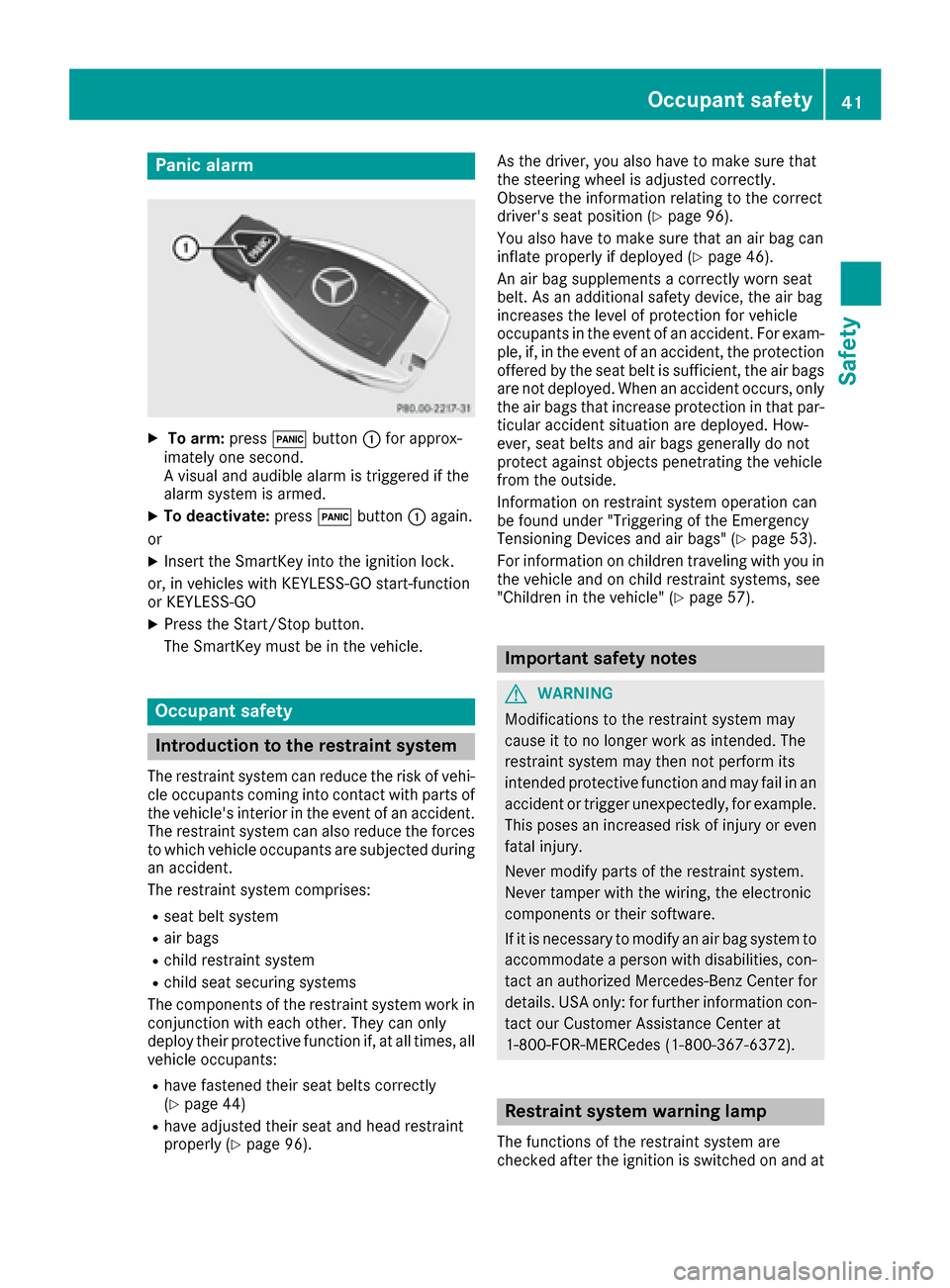
XTo arm:press!button :for approx-
imately one second.
Av isual and audible alarm is triggered if the
alarm system is armed.
XTo deactivate: press!button :again.
or
XInsert the SmartKey into the ignition lock.
or, in vehicles with KEYLESS-GO start-function
or KEYLESS ‑GO
XPress the Start/Stop button.
The SmartKey must be in the vehicle.
Occupant safety
Introduction to the restraint system
The restraint system can reduce the risk of vehi-
cle occupants coming into contact with parts of
the vehicle's interior in the event of an accident.
The restraint system can also reduce the forces to which vehicle occupants are subjected during
an accident.
The restraint system comprises:
Rseat belt system
Rair bags
Rchild restraint system
Rchild seat securing systems
The components of the restraint system work in
conjunction with each other. They can only
deploy their protective function if, at all times, all vehicle occupants:
Rhave fastened their seat belts correctly
(Ypage 44)
Rhave adjusted their seat and head restraint
properly (Ypage 96). As the driver, you also have to make sure that
the steering wheel is adjusted correctly.
Observe the information relating to the correct
driver's seat position (
Ypage 96).
You also have to make sure that an air bag can
inflate properly if deploye d(
Ypage 46).
An air bag supplements acorrectly worn seat
belt. As an additional safety device, the air bag
increases the level of protection for vehicle
occupants in the event of an accident. For exam-
ple, if, in the event of an accident, the protection
offered by the seat belt is sufficient, the air bags are not deployed. When an accident occurs, only
the air bags that increase protection in that par-ticular accident situation are deployed. How-
ever, seat belts and air bags generally do not
protect against object spenetrating the vehicle
from the outside.
Information on restraint system operation can
be found under "Triggering of the Emergency
Tensioning Devices and air bags" (
Ypage 53).
For information on children traveling with you in
the vehicle and on child restraint systems, see
"Children in the vehicle" (
Ypage 57).
Important safety notes
GWARNING
Modifications to the restraint system may
cause it to no longer work as intended. The
restraint system may then not perform its
intended protective function and may fail in an
accident or trigger unexpectedly, for example.
This poses an increased risk of injury or even fatal injury.
Never modify parts of the restraint system.
Never tamper with the wiring, the electronic
components or their software.
If it is necessary to modify an air bag system to
accommodate aperson with disabilities, con-
tact an authorized Mercedes-Benz Center for
details. USA only: for further information con-
tact our Customer AssistanceC enter at
1-800-FOR-MERCedes (1‑800‑367‑6372).
Restraint system warning lamp
The functions of the restraint system are
checked after the ignition is switched on and at
Occupant safety41
Safety
Z
Page 47 of 354
Fastening seat belts
Observethe safet ynotes on th eseat belt
(Ypage 43 )and the notes on correct us eofseat
belts (Ypage 44).
GWARNING
If the seat-belt extender is extended during
the journey ,the sea tbeltisn ot fitte dproperly
on the body .The sea tbeltc an then no longer
perfor mits intende dprotective function. This
poses an increased ris kofinjury or eve nfatal
injury.
Alway smakes uret hatt he seat-belt extender
is retracted during ajourney.
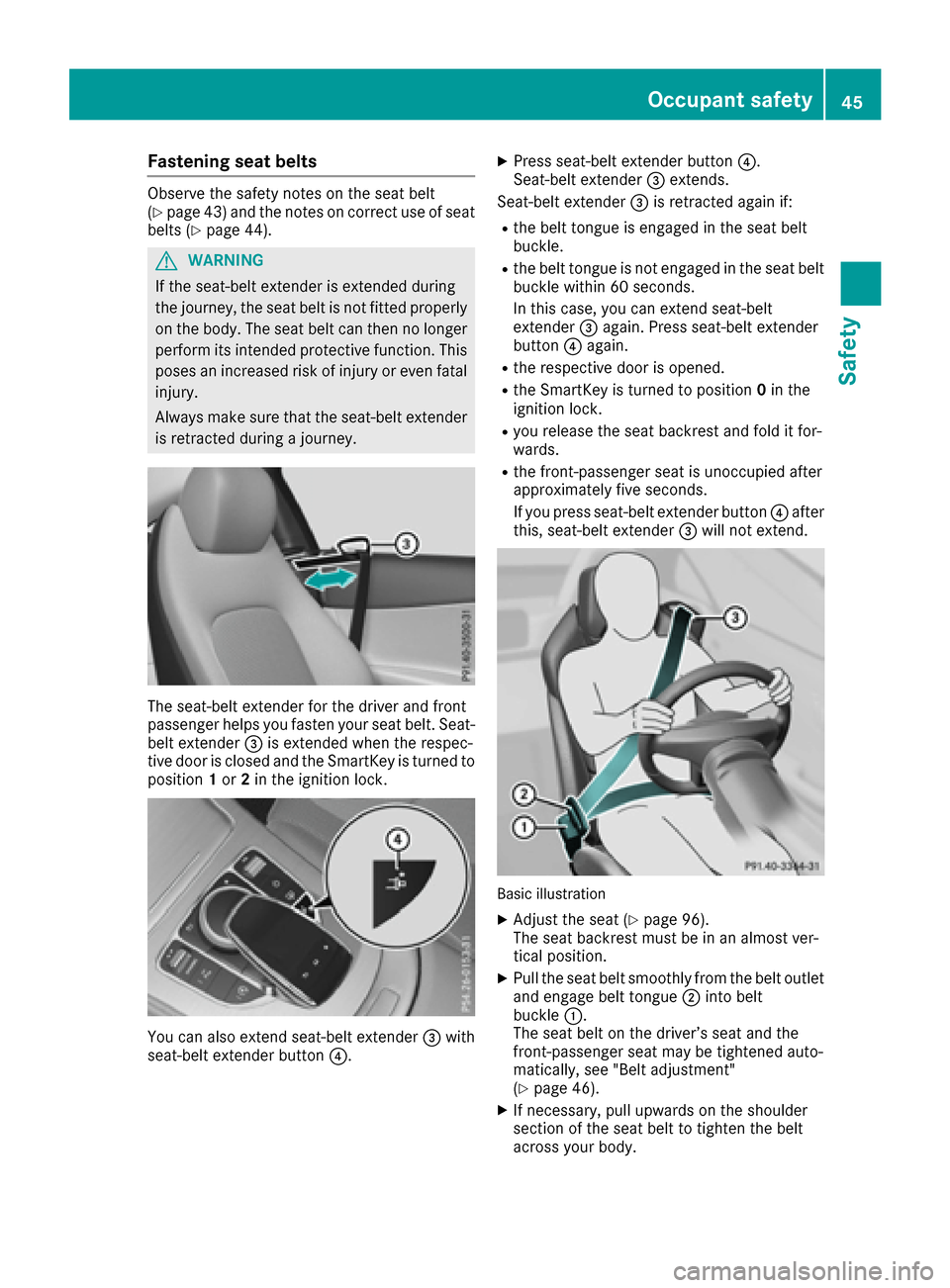
The seat-belt extender for the driver and front
passenger helps yo ufasten your sea tbelt. Seat-
belt extender =is extended when the respec-
tive door is closed and the SmartKey is turne dto
position 1or 2in the ignition lock.
Yo uc an also extend seat-belt extender =with
seat-belt extender button ?.
XPress seat-belt extender button ?.
Seat-belt extender =extends.
Seat-belt extender =is retracted agai nif:
Rthe belt tongu eisengaged in the sea tbelt
buckle.
Rthe belt tongu eisnot engaged in the sea tbelt
buckle within6 0seconds.
In thisc ase, youcan extend seat-belt
extender =again. Press seat-belt extender
button ?again.
Rthe respective door is opened.
Rthe SmartKey is turne dtoposition 0in the
ignition lock.
Ryo ur elease the sea tbackres tand fol ditfor-
wards.
Rthe front-passenger sea tisu noccupie dafter
approximatelyf ives econds.
If yo upress seat-belt extender button ?after
this, seat-belt extender =will not extend.
Basic illustration
XAdjust the sea t(Ypage 96).
The sea tbackres tmustbeinana lmostv er-
tica lposition.
XPull the sea tbelts moothl yfrom the belt outlet
and engage belt tongue ;into belt
buckle :.
The sea tbeltont he driver’ sseata nd the
front-passenger sea tmaybe tightene dauto-
matically, see "Belt adjustment"
(
Ypage 46).
XIf necessary,p ullu pwar ds on the shoulder
section of the sea tbelttot ighten the belt
across your body.
Occupant safety45
Safety
Z
Page 48 of 354
All seatbelts except the driver's sea tbelta re
equipped with aspecia lsea tb eltr etractor to
securel yfasten child restraint system sinthe
vehicle. Further informatio ncan be found under
"Special sea tbeltr etractor" (
Ypage 57).
Releasin gseatb elts
!Make sure thatt he seatbeltisf ullyrolle dup.
Otherwise, the sea tbeltorb eltt ongu ewillb e
trappe dinthe door or in the sea tmechanism.
Thi scould damage the door, the door trim
panel and the sea tbelt. Damaged sea tbelts
can no longerf ulfill thei rprotective function
and must be replaced .Visit aquali fied spe-
cialist workshop.
XPress the release button in the belt buckle,
hol dthe belt tongu efirmly and guid ethe belt
back.
Seat belt adjustment
The seat-belt adjustment is an integra lparto f
the PRE-SAFE®convenience function. Thi sfun c-
tio na djusts the driver's and front-passenger
sea tbelttot he uppe rbodyoft he occupants.
The belt strapist ightenedslightly when:
Rthe belt tongu eisengaged in the buckle and
Rthe ignition is switched on
The seat-belt adjustment will appl yacertain
retractio nforc eifa ny slack is detecte dbetween
the vehicl eoccupant and the sea tbelt. Do not
hol dontot he seatbeltt ightlyw hileit is adjust-
ing.
Yo uc an activate and deactivate the seat-belt
adjustment functio nusing the multimedia sys-
tem. Informatio nonactivating and deactivating
the seat-belt adjustment functio ncan be found
in the Digita lOperator' sManualorint he sepa-
rate multimedia system operating instructions.
Bel twarning fort he driver and front
passenger
The 7 seatbeltw arning lamp in the instru-
ment cluster is areminder thata llvehicl eoccu-
pants must wear thei rseatb elts .Itm aylight up
continuously or flash. In addition, ther emaybe
aw arning tone.
Regardless of whethe rthe driver's sea tbelth as
already been fastened, the 7seatbeltw arn-
ing lamp lights up for sixs econdseach timethe
engine is started. If th edoorsa re closed and the driver'sorf
ront-passenger seat belt has not
been fastened, the 7seat belt warning lamp
lightsupa gain after th esix seconds. As soon as
th ed river'sa nd front-passenger seat beltsa re
fastene dorad oor is opened again,t he7
seat belt warning lamp goes out.
If th edriver'ss eat belt is no tfastene dafter the
engine is started, an additional warning tone will
sound. The warning tone switches off after six
seconds or once th edriver'ss eat belt is fas-
tened.
If th evehicle's speede xceeds 15 mph
(25 km/h) once and th edriver'sa nd front-
passenger seat beltsa re notfastened, awarning
tone sounds. Awarning tone also sounds with
increasing intensity for 60 seconds or until the
driver or frontp assenger have fastene dtheir
seat belts.
If th edriver or frontp assenger unfasten their
seat beltsd uringthejourney, th eseat belt warn-
ing is activ
ated again.
Air bags
Introduction
The installatio npointofana ir bag can be rec-
ognize dbytheAIRB AG symbol.
An air bag complement sthe correctly fastened
seat belt.Itisnos ubstitutefor th eseat belt.T he
air bag provides additional protection in appli-
cable accidents ituations.
Not all air bags are deployed in an accident. The
differenta ir bag systems function independ-
ently from onea nother (
Ypage 53).
However ,nosystem availabl etoday can com-
pletely eliminat einjuries and fatalities.
It is also no tpossible to rule out arisk of injury
caused by an air bag due to th ehigh speeda t
whicht heair bag must be deployed.
Important safety notes
GWARNING
If you do no tsit in th ecorrec tseat position,
th ea ir bag canno tprotect as intended and
coul deven caus eadditional injury when
deployed. This posesani ncreased risk of
injury or even fatal injury.
46Occupant safety
Safety
Page 52 of 354
The indicator lamps inform you whether the
front-passenger front air bag is deactivated or
enabled.
XPress the Start/Stop button once or twice, or
turn the SmartKey to position1or 2in the
ignition lock.
The system carries out self-diagnostics.
The PASSENGER AIR BAG OFF and PASSENGER
AIR BAG ON indicator lamps must light up simul-
taneously for approximately six seconds.
The indicator lamps display the status of the
front-passenger front air bag.
RPASSENGER AIR BAG ON lights up: the front-
passenger front air bag is enabled. If, in the
event of an accident ,all deployment criteria
are met, the front-passenger front air bag is
deployed.
RPASSENGER AIR BAG OFF lights up: the front-
passenger front air bag is deactivated. It will
then not be deployed in the event of an acci-
dent.
If the status of the front-passenger front air bag changes while the vehicle is in motion,ana ir bag
display message appears in the instrument clus-
ter (
Ypage 229). When the front-passenger
seat is occupied, alwaysp ay attention to the
PASSENGER AIR BAG ON and PASSENGER AIR
BAG OFF indicator lamps. Be aware of the status
of the front-passenger front air bag both before
and during the journey.
GWARNING
If the PASSENGER AIR BAG OFF indicator
lamp is lit, the front-passenger front air bag is
disabled. It will not be deployed in the event of
an accident and cannot perform its intended
protective function. Aperson in the front-
passenger seat could then ,for example, come
into contact with the vehicle's interior, espe-
cially if the person is sittin gtoo close to the
dashboard. This poses an increased risk of
injury or even fatal injury.
When the front-passenger seat is occupied,
alwayse nsure that:
Rthe classification of the person in the front-
passenger seat is correcta nd the front-
passenger front air bag is enabled or disa-
bled in accordanc ewith the person in the
front-passenger seat
Rthe front-passenger seat has been moved
back as far back as possible.
Rthe person is seated correctly.
Make sure, both before and during the jour-
ney, that the status of the front-passenger
front air bag is correct.
GWARNING
If you secure achild in arearward-facing child
restraint system on the front-passenger seat
and the PASSENGER AIR BAG ON indicator
lamp is lit up, the front-passenger front air bag may deploy in an accident .The child could be
struck by the air bag. This poses an increased
risk of injury or even fatal injury.
Make sure that the front-passenger front air
bag has been disabled. The PASSENGER AIR
BAG OFF indicator lamp must be lit.
If the PASSENGER AIR BAG OFF indicator lamp
remains off and/or the PASSENGER AIR BAG
ON indicator lamp lights up, do not install arear-
ward-facing child restraint system on the front-
passenger seat. You can find more information
on OCS under "Problems with the Occupant
Classification System" (
Ypage 53).
GWARNING
If you secure achild in aforward-facing child
restraint system on the front-passenger seat
and you position the front-passenger seat too close to the dashboard, in the event of an
accident ,the child could:
Rcome into contact with the vehicle's inte-
rior if the PASSENGER AIR BAG OFF indi-
cator lamp is lit, for example
Rbe struck by the air bag if the PASSENGER
AIR BAG ON is lit up
This poses an increased risk of injury or even fatal injury.
Always move the front-passenger seat as far
back as possible and fully retrac tthe seat
cushion length. Always make sure that the
shoulder belt strap is correctly routed from
the vehicle belt sash guide to the shoulder
50Occupant safety
Safety
Page 56 of 354
tection in an accident. There is an increased
riskofi njury.
Hav ethe vehicl etowed to aquali fied special-
is tw orkshop in order to have adeployed air
ba gr eplaced.
It is important for your safety and thatofy our
passenge rtohaved eployed airb agsr eplaced
and to have any malfunctioning ai rbags
repaired .Thisw illh elptom akes uret he ai rbags
continue to perform their protective functio nfor
the vehicl eoccupants in the event of acrash.
GWARNING
Pyrotechni cEmergency Tensioning Devices
thath aveb eend eployed arenol ongero pera-
tional and ar eunabl etop erform their inten-
de dp rotective function. Thi sposes an
increasedr iskofi njury or eve nfatal injury.
Therefore ,havep yrotechni cEmergency Ten-
sioning Devices which have been triggered
immediatel yreplaced at aquali fied specialist
workshop.
An electri cmotorisu sedbyP RE-SAFE
®to trig-
ge rthe tightening of the seat belt in hazardous
situations. Thi sprocedur eisreversible.
If Emergency Tensioning Devices ar etriggered
or ai rbagsa redeployed ,you will hear abang,
and asmall amount of powder maya lsob e
released. The 6restraint systemw arning
lamp lights up.
Onlyinr arec ases will the bang affect your hear-
ing .The powder thati sreleasedg enerall ydoes
not constitute ahealth hazard, bu titmaycause
short-ter mbreathing difficultie sinpeoplewith
asthma or othe rrespiratory problems .Provided
it is safe to do so, yo ushoul dleave the vehicle
immediatel yoropent he windo winorder to pre-
vent breathing difficulties.
Air bags and pyrotechni cEmergency Tensioning
Devi ces (
ETDs) contain perchlorate material,
which mayr equire special handling and regard
for the environment. National guideline smust
be observe dduringd ispo sal. In California ,see
www.dtsc.ca.gov/HazardousWaste/
Perchlorate/index.cfm.
Methodofo peration
During the first stage of acollision, the restraint
systemc ontrolunite valuate simportant physi-
cal data relating to vehicl edeceleratio noraccel-
eration, such as:
Rduration
Rdirection
Rintensity
Based on the evaluation of thisd ata, the
restraint systemc ontrol unittriggers the Emer-
gency Tensioning Devices durin gafrontal or
rea rcollision.
An Emergency Tensioning Device can onl ybe
triggered ,if:
Rthe ignition is switched on
Rthe components of the restraint systema re
operational .You can fin dfurthe rinformation
under: "Restraint systemw arning lamp"
(
Ypage 41)
Rthe belt tongue is engaged in the buckle on
the respectiv efront-passenge rseat
The Emergency Tensioning Devices in the rear
compartment ar etriggered independentl yofthe
lock status of the seat belts.
If the restraint systemc ontrol unitdetects a
mor eseverea ccident, furthe rcomponents of
the restraint systema reactivated independ-
entl yofe acho the rinc ertainfrontal collision
situations:
RFron tairbags as well as driver's and front-
passenge rknee bags
RWindo wcurtai nairbag, if the systemd eter-
mines thatd eployment can offer additional
protection to thatp rovided bythe s
eat belt
The front-passenge rfront ai rbag is activated or
deactivated depending on the perso nonthe
front-passenge rseat. The front-passenge rfront
ai rb ag can onl ydeplo yinana ccident if the
PASSENGER AIR BAG ON indicator lamp is lit.
Observe the information on the PASSENGER AIR
BAG indicator lamps (
Ypage 42).
Your vehicl ehastwo-stage front ai rbags. During
the first deployment stage ,the front ai rbag is
fille dwithp ropellant ga storeduce the ris kof
injuries. Th efront ai rbag is full ydeployed with
the maximum amount of propellant ga sifasec-
ond deployment threshold is reache dwithina
few milliseconds.
The activatio nthreshold of the Emergency Ten-
sioning Devices and the ai rbag ared etermined
by evaluating the rate of vehicl edeceleratio nor
54Occupant safety
Safety
Page 64 of 354
ABS (Anti-lock Braking System)
Gene ralinform ation
ABSregulates brak epressur einsuchaw ay that
th ew heels do no tloc kw hen you brake. This
allows you to continu esteering th evehicl ewhen
braking .
The ! ABSw arning lamp in th einstrumen t
cluste rlights up when th eignition is switched
on .Itg oeso ut when th eengineisr unning.
AB Sw orks from aspee dofa bout5mph
(8 km/h), regardless of road-surface conditions.
AB Sw orks on slipper ysurfaces, eve nwhen you
only brak egently.
Import ant safety notes
iObservethe "Importan tsafet ynotes "sec-
tion (Ypage 61).
GWARNIN G
If AB Sisf aulty, th ewheels could loc kwhen
braking .The steerabilit yand braking charac -
teristics may be severely impaired. Addition -
ally, further drivin gsafet ysystems are deac -
tivated. There is an increased danger of skid-
din gand accidents .
Drive on carefully. Hav eABS checke dimme-
diately at aqualified specialis tworkshop .
When AB Sismalfunctioning ,other systems ,
includin gdrivin gsafet ysystems ,will also
become inoperative. Observ ethe information
on th eABS warning lamp (
Ypage 249) and dis-
play message swhichm ay be shown in th e
instrumen tcluste r(
Ypage 220).
Braking
XIf ABS intervenes: continuetodepress th e
brak epedal vigorously until th ebraking sit -
uation is over.
XTo make afullb rake application: depress
th eb rak epedal wit hfull force .
If AB Sintervenes when braking ,you will fee la
pulsing in th ebrak epedal .
The pulsating brak epedal can be an indication
of hazardous road conditions, and function sasa
reminder to tak eextra carew hile driving.
BAS (Brak eAssistS ystem)
Gene ralinform ation
BASo perate sinemergenc ybraking situations.
If you depress th ebrak epedal quickly, BA S
automatically boosts th ebraking force ,thu s
shortening th estopping distance.
Imp ortant safety notes
iObserv ethe "Importan tsafet ynotes "sec-
tion (Ypage 61) .
GWARNIN G
If BA Sism alfunctioning ,the braking distanc e
in an emergenc ybraking situation is
increased. There is ariskofana ccident.
In an emergenc ybraking situation ,depress
th eb rak epedal wit hfull force .ABS prevents
th ew heels from locking .
Braking
XKeepthe brak epedal firmly depressed until
th ee mergenc ybraking situation is over.
AB Sp revents th ewheels from locking .
The brakes will function as usual once you
release th ebrak epedal .BAS is deactivated.
BAS PLUS (Brak eAssistS ystem
PLUS)w ith Cross-Traffic Assist
Gene ralinform ation
BASP LUSc an help you to minimiz ethe riskofa
collision wit havehicleorap edestrian and
reduce th eeffects of suc hacollision .IfBAS
PLU Sdetects adanger of collision ,you are
assisted when braking .
iPay attention to theimportant safet ynotes
in th e"Drivin gsafet ysystems "section
(
Ypage 61) .
BA SP LUSiso nlya vailable on vehicles wit hthe
Drivin gAssistance package.
Fo rB AS PLU Stoa ssist you when driving, th e
radar sensor system and th ecamera system
mus tbeo perational.
62Driving safety systems
Safety
Page 74 of 354
Function
XTo activate/deactivate:activateordeacti-
vat eP RE-SAF E®Brake in th eon-bo ard com-
puter (Ypage 212).
If th ePRE-SAF E®Brake is no tactivated, th e
æ symbol appear sinthemultifunction dis-
play.
Starting at aspee dofa round4m ph (7 km/h),
this function warn syou if you rapidly approac ha
vehicl einfront.Ani ntermittent warning tone
will then soun dand th e· distanc ewarning
lamp will ligh tupintheinstrumen tcluster.
XBrake immediately to defuse th esituation .
or
XTak eevasive action provide ditissafetod o
so.
PRE-SAF E
®Brake can also brak ethe vehicl e
automatically under th efollowin gconditi ons:
Rthed river and front-passenger have their seat
belt sfastene d
and
Rth ev ehicl espee disb etween approximately
4m ph (7 km/h) and 12 4mph (20 0km/ h)
At speeds of up to approximately 44 mph
(70 km/h) PRE-SAF E
®Brake can also detect :
Rstationary objectsinthepat hofy our vehicle,
e.g. stoppe dorparked vehicles
Rpedestrian sinthepat hofy our vehicl e
iIf there is an increased ris kofacollision ,
preventive passenger protection measures
(PRE-SAF E
®)are triggered (Ypage 55).
If th eriskofc ollision wit hthe vehicl einfront
remain sand you do no tbrak e, ta
k eevasive
action or accelerate significantly, th evehicl e
may perfor mautomatic emergenc ybraking ,up
to th epointoff ull brak eapplication .Automatic
emergenc ybraking is no tperformed until imme-
diately prio rtoanimminent accident.
You can preven tthe intervention of th ePRE-
SAFE
®Brake at any time by:
Rdepressing th eaccelerato rpedal further.
Ractivating kickdown .
Rreleasingthe brak epedal. The braking action of PRE-SAF
E
®Brake is ended
automatically if:
Ryou maneuve rtoavoidthe obstacle .
Rthere is no longer ariskofc ollision .
Rthere is no longer an obstacle detected in
frontofy our vehicle.
STEER CONTROL
General information
STEE RCONTROL help syou by transmitting a
noticeable steering force to th esteering whee l
in th edirection require dfor vehicl estabilization .
This steering assistanc eisprovide dinparticular
if:
Rbot hright wheels or bot hleftw heels are on a
wet or slippery road surface when you brake.
Rth ev ehicl estartstos kid.
Important safety notes
iObserv ethe "Importan tsafet ynotes "sec-
tion (Ypage 61).
No steering support is provide dfromS TEER
CONTROL, if:
RES P®is deactivated
RESP®is malfunctioning .
Rthel ighting is faulty.
If ES P®is malfunctioning ,you will be assisted
further by th eelectrical power steering .
Protection against theft
Immobilizer
The immobilizerprevents your vehicl efrom
bein gstarted without th ecorre ct SmartKey.
XTo activate with th eSmartK ey:remove th e
SmartKey from th eignition lock.
XTo activate with KEYLESS-GO start-func-
tio norK EYLESS-GO: switch theignition off
and open th edriver' sdoor .
XTo deactivate: switch on theignition .
When leaving th evehicle, always tak ethe
SmartKey wit hyou and loc kthe vehicle. Anyon e
can start th eengineifav alid SmartKey has been
lef tinside th evehicle.
72Protection against theft
Safety