window MERCEDES-BENZ C-CLASS ESTATE 2014 Owner's Guide
[x] Cancel search | Manufacturer: MERCEDES-BENZ, Model Year: 2014, Model line: C-CLASS ESTATE, Model: MERCEDES-BENZ C-CLASS ESTATE 2014Pages: 489, PDF Size: 15.08 MB
Page 131 of 489
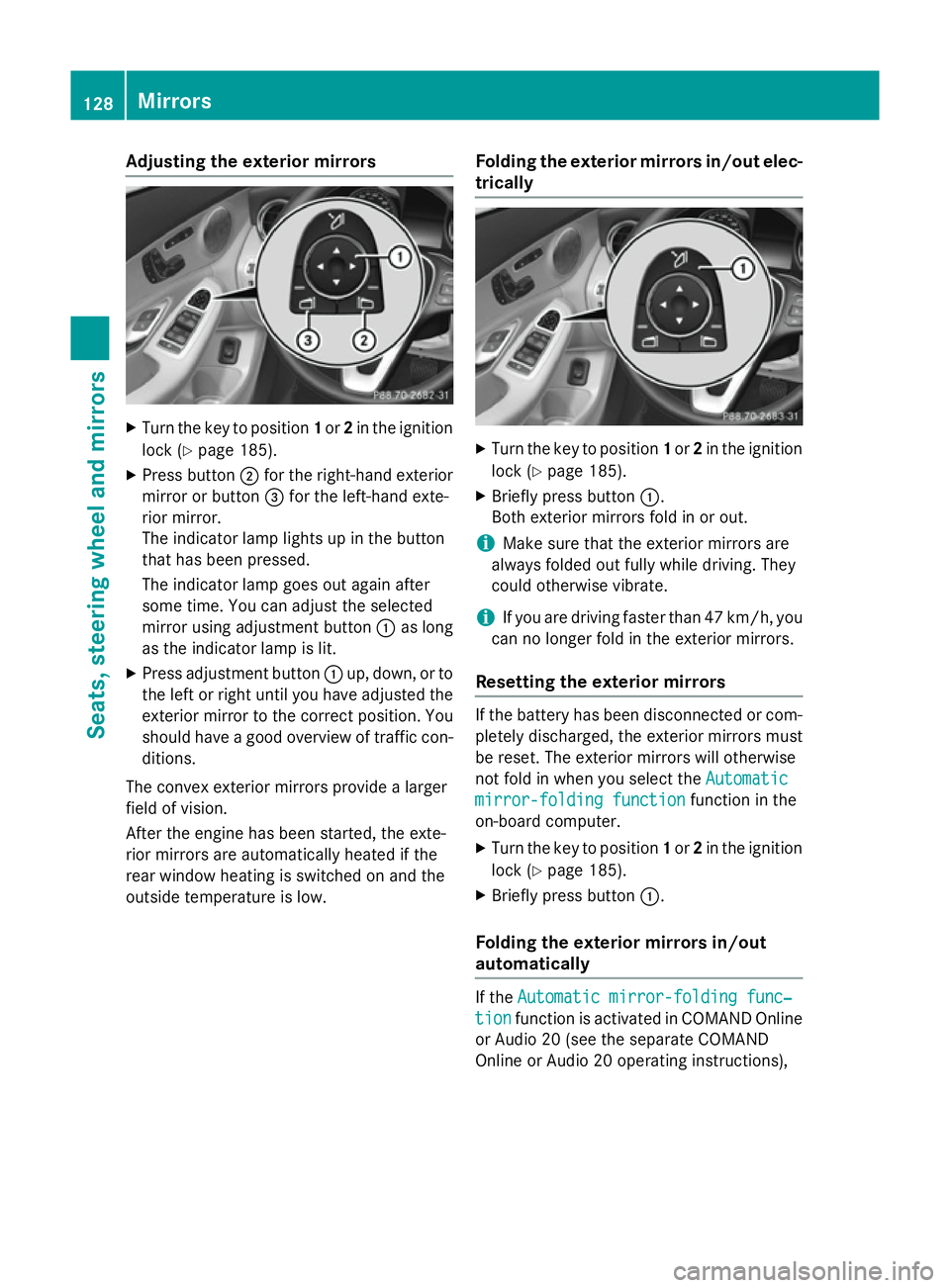
Adjusting the exterior mirrors
X
Turn the key to position 1or 2in the ignition
lock (Y page 185).
X Press button ;for the right-hand exterior
mirror or button =for the left-hand exte-
rior mirror.
The indicator lamp lights up in the button
that has been pressed.
The indicator lamp goes out again after
some time. You can adjust the selected
mirror using adjustment button :as long
as the indicator lamp is lit.
X Press adjustment button :up, down, or to
the left or right until you have adjusted the
exterior mirror to the correct position. You
should have a good overview of traffic con- ditions.
The convex exterior mirrors provide a larger
field of vision.
After the engine has been started, the exte-
rior mirrors are automatically heated if the
rear window heating is switched on and the
outside temperature is low. Folding the exterior mirrors in/out elec-
trically X
Turn the key to position 1or 2in the ignition
lock (Y page 185).
X Briefly press button :.
Both exterior mirrors fold in or out.
i Make sure that the exterior mirrors are
always folded out fully while driving. They
could otherwise vibrate.
i If you are driving faster than 47 km/h, you
can no longer fold in the exterior mirrors.
Resetting the exterior mirrors If the battery has been disconnected or com-
pletely discharged, the exterior mirrors must
be reset. The exterior mirrors will otherwise
not fold in when you select the Automatic Automatic
mirror-folding function
mirror-folding function function in the
on-board computer.
X Turn the key to position 1or 2in the ignition
lock (Y page 185).
X Briefly press button :.
Folding the exterior mirrors in/out
automatically If the
Automatic mirror-folding func‐ Automatic mirror-folding func‐
tion
tion function is activated in COMAND Online
or Audio 20 (see the separate COMAND
Online or Audio 20 operating instructions), 128
MirrorsSeats
, steering wheel and mirrors
Page 150 of 489
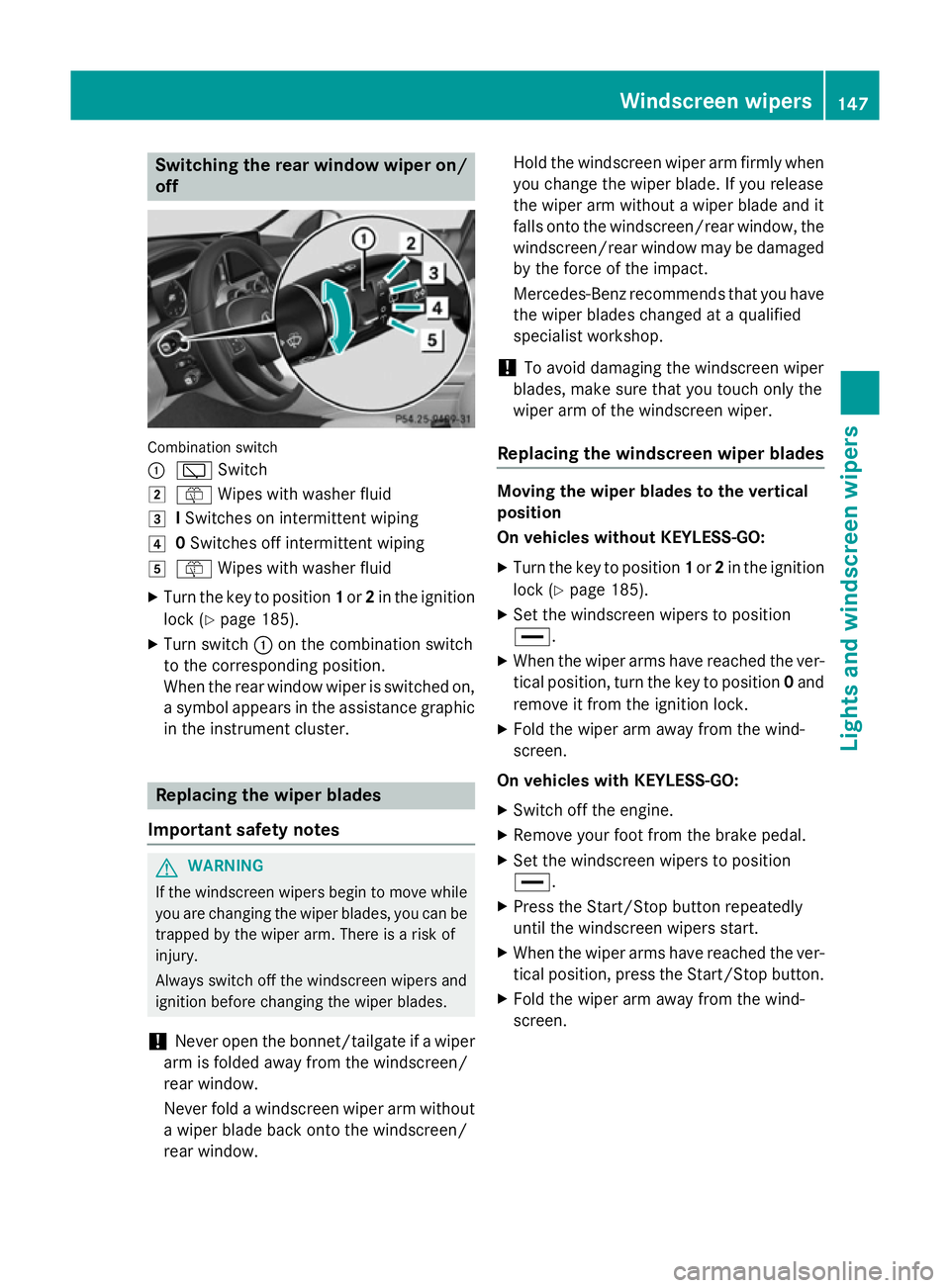
Switching the rear window wiper on/
off Combination switch
:
è Switch
2 ô Wipes with washer fluid
3 ISwitches on intermittent wiping
4 0Switches off intermittent wiping
5 ô Wipes with washer fluid
X Turn the key to position 1or 2in the ignition
lock (Y page 185).
X Turn switch :on the combination switch
to the corresponding position.
When the rear window wiper is switched on,
a symbol appears in the assistance graphic
in the instrument cluster. Replacing the wiper blades
Important safety notes G
WARNING
If the windscreen wipers begin to move while
you are changing the wiper blades, you can be trapped by the wiper arm. There is a risk of
injury.
Always switch off the windscreen wipers and
ignition before changing the wiper blades.
! Never open the bonnet/tailgate if a wiper
arm is folded away from the windscreen/
rear window.
Never fold a windscreen wiper arm without a wiper blade back onto the windscreen/
rear window. Hold the windscreen wiper arm firmly when
you change the wiper blade. If you release
the wiper arm without a wiper blade and it
falls onto the windscreen/rear window, the windscreen/rear window may be damaged
by the force of the impact.
Mercedes-Benz recommends that you have the wiper blades changed at a qualified
specialist workshop.
! To avoid damaging the windscreen wiper
blades, make sure that you touch only the
wiper arm of the windscreen wiper.
Replacing the windscreen wiper blades Moving the wiper blades to the vertical
position
On vehicles without KEYLESS-GO:
X Turn the key to position 1or 2in the ignition
lock (Y page 185).
X Set the windscreen wipers to position
°.
X When the wiper arms have reached the ver-
tical position, turn the key to position 0and
remove it from the ignition lock.
X Fold the wiper arm away from the wind-
screen.
On vehicles with KEYLESS-GO:
X Switch off the engine.
X Remove your foot from the brake pedal.
X Set the windscreen wipers to position
°.
X Press the Start/Stop button repeatedly
until the windscreen wipers start.
X When the wiper arms have reached the ver-
tical position, press the Start/Stop button.
X Fold the wiper arm away from the wind-
screen. Windscreen wipers
147Lights and windscreen wipers Z
Page 152 of 489
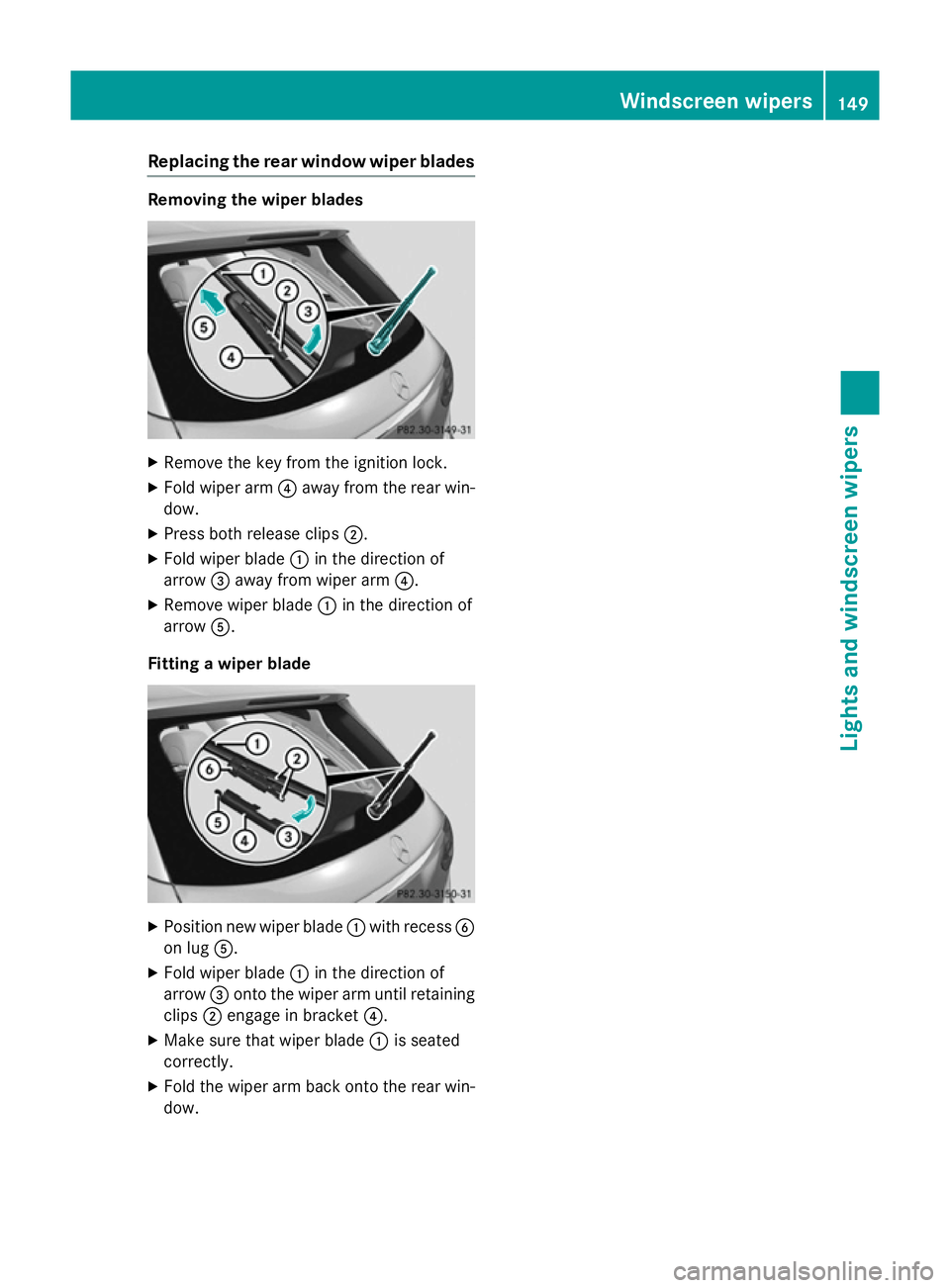
Replacing the rear window wiper blades
Removing the wiper blades
X
Remove the key from the ignition lock.
X Fold wiper arm ?away from the rear win-
dow.
X Press both release clips ;.
X Fold wiper blade :in the direction of
arrow =away from wiper arm ?.
X Remove wiper blade :in the direction of
arrow A.
Fitting a wiper blade X
Position new wiper blade :with recess B
on lug A.
X Fold wiper blade :in the direction of
arrow =onto the wiper arm until retaining
clips ;engage in bracket ?.
X Make sure that wiper blade :is seated
correctly.
X Fold the wiper arm back onto the rear win-
dow. Windscreen wipers
149Lights and windscreen wipers Z
Page 155 of 489
Useful information
i This Owner's Manual describes all mod-
els, series and optional equipment for your
vehicle that were available at the time of
going to press. National variations are pos- sible. Note that your vehicle may not be
equipped with all of the functions descri-
bed. This is also the case for systems and
functions relevant to safety.
i Read the information on qualified special-
ist workshops: (Y page 27). Overview of climate control systems
Important safety notes
Observe the settings recommended on the
following pages. The windows could other-
wise mist up.
To prevent the windows from misting up:
R switch off climate control only briefly
R switch on air-recirculation mode only
briefly
R switch on the cooling with air dehumidifi-
cation function
R switch on the "demist windscreen" function
briefly, if required
Climate control regulates the temperature
and air humidity in the vehicle interior. The
interior filter cleans the air, thus improving
the interior climate.
For vehicles with a combustion engine, the
cooling with air dehumidification function is
only available when the engine is running. For hybrid vehicles, the "Cooling with air dehu-
midification" function is also available via the
electric refrigerant compressor when the
engine is not running. Optimum climate con-
trol is only achieved with the side windows
and roof closed.
The residual heat function can only be acti-
vated or deactivated with the ignition
switched off (Y page 169). i
Ventilate the vehicle for a brief period
during warm weather, e.g. using the con-
venience opening feature (Y page 108).
This will speed up the cooling process and
the desired interior temperature will be
reached more quickly.
i The integrated filter filters out most par-
ticles of dust and soot and completely fil-
ters out pollen. It also reduces gaseous pol-
lutants and odours. A clogged filter reduces
the amount of air supplied to the vehicle
interior. For this reason, you should always observe the interval for replacing the filter,which is specified in the Service Booklet. As this depends on environmental conditions,
e.g. heavy air pollution, the interval may be
shorter than stated in the Service Booklet.
i It is possible that the blower may be acti-
vated automatically 60 minutes after the
key has been removed depending on vari-
ous factors, e.g. the outside temperature.
The vehicle is then ventilated for
30 minutes to dry the automatic climate
control. 152
Overview of climate control systemsClimate control
Page 156 of 489
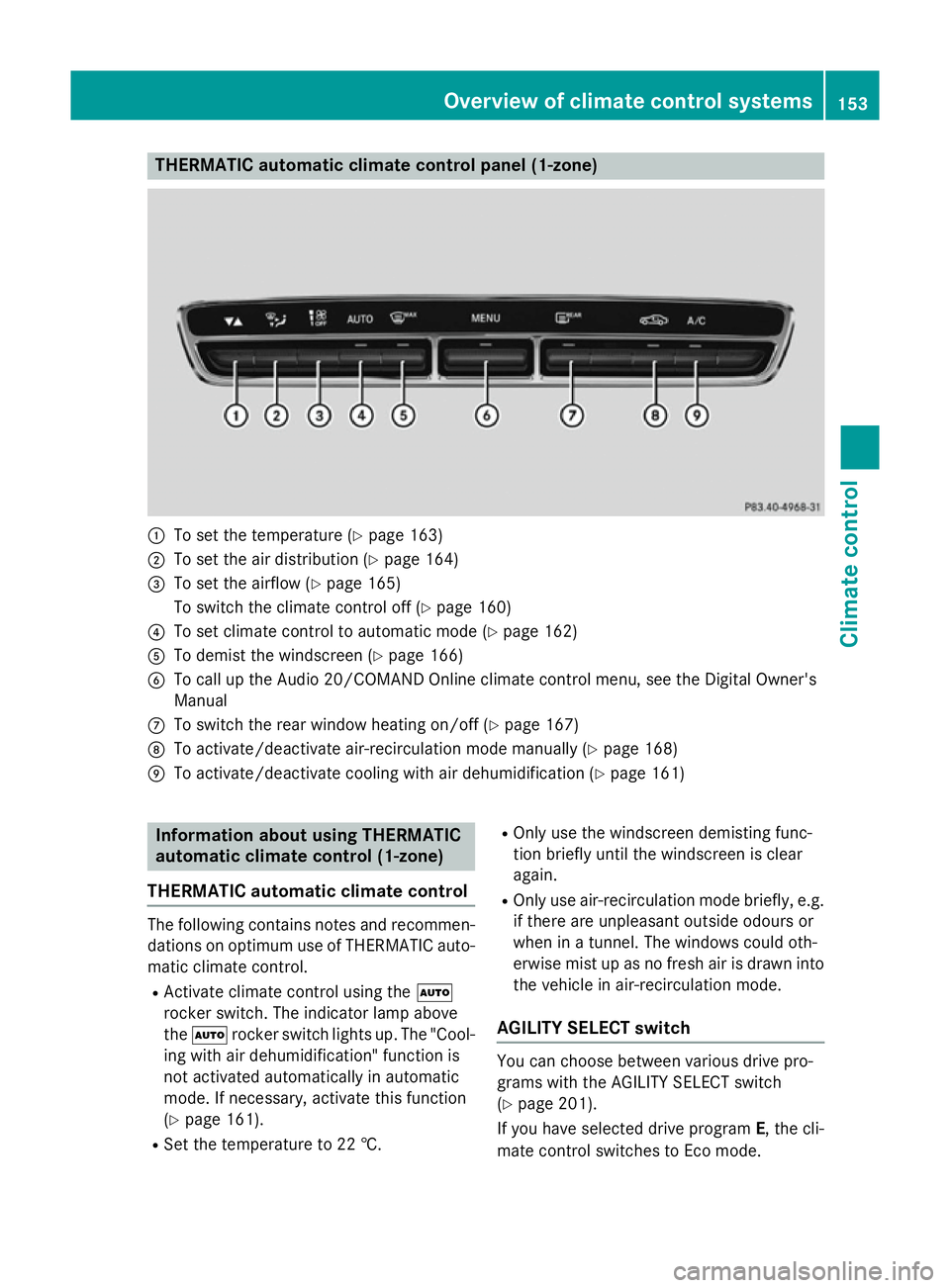
THERMATIC automatic climate control panel (1-zone)
:
To set the temperature (Y page 163)
; To set the air distribution (Y page 164)
= To set the airflow (Y page 165)
To switch the climate control off (Y page 160)
? To set climate control to automatic mode (Y page 162)
A To demist the windscreen (Y page 166)
B To call up the Audio 20/COMAND Online climate control menu, see the Digital Owner's
Manual
C To switch the rear window heating on/off (Y page 167)
D To activate/deactivate air-recirculation mode manually (Y page 168)
E To activate/deactivate cooling with air dehumidification (Y page 161)Information about using THERMATIC
automatic climate control (1 ‑zone)
THERMATIC automatic climate control The following contains notes and recommen-
dations on optimum use of THERMATIC auto-
matic climate control.
R Activate climate control using the Ã
rocker switch. The indicator lamp above
the à rocker switch lights up. The "Cool-
ing with air dehumidification" function is
not activated automatically in automatic
mode. If necessary, activate this function
(Y page 161).
R Set the temperature to 22 †. R
Only use the windscreen demisting func-
tion briefly until the windscreen is clear
again.
R Only use air-recirculation mode briefly, e.g.
if there are unpleasant outside odours or
when in a tunnel. The windows could oth-
erwise mist up as no fresh air is drawn into
the vehicle in air-recirculation mode.
AGILITY SELECT switch You can choose between various drive pro-
grams with the AGILITY SELECT switch
(Y
page 201).
If you have selected drive program E, the cli-
mate control switches to Eco mode. Overvie
w of climate cont rol systems
153Climate control
Page 157 of 489
In Eco mode:
R the cooling output is reduced when cooling
R when heating, the electrical heater booster
is deactivated and heat output is reduced
as a result
R the rear window heating running time is
reduced
If you have selected drive program C,Sor S+
the climate control switches to Comfort
mode. The current climate control settings
are maintained in Comfort mode.
ECO start/stop function During automatic engine switch-off, the cli-
mate control only operates at a reduced capa- city. If you require full climate control output,
you can switch off the ECO start/stop func-
tion by pressing the ECO button
(Y page 191). 154
Overview of climate control systemsClimate control
Page 158 of 489
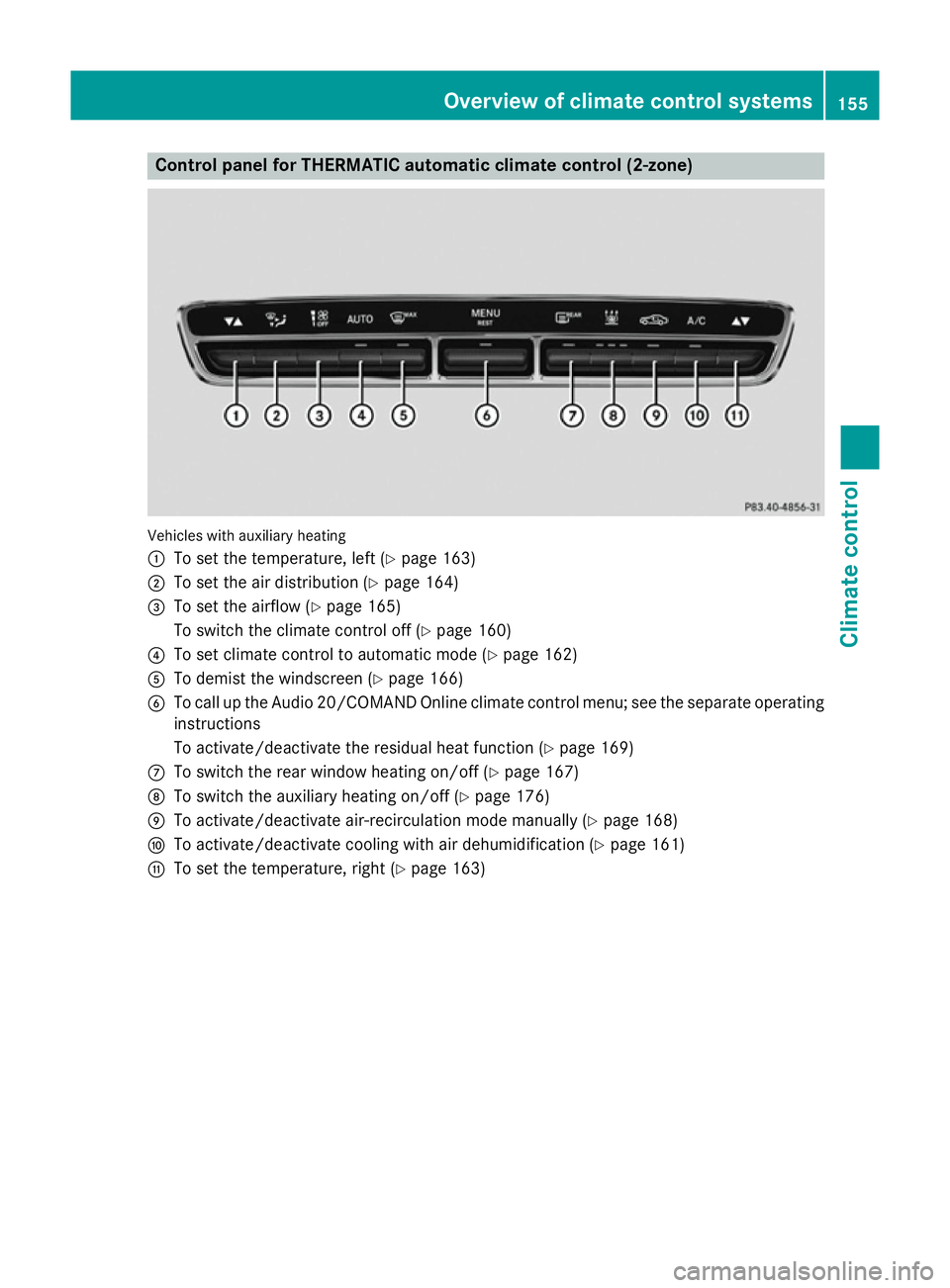
Control panel for THERMATIC automatic climate control (2-zone)
Vehicles with auxiliary heating
:
To set the temperature, left (Y page 163)
; To set the air distribution (Y page 164)
= To set the airflow (Y page 165)
To switch the climate control off (Y page 160)
? To set climate control to automatic mode (Y page 162)
A To demist the windscreen (Y page 166)
B To call up the Audio 20/COMAND Online climate control menu; see the separate operating
instructions
To activate/deactivate the residual heat function (Y page 169)
C To switch the rear window heating on/off (Y page 167)
D To switch the auxiliary heating on/off (Y page 176)
E To activate/deactivate air-recirculation mode manually (Y page 168)
F To activate/deactivate cooling with air dehumidification (Y page 161)
G To set the temperature, right (Y page 163) Overview of climate control systems
155Climate control
Page 159 of 489
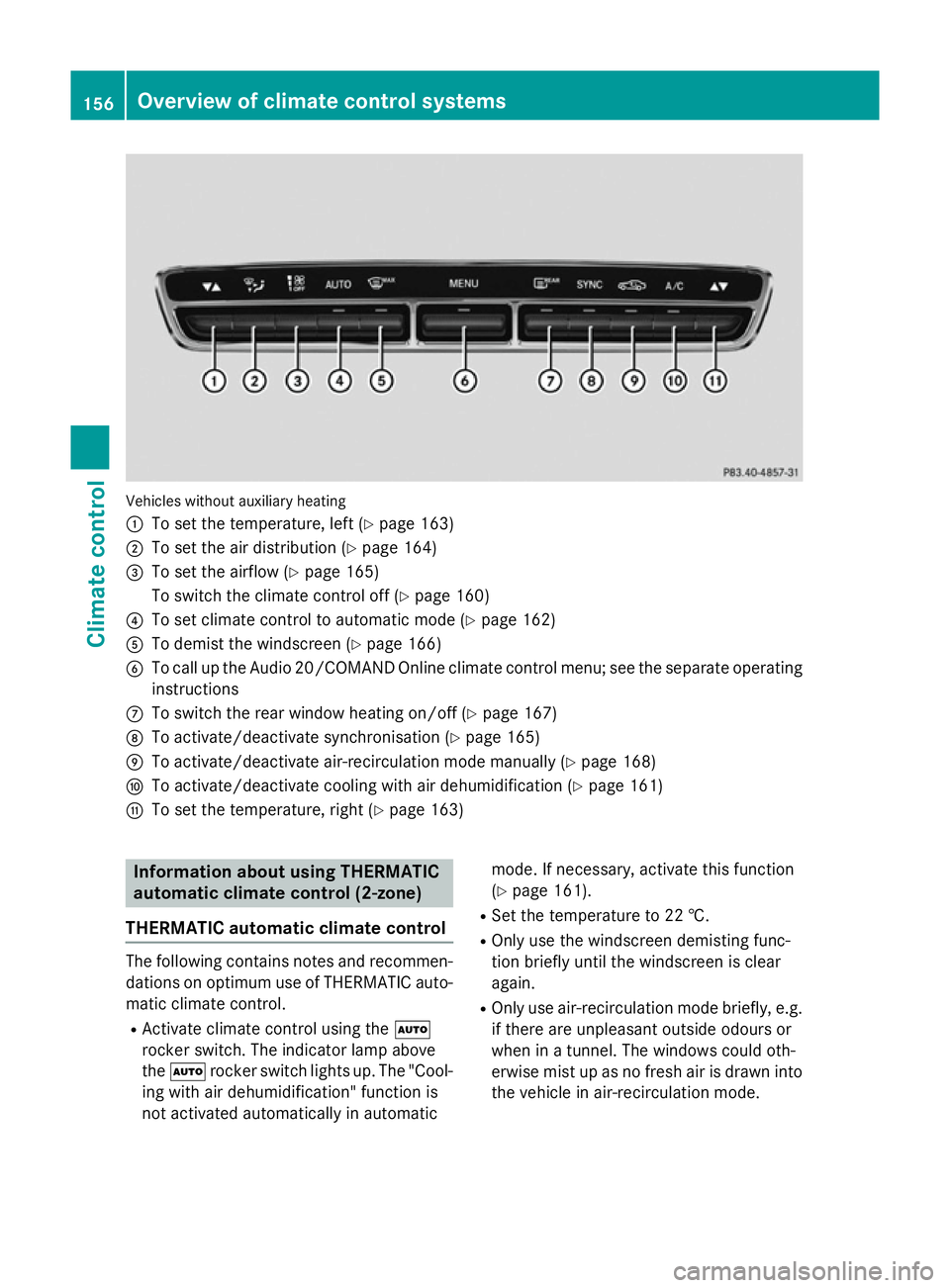
Vehicles without auxiliary heating
:
To set the temperature, left (Y page 163)
; To set the air distribution (Y page 164)
= To set the airflow (Y page 165)
To switch the climate control off (Y page 160)
? To set climate control to automatic mode (Y page 162)
A To demist the windscreen (Y page 166)
B To call up the Audio 20/COMAND Online climate control menu; see the separate operating
instructions
C To switch the rear window heating on/off (Y page 167)
D To activate/deactivate synchronisation (Y page 165)
E To activate/deactivate air-recirculation mode manually (Y page 168)
F To activate/deactivate cooling with air dehumidification (Y page 161)
G To set the temperature, right (Y page 163)Information about using THERMATIC
automatic climate control (2‑zone)
THERMATIC automatic climate control The following contains notes and recommen-
dations on optimum use of THERMATIC auto-
matic climate control.
R Activate climate control using the Ã
rocker switch. The indicator lamp above
the à rocker switch lights up. The "Cool-
ing with air dehumidification" function is
not activated automatically in automatic mode. If necessary, activate this function
(Y page 161).
R Set the temperature to 22 †.
R Only use the windscreen demisting func-
tion briefly until the windscreen is clear
again.
R Only use air-recirculation mode briefly, e.g.
if there are unpleasant outside odours or
when in a tunnel. The windows could oth-
erwise mist up as no fresh air is drawn into
the vehicle in air-recirculation mode. 156
Overview of climate control systemsClimate control
Page 160 of 489
AGILITY SELECT switch
You can choose between various drive pro-
grams with the AGILITY SELECT switch
(Y
page 201).
If you have selected drive program E, the cli-
mate control switches to Eco mode.
In Eco mode:
R the cooling output is reduced when cooling
R when heating, the electrical heater booster
is deactivated and heat output is reduced
as a result
R the rear window heating running time is
reduced
If you have selected drive program C,Sor S+
the climate control switches to Comfort
mode. The current climate control settings
are maintained in Comfort mode.
ECO start/stop function During automatic engine switch-off, the cli-
mate control only operates at a reduced capa-
city. If you require the full climate control out-
put, you can switch off the ECO start/stop
function by pressing the ECO button
(Y page 191).
Hybrid vehicles The "Cooling with air dehumidification" func-
tion is available when the vehicle is opera-
tional and the indicator lamp above the
¿
rocker switch is lit.
If the internal combustion engine has been
shut off automatically, the set interior tem-
perature will be maintained for a certain
period of time. Overview of climate control systems
157Climate control
Page 161 of 489
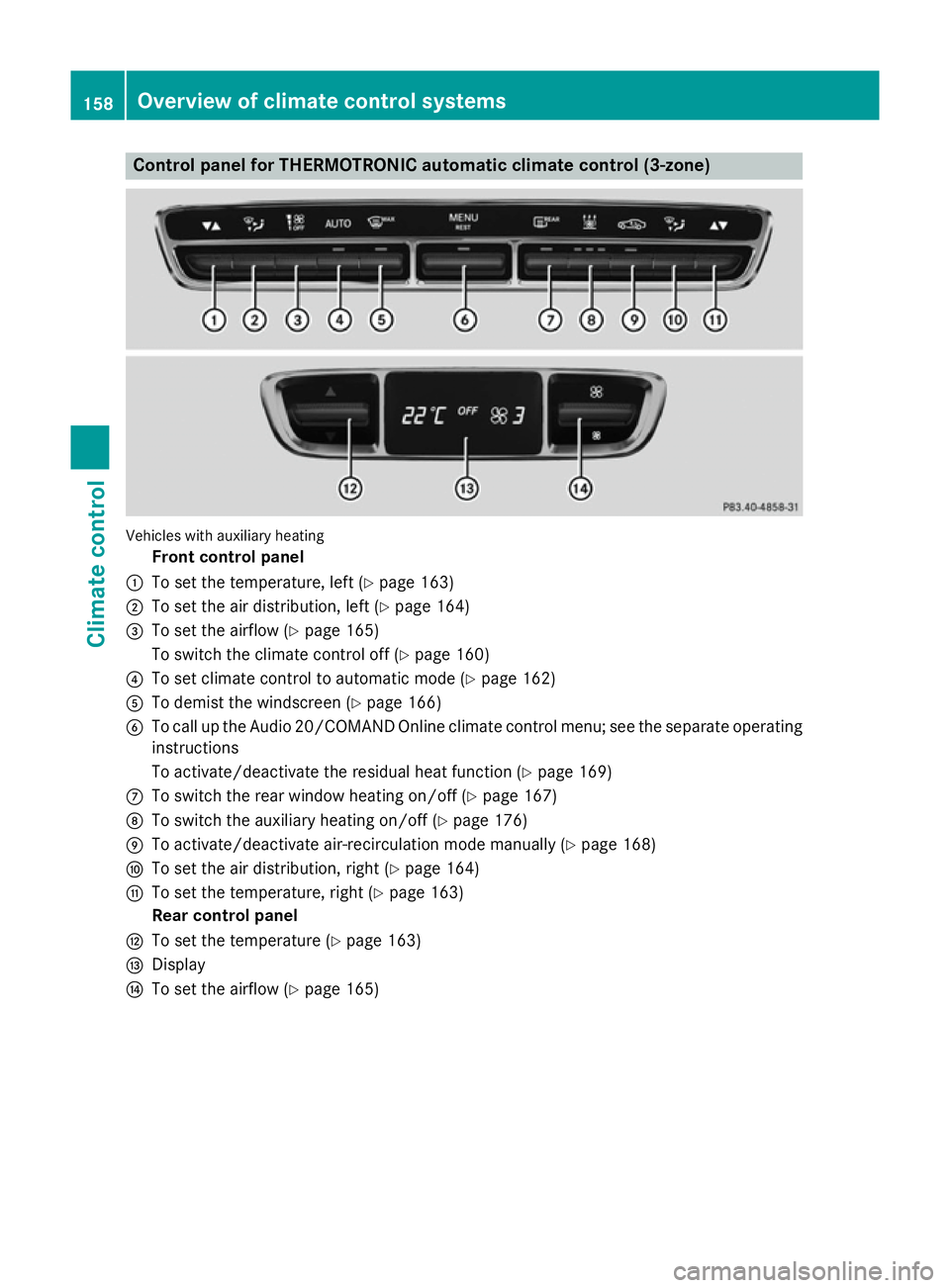
Control panel for THERMOTRONIC automatic climate control (3-zone)
Vehicles with auxiliary heating
Front control panel
: To set the temperature, left (Y page 163)
; To set the air distribution, left (Y page 164)
= To set the airflow (Y page 165)
To switch the climate control off (Y page 160)
? To set climate control to automatic mode (Y page 162)
A To demist the windscreen (Y page 166)
B To call up the Audio 20/COMAND Online climate control menu; see the separate operating
instructions
To activate/deactivate the residual heat function (Y page 169)
C To switch the rear window heating on/off (Y page 167)
D To switch the auxiliary heating on/off (Y page 176)
E To activate/deactivate air-recirculation mode manually (Y page 168)
F To set the air distribution, right (Y page 164)
G To set the temperature, right (Y page 163)
Rear control panel
H To set the temperature (Y page 163)
I Display
J To set the airflow (Y page 165)158
Overview of climate control systemsClimate control