ESP MERCEDES-BENZ C-CLASS SALOON 2007 Service Manual
[x] Cancel search | Manufacturer: MERCEDES-BENZ, Model Year: 2007, Model line: C-CLASS SALOON, Model: MERCEDES-BENZ C-CLASS SALOON 2007Pages: 377, PDF Size: 6.19 MB
Page 191 of 377
Loading and stowing
188 G
Risk of injury
Do not carry heavy or hard objects inside
the vehicle or in the luggage compartment
unless they are secured .
Otherwise, you and other vehicle occu-
pants could be injured by objects being
thrown around the vehicle in the event of
sharp braking, a sudden change in direction
or an accident.
When using the extended luggage compart-
ment always clip in the safety net. G
Risk of poisoning
Always drive with the tailgate closed .
Exhaust fumes could otherwise enter the
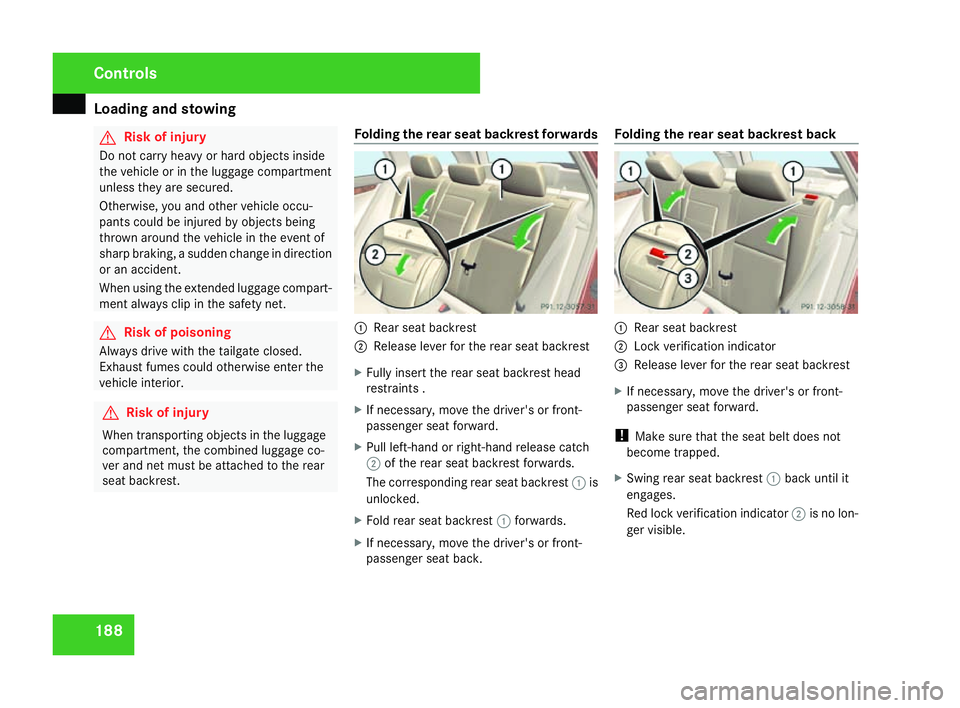
vehicle interior. Folding the rear seat backrest forwards 1
Rear seat backrest
2 Release lever for the rear seat backrest
X Fully insert the rear seat backrest hea d
restraints .
X If necessary, move the driver's or front-
passenger seat forward .
X Pull left-hand or right-hand release catch
2 of the rear seat backrest forwards.
The corresponding rear seat backrest 1is
unlocked.
X Fold rear seat backrest 1forwards.
X If necessary, move the driver's or front-
passenger seat back. Folding the rear seat backrest back
1
Rear seat backrest
2 Lock verification indicator
3 Release lever for the rear seat backrest
X If necessary, move the driver's or front-
passenger seat forward .
! Make sure that the seat belt does not
become trapped.
X Swing rear seat backrest 1back until it
engages.
Red lock verification indicator 2is no lon-
ger visible. Controls
204_AKB; 2; 3, en-GB
mkalafa,
2007-06-26T23:11:51+02:00 - Seite 188G
Risk of injur y When transporting objec
tsinthe luggage
compartment, the combine dluggage co-
ver and net mus tbe attached to the rea r
seat backres t.
Page 195 of 377
Loading and stowing
192
X
If necessary, fold lashing eyelet 5
upwards. G
Risk of injury
Distribute the load on the lashing eyelets
evenly .
Otherwise, vehicle occupants could be
injured by objects being thrown around if
you:
R brake sharply
R change direction suddenly
R have an accident
Please observe the loading guidelines.
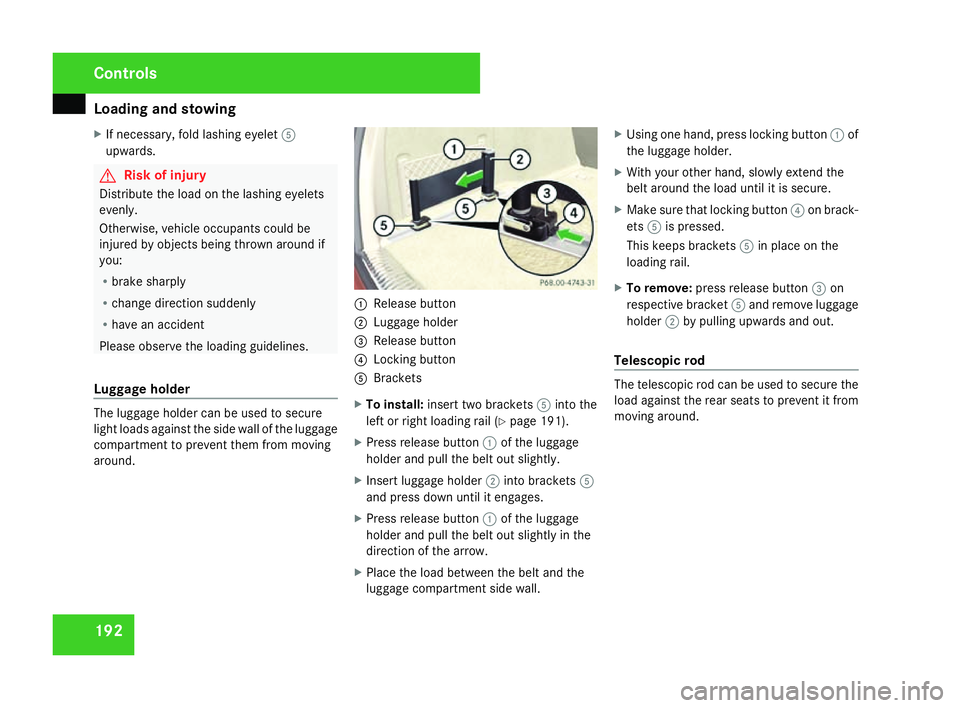
Luggage holder The luggage holder can be used to secure
light loads against the side wall of the luggage
compartment to prevent them from moving
around. 1
Release butto n
2 Luggage holder
3 Release butto n
4 Locking button
5 Brackets
X To install: insert two brackets 5into the
left or right loading rail (Y page 191).
X Press release button 1of the luggage
holder and pull the belt out slightly.
X Insert luggage holder 2into brackets 5
and press down until it engages .
X Press release button 1of the luggage
holder and pull the belt out slightly in the
direction of the arrow.
X Place the load between the belt and the
luggage compartment side wall. X
Using one hand, press locking button 1of
the luggage holder.
X With your other hand, slowly extend the
belt around the load until it is secure.
X Make sure that locking button 4on brack-
ets 5is pressed.
This keeps brackets 5in place on the
loading rail.
X To remove :press release button 3on
respective bracket 5and remove luggage
holder 2by pulling upwards and out.
Telescopic rod The telescopic rod can be used to secure the
load against the rear seats to prevent it from
moving around.Controls
204_AKB; 2; 3, en-GB
mkalafa,
2007-06-26T23:11:51+02:00 - Seite 192
Page 196 of 377
Loading and stowing
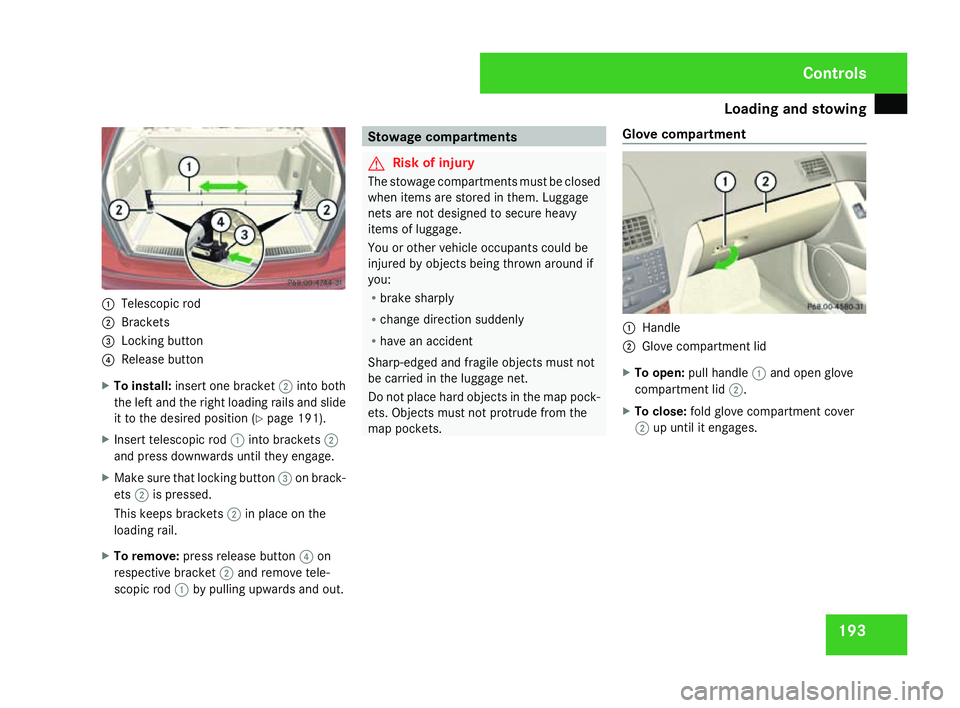
1931
Telescopic rod
2 Brackets
3 Locking button
4 Release butto n
X To install: insert one bracket 2into bot h
the left and the right loading rails and slid e
it to the desired position (Y page 191).
X Insert telescopic rod 1into brackets 2
and press downwards until they engage.
X Make sure that locking button 3on brack-
ets 2is pressed.
This keeps brackets 2in place on the
loading rail.
X To remove :press release button 4on
respective bracket 2and remove tele-
scopic rod 1by pulling upwards and out. Stowage compartment
s G
Risk of injury
The stowage compartments must be closed
when items are stored in them. Luggage
nets are not designed to secure heavy
items of luggage.
You or other vehicle occupants could be
injured by objects being thrown around if
you:
R brake sharply
R change direction suddenly
R have an accident
Sharp-edged and fragile objects must not
be carried in the luggage net.
Do not place hard objects in the map pock-
ets. Objects must not protrude from the
map pockets. Glove compartment 1
Handl e
2 Glove compartment lid
X To open: pull handle 1and open glov e
compartment lid 2.
X To close: fold glove compartment cove r
2 up until it engages . Cont
rols
204_AKB; 2; 3, en-GB
mkalafa,
2007-06-26T23:11:51+02:00 - Seite 193
Page 213 of 377
Tyres and wheels
21
0
X
Replace cap 1and tighten all the way to
the stop.
You will find further information about coolan t
in the "Technical data" section
( Y page 368). Windscreen washer system/head-
lamp cleaning system
*
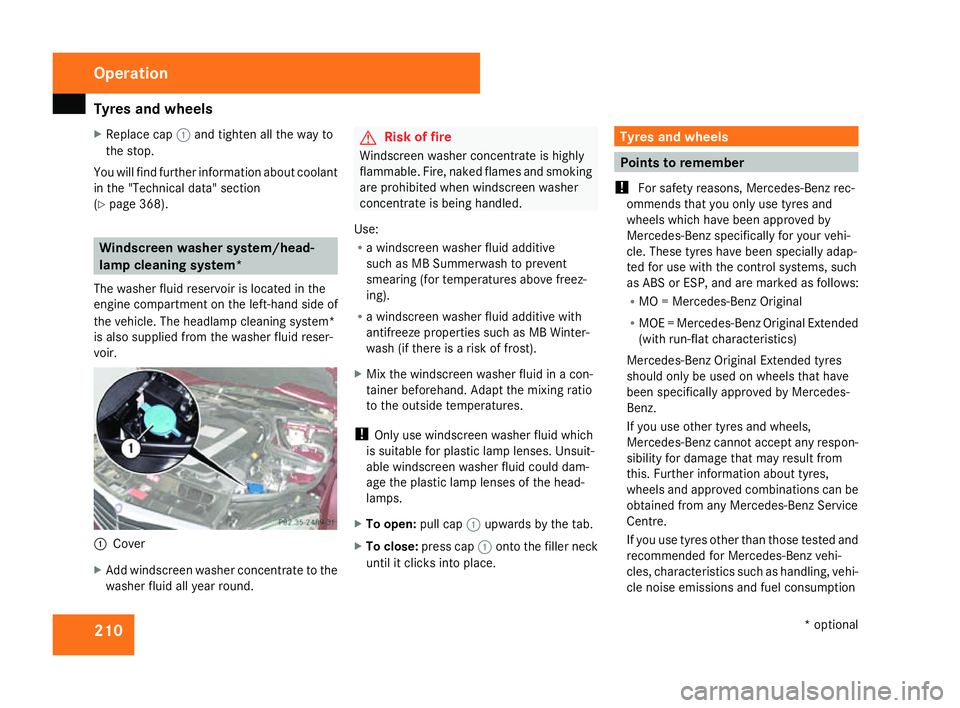
The washer fluid reservoir is located in the
engine compartment on the left-hand side of
the vehicle. The headlamp cleaning system*
is also supplied from the washer fluid reser-
voir. 1
Cove r
X Add windscreen washer concentrate to the
washer fluid all year round. G
Risk of fire
Windscreen washer concentrate is highly
flammable. Fire, naked flames and smoking
are prohibited when windscreen washe r
concentrate is being handled.
Use :
R a windscreen washer fluid additive
such as MB Summerwash to preven t
smearing (for temperatures above freez-
ing).
R a windscreen washer fluid additive wit h
antifreeze properties such as MB Winter-
wash (if there is a risk of frost).
X Mix the windscreen washer fluid in a con-
tainer beforehand. Adapt the mixing ratio
to the outside temperatures.
! Only use windscreen washer fluid which
is suitable for plastic lamp lenses. Unsuit-
able windscreen washer fluid could dam-
age the plastic lamp lenses of the head-
lamps.
X To open: pull cap1upwards by the tab .
X To close: press cap 1onto the filler neck
until it clicks into place. Tyres and wheels
Points to remember
! For safety reasons, Mercedes-Benz rec-
ommends that you only use tyres and
wheels which have been approved by
Mercedes-Benz specifically for your vehi-
cle. These tyres have been specially adap-
ted for use with the control systems, such
as ABS or ESP, and are marked as follows:
R MO = Mercedes-Benz Original
R MOE = Mercedes-Benz Original Extended
(with run-flat characteristics)
Mercedes-Benz Original Extended tyres
should only be used on wheels that have
been specifically approved by Mercedes-
Benz.
If you use other tyres and wheels,
Mercedes-Benz cannot accept any respon-
sibility for damage that may result from
this. Further information about tyres,
wheels and approved combinations can be
obtained from any Mercedes-Benz Service
Centre.
If you use tyres other than those tested and
recommended for Mercedes-Benz vehi-
cles, characteristics such as handling, vehi-
cle noise emissions and fuel consumption Operation
* optional
204_AKB; 2; 3, en-GB
mkalafa
, 2007-06-26T23:11:51+02:00 - Seite 210
Page 217 of 377
Tyres and wheels
21
4 Tyre pressure loss warning system
G
Risk of accident
The tyre pressure loss warning system*
does not warn you of an incorrectly set tyre
pressure. The table on the inside of the fue l
filler flap will help you decide whether the
tyre pressures should be corrected.
The tyre pressure loss warning system*
does not replace the need to regularly
check your vehicle's tyre pressures, since
an even loss of pressure on several tyres at
the same time cannot be detected by the
tyre pressure loss warning system*.
The tyre pressure loss warning system* is
not able to warn you of a sudden loss of
pressure, e.g. following penetration by a
foreign object.
In the event of a sudden loss of pressure,
bring the vehicle to a halt by braking care-
fully. Do not make any sudden steering
movements when doing so.
While the vehicle is in motion, the tyre pres-
sure loss warning system* monitors the set
tyre pressure using the rotational speed of
the wheels. This enables the system to detect
significant pressure loss in a tyre. If the spee d
of rotation of a wheel changes as a result of a loss of pressure, a corresponding warning
message will appear in the multi-function dis-
play.
The function of the tyre pressure loss warning
system* is limited or delayed if:
R
snow chains are fitted to your vehicle's
tyres
R road conditions are wintry
R you are driving on sand or grave l
R you adopt a very sporty driving style (cor -
nering at high speeds or driving with high
rates of acceleration)
R you are towing a very heavy or large trailer
R you are driving with a heavy load (in th e
vehicle or on the roof)
Restarting the tyre pressure loss warn-
ing system* Restart the tyre pressure loss warning sys-
tem* if you have
:
R changed the tyre pressure
R changed the wheels or tyre s
R fitted new wheels or tyres
X Before restarting, consult the table of tyre
pressures on the inside of the fuel filler fla pto ensure that the tyre pressure in all fou
r
tyres is set correctly for the operating con-
ditions concerned .
X Also observe the notes in the section on
tyre pressures (Y page 213). G
Risk of accident
The tyre pressure loss warning system* can
only give reliable warnings if you have set
the correct tyre pressure.
If an incorrect tyre pressure is set, thes e
incorrect values will be monitored.
A tyre with insufficient pressure results in
an instability of the vehicle when driving,
thus increasing the risk of an accident .
Configuring with the multi-function steer-
ing wheel
X Make sure that the key is in position 2in
the ignition lock .
X Press èto select Tyre pressure
menu: R.
X Press the íbutton.
The following appears in the multi-function
display: RFI active Reactivate: ROperation
* optional
204_AKB; 2; 3, en-GB
mkalafa,
2007-06-26T23:11:51+02:00 - Seite 214
Page 219 of 377
Winter driving
216
The wear patterns on the front and rear tyres
differ depending on the operating conditions.
Interchange the wheels before a clear wea
r
pattern has formed on the tyres. The fron t
tyres typically wear more on the shoulders
and the rear tyres in the centre.
Clean the contact surfaces of the wheel and
the brake disc thoroughly every time a whee l
is interchanged. Check the tyre pressure and,
if necessary, restart the tyre pressure loss
warning system*. Winter driving
Have your vehicle winterproofed at a qualified
specialist workshop, e.g. at a Mercedes-Ben z
Service Centre, at the onset of winter. Winter tyres
Use winter tyres at temperatures below +7 °
C and on snow or ice-covered roads. Only
then can the effect of the ABS, ESP ®
and
4MATIC* driving systems be ensured in win-
ter too.
Use winter tyres of the same make and tread
on all wheels to maintain safe handling char-
acteristics. G
Risk of accident
You must replace winter tyres with a trea d
depth of less than 4 mm immediately. They
are no longer suitable for winter use, in par-
ticular because they do not provide suffi-
cient grip. This could cause you to lose
control of your vehicle and cause an acci-
dent .
Always observe the maximum permitted
speed specified for the winter tyres you have
fitted. If you fit winter tyres which have a
lower maximum permitted speed than that of the vehicle, affix an appropriate warning sign
in the driver's field of vision. This can be
obtained at a qualified specialist workshop,
e.g. from a Mercedes-Benz Service Centre.
In such circumstances, you should also use
permanent Speedtronic *15
to restrict the
maximum speed of the vehicle to the maxi-
mum permissible speed for winter tyres
( Y page 148). G
Risk of accident
If you fit the spare wheel* when driving with
winter tyres, bear in mind that driving sta-
bility will be impaired owing to unstable
cornering characteristics caused by the dif-
ferent tyres. You should therefore adap t
your driving style and drive carefully.
Have the spare wheel* replaced at th e
nearest qualified specialist workshop
which has the necessary specialist knowl-
edge and tools to carry out the work
required. Mercedes-Benz recommends
that you use a Mercedes-Benz Service
Centre for this purpose. In particular, work
relevant to safety or on safety-related sys-
tems must be carried out at a qualified
specialist workshop .
15 Only available for certain countries. Operation
* optional
204_AKB; 2; 3, en-GB
mkalafa,
2007-06-26T23:11:51+02:00 - Seite 216
Page 220 of 377
Driving
tips 21
7 Snow chains
For safety reasons, Mercedes-Benz recom-
mends that you only use snow chains which
have been specially approved for your vehicle
by Mercedes-Benz or are of a correspondin g
standard of quality.
! Information about the use of snow chain
compatible AMG winter tyres is applicable
for AMG tyres. Use of snow chains is only
permissible with these tyres.
If you intend to fit snow chains, please bear
the following points in mind:
R Snow chains cannot be fitted on all wheel /
tyre combinations .
R Snow chains cannot be fitted to emergency
spare wheels, e.g. on a "Minispare" emer-
gency spare wheel .
R Always fit snow chains on both the rea r
wheels, even on vehicles with 4MATIC* .
Comply with the manufacturer's installa-
tion instructions.
! If snow chains are fitted to the fron t
wheels, they may come into contact with
the bodywork and axle components when
the vehicle is in motion and damage th e
tyre or the vehicle. Do not exceed the maximum permissibl
e
speed of 50 km/h.
i You may wish to deactivate ES P®
when
pulling away with snow chains fitted
( Y page 68). This way you can allow the
wheels to spin in a controlled manner, ach-
ieving an increased driving force (cutting
action). Winter driving
G
Risk of accident
Do not shift down for additional engine
braking on a slippery road surface. Thi s
could cause the drive wheels to lose thei r
grip and the vehicle could skid.
You should drive particularly carefully on slip-
pery road surfaces. Avoid sudden accelera-
tion, steering and braking manoeuvres.
If the vehicle threatens to skid or cannot be
stopped when moving at low speed:
X Vehicles with manual transmission: engage
neutral.
X Vehicles with automatic transmission*:
shift the selector lever to N.
X Try to bring the vehicle under control using
corrective steering. Driving tips
Rolling with the engine switched off
G
Risk of accident
Never switch the engine off while the vehi-
cle is in motion.
There is no power assistance for the steer-
ing and the service brake when the engine
is not running.
You will require considerably more effort to
steer and brake and you could therefore
lose control of the vehicle and cause an
accident. Brakin
g G
Risk of accident
Do not change down for additional engine
braking on a slippery road surface. Thi s
could cause the drive wheels to lose thei r
grip and the vehicle could skid. G
Risk of accident
Make sure that other road users are not
endangered by your braking. Operatio
n
* optional
204_AKB; 2; 3, en-GB
mkalafa,
2007-06-26T23:11:51+02:00 - Seite 217
Page 221 of 377
Driving
tips 21
8
Downhill gradient
sOn long and steep downhill stretches, espe-
cially if the vehicle is laden or towing a trailer,
you must shift to a lower gear in good time or,
on vehicles with automatic transmission*,
select shift range 1,2 or 3.
i This also applies if you have activated
cruise control* or Speedtronic*.
This uses the braking effect of the engine and
you will not have to brake to such an exten t
to maintain the same speed. This relieves the
load on the brake system and prevents the
brakes from overheating and wearing too
quickly. If you need additional braking ,
depress the brake pedal repeatedly rather
than continuously.
Heavy and light loads If the brakes have been subjected to a heavy
load, do not stop the vehicle immediately, but
drive on for a short while. This allows the air-
flow to cool the brakes more quickly. G
Risk of accident
Never depress the brake pedal continu -
ously while the vehicle is in motion, e.g.
never cause the brakes to rub by applying constant slight pedal pressure. This causes
the brake system to overheat, increases
the braking distance and can lead to the
brakes failing completely.
If the brakes have been used only moderately,
you should occasionally test their effective-
ness. To do this, brake more firmly from a
higher speed. This improves the grip of the
brakes.
Wet roads If you drive for a long time in the rain without
braking, there may be a delayed reaction
when you first brake and you will have to
depress the pedal harder.
You must therefore maintain a greater dis-
tance from the vehicle in front.
Brake firmly after driving on a wet road. Thi
s
way the brake discs will become warm, dryin g
more quickly, which will protect them against
corrosion. Limited braking performance on salted
roads G
Risk of accident
The layer of salt on the brake discs and the
brake linings may cause a delay in the brak-
ing effect, resulting in a significantly longer
braking distance, which could lead to an
accident.
To avoid this danger, you should:
R occasionally brake carefully when you
are driving on salted roads, so that any
layer of salt that may have started to
build up on the brake discs and the brake
linings is removed without putting other
road users at risk.
R maintain a greater distance to the vehicl e
ahead and drive with particular car e
R carefully apply the brakes at the end of a
trip and immediately after commencing a
new trip, so that salt residues ar e
removed from the brake disc.
New brake linings For safety reasons, Mercedes-Benz recom
-
mends that you have only brake pads/linings
fitted to your vehicle that have been approved Operation
* optional
204_AKB; 2; 3, en-GB
mkalafa,
2007-06-26T23:11:51+02:00 - Seite 218
Page 228 of 377
Trailer towing*
22
5 Trailer power suppl
y
When delivered from the factory, your vehi-
cle's trailer socket outlet is equipped with a
permanent power supply and a power supply
that is switched on via the ignition lock .
The permanent power supply is supplied via
trailer socket pin 9.
The power supply that is switched on via the
ignition lock is supplied via trailer socket pin
10.
! You can connect consumers with a power
rating of up to 240 W to the permanen t
power supply and up to 180 W to the power
supply that is switched on via the ignition
lock .
You must not charge a trailer battery using
the power supply.
You can obtain further information about
installing the trailer electrics from a qualified
specialist workshop, e.g. a Mercedes-Ben z
Service Centre.
X To switch the switched power supply on
or off: turn the key in the ignition lock to
position 2or 0, respectively. Trailer with 7-pin connector
If your trailer has a 7-pin connector, you can
connect it to the 13-pin socket on the ball
coupling using an adapter or, if necessary, an
adapter cable. Both of these can be obtained
at a qualified specialist workshop, e.g. at a
Mercedes-Benz Service Centre.
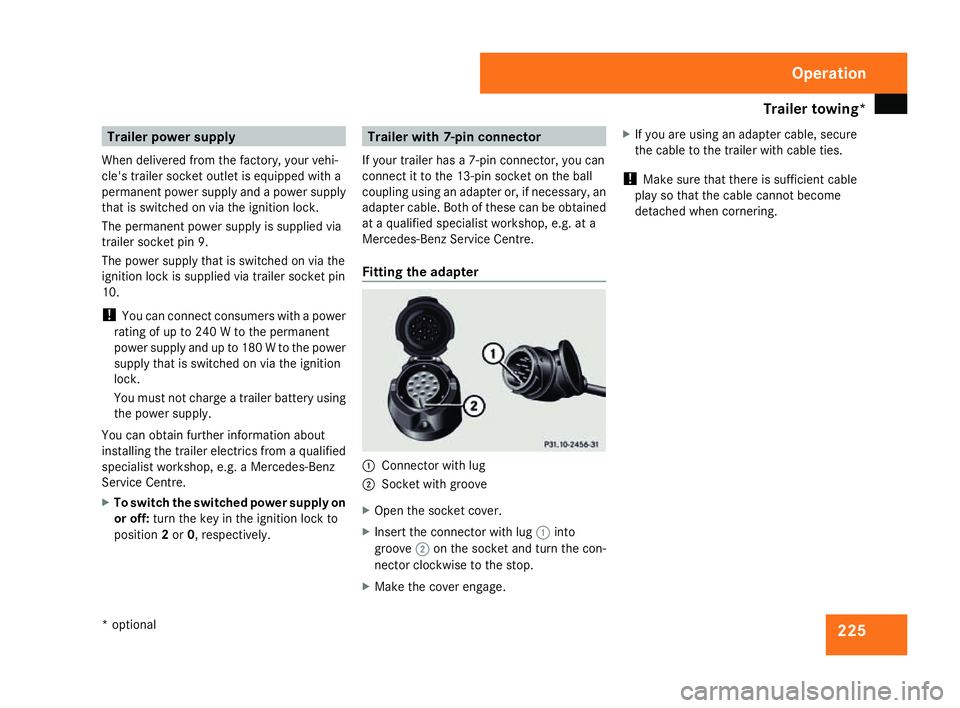
Fitting the adapter 1
Connector with lug
2 Socket with groove
X Open the socket cover.
X Insert the connector with lug 1into
groove 2on the socket and turn the con-
nector clockwise to the stop.
X Make the cover engage. X
If you are using an adapter cable, secure
the cable to the trailer with cable ties.
! Make sure that there is sufficient cable
play so that the cable cannot become
detached when cornering. Operation
* optional
204_AKB; 2; 3, en-GB
mkalafa
, 2007-06-26T23:11:51+02:00 - Seite 225
Page 230 of 377
Car
e 227Care
Notes on care
Regular and proper care maintains the value
of your vehicle.
i It is advisable to use Mercedes-Benz care
products.
Scratches, corrosive deposits, areas affected
by corrosion and damage caused by inade-
quate care cannot always be completely
repaired. In such cases, visit a qualified spe-
cialist workshop immediately, e.g. a
Mercedes-Benz Service Centre.
Repair damage caused by loose chippings
and remove the following substances imme-
diately, whilst avoiding rubbing too hard:
R Soak insect remains with insect remover
and rinse off afterwards .
R Soak bird droppings with water and rins e
off afterwards.
R Remove tree resin, oils, fuels and grease by
rubbing gently with a cloth soaked in clean-
ing or lighter fluid .
R Use silicone remover to remove wax.
R Use tar remover to remove tar stains. H
Environmental not
e
Dispose of empty packaging, cleaning
cloths and polishing wads in an environ-
mentally-responsible manner.
! Do not affix :
R stickers
R films
R magnetic plates or similar
to painted surfaces, otherwise you could
damage the paintwork. Vehicle care
! Do not park the vehicle for a long perio d
of time directly after cleaning, especially if
the wheels have just been cleaned with a
wheel cleaner. Wheel cleaners could cause
rapid corrosion of the brake discs and
brake pads/linings. After cleaning, park
the vehicle when it is at normal operatin g
temperature.
Automatic car wash You can wash the vehicle in an automatic car
wash from the very start,!
Do not use high pressure car wash sys-
tems. The strong water jet could damage
painted parts or attachments.
! Do not use a brush-free automatic car
wash that uses chemical agents to wash
the vehicle.
but preferably one without brushes.
If the vehicle is very dirty, prewash it befor e
cleaning it in an automatic car wash.
! Make sure that the automatic car wash is
suitable for the size of the vehicle. Fold in
the exterior mirrors before the vehicle is
washed. There is otherwise a risk of dam-
age to the exterior mirrors.
! Make sure the side windows are com-
pletely closed, the ventilation/heater
blower is fully turned off and the wind-
screen wiper switch is set to 0. The rai n
sensor may otherwise be activated, for
instance, leading to inadvertent wiper
sweeps being triggered. This could cause
damage to the vehicle.
After using an automatic car wash, wipe off
wax from the windscreen and the wiper
blades. This will prevent smears and reduce
wiping noises caused by residue on the wind-
screen. Operation
204_AKB; 2; 3, en-GB
mkalafa,
2007-06-26T23:11:51+02:00 - Seite 227