ESP MERCEDES-BENZ C-CLASS SALOON 2007 Repair Manual
[x] Cancel search | Manufacturer: MERCEDES-BENZ, Model Year: 2007, Model line: C-CLASS SALOON, Model: MERCEDES-BENZ C-CLASS SALOON 2007Pages: 377, PDF Size: 6.19 MB
Page 254 of 377

Display
messages 25
1 Display messages Possible cause/consequence Possible solution
3 EBV, ABS, ESP inop-
erative See Own-
er's Manual
G
Risk of accident
EBV, ABS, ESP ®
, BAS, PRE–SAFE ®
*, hill
start assist and ESP ®
trailer stabilisatio n
are unavailable due to a malfunction. In
addition, the vwarning lamp in th e
instrument cluster lights up and a warnin g
tone sounds.
The brake system continues to functio n
normally, but without the functions listed
above . X
Drive on carefully.
X Visit a qualified specialist workshop immedi-
ately. ñ Clean the fuel fil-
ter X
Visit a qualified specialist workshop. D 4-button multi-function
steering wheel:
Stop vehicl
e
Engine off
12-button luxury multi-
function steering
wheel:
Coolant Stop vehi-
cle Switch engine
off The coolant is too hot. In addition, the
D
warning lamp in the instrument clus-
ter lights up and a warning tone sounds. X
Stop the vehicle. Pay attention to the traffic
conditions as you do so.
X Switch off the engine.
X Wait until the display message disappears
before restarting the engine. There is other-
wise a risk of engine damage.
X Observe the coolant temperature gauge.
X If the temperature increases again, visit a quali-
fied specialist workshop immediately. Practical advice
* optional
204_AKB; 2; 3, en-GB
mkalafa,
2007-06-26T23:11:51+02:00 - Seite 251 Z
Page 282 of 377
Troubleshooting
27
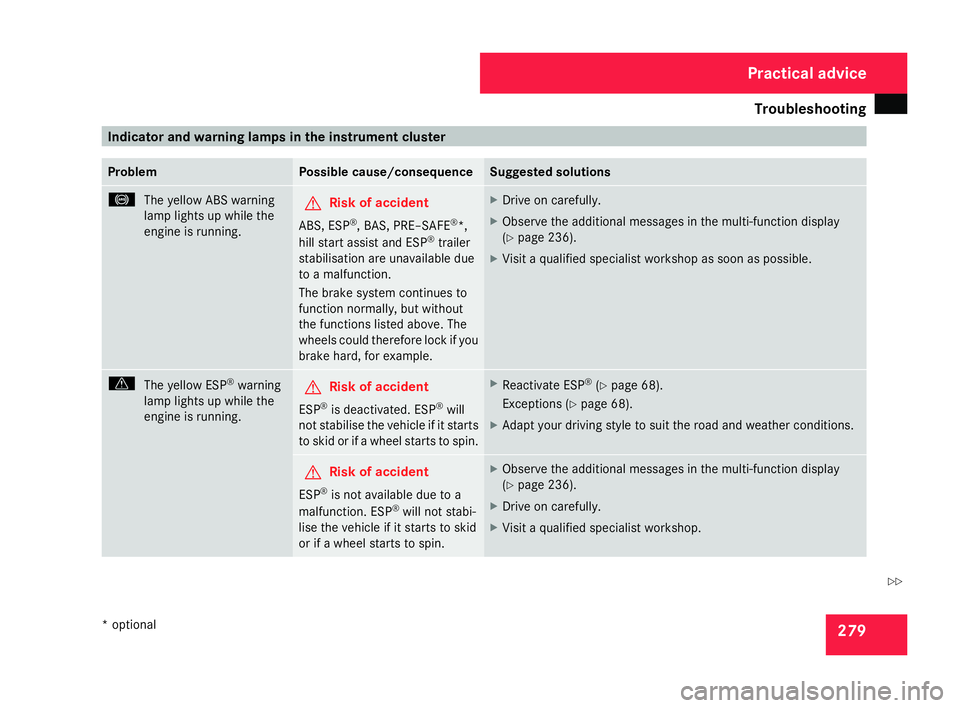
9 Indicator and warning lamps in the instrument cluster
Problem Possible cause/consequence Suggested solutions
-
The yellow ABS warning
lamp lights up while the
engine is running. G
Risk of accident
ABS, ESP ®
, BAS, PRE–SAFE ®
*,
hill start assist and ESP ®
trailer
stabilisation are unavailable du e
to a malfunction.
The brake system continues to
function normally, but without
the functions listed above. Th e
wheels could therefore lock if you
brake hard, for example. X
Drive on carefully.
X Observe the additional messages in the multi-function display
(Y page 236).
X Visit a qualified specialist workshop as soon as possible. v
The yellow ESP ®
warning
lamp lights up while th e
engine is running. G
Risk of accident
ESP ®
is deactivated. ES P®
will
not stabilise the vehicle if it start s
to skid or if a wheel starts to spin. X
Reactivate ES P®
(Y page 68).
Exceptions (Y page 68).
X Adapt your driving style to suit the road and weather conditions. G
Risk of accident
ESP ®
is not available due to a
malfunction. ESP ®
will not stabi-
lise the vehicle if it starts to skid
or if a wheel starts to spin . X
Observe the additional messages in the multi-function display
(Y page 236).
X Drive on carefully.
X Visit a qualified specialist workshop. Practical advice
* optional
204_AKB; 2; 3, en-GB
mkalafa,
2007-06-26T23:11:51+02:00 - Seite 279 Z
Page 283 of 377
Troubleshooting
28
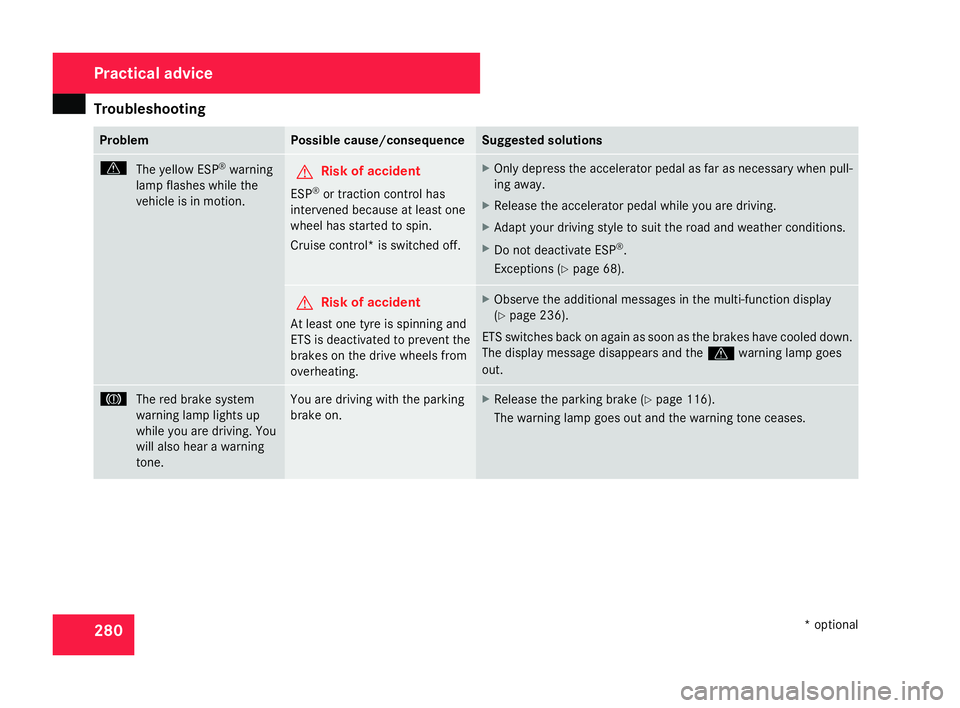
0 Problem Possible cause/consequence Suggested solutions
v
The yellow ESP ®
warning
lamp flashes while th e
vehicle is in motion. G
Risk of accident
ESP ®
or traction control has
intervened because at least one
wheel has started to spin.
Cruise control* is switched off. X
Only depress the accelerator pedal as far as necessary when pull-
ing away.
X Release the accelerator pedal while you are driving.
X Adapt your driving style to suit the road and weather conditions.
X Do not deactivate ESP ®
.
Exceptions (Y page 68). G
Risk of accident
At least one tyre is spinning and
ETS is deactivated to prevent the
brakes on the drive wheels from
overheating. X
Observe the additional messages in the multi-function display
(Y page 236).
ETS switches back on again as soon as the brakes have cooled down.
The display message disappears and the vwarning lamp goes
out. 3
The red brake system
warning lamp lights up
while you are driving. You
will also hear a warning
tone. You are driving with the parking
brake on. X
Release the parking brake (Y page 116).
The warning lamp goes out and the warning tone ceases. Practical advice
* optional
204_AKB; 2; 3, en-GB
mkalafa,
2007-06-26T23:11:51+02:00 - Seite 280
Page 293 of 377
Troubleshooting
29
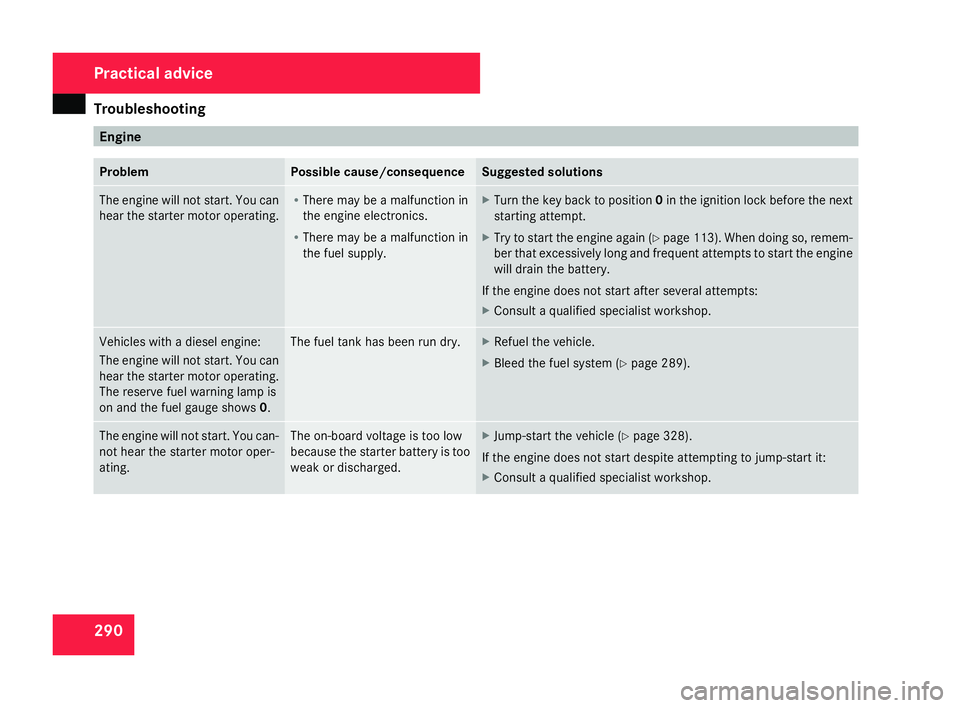
0 Engine
Problem Possible cause/consequence Suggested solutions
The engine will not start. You can
hear the starter motor operating. R
There may be a malfunction in
the engine electronics.
R There may be a malfunction in
the fuel supply. X
Turn the key back to position 0in the ignition lock before the nex t
starting attempt.
X Try to start the engine again (Y page 113). When doing so, remem-
ber that excessively long and frequent attempts to start the engin e
will drain the battery.
If the engine does not start after several attempts:
X Consult a qualified specialist workshop. Vehicles with a diesel engine:
The engine will not start. You can
hear the starter motor operating
.
The reserve fuel warning lamp is
on and the fuel gauge shows 0. The fuel tank has been run dry. X
Refuel the vehicle.
X Bleed the fuel system (Y page 289). The engine will not start. You can-
not hear the starter motor oper-
ating. The on-board voltage is too low
because the starter battery is too
weak or discharged. X
Jump-start the vehicle (Y page 328).
If the engine does not start despite attempting to jump-start it:
X Consult a qualified specialist workshop. Practical advice
204_AKB; 2; 3, en-GB
mkalafa,
2007-06-26T23:11:51+02:00 - Seite 29
0
Page 314 of 377
Changing the bulbs
311
X
Rear foglamp/turn signal/parkin g
lamp/brake lamp/tail lamp/reversing
lamp: press the respective lamp back -
wards and turn it out of the bulb holder in
an anti-clockwise direction.
X Side marker lamp: pull bulb2out of the
bulb holder.
X Rear foglamp/turn signal/parkin g
lamp/brake lamp/tail lamp/reversing
lamp: insert the new bulb in the bulb holder
and turn in a clockwise direction .
X Side marker lamp: insert the new bulb in
the bulb holder and press in.
X Vehicles with LED turn signals: connect
the cables of the LED turn signal to the
connectors of the bulb holder.
X Reinsert the bulb holder and lock in posi-
tion .
X Close the side trim panel.
Estat e
X Switch off the lights .
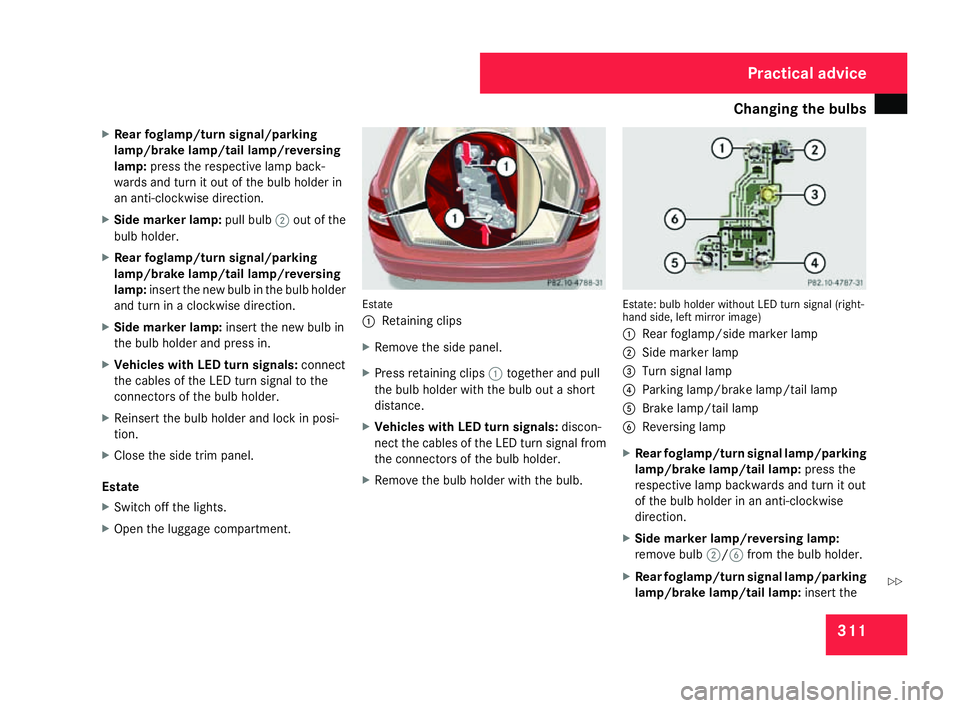
X Open the luggage compartment. Estate
1
Retaining clips
X Remove the side panel.
X Press retaining clips 1together and pull
the bulb holder with the bulb out a short
distance.
X Vehicles with LED turn signals: discon-
nect the cables of the LED turn signal from
the connectors of the bulb holder.
X Remove the bulb holder with the bulb. Estate: bulb holder without LED turn signal (right
-
hand side, left mirror image)
1 Rear foglamp/side marker lamp
2 Side marker lamp
3 Turn signal lamp
4 Parking lamp/brake lamp/tail lamp
5 Brake lamp/tail lamp
6 Reversing lamp
X Rear foglamp/turn signal lamp/parkin g
lamp/brake lamp/tail lamp: press the
respective lamp backwards and turn it out
of the bulb holder in an anti-clockwise
direction .
X Side marker lamp/reversing lamp:
remove bulb 2/6 from the bulb holder.
X Rear foglamp/turn signal lamp/parkin g
lamp/brake lamp/tail lamp: insert the Practical advice
204_AKB; 2; 3, en-GB
mkalafa,
2007-06-26T23:11:51+02:00 - Seite 311 Z
Page 322 of 377
Flat tyre
319specialist workshop which has the neces-
sary specialist knowledge and tools to carry
out the work required. Mercedes-Benz rec -
ommends that you use a Mercedes-Benz
Service Centre for this purpose. In particu-
lar, work relevant to safety or on safety-
related systems must be carried out at a
qualified specialist workshop. 9
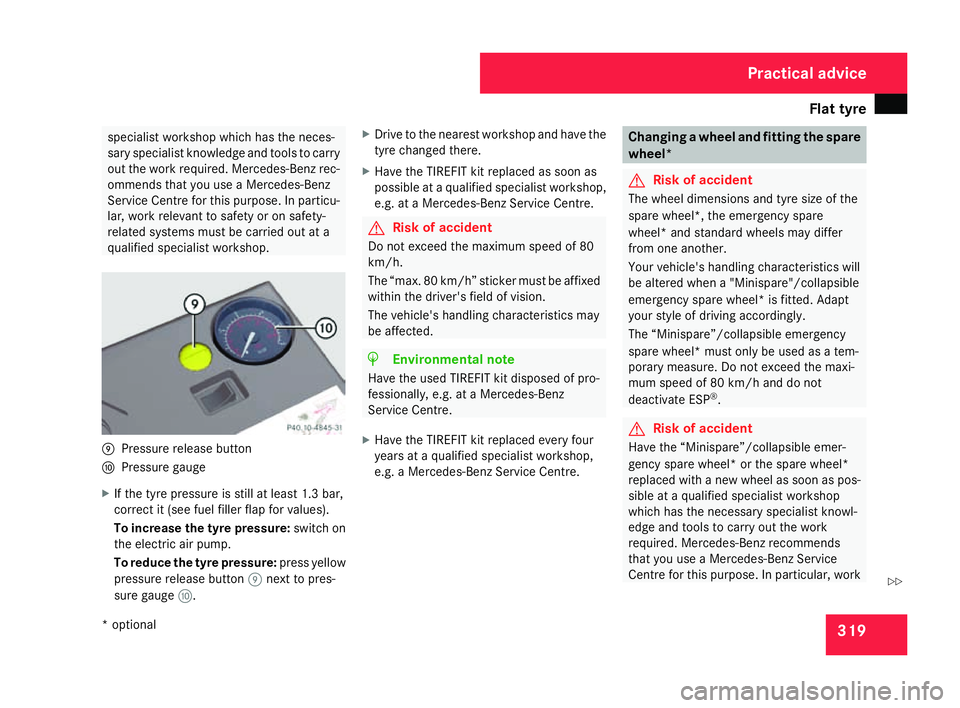
Pressure release button
a Pressure gauge
X If the tyre pressure is still at least 1.3 bar,
correct it (see fuel filler flap for values).
To increase the tyre pressure: switch on
the electric air pump.
To reduce the tyre pressure :press yellow
pressure release button 9next to pres-
sure gauge a. X
Drive to the nearest workshop and have the
tyre changed there.
X Have the TIREFIT kit replaced as soon as
possible at a qualified specialist workshop ,
e.g. at a Mercedes-Benz Service Centre. G
Risk of accident
Do not exceed the maximum speed of 80
km/h.
The “max. 80 km/h” sticker must be affixe d
within the driver's field of vision.
The vehicle's handling characteristics may
be affected. H
Environmental not
e
Have the used TIREFIT kit disposed of pro-
fessionally, e.g. at a Mercedes-Benz
Service Centre.
X Have the TIREFIT kit replaced every fou r
years at a qualified specialist workshop ,
e.g. a Mercedes-Benz Service Centre. Changing a wheel and fitting the spar
e
wheel * G
Risk of accident
The wheel dimensions and tyre size of the
spare wheel*, the emergency spare
wheel* and standard wheels may differ
from one another.
Your vehicle's handling characteristics will
be altered when a "Minispare"/collapsibl e
emergency spare wheel* is fitted. Adapt
your style of driving accordingly.
The “Minispare”/collapsible emergency
spare wheel* must only be used as a tem-
porary measure. Do not exceed the maxi-
mum speed of 80 km/h and do not
deactivate ESP ®
. G
Risk of accident
Have the “Minispare”/collapsible emer-
gency spare wheel* or the spare wheel *
replaced with a new wheel as soon as pos-
sible at a qualified specialist workshop
which has the necessary specialist knowl-
edge and tools to carry out the work
required. Mercedes-Benz recommends
that you use a Mercedes-Benz Service
Centre for this purpose. In particular, work Practical advice
* optiona l
204_AKB; 2; 3, en-GB
mkalafa,
2007-06-26T23:11:51+02:00 - Seite 319 Z
Page 324 of 377
Flat tyre
321
X
Using the wheel wrench, loosen the wheel
bolts on the wheel you wish to change by
about one full turn. Do not unscrew the
bolts completely. G
Risk of accident
If you fail to position the jack correctly, the
vehicle may :
R slip off the jack
R injure you or others
R be damaged
It is thus important to ensure that the jack
is positioned correctly in the respective
jacking points. Before positioning the jack ,
remove any dirt that may have collected in
the jacking points.
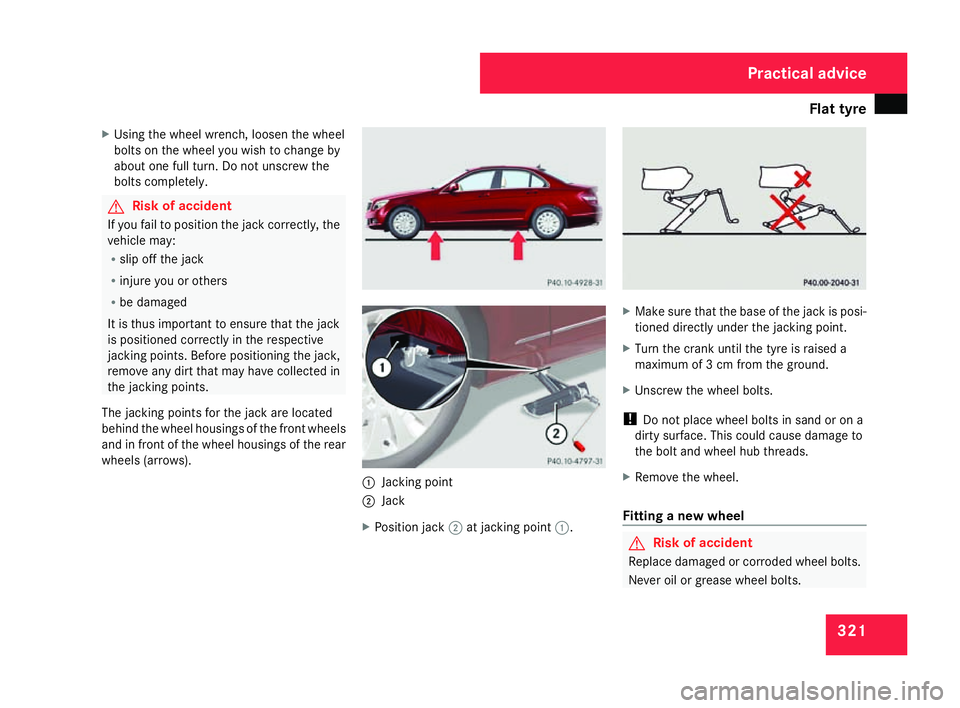
The jacking points for the jack are located
behind the wheel housings of the front wheels
and in front of the wheel housings of the rear
wheels (arrows). 1
Jacking poin t
2 Jack
X Position jack 2at jacking point 1. X
Make sure that the base of the jack is posi-
tioned directly under the jacking point.
X Turn the crank until the tyre is raised a
maximum of 3 cm from the ground .
X Unscrew the wheel bolts.
! Do not place wheel bolts in sand or on a
dirty surface. This could cause damage to
the bolt and wheel hub threads.
X Remove the wheel.
Fitting a new wheel G
Risk of accident
Replace damaged or corroded wheel bolts.
Never oil or grease wheel bolts. Practical advice
204_AKB; 2; 3, en-G
B
mkalafa , 2007-06-26T23:11:51+02:00 - Seite 321
Page 326 of 377
Flat tyre
323
X
Turn the jack back to its initial position and
store it and the rest of the vehicle tool kit
in the boot/luggage compartment.
Vehicles with the "Minispare" emergency
spare wheel*:
X Transport the faulty wheel in the boot/lug-
gage compartment.
or
X Depending on the size of the wheel, yo u
may also be able to secure the faulty whee l
in the spare wheel well. In this case, you
will have to remove the stowage well casin g
from the spare wheel well and stow it
securely in the boot/luggage compart-
ment. MOExtended run-flat system*
The MOExtended run-flat system* must only
be used in conjunction with the tyre pressure
loss warning system*.
! The maximum permissible distance which
can be driven in run-flat mode depends on
the load in the vehicle. It is 50 km if the
vehicle is partially laden and 30 km if fully
laden. The maximum permissible distance which
can be driven in run-flat mode is counted
from the moment the tyre pressure loss
warning appears in the multi-function dis-
play.
You must not exceed a maximum speed of
80 km/h.
i Vehicles featuring the MOExtended run-
flat system* are not equipped with the
TIREFIT kit*.
It is therefore recommended to additionally
equip your vehicle with the TIREFIT kit*
when fitting tyres that do not feature run-
flat properties, e.g. winter tyres.
i A TIREFIT kit* is available from any quali-
fied specialist workshop, e.g. a Mercedes-
Benz Service Centre. G
Risk of accident
The handling characteristics of your vehicl e
deteriorate in run-flat mode, for example:
R when cornering
R when braking
R when accelerating rapidly
Adapt your driving style accordingly and
avoid sudden changes in direction and sud- den acceleration, as well as driving over
obstacles (i.e. kerbs, potholes), and driving
off-road. This is particularly the case when
the vehicle is heavily laden .
The maximum permissible distance that
can be driven in run-flat mode depends to
a large extent on the loads placed on the
vehicle. It can be shorter due to high
speeds, a heavy load, sudden acceleration
and/or manoeuvring, the road surface con-
dition, outside temperature, etc., or further
if you drive carefully and conservatively.
Do not continue to drive in run-flat mode if:
R you hear banging noises
R the vehicle starts to shake
R you see smoke and smell rubber
R ESP ®
is intervening constantly
R there are tears in the sidewalls of the tyr e
After driving in run-flat mode, you must
have the rims checked for damage at a
qualified specialist workshop which has the
necessary specialist knowledge and tools
to carry out the work required. The faulty
tyre must be replaced in every case.
Mercedes-Benz recommends that you use
a Mercedes-Benz Service Centre for this Practical advice
* optional
204_AKB; 2; 3, en-GB
mkalafa,
2007-06-26T23:11:51+02:00 - Seite 323 Z
Page 327 of 377
Battery
32
4 purpose. In particular, work relevant to
safety or on safety-related systems must be
carried out at a qualified specialist work-
shop.
i On a vehicle with MOExtended tyres*,
only MOExtended spare tyres* should be
used. These must be of the size specified
for the vehicle Battery
Notes on the battery
In order for the battery to achieve the maxi-
mum possible service life, it must always be
sufficiently charged .
Have the battery charge checked more fre-
quently if you use the vehicle mainly for shor t
trips or if you leave it standing idle for a
lengthy period.
To prevent damage from corrosion, only
replace the battery with one that has a central
ventilation cover.
Consult a Mercedes-Benz Service Centre if
you wish to leave your vehicle parked up for
a long period of time. G
Risk of injury
Comply with safety precautions and take
protective measures when handling batter-
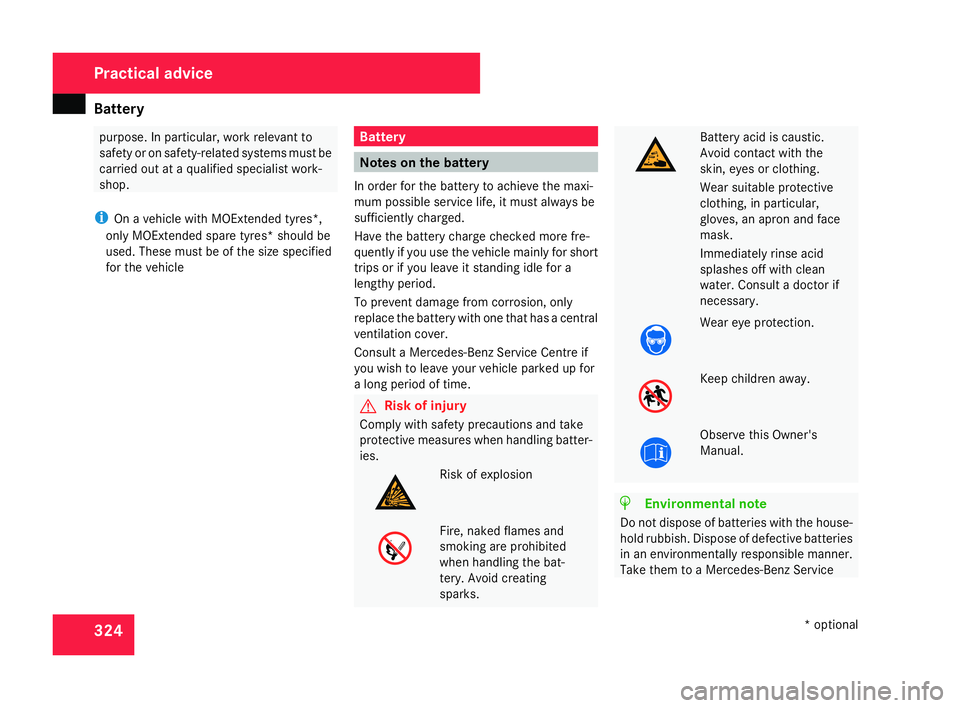
ies. Risk of explosion
Fire, naked flames and
smoking are prohibited
when handling the bat-
tery. Avoid creating
sparks. Battery acid is caustic.
Avoid contact with the
skin, eyes or clothing
.
Wear suitable protective
clothing, in particular,
gloves, an apron and face
mask.
Immediately rinse acid
splashes off with clean
water. Consult a doctor if
necessary. Wear eye protection
. Keep children away.
Observe this Owner's
Manual.
H
Environmental not
e
Do not dispose of batteries with the house-
hold rubbish. Dispose of defective batteries
in an environmentally responsible manner.
Take them to a Mercedes-Benz Service Practical advice
* optional
204_AKB; 2; 3, en-G
B
mkalafa , 2007-06-26T23:11:51+02:00 - Seite 324
Page 333 of 377
Towing and tow-startin
g330
R
Vehicles with an automatic transmission*
must not be tow-started.
R If the engine does not start, try jump-start-
ing it (Y page 328).
R If it is not possible to jump-start the vehicle ,
have it towed to the nearest qualified spe-
cialist workshop, e.g. a Mercedes-Ben z
Service Centre.
R If the vehicle has suffered transmission
damage, only tow it with the propeller shaft
disconnected.
R The selector lever must be in position Non
vehicles with automatic transmission*.
R If you are towing the vehicle over a consid-
erable distance, this may only be done with
the rear axle raised.
R The ignition must be switched off if you are
towing the vehicle with the front/rear axle
raised. Intervention by ESP ®
could other-
wise damage the brake system.
R Vehicles with 4MATIC* may not be towed
with the front or rear axle raised.
R Before towing the vehicle, make sure that
the battery is connected and charged. Oth-
erwise : -
You cannot switch on the ignition
- You cannot move the selector lever
to N(on vehicles with automatic trans-
mission*)
- You have no support when braking
i Switch off the automatic locking feature
before the vehicle is towed. You could oth-
erwise be locked out when pushing or tow -
ing the vehicle.
Deactivate tow-away protection befor e
towing (Y page 71). Fitting the towing eye
Vehicles with a trailer coupling: your vehi-
cle does not have a rear threaded socket for
mounting the towing eye. If you intend to use
the vehicle for towing, fold out the ball cou-
pling and secure the towline to it
( Y page 220).
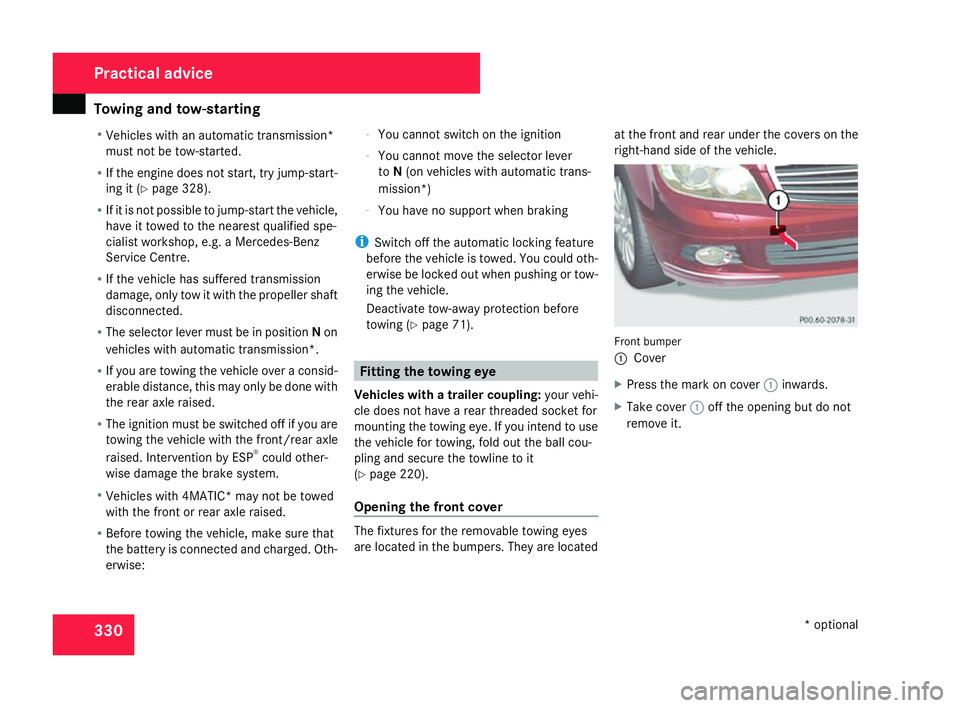
Opening the front cover The fixtures for the removable towing eyes
are located in the bumpers. They are locatedat the front and rear under the covers on the
right-hand side of the vehicle.
Front bumper
1
Cove r
X Press the mark on cover 1inwards.
X Take cover 1off the opening but do not
remove it. Practical advice
* optional
204_AKB; 2; 3, en-GB
mkalafa,
2007-06-26T23:11:51+02:00 - Seite 330