service MERCEDES-BENZ C-CLASS SALOON 2011 User Guide
[x] Cancel search | Manufacturer: MERCEDES-BENZ, Model Year: 2011, Model line: C-CLASS SALOON, Model: MERCEDES-BENZ C-CLASS SALOON 2011Pages: 401, PDF Size: 9.74 MB
Page 26 of 401

Towing away
Fitting the towing ey e.................... 352
Removing the towing eye. ..............353
With both axles on the ground .......353
Tow-starting
Emergency engine starting ............354
Fitting the towing eye. ...................352
Important safety notes ..................351
Removing the towing eye. ..............353
Trailer coupling
see Towing atrailer
Trailer towing
7-pin connector ............................. 220
Blind Spot Assist ............................ 207
Cleaning the trailer tow hitch ......... 331
Coupling up atrailer ...................... 218
Decoupling atrailer ....................... 218
Driving tips .................................... 215
ESP ®
................................................ 77
Folding in the ball coupling ............218
Folding out the ball coupling ..........217
Important safety notes ..................215
Mounting dimensions ....................387
Parking Guidance ........................... 202
Parktroni c...................................... 198
Power supply ................................. 219
Shift range ..................................... 163
Trailer loads ................................... 388
Transmission
see Automatic transmission
see Manual transmission
Transporting the vehicle ..................353
Trim pieces (cleaning instructions) .332
Trip computer On-board computer (12-button
multifunctio nsteering wheel) ........231
On-board computer (4-button
multifunctio nsteering wheel) ........226
Trip meter
Displaying/resetting (4-button
multifunctio nsteering wheel) ........225
Displaying (12-button multifunc-
tion steering wheel) .......................231
Resetting (12-button multifunc-
tion steering wheel) .......................232
Trip odometer
see Trip meter Turn signal
Display message (12-button mul-
tifunctio nsteering wheel) ..............265
Display message (4-button multi-
function steering wheel) ................262
Turn signals
Switching on/off ........................... 120
Two-way radio
Frequencies ................................... 377
Installatio n..................................... 377
Transmission output (maximum) .... 377
Type identification plate
see Vehicle identification plate
Tyre pressure
Calling up (on-board computer) .....363
Display message (12-button mul-
tifunctio nsteering wheel) ..............281
Display message (4-button multi-
function steering wheel) ................280
Not reached (TIREFIT) ....................340
Pressure loss warning ....................362
Reached (TIREFIT) ..........................340
Recommended ............................... 361
Tyre pressure monitor
Function/notes ............................. 363
Restarting ...................................... 365
Warning lamp ................................. 300
Tyres
Checking ........................................ 358
Directio nofrotation ...................... 366
Display message (12-button mul-
tifunction steering wheel) ..............281
Display message (4-button multi-
function steering wheel) ................280
Grip ................................................ 177
Important safety notes ..................358
Replacing ....................................... 365
Service life ..................................... 359
Storing ........................................... 366
Tyr esize (data) .............................. 366
Tyr etread ...................................... 359
see Flat tyre Index
23
Page 29 of 401
Protection of the environment
Notes
H
Environmental note
Daimler's declared policy is one of integrated
environmental protection.
The objectives are for the natural resources
which form the basis of our existence on this
planet to be used sparingly and in a manner
which takes the requirements of both nature
and humanity into account.
You too can help to protect the environment
by operating your vehicle in an environmen-
tally responsible manner.
Fuel consumption and the rate of engine,
transmission, brake and tyre wear depend on
the following factors:
R operating conditions of your vehicle
R your personal driving style
You can influence both factors. You should
bear the following in mind:
Operating conditions:
R avoid short trips as these increase fuel con-
sumption.
R make sure that the tyre pressures are
always correct.
R do not carry any unnecessary weight.
R keep an eye on the vehicle's fuel consump-
tion.
R remove roof racks once you no longer need
them.
R a regularly serviced vehicle will contribute
to environmental protection. You should
therefore adhere to the service intervals.
R always have maintenance work carried out
at a qualified specialist workshop, e.g. a
Mercedes-Benz Service Centre.
Personal driving style:
R do not depress the accelerator pedal when
starting the engine.
R do not warm up the engine with the vehicle
stationary. R
drive carefully and maintain a safe distance
from the vehicle in front.
R avoid frequent, sudden acceleration.
R change gear in good time and use each gear
only up to Ôof its maximum engine speed.
R switch off the engine in stationary traffic. Returning end-of-life vehicles
Mercedes-Benz will take back your
Mercedes-Benz to dispose of it in an environ-
mentally responsible manner, in accordance
with the European Union (EU) End of Life
Vehicles Directive.
The End of Life Vehicles Directive applies to
vehicles with a gross vehicle weight of up to
3.5 t, in accordance with national regulations.
For several years, Mercedes-Benz has been
meeting all the legal requirements for a
design which allows for recycling and reuse.
There is a network of return points and dis-
assembly plants which can recycle your vehi-
cle in an environmentally responsible man-
ner. The options for recycling vehicles and
parts are constantly being developed and
improved. This means that your Mercedes-
Benz will also continue to meet even the
increased recycling quotas in the future in
good time. You can obtain further information
from your national Mercedes-Benz homepage
or your national hotline number. Vehicle equipment
This Owner's Manual describes all models
and all standard and optional equipment of
your vehicle available at the time of publica-
tion of the Owner's Manual. Country-specific
differences are possible. Please note that
your vehicle may not be equipped with all fea-
tures described. This also applies to safety-
relevant systems and functions. The equip-
ment in your vehicle may therefore differ from
that shown in the descriptions and illustra-
tions. All the systems found in your vehicle 26
Introduction
Page 30 of 401
are listed in the original purchase agreement
of your vehicle .Should you have any ques-
tions concerning equipment and operation,
please consult a Mercedes-Ben zService
Centre. Operating safety
Safety notes
G
WARNING
All work on the vehicle and, in particular, work
relevant to safety or on safety-related sys-
tems must be carried out at a qualified spe-
cialist workshop. The specialist workshop
must have the necessary specialist knowl-
edge and tools to carry out the work required.
Mercedes-Benz recommends that you use a
Mercedes-Benz Service Centre for this pur-
pose. G
WARNING
Some safety systems only function when the
engine is running. You should therefore never
switch off the engine when driving. Otherwise,
the safety systems of your vehicle may not
function correctly and as a result will no lon-
ger protec tyou and other persons as inten-
ded. In addition, there is a risk that you may
lose control of your vehicle and thus cause an
accident. G
WARNING
Work carried out incorrectly, or alterations
made to the vehicle, e.g. re-routing of cables
under coverings, could cause the safety sys-
tems of your vehicle to stop working properly.
The safety systems would thus no longer pro-
tect you and other persons as intended. In
addition, there is a risk that you may lose con-
trol of your vehicle and thus cause an acci-
dent.
All work and alterations to the vehicle, e.g.
installations or modifications, should there-
fore be carried out at aqualified specialist
workshop. G
WARNING
If work on electronic equipment and its soft-
ware is carried out incorrectly, this equipment
could stop working .The electronic systems
are networked via interfaces. Tampering with
these electronic systems could cause mal-
functions in systems which have not been
modified. Malfunctions such as these can
seriously jeopardise the vehicle's operating
safety and therefore your own safety.
You should therefore have all work and mod-
ifications to electronic components carried
out at a qualified specialist workshop. General notes
The following information applies to all radio
system components in the vehicle and to
COMAND:
The radio system components in this vehicle
are compliant with the basic requirements
and all other relevant conditions of Directive
1999/5/EC. You can obtain further informa-
tion from any Mercedes-Benz Service Centre.
The equipment is approved by the vehicle
manufacturer in accordance with European
Automotive EMC Directive 95/54/EC. Oper-
ation according to its intended purpose is
thus approved for your vehicle. The equip-
ment does not require certification.
The equipment conforms to the relevant
equipment-specific EMC specifications in
accordance with the following European
standards:
R EN 55013
R EN 55020
Therefore, adherence to the relevant specifi-
cations for electromagnetic compatibility is
guaranteed for this device.
As a result, interference caused by your
equipment to other electrical/electronic
equipment and interference to your equip-
ment caused by other electrical/electronic
equipment can be largely prevented. Introduction
27 Z
Page 31 of 401
On-Board diagnostic interface
G
WARNING
If you connect equipment to the on-board
diagnostic interface, it can affect the opera-
tion of the vehicle systems. This can impair
the operating safety of your vehicle while driv-
ing. There is a risk of accident.
Do not connect any equipment to the on-
board diagnostic interface. G
WARNING
Loose equipment or equipment cables which
are connected to the on-board diagnostic
interface may infringe on the space around
the pedals. The equipment or the cables could
get between the pedals in the event of sudden
braking or acceleration. You may then no lon-
ger be able to brake, operate the clutch or
accelerate as intended. There is a risk of acci-
dent.
Do not attach any equipment or cables in the
driver footwell.
Connecting equipment to the on-board diag-
nostic interface can lead to emissions moni-
toring information being reset .This may lead
to the vehicle failing to meet the require-
ments at the next emissions control test or
main inspection.
If the engine is switched off and equipment
on the on-board diagnostic interface is used,
the starter battery may discharge.
The on-board diagnostic interface is intended
for the connection of diagnostic equipment at
a qualified specialist workshop. Qualified specialist workshop
Aq ualified specialist workshop has the nec-
essary specialist knowledge, tools and quali-
fications to correctl ycarry out the work
required on your vehicle .This is especially the
case for work relevant to safety.
Observe the information in the Service Book-
let. Always have the following work carried out at
a qualified specialist workshop:
R
work relevant to safety
R service and maintenance work
R repair work
R alterations, installation work and modifica-
tions
R work on electronic components
Mercedes-Ben zrecommends that you use a
Mercedes-Benz Service Centre. Vehicle registration
Mercedes-Benz may ask its Service Centres
to carry out technical inspections on certain
vehicles to improve their quality or safety.
If you did not purchase your vehicle from an
authorised specialist dealer and your vehicle
has never been inspected at a Mercedes-
BenzS ervice Centre, it is possible that your
vehicle is not registered in your name with
Mercedes-Benz. Mercedes-Benz can only
infor myou about vehicle checks if it has your
registration data.
It is advisable to register your vehicle with a
Mercedes-Benz Service Centre.
InformM ercedes-Benza s soon as possible
abouta ny change in address or vehicle own-
ership. Correc
tuse G
WARNING
Various warning stickers are affixed to your
vehicle. Their purpose is to draw your atten-
tion, and the attention of others, to various
dangers. Therefore, do not remove any warn-
ing stickers unless the sticker clearly states
that you may do so.
If you remove the warning stickers, you or
others could be injured by failing to recognise
certain dangers. 28
Introduction
Page 32 of 401
Observe the following information when using
your vehicle:
R the safety notes in this manual
R the "Technical data" section in this manual
R national road traffic regulations
R national road traffic licensing regulations Implied warranty
! Follow the instructions in this manual
aboutt he proper operation of your vehicle
as well as about possible vehicle damage.
Damage to your vehicle that arises from
culpable contraventions against these
instructions are not covered either by
Mercedes-Ben zimplied warranty or by the
New or Used-Vehicle Warranty of
Daimler AG. Data stored in the vehicle
Fault data
Components critical for vehicle operation are
equipped with fault data memories as stand-
ard. There are also data storage devices
which record the technical reactions of vehi-
cle components to certain driving situations
(e.g. airbag deployment or ESP ®
interven-
tion).
This data is used exclusively to:
R assist in the rectificatio noffaults and
defects
R help Mercedes-Ben zoptimise and develop
vehicle functions
The data cannot be used to trace the vehicle's
movements.
When your vehicle is serviced by Mercedes-
Benz, this technical information can be read
out from the fault memory. This is performed
by authorised employees of the Mercedes-
Ben zservice network using special diagnos-
tic computers. After a fault has been rectified, the informa-
tion is deleted from the memory. Other mem-
ory data is constantly overwritten. Other devices that store data
Depending on the equipment level, your vehi-
cle may feature communications and/or
entertainment systems (e.g. navigation devi-
ces, telephone systems). These allow you to
save and edit data required for the operation
of the respective device.
Further information on operation (e.g. on
deleting data) can be found in the separate
operating instructions. Introduction
29 Z
Page 49 of 401
Useful information
i This Owner's Manual describes all models
and all standard and optional equipment
available to your vehicle at the time of pub-
lication of the Owner's Manual. Country-
specific deviations are possible. Please
note that your vehicle may not be equipped
with all features described. This also
applies to safety-relevan tsystems and
functions.
i Please read the information on qualified
specialist workshops (Y page 28).Occupant safety
Important safety notes
Seat belts, together with the Supplemental
Restraint System – SRS (Y page 47), are
complementary, co-ordinated restrain tsys-
tems .They reduce the risk of injury in spe-
cific, pre-defined types of accident situations
and thereby increase occupant safety. How-
ever, seat belts and airbags generally do not
protect against objects penetrating the vehi-
cle from the outside.
To ensure that the restraint systems can
deliver their full potential protection, make
sure that:
R the seat and head restraint are adjusted
properly (Y page 104).
R the seat belt has been fastened properly
(Y page 55).
R the airbags can inflate unrestricted if
deployed (Y page 48).
R the steering wheel is adjusted properly
(Y page 104).
R the restraint systems have not been modi-
fied.
i An airbag increases the protection of
vehicle occupants wearing a seat belt. As
such, they are only an additional restraint
system which complements, but does not
replace, the seat belt. All vehicle occupants must wear their seat belt correctly at all
times, even if the vehicle is equipped with
airbags. The airbags are not deployed in all
types of accidents. For example, if the pro-
tective capacity of correctly fastened seat
belts is not increased by deploying the air-
bags, the airbags will not deploy.A
irbag
deploymen tonly provides increased pro-
tection if the seat belt is worn correctly
because:
R the sea tbelt helps to keep the vehicle
occupan tinthe best position in relation
to the airbag.
R in a head-on collision, for example, the
seat belt prevents the vehicle occupant
from being propelled towards the point
of impact. It can thus reduce the risk of
injury.
In accidents in which an airbag is deployed,
it provides increased protection only if the
seat belt is worn correctly. G
WARNING
If service work is not carried out correctly, the
operating safety of your vehicle may be affec-
ted. This could cause you to lose control of
your vehicle and cause an accident. More-
over, the safety systems may no longer be
able to protect you or others as they are
designed to do.
Always have service work carried out at a
qualified specialist workshop. The workshop
must have the necessary specialist knowl-
edge and tools to carry out the work required.
Mercedes-Ben zrecommends that you use a
Mercedes-Benz Service Centre for this pur-
pose. In particular, work relevant to safety or
on safety-related systems must be carried out
at a qualified specialist workshop. 46
Occupant safetySafety
Page 50 of 401
G
WARNING
Modifications to or work performed incor-
rectly on the following parts can result in the
restraint systems not functioning as intended:
R the restraint system, consisting of seat
belts and their anchorage points, beltt en-
sioners, belt force limiters and airbags
R the wiring
R networked electronic systems
Airbags and belt tensioners could fail to
deploy or be triggered in an acciden tdespite
the deceleration force being sufficien tto trig-
ger the systems, or could be triggered unin-
tentionally. For this reason, never make any
modifications to the restraint systems.
Therefore, you must not tamper with elec-
tronic components or their software. SRS (Supplemental Restraint System)
Introduction SRS consists of:
R
the 6 SRS warning lamp
R airbags
R airbag control unit (with crash sensors)
R belt tensioners
R belt force limiters
SRS reduces the risk of occupants coming
into contact with the vehicle's interior in the
event of an accident. It can also reduce the
effect of the forces to which occupants are
subjected during an accident.
SRS warning lamp SRS functions are checked regularly when
you switch on the ignition and when the
engine is running. Therefore, malfunctions
can be detected in good time.
The 6 SRS warning lamp in the instrument
cluster lights up when the ignition is switched
on. It goes out no later than a few seconds
after the engine is started. G
WARNING
If SRS is malfunctioning, individual systems
may be activated unintentionally or may not
be triggered in the event of an accident with
a high rate of vehicle deceleration.
A malfunction has occurred if:
R the 6 SRS warning lamp does not light
up when the ignition is switched on.
R the engine is running and the 6SRS
warning lamp does not go out after a few
seconds.
R the engine is running and the 6SRS
warning lamp lights up again.
In this case, have SRS checked immediately
at a qualified specialist workshop. Mercedes-
Benz recommends that you use a Mercedes-
Benz Service Centre for this purpose.
In particular, work relevant to safety or on
safety-related systems must be carried out at
a qualified specialist workshop.
Triggering of belt tensioners, belt force
limiters and airbags During the first stage of a collision, the airbag
control unit evaluates important physical
data relating to vehicle deceleration or accel-
eration, such as:
R
duration
R direction
R magnitude
Based on the evaluation of this data, the air-
bag control unit pre-emptively triggers the
belt tensioners in the first stage.
i The front belt tensioners can only be trig-
gered if the seat belt tongues on the front
seats are correctly engaged in the seat belt
buckles.
If there is an even higher rate of vehicle decel-
eration or acceleration in a longitudinal direc-
tion, the front airbags are also deployed.
Your vehicle has adaptive, two-stage front air-
bags. The airbag control unit evaluates vehi-
cle deceleration or acceleration in the event Occupant safety
47Safety Z
Page 54 of 401
intended protection in the event of an acci-
dent. Appropriate seat covers can be
obtained from a Mercedes-Benz Service
Centre.
When deployed, the sidebags offer additional
protection for the thorax of the vehicle occu-
pants on the side of the vehicle on which the
impact occurs. However, they do not protect
the:
R head
R neck
R arms Example: Saloon
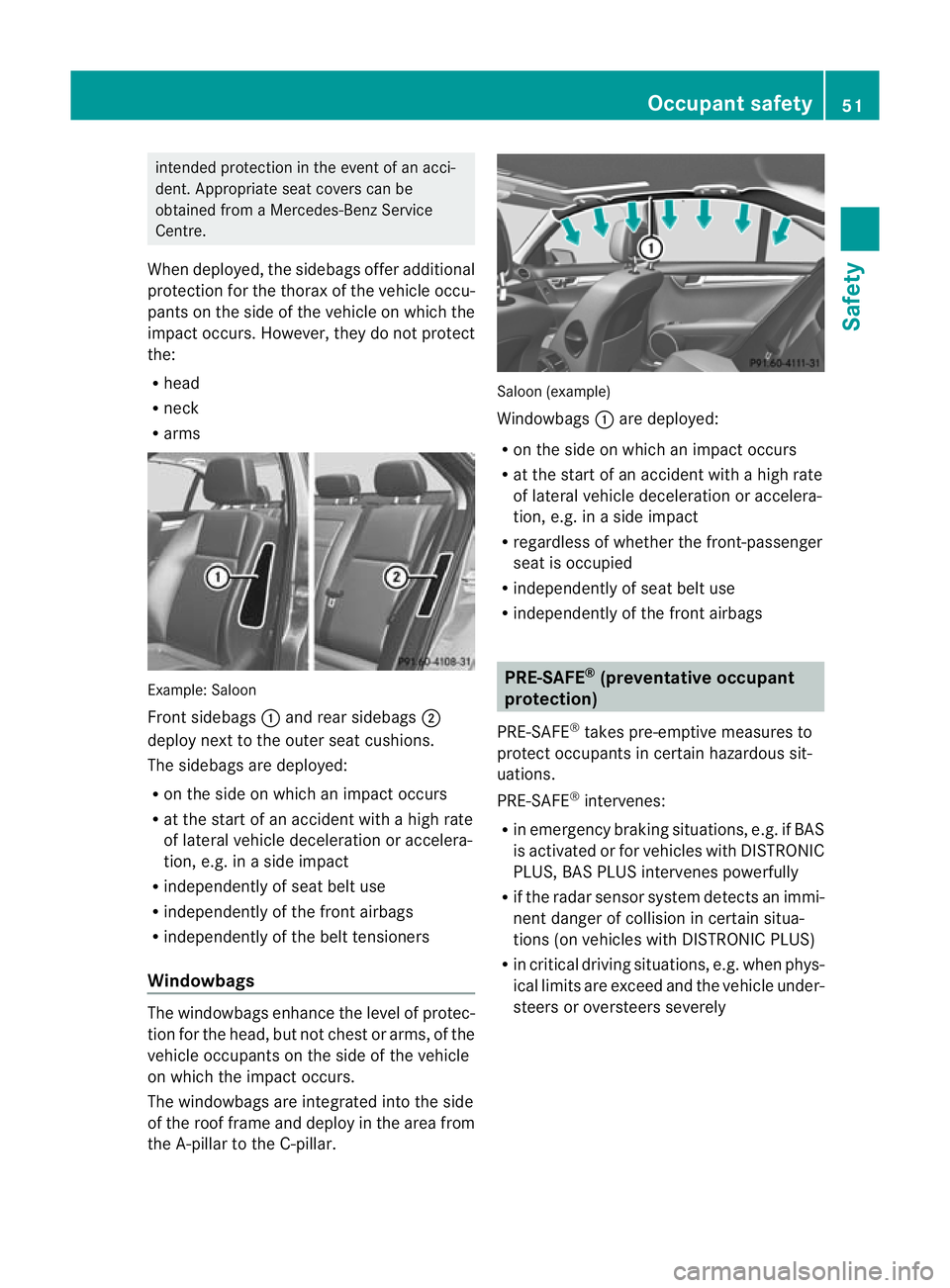
Front sidebags
:and rear sidebags ;
deploy nex tto the outer seat cushions.
The sidebags are deployed:
R on the side on which an impact occurs
R at the start of an accident with a high rate
of lateral vehicle deceleration or accelera-
tion, e.g. in a side impact
R independently of seat belt use
R independently of the front airbags
R independently of the belt tensioners
Windowbags The windowbags enhance the level of protec-
tion for the head, but not chest or arms, of the
vehicle occupants on the side of the vehicle
on which the impact occurs.
The windowbags are integrated into the side
of the roof frame and deploy in the area from
the A-pillar to the C-pillar. Saloon (example)
Windowbags
:are deployed:
R on the side on which an impact occurs
R at the start of an accident with a high rate
of lateral vehicle deceleration or accelera-
tion, e.g. in a side impact
R regardless of whether the front-passenger
seat is occupied
R independently of seat belt use
R independently of the front airbags PRE-SAFE
®
(preventative occupant
protection)
PRE-SAFE ®
takes pre-emptive measures to
protec toccupants in certain hazardous sit-
uations.
PRE-SAFE ®
intervenes:
R in emergency braking situations, e.g. if BAS
is activated or for vehicles with DISTRONIC
PLUS, BAS PLUS intervenes powerfully
R if the radar sensor system detects an immi-
nent danger of collisio nincertain situa-
tions (on vehicles with DISTRONIC PLUS)
R in critical driving situations, e.g. when phys-
ical limits are exceed and the vehicle under-
steers or oversteers severely Occupant safety
51Safety Z
Page 55 of 401
PRE-SAFE
®
takes the following measures
depending on the hazardous situation detec-
ted:
R the fronts eat belts are pre-tensioned.
R vehicles with the memory function :it
adjusts the front-passenger seat if it is in
an unfavourable position.
R if the vehicle skids, the sliding sunroof/
panorama sliding sunroo fand the side win-
dows are closed so tha tonly a small gap
remains.
If the hazardous situatio npasses without
resulting in an accident, PRE-SAFE ®
slackens
the belt pretensioning .The air pressure in the
side bolsters on the multicontour seat is
reduced again. All settings made by PRE-
SAFE ®
can then be reversed.
If the seat belts are not released:
X Move the backrest or seat back slightly, but
only when the vehicle is stationary.
The belt pretensioning is reduced and the
locking mechanism is released. G
WARNING
When adjusting the seat, make sure that
nobody can become trapped.
! Make sure that there are no objects in the
footwell or behind the seats when moving
the seat back. There is a risk that the seats
and/or the objects could be damaged.
More information about seat-belt adjust-
ment,ac onvenience function integrated into
PRE-SAFE ®
, can be found in the "Seat-belt
adjustment" section (Y page 55).NECK-PRO head restraint/NECK-PRO
luxury head restraint (except AMG
vehicles)
NECK-PRO head restraints/NECK-PRO luxury
head restraints increase protection of the
driver's and front-passenger's head and
neck.Int he event of a rear collision of a cer-
tain severity, the NECK-PRO head restraints/ NECK-PRO luxury head restraints on the driv-
er's and front-passenger seats are moved for-
wards and upwards. This provides better
head support. G
WARNING
Only use head restraint covers which have
been tested and approved by Mercedes-Benz
for your vehicle model.
The use of non-approved head restraint cov-
ers may prevent NECK-PRO head restraints/
NECK-PRO luxury head restraints from trig-
gering properly. The NECK-PRO head
restraints/NECK-PRO luxury head restraints
can therefore not provide the intended pro-
tection.
Consult a Mercedes-Benz Service Centre
regarding availability.
If the NECK-PRO head restraints/NECK-PRO
luxury head restraints have been triggered in
an accident, reset the NECK-PRO head
restraints/NECK-PRO luxury head restraints
on the driver's and front-passenger seats
(Y page 52). Otherwise, the additional pro-
tection will not be available in the event of
another rear-end collision. NECK-PRO head
restraints/NECK-PRO luxury head restraints
that have been triggered are moved forwards
and can no longer be adjusted. Resetting
atriggered NECK-PRO head
restraint/NECK-PRO luxury head
restraint
Important safety notes Mercedes-Benz recommends tha
tyou have
NECK-PRO head restraints/NECK-PRO luxury
head restraints checked at a qualified spe-
cialist workshop, e.g. a Mercedes-Benz
Service Centre, if your vehicle is involved in a
rear-end collision. 52
Occupant safetySafety
Page 56 of 401
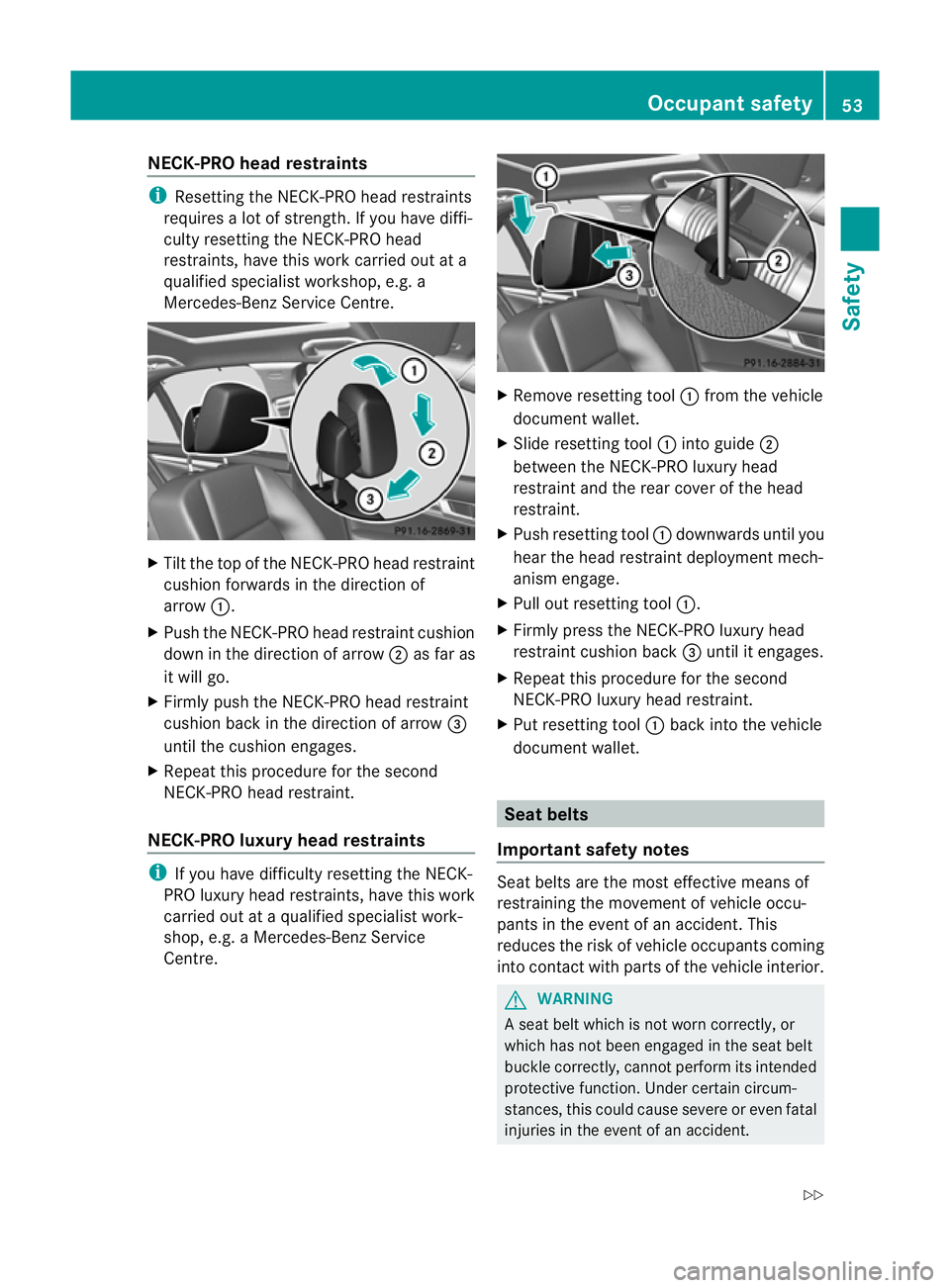
NECK-PRO head restraints
i
Resetting the NECK-PRO head restraints
requires a lo tofstrength. If you have diffi-
culty resetting the NECK-PRO head
restraints, have this work carried ou tata
qualified specialist workshop, e.g. a
Mercedes-Benz Service Centre. X
Tilt the top of the NECK-PRO head restraint
cushion forwards in the direction of
arrow :.
X Push the NECK-PRO head restraint cushion
down in the direction of arrow ;as far as
it will go.
X Firmly push the NECK-PRO head restraint
cushion back in the direction of arrow =
until the cushion engages.
X Repeat this procedure for the second
NECK-PRO head restraint.
NECK-PRO luxury head restraints i
If you have difficulty resetting the NECK-
PRO luxury head restraints, have this work
carried out at a qualified specialist work-
shop, e.g. a Mercedes-Benz Service
Centre. X
Remove resetting tool :from the vehicle
documen twallet.
X Slide resetting tool :into guide ;
between the NECK-PRO luxury head
restraint and the rear cover of the head
restraint.
X Push resetting tool :downwards until you
hear the head restraint deploymen tmech-
anism engage.
X Pull out resetting tool :.
X Firmly press the NECK-PRO luxury head
restraint cushion back =until it engages.
X Repeat this procedure for the second
NECK-PRO luxury head restraint.
X Put resetting tool :back into the vehicle
documen twallet. Seat belts
Important safety notes Seat belts are the most effective means of
restraining the movement of vehicle occu-
pants in the event of an accident. This
reduces the ris
kofvehicle occupants coming
into contact with parts of the vehicle interior. G
WARNING
A seat belt which is not worn correctly, or
which has not been engaged in the seat belt
buckle correctly, cannot perform its intended
protective function. Under certain circum-
stances, this could cause severe or even fatal
injuries in the event of an accident. Occupant safety
53Safety
Z