lock MERCEDES-BENZ C-CLASS SALOON 2014 User Guide
[x] Cancel search | Manufacturer: MERCEDES-BENZ, Model Year: 2014, Model line: C-CLASS SALOON, Model: MERCEDES-BENZ C-CLASS SALOON 2014Pages: 489, PDF Size: 14.88 MB
Page 25 of 489
Function/notes ............................. 433
General notes ................................ 433
Important safety notes .................. 434
Radio type approval for the tyre
pressure monitor ........................... 436
Restarting ...................................... 435
Warning lamp ................................ .364
Warning message .......................... 435
Tyres
Changing a wheel .......................... 437
Checking ........................................ 429
Direction of rotatio n...................... 438
Display message ............................ 343
Important safety notes .................. 428
MOExtended tyre s......................... 430
Replacing ....................................... 438
Service life ..................................... 429
Storing ........................................... 438
Summer tyres in winter ................. 430
Tyre size (data ).............................. 444
Tyre tread ...................................... 429
Wheel and tyre combinations ........ 445
see Flat tyre U
Unlocking Emergency unlocking ....................... 98
From inside the vehicle (central
unlocking button) ............................. 97 V
Vanity mirror (in sun visor) .............. 378
Vehicle
Correct use ...................................... 28
Data acquisition ............................... 28
Display message ............................ 345
Electronics ..................................... 466
Equipment ....................................... 25
Implied warranty .............................. 28
Individual settings .......................... 307
Leaving parked up ......................... 211
Locking (in an emergency) ............. 100
Locking (key) ................................... 91
Lowering ........................................ 443
Operating safety .............................. 25
Pulling away ................................... 184
Raising ........................................... 439 Registration ..................................... 28
Securing from rolling away ............ 439
Towing away .................................. 420
Transporting .................................. 423
Unlocking (in an emergency) ........... 98
Unlocking (key) ................................ 91
Vehicle data ................................... 476
Vehicle data
Boot load (maximum) ..................... 476
Roof load (maximum) ..................... 476
Vehicle dimensions ........................... 476
Vehicle emergency locking .............. 100
Vehicle identification number
see VIN
Vehicle identification plate .............. 468
Vehicle level
AIRMATIC ...................................... 234
Display message ............................ 337
Vehicle maintenance
see ASSYST PLUS
Vehicle tool kit .................................. 407
Video
Operating the DVD ......................... 303
VIN ...................................................... 468 W
Warning and indicator lamps ABS ................................................ 355
Brakes ........................................... 353
Distance warning signal ................. 363
ESP ®
.............................................. 357
ESP ®
OFF ....................................... 358
Hybrid system ................................ 362
LIM (cruise control )........................ 216
LIM (DISTRONIC PLUS) .................. 223
LIM (variable SPEEDTRONIC) ......... 219
Overview .......................................... 35
Parking brake ................................ 359
PASSENGER AIR BAG ...................... 46
RBS (Recuperative Brake Sys-
tem) ............................................... 362
Reserve fuel ................................... 360
Seat belt ........................................ 351
SRS ................................................ 282
Steering ......................................... 365
Tyre pressure monitor ................... 364
Warning triangle ................................ 40622
Index
Page 30 of 489
warning stickers. The cables of the vehicle's
high-voltage electrical system are orange.
Vehicles with an electric motor generate sig-
nificantly less noise than vehicles with inter-
nal combustion engines. As a result, in certain situations your vehicle may not be heard by
other road users. This can happen, for exam-
ple, when you are parking and your vehicle is not seen by other road users. This requires
you to adopt a particularly anticipatory driving
style, as it is necessary to allow for the pos-
sibility that other road users may behave
unpredictably. Declarations of conformity
Wireless vehicle components The following information applies to all com-
ponents of the vehicle and the information
systems and communication devices integra-
ted into the vehicle which receive and/or
transmit radio waves:
The components of this vehicle that receive
and/or transmit radio waves are compliant
with the basic requirements and all other rel- evant conditions of Directive 1999/5/E C.
You can obtain further information from any
Mercedes-Benz Service Centre.
Electromagnetic compatibility The electromagnetic compatibility of the vehi-
cle components has been checked and certi-fied according to the currently valid version of
Regulation ECE-R 10. Diagnostics connection
The diagnostics connection is only intended
for the connection of diagnostic equipment at a qualified specialist workshop. G
WARNING
If you connect equipment to a diagnostics
connection in the vehicle, it can affect the
operation of the vehicle systems. This may affect the operating safety of the vehicle.
There is a risk of an accident.
Do not connect any equipment to a diagnos-
tics connection in the vehicle.
G
WARNING
Objects in the driver's footwell may restrict
the clearance around the pedals or block a
depressed pedal. This jeopardises the oper-
ating and road safety of the vehicle. There is a risk of an accident.
Stow all objects securely in the vehicle so that
they do not get into the driver's footwell.
Always fit the floormats securely and as pre-
scribed in order to ensure that there is always sufficient room for the pedals. Do not use
loose floormats and do not place several floor-mats on top of one another.
! If the engine is switched off and equip-
ment on the diagnostics connection is
used, the starter battery may discharge.
Connecting equipment to the diagnostics
connection can lead to emissions monitoring information being reset, for example. This
may lead to the vehicle failing to meet the
requirements of the next emissions test dur-
ing the main inspection. Qualified specialist workshop
A qualified specialist workshop has the nec-
essary special skills, tools and qualifications
to correctly carry out any necessary work on
your vehicle. This particularly applies to work
relevant to safety.
Observe the notes in the Service Booklet.
Always have the following work carried out at a qualified specialist workshop:
R work relevant to safety
R service and maintenance work
R repair work
R modifications, installations and conver-
sions Introduction
27 Z
Page 35 of 489
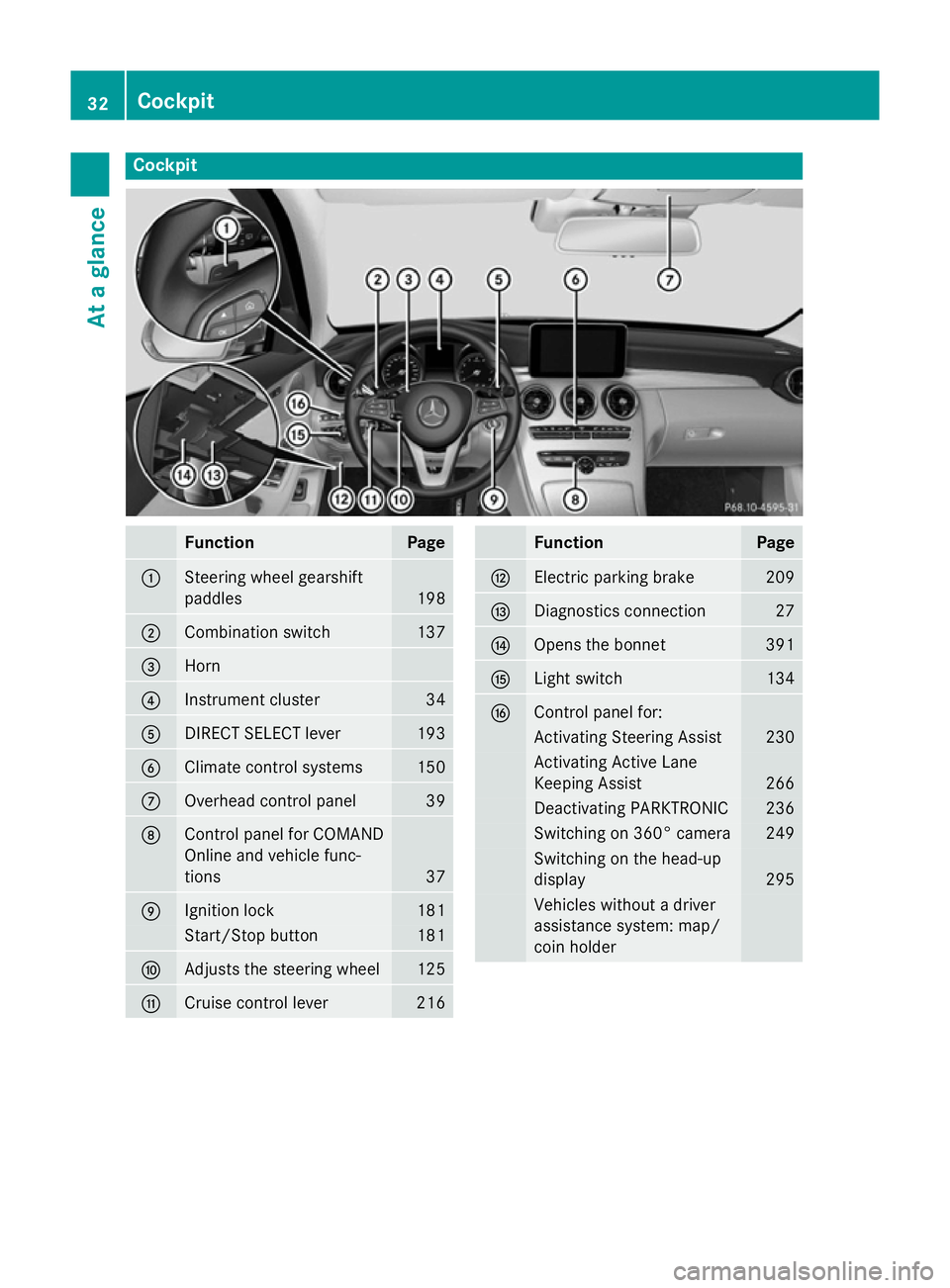
Cockpit
Function Page
:
Steering wheel gearshift
paddles
198
;
Combination switch 137
=
Horn
?
Instrument cluster 34
A
DIRECT SELECT lever 193
B
Climate control systems 150
C
Overhead control panel 39
D
Control panel for COMAND
Online and vehicle func-
tions
37
E
Ignition lock 181
Start/Stop button 181
F
Adjusts the steering wheel 125
G
Cruise control lever 216 Function Page
H
Electric parking brake 209
I
Diagnostics connection 27
J
Opens the bonnet 391
K
Light switch 134
L
Control panel for:
Activating Steering Assist 230
Activating Active Lane
Keeping Assist 266
Deactivating PARKTRONIC 236
Switching on 360° camera 249
Switching on the head-up
display
295
Vehicles without a driver
assistance system: map/
coin holder32
CockpitAt a glance
Page 36 of 489
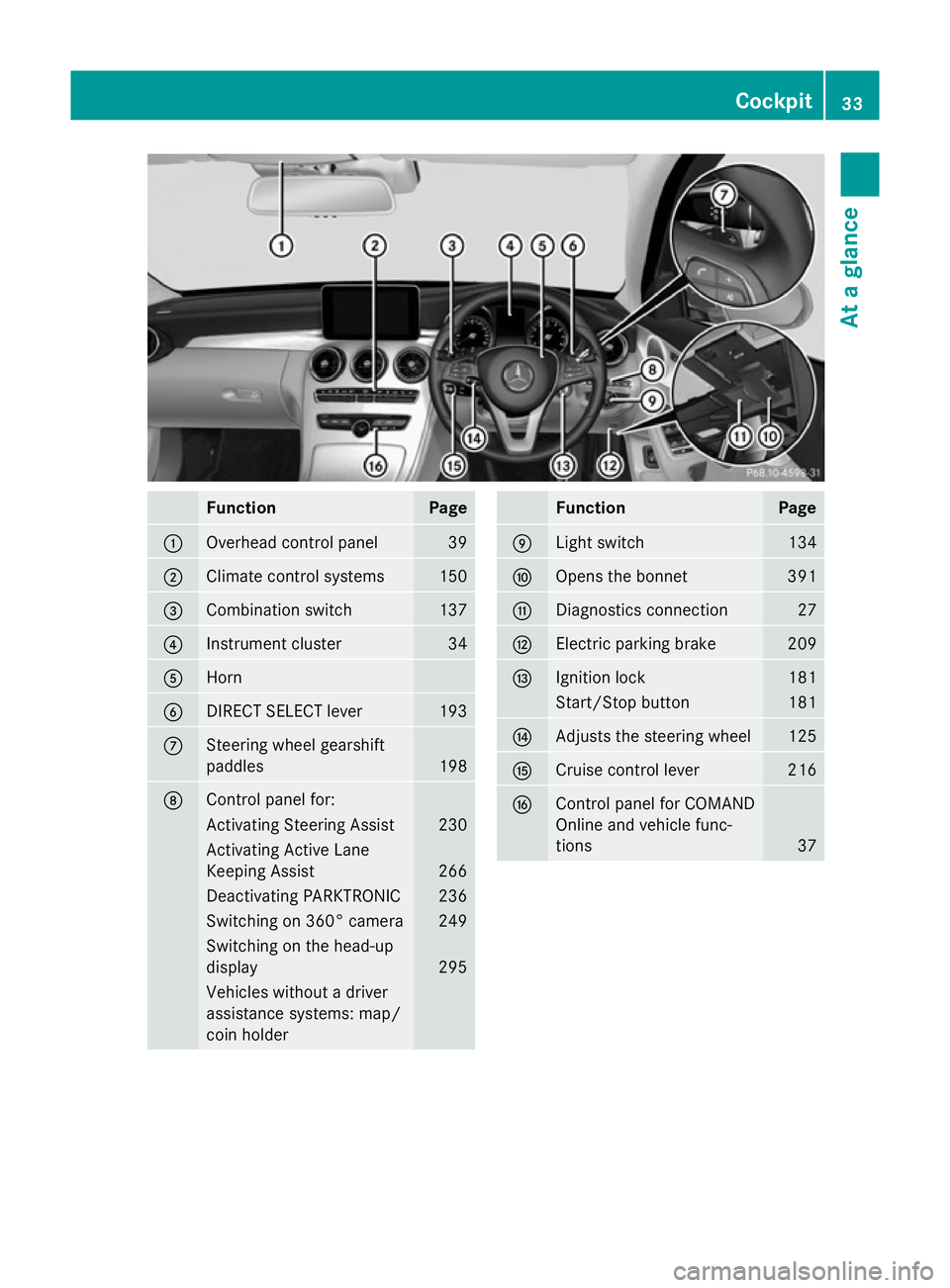
Function Page
:
Overhead control panel 39
;
Climate control systems 150
=
Combination switch 137
?
Instrument cluster 34
A
Horn
B
DIRECT SELECT lever 193
C
Steering wheel gearshift
paddles
198
D
Control panel for:
Activating Steering Assist 230
Activating Active Lane
Keeping Assist
266
Deactivating PARKTRONIC 236
Switching on 360° camera 249
Switching on the head-up
display
295
Vehicles without a driver
assistance systems: map/
coin holder Function Page
E
Light switch 134
F
Opens the bonnet 391
G
Diagnostics connection 27
H
Electric parking brake 209
I
Ignition lock 181
Start/Stop button 181
J
Adjusts the steering wheel 125
K
Cruise control lever 216
L
Control panel for COMAND
Online and vehicle func-
tions
37Cockpit
33At a glance
Page 40 of 489
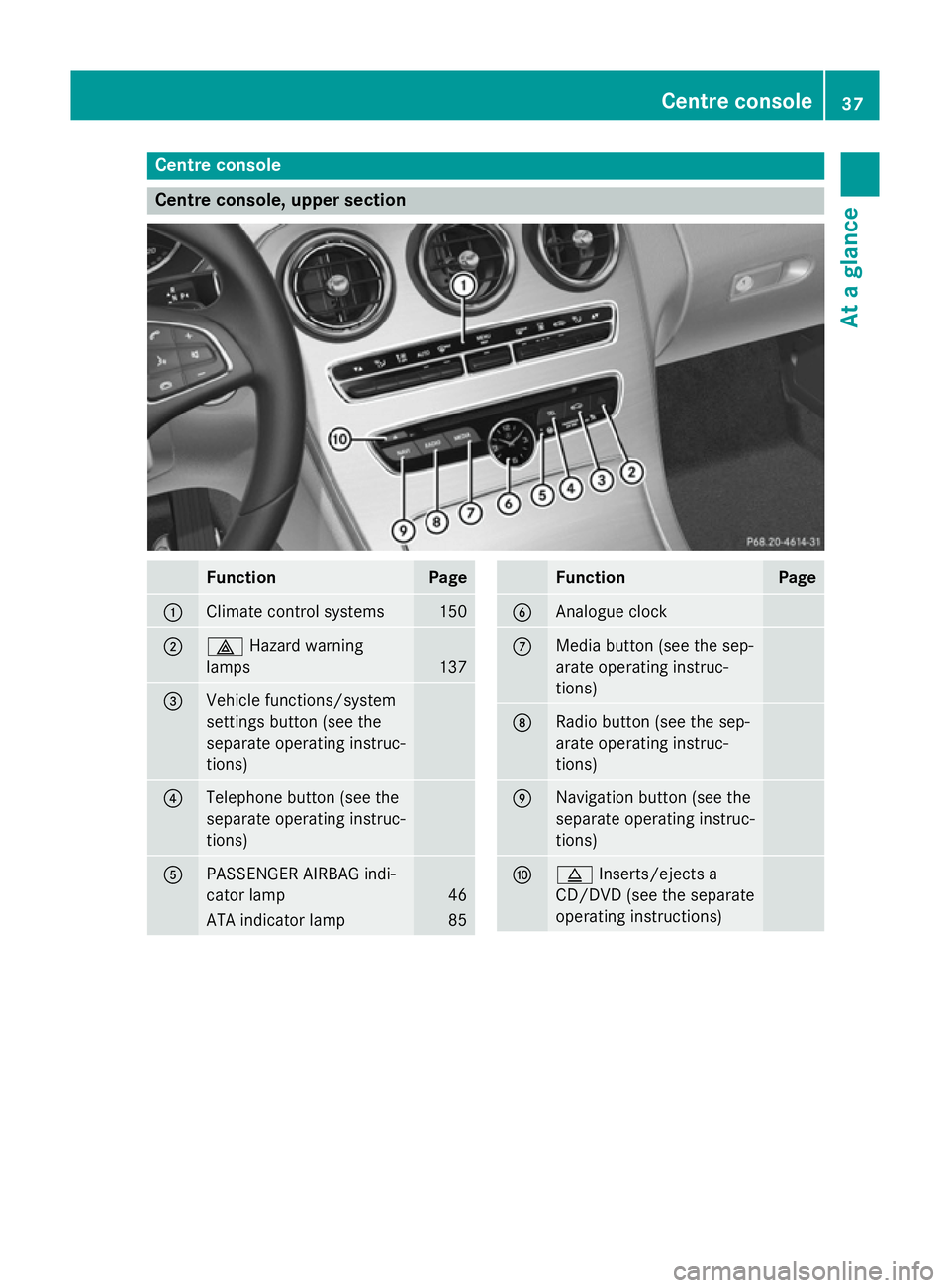
Centre console
Centre console, upper section
Function Page
:
Climate control systems 150
;
£
Hazard warning
lamps 137
=
Vehicle functions/system
settings button (see the
separate operating instruc-
tions) ?
Telephone button (see the
separate operating instruc-
tions) A
PASSENGER AIRBAG indi-
cator lamp
46
ATA indicator lamp 85 Function Page
B
Analogue clock
C
Media button (see the sep-
arate operating instruc-
tions)
D
Radio button (see the sep-
arate operating instruc-
tions) E
Navigation button (see the
separate operating instruc-
tions)
F
þ
Inserts/ejects a
CD/DVD (see the separate
operating instructions) Centre console
37At a glance
Page 43 of 489
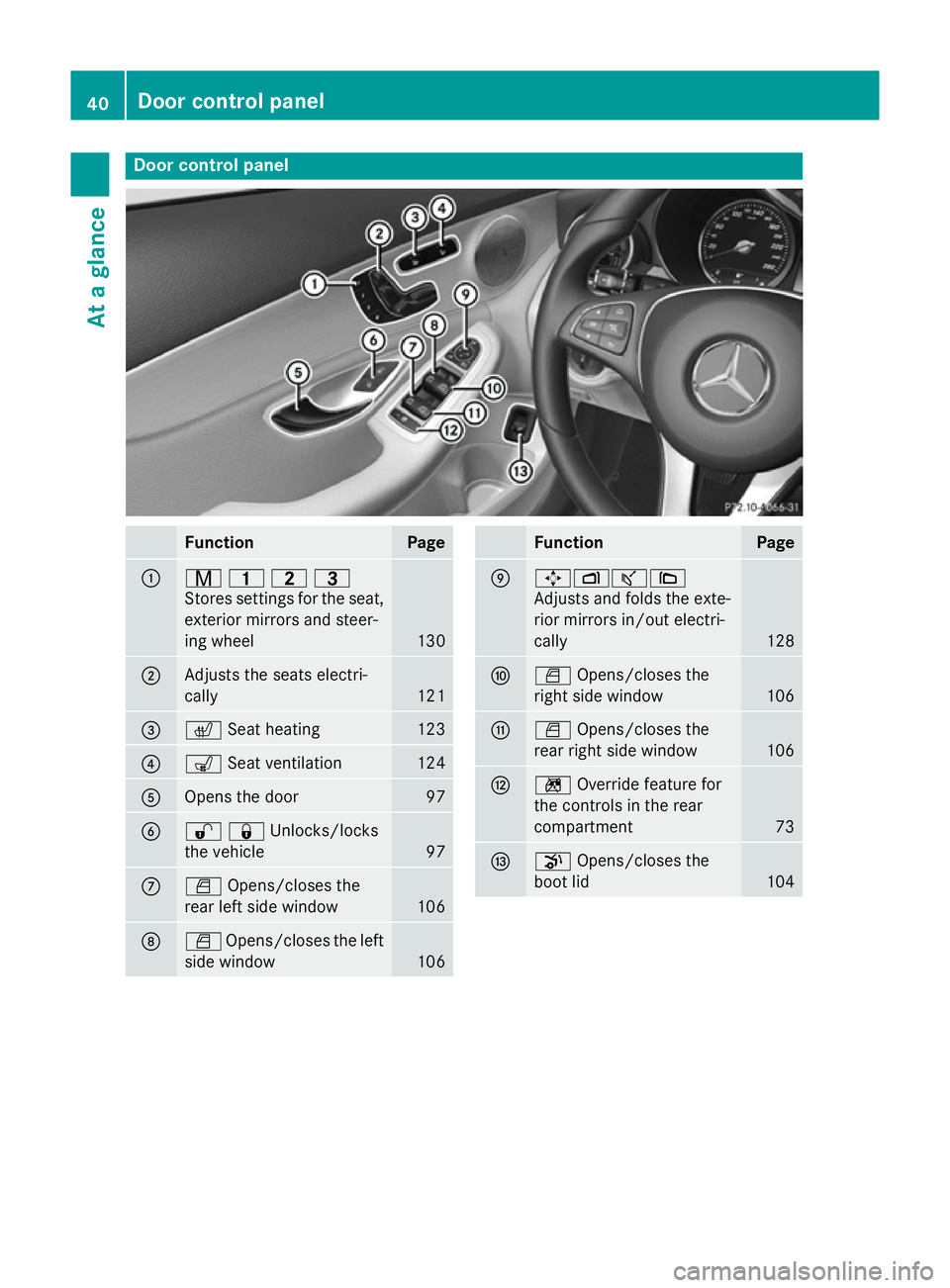
Door control panel
Function Page
:
r
45=
Stores settings for the seat, exterior mirrors and steer-
ing wheel 130
;
Adjusts the seats electri-
cally
121
=
c
Seat heating 123
?
s
Seat ventilation 124
A
Opens the door 97
B
%&Unlocks/locks
the vehicle 97
C
W
Opens/closes the
rear left side window 106
D
W
Opens/closes the left
side window 106 Function Page
E
7Zª\
Adjusts and folds the exte-
rior mirrors in/out electri-
cally
128
F
W
Opens/closes the
right side window 106
G
W
Opens/closes the
rear right side window 106
H
n
Override feature for
the controls in the rear
compartment 73
I
p
Opens/closes the
boot lid 10440
Door control panelAt a glance
Page 46 of 489
Have the restraint system checked and
repaired immediately at a qualified specialist
workshop. After an accident, immediately
switch the ignition off and remove the key
from the ignition lock.
If components of the restraint system are
activated during an accident, the hybrid sys-
tem is automatically deactivated.
The hybrid system is not activated when the
vehicle is started if:
R a short circuit is detected in the hybrid sys-
tem.
R a hybrid system electrical connection is
disconnected.
This ensures that you do not come into con-
tact with high voltage.
Manual deactivation of the hybrid sys-
tem The hybrid system can be deactivated man-
ually using the high voltage switch-off device.
! To prevent damage to the hybrid system
please observe the following instructions:
R only deactivate the hybrid system man-
ually in the following situations.
R work on the hybrid system may only be
carried out at a qualified specialist work-
shop, even when it has been deactivated
manually.
R if the 6 restraint system warning lamp
in the instrument cluster lights up after an
accident.
R if the vehicle is badly damaged, e.g. after an
accident, and the restraint system compo-
nents were not activated.
R if the vehicle is badly damaged and has to
be towed or transported.
X If possible, move the vehicle out of the
danger zone: shift the automatic transmis-
sion into position N.
X Release the electric parking brake.
X Roll the vehicle to a safe place and park it
safely. Get assistance from others if necessary.
The vehicle is locked automatically when the
ignition is switched on and the wheels are
turning. There is therefore a risk of being
locked out if the vehicle is being pushed or
tested on a dynamometer.
X Switch the ignition off.
X Shift the automatic transmission to park
position P.
Apply the electric parking brake
(Y page 209).
Secure the vehicle to prevent it from rolling
away (Y page 439).
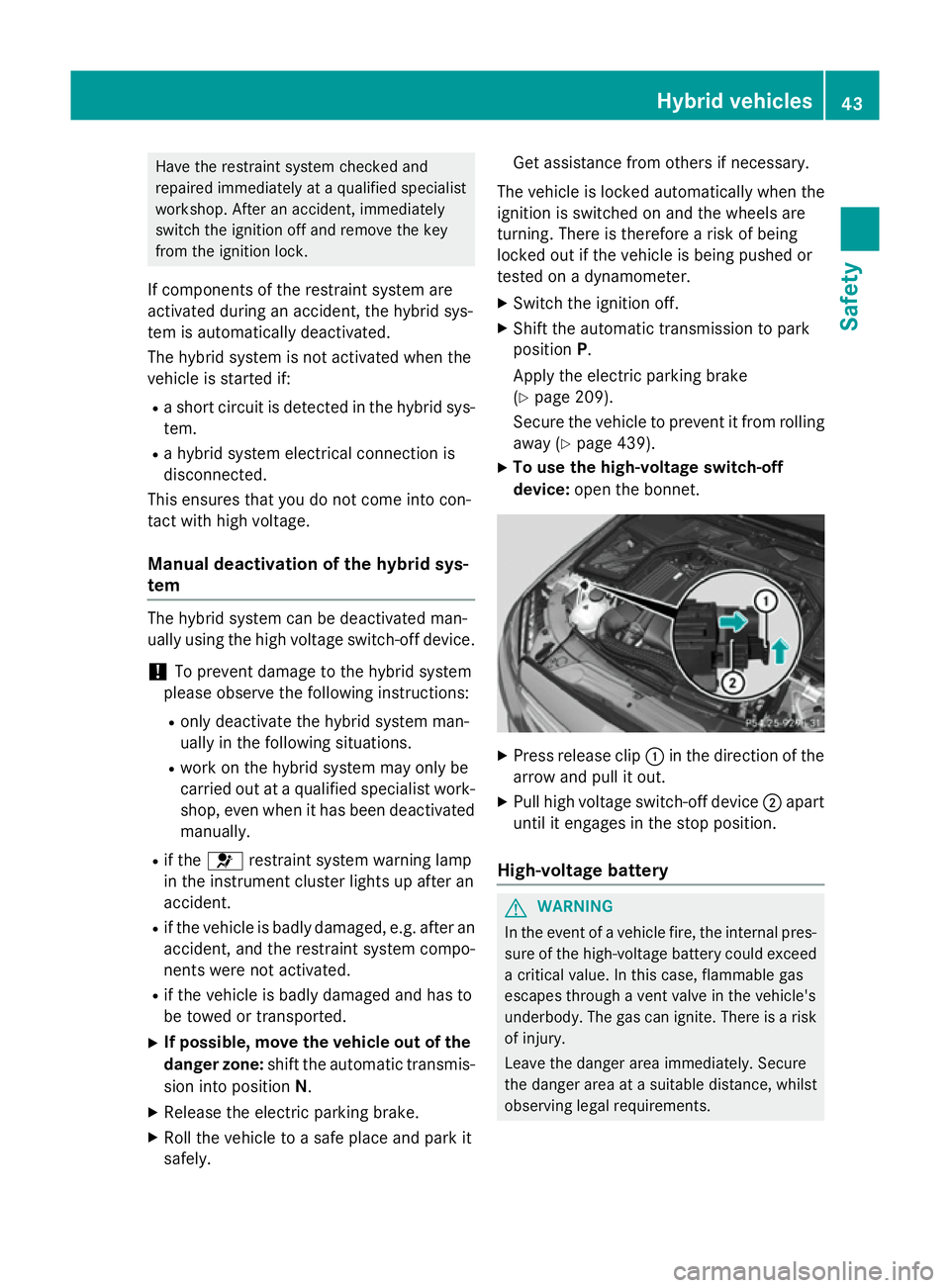
X To use the high-voltage switch-off
device: open the bonnet. X
Press release clip :in the direction of the
arrow and pull it out.
X Pull high voltage switch-off device ;apart
until it engages in the stop position.
High-voltage battery G
WARNING
In the event of a vehicle fire, the internal pres- sure of the high-voltage battery could exceeda critical value. In this case, flammable gas
escapes through a vent valve in the vehicle's
underbody. The gas can ignite. There is a risk
of injury.
Leave the danger area immediately. Secure
the danger area at a suitable distance, whilst
observing legal requirements. Hybrid vehicles
43Safety Z
Page 47 of 489
G
WARNING
If the housing of the high-voltage battery has
been damaged, electrolyte and gases may
leak out. These are poisonous and caustic.
There is a risk of injury.
Avoid contact with the skin, eyes or clothing. Immediately rinse electrolyte splashes off
with water and seek medical attention
straight away.
! Exhaustive discharge caused by the vehi-
cle standing idle for lengthy periods can
damage the high-voltage battery.
If the vehicle is idle for lengthy periods, run
it for a few minutes once every six weeks to
charge up the high-voltage battery.
During the charging process, switch off all
electrical consumers, e.g. the automatic
climate control or the seat heating.
Information on charging the high-voltage bat-
tery (Y page 416).
Engine compartment Before opening the bonnet:
X Apply the electric parking brake.
X Shift the automatic transmission to park
position P.
X Switch the ignition off.
X Remove the key from the ignition lock.
or, in vehicles with KEYLESS-GO start-func-
tion or KEYLESS ‑GO
X Remove the Start/Stop button from the
ignition lock.
X Observe the warning notes on the risk of
electric shock (Y page 42).
X Observe the warning notes about the bon-
net (Y page 391). RBS driving safety system (Recupera-
tive Brake System)
RBS supports you when braking with an elec-
tronically-controlled brake boost mode and enables the recovery of kinetic energy (recu-
peration).
For further information on the RBS system
(Y page 269). Panic alarm
X
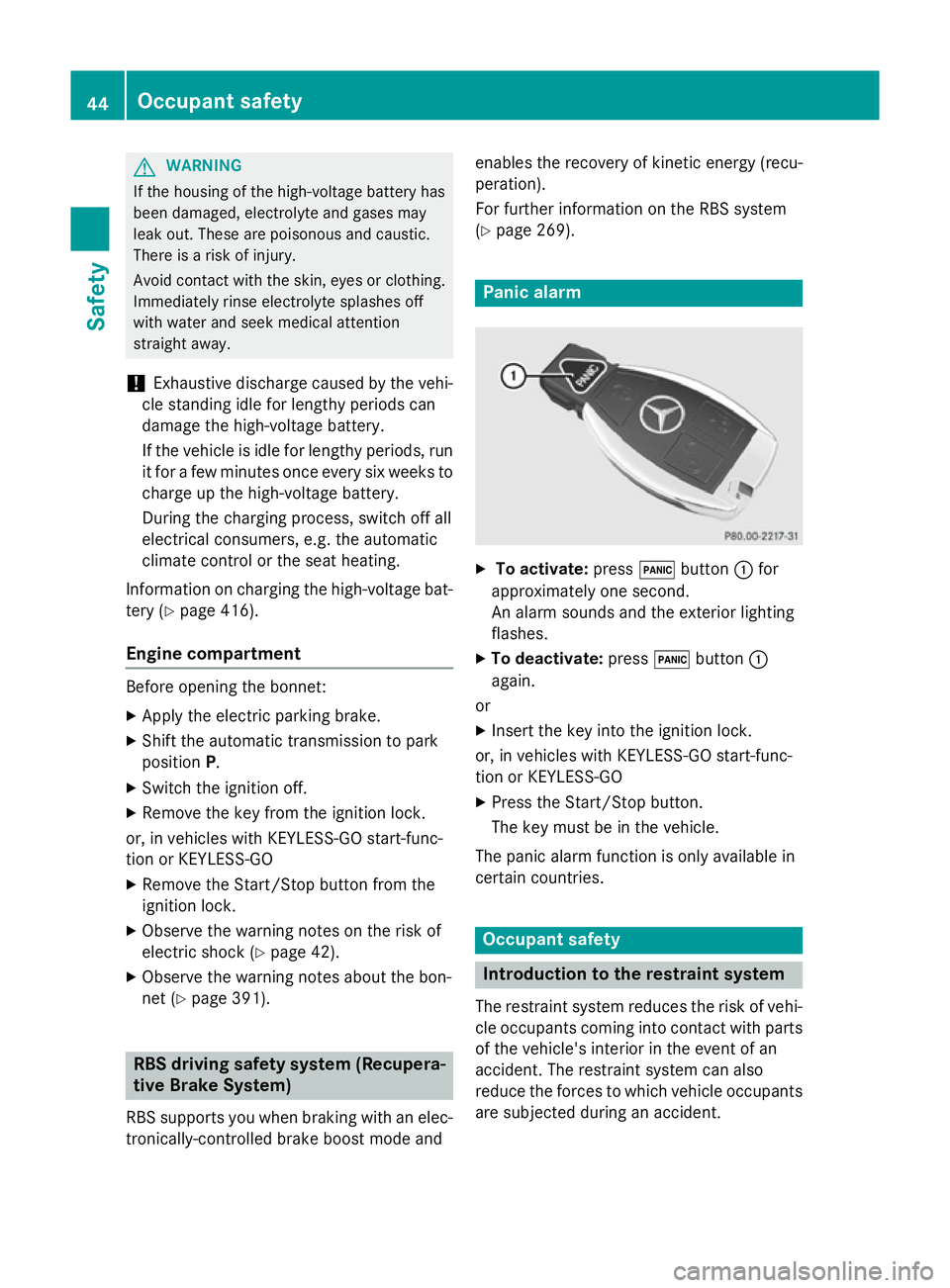
To activate: press!button :for
approximately one second.
An alarm sounds and the exterior lighting
flashes.
X To deactivate: press!button :
again.
or
X Insert the key into the ignition lock.
or, in vehicles with KEYLESS-GO start-func-
tion or KEYLESS ‑GO
X Press the Start/Stop button.
The key must be in the vehicle.
The panic alarm function is only available in
certain countries. Occupant safety
Introduction to the restraint system
The restraint system reduces the risk of vehi- cle occupants coming into contact with parts
of the vehicle's interior in the event of an
accident. The restraint system can also
reduce the forces to which vehicle occupants
are subjected during an accident. 44
Occupant safetySafety
Page 49 of 489
There is an increased risk of serious or even
fatal injuries.
Have the restraint system checked and
repaired immediately at a qualified specialist
workshop.
Hybrid vehicles: G
DANGER
If the restraint system is malfunctioning,
restraint system components may be trig-
gered unintentionally or might not be trig-
gered at all in the event of an accident with a high rate of vehicle deceleration. This can
effect belt tensioners or airbags, for example. In addition, the vehicle's high-voltage electri-
cal system may not be deactivated as inten-
ded in the event of an accident. Touching
damaged components of the vehicle's high-
voltage electrical system could result in an
electric shock. There is an increased risk of
injury, possibly even fatal.
Have the restraint system checked and
repaired immediately at a qualified specialist
workshop. After an accident, immediately
switch the ignition off and remove the key
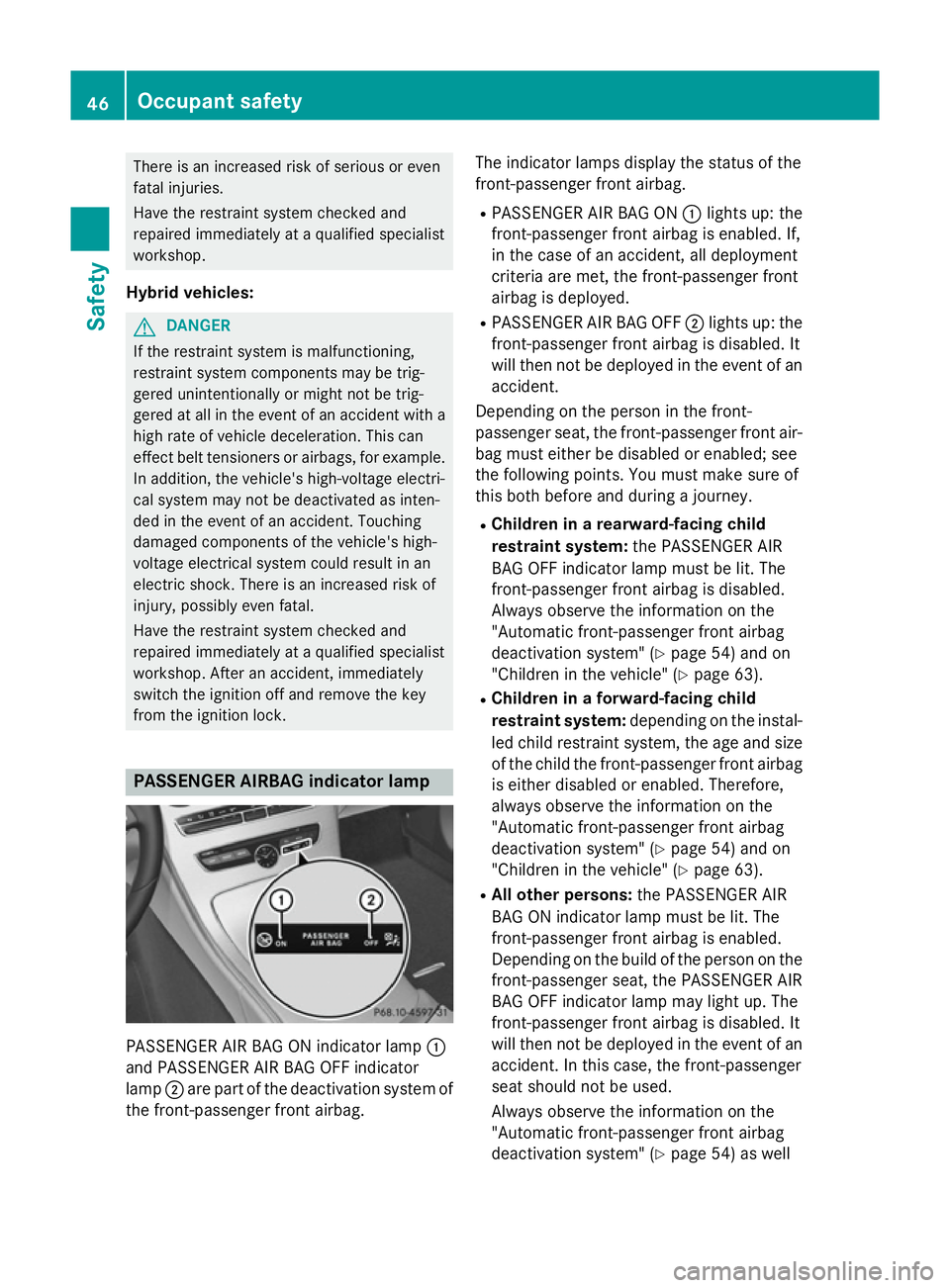
from the ignition lock. PASSENGER AIRBAG indicator lamp
PASSENGER AIR BAG ON indicator lamp
:
and PASSENGER AIR BAG OFF indicator
lamp ;are part of the deactivation system of
the front-passenger front airbag. The indicator lamps display the status of the
front-passenger front airbag.
R PASSENGER AIR BAG ON :lights up: the
front-passenger front airbag is enabled. If,
in the case of an accident, all deployment
criteria are met, the front-passenger front
airbag is deployed.
R PASSENGER AIR BAG OFF ;lights up: the
front-passenger front airbag is disabled. It
will then not be deployed in the event of an accident.
Depending on the person in the front-
passenger seat, the front-passenger front air-
bag must either be disabled or enabled; see
the following points. You must make sure of
this both before and during a journey.
R Children in a rearward-facing child
restraint system: the PASSENGER AIR
BAG OFF indicator lamp must be lit. The
front-passenger front airbag is disabled.
Always observe the information on the
"Automatic front-passenger front airbag
deactivation system" (Y page 54) and on
"Children in the vehicle" (Y page 63).
R Children in a forward-facing child
restraint system: depending on the instal-
led child restraint system, the age and size of the child the front-passenger front airbag
is either disabled or enabled. Therefore,
always observe the information on the
"Automatic front-passenger front airbag
deactivation system" (Y page 54) and on
"Children in the vehicle" (Y page 63).
R All other persons: the PASSENGER AIR
BAG ON indicator lamp must be lit. The
front-passenger front airbag is enabled.
Depending on the build of the person on the front-passenger seat, the PASSENGER AIR
BAG OFF indicator lamp may light up. The
front-passenger front airbag is disabled. It
will then not be deployed in the event of an
accident. In this case, the front-passenger
seat should not be used.
Always observe the information on the
"Automatic front-passenger front airbag
deactivation system" (Y page 54) as well46
Occupant safetySafety
Page 50 of 489
as on "Seat belts" (Y
page 47) and "Air-
bags" (Y page 51). There you can also find
information on the correct seat position. Seat belts
Introduction A correctly fastened seatbelt is the most
effective means of restraining the movement
of vehicle occupants in the event of a collision or if the vehicle overturns. This reduces the
risk of vehicle occupants coming into contact
with parts of the vehicle interior or being
thrown from the vehicle. Additionally, the
seat belt helps to keep the vehicle occupant
in the best position in relation to the airbag.
The seat belt system consists of:
R seat belts
R belt tensioners for the front seat belts and
the outer seat belts in the rear
R belt force limiters for the front seat belts
and the outer seat belts in the rear
If the seat belt is pulled too quickly or sud-
denly from the belt outlet, the inertia reel will
lock. The belt strap cannot be pulled out fur-
ther.
In an impact, the belt tensioner tightens the
belt to pull it close to the body. It does not pull the vehicle occupants back in the direction of
the seat backrest.
The belt tensioner cannot compensate for the
seat position being incorrect or for a seat belt being routed or worn incorrectly.
If the seat belt is also fitted with a belt force
limiter and this is triggered, the force exerted by the seat belt on the vehicle occupant is
reduced.
The belt force limiters on the front seats are
synchronised with the front airbags, which
take on a part of the deceleration force. This
reduces the forces to which vehicle occu-
pants are subjected during an accident.
! If the co-driver's seat is not occupied, do
not engage the seat belt tongue in the buckle on the co-driver's seat. Otherwise,
the belt tensioner could be triggered in the
event of an accident and would have to be
replaced.
Important safety notes G
WARNING
The seat belt cannot perform its intended pro- tective function if it is not fastened correctly. Also, an improperly fastened seat belt can
cause additional injuries in the event of an
accident, sudden braking or abrupt changes
of direction. There is an increased risk of
injury, possibly even fatal.
Always make sure that all vehicle occupants
are wearing their seat belt properly and are
seated correctly. G
WARNING
The seat belt does not offer the intended level of protection if you have not moved the back-
rest to an almost vertical position. When brak-
ing or in the event of an accident, you could
slide underneath the seat belt and sustain
abdomen or neck injuries, for example. This
poses an increased risk of injury or even fatal injury.
Adjust the seat properly before beginning
your journey. Always ensure that the backrest
is in an almost vertical position and that the
shoulder section of your seatbelt is routed
across the centre of your shoulder. G
WARNING
Persons under 1.50 mtall cannot wear the
seat belts correctly without a suitable, addi-
tional restraint system. The seat belt cannot
perform its intended protective function if it is not fastened correctly. Also, an improperly
fastened seat belt can cause additional inju-
ries in the event of an accident, sudden brak-
ing or abrupt changes of direction. There is an increased risk of injury, possibly even fatal.
Secure persons less than 1.50 mtall in a suit-
able restraint system. Occupant safety
47Safety Z