light MERCEDES-BENZ C-CLASS SALOON 2018 Owners Manual
[x] Cancel search | Manufacturer: MERCEDES-BENZ, Model Year: 2018, Model line: C-CLASS SALOON, Model: MERCEDES-BENZ C-CLASS SALOON 2018Pages: 609, PDF Size: 11.19 MB
Page 437 of 609
Battery (vehicle)
Note
s onthe12 V battery 000A
WARNING Risk of an accident due to
wo rkcar ried out incor rectly on the bat‐
te ry
Wo rkcar ried out incor rectly on the battery
can, forex ample, lead toa short circuit. This
can lead tofunction restrictions in saf ety-re l‐
eva nt sy stems, e.g. the lighting sy stem, ABS
(anti-lock braking sy stem) or ESP ®
(Elec‐
tronic Stability Prog ram). The operating
saf ety of your vehicle may be restricted.
Yo u could lose cont rol of theve hicle in the
fo llowing situations:
R when braking
R intheeve nt of ab rupt steering manoeu‐
vres and/or when theve hicle's speed is
not adap tedto thero ad conditions 0007
Intheeve nt of a sho rtcircuit or a simi‐
lar incident, contact a qualified special‐
ist workshop immediately. 0007
Do not continue driving. 0007
Alw ays ha vewo rkon the battery car ried
out at a qualified specialist workshop. R
Further information on ABS
(0013 page 203)
R Further information on ESP ®
(0013 page 204)
Fo r saf etyre asons, Mercedes-Benz recommends
th at you on lyuse bat teries which ha vebeen tes‐
te d and appr ovedfo ryo ur vehicle byMercedes-
Benz. These batteries pr ovide inc reased impact
pr otection topreve ntvehicle occupants from
suf fering acid bu rns should the battery be dam‐
aged in theeve nt of an accident.
All vehicles except vehicles with a lithium-
ion battery 000A
WARNING Risk ofexplosion due toelec‐
tros tatic charge
Electros tatic charge can cause spa rks which
may ignite the highly flammable gas mixture
in the batter y. 0007
Todischar geany electros tatic charge
th at may ha vebuilt up, touch the me tal
ve hicle body before handling the bat‐
te ry. The highly
flammable gas mixture is created
while the battery is charging and during starting
assis tance. 000A
WARNING Danger of chemical burns
from the battery acid
Battery acid is caustic. 0007
Avoid contact with the skin, eyes or
clo thing. 0007
Do not lean overth e batter y. 0007
Do not inhale battery gases. 0007
Keep children away from the batter y. 0007
Immedia tely rinse battery acid off thor‐
oughly with plenty of clean water and
seek medical attention immediately. 434
Breakdown assi stance
Page 439 of 609
000E
NO
TEDama getothe battery from over‐
vo ltage When
charging using a bat tery charge r with‐
out a maximum charging voltage, the battery
or the on-board electronics may be damaged. 0007
Only use battery charge rs with a maxi‐
mum charging voltage of 14.4 V. All
other vehicles
When charging the battery and during starting
assis tance, al ways use the jump-s tart connec‐
tion point in the engine compartment.
000E NO
TEDamaging the battery thro ugh
ove rvoltage When using a battery
charge r without a maxi‐
mum charging voltage, the battery or the
ve hicle electronics may be damaged. 0007
Only use battery charge rs with a maxi‐
mum charging voltage of 14.8 V. 000A
WARNING Risk ofexplosion from hydro‐
ge nga s igniting
A battery generates hydrogen gas during the
ch arging process. If there is a short circuit or
spar ksstart toform ,th ere is a danger of the
hy drogen gas igniting. 0007
Make sure that the positive term inal of
th e connected battery does not come
into conta ct withvehicle parts. 0007
Never place me tal objects or tools on a
batter y. 0007
When connecting and disconnecting the
batter y,yo u must obse rveth e descri‐
bed order forth e battery clamps. 0007
When giving starting assis tance, al ways
make sure that you on lyconnect bat‐
te ry term inals with identical polarity. 0007
During starting assis tance, you must
obse rveth e described order for con‐
necting and disconnecting the jump
lead. 0007
Do not connect or disconnect the bat‐
te ry cla mp s while the engine is running. 000A
WARNING Risk ofexplosion during
ch arging process and starting assis tance
During thech arging process and starting
assis tance, the battery may release an explo‐
sive gas mixture. 0007
Avoid fire , naked flames, creating
spar ksand smoking. 0007
Make sure that there is suf ficient venti‐
lation du ring thech arging process and
during starting assis tance. 0007
Do not lean over a batter y. 000A
WARNING Risk ofexplosion from a fro‐
zen battery
A dischar ged battery may freeze at temp era‐
tures slightly abo veor below freezing point.
During starting assis tance or battery charg‐
ing, bat tery gas may be released. 0007
Alw aysth aw a frozen bat tery out first
before charging it or per form ing start‐
ing assis tance. 436
Breakdown assi stance
Page 440 of 609
If
th e indicator/warning lamps in the instrument
clus ter do not light up at low temp eratures, it is
ve ry likely that the dischar ged battery has fro‐
zen. In this case you may neither jump-s tart the
ve hicle nor charge the batter y.
The service life of a battery that has been
th awe d may be dramatically shor tened. The
st arting characteristics may be impaired, espe‐
cially at low temp eratures.
It is recommended that you ha veathaw ed bat‐
te ry checked at a qualified specialist workshop.
All vehicles
Plug-in hybrid: obser vethe no tes in the Supple‐
ment. Otherwise, you may failto recognise dan‐
ge rs.
000E NO
TEDama gecaused bynumerous or
ex tended attem ptsto start the engine Nume
rous or extended attem ptsto start the
engine may damage the catalytic con verter
due tonon-combu sted fuel. 0007
Avoid numerous and extended attem pts
to start the engine. Obser
vethefo llowing points during starting
assis tance and when charging the battery:
R Only use undamaged jump lead/charging
cables with a suf ficient cross-section and
insula tedte rm inal clamps.
R Non- insulated parts of thete rm inal clamps
must not come into con tact wi thother me tal
parts while the jump lead/charging cable is
connected tothe battery/jump-s tart connec‐
tion point.
R The jump lead/charging cable must not
come into contact wi thany parts which may
mo vewhen the engine is running.
R Alw ays make sure that nei ther you nor the
battery is elect rostatically charge d.
R Keep away from fire and naked flames.
R Do not lean overth e batter y.
Obser vethe additional following points when
ch arging the battery:
R Only use battery charge rs tested and
appr oved for Mercedes-Benz.
R Read the battery charge r's operating instruc‐
tions before charging the batter y. Obser
vethe additional following points during
st arting assis tance:
R Starting assis tance may only be pr ovided
using batteries with a nominal voltage of
12 V.
R The vehicles must not touch.
R Petrol engine: only acceptstarting assis‐
ta nce if the engine and exhaust sy stem are
cold. St
arting assi stance and charging the12 V
battery Requ
irements:
R The vehicle is secured with the electric park‐
ing brake.
R Automatic transmission: the transmission
is in position 005D.
R Manual transmission: the transmission is in
neutral.
R The ignition and all electrical consumers are
switched off.
R The bonn etis open. Breakdown assis
tance 437
Page 441 of 609
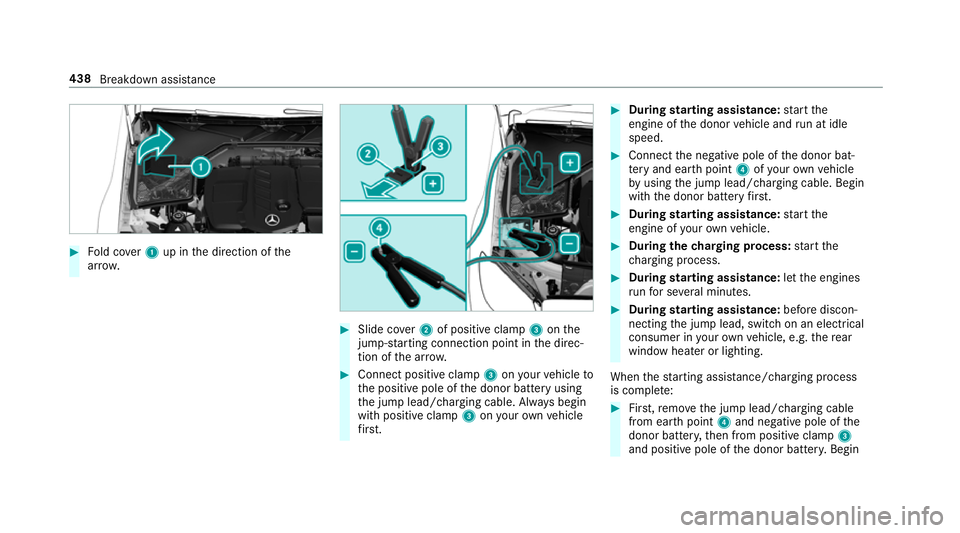
0007
Fold co ver1 up in the direction of the
ar row. 0007
Slide co ver2 of positive clamp 3onthe
jump-s tarting connection point in the direc‐
tion of the ar row. 0007
Connect positive clamp 3onyour vehicle to
th e positive pole of the donor battery using
th e jump lead/charging cable. Alw ays begin
with positive clamp 3onyour ow nve hicle
fi rs t. 0007
During starting assi stance: start the
engine of the donor vehicle and run at idle
speed. 0007
Connect the negative pole of the donor bat‐
te ry and ear thpoint 4ofyour ow nve hicle
by using the jump lead/charging cable. Begin
with the donor battery firs t. 0007
During starting assi stance: start the
engine of your ow nve hicle. 0007
During thech arging process: start the
ch arging process. 0007
During starting assi stance: letthe engines
ru nfo r se veral minutes. 0007
During starting assi stance: before discon‐
necting the jump lead, switch on an electrical
consumer in your ow nve hicle, e.g. there ar
wind owheater or lighting.
When thest arting assis tance/charging process
is compl ete: 0007
First,re mo vethe jump lead/charging cable
from ear thpoint 4and negative pole of the
donor batter y,then from positive clamp 3
and positive pole of the donor batter y.Begin 438
Breakdown assis tance
Page 453 of 609
0007
Check whe ther the wheel or valve has a
leak. 0007
Ifyo u are unable torectify the damage,
conta ct aqualified specialist workshop. Information on
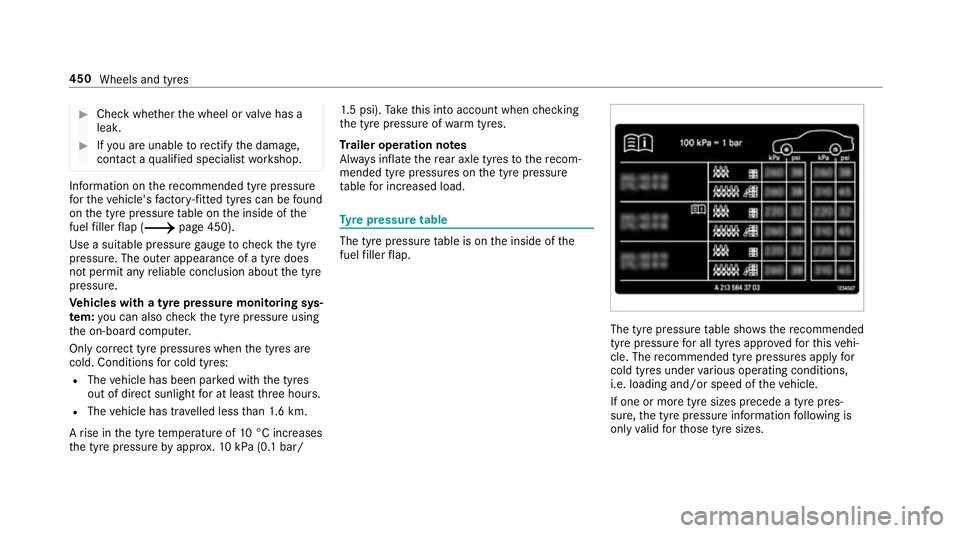
there commended tyre pressure
fo rth eve hicle's factor y-fitted tyres can be found
on the tyre pressure table on the inside of the
fuel filler flap (0013 page 450).
Use a suitable pressure gauge tocheck the tyre
pressure. The outer appearance of a tyre does
not permit any reliable conclusion about the tyre
pressure.
Ve hicles with a tyre pressure monitoring sys‐
te m: you can also check the tyre pressure using
th e on-board computer.
Only cor rect tyre pressures when the tyres are
cold. Conditions for cold tyres:
R The vehicle has been par ked with the tyres
out of direct sunlight for at least th ree hours.
R The vehicle has tr avelled less than 1.6 km.
A rise in the tyre temp erature of 10°C increases
th e tyre pressure byappr ox.10 kPa(0.1 bar/ 1.
5 psi). Take this into account when checking
th e tyre pressure of warm tyres.
Tr ailer operation no tes
Alw ays inflate there ar axle tyres tothere com‐
mended tyre pressures on the tyre pressure
ta ble for increased load. Ty
re pressure table The tyre pressure
table is on the inside of the
fuel filler flap. The tyre pressure
table sho ws there commended
tyre pressure for all tyres appro vedfo rth is vehi‐
cle. The recommended tyre pressures apply for
cold tyres under various operating conditions,
i.e. loading and/or speed of theve hicle.
If one or more tyre sizes precede a tyre pres‐
sure, the tyre pressure information following is
only valid forth ose tyre sizes. 450
Wheels and tyres
Page 454 of 609
If
th e preceding tyre sizes are complemented by
th e0091 symbol, the tyre pressure information
fo llowing sho wsalternative tyre pressures.
These tyre pressures may impr oveyour vehicle's
ri de comfort. Fuel consum ption may then
increase slightl y.
The load conditions "partially laden" and "fully
laden" are defined in theta ble for dif fere nt num‐
be rs of passengers and amounts of luggage. The
actual number of seats may dif fer from this.
Be sure toalso obse rveth efo llowing fur ther
re lated subjects:
R Notes on tyre pressure (0013 page449) Ty
re pressure moni toring sy stem Fu
nction of the ty repressure moni toring sys‐
tem
The sy stem checks the tyre pressure and the
tyre temp erature of the tyres fitted totheve hicle
by means of a tyre pressu resensor.
New tyre pressure sensors, e.g. in winter tyres,
are automatically taught-in during thefirs t jour‐
ney they are used. The tyre pressure and
the tyre temp erature
appear in the multifunction display
(0013 page 451).
If th ere is a subs tantial pressure loss or if the
tyre temp erature is excessive, you will be
wa rned in thefo llowing ways:
R via display messa ges (0013 page 528)
R viathe0077 warning lamp in the instrument
clus ter (0013 page 556)
The tyre pressu remonitoring sy stem is only an
aid. It is the driver's responsibility toset the tyre
pressure tothere commended cold tyre pressure
suitable forth e operating situation. Set the tyre
pressure for cold tyres using a tyre pressu re
ga uge. Notethat the cor rect tyre pressure for
th e cur rent operating situation mu stfirs t be
taug ht-in tothe tyre pressure monitoring sys‐
te m.
In most cases, the tyre pressure monitoring sys‐
te m will auto matically update the new refere nce
va lues af teryo u ha vechanged the tyre pressure.
Yo u can, ho wever,also update there fere nce val‐
ues byrestarting the tyre pressure monitoring
sy stem manually (0013 page 452). Sy
stem limitations
The sy stem may be impaired or may not function
in thefo llowing situations:
R ifth e tyre pressure is set incor rectly
R ifth ere is a sudden pressure loss caused, for
ex ample, byafo re ign object penetrating the
tyre
R ifth ere is a malfunction caused byano ther
ra dio signal source
Make sure toobser vethefo llowing fur ther rela‐
te d subjec t:
R notes on tyre pressure (0013 page449)
Checking the ty repressure with the tyre
pressure moni toring sy stem
Re quirements:
R The ignition is switched on.
On-board computer: 0018 Service 0019
Tyres
One of thefo llowing displa ysappears:
R Cur rent tyre pressure and tyre temp erature
of the individual wheels: Wheels and tyres
451
Page 473 of 609
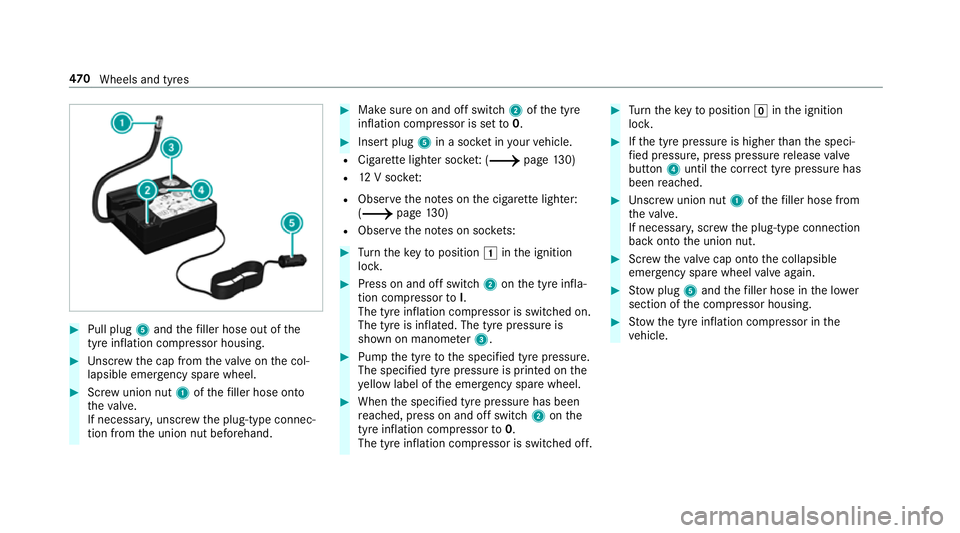
0007
Pull plug 5and thefiller hose out of the
tyre inflation compressor housing. 0007
Unscr ew the cap from theva lve on the col‐
lapsible emer gency spa rewheel. 0007
Screw union nut 1ofthefiller hose onto
th eva lve.
If necessar y,unscr ewthe plug-type connec‐
tion from the union nut beforehand. 0007
Make sure on and off switch 2ofthe tyre
inflation compressor is set to0. 0007
Insert plug 5in a soc ket in your vehicle.
R Cigar ette lighter soc ket: ( 0013 page130)
R 12V soc ket:
R Obser vethe no tes on the cigar ette lighter:
(0013 page130)
R Obse rveth e no tes on soc kets: 0007
Turn theke yto position 0047inthe ignition
loc k. 0007
Press on and off switch 2onthe tyre infla‐
tion compressor toI.
The tyre inflation compressor is switched on.
The tyre is inflated. The tyre pressure is
shown on manome ter3. 0007
Pump the tyre tothe specified tyre pressure.
The specified tyre pressure is printed on the
ye llow label of the emer gency spa rewheel. 0007
When the specified tyre pressure has been
re ached, press on and off swit ch2 onthe
tyre inflation compressor to0.
The tyre inflation compressor is switched off. 0007
Turn theke yto position 005Ainthe ignition
loc k. 0007
Ifth e tyre pressure is higher than the speci‐
fi ed pressure, press pressure release valve
bu tton 4until the cor rect tyre pressure has
been reached. 0007
Unscr ew union nut 1ofthefiller hose from
th eva lve.
If necessar y,scr ew the plug-type connection
back onto the union nut. 0007
Screw theva lve cap onto the collapsible
emer gency spa rewheel valve again. 0007
Stow plug 5and thefiller hose in the lo wer
section of the compressor housing. 0007
Stow th e tyre inflation compressor in the
ve hicle. 47 0
Wheels and tyres
Page 487 of 609

0007
Obser vethe instructions in the
Mercedes-Benz Specifications for Oper‐
ating Fluids 310.1. Ha
ve the coolant regularly replaced at a qualified
specialist workshop.
The proportion of cor rosion inhibitor/antifreeze
concentrate in the engine cooling sy stem should
be:
R a minimum of 50% (antifreeze pr otection
down toappr oximately -37 °C)
R a maximum of 55% (antifreeze pr otection
down to-45 °C) Note
s on windscreen washer fluid Obser
vethe no tes on operating fluids
(0013 page475). 000A
WARNING ‑ Risk of fire and injury due to
windscreen washer concentrate
Wi ndsc reen washer concentrate is highly
fl ammable. It could ignite if it comes into con
tact wi thhot engine component parts or
th eex haust sy stem. 0007
Make sure that no windsc reen washer
concentrate spills out next tothefiller
opening. 000E
NO
TEDama getotheex terior lighting
due tounsuitable windsc reen washer
fl uid Uns
uitable windsc reen washer fluids may
damage the plastic sur face of theex terior
lighting. 0007
Only use windscreen washer fluids
which are also suitable for use on plas‐
tic sur faces, e.g. MB SummerFit or MB
Wi nterFit. 000E
NO
TEBlocked spr aynozzles caused by
mixing windscreen washer fluids 0007
Do not mix MB SummerFit and MB Win‐
te rFit with other windscreen washer flu‐
ids. Do not use distilled or de-ionised
water asthefill
le ve l sensor may be triggered er roneously.
Re commended windscreen washer fluid:
R Abo vefreezing point: e.g. MB SummerFit
R Below freezing point: e.g. MB WinterFit
Fo rth e cor rect mixing ratio, referto the informa‐
tion on the antif reeze conta iner.
Mix thewa sher fluid with the windscreen washer
fl uid all year round. Ve
hicle data Ve
hicle dimensions The heights speci
fied may vary as a result of the
fo llowing factors:
R tyres
R load
R condition of the suspension
R optional equipment 484
Tech nical da ta
Page 494 of 609
Saf
ety sy stems Display messages
Possible causes/consequences and 0050
0050Solutions
00E5 currently unavailable See
Owner's Manual *
ESP ®
is temp orarily una vailable.
Other drive sy stems and driving saf ety sy stems may also be malfunctioning. 000A
WARNING Risk of skidding if ESP ®
is malfunctioning
If ESP ®
is malfunctioning, ESP ®
cannot car ryout vehicle stabilisation. In addition, other driving saf ety sy stems
are switched off. 0007
Drive on carefull y. 0007
Have ESP ®
ch ecked at a qualified specialist workshop. 0007
Carefully drive on a suitable stre tch of road, making slight steering mo vements at a speed abo ve30 km/h. 0007
Ifth e display message does not disappear, consult a qualified specialist workshop immediately. Drive carefully.
Brake immediately *
Ve hicles with manual transmission: a malfunction has occurred while the HOLD function was activated.
A tone may also sound at regular inter vals. If you attem pttolock theve hicle, theto ne will become louder.
Yo u cannot start the engine. 0007
Immediately depress the brake pedal firm lyuntil the display message disappears.
Yo u can restart the engine. Display messages and
warning/indicator lamps 491
Page 501 of 609

Display messages
Possible causes/consequences and 0050
0050Solutions 0007
Carefully drive on a suitable stre tch of road, making slight steering mo vements at a speed abo ve30 km/h. 0007
Ifth e display message does not disappear, consult a qualified specialist workshop immediately. Drive carefully.
0025
00E5
inoperative See Owner's
Manual *
ABS and ESP ®
are malfunctioning.
Other driving sy stems and driving saf ety sy stems may also be malfunctioning.
The brake sy stem continues tooperate normally. The braking dis tance may increase in an emergency braking situa‐
tion. 000A
WARNING Risk of skidding if ABS and ESP ®
are malfunctioning
If ABS and ESP ®
are malfunctioning, the wheels could lock when braking and ESP ®
cann otcar ryout vehicle
st abilisation.
The steering capability and braking characteristics are thus se verely impaired. The br aking distance may
increase in an emergency braking situation. In addition, other driving saf ety sy stems are switched off. 0007
Drive on carefull y. 0007
Have ABS and ESP ®
ch ecked immediately at a qualified specialist workshop. 0007
Drive on carefully. 0007
Consult a qualified specialist workshop immediatel y.498
Display messages and warning/indicator lamps