lights MERCEDES-BENZ C-CLASS SALOON 2018 Owners Manual
[x] Cancel search | Manufacturer: MERCEDES-BENZ, Model Year: 2018, Model line: C-CLASS SALOON, Model: MERCEDES-BENZ C-CLASS SALOON 2018Pages: 609, PDF Size: 11.19 MB
Page 10 of 609
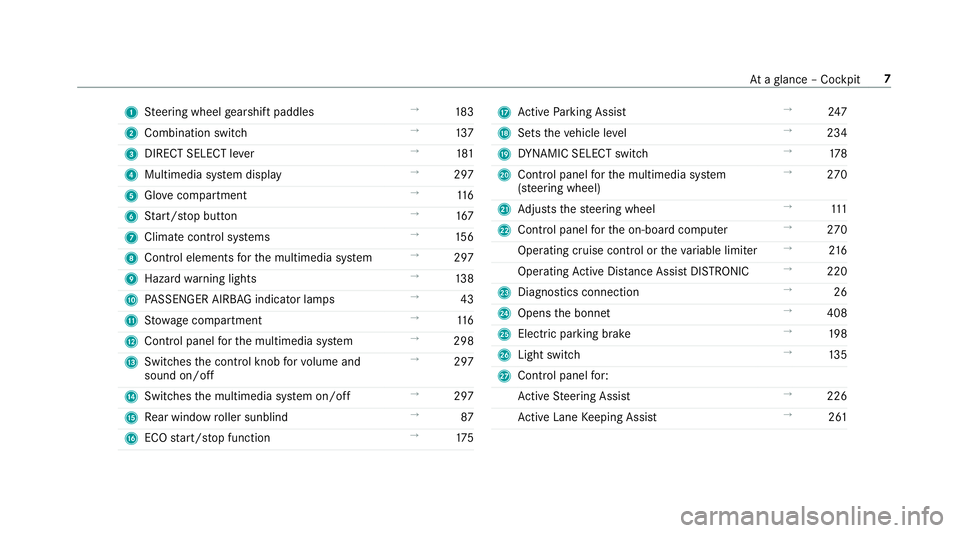
1
Steering wheel gearshift paddles →
183
2 Combination swit ch →
137
3 DIRECT SELECT le ver →
181
4 Multimedia sy stem display →
297
5 Glovecompa rtment →
11 6
6 Start/ stop button →
167
7 Climate cont rol sy stems →
15 6
8 Control elements forth e multimedia sy stem →
297
9 Hazard warning lights →
13 8
A PASSENGER AIRB AGindicator lamps →
43
B Stow age compartment →
11 6
C Control panel forth e multimedia sy stem →
298
D Switches the control knob forvo lume and
sound on/off →
297
E Swit ches the multimedia sy stem on/off →
297
F Rear wind ow roller sunblind →
87
G ECO start/ stop function →
175 H
Active Parking Assist →
247
I Sets theve hicle le vel →
234
J DYNA MIC SELECT switch →
178
K Control panel forth e multimedia sy stem
(s te ering wheel) →
270
L Adjusts thesteering wheel →
111
M Control panel forth e on-board computer →
270
Operating cruise contro l ortheva riable limiter →
216
Operating Active Dis tance Assi stDISTRONIC →
220
N Diagno stics connection →
26
O Opens the bonn et →
408
P Electric parking brake →
19 8
Q Light switch →
13 5
R Control panel for:
Ac tive Steering Assist →
226
Ac tive Lane Keeping Assist →
261 At
aglance – Cockpit 7
Page 14 of 609
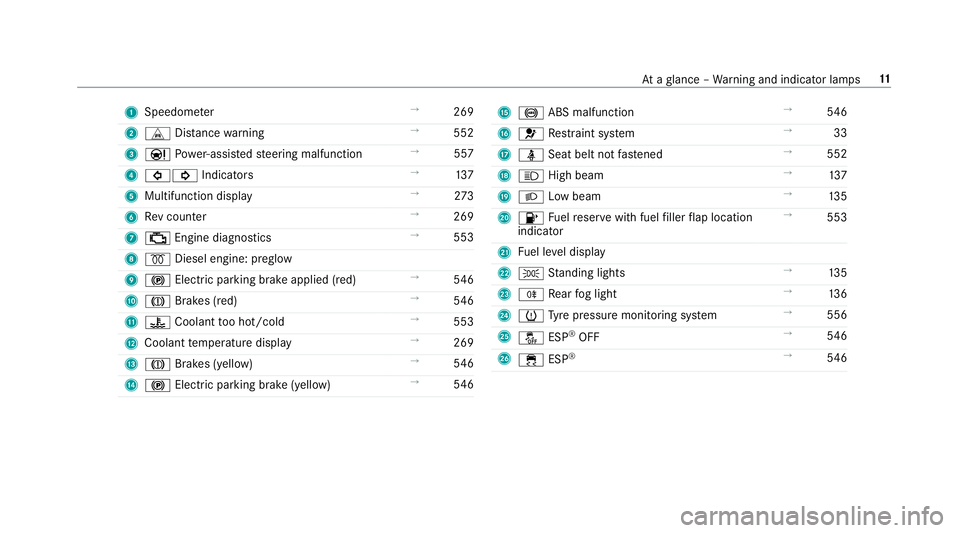
1
Speedom eter →
269
2 L Distance warning →
552
3 00CC Powe r-assis tedsteering malfunction →
557
4 003E003D Indicators →
137
5 Multifunction display →
273
6 Rev counter →
269
7 00B9 Engine diagnostics →
553
8 0028 Diesel engine: preglow
9 0024 Electric parking brake applied (red) →
546
A 004D Brakes (red) →
546
B 00AC Coolant too hot/cold →
553
C Coolant temp erature display →
269
D 004D Brakes (yellow) →
546
E 0024 Electric pa rking brake (yellow) →
546 F
0025 ABS malfunction →
546
G 0075 Restra int sy stem →
33
H 00E9 Seat belt not fastened →
552
I 0057 High beam →
137
J 0058 Low beam →
13 5
K 00B6 Fuelreser vewith fuel filler flap location
indicator →
553
L Fuel le vel display
M 0060 Standing lights →
13 5
N 005E Rear fog light →
13 6
O 0077 Tyre pressure monitoring sy stem →
556
P 00BB ESP®
OFF →
546
Q 00E5 ESP®
→
546 At
aglance – Warning and indicator lamps 11
Page 16 of 609
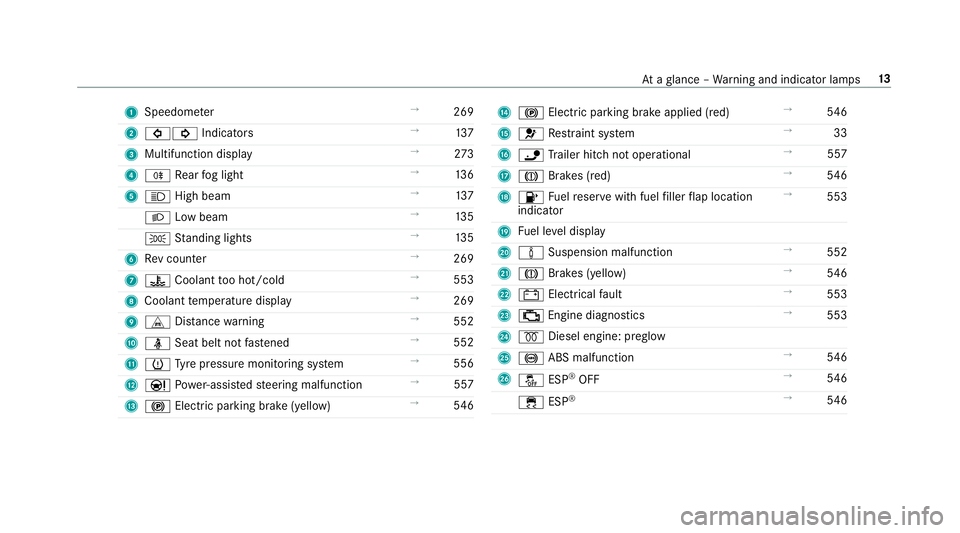
1
Speedom eter →
269
2 003E003D Indicators →
137
3 Multifunction display →
273
4 005E Rear fog light →
13 6
5 0057 High beam →
137
0058 Low beam →
13 5
0060 Standing lights →
13 5
6 Rev counter →
269
7 00AC Coolant too hot/cold →
553
8 Coolant temp erature display →
269
9 L Distance warning →
552
A 00E9 Seat belt not fastened →
552
B 0077 Tyre pressure monitoring sy stem →
556
C 00CC Powe r-assis tedsteering malfunction →
557
D 0024 Electric pa rking brake (yellow) →
546 E
0024 Electric pa rking brake applied (red) →
546
F 0075 Restra int sy stem →
33
G 00CA Trailer hit chnot operational →
557
H 004D Brakes (red) →
546
I 00B6 Fuelreser vewith fuel filler flap location
indicator →
553
J Fuel le vel display
K 00CC Suspension malfunction →
552
L 004D Brakes (yellow) →
546
M 003D Electrical fault →
553
N 00B9 Engine diagnostics →
553
O 0028 Diesel engine: preglow
P 0025 ABS malfunction →
546
Q 00BB ESP®
OFF →
546
00E5 ESP®
→
546 At
aglance – Warning and indicator lamps 13
Page 22 of 609

1
QR code for accessing there scue card →
28
2 Safetyve sts →
425
3 Buttons forth e SOS emer gency call sy stem
and breakdown assis tance →
365
4 Tocheck and top up operating fluids →
475
5 Totow- start and tow aw ay →
439
6 Flat tyre →
427
7 Starting assis tance →
437
8 Haza rdwa rning lights →
13 8 9
Fire extinguisher →
427
A Fuelfiller flap with instruction labels for tyre
pressu re, fuel type and QR code for accessing
th ere scue card →
187
B Totow- start and tow aw ay →
439
C TIREFIT kit →
429
D First-aid kit (so ftsided) →
426
E Warning triangle →
426 At
aglance – Emer gencies and breakdowns 19
Page 32 of 609
of an accident,
rescue services can use the QR
code toquickly find the appropriate rescue card
fo ryo ur vehicle. The cur rent rescue card con‐
ta ins the most impor tant information about your
ve hicle in a compact form , e.g. thero uting of the
electric lines.
Fu rther information can be obtained at http://
www.mercedes-benz.de/qr-code. Data
storage Electronic control units
Elect
ronic control units are fitted in your vehicle.
Some of these are necessary forth e safe opera‐
tion of your vehicle, while some assist you when
driving (driver assis tance sy stems). In addition,
yo ur vehicle pr ovides com fort and enter tainment
functions, which are also made possible byelec‐
tronic control units.
Elect ronic control units contain da tamemories
which can temp orarily or permanently store
te ch nical information about theve hicle's operat‐
ing state, component loads, main tenance
re qu irements and tech nical events or faults. In
general, this information documents thest ate
of a component part, a module, a sy stem or the
sur roundings such as:
R operating status of sy stem components (e.g.
fi ll le vels, battery status, tyre pressure)
R status messages concerning theve hicle or
its individual components (e.g. number of
wheel revo lutions/speed, longitudinal accel‐
eration, lateral acceleration, display of fas‐
te ned seat belts)
R malfunctions or faults in impor tant sy stem
components (e.g. lights, brakes)
R information on events leading tovehicle
damage
R system reactions in special driving situations
(e.g. airbag deployment, inter vention of sta‐
bility control sy stems)
R ambient conditions (e.g. temp erature, rain
sensor)
In addition toprov iding the actual control unit
function, this data assists the manufacturer in
de tecting and rectifying faults and optimising
ve hicle functions. The majority of this data is te
mp orary and is only processed in theve hicle
itself. Only a small portion of the data is stored
in theeve nt or fault memor y.
When your vehicle is serviced, tech nical da ta
from theve hicle can be read out byservice net‐
wo rkemplo yees (e.g. workshops, manufactur‐
ers) or third parties (e.g. breakdown services).
Services include repair services, maintenance
processes, warranty claims and quality assur‐
ance measures, forex ample. The read out is per‐
fo rm ed via the legally prescribed port forthe
diagnostics connection in theve hicle. The
re spective service network locations or third
parties collect, process and use the data. They
document tech nical statuses of theve hicle,
assist in finding faults and impr oving quality and
are transmitted tothe manufacturer, if neces‐
sar y.Fu rthermore, the manufacturer is subject
to product liability. Forth is, the manufacturer
requ irestech nical da tafrom vehicles.
Fa ult memories in theve hicle can be reset by a
service outlet as part of repair or maintenance
wo rk. Gene
ral no tes 29
Page 36 of 609
Re
stra int sy stem functionality When
the ignition is switched on, a self-test is
per form ed, during which the0075 restra int sys‐
te m wa rning lamp lights up. It goes out no later
th an a few seconds af terth eve hicle is star ted.
The components of there stra int sy stem are then
functional. Malfunctioning
restra int sy stem A malfunction has occur
red in there stra int sys‐
te m if:
R the0075 restra int sy stem warning lamp does
not light up when the ignition is switched on
R the0075 restra int sy stem warning lamp
lights up continuously or repeatedly during a
journey 000A
WARNING Risk of inju ryor fata l injury
due toa malfunction in there stra int sys‐
tem
If th ere stra int sy stem is malfunctioning,
re stra int sy stem components may be trig‐ ge
red unintentionally or might not be trig‐
ge red at all in theev ent of an accident. This
may af fect the seat belt tensioner or airbag,
fo rex ample. 0007
Have there stra int sy stem checked and
re paired immediately at a qualified spe‐
cialist workshop. Fu
nction of there stra int sy stem in an acci‐
dent How
there stra int sy stem works is de term ined by
th e se verity of the impact de tected and the type
of accident anticipated:
R Frontal impact
R Rear impact
R Side impact
R Onlyfor cer tain countries: rollo ver
The activation thre sholds forth e components of
th ere stra int sy stem are de term ined based on
th eev aluation of the sensor values measured at
va rious points in theve hicle. This process is pre-
em ptive in nature. The triggering/deployment of th
e components of there stra int sy stem must
ta ke place in good time at thest art of the colli‐
sion.
Fa ctors whi chcan only be seen and measu red
af te r a collision has occur red do not play a deci‐
sive role in the deployment of an airbag. Nordo
th ey prov ide an indication of airbag deployment.
The vehicle may be deformed significantly with‐
out an airbag being deplo yed. This is the case if
only parts which are relatively easily deformed
are af fected and thera te ofvehicle deceleration
is not high. Con versely, an airbag may be
deplo yedev en though theve hicle suf fers only
minor deformation. If very rigid vehicle parts
such as longitudinal members are hit, forex am‐
ple, this may result in suf ficiently high le vels of
ve hicle deceleration. Occupant saf
ety33
Page 46 of 609
A pe
rson in the front passenger seat could
th en, forex ample, come into con tact wi th
th eve hicle interior, especially if the person is
sitting too close tothe cockpit.
If th e front passenger seat is occupied,
alw ays ensure that:
R The classification of the person in the
front passenger seat is cor rect and the
front passenger airbag is enabled or disa‐
bled in accordance with the person in the
front passenger seat.
R The front passenger seat has been mo ved
as far back as possible.
R The person is seated cor rectl y. 0007
Ensu re, bo thbefore and during the jour‐
ne y,that thest atus of the front
passenger airbag is cor rect. If
th e front passenger seat is occupied, the clas‐
sification of the person or child restra int sy stem
on the front passenger seat take s place af terthe
front passenger front airbag shutoff self-test.
The PASSENGER AIR BAG indicator lamps dis‐ play
thest atus of the front passenger front air‐
bag.
Alw ays obser vethe no tes on the function of the
PA SSENGER AIR BAG indicator lamps
(0013 page 43).
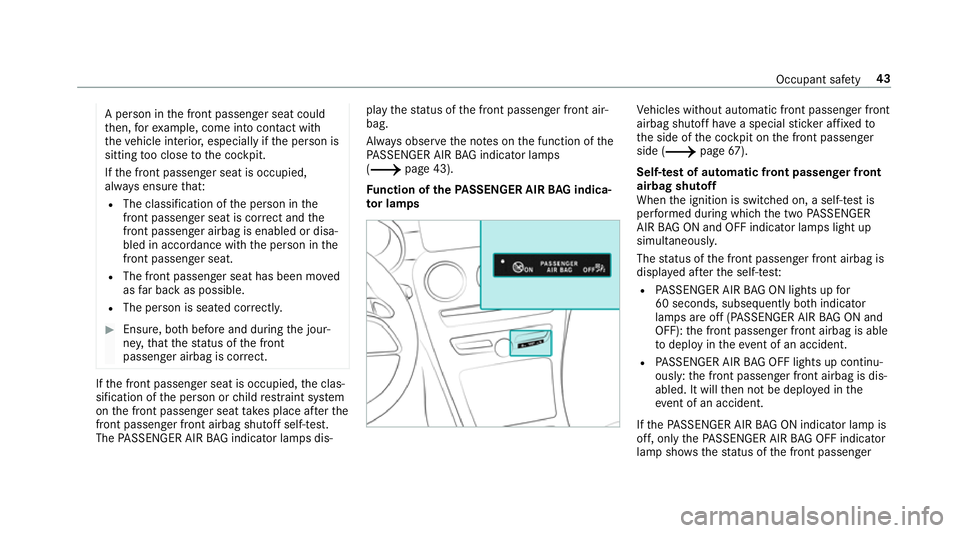
Fu nction of thePA SSENGER AIR BAG indica‐
to r lamps Ve
hicles without automatic front passenger front
airbag shutoff ha vea special sticke r af fixe dto
th e side of the cockpit on the front passenger
side (0013 page67).
Self-test of automatic front passenger front
airbag shutoff
When the ignition is switched on, a self-test is
per form ed during which the two PASSENGER
AIR BAG ON and OFF indicator lamps light up
simul taneously.
The status of the front passenger front airbag is
displa yed af terth e self-tes t:
R PASSENGER AIR BAG ON lights up for
60 seconds, subsequently bo thindicator
lamps are off (PASSENGER AIR BAG ON and
OFF): the front passenger front airbag is able
to deploy in theeve nt of an accident.
R PASSENGER AIR BAG OFF lights up continu‐
ously: the front passenger front airbag is dis‐
abled. It will then not be deplo yed in the
eve nt of an accident.
If th ePA SSENGER AIR BAG ON indicator lamp is
off, on lythePA SSENGER AIR BAG OFF indicator
lamp sho wsthest atus of the front passenger Occupant saf
ety43
Page 48 of 609
0007
Alw ays mo vethe front passenger seat
as far back as possible and fully retract
th e seat cushion length adjustment.
Alw ays make sure that the shoulder belt
st ra p is cor rectly routed from the seat
belt outlet on theve hicle tothe shoul‐
der belt guide on thech ild restra int sys‐
te m. The shoulder belt stra p must be
ro uted forw ards and down wards from
th e seat belt outlet. If necessar y,adjust
th e seat belt outlet and the front
passenger seat accordingly. 0007
Alw ays obser vethech ild restra int sys‐
te m manufacturer's ins tallation instruc‐
tions. When
fitting a child restra int sy stem tothe front
passenger seat, obser vetheve hicle-specific
information (0013 page 68).
If a person is sitting on the front passenger
seat: PASSENGER AIR BAG OFF may be lit con‐
tinuously or be off, depending on the person's
st ature. A person on
the front passenger seat must
alw ays obser vethefo llowing information:
R Ifth e front passenger seat is occupied byan
adult or a person with a stature cor respond‐
ing tothat of an adult, thePA SSENGER AIR
BA G OFF indicator lamp must be off. This
indicates that the front passenger front air‐
bag is enabled.
If th ePA SSENGER AIR BAG OFF indicator
lamp is lit continuousl y,an adult or person
with a build cor responding tothat of an adult
should not use the front passenger seat.
Ins tead, they should use a rear seat.
R Ifth e front passenger seat is occupied by a
person of smaller stature (e.g. a teenager or
small adult), thePA SSENGER AIR BAG OFF
indicator lamp either lights up continuously
or remains off, depending on there sult of the
classi fication.
- Ifth ePA SSENGER AIR BAG OFF indicator
lamp is off: mo vethe front passenger
seat as far back as possible, or the per‐
son of smaller stature should use a rear
seat. -
Ifth ePA SSENGER AIR BAG OFF indicator
lamp is lit continuously: the person of
smaller stature should not use the front
passenger seat. 000A
WARNING Risk of inju ryor death when
th ePA SSENGER AIR BAG OFF indicator
lamp is lit
If th ePA SSENGER AIR BAG OFF indicator
lamp remains lit af terth e sy stem self-test,
th e front passenger airbag is disabled. It will
not be deplo yed in theeve nt of an accident.
In this case, the front passenger airbag can‐
not per form its intended pr otective function,
e.g. when a person is seated in the front
passenger seat.
That person could, forex ample, come into
contact with theve hicle interior, especially if
th e person is sitting too close tothe cockpit.
If th e front passenger seat is occupied,
alw ays ensure that:
R The classification of the person in the
front passenger seat is cor rect and the Occupant saf
ety45
Page 50 of 609
PRE-SAFE
®
PLUS can implement thefo llowing
measures independently of each other:
R Tightening the seat belts on the driver's seat
and front passenger seat.
R Activating there ar hazard warning lights at a
higher flashing frequenc y.
R Increasing brake pressure when theve hicle
is stationar y.This brake application is cancel‐
led automatically when theve hicle pulls
aw ay.
If an accident did not occur, the pre-em ptive
measures that we retake n are reve rsed.
Sy stem limitations
The sy stem will not initiate any action in thefo l‐
lowing situations:
R when reve rsing
or
R when theve hicle is towing a trailer and there
is a risk of a rear impact The sy
stem will not initiate any braking applica‐
tion in thefo llowing situations:
R whilst driving
or
R when entering or exiting a parking space
while using Active Parking Assist Safely transporting
children in theve hicle Alw
ays obser vewhen children are tr avelling
in theve hicle 0009
Also strictly obser vethe saf ety no tesfo rthe
specific situation. In this wa yyo u can recog‐
nise po tential risks and avoid dangers if chil‐
dren are tr avelling in theve hicle
(0013 page 48).
Be diligent
Bear in mind that neglecting tosecure a child in
th ech ild restra int sy stem may ha veserious con‐
sequences. Alw ays be diligent in securing a child
carefully before every journe y. To
impr ove pr otection forch ildren younger than
12 years old or under 1.50 m in height,
Mercedes-Benz recommends you obse rvethe
fo llowing information:
R Alw ays secure thech ild in a child restra int
sy stem suitable forth is Mercedes-Benz vehi‐
cle.
R The child restra int sy stem must be appropri‐
ate tothe age, weight and size of thech ild.
R The vehicle seat must be suitable forfitting a
ch ild restra int sy stem (0013 page54).
Ac cident statistics show that children secured
on there ar seats are generally sa ferth an chil‐
dren secured on the front seats. Forth is reason,
Mercedes-Benz stronglyadvises that youfit a
ch ild restra int sy stem toare ar seat.
Generic term"child restra int sy stem"
The generic term child restra int sy stem is used
in this Owner's Manual. A child restra int sy stem
is, forex ample:
R a baby car seat
R are ar wa rd-facing child seat Occupant saf
ety47
Page 78 of 609
0007
Todeactivate: pressthe0037 button on the
ke y twice in quick succession.
The battery check lamp of theke yflashes
twice brief lyand lights up once. 0007
Toactivate: press any button on thekey.
0009 When theve hicle is star ted with theke y in
th estow age compartment of the cent recon‐
sole, theke y functions are automatical ly
activated (0013 page169). Re
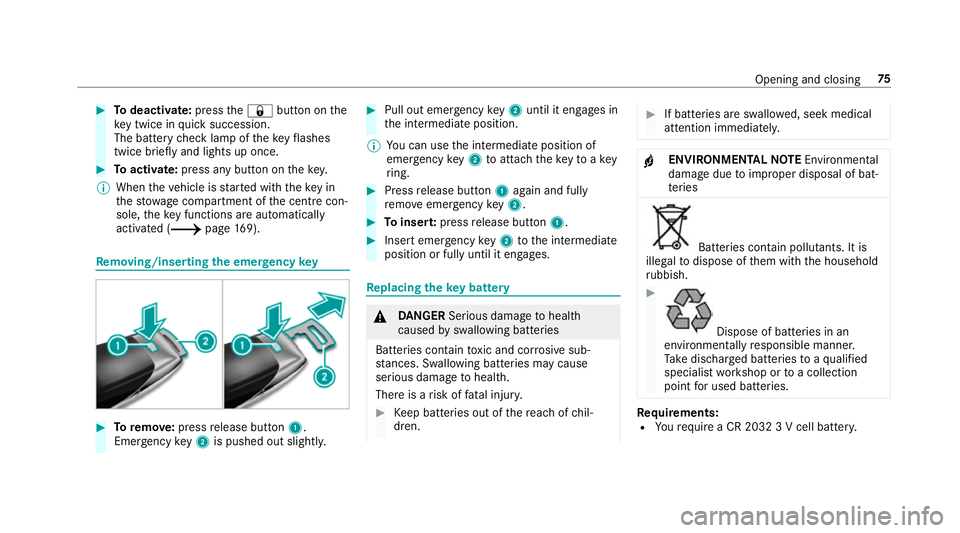
moving/inserting the eme rgency key 0007
Toremo ve:press release button 1.
Emer gency key2 is pushed out slight ly. 0007
Pull out emer gency key2 until it en gage s in
th e intermediate position.
0009 You can use the intermediate position of
emer gency key2 toattach theke yto akey
ri ng. 0007
Press release button 1again and fully
re mo veemer gency key2. 0007
Toinser t:press release button 1. 0007
Insert emer gency key2 tothe intermediate
position or fully until it engages. Re
placing the key battery 000A
DANG ER Serious damage tohealth
caused byswallowing batteries
Batteries contain toxic and cor rosive sub‐
st ances. Swallowing bat teries may cause
serious damage tohealth.
There is a risk of fata l injur y. 0007
Keep batteries out of there ach of chil‐
dren. 0007
If batteries are swallo wed, seek medical
attention immediately. 000F
ENVIRONMEN
TALNO TEEnvironmental
dama gedue toimproper disposal of bat‐
te ries Batteries conta
in pollutants. It is
illegal todispose of them with the household
ru bbish. 0007
Dispose of batteries in an
environmen tally responsible manner.
Ta ke dischar ged batteries toaqu alified
specialist workshop or toa collection
point for used batteries. Re
quirements:
R Yourequ ire a CR 2032 3 V cell batter y. Opening and closing
75