vehicle MERCEDES-BENZ C-Class SEDAN 2016 W205 Owner's Guide
[x] Cancel search | Manufacturer: MERCEDES-BENZ, Model Year: 2016, Model line: C-Class SEDAN, Model: MERCEDES-BENZ C-Class SEDAN 2016 W205Pages: 398, PDF Size: 9.57 MB
Page 38 of 398
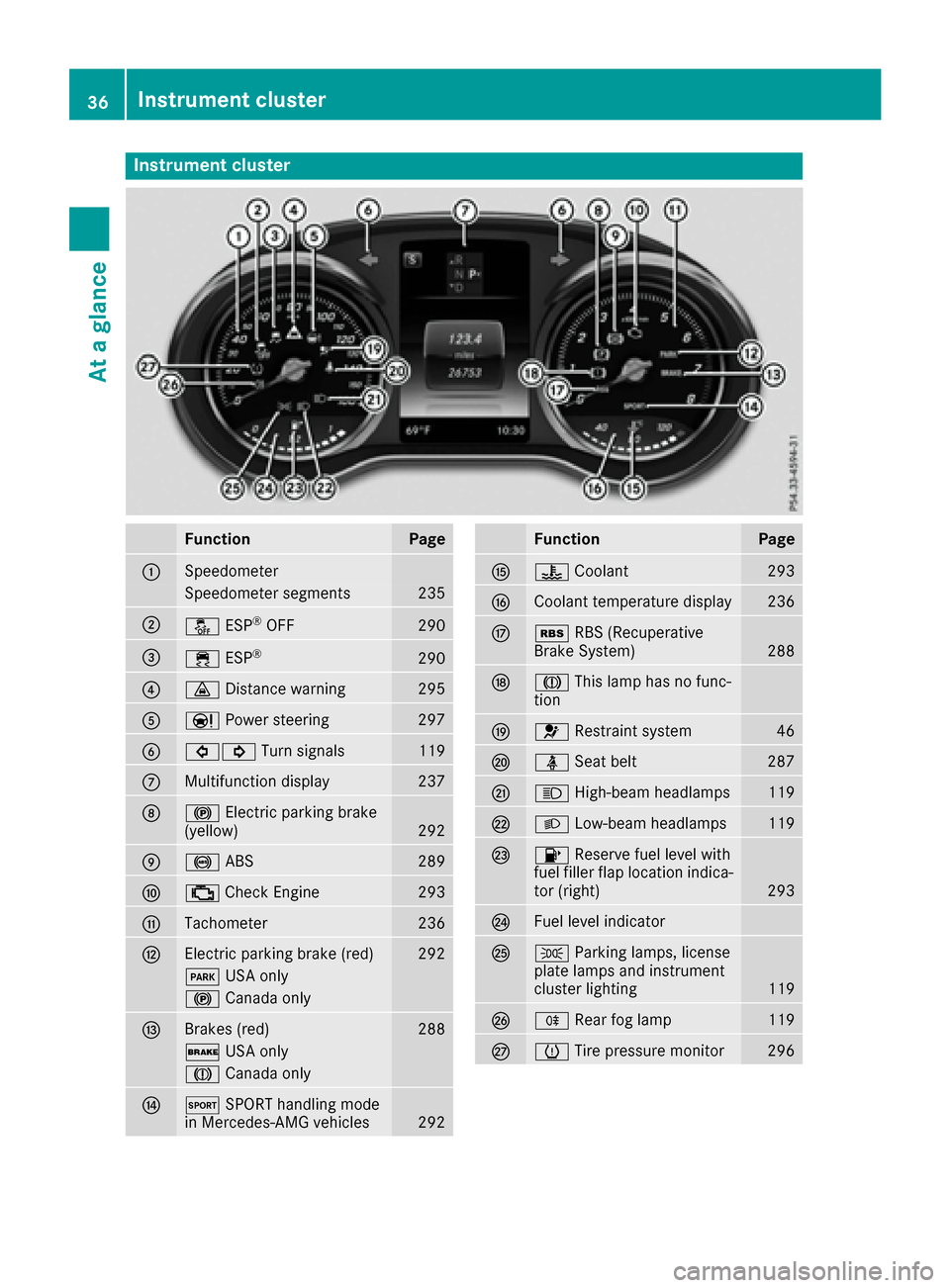
Instrument cluster
FunctionPage
:Speedometer
Speedometer segments235
;å ESP®OF F290
=÷ ESP®29 0
?· Distanc ewarning29 5
AÐ Powersteering29 7
B#! Turn signals119
CMultifunction display237
D! Electric parking brak e
(yellow)29 2
E! ABS289
F; CheckEngin e293
GTachometer236
HElectric parking brak e(red)29 2
F USAonly
! Canad aonly
IBrake s(red)28 8
$ USAonly
J Canad aonly
JM SPORT handlin gmod e
in Mercedes-AM Gvehicles29 2
FunctionPag e
K? Coolan t293
LCoolan ttemperature display23 6
Mé RBS (Recuperative
Brake System)28 8
NJ This lamp has no func-
tion
O6 Restrain tsystem46
Pü Seat belt287
QK High-beam headlamps119
RL Low-beam headlamps119
S8 Reserve fuel level wit h
fuel filler flap location indica-
to r(right )
293
TFue llevel indicator
UT Parking lamps, license
plat elamp sand instrumen t
cluste rlighting
11 9
VR Rear fog lamp119
Wh Tirepressur emonitor29 6
36Instrument cluster
At a glance
Page 40 of 398
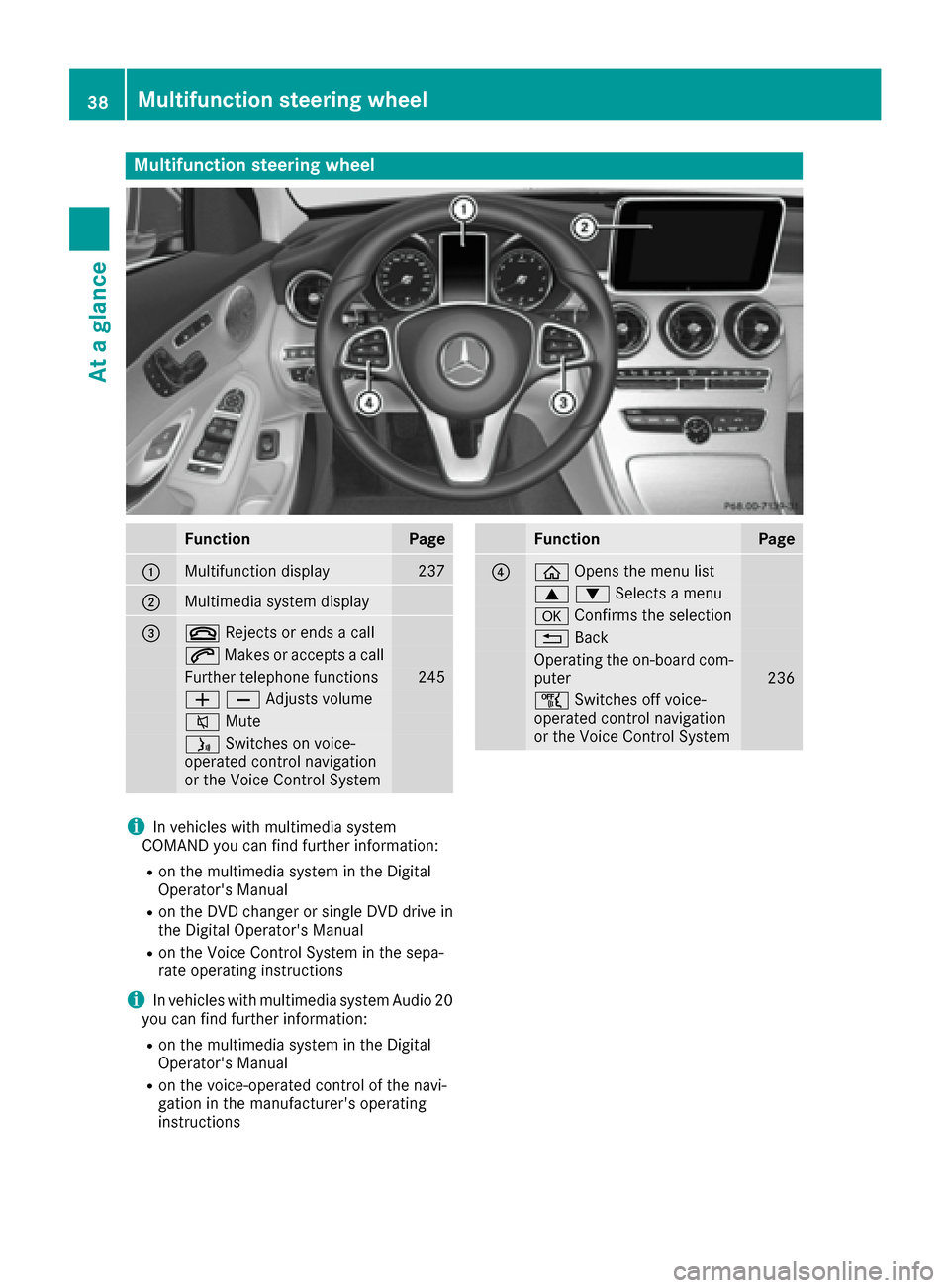
Multifunction steering wheel
FunctionPage
:Multifunction display237
;Multimedia system display
=~Rejects or ends a call
6Makes or accepts a call
Further telephone functions245
WXAdjusts volume
8 Mute
óSwitches on voice-
operated control navigation
or the Voice Control System
FunctionPage
?ò Opens the menu list
9:Selects a menu
aConfirms the selection
%Back
Operating the on-board com-
puter236
ñSwitches off voice-
operated control navigation
or the Voice Control System
iIn vehicles with multimedia system
COMAND you can find further information:
Ron the multimedia system in the Digital
Operator's Manual
Ron the DVD changer or single DVD drive in
the Digital Operator's Manual
Ron the Voice Control System in the sepa-
rate operating instructions
iIn vehicles with multimedia system Audio 20
you can find further information:
Ron the multimedia system in the Digital
Operator's Manual
Ron the voice-operated control of the navi-
gation in the manufacturer's operating
instructions
38Multifunction steering wheel
At a glance
Page 41 of 398
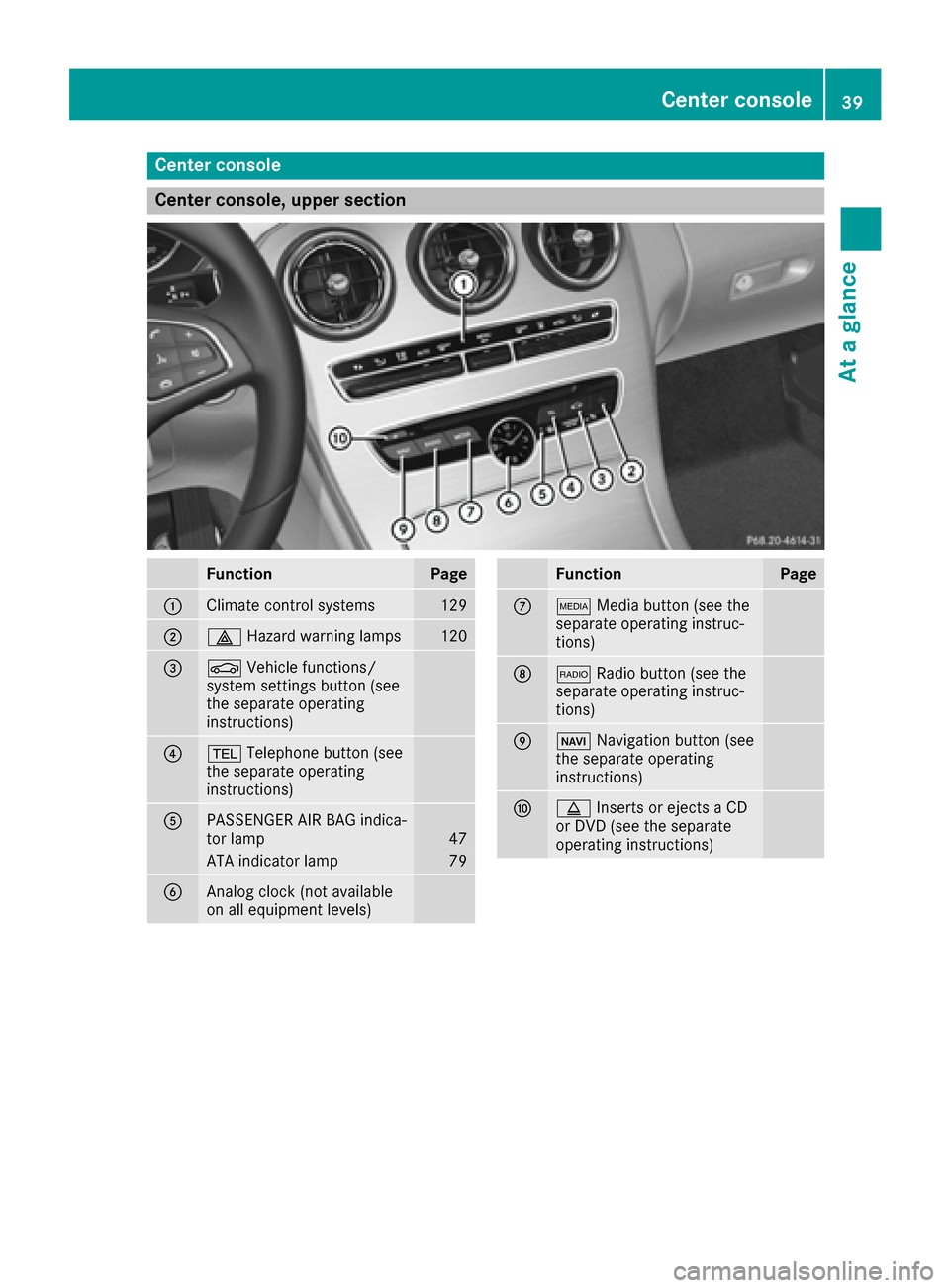
Center console
Center console, upper section
FunctionPage
:Climate control systems129
;£Hazard warning lamps120
=ØVehicle functions/
system settings button (see
the separate operating
instructions)
?% Telephone button (see
the separate operating
instructions)
APASSENGER AIR BAG indica-
tor lamp47
ATA indicator lamp79
BAnalog clock (not available
on all equipment levels)
FunctionPage
CÕ Media button (see the
separate operating instruc-
tions)
D$ Radio button (see the
separate operating instruc-
tions)
EØ Navigation button (see
the separate operating
instructions)
Fþ Inserts or ejects a CD
or DVD (see the separate
operating instructions)
Center console39
At a glance
Page 42 of 398
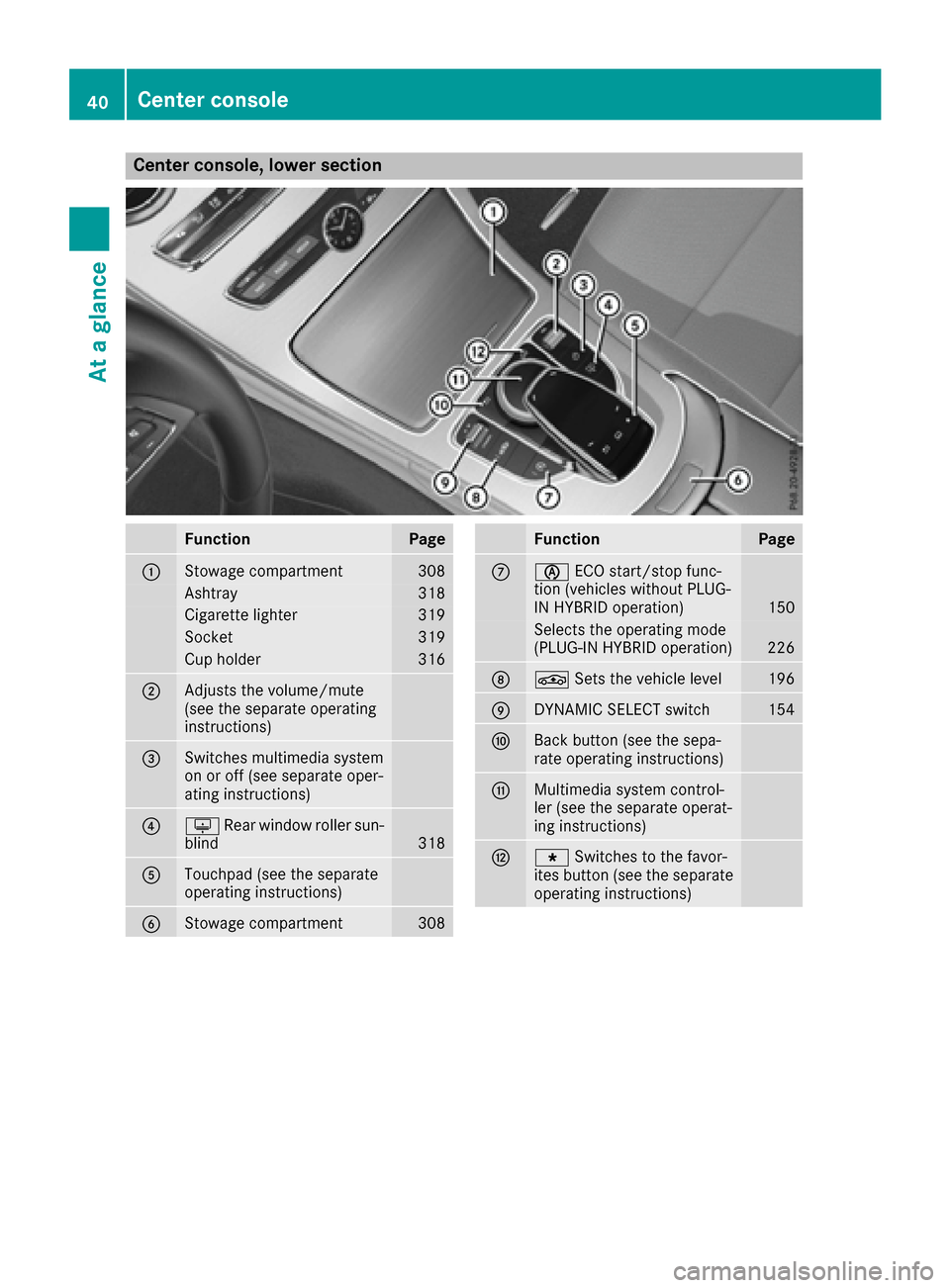
Center console, lower section
FunctionPage
:Stowage compartment308
Ashtray318
Cigarette lighter319
Socket319
Cup holder316
;Adjusts the volume/mute
(see the separate operating
instructions)
=Switches multimedia system
on or off (see separate oper-
ating instructions)
?uRear window roller sun-
blind318
ATouchpad (see the separate
operating instructions)
BStowage compartment308
FunctionPage
Cè ECO start/stop func-
tion (vehicles without PLUG-
IN HYBRID operation)
150
Selects the operating mode
(PLUG-IN HYBRID operation)226
DÉ Sets the vehicle level196
EDYNAMIC SELECT switch154
FBack button (see the sepa-
rate operating instructions)
GMultimedia system control-
ler (see the separate operat-
ing instructions)
HgSwitches to the favor-
ites button (see the separate
operating instructions)
40Center console
At a glance
Page 43 of 398
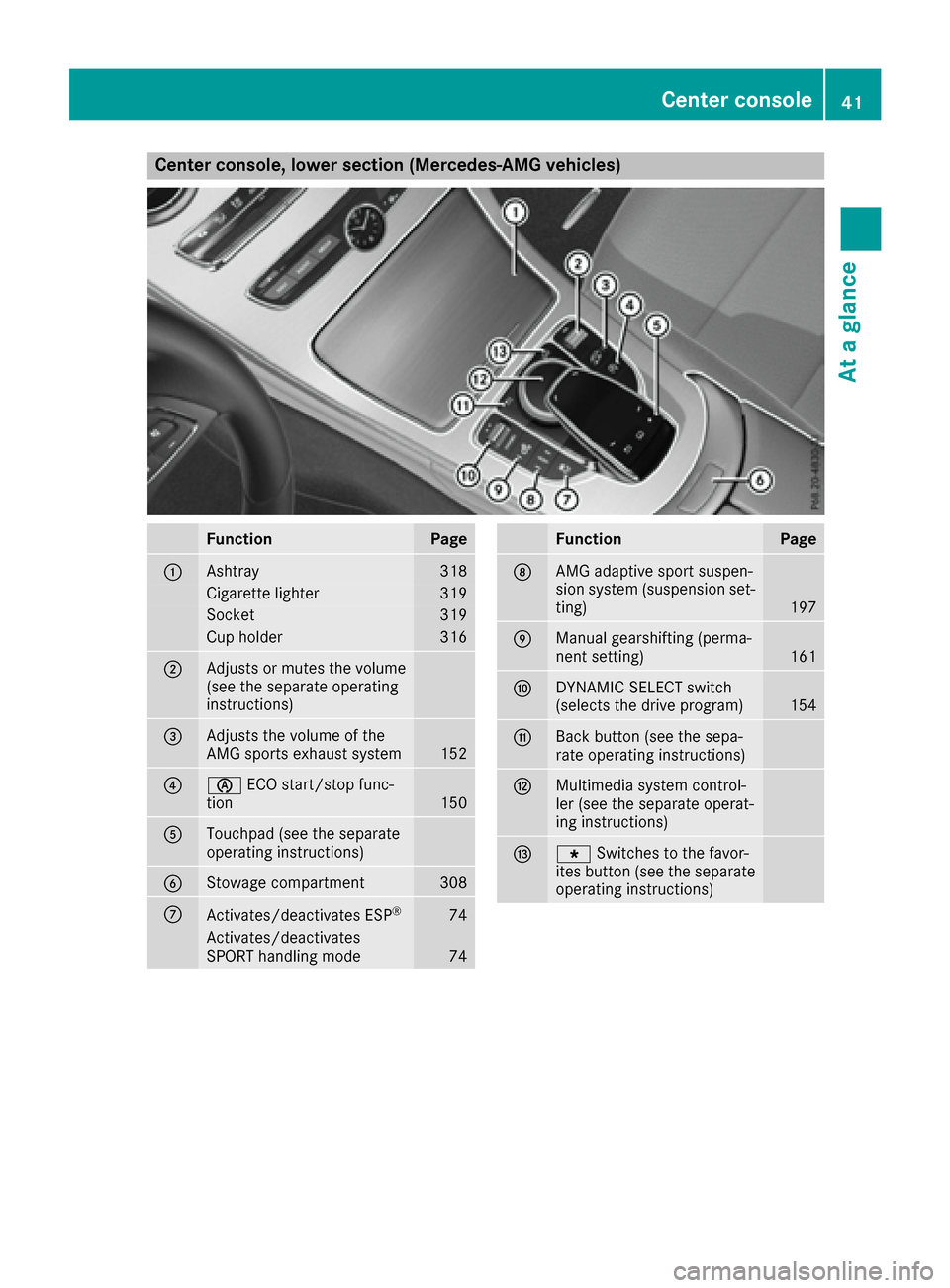
Center console, lower section (Mercedes-AMG vehicles)
FunctionPage
:Ashtray318
Cigarette lighter319
Socket319
Cup holder316
;Adjusts or mutes the volume
(see the separate operating
instructions)
=Adjusts the volume of the
AMG sports exhaust system152
?èECO start/stop func-
tion150
ATouchpad (see the separate
operating instructions)
BStowage compartment308
CActivates/deactivates ESP®74
Activates/deactivates
SPORT handling mode74
FunctionPage
DAMG adaptive sport suspen-
sion system (suspension set-
ting)
197
EManual gearshifting (perma-
nent setting)161
FDYNAMIC SELECT switch
(selects the drive program)154
GBack button (see the sepa-
rate operating instructions)
HMultimedia system control-
ler (see the separate operat-
ing instructions)
Ig Switches to the favor-
ites button (see the separate
operating instructions)
Center console41
At a glance
Page 45 of 398
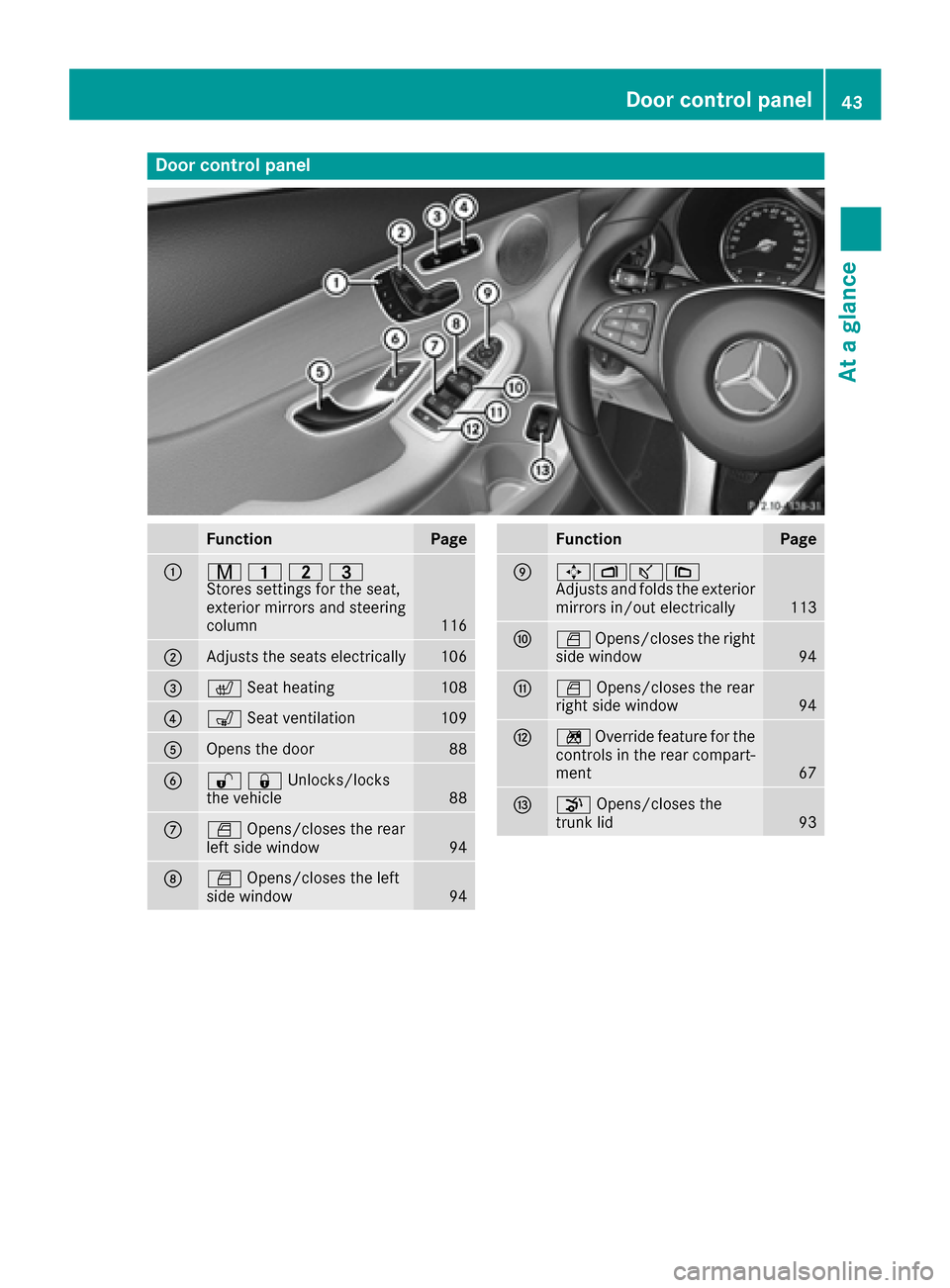
Door controlpanel
FunctionPage
:r 45=
Stores settings for the seat,
exterior mirrors and steering
column
116
;Adjusts the seats electrically106
=c Seat heating108
?sSeat ventilation109
AOpens the door88
B%&Unlocks/locks
the vehicle88
CWOpens/closes the rear
left side window94
DW Opens/closes the left
side window94
FunctionPage
E7Zª\
Adjusts and folds the exterior
mirrors in/out electrically
113
FW Opens/closes the right
side window94
GW Opens/closes the rear
right side window94
Hn Override feature for the
controls in the rear compart-
ment
67
Ip Opens/closes the
trunk lid93
Door control panel43
At a glance
Page 46 of 398
Hybrid vehicles
General notes
Hybrid technology combines a fuel efficient
internal combustion engine with a powerful
electric motor.
Important safety notes
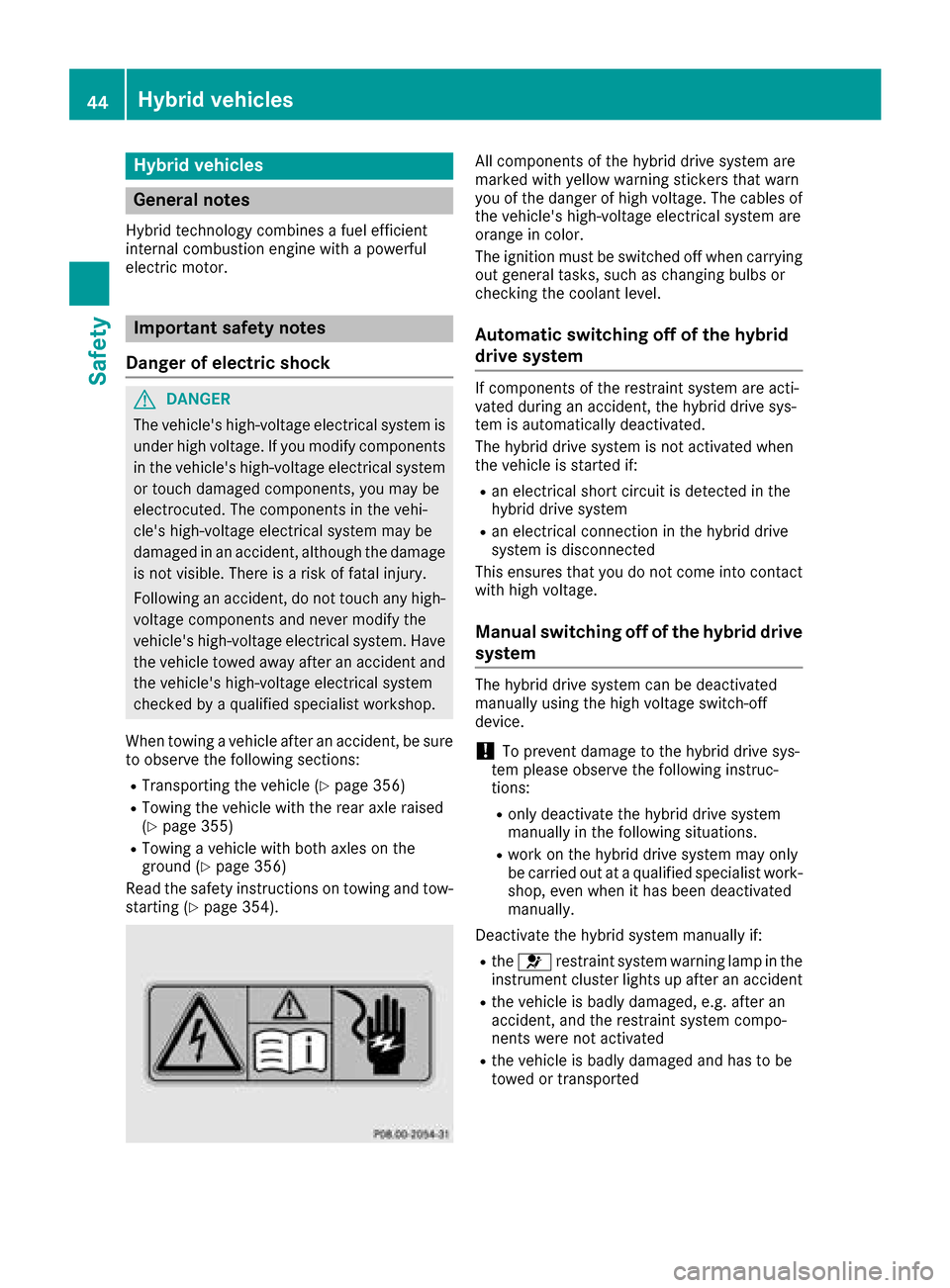
Danger of electric shock
GDANGER
The vehicle's high-voltage electrical system is under high voltage. If you modify components
in the vehicle's high-voltage electrical system
or touch damaged components, you may be
electrocuted. The components in the vehi-
cle's high-voltage electrical system may be
damaged in an accident, although the damage
is not visible. There is a risk of fatal injury.
Following an accident, do not touch any high-
voltage components and never modify the
vehicle's high-voltage electrical system. Have
the vehicle towed away after an accident and
the vehicle's high-voltage electrical system
checked by a qualified specialist workshop.
When towing a vehicle after an accident, be sure
to observe the following sections:
RTransporting the vehicle (Ypage 356)
RTowing the vehicle with the rear axle raised
(Ypage 355)
RTowing a vehicle with both axles on the
ground (Ypage 356)
Read the safety instructions on towing and tow-
starting (
Ypage 354).
All components of the hybrid drive system are
marked with yellow warning stickers that warn
you of the danger of high voltage. The cables of
the vehicle's high-voltage electrical system are
orange in color.
The ignition must be switched off when carrying
out general tasks, such as changing bulbs or
checking the coolant level.
Automatic switching off of the hybrid
drive system
If components of the restraint system are acti-
vated during an accident, the hybrid drive sys-
tem is automatically deactivated.
The hybrid drive system is not activated when
the vehicle is started if:
Ran electrical short circuit is detected in the
hybrid drive system
Ran electrical connection in the hybrid drive
system is disconnected
This ensures that you do not come into contact
with high voltage.
Manual switching off of the hybrid drive
system
The hybrid drive system can be deactivated
manually using the high voltage switch-off
device.
!To prevent damage to the hybrid drive sys-
tem please observe the following instruc-
tions:
Ronly deactivate the hybrid drive system
manually in the following situations.
Rwork on the hybrid drive system may only
be carried out at a qualified specialist work-
shop, even when it has been deactivated
manually.
Deactivate the hybrid system manually if:
Rthe 6 restraint system warning lamp in the
instrument cluster lights up after an accident
Rthe vehicle is badly damaged, e.g. after an
accident, and the restraint system compo-
nents were not activated
Rthe vehicle is badly damaged and has to be
towed or transported
44Hybrid vehicles
Safety
Page 47 of 398
XIf possible, move the vehicle out of the
danger zone:shift the transmission into posi-
tion N.
XRelease the electric parking brake.
XRoll the vehicle to a safe place and park it
safely.
Get assistance from others if necessary.
The vehicle is locked automatically when the
ignition is switched on and the wheels are turn-
ing. There is therefore a risk of being locked out
if the vehicle is being pushed or tested on a
dynamometer.
XSwitch the ignition off.
XShift the transmission to position P.
Depress the electric parking brake
(
Ypage 178).
Secure the vehicle against rolling away
(
Ypage 380).
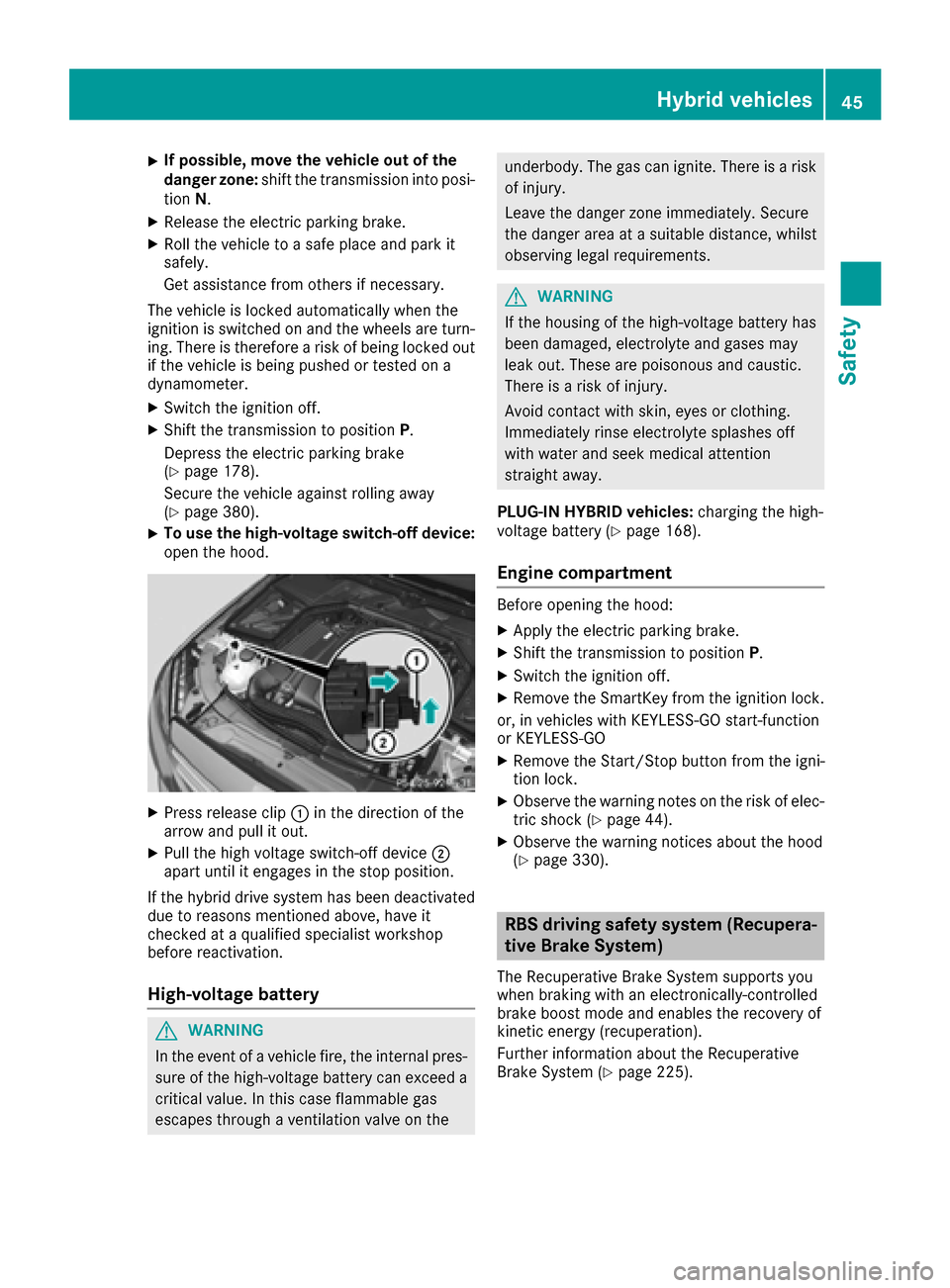
XTo use the high-voltage switch-off device:
open the hood.
XPress release clip :in the direction of the
arrow and pull it out.
XPull the high voltage switch-off device ;
apart until it engages in the stop position.
If the hybrid drive system has been deactivated
due to reasons mentioned above, have it
checked at a qualified specialist workshop
before reactivation.
High-voltage battery
GWARNING
In the event of a vehicle fire, the internal pres- sure of the high-voltage battery can exceed a
critical value. In this case flammable gas
escapes through a ventilation valve on the
underbody. The gas can ignite. There is a risk
of injury.
Leave the danger zone immediately. Secure
the danger area at a suitable distance, whilst
observing legal requirements.
GWARNING
If the housing of the high-voltage battery has
been damaged, electrolyte and gases may
leak out. These are poisonous and caustic.
There is a risk of injury.
Avoid contact with skin, eyes or clothing.
Immediately rinse electrolyte splashes off
with water and seek medical attention
straight away.
PLUG-IN HYBRID vehicles: charging the high-
voltage battery (
Ypage 168).
Engine compartment
Before opening the hood:
XApply the electric parking brake.
XShift the transmission to position P.
XSwitch the ignition off.
XRemove the SmartKey from the ignition lock.
or, in vehicles with KEYLESS-GO start-function
or KEYLESS ‑GO
XRemove the Start/Stop button from the igni-
tion lock.
XObserve the warning notes on the risk of elec-
tric shock (Ypage 44).
XObserve the warning notices about the hood
(Ypage 330).
RBS driving safety system (Recupera-
tive Brake System)
The Recuperative Brake System supports you
when braking with an electronically-controlled
brake boost mode and enables the recovery of
kinetic energy (recuperation).
Further information about the Recuperative
Brake System (
Ypage 225).
Hybrid vehicles45
Safety
Z
Page 48 of 398
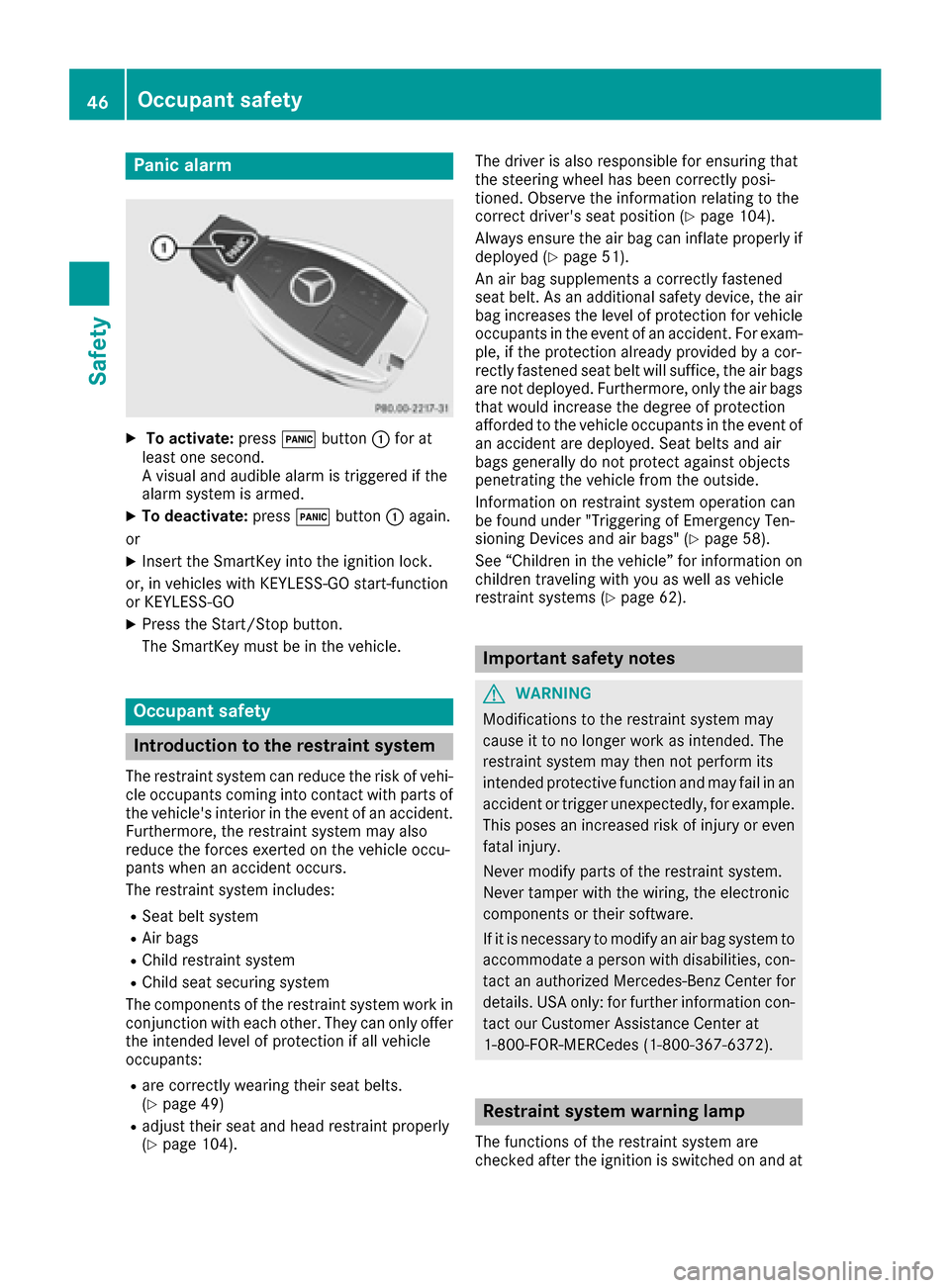
Panic alarm
XTo activate:press!button :for at
least one second.
A visual and audible alarm is triggered if the
alarm system is armed.
XTo deactivate: press!button :again.
or
XInsert the SmartKey into the ignition lock.
or, in vehicles with KEYLESS-GO start-function
or KEYLESS ‑GO
XPress the Start/Stop button.
The SmartKey must be in the vehicle.
Occupant safety
Introduction to the restraint system
The restraint system can reduce the risk of vehi-
cle occupants coming into contact with parts of
the vehicle's interior in the event of an accident.
Furthermore, the restraint system may also
reduce the forces exerted on the vehicle occu-
pants when an accident occurs.
The restraint system includes:
RSeat belt system
RAir bags
RChild restraint system
RChild seat securing system
The components of the restraint system work in
conjunction with each other. They can only offer
the intended level of protection if all vehicle
occupants:
Rare correctly wearing their seat belts.
(Ypage 49)
Radjust their seat and head restraint properly
(Ypage 104). The driver is also responsible for ensuring that
the steering wheel has been correctly posi-
tioned. Observe the information relating to the
correct driver's seat position (
Ypage 104).
Always ensure the air bag can inflate properly if
deployed (
Ypage 51).
An air bag supplements a correctly fastened
seat belt. As an additional safety device, the air
bag increases the level of protection for vehicle
occupants in the event of an accident. For exam-
ple, if the protection already provided by a cor-
rectly fastened seat belt will suffice, the air bags
are not deployed. Furthermore, only the air bags that would increase the degree of protection
afforded to the vehicle occupants in the event of
an accident are deployed. Seat belts and air
bags generally do not protect against objects
penetrating the vehicle from the outside.
Information on restraint system operation can
be found under "Triggering of Emergency Ten-
sioning Devices and air bags" (
Ypage 58).
See “Children in the vehicle” for information on
children traveling with you as well as vehicle
restraint systems (
Ypage 62).
Important safety notes
GWARNING
Modifications to the restraint system may
cause it to no longer work as intended. The
restraint system may then not perform its
intended protective function and may fail in an
accident or trigger unexpectedly, for example.
This poses an increased risk of injury or even fatal injury.
Never modify parts of the restraint system.
Never tamper with the wiring, the electronic
components or their software.
If it is necessary to modify an air bag system to
accommodate a person with disabilities, con-
tact an authorized Mercedes-Benz Center for
details. USA only: for further information con-
tact our Customer Assistance Center at
1-800-FOR-MERCedes (1‑800‑367‑6372).
Restraint system warning lamp
The functions of the restraint system are
checked after the ignition is switched on and at
46Occupant safety
Safety
Page 49 of 398
regular intervals while the engine is running.
Therefore, malfunctions can be detected in
good time.
The6 restraint system warning lamp in the
instrument cluster lights up when the ignition is
switched on. It goes out no later than a few sec-
onds after the vehicle is started. The compo-
nents of the restraint system are in operational
readiness.
A malfunction has occurred if the 6restraint
system warning lamp:
Rdoes not light up after the ignition is switched
on
Rdoes not go out after a few seconds with the
engine running
Rlights up again while the engine is running
All vehicles, except hybrid vehicles:
GWARNING
If restraint system is malfunctioning, restraint
system components may be triggered unin-
tentionally or might not be triggered at all in
the event of an accident with a high rate of
vehicle deceleration. This can affect the Emer- gency Tensioning Device or air bag, for exam-
ple. This poses an increased risk of injury or
even fatal injury.
Have the restraint system checked and
repaired in a qualified specialist workshop as
soon as possible.
Hybrid vehicles:
GDANGER
If the restraint system is malfunctioning, indi- vidual restraint system components may be
triggered unintentionally or might not be trig-
gered at all in the event of an accident with a
high rate of vehicle deceleration. This could
affect Emergency Tensioning Devices or air
bags, for example. The vehicle's high-voltage
electrical system may also not be deactivated
as intended in the event of an accident. You
could suffer an electric shock if you touch the
damaged components of the vehicle's high-
voltage electrical system. This poses an
increased risk of injury or even fatal injury.
Have the restraint system checked and
repaired immediately at a qualified specialist
workshop. Immediately switch off the ignitionand remove the SmartKey from the ignition
lock after an accident.
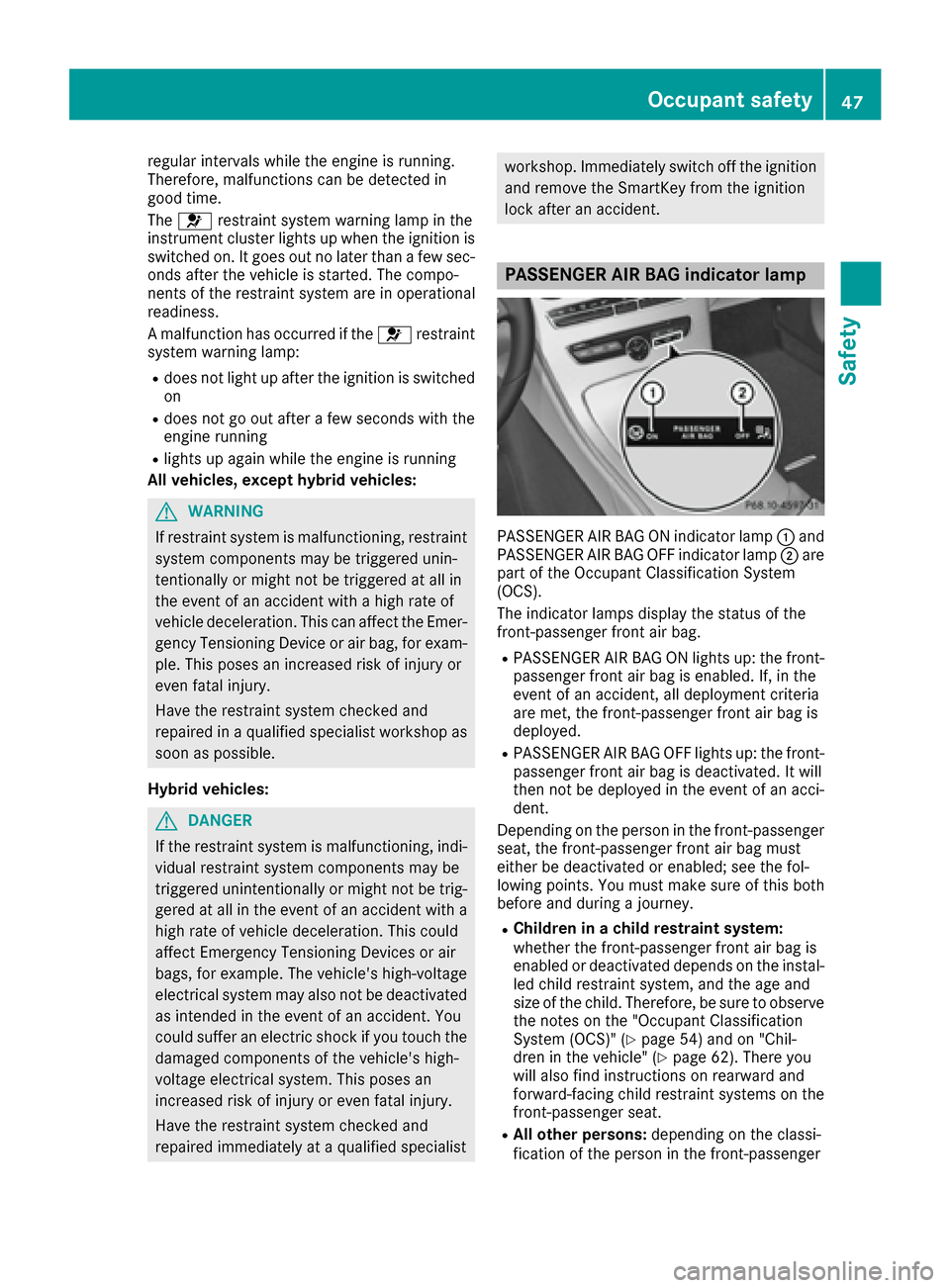
PASSENGER AIR BAG indicator lamp
PASSENGER AIR BAG ON indicator lamp :and
PASSENGER AIR BAG OFF indicator lamp ;are
part of the Occupant Classification System
(OCS).
The indicator lamps display the status of the
front-passenger front air bag.
RPASSENGER AIR BAG ON lights up: the front-
passenger front air bag is enabled. If, in the
event of an accident, all deployment criteria
are met, the front-passenger front air bag is
deployed.
RPASSENGER AIR BAG OFF lights up: the front-
passenger front air bag is deactivated. It will
then not be deployed in the event of an acci-
dent.
Depending on the person in the front-passenger
seat, the front-passenger front air bag must
either be deactivated or enabled; see the fol-
lowing points. You must make sure of this both
before and during a journey.
RChildren in a child restraint system:
whether the front-passenger front air bag is
enabled or deactivated depends on the instal-
led child restraint system, and the age and
size of the child. Therefore, be sure to observe
the notes on the "Occupant Classification
System (OCS)" (
Ypage 54) and on "Chil-
dren in the vehicle" (Ypage 62). There you
will also find instructions on rearward and
forward-facing child restraint systems on the
front-passenger seat.
RAll other persons: depending on the classi-
fication of the person in the front-passenger
Occupant safety47
Safety
Z