ESP MERCEDES-BENZ C240 2001 W203 Workshop Manual
[x] Cancel search | Manufacturer: MERCEDES-BENZ, Model Year: 2001, Model line: C240, Model: MERCEDES-BENZ C240 2001 W203Pages: 381, PDF Size: 19.92 MB
Page 325 of 381
316 Battery
Te ch n i c a l
data Instruments
and controlsOperation DrivingInstrument
cluster displayPractical hintsCar care Index
warm tires only if pressure has dropped below the
pressure listed in the table and the respective operating
conditions are taken into consideration.
An underinflated tire due to a slow leak (e.g. due to a
nail in the tire) may cause damage such as tread
separation, bulging etc. Regular tire pressure checks
(including the spare tire) at intervals of no more than
14 days are therefore essential.
If a tire constantly loses air, it should be inspected for
damage.
The spare tire should be checked periodically for
condition and inflation. Spare tire will age and become
worn over time even if never used, and thus should be
inspected and replaced when necessary.Battery
Important!
Battery replacement information:
The maintenance-free battery is located in the engine
compartment on the right hand side.
The service life of the battery is dependent on its
condition of charge. The battery should always be kept
sufficiently charged, in order to last an optimum length
of time.
Wa r n i n g !
Do not overinflate tires. Overinflating tires can
result in sudden deflation (blowout) because they
are more likely to become punctured or damaged
by road debris, potholes etc. Follow recommended
inflation pressures.Do not overload the tires by exceeding the specified
vehicle capacity weight as indicated by the label on
the driver’s door latch post). Overloading the tires
can overheat them, possibly causing a blowout.
Wa r n i n g !
Failure to follow these instructions can result in
severe injury or death.Never lean over batteries while connecting, you
might get injured.Battery fluid contains sulfuric acid. Do not allow
this fluid to come in contact with eyes, skin or
clot hin g. In cas e i t d oes , i mm ed ia tely f lus h a f fected
area with water and seek medical help if necessary.A battery will also produce hydrogen gas, which is
flammable and explosive. Keep flames or sparks
away from battery, avoid improper connection of
jumper cables, smoking etc.
Page 326 of 381
317 Battery
Te ch n i c a l
data Instruments
and controlsOperation DrivingInstrument
cluster displayPractical hintsCar care Index Therefore, we strongly recommend that you have the
battery charge checked frequently, and corrected if
necessary, especially if you use the vehicle less than
approximately 200 miles (300 km) per month,
mostly for short distance trips, or if it is not used for
long periods of time.
Only charge a battery with a battery charger after the
battery has been disconnected from the vehicle’s
electrical circuit.
Always disconnect the battery negative lead first and
connect last.
When removing and connecting the battery, always
make sure that all electrical consumers are off and the
electronic key is in starter switch position 0. The
battery, its filler caps, the vent tube and the opposite
plug must always be securely installed when the vehicle
is in operation.
While the engine is running the battery terminal clamps
must not be loosened or detached, otherwise the
generator and other electronic components would be
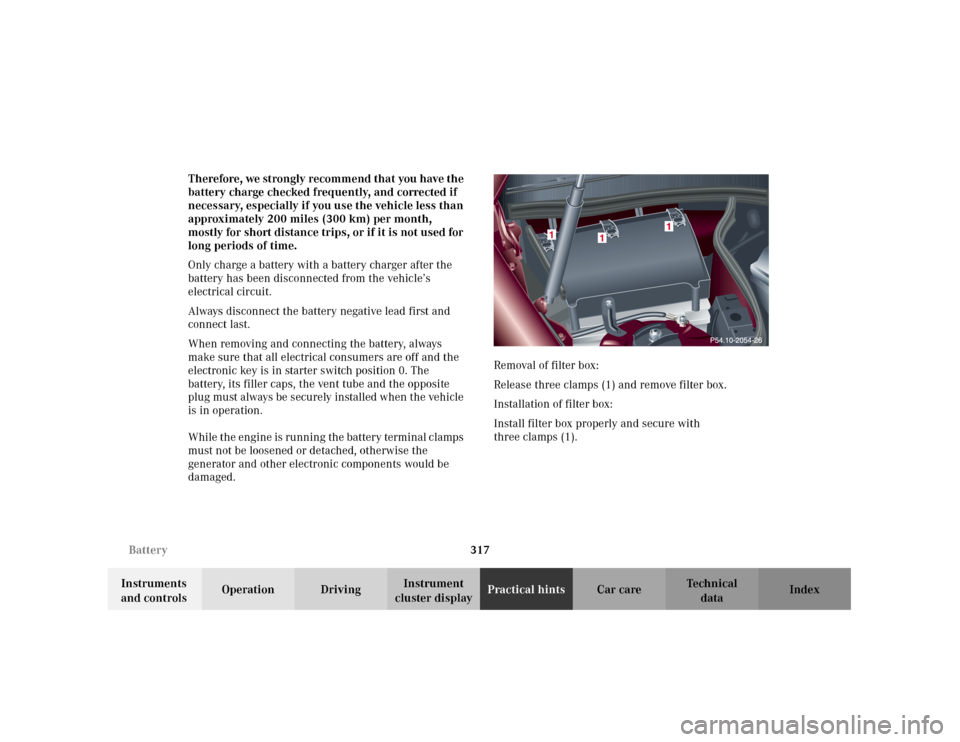
damaged.Removal of filter box:
Release three clamps (1) and remove filter box.
Installation of filter box:
Install filter box properly and secure with
three clamps (1).
Page 333 of 381
324 Towing the vehicle
Te ch n i c a l
data Instruments
and controlsOperation DrivingInstrument
cluster displayPractical hintsCar care Index
Use wheel lift, dolly, or flat bed equipment, with
electronic key in starter switch turned to position 0.
Note:
To signal turns while being towed with hazard warning
flasher in use, turn electronic key in starter switch to
position 2 and activate combination switch for left or
right turn signal in usual manner – only the selected
turn signal will operate.Upon canceling the turn signal, the hazard warning
flasher will operate again.
Caution!
If the vehicle is towed with the front axle raised, the
engine must be shut off (electronic key in starter switch
position 0 or 1). Otherwise, the ESP will immediately be
engaged and will apply the rear wheel brakes.
Switch off the tow-away alarm (see page 39) as well as
the ESP (see page 260).
Wa r n i n g !
With the engine not running, there is no power
assistance for the braking and steering systems. In
this case, it is important to keep in mind that a
considerably higher degree of effort is necessary to
brake and steer the vehicle.
Page 340 of 381
331 Trunk lamp
Te ch n i c a l
data Instruments
and controlsOperation DrivingInstrument
cluster displayPractical hintsCar care Index Standby bulb function
a) The stop lamps, dimmed, will act as a replacement
lamp, if one taillamp stops working.
b) The left stop lamp acts as a replacement for the rear
fog lamp, if it stops working.
c) The respective fog lamp, dimmed, will act as a
replacement lamp, if the left or right standing lamp
stops working.
Notes:
The multifunction display will indicate that a bulb has
failed. See malfunction and warning messages on
page 274.Trunk lamp
The trunk lamp will switch off after approximately
10 minutes if the trunk lid is left open.
Page 360 of 381
351 Technical data
Te ch n i c a l
data Instruments
and controlsOperation DrivingInstrument
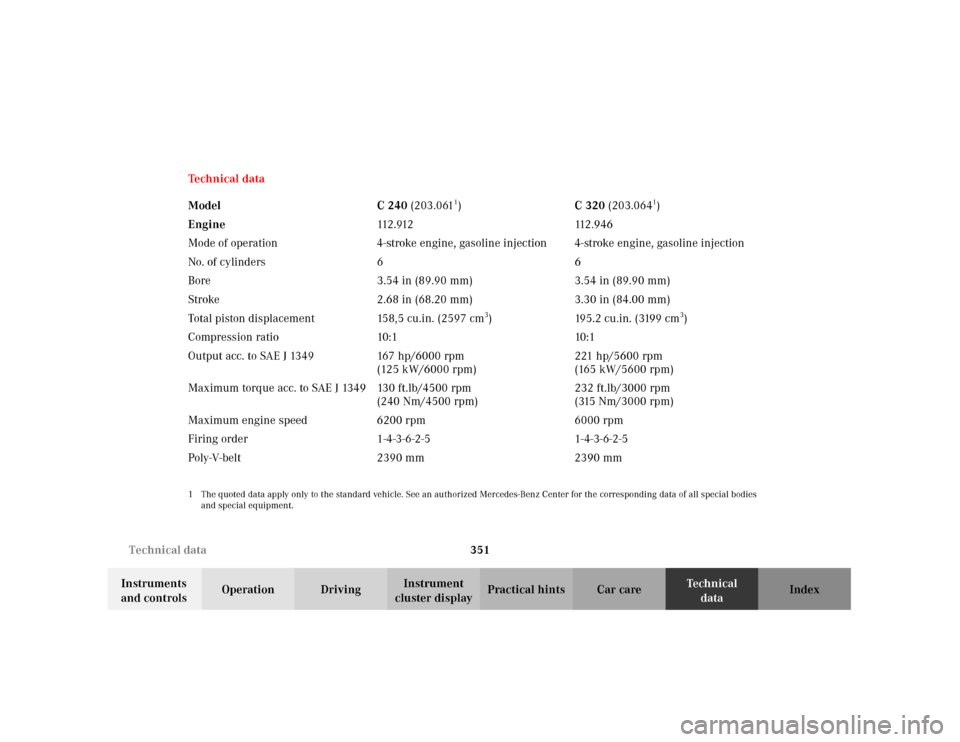
cluster displayPractical hints Car care Index Te ch n i c a l d a t a
Model C 240 (203.061
1)C 320 (203.064
1)
Engine112.912 112.946
Mode of operation 4-stroke engine, gasoline injection 4-stroke engine, gasoline injection
No. of cylinders 6 6
Bore 3.54 in (89.90 mm) 3.54 in (89.90 mm)
Stroke 2.68 in (68.20 mm) 3.30 in (84.00 mm)
Total piston displacement 158,5 cu.in. (2597 cm
3) 195.2 cu.in. (3199 cm
3)
Compression ratio 10:1 10:1
O u t p u t a c c . t o S A E J 13 4 9 16 7 h p / 6 0 0 0 r p m
(125 kW/6000 rpm)221 hp/5600 rpm
(165 kW/5600 rpm)
Maximum torque acc. to SAE J 1349 130 ft.lb/4500 rpm
(240 Nm/4500 rpm)232 ft.lb/3000 rpm
(315 Nm/3000 rpm)
Maximum engine speed 6200 rpm 6000 rpm
Firing order 1-4-3-6-2-5 1-4-3-6-2-5
Poly-V-belt 2390 mm 2390 mm
1 The quoted data apply only to the standard vehicle. See an authorized Mercedes-Benz Center for the corresponding data of all special bodies
and special equipment.
Page 364 of 381
355 Fuels, coolants, lubricants etc. - capacities
Te ch n i c a l
data Instruments
and controlsOperation DrivingInstrument
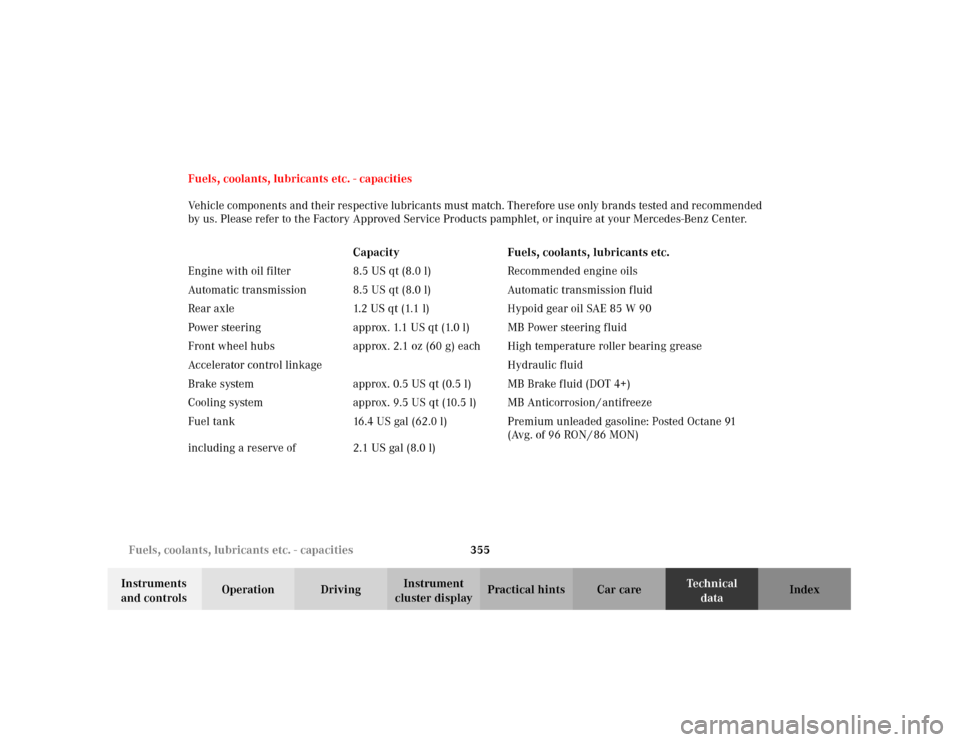
cluster displayPractical hints Car care Index Fuels, coolants, lubricants etc. - capacities
Vehicle components and their respective lubricants must match. Therefore use only brands tested and recommended
by us. Please refer to the Factory Approved Service Products pamphlet, or inquire at your Mercedes-Benz Center.
Capacity Fuels, coolants, lubricants etc.
Engine with oil filter 8.5 US qt (8.0 l) Recommended engine oils
Automatic transmission 8.5 US qt (8.0 l) Automatic transmission fluid
Rear axle 1.2 US qt (1.1 l) Hypoid gear oil SAE 85 W 90
Power steering approx. 1.1 US qt (1.0 l) MB Power steering fluid
Front wheel hubs approx. 2.1 oz (60 g) each High temperature roller bearing grease
Accelerator control linkage Hydraulic fluid
Brake system approx. 0.5 US qt (0.5 l) MB Brake fluid (DOT 4+)
Cooling system approx. 9.5 US qt (10.5 l) MB Anticorrosion / antifreeze
Fuel tank
including a reserve of16.4 US gal (62.0 l)
2.1 US gal (8.0 l)Premium unleaded gasoline: Posted Octane 91
(Avg. of 96 RON / 86 MON)
Page 368 of 381
359 Fuels, coolants, lubricants etc. - capacities
Te ch n i c a l
data Instruments
and controlsOperation DrivingInstrument
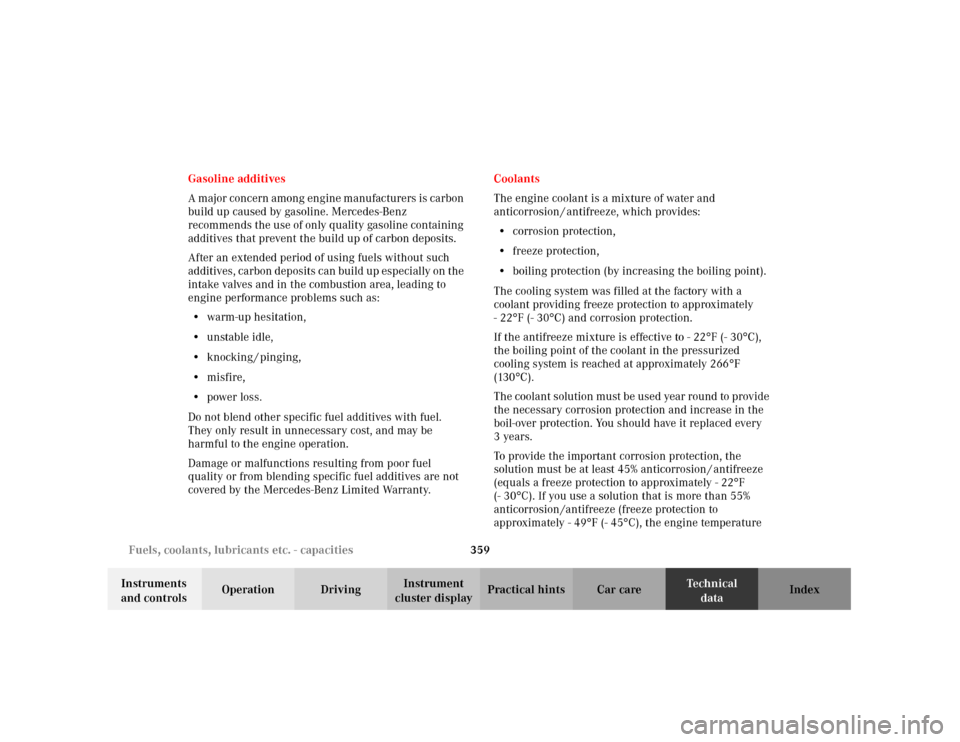
cluster displayPractical hints Car care Index Gasoline additives
A major concern among engine manufacturers is carbon
build up caused by gasoline. Mercedes-Benz
recommends the use of only quality gasoline containing
additives that prevent the build up of carbon deposits.
After an extended period of using fuels without such
ad ditives , car bon d ep osits c an bui ld up esp eci ally on t he
intake valves and in the combustion area, leading to
engine performance problems such as:
•warm-up hesitation,
•unstable idle,
•knocking / pinging,
•misfire,
•power loss.
Do not blend other specific fuel additives with fuel.
They only result in unnecessary cost, and may be
harmful to the engine operation.
Damage or malfunctions resulting from poor fuel
quality or from blending specific fuel additives are not
covered by the Mercedes-Benz Limited Warranty.Coolants
The engine coolant is a mixture of water and
anticorrosion / antifreeze, which provides:
•corrosion protection,
•freeze protection,
•boiling protection (by increasing the boiling point).
The cooling system was filled at the factory with a
coolant providing freeze protection to approximately
- 22
°F (- 30
°C) and corrosion protection.
If the antifreeze mixture is effective to - 22
°F (- 30
°C),
the boiling point of the coolant in the pressurized
cooling system is reached at approximately 266
°F
(130
°C).
The coolant solution must be used year round to provide
the necessary corrosion protection and increase in the
boil-over protection. You should have it replaced every
3years.
To provide the important corrosion protection, the
solution must be at least 45% anticorrosion / antifreeze
(equals a freeze protection to approximately - 22
°F
(- 30
°C). If you use a solution that is more than 55%
anticorrosion /antifreeze (freeze protection to
approximately - 49
°F (- 45
°C), the engine temperature
Page 371 of 381
362 Consumer information
Te ch n i c a l
data Instruments
and controlsOperation DrivingInstrument
cluster displayPractical hints Car care Index
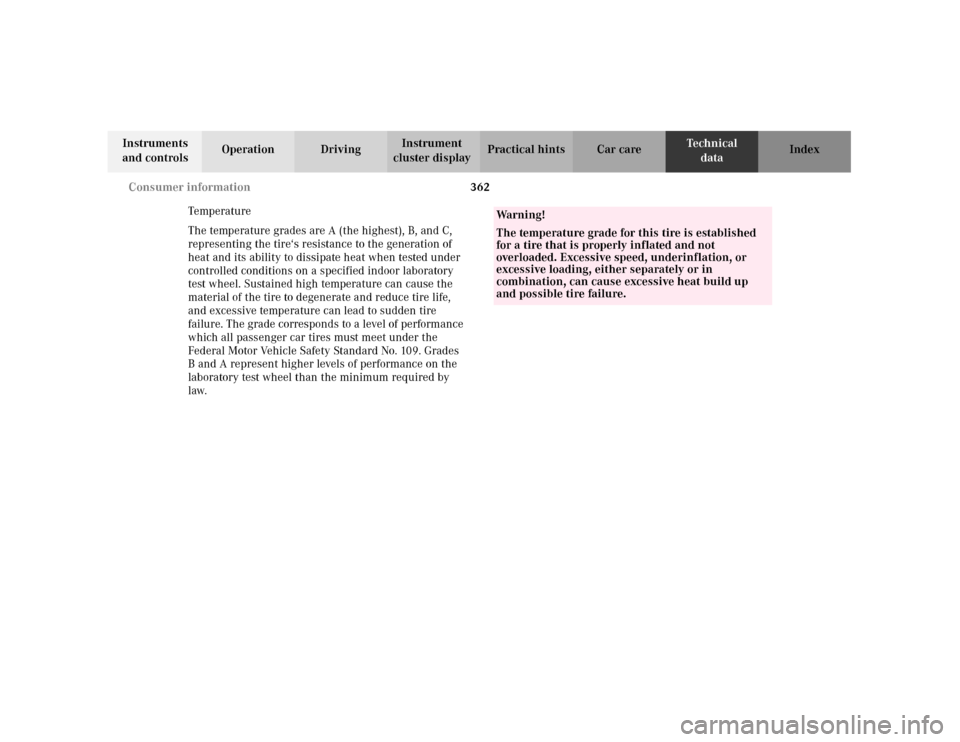
Tempera t u re
The temperature grades are A (the highest), B, and C,
representing the tire‘s resistance to the generation of
heat and its ability to dissipate heat when tested under
controlled conditions on a specified indoor laboratory
test wheel. Sustained high temperature can cause the
material of the tire to degenerate and reduce tire life,
and excessive temperature can lead to sudden tire
failure. The grade corresponds to a level of performance
which all passenger car tires must meet under the
Federal Motor Vehicle Safety Standard No. 109. Grades
B and A represent higher levels of performance on the
laboratory test wheel than the minimum required by
law.
Wa r n i n g !
The temperature grade for this tire is established
for a tire that is properly inflated and not
overloaded. Excessive speed, underinflation, or
excessive loading, either separately or in
combination, can cause excessive heat build up
and possible tire failure.
Page 375 of 381
366 Index
Te ch n i c a l
data Instruments
and controlsOperation DrivingInstrument
cluster displayPractical hints Car careIndex
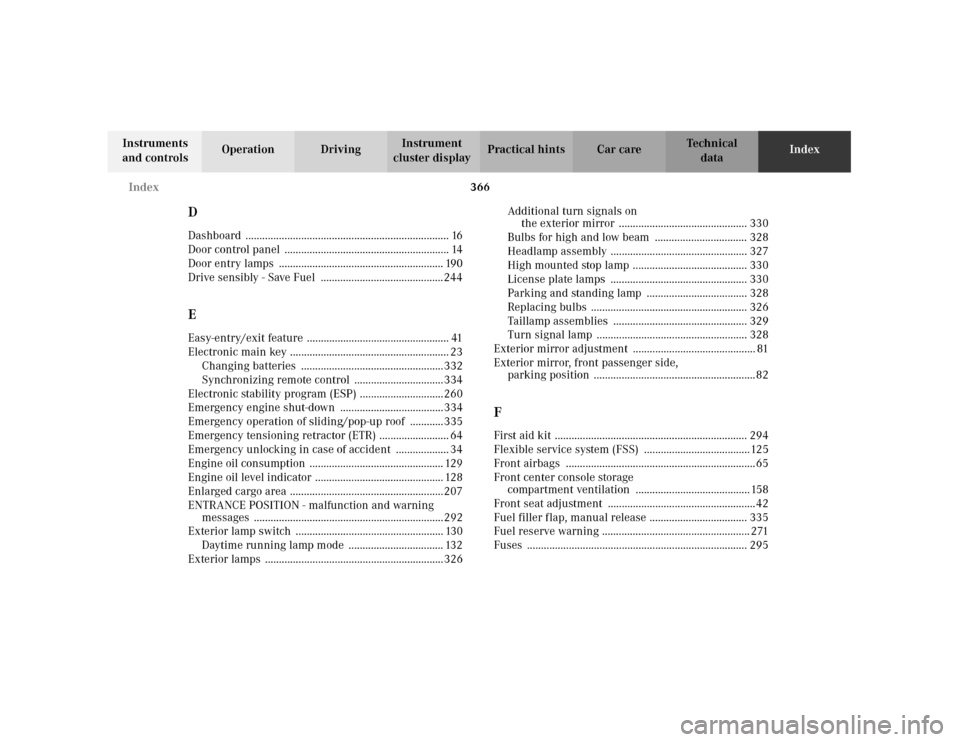
DDashboard ......................................................................... 16
Door control panel ........................................................... 14
Door entry lamps ........................................................... 190
Drive sensibly - Save Fuel ............................................244EEasy-entry/exit feature ................................................... 41
Electronic main key ......................................................... 23
Changing batteries ...................................................332
Synchronizing remote control ................................334
Electronic stability program (ESP) ..............................260
Emergency engine shut-down .....................................334
Emergency operation of sliding/pop-up roof ............335
Emergency tensioning retractor (ETR) ......................... 64
Emergency unlocking in case of accident ................... 34
Engine oil consumption ................................................ 129
Engine oil level indicator .............................................. 128
Enlarged cargo area .......................................................207
ENTRANCE POSITION - malfunction and warning
messages ....................................................................292
Exterior lamp switch ..................................................... 130
Daytime running lamp mode .................................. 132
Exterior lamps ................................................................326Additional turn signals on
the exterior mirror .............................................. 330
Bulbs for high and low beam ................................. 328
Headlamp assembly ................................................. 327
High mounted stop lamp ......................................... 330
License plate lamps ................................................. 330
Parking and standing lamp .................................... 328
Replacing bulbs ........................................................ 326
Taillamp assemblies ................................................ 329
Turn signal lamp ...................................................... 328
Exterior mirror adjustment ............................................ 81
Exterior mirror, front passenger side,
parking position ..........................................................82
FFirst aid kit ..................................................................... 294
Flexible service system (FSS) ......................................125
Front airbags ....................................................................65
Front center console storage
compartment ventilation ......................................... 158
Front seat adjustment .....................................................42
Fuel filler flap, manual release ................................... 335
Fuel reserve warning ..................................................... 271
Fuses ............................................................................... 295