check engine MERCEDES-BENZ CL COUPE 2009 Owner's Manual
[x] Cancel search | Manufacturer: MERCEDES-BENZ, Model Year: 2009, Model line: CL COUPE, Model: MERCEDES-BENZ CL COUPE 2009Pages: 421, PDF Size: 10.78 MB
Page 334 of 421
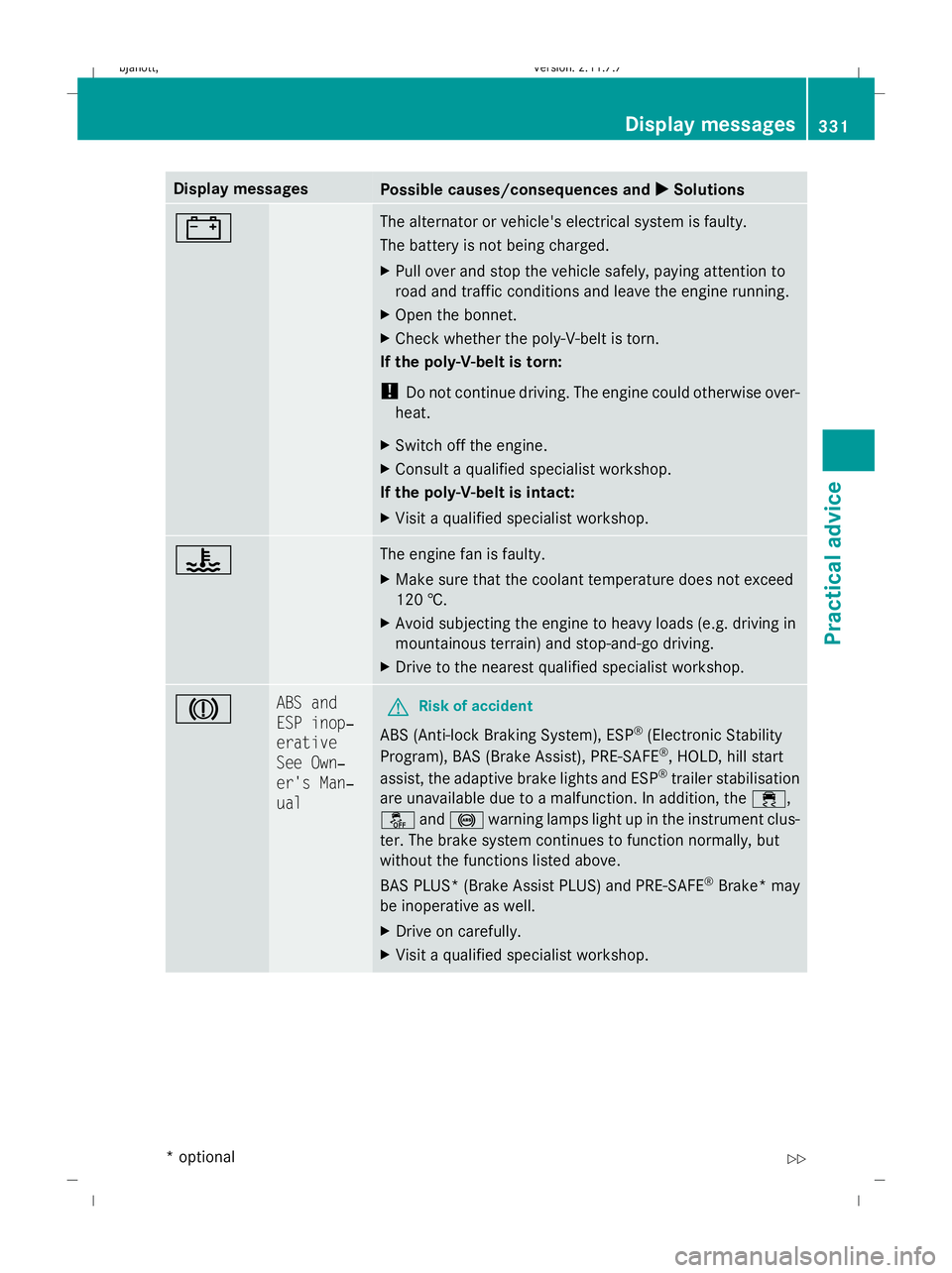
Display messages
Possible causes/consequences and
X
X Solutions # The alternator or vehicle's electrical system is faulty.
The battery is not being charged.
X
Pull over and stop the vehicle safely, paying attention to
road and traffic conditions and leave the engine running.
X Open the bonnet.
X Check whether the poly-V-belt is torn.
If the poly-V-belt is torn:
! Do not continue driving. The engine could otherwise over-
heat.
X Switch off the engine.
X Consult a qualified specialist workshop.
If the poly-V-belt is intact:
X Visit a qualified specialist workshop. ? The engine fan is faulty.
X
Make sure that the coolant temperature does not exceed
120 †.
X Avoid subjecting the engine to heavy loads (e.g. driving in
mountainous terrain) and stop-and-go driving.
X Drive to the nearest qualified specialist workshop. J ABS and
ESP inop‐
erative
See Own‐
er's Man‐
ual
G
Risk of accident
ABS (Anti-lock Braking System), ESP ®
(Electronic Stability
Program), BAS (Brake Assist), PRE-SAFE ®
, HOLD, hill start
assist, the adaptive brake lights and ESP ®
trailer stabilisation
are unavailable due to a malfunction. In addition, the ÷,
å and! warning lamps light up in the instrument clus-
ter. The brake system continues to function normally, but
without the functions listed above.
BAS PLUS* (Brake Assist PLUS) and PRE-SAFE ®
Brake *may
be inoperative as well.
X Drive on carefully.
X Visit a qualified specialist workshop. Display messages
331Practical advice
* optional
216_AKB; 2; 3, en-GB
bjanott,
Version: 2.11.7.7 2009-02-27T14:54:17+01:00 - Seite 331 Z
Dateiname: 6515230602_buchblock.pdf; erzeugt am 04. Mar 2009 11:16:37; WK
Page 345 of 421
Display messages
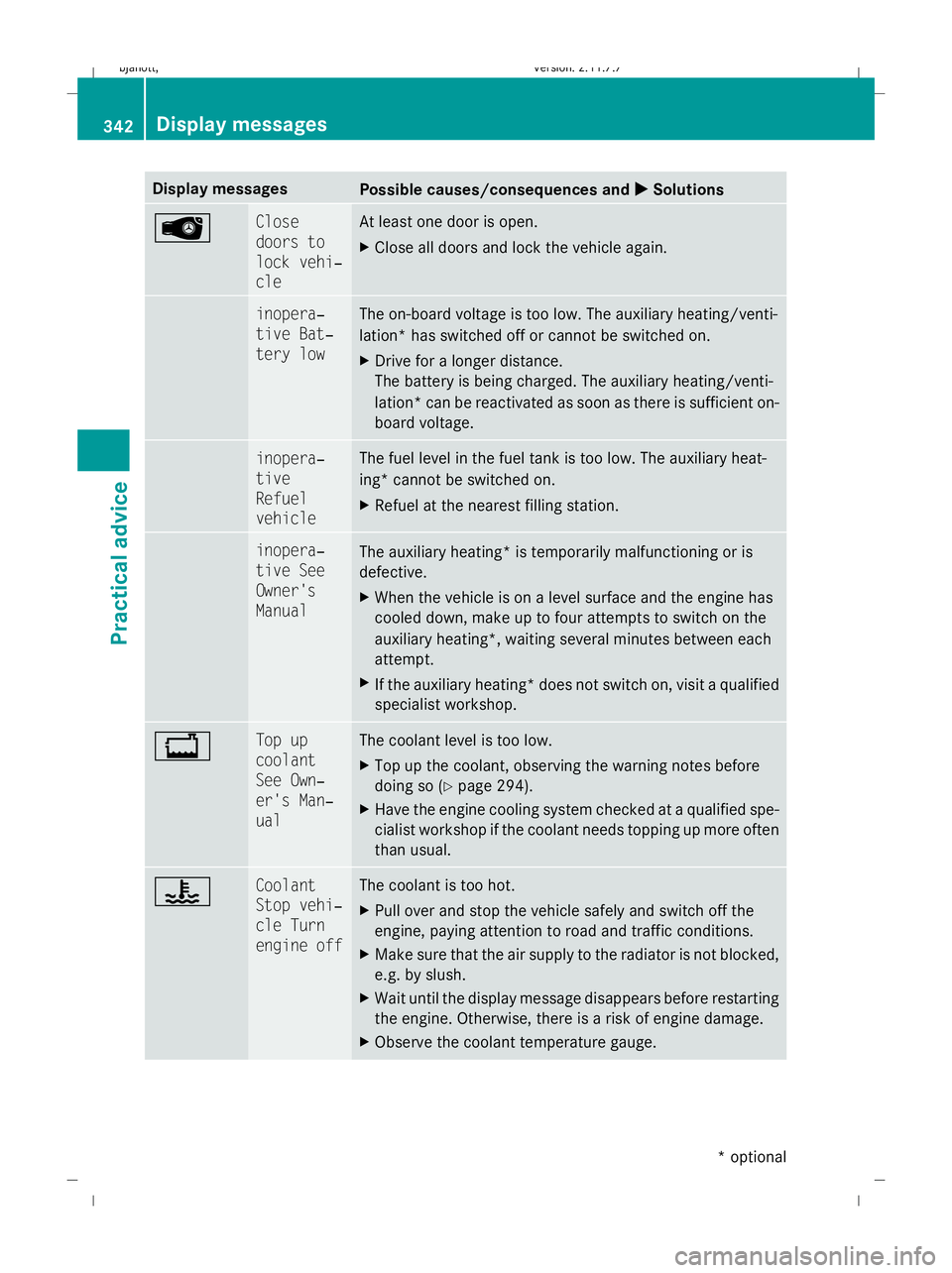
Possible causes/consequences and
X
X Solutions  Close
doors to
lock vehi‐
cle At least one door is open.
X
Close all doors and lock the vehicle again. & inopera‐
tive Bat‐
tery low The on-board voltage is too low. The auxiliary heating/venti-
lation* has switched off or cannot be switched on.
X
Drive for a longer distance.
The battery is being charged. The auxiliary heating/venti-
lation *can be reactivated as soon as there is sufficient on-
board voltage. & inopera‐
tive
Refuel
vehicle The fuel level in the fuel tank is too low. The auxiliary heat-
ing* cannot be switched on.
X
Refuel at the nearest filling station. & inopera‐
tive See
Owner's
Manual
The auxiliary heating
*is temporarily malfunctioning or is
defective.
X When the vehicle is on a level surface and the engine has
cooled down, make up to four attempts to switch on the
auxiliary heating*, waiting several minutes between each
attempt.
X If the auxiliary heating* does not switch on, visit a qualified
specialist workshop. + Top up
coolant
See Own‐
er's Man‐
ual The coolant level is too low.
X
Top up the coolant, observing the warning notes before
doing so (Y page 294).
X Have the engine cooling system checked at a qualified spe-
cialist workshop if the coolant needs topping up more often
than usual. ? Coolant
Stop vehi‐
cle Turn
engine off The coolant is too hot.
X
Pull over and stop the vehicle safely and switch off the
engine, paying attention to road and traffic conditions.
X Make sure that the air supply to the radiator is not blocked,
e.g. by slush.
X Wait until the display message disappears before restarting
the engine. Otherwise, there is a risk of engine damage.
X Observe the coolant temperature gauge. 342
Display messagesPractical advice
* optional
216_AKB; 2; 3, en-GB
bjanott
,V ersion: 2.11.7.7
2009-02-27T14:54:17+01:00 - Seite 342
Dateiname: 6515230602_buchblock.pdf; erzeugt am 04. Mar 2009 11:16:38; WK
Page 346 of 421
Display messages
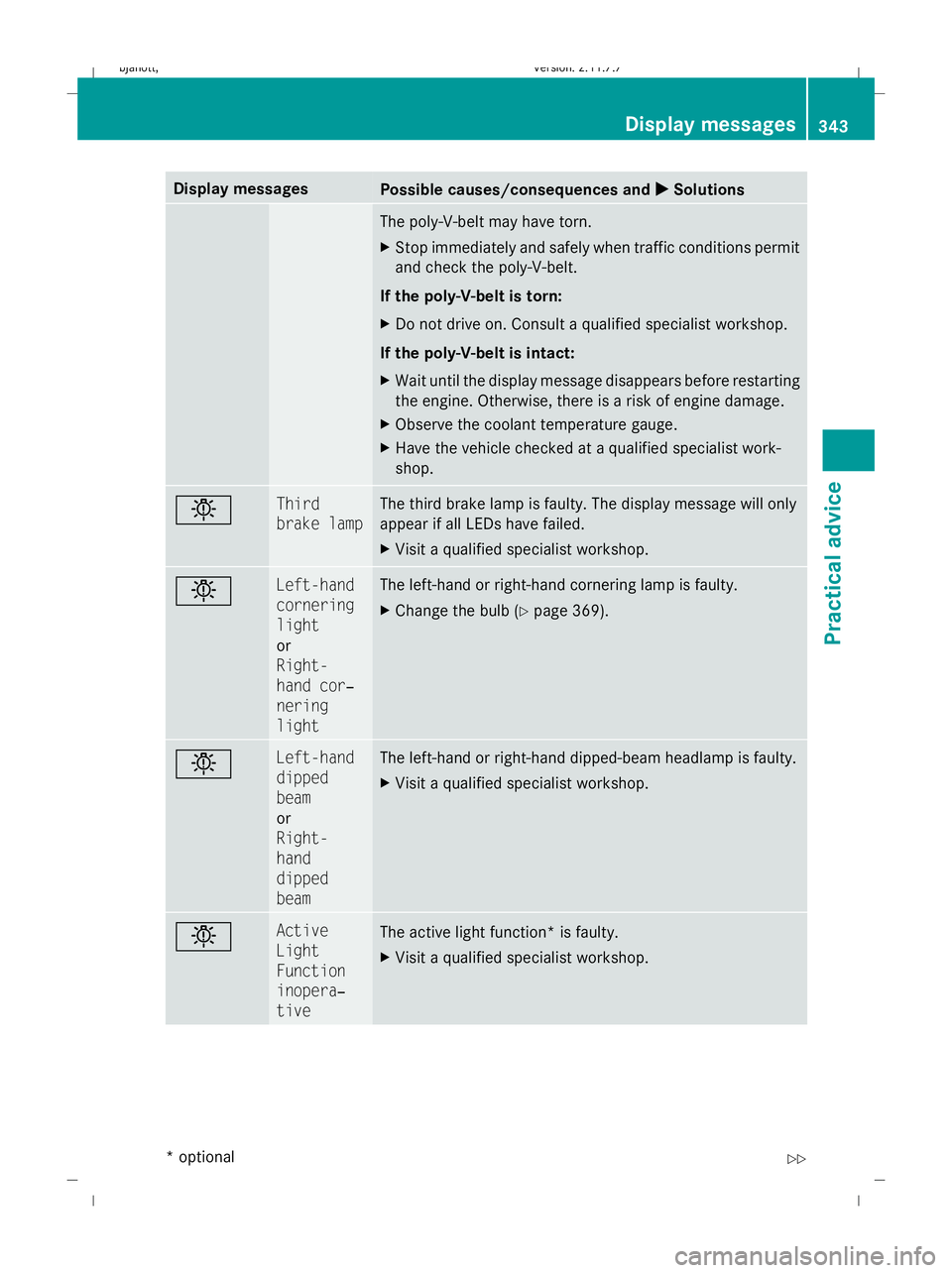
Possible causes/consequences and
X
X Solutions The poly-V-belt may have torn.
X
Stop immediately and safely when traffic conditions permit
and check the poly-V-belt.
If the poly-V-belt is torn:
X Do not drive on. Consult a qualified specialist workshop.
If the poly-V-belt is intact:
X Wait until the display message disappears before restarting
the engine. Otherwise, there is a risk of engine damage.
X Observe the coolant temperature gauge.
X Have the vehicle checked at a qualified specialist work-
shop. b Third
brake lamp The third brake lamp is faulty. The display message will only
appear if all LEDs have failed.
X
Visit a qualified specialist workshop. b Left-hand
cornering
light
or
Right-
hand cor‐
nering
light The left-hand or right-hand cornering lamp is faulty.
X
Change the bulb (Y page 369). b Left-hand
dipped
beam
or
Right-
hand
dipped
beam The left-hand or right-hand dipped-beam headlamp is faulty.
X
Visit a qualified specialist workshop. b Active
Light
Function
inopera‐
tive
The active light function* is faulty.
X
Visit a qualified specialist workshop. Display
messages
343Practical advice
* optional
216_AKB; 2; 3, en-GB
bjanott
,V ersion: 2.11.7.7
2009-02-27T14:54:17+01:00 - Seite 343 Z
Dateiname: 6515230602_buchblock.pdf; erzeugt am 04. Mar 2009 11:16:39; WK
Page 350 of 421
Display messages
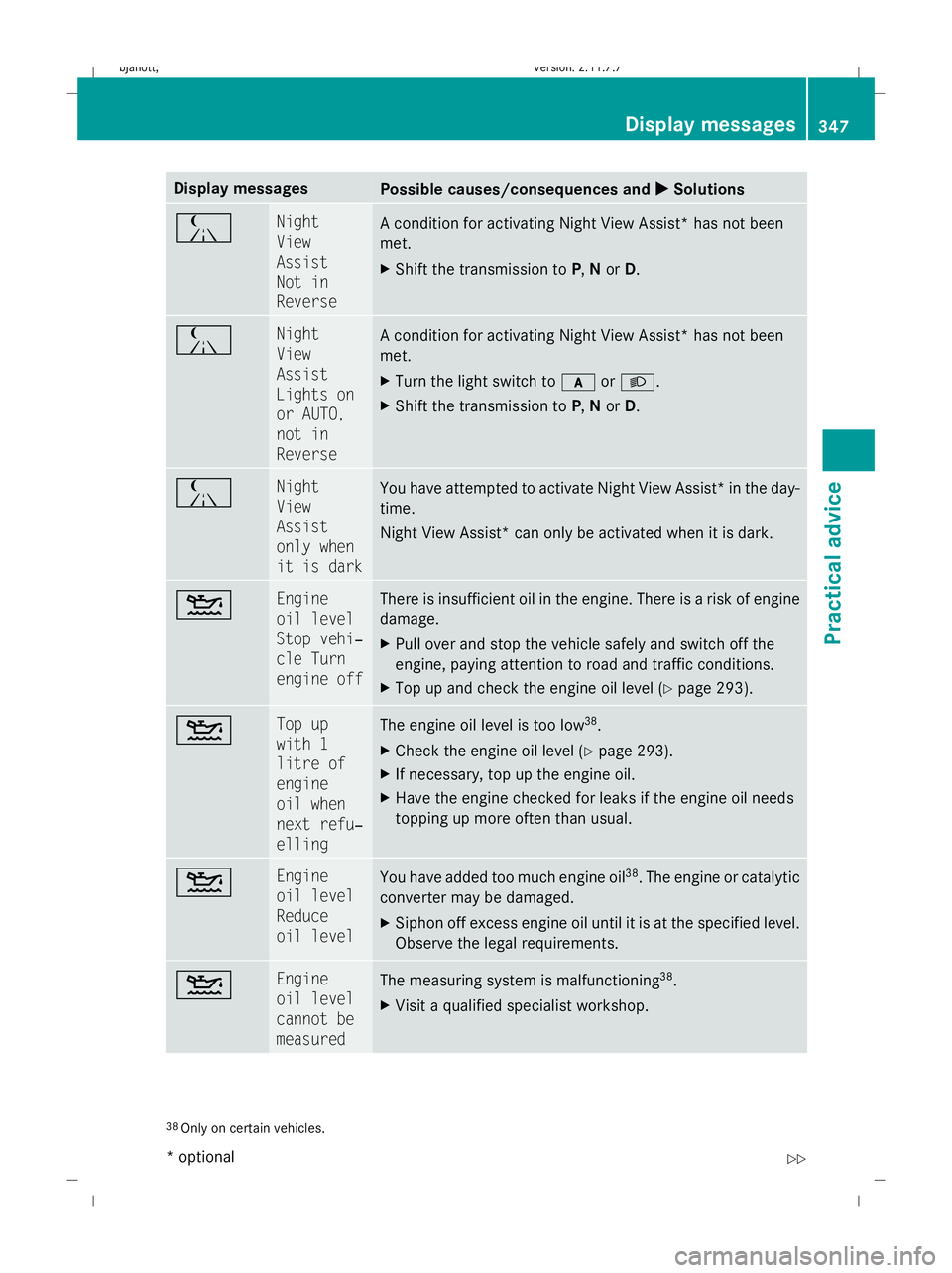
Possible causes/consequences and
X
X Solutions Á Night
View
Assist
Not in
Reverse
A condition for activating Night View Assist* has not been
met.
X
Shift the transmission to P,Nor D. Á Night
View
Assist
Lights on
or AUTO,
not in
Reverse
A condition for activating Night View Assist* has not been
met.
X
Turn the light switch to corL.
X Shift the transmission to P,Nor D. Á Night
View
Assist
only when
it is dark
You have attempted to activate Night View Assist* in the day-
time.
Night View Assist* can only be activated when it is dark.
4 Engine
oil level
Stop vehi‐
cle Turn
engine off There is insufficient oil in the engine. There is a risk of engine
damage.
X
Pull over and stop the vehicle safely and switch off the
engine, paying attention to road and traffic conditions.
X Top up and check the engine oil level (Y page 293).4 Top up
with 1
litre of
engine
oil when
next refu‐
elling
The engine oil level is too low
38
.
X Check the engine oil level ( Ypage 293).
X If necessary, top up the engine oil.
X Have the engine checked for leaks if the engine oil needs
topping up more often than usual. 4 Engine
oil level
Reduce
oil level
You have added too much engine oil
38
. The engine or catalytic
converter may be damaged.
X Siphon off excess engine oil until it is at the specified level.
Observe the legal requirements. 4 Engine
oil level
cannot be
measured
The measuring system is malfunctioning
38
.
X Visit a qualified specialist workshop. 38
Only on certain vehicles. Display
messages
347Practical advice
* optional
216_AKB; 2; 3, en-GB
bjanott
,V ersion: 2.11.7.7
2009-02-27T14:54:17+01:00 - Seite 347 Z
Dateiname: 6515230602_buchblock.pdf; erzeugt am 04. Mar 2009 11:16:40; WK
Page 351 of 421
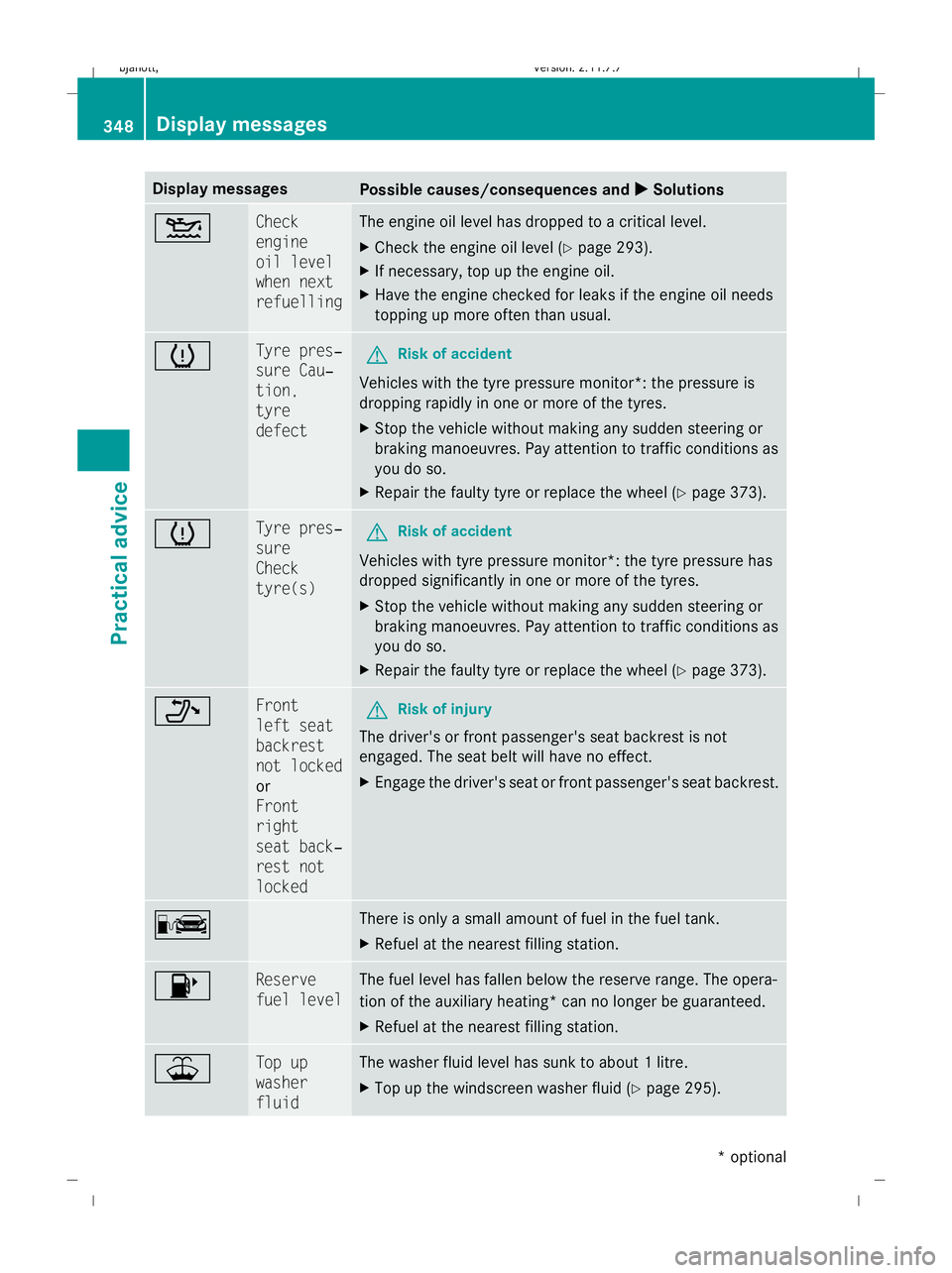
Display messages
Possible causes/consequences and
X
X Solutions 4 Check
engine
oil level
when next
refuelling The engine oil level has dropped to a critical level.
X
Check the engine oil level ( Ypage 293).
X If necessary, top up the engine oil.
X Have the engine checked for leaks if the engine oil needs
topping up more often than usual. h Tyre pres‐
sure Cau‐
tion,
tyre
defect
G
Risk of accident
Vehicles with the tyre pressure monitor*: the pressure is
dropping rapidly in one or more of the tyres.
X Stop the vehicle without making any sudden steering or
braking manoeuvres. Pay attention to traffic conditions as
you do so.
X Repair the faulty tyre or replace the wheel (Y page 373).h Tyre pres‐
sure
Check
tyre(s)
G
Risk of accident
Vehicles with tyre pressure monitor*: the tyre pressure has
dropped significantly in one or more of the tyres.
X Stop the vehicle without making any sudden steering or
braking manoeuvres. Pay attention to traffic conditions as
you do so.
X Repair the faulty tyre or replace the wheel (Y page 373)._ Front
left seat
backrest
not locked
or
Front
right
seat back‐
rest not
locked
G
Risk of injury
The driver's or front passenger's seat backrest is not
engaged. The seat belt will have no effect.
X Engage the driver's seat or front passenger's seat backrest. C There is only a small amount of fuel in the fuel tank.
X
Refuel at the nearest filling station. 8 Reserve
fuel level The fuel level has fallen below the reserve range. The opera-
tion of the auxiliary heating
* can nolonger be guaranteed.
X Refuel at the nearest filling station. ¥ Top up
washer
fluid The washer fluid level has sunk to about 1 litre.
X
Top up the windscreen washer fluid (Y page 295).348
Display messagesPractical advice
* optional
216_AKB; 2; 3, en-GB
bjanott
,V ersion: 2.11.7.7
2009-02-27T14:54:17+01:00 - Seite 348
Dateiname: 6515230602_buchblock.pdf; erzeugt am 04. Mar 2009 11:16:40; WK
Page 357 of 421
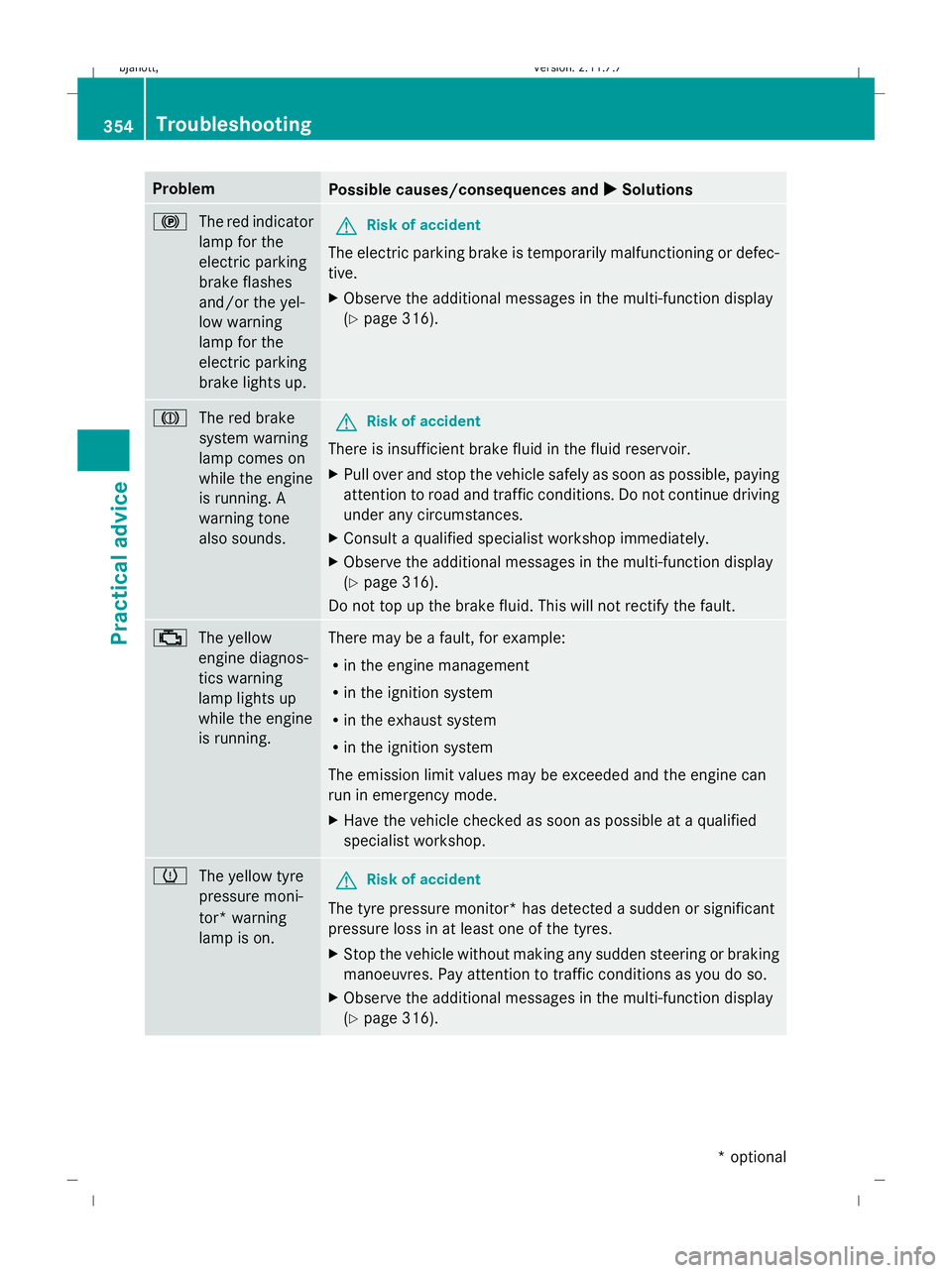
Problem
Possible causes/consequences and
X XSolutions !
The red indicator
lamp for the
electric parking
brake flashes
and/or the yel-
low warning
lamp for the
electric parking
brake lights up. G
Risk of accident
The electric parking brake is temporarily malfunctioning or defec-
tive.
X Observe the additional messages in the multi-function display
(Y page 316). J
The red brake
system warning
lamp comes on
while the engine
is running. A
warning tone
also sounds. G
Risk of accident
There is insufficient brake fluid in the fluid reservoir.
X Pull over and stop the vehicle safely as soon as possible, paying
attention to road and traffic conditions. Do not continue driving
under any circumstances.
X Consult a qualified specialist workshop immediately.
X Observe the additional messages in the multi-function display
(Y page 316).
Do not top up the brake fluid. This will not rectify the fault. ;
The yellow
engine diagnos-
tics warning
lamp lights up
while the engine
is running. There may be a fault, for example:
R
in the engine management
R in the ignition system
R in the exhaust system
R in the ignition system
The emission limit values may be exceeded and the engine can
run in emergency mode.
X Have the vehicle checked as soon as possible at a qualified
specialist workshop. h
The yellow tyre
pressure moni-
tor* warning
lamp is on. G
Risk of accident
The tyre pressure monitor* has detected a sudden or significant
pressure loss in at least one of the tyres.
X Stop the vehicle without making any sudden steering or braking
manoeuvres. Pay attention to traffic conditions as you do so.
X Observe the additional messages in the multi-function display
(Y page 316). 354
TroubleshootingPractical advice
* optional
216_AKB; 2; 3, en-GB
bjanott,
Version: 2.11.7.7 2009-02-27T14:54:17+01:00 - Seite 354
Dateiname: 6515230602_buchblock.pdf; erzeugt am 04. Mar 2009 11:16:41; WK
Page 362 of 421
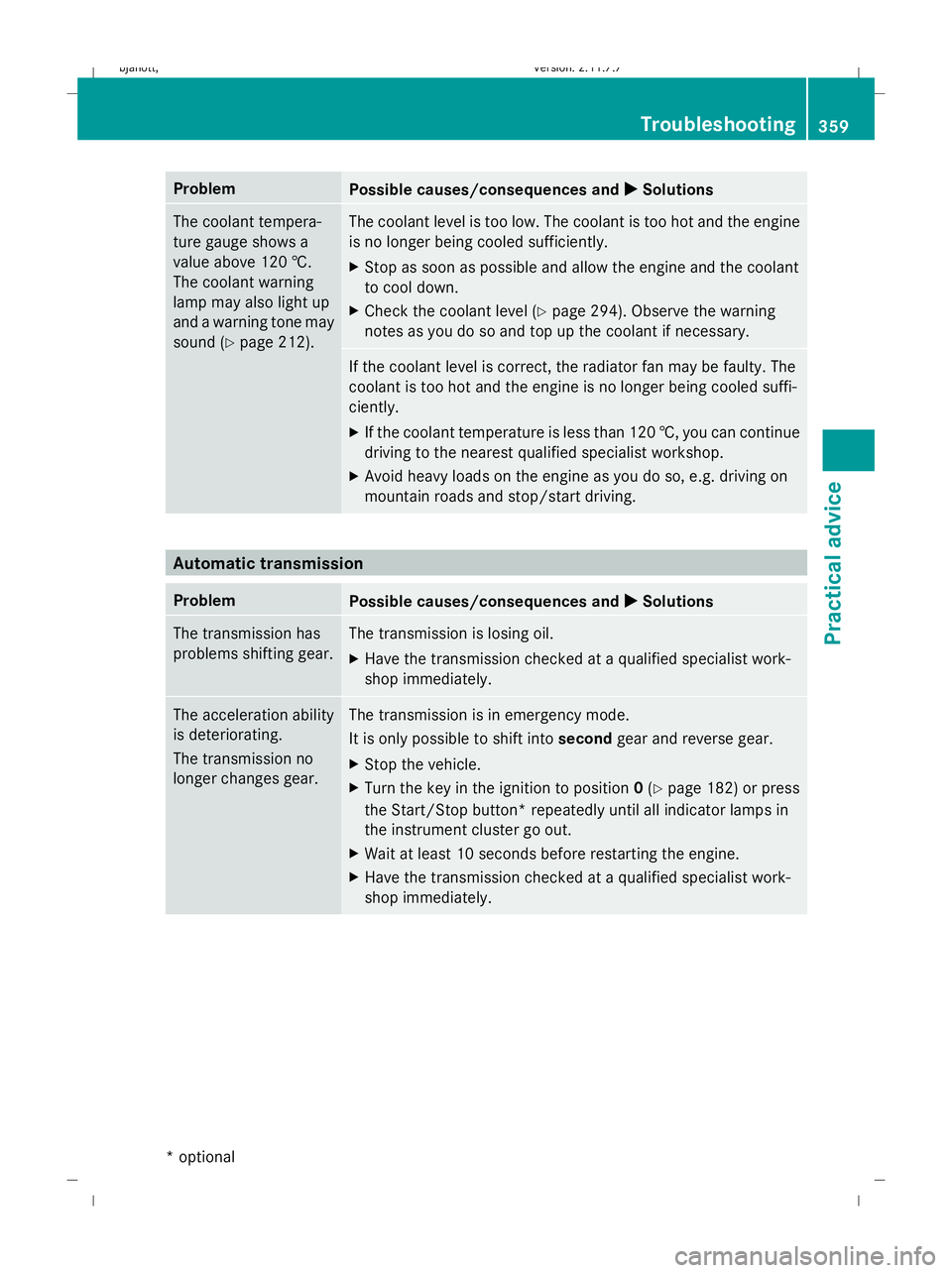
Problem
Possible causes/consequences and
X
X Solutions The coolant tempera-
ture gauge shows a
value above 120 †.
The coolant warning
lamp may also light up
and a warning tone may
sound (Y
page 212). The coolant level is too low. The coolant is too hot and the engine
is no longer being cooled sufficiently.
X
Stop as soon as possible and allow the engine and the coolant
to cool down.
X Check the coolant level (Y page 294). Observe the warning
notes as you do so and top up the coolant if necessary. If the coolant level is correct, the radiator fan may be faulty. The
coolant is too hot and the engine is no longer being cooled suffi-
ciently.
X
If the coolant temperature is less than 120 †, you can continue
driving to the nearest qualified specialist workshop.
X Avoid heavy loads on the engine as you do so, e.g. driving on
mountain roads and stop/start driving. Automatic transmission
Problem
Possible causes/consequences and
X
X Solutions The transmission has
problems shifting gear. The transmission is losing oil.
X
Have the transmission checked at a qualified specialist work-
shop immediately. The acceleration ability
is deteriorating.
The transmission no
longer changes gear. The transmission is in emergency mode.
It is only possible to shift into
secondgear and reverse gear.
X Stop the vehicle.
X Turn the key in the ignition to position 0(Y page 182) or press
the Start/Stop button* repeatedly until all indicator lamps in
the instrument cluster go out.
X Wait at least 10 seconds before restarting the engine.
X Have the transmission checked at a qualified specialist work-
shop immediately. Troubleshooting
359Practical advice
* optional
216_AKB; 2; 3, en-GB
bjanott,
Version: 2.11.7.7 2009-02-27T14:54:17+01:00 - Seite 359 Z
Dateiname: 6515230602_buchblock.pdf; erzeugt am 04. Mar 2009 11:16:42; WK
Page 366 of 421
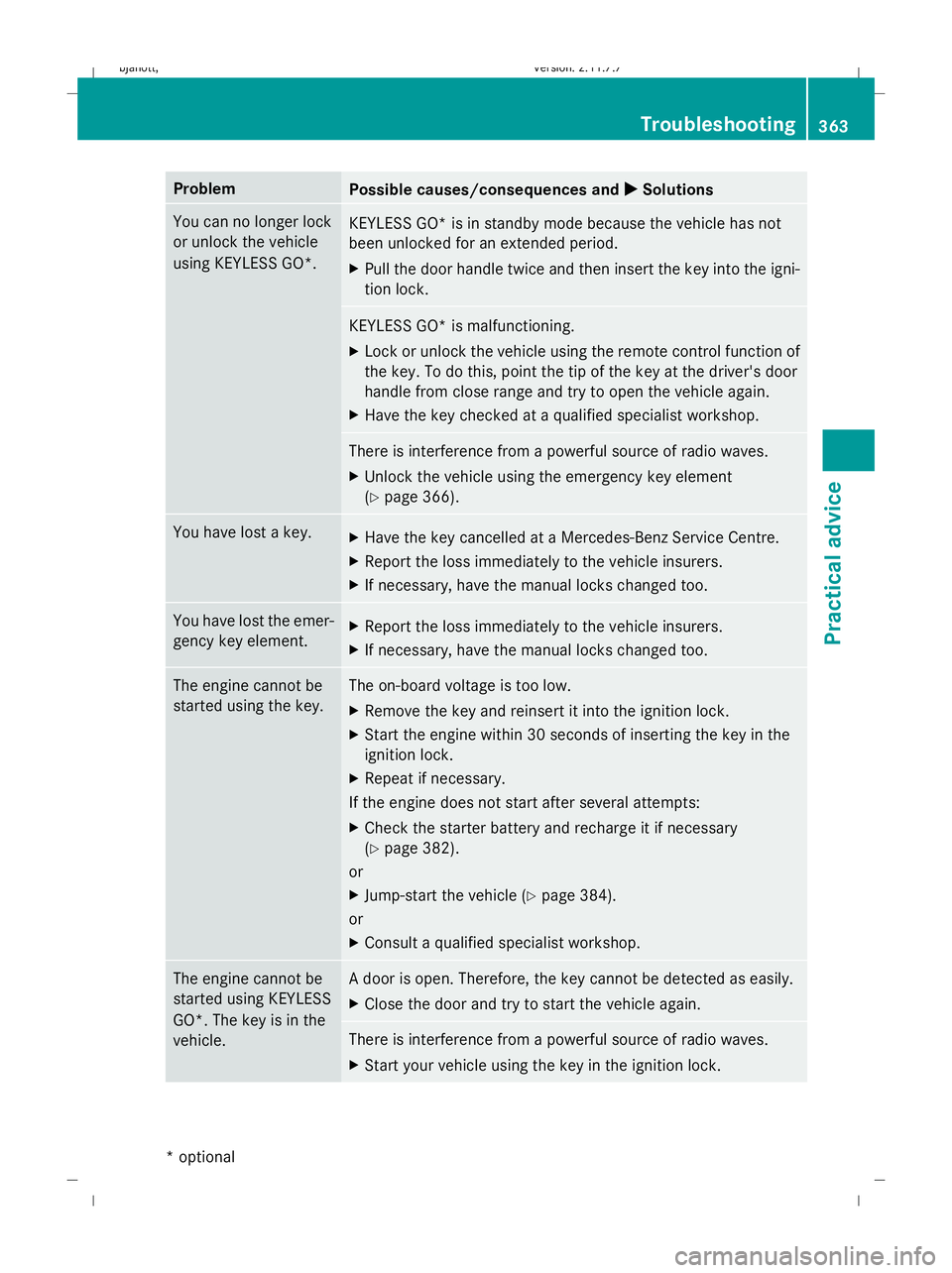
Problem
Possible causes/consequences and
X
X Solutions You can no longer lock
or unlock the vehicle
using KEYLESS GO*.
KEYLESS GO* is in standby mode because the vehicle has not
been unlocked for an extended period.
X
Pull the door handle twice and then insert the key into the igni-
tion lock. KEYLESS GO* is malfunctioning.
X
Lock or unlock the vehicle using the remote control function of
the key. To do this, point the tip of the key at the driver's door
handle from close range and try to open the vehicle again.
X Have the key checked at a qualified specialist workshop. There is interference from a powerful source of radio waves.
X
Unlock the vehicle using the emergency key element
(Y page 366). You have lost a key.
X
Have the key cancelled at a Mercedes-Benz Service Centre.
X Report the loss immediately to the vehicle insurers.
X If necessary, have the manual locks changed too. You have lost the emer-
gency key element.
X
Report the loss immediately to the vehicle insurers.
X If necessary, have the manual locks changed too. The engine cannot be
started using the key. The on-board voltage is too low.
X Remove the key and reinsert it into the ignition lock.
X Start the engine within 30 seconds of inserting the key in the
ignition lock.
X Repeat if necessary.
If the engine does not start after several attempts:
X Check the starter battery and recharge it if necessary
(Y page 382).
or
X Jump-start the vehicle (Y page 384).
or
X Consult a qualified specialist workshop. The engine cannot be
started using KEYLESS
GO*. The key is in the
vehicle. A door is open. Therefore, the key cannot be detected as easily.
X
Close the door and try to start the vehicle again. There is interference from a powerful source of radio waves.
X
Start your vehicle using the key in the ignition lock. Troubleshooting
363Practical advice
* optional
216_AKB; 2; 3, en-GB
bjanott,
Version: 2.11.7.7 2009-02-27T14:54:17+01:00 - Seite 363 Z
Dateiname: 6515230602_buchblock.pdf; erzeugt am 04. Mar 2009 11:16:42; WK
Page 387 of 421
ers. The vehicle will then use very little
energy, thus conserving the battery.
i If the battery is discharged, you must use
the emergency key element to unlock the
vehicle. Charging the battery
G
Risk of injury
Only charge the installed battery using a
Mercedes-Benz approved battery charger.
Otherwise, the vehicle's electronic system
may be damaged. Only charge the battery in
a well-ventilated area. As the battery is being
charged, gases can escape and generate
minor explosions. This could injure you and
other persons or cause damage to the paint-
work or acid corrosion on the vehicle.
You can obtain information about battery
chargers which allow the battery to be
charged while still installed from a qualified
specialist workshop, e.g. a Mercedes-Benz
Service Centre. G
Risk of injury
There is a risk of acid burns during the charg-
ing process due to the gases which escape
from the battery. Do not lean over the battery
during the charging process.
X Use the electric parking brake to secure the
vehicle and use the DIRECT SELECT lever
to set the transmission to P.
X Switch off all electrical consumers.
X Turn the key to position 0in the ignition
lock and remove it.
X Open the bonnet.
X Check that the breather hose is fitted and
that there is a cell cap on the opposite side
of the battery.
X Remove the cover from the positive termi-
nal.
X Connect the positive clamp of the battery
charger to the positive terminal of the bat-
tery. X
Connect the negative clamp of the battery
charger to the vehicle's earth point.
X Charge the battery. Observe the notes in
the operating instructions for your battery
charger.
X Disconnect the battery charger after charg-
ing.
X Attach the positive terminal cover.
X Close the bonnet. Jump-starting
If your vehicle's battery is discharged, the
engine can be jump-started from another
vehicle or from an external battery using jump
leads.
Observe the following points:
R jump-starting may only be performed when
the engine and catalytic converter are cold.
R do not start the engine if the battery is fro-
zen. Let the battery thaw first.
R jump-starting may only be performed from
batteries with a nominal voltage of 12 V.
R only use jump leads which have a sufficient
cross-section and insulated terminal
clamps.
i Jump leads and further information about
jump-starting can be obtained from any
Mercedes-Benz Service Centre.
! Avoid repeated and lengthy starting
attempts.
Never start the vehicle using a rapid battery
charger. G
Risk of injury
There is a risk of acid burns when jump-start-
ing a vehicle due to the gases which escape
from the battery. Do not lean over the battery
while the engine is being jump-started. 384
BatteryPractical advice
216_AKB; 2; 3, en-GB
bjanott,
Version: 2.11.7.7 2009-02-27T14:54:17+01:00 - Seite 384
Dateiname: 6515230602_buchblock.pdf; erzeugt am 04. Mar 2009 11:16:52; WK
Page 388 of 421
G
Risk of explosion
Gases escaping from the battery during jump-
starting may cause minor explosions. Avoid
creating sparks. Keep naked flames away
from the battery, and do not smoke.
Comply with safety precautions and take pro-
tective measures when handling batteries.
You will find these under "Battery" in the
index. X
Make sure that the two vehicles do not
touch.
X Secure the vehicle by applying the electric
parking brake.
X Move the DIRECT SELECT lever to P.
X Switch off all electrical consumers (e.g.
radio, blower, etc.).
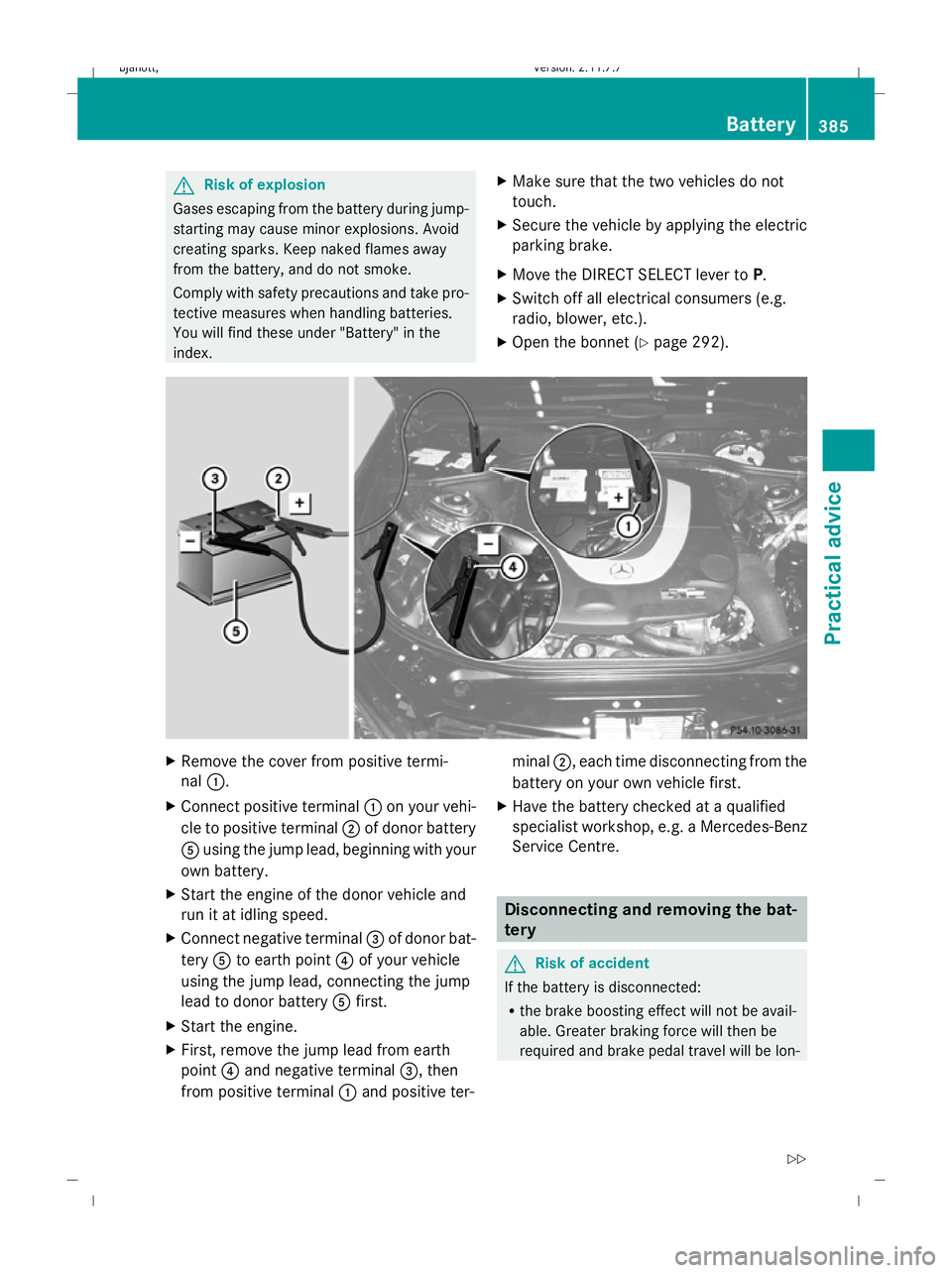
X Open the bonnet (Y page 292). X
Remove the cover from positive termi-
nal :.
X Connect positive terminal :on your vehi-
cle to positive terminal ;of donor battery
A using the jump lead, beginning with your
own battery.
X Start the engine of the donor vehicle and
run it at idling speed.
X Connect negative terminal =of donor bat-
tery Ato earth point ?of your vehicle
using the jump lead, connecting the jump
lead to donor battery Afirst.
X Start the engine.
X First, remove the jump lead from earth
point ?and negative terminal =, then
from positive terminal :and positive ter- minal
;, each time disconnecting from the
battery on your own vehicle first.
X Have the battery checked at a qualified
specialist workshop, e.g. a Mercedes-Benz
Service Centre. Disconnecting and removing the bat-
tery
G
Risk of accident
If the battery is disconnected:
R the brake boosting effect will not be avail-
able. Greater braking force will then be
required and brake pedal travel will be lon- Battery
385Practical advice
216_AKB; 2; 3, en-GB
bjanott, Version: 2.11.7.7 2009-02-27T14:54:17+01:00 - Seite 385 Z
Dateiname: 6515230602_buchblock.pdf; erzeugt am 04. Mar 2009 11:16:52; WK