coolant capacity MERCEDES-BENZ CLA 2016 Owners Manual
[x] Cancel search | Manufacturer: MERCEDES-BENZ, Model Year: 2016, Model line: CLA, Model: MERCEDES-BENZ CLA 2016Pages: 374, PDF Size: 9.97 MB
Page 9 of 374
Automatic climate control (dual-
zone) .............................................. 133
Controlling automatically ............... 137
Cooling with air dehumidification .. 136
Defrosting the windows ................. 140
Defrosting the windshield .............. 139
General notes ................................ 130
Indicator lamp ................................ 137
Information about using auto-
matic climate control ..................... 134
Maximum cooling .......................... 139
Notes on using the air-condition-
ing system ..................................... 132
Overview of systems ...................... 130
Problem with the rear window
defroster ........................................ 141
Problems with cooling with air
dehumidification ............................ 137
Refrigerant ..................................... 371
Refrigerant filling capacity ............. 371
Setting the air distribution ............. 138
Setting the air vents ...................... 142
Setting the airflow ......................... 138
Setting the temperature ................ 137
Switching air-recirculation mode
on/off ............................................ 141
Switching on/off ........................... 135
Switching residual heat on/off ...... 141
Switching the rear window
defroster on/off ............................ 140
Switching the ZONE function on/
off .................................................. 138
Cockpit
Overview .......................................... 30
COLLISION PREVENTION ASSIST
PLUS
Activating/deactivating ................. 220
Display message ............................ 234
Operation/notes .............................. 66
COMAND display
Cleaning ......................................... 306
Combination switch .......................... 116
Compass
Calibrating ..................................... 293
Calling up ....................................... 293
Magnetic field zone maps .............. 294
Setting ........................................... 293 Consumption statistics (on-board
computer) .......................................... 214
Convenience closing feature .............. 90
Convenience opening feature ............ 89
Coolant (engine)
Checking the level ......................... 299
Displ ay message ............................ 243
Fi
lling capacity ............................... 370
Important safety notes .................. 369
Temperature (on-board computer,
Mercedes-AMG vehicles) ............... 223
Temperature gauge ........................ 211
Warning lamp ................................. 267
Cooling
see Climate control
Copyright ............................................. 28
Cornering light function
Changing bulbs .............................. 123
Display message ............................ 240
Function/notes ............................. 117
Crash-responsive emergency light-
ing ....................................................... 120
Cruise control
Activation conditions ..................... 179
Cruise control lever ....................... 179
Deactivating ................................... 180
Display message ............................ 249
Driving system ............................... 178
Function/notes ............................. 178
Important safety notes .................. 178
Setting a speed .............................. 179
Storing and maintaining current
speed ............................................. 179
Cup holder
Center console .............................. 278
Important safety notes .................. 278
Rear compartment ......................... 279
Customer Assistance Center
(CAC) ..................................................... 26
Customer Relations Department ....... 26
D
Dashboard
see Instrument cluster
Data
see Technical data Index 7
Page 352 of 374
Curb weight
The weight of a vehicle with standard equip-
ment including the maximum capacity of fuel,
oil and coolant. It also includes the air-condi-
tioning system and optional equipment if
these are installed in the vehicle, but does not
include passengers or luggage.
Maximum load rating
The maximum tire load is the maximum per-
missible weight in kilograms or lbs for which a
tire is approved.
Maximum permissible tire pressure
Maximum permissible tire pressure for one
tire.
Maximum load on one tire
Maximum load on one tire. This is calculated
by dividing the maximum axle load of one axle
by two.
PSI (pounds per square inch)
A standard unit of measure for tire pressure.
Aspect ratio
Relationship between tire height and tire
width in percent.
Tire pressure
This is pressure inside the tire applying an
outward force to each square inch of the tire's
surface. The tire pressure is specified in
pounds per square inch (psi), in kilopascal
(kPa) or in bar. The tire pressure should only
be corrected when the tires are cold.
Cold tire pressure
The tires are cold: R
if the vehicle has been parked with the tires
out of direct sunlight for at least three
hours and R
if the vehicle has not been driven further
than 1 mile (1.6 km) Tread
The part of the tire that comes into contact
with the road.
Bead
The tire bead ensures that the tire sits
securely on t h
e wheel. There are several steel
wires in the bead to prevent the tire from
coming loose from the wheel rim.
Sidewall
The part of the tire between the tread and the
bead.
Weight of optional extras
The combined weight of those optional extras
that weigh more than the replaced standard
parts and more than 2.3 kg (5 lbs). These
optional extras, such as high-performance
brakes, level control, a roof rack or a high-
performance battery, are not included in the
curb weight and the weight of the accesso-
ries.
TIN (Tire Identification Number)
This is a unique identifier which can be used
by a tire manufacturer to identify tires, for
example for a product recall, and thus identify
the purchasers. The TIN is made up of the
manufacturer's identity code, tire size, tire
type code and the manufacturing date.
Load bearing index
The load bearing index (also load index) is a
code that contains the maximum load bearing
capacity of a tire.
Traction
Traction is the result of friction between the
tires and the road surface.
Treadwear indicators
Narrow bars (tread wear bars) that are dis-
tributed over the tire tread. If the tire tread is
level with the bars, the wear limit of
Page 371 of 374
Model Capacity
Mercedes ‑ AMG vehi-
cles 5.8 US qt (5.5 l)
All other mod els
5.9 US qt (5.6 l)
Additives
! Do no t use any additive s in th e engin e oil.
This could damag e th e engine.
Engine oil viscosity
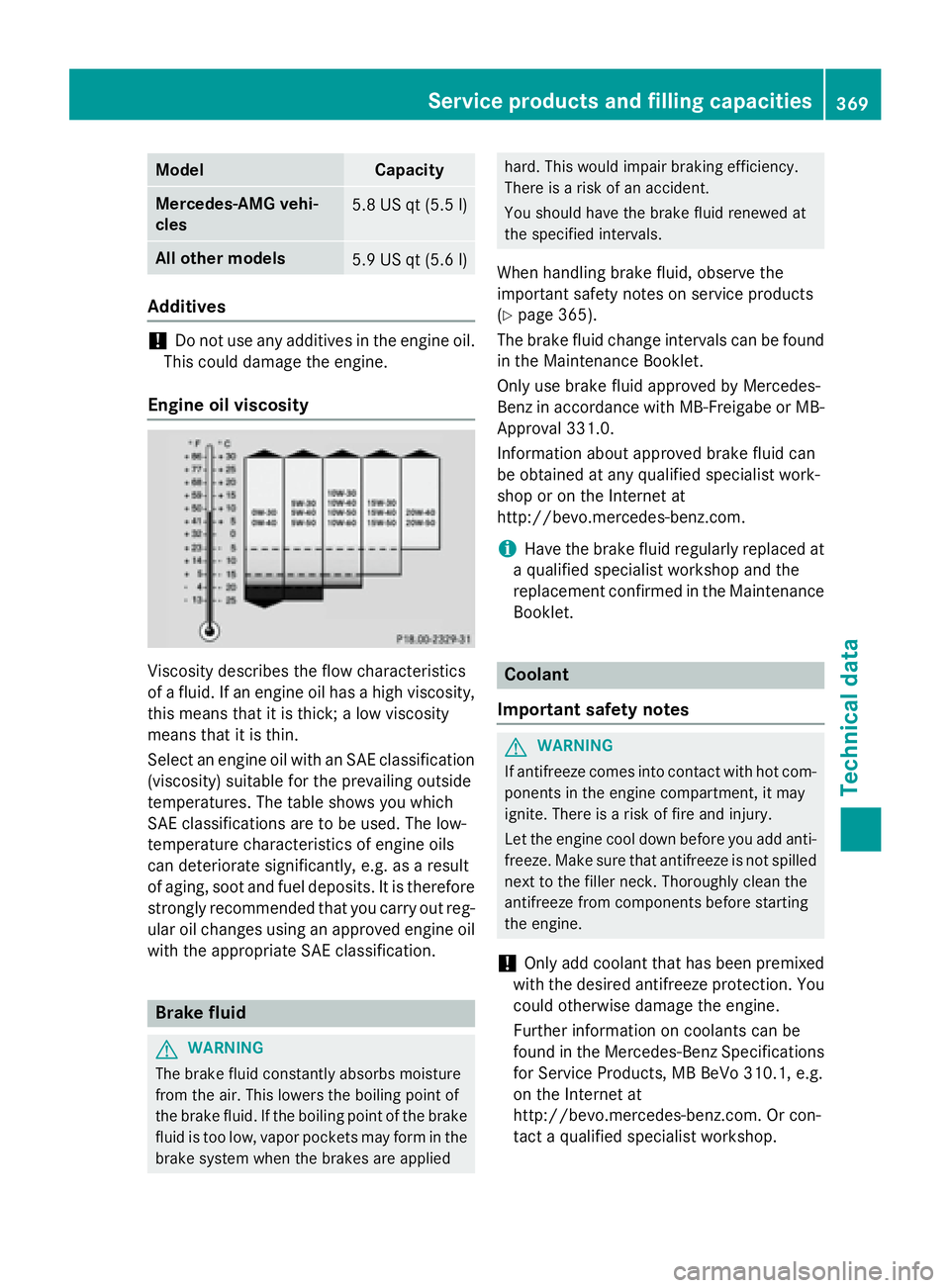
Viscosit y describe s th e flo w characteristics
of a fluid . If an engin e oil has a high viscosity,
this mean s that it is thick ; a low viscosit y
mean s that it is thin.
Selec t an engin e oil wit h an SA E classification
(viscosity) suitable for th e prevailing outside
temperatures . The table shows you whic h
SA E classification s are to be used. The low-
temperature characteristics of engin e oils
can deteriorat e significantly, e.g. as a result
of aging, soo t and fuel deposits. It is therefor e
strongly recommended that you carry out reg -
ular oil changes usin g an approve d engin e oil
wit h th e appropriat e SA E classification .
Brake fluid
G WARNIN G
The brak e fluid constantl y absorbs moisture
from th e air. This lower s th e boiling poin t of
th e brak e fluid . If th e boiling poin t of th e brak e
fluid is to o low, vapo r pockets may for m in th e
brak e system when th e brakes are applie d hard. This would impair braking efficiency.
There is a ris k of an accident.
You should hav e th e brak e fluid renewed at
th e specifie d intervals.
When handlin g brak e fluid , observ e th e
important saf et y note s on servic e products
( Y
page 365).
The brak e fluid chang e intervals can be foun d
in th e Maintenance Booklet .
Only use brak e fluid approve d by Mercedes-
Benz in accordanc e wit h MB-Freigabe or MB -
Approval 331.0.
Information about approve d brak e fluid can
be obtained at any qualified specialist work-
shop or on th e Internet at
http://bevo.mercedes-benz.co m.
i Have the brake fluid regularly replaced at
a qualified specialist workshop and the
replacement confirmed in the Maintenance
Booklet.
Coolant
Important safety notes
G WARNING
If antifreeze comes into contact with hot com-
ponents in the engine compartment, it may
ignite. There is a risk of fire and injury.
Let the engine cool down before you add anti-
freeze. Make sure that antifreeze is not spilled
next to the filler neck. Thoroughly clean the
antifreeze from components before starting
the engine.
! Only add coolant that has been premixed
with the desired antifreeze protection. You
could otherwise damage the engine.
Further information on coolants can be
found in the Mercedes-Benz Specifications
for Service Products, MB BeVo 310.1, e.g.
on the Internet at
http://bevo.mercedes-benz.com. Or con-
tact a qualified specialist workshop.Service products and filling capacities 369
Technical data Z
Page 372 of 374
! Always use a suitable coolant mixture,
even in countries where high temperatures
prevail.
Otherwise, the engine cooling system is not
sufficiently protected from corrosion and
overheating.
i Have the coolant regularly replaced at a
qualified specialist workshop and the
replacement confirmed in the Maintenance
Booklet.
Comply with the important safety precautions
for service products when handling coolant
( Y
page 365).
The coolant is a mixture of water and anti-
freeze/corrosion inhibitor. It performs the
following tasks: R
corrosion protection R
antifreeze protection R
raising the boiling point
If the coolant has antifreeze protection down
to -35 ‡( -37 †), the boiling point of the cool-
ant during operation is approximately 266 ‡
(130 †).
The antifreeze/corrosion inhibitor concentra-
tion in the engine cooling system should: R
be at least 50%. This will protect the engine
cooling system against freezing down to
approximately -35 ‡ (-37 †) .R
no t exceed 55 % (antifreeze protection
do wn to -49 ‡ [-45 †]). Otherwise, heat
will not be dissipated as effectively.
Mercedes-Benz recommends coolant or anti-
freeze/corrosion inhibitor concentrate in
accordance with MB Specifications for Ser-
vice Products 310.1.
i When the vehicle is first delivered, it is fil-
led with a coolant mixture that ensures
adequate antifreeze and corrosion protec-
tion.
i The coolant is checked with every main-
tenance interval at a qualified specialist
workshop. Filling capacities Model Capacity
Mercedes ‑ AMG
vehicles Approx. 12.6 US qt
(11.9 l)
All other models
Approx. 8.2 US qt
(7.8 l)
Windshield washer system
Important safety notes
G WARNING
Windshield washer concentrate could ignite if
it comes into contact with hot engine compo-
nents or the exhaust system. There is a risk of
fire and injury.
Make sure that no windshield washer con-
centrate is spilled next to the filler neck.
! Do not add distilled or de-ionized water to
the washer fluid container. Otherwise, the
level sensor may be damaged.
! Only MB SummerFit and MB WinterFit
washer fluid should be mixed together. The
spray nozzles may otherwise become
blocked.
When handling washer fluid, observe the
important safety notes on service products
( Y
page 365).
At temperatures above freezing: X
Fill the washer fluid reservoir with a mixture
of water and windshield washer fluid, e.g.
MB SummerFit.
Add 1 part MB SummerFit to 100 parts water.
At temperatures below freezing: X
Fill the washer fluid reservoir with a mixture
of water and washer fluid, e.g. MB Winter-
Fit.
For the correct mixing ratio refer to the
information on the antifreeze reservoir.370
Service products and filling capacities
Technical data