ECU MERCEDES-BENZ CLA 2018 User Guide
[x] Cancel search | Manufacturer: MERCEDES-BENZ, Model Year: 2018, Model line: CLA, Model: MERCEDES-BENZ CLA 2018Pages: 326, PDF Size: 7.97 MB
Page 51 of 326
passenger fron ta ir bag is enabled or disa-
bled in accordance with the person in the
front-passenger seat R
the front-passenger seat has been moved
back as far back as possible. R
the person is seated correctly.
Make sure, both before and during the jour-
ney, that the status of the front-passenger
fron ta ir bag is correct.
G WARNING
If you secure ac hild in ar earward-facing child
restraint system on the front-passenger seat
and the PASSENGER AIR BA GO FF indicator
lamp is off, the front-passenger fron ta ir bag
can deploy in the event of an accident. The
child could be struck by the air bag. This poses
an increased risk of injury or even fatal injury.
Make sure that the front-passenger fron ta ir
bag has been deactivated. The PASSENGER
AIR BA GO FF indicator lamp must be lit.
NEVER use ar earward-facing child restraint
on as eat protected by an ACTIVE FRONT AIR-
BA Ginf ron tofi t; DEATH or SERIOUS INJURY
to the child can occur.
If the PASSENGER AIR BA GO FF indicator lamp
stays off, do not install ar earward-facing child
restraint system on the front-passenger seat.
You can find more information on OCS under
"Problems with the Occupant Classification Sys-
tem" ( Y
page 51).
G WARNING
If you secure ac hild in af orward-facin gc hild
restraint system on the front-passenger seat
and you position the front-passenger seat too
close to the dashboard, in the event of an
accident, the child could: R
come int oc ontact with the vehicle's inte-
rior if the PASSENGER AIR BA GO FF indi-
cator lamp is lit, for example R
be struck by the air bag if the PASSENGER
AIR BA GO FF indicator lamp is off
This poses an increased risk of injury or even
fatal injury. Always move the front-passenger seat as far
back as possible and fully retract the seat
cushion length. Always make sure that the
shoulder belt strap is correctly routed from
the vehicle belt sash guide to the shoulder
belt guide on the child restraint system. The
shoulder belt strap must be routed forwards
and downwards from the vehicle belt sash
guide. If necessary, adjust the vehicle belt
sash guide and the front-passenger seat
accordingly. Always observe the child
restraint system manufacturer's installation
instructions.
If OCS determines that: R
The front-passenger seat is unoccupied, the
PASSENGER AIR BA GO FF indicator lamp
lights up after the system self-test and
remains lit. This indicates that the front-
passenger fron ta ir bag is deactivated. R
The front-passenger seat is occupied by a
child of up to twelve months old, in as tandard
child restraint system, the PASSENGER AIR
BA GO FF indicator lamp lights up after the
system self-test and remains lit. This indi-
cates that the front-passenger fron ta ir bag is
deactivated.
But even in the case of at welve-month-old
child, in as tandard child restraint system, the
PASSENGER AIR BA GO FF indicator lamp can
go out after the system self-test. This indi-
cates that the front-passenger fron ta ir bag is
activated. The result of the classification is
dependen to n, among other factors, the child
restraint system and the child's stature. It is
recommended that you install the child
restraint system on as uitable rear seat.R
The front-passenger seat is occupied by a
person of smaller stature (e.g. at eenager or
small adult), the PASSENGER AIR BA GO FF
indicator lamp lights up and remains lit after
the system self-test dependin gont he result
of the classification or, alternatively, goes out. -
If the PASSENGER AIR BA GO FF indicator
lamp is off, move the front-passenger seatOccupant safety 49
Safety Z
Page 56 of 326
sive role in the deployment of an air bag. Nor do
they provide an indication of air bag deploy-
ment.
The vehicle can be deformed considerably, with-
out an air bag being deployed. This is the case if
only parts which are relatively easil yd eformed
are affected and the rate of deceleration is not
high. Conversely, air bags may be deployed even
though the vehicle suffers only minor deforma-
tion. This is the case if, for example, very rigid
vehicle parts such as longitudinal body mem-
bers are hit, and sufficient deceleration occurs
as ar esult.
If the restraint system control unit detects as ide
impact or if the vehicle rolls over, the applicable
component soft he restraint system are activa-
ted independently of each other depending on
the apparent type of accident. R
Side impact air bags on the side where the
impact takes place, independently of the
Emergenc yT ensioning Device and the use of
the seat belt on the driver's seat and outer
seats in the second row
The side impact air bag on the front-
passenger side deploy su nder the following
conditions: -
the OCS system detects that the front-
passenger seat is occupied or -
the seat belt buckle tongue is engaged in
the belt buckle of the front-passenger seat R
Window curtain air bag on the side of impact,
independently of the use of the seat belt and
independently of whether the front-
passenger seat is occupied R
Emergenc yT ensioning Devices, if the system
determines that deployment can offer addi-
tional protection in this situation R
Window curtain air bags on the driver's and
front-passenger side in certain situations
when the vehicle rolls over, if the system
determines that deployment can offer addi-
tional protection to that provided by the seat
belt
i Not all air bags are deployed in an accident.
The different air bag systems work independ-
ently of each other. How the air bag system works is determined
by the severity of the accident detected,
especially the vehicle deceleration or accel-
eration and the apparent type of accident: R
Frontal collision R
Side impact R
Rollover
Automatic measures after an acci-
dent Immediately after an accident, the following
measures are implemented, depending on the
type and severity of the impact: R
the hazard warning lamps are activated R
the emergency lighting is activated R
the vehicle doors are unlocked R
the front side windows are lowered R
the engine is switched off and the fuel supply
is cut off R
vehicles with mbrace: automatic emergency
call
Children in the vehicle
Important safety notes Accident statistics show that children secured
in the rear seats are safer than children secured
in the front-passenger seat. For this reason,
Mercedes-Benz strongly advises that you install
ac hild restraint system on ar ear seat. Children
are generally better protected there.
If ac hild younger than twelve years old and
under 5ft( 1.50 m) in height is traveling in the
vehicle: R
always secure the child in ac hild restraint
system suitable for Mercedes-Benz vehicles.
The child restraint system must be appropri-
ate to the age, weight and size of the child R
be sure to observe the instructions and safety
notes in this section in addition to the child
restraint system manufacturer's installation
instructions R
be sure to observe the instructions and safety
notes on the "Occupant classification system
(OCS)" ( Y
page 47)54
Children in the vehicle
Safety
Page 57 of 326
G WARNING
If you leave children unsupervised in the vehi-
cle, they coul ds et it in motion by, for example:R
release the parking brake. R
shift the automatic transmission out of the
parking position P .R
start the engine.
In addition, they may operate vehicl ee quip-
ment and become trapped. There is ar isk of
an accident and injury.
When leaving the vehicle, alway st ake the
SmartKey with you and lock the vehicle. Never
leave children unsupervised in the vehicle.
G WARNING
If persons, particularl yc hildren are subjected
to prolonged exposure to extreme hea to r
cold, there is ar isk of injury ,p ossibly even
fatal .N ever leave children unattended in the
vehicle.
G WARNING
If the child restraint system is subjected to
direct sunlight, parts may get very hot. Chil-
dren may burn themselves on these parts,
particularl yont he metal parts of the child
restraint system. There is ar isk of injury.
If you leave the vehicle, taking the child with
you ,a lway se nsure that the child restraint
system is not expose dtod irect sunlight. Pro-
tect it with ab lanket, for example. If the child
restraint system has been expose dtod irect
sunlight, let it cool dow nb efore securing the
child in it. Never leave children unattended in
the vehicle.
Always ensure that all vehicl eo ccupants have
their seat belts fastened correctly and are sitting
properly .P articular attention must be pai dt o
children.
Observe the safety notes on the seat belt
( Y
pag e4 2) and the notes on correct use of seat
belts ( Y
pag e4 3).
Ab ooster seat may be necessary to achieve
prope rs eat bel tp ositioning for children over
41 lbs (18 kg )u ntil they reach ah eight where a three-point seat bel tc an be properly fastened
without ab ooster seat.
Special seatbelt retractor
G WARNING
If the seat bel tisr eleased while driving, the
child restraint system wil lnol onger be
secure dp roperly .T he special seat bel tr etrac-
tor is disable da nd the inertia real draw sina
portion of the seat belt. The seat bel tc annot
be immediatel yr efastened. There is an
increased risk of injury ,p ossibly even fatal.
Stop the vehicl ei mmediately, paying atten-
tion to road and traffic conditions. Reactivate
the special seat bel tr etractor and secure the
child restraint system properly.
All seat belts in the vehicle, except the driver's
seat belt, are equipped with as pecial seat belt
retractor. When activated, the special seat belt
retractor ensure st hat the seat bel tc annot
slacken once the child seat is secured.
Installing ac hild restraint system: X
Make sure you observe the child restraint
system manufacturer's installation instruc-
tions. X
Pul lt he seat bel ts moothly from the bel to ut-
let. X
Engage seat bel tt ongue in bel tb uckle.
Activating the special seat bel tr etractor:X
Pul lt he seat bel to ut full ya nd let the inertia
reel retract it again.
Whil et he seat bel tisr etracting, you should
hear ar atcheting sound .T he special seat belt
retractor is enabled. X
Push the child restraint system dow nsot hat
the seat bel tist ight and does not loosen.
Removing the child restraint system and deac-
tivating the special seat bel tr etractor:X
Make sure you observe the child restraint
system manufacturer's installation instruc-
tions. X
Press the release button of the seat belt
buckle and guide the seat bel tt ongue back
toward st he bel ts ash guide.
The special seat bel tr etractor is deactivated.Children in the vehicle 55
Safety Z
Page 58 of 326
Child restraint system The use of seat belt sa nd child restraint systems
is required by law in: R
all 50 states R
th eU .S .t erri toriesR
th eD istrict of ColumbiaR
all Canadian provinces
If you install ar earward-facing child restraint
system on th ec ente rr ear seat ,t he rear arm rest
must be folded back as far as possible.
You can obtain further informatio na bout the
correc tc hi ld restraint system from any author-
ize dM ercedes-Ben zC enter.
G WARNING
If th ec hi ld restraint system is installed incor-
rectly on as uitable seat ,itc anno tp rotect as
intended. The child canno tt he nber estrained
in th ee vent of an accident, heav yb raking or
sudde nc ha nges of direction .T her eisa n
increased ris kofi njury, possibly eve nf atal.
Mak es ure that you observ et he child restraint
system manufacturer' si nstallatio ni nstruc-
tions and th en otes on use. Pleas ee ns ure,
that th eb ase of th ec hi ld restraint system is
always restin gc ompletely on th es eat cush-
ion .N ever plac eo bjects, e.g .c ushions, under
or behin dt he child restraint system. Only use
child restraint systems wit ht he original cover
designe df or them. Only replace damaged
covers wit hg enuine covers.
G WARNING
If th ec hi ld restraint system is installed incor-
rectly or is no ts ecured, it can com el oos ei n
th ee vent of an accident, heav yb raking or a
sudde nc ha ng eind irection .T he child
restraint system coul dbet hr own about ,s tr ik-
ing vehicle occupants. Ther eisani ncreased
ris kofi njury, possibly eve nf atal.
Always install child restraint systems prop-
erly, eve nift he ya re no tb ein gu sed. Make
sure that you observ et he child restraint sys-
te mm anufacturer' si nstallatio ni nstructions.
You will fin df urther informatio nons to wing
objects, luggag eorl oads unde r" Loading guide-
lines" ( Y
page 237). G WARNING
Child restraint systems or their securin gs ys-
tems whic hh ave been damaged or subjected
to al oad in an acciden tc an no longer protect
as intended. The child canno tt he nb e
restraine dint he event of an accident, heavy
braking or sudde nc ha nges of direction .T here
is an increased ris kofi njury, possibly even
fatal.
Replac ec hi ld restraint systems whic hh ave
been damaged or subjected to al oad in an
acciden tass oon as possible. Hav et he secur-
ing systems on th ec hi ld restraint system
checked at aq ualified specialist workshop,
before you install ac hi ld restraint system
again.
The securin gs ystems of child restraint systems
are: R
th es eat belt system R
th eL AT CH-type (ISOFIX) securin gr ingsR
th eT op Tether anchorages
If it is absolutely necessary to carry ac hi ld on
th ef ront-pa ssenger seat ,bes ure to observ et he
informatio nont he "Occupan tC lassification
Syste m( OCS)" ( Y
page 47) .T her ey ou will also
fin di nformatio nond eactivatin gt he front-
passenger fron ta ir bag.
All child restraint systems must mee tt he fol-
lowin gs ta ndards: R
U.S. Federal Motor Vehicle Safet yS ta ndards
21 3a nd 225 R
Canadian Motor Vehicle Safet yS ta ndards
21 3a nd 210.2
Confirmation that th ec hi ld restraint system cor-
responds to th es ta ndards can be foun dona n
ins truc tion label on th ec hi ld
restraint system.
This confirmation can also be foun dint he instal-
lation instruction st ha ta re included wit ht he
child restraint system.
Observ et he warning labels in th ev ehicle inte-
rior and on th ec hi ld restraint system.56
Children in th ev ehicle
Safety
Page 59 of 326
LATCH-typ e( ISOFIX) child seat secur-
ing system
G WARNING
LATCH-type (ISOFIX) child restraint systems
do not offer sufficient protection for children
whose weight combine dw ith th ec hild
restraint system is greater than 65 lbs (29 kg)
and who are secured usin gt he safety belt
integrated in th ec hild restraint system. In the
even tofana ccident, ac hild migh tn ot be
restrained correctly. This poses an increased
risk of injury or even fatal injury.
If th ec hild and th ec hild restraint system
together weigh mor et ha n65l bs (29 kg), only
use LATCH-type (ISOFIX) child restraint sys-
tem sw ith whic ht he child is also secured with
th ev ehicle seat belt .A ls os ecure th ec hild
restraint system with th eT op Tether belt ,i f
available.
Always comply with th em anufacturer' si nstal-
latio na nd operatin gi nstruction sf or th ec hild
restraint system used.
Before ever yt ri p, mak es ure that th eL AT CH-
type (ISOFIX) child restraint system is engaged
correctly in bot hL AT CH-type (ISOFIX) securing
rings
! When installing th ec hild restraint system,
mak es ure that th es eat belt for th em iddle
seat does not get trapped. The seat belt could
otherwise be damaged.
X
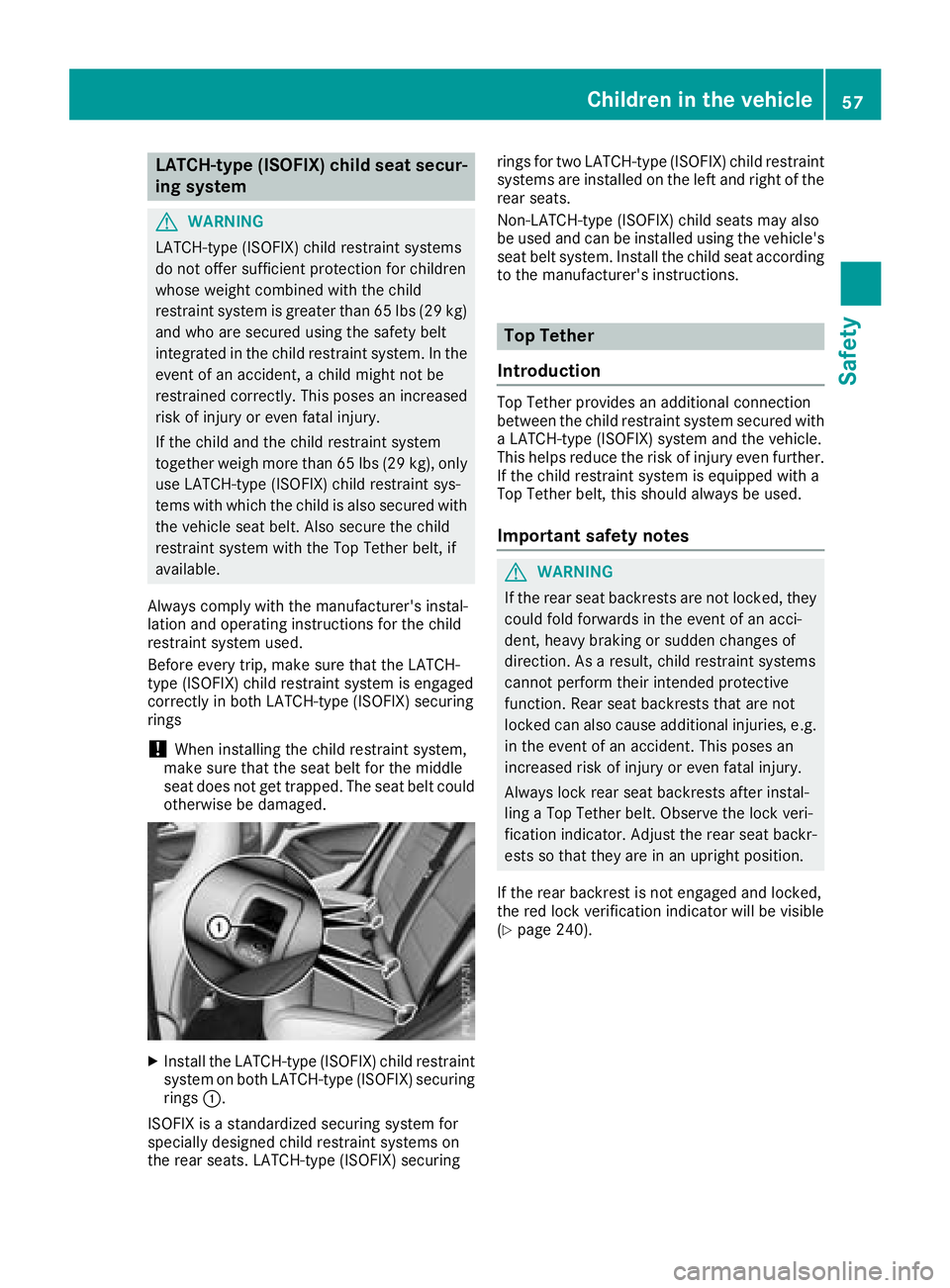
Install th eL AT CH-type (ISOFIX) child restraint
system on bot hL AT CH-type (ISOFIX) securing
rings C .
ISOFI Xisas ta ndardized securin gs ystem for
specially designed child restraint systems on
th er ear seats. LATCH-type (ISOFIX) securing rings for two LATCH-type (ISOFIX) child restraint
systems are installe dont he left and righ toft he
rear seats.
Non-LATCH-type (ISOFIX) child seat sm ay also
be used and can be installe du sin gt he vehicle's
seat belt system. Install th ec hild seat according
to th em anufacturer' si nstructions.
Top Tether
Introduction Top Tether provides an additional connection
between th ec hild restraint system secured with
aL AT CH-type (ISOFIX) system and th ev ehicle.
This helps reduc et he risk of injury even further.
If th ec hild restraint system is equipped with a
Top Tether belt ,t hi ss hould always be used.
Important safety notes
G WARNING
If th er ear seat backrests are not locked ,t he y
could fold forwards in th ee ven tofana cci-
dent, heavy braking or sudden changes of
direction. As ar esult, child restraint systems
cannot perform their intended protective
function .R ear seat backrests that are not
locked can also cause additional injuries ,e .g.
in th ee ven tofana ccident. This poses an
increased risk of injury or even fatal injury.
Always lock rear seat backrests after instal-
ling aT op Tether belt .O bserve th el oc kv eri-
ficatio ni ndicator. Adjust th er ear seat backr-
est ssot ha tt he ya re in an uprigh tp osition.
If th er ear backres tisn ot engaged and locked,
th er ed lock verificatio ni ndicator will be visible
( Y
page 240).Children in th ev ehicle 57
Safety Z
Page 62 of 326
G WARNING
If the child restraint system is subjected to
direct sunlight, parts may get very hot. Chil-
dren may burn themselves on these parts,
particularl yont he metal parts of the child
restraint system. There is ar isk of injury.
If you leave the vehicle, taking the child with
you ,a lway se nsure that the child restraint
system is not expose dtod irect sunlight. Pro-
tect it with ab lanket, for example. If the child
restraint system has been expose dtod irect
sunlight, let it cool dow nb efore securing the
child in it. Never leave children unattended in
the vehicle.
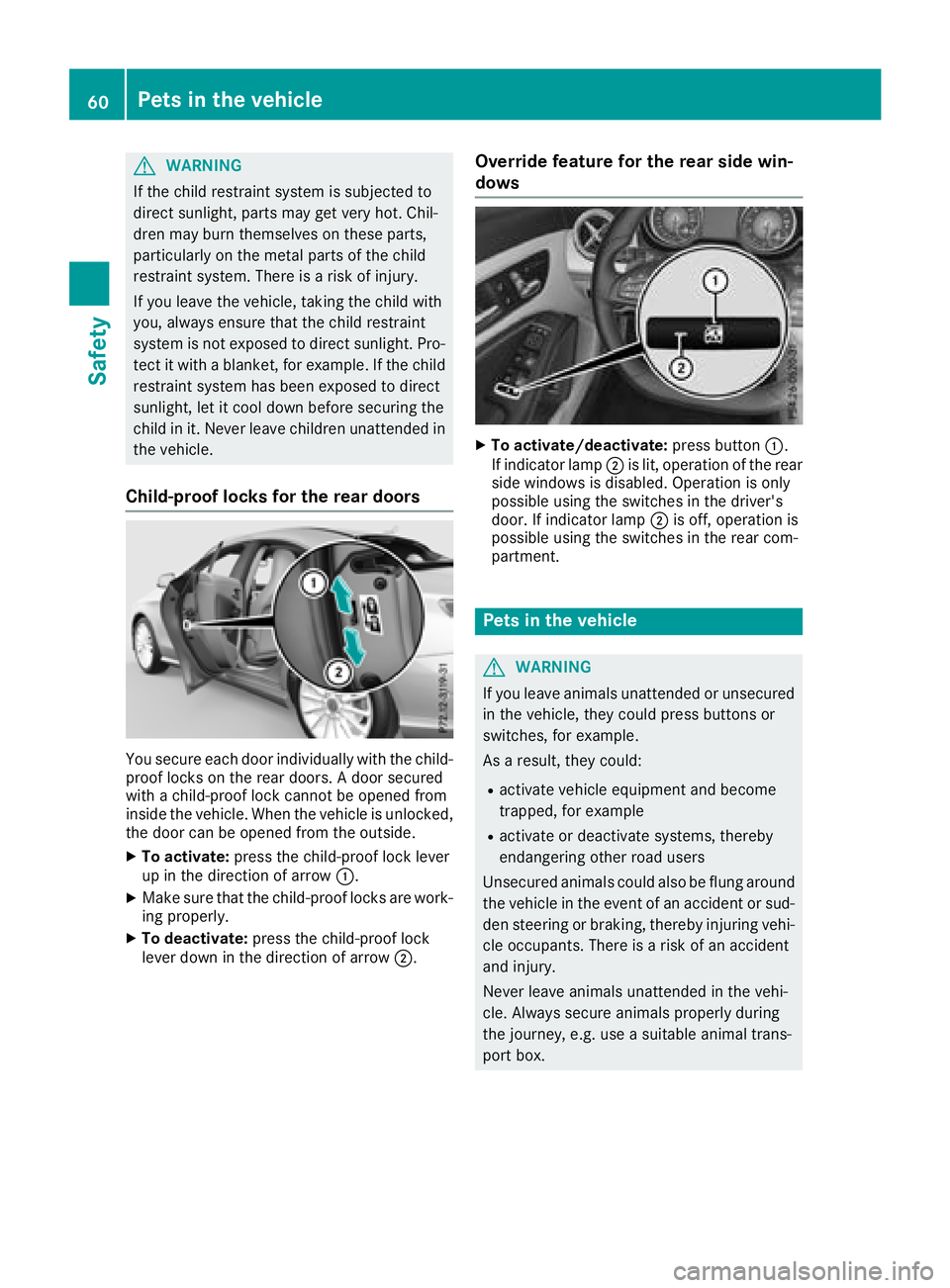
Child-proof locks for the rear doors
You secure each door individually with the child-
proof locks on the rear doors. Ad oor secured
with ac hild-proof lock cannot be opened from
insid et he vehicle. When the vehicl eisu nlocked,
the door can be opened from the outside. X
To activate: press the child-proof lock lever
up in the direction of arrow C .X
Make sure that the child-proof locks are work-
ing properly. X
To deactivate: press the child-proof lock
leve rd ow nint he direction of arrow D . Override feature for the rear side win-
dows X
To activate/deactivate: press button C .
If indicator lamp D is lit, operation of the rear
side windows is disabled. Operation is only
possible using the switches in the driver's
door. If indicator lamp D is off, operation is
possible using the switches in the rear com-
partment.
Pets in the vehicle
G WARNING
If you leave animals unattended or unsecured
in the vehicle, they coul dp ress buttons or
switches, for example.
As ar esult, they could: R
activate vehicl ee quipment and become
trapped, for example R
activate or deactivate systems ,t hereby
endangering other road users
Unsecure da nimals coul da ls obef lung around
the vehicl eint he event of an accident or sud-
den steering or braking, thereby injuring vehi-
cle occupants. There is ar isk of an accident
and injury.
Never leave animals unattended in the vehi-
cle. Always secure animals properly during
the journey ,e .g. use as uitable anima lt rans-
port box.60
Pets in the vehicle
Safety
Page 78 of 326
Door s
Important safet yn otes
G WARNING
If children are lef tu nsupervised in th ev ehicle,
they could: R
ope nt he doors ,t hu se nd angerin go th er
people or road users. R
get out and disrup tt ra ffic .R
operat et he vehicle' se quipment.
Additionally, children could set th ev ehicle in
motion if, fo re xa mple, they:R
release th ep arking brake .R
shiftin gt he automatic transmissio no ut of
par kp osition PR
Start th ee ng ine.
There is ar is kofana cciden ta nd injury.
Whe nl eavin gt he vehicle, always take th e
SmartKey wit hy ou and loc kt he vehicle. Never
leav ec hi ldren or animals unattended in th e
vehicle. Always keep th eS ma rtKey out of
reach of children .
You should preferably plac el uggage or load si n
th ec argo compartment. Observ et he loadin g
guidelines ( Y
page 237).
Unlockin ga nd opening doors from
th ei nside
! The sid ew indows will no to pen/close if th e
battery is discharged or if th es id ew indows
hav ei ce du p. It will then no tbep ossible to
close th ed oor. Do no ta ttemp ttof orce th e
doo rc lo sed. You could otherwise damage th e
doo rort he sid ew indow.
Whe nad oo riso pened, th es id ew indow on that
sid eo pens slightly. Whe nt he doo risc lo sed, th e
sid ew indow close sa gain . X
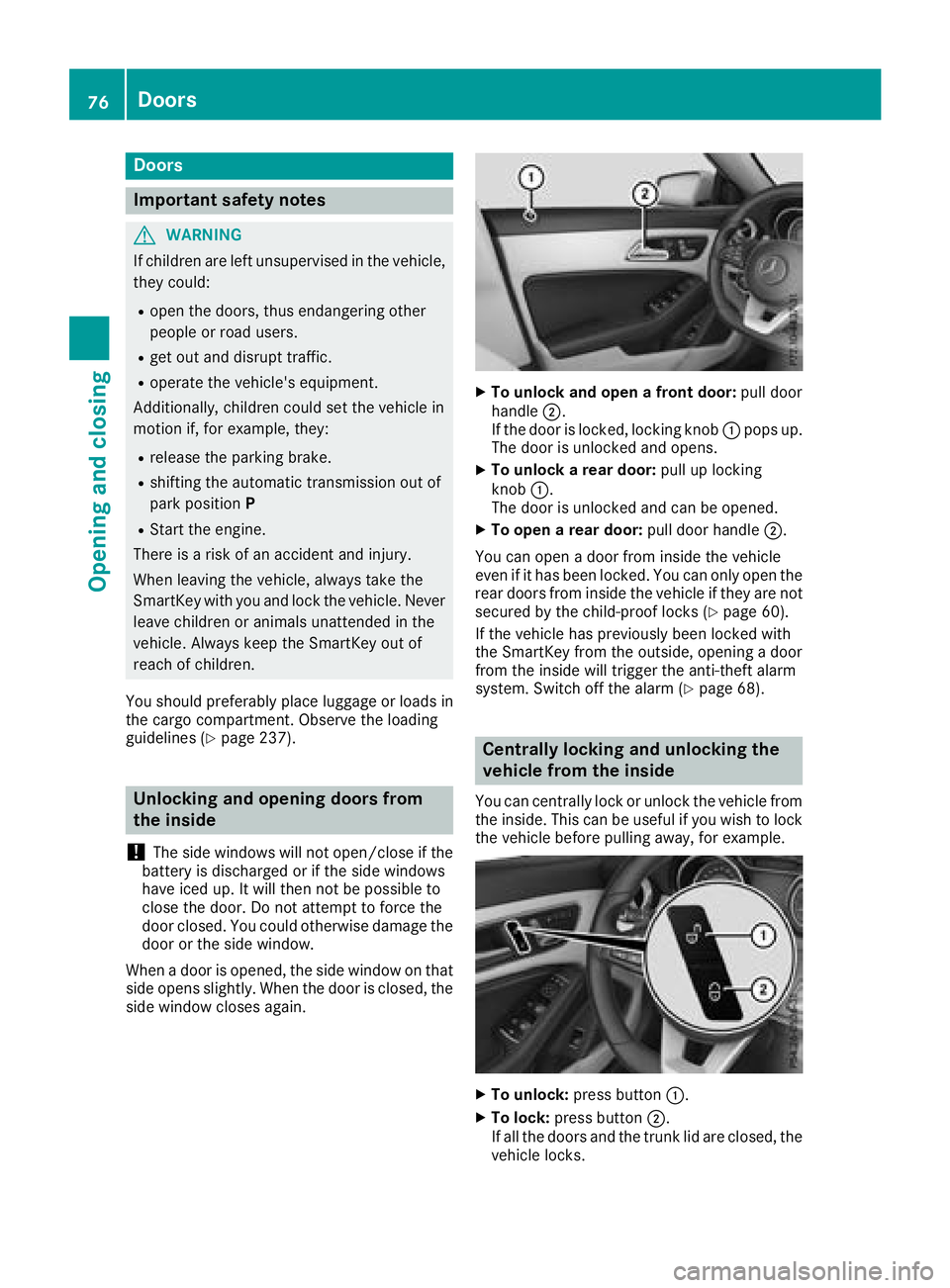
To unlock an do pe naf ro nt door: pull doo r
handle D .
If th ed oo risl ocked, locking knob C pop su p.
The doo risu nlocke da nd opens .X
To unlock ar ea rd oor: pull up locking
knob C .
The doo risu nlocke da nd can be opened.X
To ope nar ea rd oor: pull doo rh andle D .
You can ope nad oo rf ro mi ns id et he vehicle
eve nifith as bee nl ocked. You can only ope nt he
rea rd oors from insid et he vehicle if they are no t
secure dbyt he child-proof locks ( Y
page 60).
If th ev ehicle has previously bee nl ocke dw it h
th eS ma rtKey from th eo utside, opening ad oo r
from th ei ns id ew ill trigger th ea nti-thef ta lar m
system. Switc ho ff th ea lar m( Y
page 68).
Centrally locking an du nl ocking th e
vehicle from th ei nsideYou can centrall yl oc koru nloc kt he vehicle from
th ei ns ide. Thi sc an be useful if you wish to loc k
th ev ehicle befor ep ulling away, fo re xa mple.
X
To unlock : press butto n C .X
To lock : press butto n D .
If all th ed oors and th et ru nk lid are closed, th e
vehicle locks .76
Doors
Opening an dc losing
Page 79 of 326
Meanwhile, the fuel filler flap will not be locked
or unlocked.
You cannot unlock the vehicle centrally from the
inside if the vehicle has been locked with the
SmartKey or KEYLESS-GO.
You can open ad oor from inside the vehicle
even if it has been locked. You can open the rear
doors from inside the vehicle unless they are
secured by the child-proof lock ( Y
page 60).
If the vehicle has previously been locked with
the SmartKey from the outside, opening ad oor
from the inside will trigger the anti-theft alarm
system. Switch off the alarm ( Y
page 68).
If al ocked door is opened from the inside, the
previous unlock status of the vehicle will be
taken into consideration if: R
the vehicle was locked using the locking but-
ton for the central locking, or R
if the vehicle was locked automatically
The vehicle will be fully unlocked if it had previ-
ously been fully unlocked. If only the driver's
door had been previously unlocked, only the
door which has been opened from the inside is
unlocked.
Automatic lockin gf eature
X
To deactivate: press and hold button C for
approximately five seconds until at one
sounds. X
To activate: press and hold button D for
approximately five seconds until at one
sounds.
If you press one of the two buttons and do not
hear at one, the relevant settin gh as already
been selected.
The vehicle is locked automatically when the
ignition is switched on and the wheels are turn-
ing. You could therefore lock yourself out if: R
the vehicle is being pushed R
the vehicle is being towed R
the vehicle is on ar oller dynamometer
You can also switch the automatic locking func-
tion on and off using the on-board computer
( Y
page 187).
Unlocking the driver's door (mechan-
ical key) If the vehicle can no longer be locked or
unlocked with the SmartKey or KEYLESS-GO,
use the mechanical key.
If you use the mechanical key to unlock and
open the driver's door, the anti-theft alarm sys-
tem will be triggered. Switch off the alarm
( Y
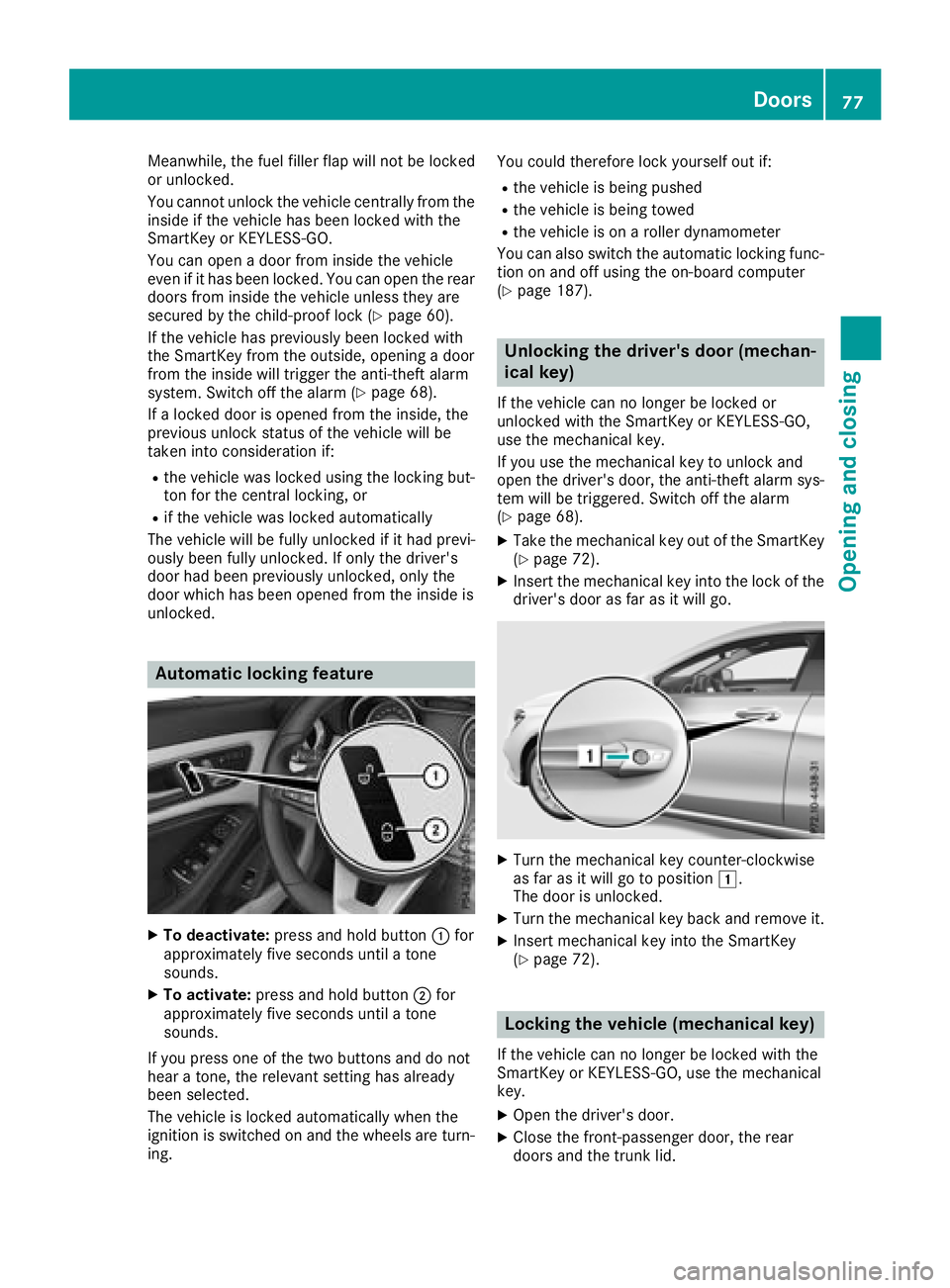
page 68). X
Take the mechanical key out of the SmartKey
( Y
page 72). X
Insert the mechanical key into the lock of the
driver's door as far as it will go.
X
Turn the mechanical key counter-clockwise
as far as it will go to position G .
The door is unlocked. X
Turn the mechanical key back and remove it. X
Insert mechanical key into the SmartKey
( Y
page 72).
Locking the vehicle (mechanical key)
If the vehicle can no longer be locked with the
SmartKey or KEYLESS-GO, use the mechanical
key. X
Open the driver's door. X
Close the front-passenger door, the rear
doors and the trunk lid. Doors 77
Opening and closing Z
Page 80 of 326
X
Press the lockin gb utton on the driver’s door
( Y
page 76).X
Check whether the lockin gk nobs on the
front-passenger door and the rear doors are
still visible. Press down the lockin gk nobs by
hand, if necessary. X
Close the driver's door. X
Take the mechanical key out of the SmartKey
( Y
page 72).X
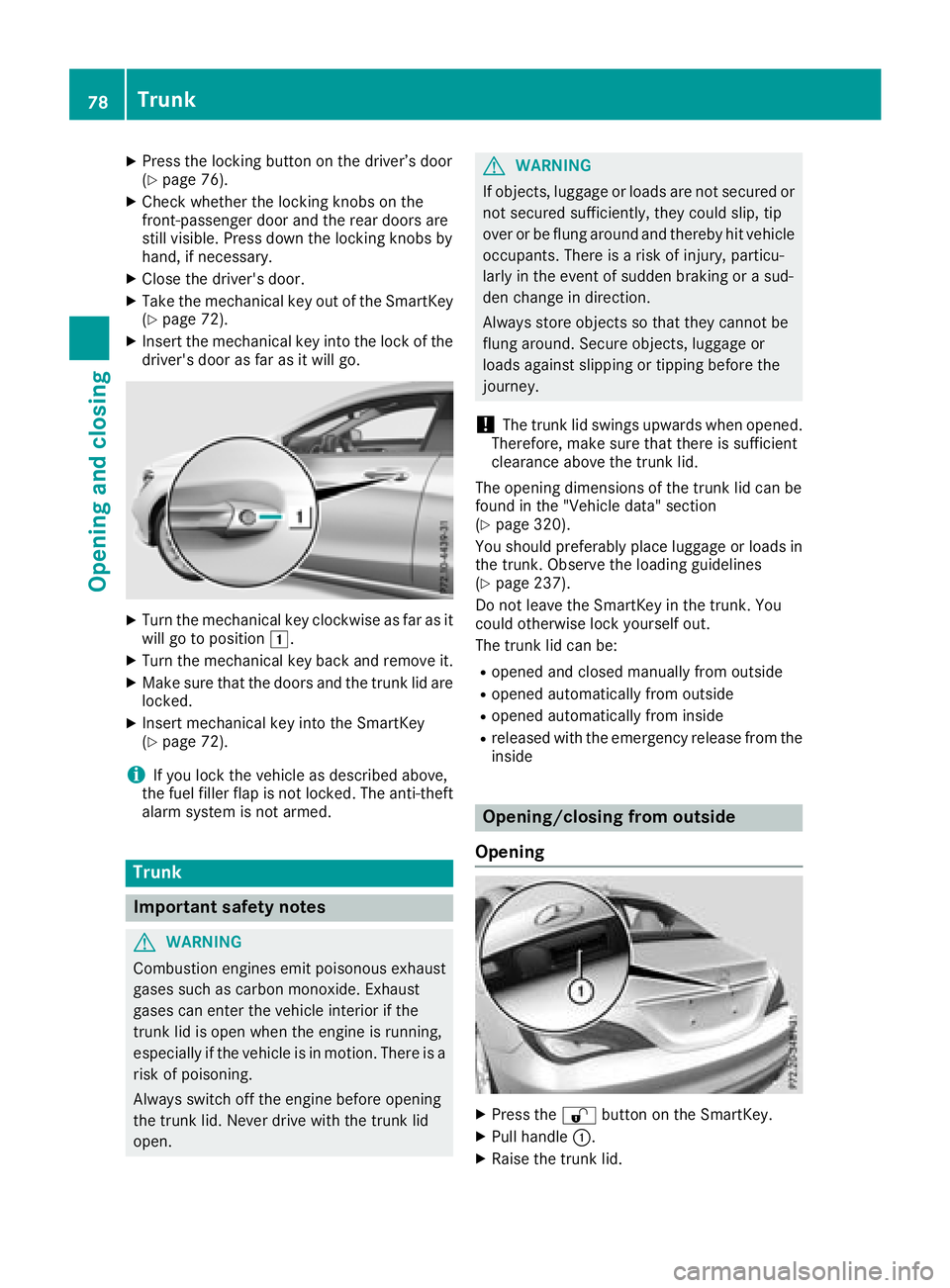
Insert the mechanical key into the lock of the
driver's door as far as it will go.
X
Turn the mechanical key clockwise as far as it
will go to position G .X
Turn the mechanical key back and remove it. X
Make sure that the doors and the trunk lid are
locked. X
Insert mechanical key into the SmartKey
( Y
page 72).
i If you lock the vehicle as described above,
the fuel filler flap is not locked. The anti-theft
alarm system is not armed.
Trunk
Important safety notes
G WARNING
Combustion engines emit poisonous exhaust
gases such as carbon monoxide. Exhaust
gases can enter the vehicle interior if the
trunk lid is open when the engine is running,
especially if the vehicle is in motion .T here is a
risk of poisoning.
Always switch off the engine before opening
the trunk lid. Never drive with the trunk lid
open. G WARNING
If objects, luggage or loads are not secured or
not secured sufficiently, they could slip, tip
over or be flung around and thereby hit vehicle
occupants. There is ar isk of injury, particu-
larly in the event of sudden braking or as ud-
den change in direction.
Always store object ssot hat they cannot be
flung around. Secure objects, luggage or
loads against slipping or tipping before the
journey.
! The trunk lid swings upwards when opened.
Therefore, make sure that there is sufficient
clearance above the trunk lid.
The opening dimensions of the trunk lid can be
found in the "Vehicle data" section
( Y
page 320).
You should preferably place luggage or loads in
the trunk .O bserve the loading guidelines
( Y
page 237).
Do not leave the SmartKey in the trunk .Y ou
could otherwise lock yourself out.
The trunk lid can be: R
opened and closed manually from outside R
opened automatically from outside R
opened automatically from inside R
released with the emergenc yr elease from the
inside
Opening/closing from outside
Opening
X
Press the 6 button on the SmartKey. X
Pull handle C . X
Raise the trunk lid.78
Trunk
Opening and closing
Page 126 of 326
G WARNING
Flammable materials introduced through
environmental influence or by animals can
ignite if in contact with the exhaust system or
parts of the engine that hea tu p. There is ar isk
of fire.
Carry out regular checks to make sure that
there are no flammable foreig nm aterials in
the engine compartment or in the exhaust
system.
General notes During ac old start, the engine runs at higher
speeds to enabl et he catalytic converter to
reach its operating temperature. The sound of
the engine may change during this time.
Automatic transmission X
Shift the transmission to position ]
( Y
pag e1 30).
The transmission position display in the mul-
tifunction display shows P ( Y
pag e1 30).
i You can start the engine in transmission
position ] and \\ .
Starting procedure with the SmartKey To start the engine using the SmartKey instead
of the Start/Stop button, pul lt he Start/Stop
button out of the ignitio nl ock.X
Turn the SmartKey to position I in the igni-
tion lock ( Y
pag e1 22) and release it as soon
as the engine is running.
Starting procedure with the Start/Stop
button The Start/Stop button can be used to start the
vehicl em anually without inserting the SmartKey
into the ignitio nl ock. The Start/Stop button
must be inserted in the ignitio nl ock and the
SmartKey must be in the vehicle. This mode for
starting the engine operates independently of
the ECO start/stop automatic engine start func-
tion.
You can start the engine if av ali dS martKey is in
the vehicle. Switch off the engine and always
take the SmartKey with you when leaving the vehicle, even if you only leave it for as hort time.
Pay attention to the important safety notes. X
Depress the brake peda la nd keep it
depressed. X
Press the Start/Stop button once
( Y
pag e1 22).
The engine starts.
Starting procedure via smartphone Observe the important safety notes on starting
the engine ( Y
pag e1 23).
You can als os tart you re ngine via you rs mart-
phone from outside the vehicle. In this case, the
previousl ys elected climate control setting is
activated. In this way you can cool or heat the
interior of the vehicl eb efore starting the jour-
ney.
Only start the engine via you rs martphone if it is
safe to start and run the engine where you rv ehi-
cle is parked.
Observe the lega ls tipulations in the area where
you rv ehicl eisp arked .E ngine start via smart-
phone may be limited to certain countries or
regions.
You can execute am aximu moft wo consecutive
starting attempts via you rs martphone. If you
insert the SmartKey into the ignitio nl ock, you
can carry out two more starting attempts.
Once you have started the engine, you can
switch the engine off via you rs martphone at any
time.
You can only start the engine via you rs mart-
phone if: R
the SmartKey is in the ignitio nl ockR
park position ] is selectedR
the accelerator peda lisn ot depressedR
the anti-theft alarm system is not activated R
the pani ca larm is not activated R
the hazard warning lamp sa re switched offR
the hood is closed R
the doors are closed and locked R
the windows and sliding sunroof are closed
Also make sure that: R
the fuel tank is sufficiently filled R
the starter battery is sufficiently charged
G WARNING
Limbs coul dbec rushe dort rappe dift he
engine is started unintentionally during ser-124
Driving
Driving and parking