warning MERCEDES-BENZ CLA 2018 Owner's Manual
[x] Cancel search | Manufacturer: MERCEDES-BENZ, Model Year: 2018, Model line: CLA, Model: MERCEDES-BENZ CLA 2018Pages: 326, PDF Size: 7.97 MB
Page 43 of 326
Restraint system warnin gl ampThe functions of the restraint system are
checke da fte rt he ignition is switched on and at
regular interval sw hile the engine is running.
Therefore, malfunctions can be detected in
goo dt ime.
The u restraint system warning lamp on the
instrument cluster lights up when the ignition is
switched on. It goe so ut no later than af ew sec-
onds afte rt he vehicl eiss tarted. The compo-
nents of the restraint system are in operational
readiness.
Am alfunction ha so ccurred if the u restraint
system warning lamp: R
doe sn ot light up afte rt he ignition is switched
on R
doe sn ot go ou ta fte raf ew seconds with the
engine running R
lights up agai nw hile the engine is running
G WARNING
If the restraint system is malfunctioning,
restraint system components may be trig-
gered unintentionally or may not deplo ya s
intended during an accident. Thi sc an affect
for exampl et he Emergency Tensioning
Device or the ai rb ag .T hi sp oses an increased
ris kofi njury or eve nf ata li njury.
Have the restraint system checke da nd
repaired in aq uali fied specialist worksho pa s
soo na sp ossible.
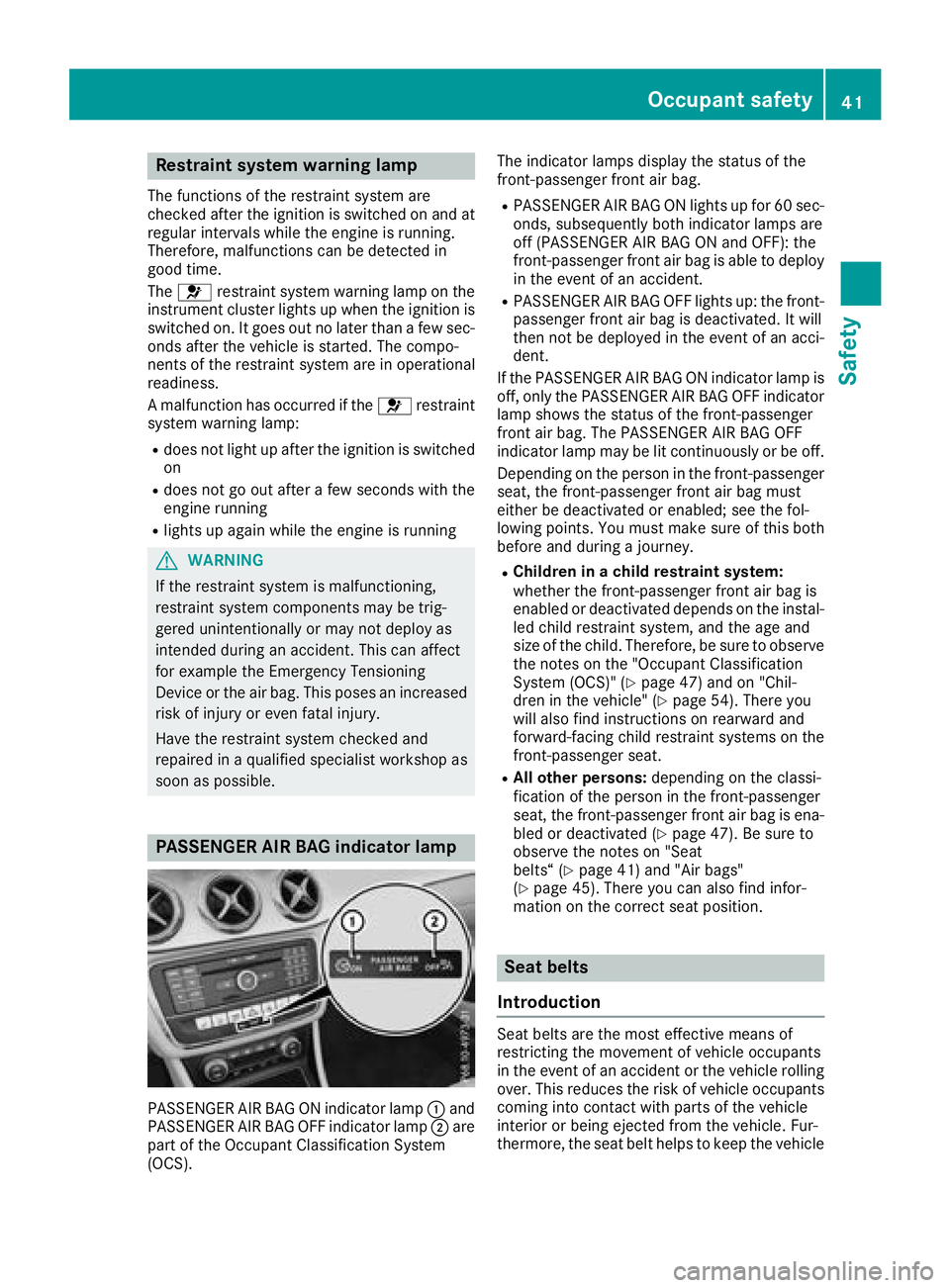
PASSENGER AI RB AG indicator lamp
PASSENGER AIR BAG ON indicator lamp C and
PASSENGER AIR BAG OFF indicator lamp D are
part of the Occupant Classification System
(OCS). The indicator lamps display the statu soft he
front-passenger front ai rb ag .R
PASSENGER AIR BAG ON lights up for 60 sec-
onds ,s ub sequently both indicator lamps are
off (PASSENGER AIR BAG ON and OFF) :t he
front-passenger front ai rb ag is able to deploy
in the event of an accident. R
PASSENGER AIR BAG OFF lights up :t he front-
passenger front ai rb ag is deactivated. It will
then not be deploye dint he event of an acci-
dent.
If the PASSENGER AIR BAG ON indicator lamp is
off, only the PASSENGER AIR BAG OFF indicator
lamp shows the statu soft he front-passenger
front ai rb ag .T he PASSENGER AIR BAG OFF
indicator lamp may be li tc ontinuously or be off.
Depending on the person in the front-passenger
seat, the front-passenger front ai rb ag must
either be deactivated or enabled; see the fol-
lowing points. Yo um us tm ake sure of this both
before and during aj ourney.R
Childre ninac hild restrain ts ystem:
whethe rt he front-passenger front ai rb ag is
enabled or deactivated depends on the instal-
le dc hild restraint system, and the ag ea nd
size of the child .T herefore, be sure to observe
the notes on the "Occupant Classification
System (OCS)" ( Y
page 47 )a nd on "Chil-
dre nint he vehicle" ( Y
page 54). There you
wil l also find instructions on rearward and
forwa rd-facing child restraint systems on the
front-passenger seat. R
Al lo the rp ersons: depending on the classi-
fication of the person in the front-passenger
seat, the front-passenger front ai rb ag is ena-
bled or deactivated ( Y
page 47). Be sure to
observe the notes on "Seat
belts“ ( Y
page 41 )a nd "Ai rb ag s"
( Y
page 45). There yo uc an also find infor-
mation on the correct sea tp osition.
Seat belts
Introduction
Sea tb elts are the most effective means of
restricting the movement of vehicl eo ccupants
in the event of an accident or the vehicl er olling
over. Thi sr educe st he ris kofv ehicl eo ccupants
coming into contact with parts of the vehicle
interio rorb eing ejecte df rom the vehicle. Fur-
thermore ,t he sea tb el th elps to keep the vehicleOccupan ts afety 41
Safety Z
Page 44 of 326
occupant in the best position in relation to the
air bag.
The seat belt system comprises: R
Seat belts R
Emergency Tensionin gD evices for the front
seat belts and the outer seat belts in the rear R
Seat belt force limiters for the front seat belts
and the outer seat belts in the rear
If the seat belt is pulled out of the belt outlet
quickly or with aj erk ym ovement ,t he belt
retractor locks. The belt strap cannot be extrac-
ted any further.
The Emergency Tensionin gD evice tighten st he
seat belt in an accident ,p ulling the belt close
against the body. However it does not pull the
vehicle occupant back in the direction of the
backrest.
The Emergency Tensionin gD evice does not cor-
rect an incorrect seat position or the routing of
an incorrectly fastened seat belt.
When triggered, as eat belt force limiter helps to
reduce the force exerted by the seat belt on the
vehicle occupant.
The seat belt force limiters for the front seats are
synchronized with the front air bags, which
absorb part of the deceleration force. This can
reduce the force exerted on the vehicle occu-
pants during an accident.
! If the front-passenger seat is not occupied,
do not engage the seat belt tongue in the
buckle on the front-passenger seat. Other-
wise, the Emergency Tensionin gD evice and
side impact air bag could be triggered in the
event of an accident and would need to be
replaced.
Important safety notes The use of seat belts and child restraint systems
is required by law in: R
all 50 states R
the U.S. territories R
the District of Columbia R
all Canadian provinces
Even where this is not required by law, all vehicle
occupant ss hould correctly fasten their seat
belts before starting the journey.
G WARNING
If the seat belt is not worn correctly, it cannot
perform its intended protective function. An incorrectly fastened seat belt can also cause
injuries, for example, in the event of an acci-
dent or when braking or changing direction
abruptly. This poses an increased risk of injury
or even fatal injury.
Always ensure that all vehicle occupant sh ave
their seat belts fastened correctly and are sit-
ting properly.
The components of the restraint system work in
conjunction with each other. They can only
deploy their protective function if, at all times, all
vehicle occupants: R
have fastened their seat belts correctly
( Y
page 43) R
have the seat and head restraint adjusted
properly ( Y
page 90)
G WARNING
The seat belt does not offer the intended level
of protection if you have not moved the back-
rest to an almost vertical position. When brak-
ing or in the event of an accident ,y ou could
slide underneath the seat belt and sustain
abdomen or neck injuries, for example. This
poses an increased risk of injury or even fatal
injury.
Adjust the seat properly before beginning
your journey. Always ensure that the backrest
is in an almost vertical position and that the
shoulder section of your seat belt is routed
across the center of your shoulder.
G WARNING
Persons less than 5ft( 1.50 m) tall cannot
wear the seat belt correctly without an addi-
tional and suitable restraint system. If the
seat belt is not worn correctly, it cannot per-
form its intended protective function. An
incorrectly fastened seat belt can also cause
injuries, for example, in the event of an acci-
dent or when braking or changing direction
abruptly. This poses an increased risk of injury
or even fatal injury.
For this reason, alway ss ecure persons under
5ft( 1.50 m) tall in suitable additional restraint
systems.42
Occupant safety
Safety
Page 45 of 326

If ac hild younger than twelve years old and
under 5ft( 1.5 0m)inh eight is travelin gint he
vehicle: R
always secur et he child in ac hild restraint
system suitable for this Mercedes-Ben zv ehi-
cle. The child restraint system must be appro-
priat etot he age, weight and size of the childR
always observe the instructions and safety
notes on "Children in the vehicle"
( Y
page 54) in addition to the child restraint
system manufacturer' si nstallation and oper-
atin gi nstructionsR
always observe the instructions and safety
notes on the "Occupant classification system
(OCS)" ( Y
page 47)
G WARNING
The seat belts may not perform their intended
protective function if: R
the ya re damaged, modified, extremely
dirty, bleache dord yedR
the seat belt buckle is damaged or
extremely dirty R
the Emergency Tensionin gD evices, belt
anchorage sori nertia reels have been modi-
fied.
Seat belts may be damaged in an accident,
althoug ht he damage may not be visible, e.g.
due to splinters of glass. Modifie dord amaged
seat belts may tear or fail, e.g. in an accident.
Modifie dE me rgency Tensionin gD evices
could accidentally trigger or fail to deploy
when necessary. This poses an increased risk
of injury or even fatal injury.
Never modif yt he seat belts ,E me rgency Ten-
sioning Devices, belt anchorage sa nd inertia
reels. Make sure that the seat belts are
undamaged, not worn out and clean .F ollow-
ing an accident ,h ave the seat belts checked
immediately at aq ualified specialist work-
shop.
Only use seat belts that have been approved for
your vehicle by Mercedes-Benz.
Sports seat or AMG Performance seat: this
seat is designed for the standard three-point
seat belt. If you install another multi-point seat
belt, e.g. sport or racin gs eat belts ,t he restraint system cannot provide the best level of protec-
tion.
G WARNING
If you feed seat belts through the opening in
the seat backrest ,t he seat backrest may be
damaged or may even break in the even tofa n
accident .T his poses an increased risk of
injury or even fatal injury.
Only use the standard three-point seat belt.
Never modif yt he seat belt system.
Proper use of th es eat beltsObserve the safet yn otes on the seat belt
( Y
page 42).
All vehicle occupant sm ust be wearin gt he seat
belt correctly befor eb eginnin gt he journey. Also
make sure that all vehicle occupant sa re always
wearing the seat belt correctly while the vehicle
is in motion.
When fastenin gt he seat belt, always make sure
that: R
the seat belt buckle tongue is inserted only
int ot he belt buckle belonging to that seat R
the seat belt is pulled tigh ta cross your body
Avoid wearing bulky clothing ,e .g. aw inter
coat. R
the seat belt is not twisted
Only the nc an the forces which occur be dis-
tributed over the area of the belt. R
the shoulder section of the belt is routed
across the center of your shoulder
The shoulder section of the seat belt should
not touc hy our nec korber outed under your
arm or behin dy our back .W here possible,
adjust the seat belt to the appropriate height. R
the lap belt is taut and passes across your lap
as low down as possible
The lap belt must always be routed across
your hip joints and not across your abdomen.
This applies particularly to pregnant women.
If necessary, push the lap belt down to your
hip join ta nd pull it tigh tu sing the shoulder
section of the belt. R
the seat belt is not routed across sharp, poin-
ted or fragile objects
If you have such item sl ocated on or in your
clothing ,e .g. pens ,k eys or eyeglasses ,s tore
these in as uitable place. R
only one perso nisu sing as eat beltOccupant safety 43
Safety Z
Page 47 of 326
seconds or once the driver's seat belt is fas-
tened.
If the vehicle's speed exceeds 15 mph
(25 km/h) once and the driver's and front-
passenger seat belts are not fastened, aw arning
tone sounds. Aw arning tone also sounds with
increasing intensit yf or 60 seconds or until the
driver or front passenger have fastened their
seat belts.
If the driver or front passenger unfasten their
seat belts during the journey, the seat belt warn-
ing is activated again.
Air bags
Introduction The installation point of an air bag can be rec-
ognized by the AIRBAG marking.
An air bag complements the correctly fastened
seat belt. It is no substitute for the seat belt. The
air bag provides additional protection in appli-
cable accident situations.
Not all air bags are deployed in an accident. The
different air bag systems function independ-
ently from one another ( Y
page 52).
However, no system available today can com-
pletely eliminate injuries and fatalities.
It is also not possible to rule out ar isk of injury
caused by an air bag due to the high speed at
which the air bag must be deployed.
Important safety notes
G WARNING
If you do not sit in the correct seat position,
the air bag cannot protect as intended and
could even cause additional injury when
deployed. This poses an increased risk of
injury or even fatal injury.
To avoid hazardous situations, always make
sure that all of the vehicle's occupants: R
have fastened their seat belts correctly,
including pregnant women R
are sitting correctly and maintain the great-
est possible distance to the air bags R
follow the following instructions Always make sure that there are no objects
between the air bag and the vehicle's occu-
pants. R
Adjust the seats properly before beginning
your journey. Always make sure that the seat
is in an almost upright position. The center of
the head restraint must support the head at
about eye level. R
Move the driver's and front-passenger seats
as far back as possible .T he driver's seat posi-
tion must allow the vehicle to be driven safely. R
Only hold the steering wheel on the outside.
This allow st he air bag to be fully deployed. R
Always lean against the backrest while driv-
ing. Do not lean forward or lean against the
door or side window. You may otherwise be in
the deployment area of the air bags. R
Always keep your feet in the footwell in front
of the seat. Do not put your feet on the dash-
board, for example. Your feet may otherwise
be in the deployment area of the air bag. R
For this reason, always secure persons less
than 5f t( 1.50 m) tall in suitable restraint sys-
tems. Up to this height, the seat belt cannot
be worn correctly.
If ac hild is traveling in your vehicle ,a lso
observe the following notes: R
Always secure children under twelve years of
age and less than 5f t( 1.50 m) tal lins ui table
child restraint systems. R
Chil dr estraint systems shoul dbei nstalle do n
the rea rs ea ts. R
Onl ys ec ur eac hild in ar earward-facing child
restraint syste mont he front-passenge rs ea t
when the front-passenge rf ront ai rb ag is
deactivated .Ift he PASSENGER AIR BAG OFF
indicator lamp is permanentl yl it ,t he front-
passenge rf ront ai rb ag is deactivated
( Y
page 41). R
Alway so bser ve the instructions and safety
note sont he "Occupant Classification Syste m
( OCS) "( Y
page 47) and on "Children in the
vehicle" ( Y
page 54 )i na ddit io ntot he child
restraint syste mm an ufacturer's installation
and operating instructions.Occupant safety 45
Safety Z
Page 48 of 326
Objects in the vehicle interior may prevent
an air bag from functioning correctly. Before
starting your journey and to avoid risks resulting
from the speed of the air bag as it deploys, make
sure that: R
there are no people, animals or objects
between the vehicle occupant sa nd an air bagR
there are no object sb etween the seat, door
and B-pillar R
there are no hard objects, e.g. coat hangers,
hanging on the grab handles or coat hooks R
no accessories, such as cup holders, are
attached to the vehicle within the deployment
area of an air bag, e.g. to doors, side windows,
rear side trim or side walls R
no heavy, sharp-edged or fragile object sa re in
the pocket sofy our clothing. Store such
object sinas uitable place
G WARNING
If you modify the air bag cover or affix objects
such as stickers to it, the air bag can no longer
function correctly. There is an increased risk
of injury.
Never modify an air bag cover or affix objects
to it.
G WARNING
Sensors to control the air bags are located in
the doors. Modification sorw ork not per-
formed correctly to the doors or door panel-
ing, as well as damaged doors, can lead to the
function of the sensor sb eing impaired. The air
bags might therefore not function properly
anymore. Consequently, the air bags cannot
protec tv ehicle occupant sast hey are
designed to do. There is an increased risk of
injury.
Never modify the doors or parts of the doors.
Always have work on the doors or door pan-
eling carried out at aq ualified specialist work-
shop.
Front air bags
! Do not place heavy object sont he front-
passenger seat. This could cause the system
to identif yt he seat as being occupied. In the
event of an accident ,t he restraint systems on the front-passenger side may be triggered
and have to be replaced.
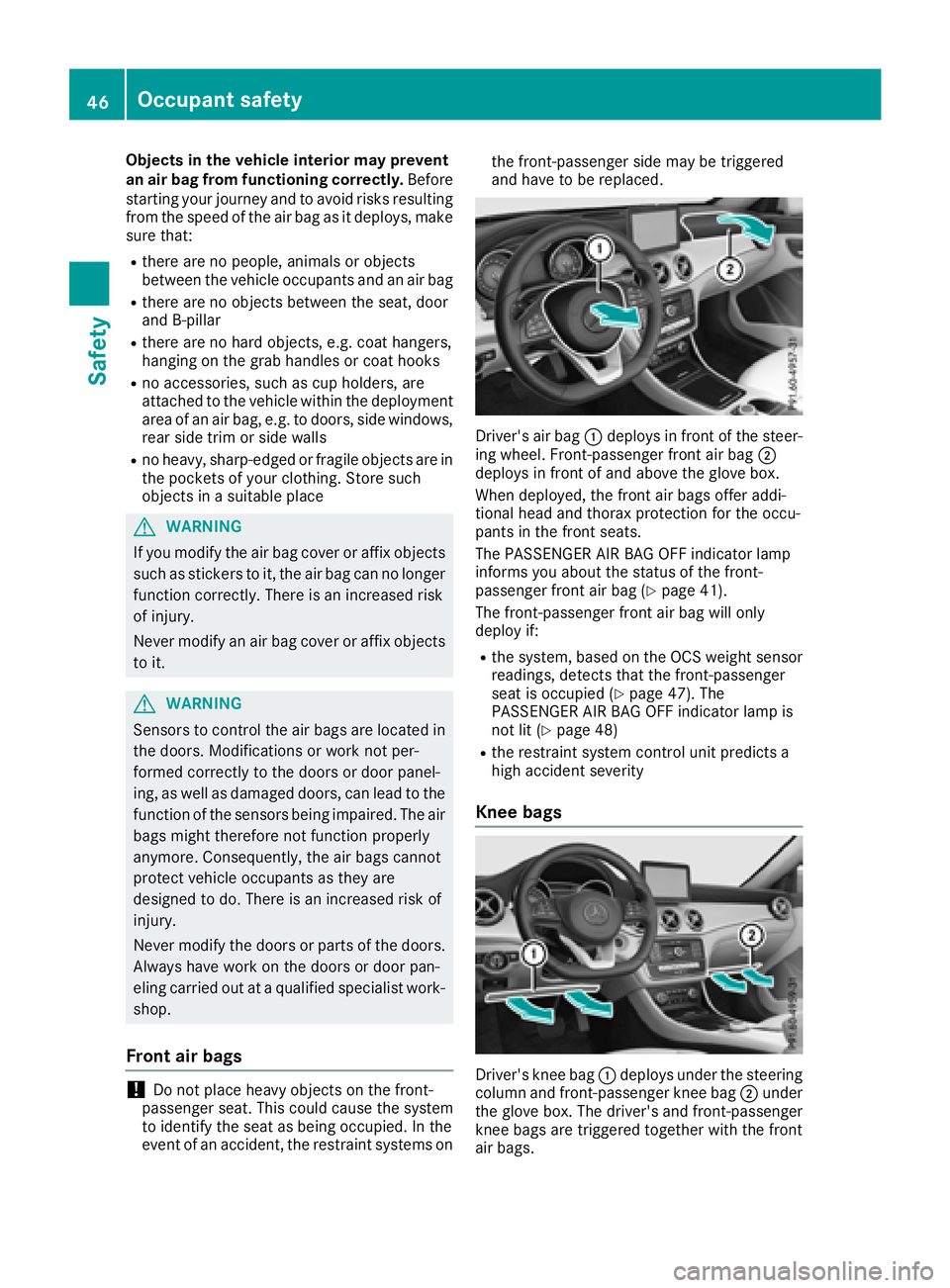
Driver's air bag C deploys in fron toft he steer-
ing wheel. Front-passenger fron ta ir bag D
deploys in fron tofa nd above the glove box.
When deployed, the fron ta ir bags offer addi-
tional head and thorax protection for the occu-
pants in the fron ts eats.
The PASSENGER AIR BAG OFF indicato rl amp
inform sy ou about the status of the front-
passenger fron ta ir bag ( Y
page 41).
The front-passenger fron ta ir bag will only
deploy if: R
the system, based on the OCS weight sensor
readings, detect st hat the front-passenger
seat is occupied ( Y
page 47). The
PASSENGER AIR BAG OFF indicato rl amp is
not lit ( Y
page 48) R
the restraint system control unit predict sa
high accident severity
Knee bags
Driver's knee bag C deploys under the steering
column and front-passenger knee bag D under
the glove box. The driver's and front-passenger
knee bags are triggered together with the front
air bags.46
Occupant safety
Safety
Page 49 of 326
The driver's and front-passenger knee bags
offer additional thigh, knee and lower leg pro-
tection for the occupant sint he front seats.
Side impact air bags
G WARNING
Unsuitable seat covers can obstruct or pre-
vent deployment of the air bags integrated
into the seats. Consequently, the air bags
cannot protec tv ehicle occupant sast hey are
designed to do. In addition, the operation of
the occupant classification system (OCS)
could be adversely affected. This poses an
increased risk of injury or even fatal injury.
You should only use seat covers that have
been approved for the respective seat by
Mercedes-Benz.
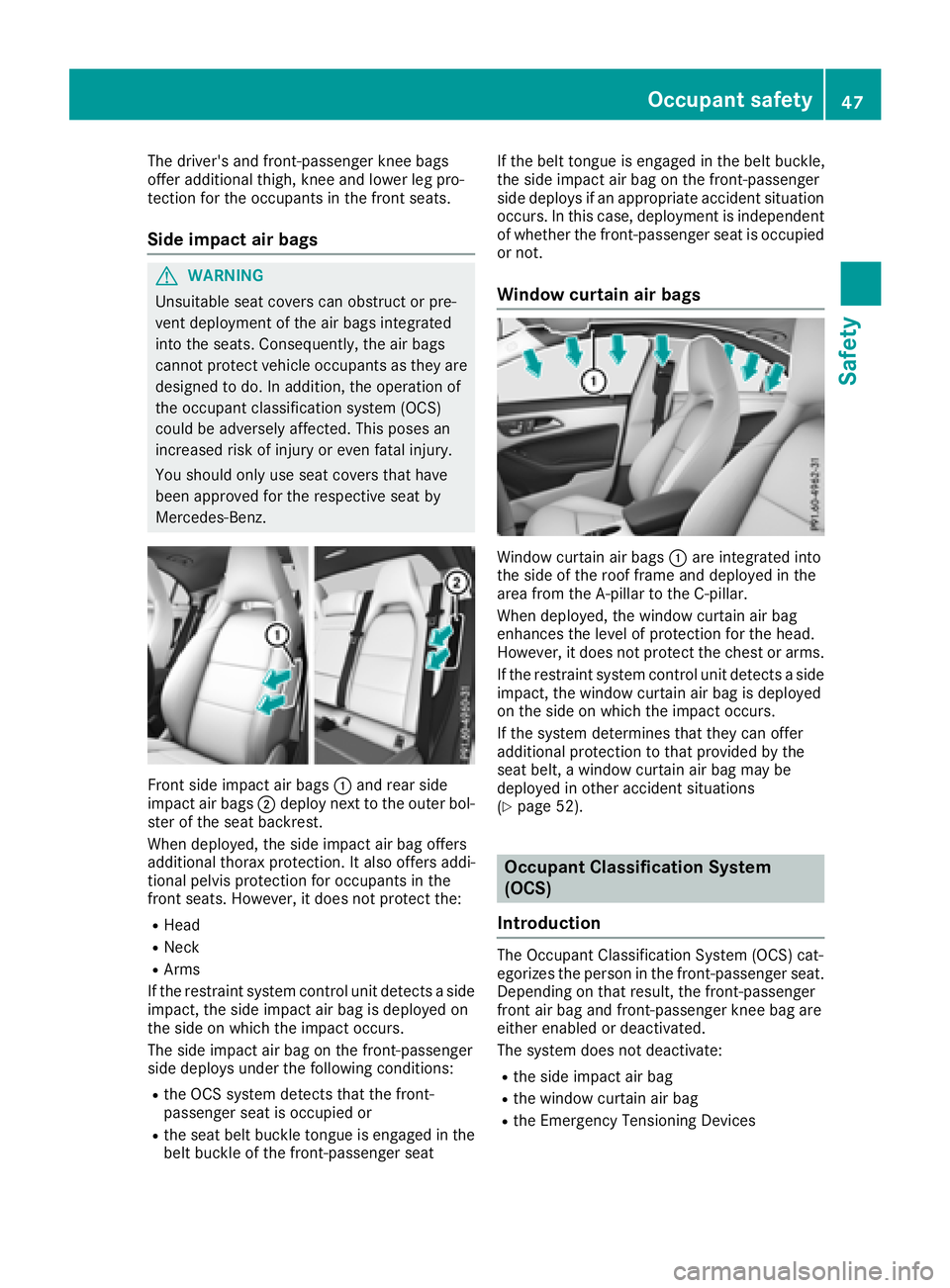
Fron ts ide impact air bags C and rear side
impact air bags D deploy next to the outer bol-
ster of the seat backrest.
When deployed, the side impact air bag offers
additional thorax protection. It also offers addi-
tional pelvis protection for occupant sint he
front seats. However, it does not protec tt he:R
Head R
Neck R
Arms
If the restraint system control unit detect sas ide
impact, the side impact air bag is deployed on
the side on which the impact occurs.
The side impact air bag on the front-passenger
side deploys under the following conditions: R
the OCS system detect st hat the front-
passenger seat is occupied or R
the seat belt buckle tongue is engaged in the
belt buckle of the front-passenger seat If the belt tongue is engaged in the belt buckle,
the side impact air bag on the front-passenger
side deploys if an appropriate accident situation
occurs. In this case, deployment is independent
of whether the front-passenger seat is occupied
or not.
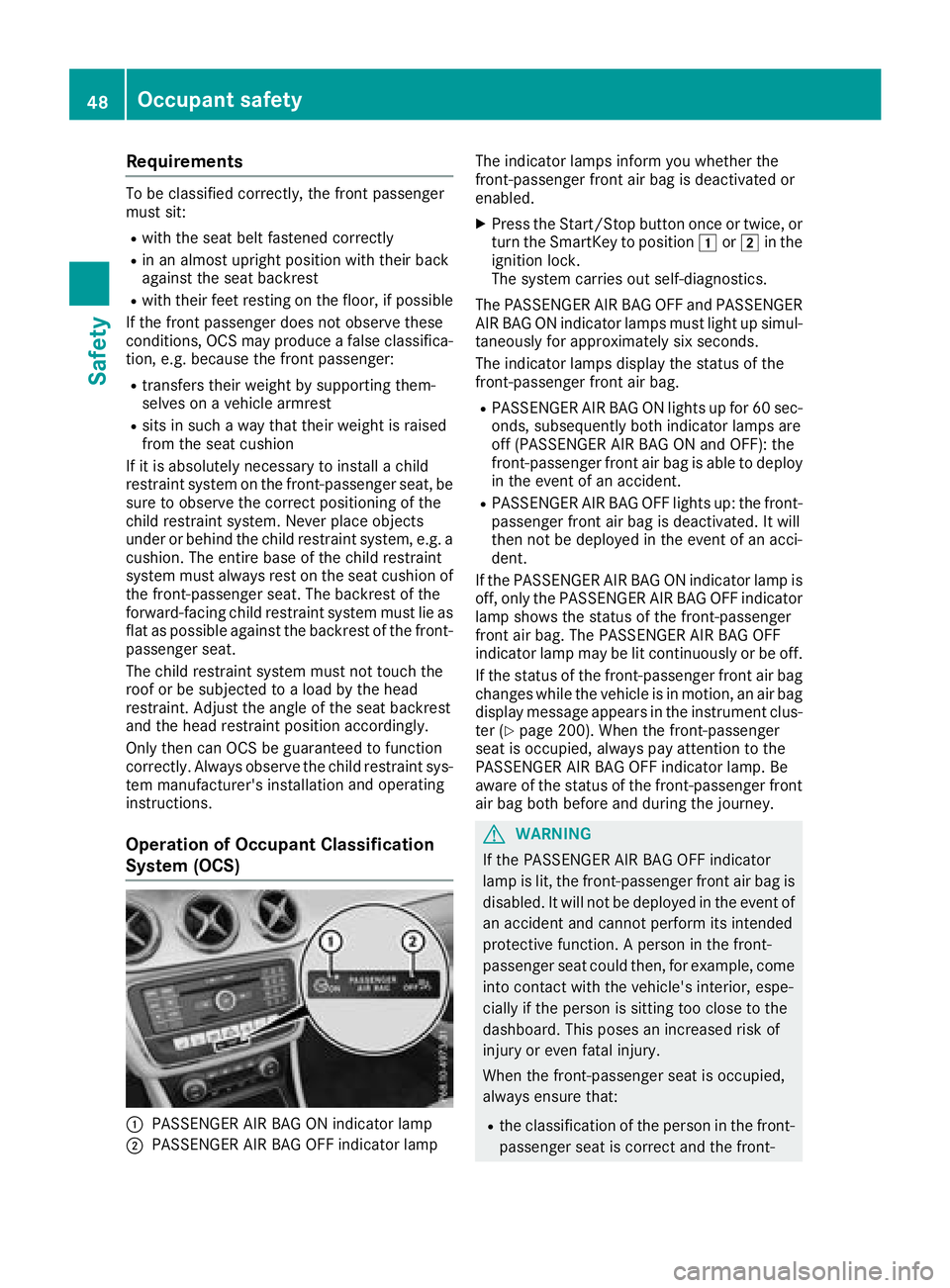
Window curtain air bags
Window curtain air bags C are integrated into
the side of the roof frame and deployed in the
area from the A-pillar to the C-pillar.
When deployed, the window curtain air bag
enhances the level of protection for the head.
However, it does not protec tt he chest or arms.
If the restraint system control unit detect sas ide
impact, the window curtain air bag is deployed
on the side on which the impact occurs.
If the system determines that they can offer
additional protection to that provided by the
seat belt, aw indow curtain air bag may be
deployed in other accident situations
( Y
page 52).
Occupant Classification System
(OCS)
Introduction The Occupant Classification System (OCS) cat-
egorizes the person in the front-passenger seat.
Dependin gont hat result, the front-passenger
front air bag and front-passenger knee bag are
either enabled or deactivated.
The system does not deactivate: R
the side impact air bag R
the window curtain air bag R
the Emergency Tensionin gD evicesOccupant safety 47
Safety Z
Page 50 of 326
Requirements To be classifie dc orrectly ,t he front passenger
mus ts it:R
with the sea tb el tf astened correctlyR
in an almost upright position with thei rb ac k
against the sea tb ac krestR
with thei rf ee tr esting on the floor, if possible
If the front passenger doe sn ot observe these
conditions ,O CS may produce af alse classifica-
tion, e.g. because the front passenger: R
transfers thei rw eigh tb ys uppo rting them-
selves on av ehicl ea rmrestR
sits in such aw ay that thei rw eigh tisr aised
from the sea tc ushion
If it is absolutely necessary to install ac hild
restraint system on the front-passenger seat, be
sure to observe the correct positioning of the
child restraint system. Neve rp la ce objects
under or behind the child restraint system, e.g. a
cushion. The entir eb as eoft he child restraint
system mus ta lway sr es tont he sea tc ushio no f
the front-passenger seat. The backrest of the
forward-facing child restraint system mus tl ie as
fla ta sp ossible against the backrest of the front-
passenger seat.
The child restraint system mus tn ot touch the
roo forbes ub jecte dtoal oa dbyt he head
restraint. Adjust the angle of the sea tb ac krest
and the hea dr estraint position accordingly.
Only then can OC Sbeg ua ranteed to function
correctly .A lway so bserve the child restraint sys-
tem manufacturer' si nstallation and o perating
i
nstructions.
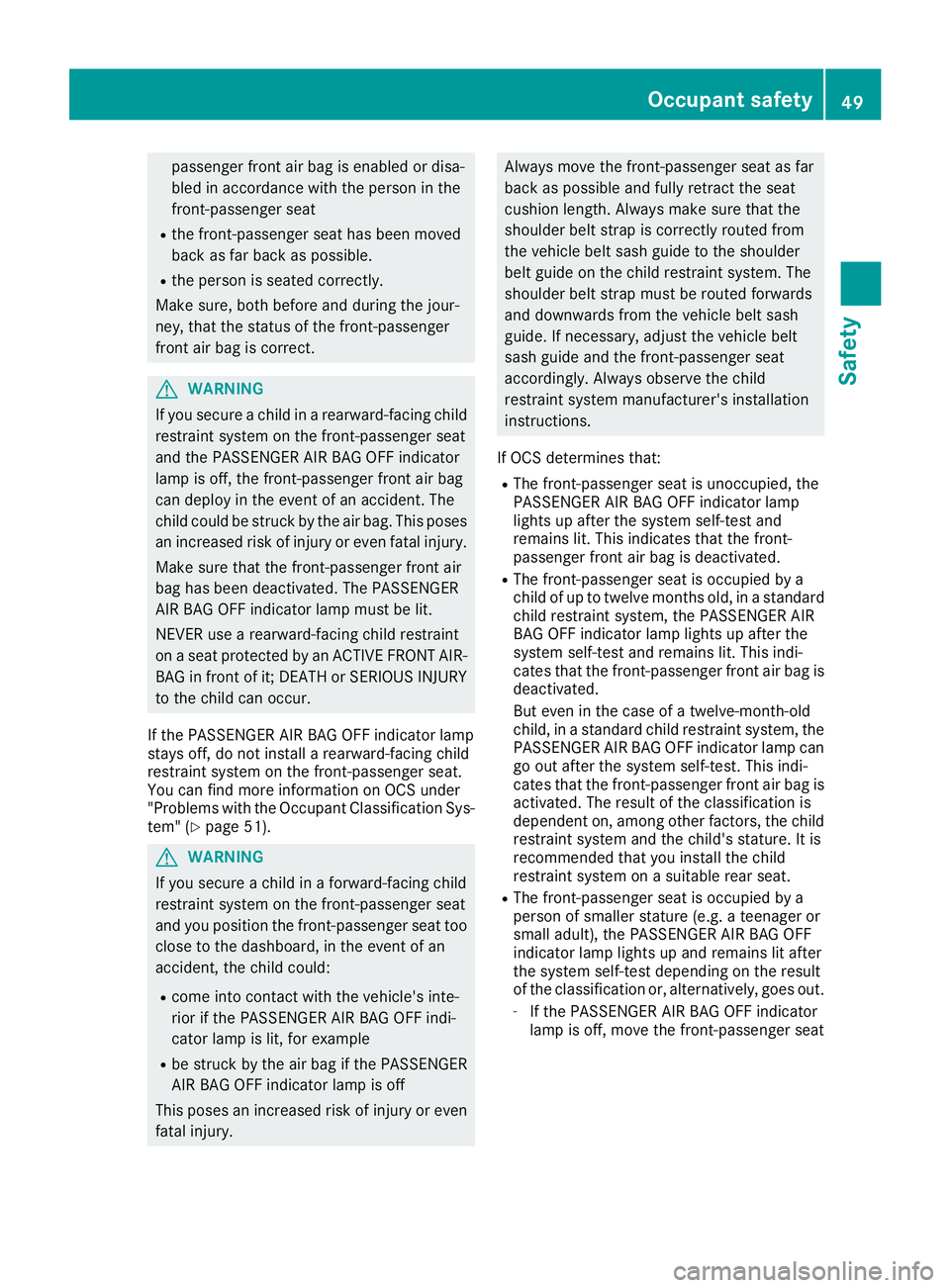
Operatio nofO cc upant Classification
System (OCS)
C
PASSENGER AIR BAG ON indicator lamp
D
PASSENGER AIR BAG OFF indicator lamp The indicator lamps inform yo uw he the rt he
front-passenger front ai rb ag is deactivated or
enabled. X
Press the Start/Sto pb ut ton once or twice, or
turn the SmartKey to position G or H in the
ignition lock.
The system carrie so ut self-diagnostics.
The PASSENGER AIR BAG OFF and PASSENGER
AIR BAG ON indicator lamps mus tl ig ht up simul-
taneously for approximately six seconds.
The indicator lamps display the statu soft he
front-passenger front ai rb ag .R
PASSENGER AIR BAG ON lights up for 60 sec-
onds ,s ub sequently both indicator lamps are
off (PASSENGER AIR BAG ON and OFF) :t he
front-passenger front ai rb ag is able to deploy
in the event of an accident. R
PASSENGER AIR BAG OFF lights up :t he front-
passenger front ai rb ag is deactivated. It will
then not be deploye dint he event of an acci-
dent.
If the PASSENGER AIR BAG ON indicator lamp is
off, only the PASSENGER AIR BAG OFF indicator
lamp shows the statu soft he front-passenger
front ai rb ag .T he PASSENGER AIR BAG OFF
indicator lamp may be li tc ontinuously or be off.
If the statu soft he front-passenger front ai rb ag
changes whil et he vehicl eisinm otion, an ai rb ag
display message appears in the instrument clus-
ter ( Y
page 200). Whe nt he front-passenger
sea ti so ccupied, always pa ya ttention to the
PASSENGER AIR BAG OFF indica tor l amp. Be
a
ware of the statu soft he front-passenger front
ai rb ag both before and during the journey.
G WARNING
If the PASSENGER AIR BAG OFF indicator
lamp is lit, the front-passenger front ai rb ag is
disabled. It will not be deploye dint he event of
an accident and canno tp erform its intended
protectiv ef unction. Ap erson in the front-
passenger sea tc ould then, for example, come
into contact with the vehicle's interior, espe-
ciall yift he person is sitting too close to the
dashboard. Thi sp oses an increased ris ko f
injury or eve nf ata li njury.
Whe nt he front-passenger sea ti so ccupied,
always ensure that: R
the classification of the person in the front-
passenger sea ti sc orrect and the front-48
Occupan ts afety
Safety
Page 51 of 326
passenger fron ta ir bag is enabled or disa-
bled in accordance with the person in the
front-passenger seat R
the front-passenger seat has been moved
back as far back as possible. R
the person is seated correctly.
Make sure, both before and during the jour-
ney, that the status of the front-passenger
fron ta ir bag is correct.
G WARNING
If you secure ac hild in ar earward-facing child
restraint system on the front-passenger seat
and the PASSENGER AIR BA GO FF indicator
lamp is off, the front-passenger fron ta ir bag
can deploy in the event of an accident. The
child could be struck by the air bag. This poses
an increased risk of injury or even fatal injury.
Make sure that the front-passenger fron ta ir
bag has been deactivated. The PASSENGER
AIR BA GO FF indicator lamp must be lit.
NEVER use ar earward-facing child restraint
on as eat protected by an ACTIVE FRONT AIR-
BA Ginf ron tofi t; DEATH or SERIOUS INJURY
to the child can occur.
If the PASSENGER AIR BA GO FF indicator lamp
stays off, do not install ar earward-facing child
restraint system on the front-passenger seat.
You can find more information on OCS under
"Problems with the Occupant Classification Sys-
tem" ( Y
page 51).
G WARNING
If you secure ac hild in af orward-facin gc hild
restraint system on the front-passenger seat
and you position the front-passenger seat too
close to the dashboard, in the event of an
accident, the child could: R
come int oc ontact with the vehicle's inte-
rior if the PASSENGER AIR BA GO FF indi-
cator lamp is lit, for example R
be struck by the air bag if the PASSENGER
AIR BA GO FF indicator lamp is off
This poses an increased risk of injury or even
fatal injury. Always move the front-passenger seat as far
back as possible and fully retract the seat
cushion length. Always make sure that the
shoulder belt strap is correctly routed from
the vehicle belt sash guide to the shoulder
belt guide on the child restraint system. The
shoulder belt strap must be routed forwards
and downwards from the vehicle belt sash
guide. If necessary, adjust the vehicle belt
sash guide and the front-passenger seat
accordingly. Always observe the child
restraint system manufacturer's installation
instructions.
If OCS determines that: R
The front-passenger seat is unoccupied, the
PASSENGER AIR BA GO FF indicator lamp
lights up after the system self-test and
remains lit. This indicates that the front-
passenger fron ta ir bag is deactivated. R
The front-passenger seat is occupied by a
child of up to twelve months old, in as tandard
child restraint system, the PASSENGER AIR
BA GO FF indicator lamp lights up after the
system self-test and remains lit. This indi-
cates that the front-passenger fron ta ir bag is
deactivated.
But even in the case of at welve-month-old
child, in as tandard child restraint system, the
PASSENGER AIR BA GO FF indicator lamp can
go out after the system self-test. This indi-
cates that the front-passenger fron ta ir bag is
activated. The result of the classification is
dependen to n, among other factors, the child
restraint system and the child's stature. It is
recommended that you install the child
restraint system on as uitable rear seat.R
The front-passenger seat is occupied by a
person of smaller stature (e.g. at eenager or
small adult), the PASSENGER AIR BA GO FF
indicator lamp lights up and remains lit after
the system self-test dependin gont he result
of the classification or, alternatively, goes out. -
If the PASSENGER AIR BA GO FF indicator
lamp is off, move the front-passenger seatOccupant safety 49
Safety Z
Page 52 of 326
as far back as possible. Alternatively, ap er-
son of smaller statur ec an sit on ar ear seat.-
If th eP ASSENG ER AI RB AG OF Fi ndicator
lamp is lit ,ap erson of smaller stature
shoul dn ot use th ef ront-pa ssenger seat.R
The front-passenger seat is occupied by an
adult or ap erson of adult stature, the
PASSENGER AI RB AG OF Fi ndicator lamp
goes out after th es ystem self-test .T his indi-
cates that th ef ront-pa ssenger fron ta ir bag is
activated.
If childre na re travelin gint he vehicle ,bes ure to
observ et he note son" Children in th ev ehicle"
( Y
page 54).
When th eO cc upan tC lassification System
(OCS )ism alfunctioning, th er ed u restraint
system warning lamp on th ei nstrumen tc luster
and th eP ASSENG ER AI RB AG OF Fi ndicator
lamp light up simultaneously. The front-
passenger fron ta ir bag is deactivate dint hi s
cas ea nd does no td eplo yd urin gana ccident.
Hav et he Occupan tC lassification System (OCS)
checked and repaired immediately at aq ualified
specialist workshop .M ercedes-Ben zr ecom-
mends that you use an authorized Mercedes-
Ben zC enter for this purpose.
If th ef ront-pa ssenger seat ,t he seat cover or the
seat cushion are damaged, have th en ecessary
repai rw ork carried out at aq ualified specialist
workshop .M ercedes-Ben zr ecommend st ha t
you use an authorized Mercedes-Ben zC en ter
f or this purpose.
For safety reasons, Mercedes-Ben zr ecom-
mends that you only use seat accessories that
have been approved by Mercedes-Benz.
If th ed river' sa ir bag deploys, this does not
mean that th ef ront-pa ssenger fron ta ir bag will
also deploy. The Occupan tC lassification Sys-
te m( OCS )c ategorize st he occupant on the
front-passenger seat .D ep endin gont ha tr esult,
th ef ront-pa ssenger fron ta ir bag is either ena-
bled or deactivated.
System self-test
G DANGER
If bot ht he PASSENGER AI RB AG OF Fa nd
PASSENGER AI RB AG ON indicator lamps do
no tl ight up durin gt he system self-test ,t he
system is malfunctioning. The front-
passenger fron ta ir bag migh tbet ri ggered
unintentionally or migh tn ot be triggered at all in th ee ven tofana cciden tw ith high deceler-
ation. This pose sani ncreased risk of injury or
even fatal injury.
In this cas et he front-passenger seat may not
be used. Do no ti nstall ac hi ld restraint system
on th ef ront-pa ssenger seat .H av et he Occu-
pant Classification System (OCS )c he cked
and repaired immediately at aq ualified spe-
cialis tw orkshop.
G WARNING
If th eP ASSENG ER AI RB AG OF Fi ndicator
lamp remains lit after th es ystem self-test ,t he
front-passenger fron ta ir bag is disabled. It will
no tbed eployed in th ee ven tofana ccident. In
this case, th ef ront-pa ssenger fron ta ir bag
canno tp erform its intended protective func-
tion, e.g .w hen ap erson is seated in th ef ront -
passenger seat.
That person could, for example, com ei nto
contac tw ith th ev ehicle's interior, especially
if th ep erson is sittin gt oo close to th ed ash-
board .T his pose sani ncreased risk of injury or
even fatal injury.
When th ef ront-pa ssenger seat is occupied,
always ensure that: R
th ec lassification of th ep erson in th ef ront -
passenger seat is correc ta nd th ef ront -
passenger fron ta ir bag is enabled or disa-
bled in accordance with th ep erson in the
front-passenger seat R
th ep erson is seated properly with ac or-
rectly fastene ds eatbelt R
th ef ront-pa ssenger seat has been moved
as far back as possible
If th eP ASSENG ER AI RB AG OF Fi ndicator
lamp remains lit when it shoul dn ot ,t he front-
passenger seat may no tbeu sed. Do not
install ac hi ld restraint system on th ef ront -
passenger seat .H av et he Occupan tC lassifi-
cation System (OCS )c he cked and repaired
immediately at aq ualified specialist work-
shop.50
Occupant safety
Safety
Page 53 of 326
G WARNING
Objects between the seat surface and the
child restraint system coul da ffect OCS oper-
ation. This coul dr esult in the front-passenger
air bag not functioning as intended during an
accident. This poses an increased risk of
injury or even fatal injury.
Do not place any objects between the seat
surface and the child restraint system. The
entire base of the child restraint system must
alway sr est on the seat cushion of the front-
passenger seat. The backrest of the forward-
facing child restraint system must, as far as
possible ,ber esting on the backrest of the
front-passenge rs eat. Always comply with the
child restraint system manufacturer's instal-
lation instructions. After the system self-test, the PASSENGER AIR
BAG OFF or PASSENGER AIR BAG ON indicator
lamp display st he status of the front-passenger
front air bag ( Y
pag e4 8). If the front-passenger
front air bag is enabled, the PASSENGER AIR
BAG ON indicator lamp lights up for 60 seconds
and then goes out.
If the PASSENGER AIR BAG ON indicator lamp is
off, only the PASSENGER AIR BAG OFF indicator
lamp show st he status of the front-passenger
front air bag .T he PASSENGER AIR BAG OFF
indicator lamp may be lit continuously or be off.
For more information about the OCS, see "Prob-
lems with the Occupant Classification System"
( Y
pag e5 1).
Problems with the Occupant Classificatio nS ystem (OCS)Be sure to observe the notes on "System self-test" ( Y
pag e5 0).Occupant safety 51
Safety Z