engine MERCEDES-BENZ CLS-Class 2014 W218 Owner's Manual
[x] Cancel search | Manufacturer: MERCEDES-BENZ, Model Year: 2014, Model line: CLS-Class, Model: MERCEDES-BENZ CLS-Class 2014 W218Pages: 382, PDF Size: 5.36 MB
Page 276 of 382
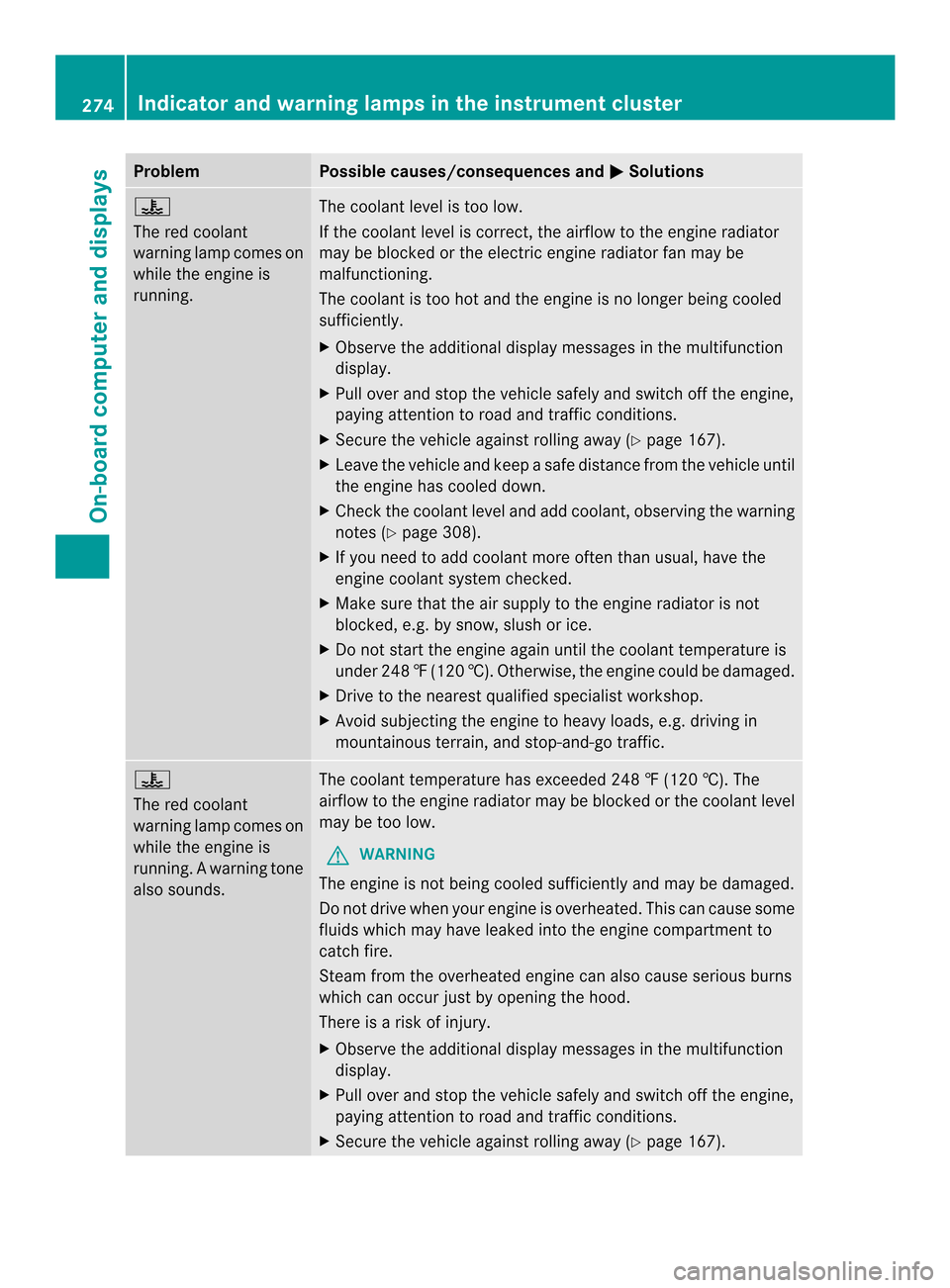
Problem Possible causes/consequences and
000B Solutions
0017
The red coolant
warning lamp comes on
while the engine is
running.
The coolant level is too low.
If the coolant level is correct, the airflow to the engine radiator
may be blocked or the electric engine radiator fan may be
malfunctioning.
The coolant is too hot and the engine is no longer being cooled
sufficiently.
X
Observe the additional display messages in the multifunction
display.
X Pull over and stop the vehicle safely and switch off the engine,
paying attention to road and traffic conditions.
X Secure the vehicle against rolling away (Y page 167).
X Leave the vehicle and keep asafe distance from the vehicle until
the engine has cooled down.
X Check the coolant level and add coolant, observing the warning
notes (Y page 308).
X If you need to add coolant more often than usual, have the
engine coolant system checked.
X Make sure that the air supply to the engine radiator is not
blocked, e.g. by snow, slush or ice.
X Do not start the engine again until the coolant temperature is
under 248 ‡(120 †). Otherwise ,the engine coul dbedamaged.
X Drive to the nearest qualified specialist workshop.
X Avoid subjecting the engine to heavy loads, e.g. driving in
mountainou sterrain, and stop-and-go traffic. 0017
The red coolant
warning lamp comes on
while the engine is
running.
Awarning tone
also sounds. The coolant temperature has exceeded 248
‡(120 †). The
airflow to the engine radiator may be blocked or the coolant level
may be too low.
G WARNING
The engine is not being coole dsufficiently and may be damaged.
Do not drive whe nyour engine is overheated. This can cause some
fluids which may have leaked into the engine compartment to
catchf ire.
Steam from the overheated engine can also cause serious burns
which can occur just by opening the hood.
There is arisk of injury.
X Observe the additional display messages in the multifunction
display.
X Pull over and stop the vehicle safely and switch off the engine,
paying attention to road and traffic conditions.
X Secure the vehicle against rolling away (Y page 167).274
Indicator and warning lampsint
he instrument clusterOn-board computer and displays
Page 277 of 382
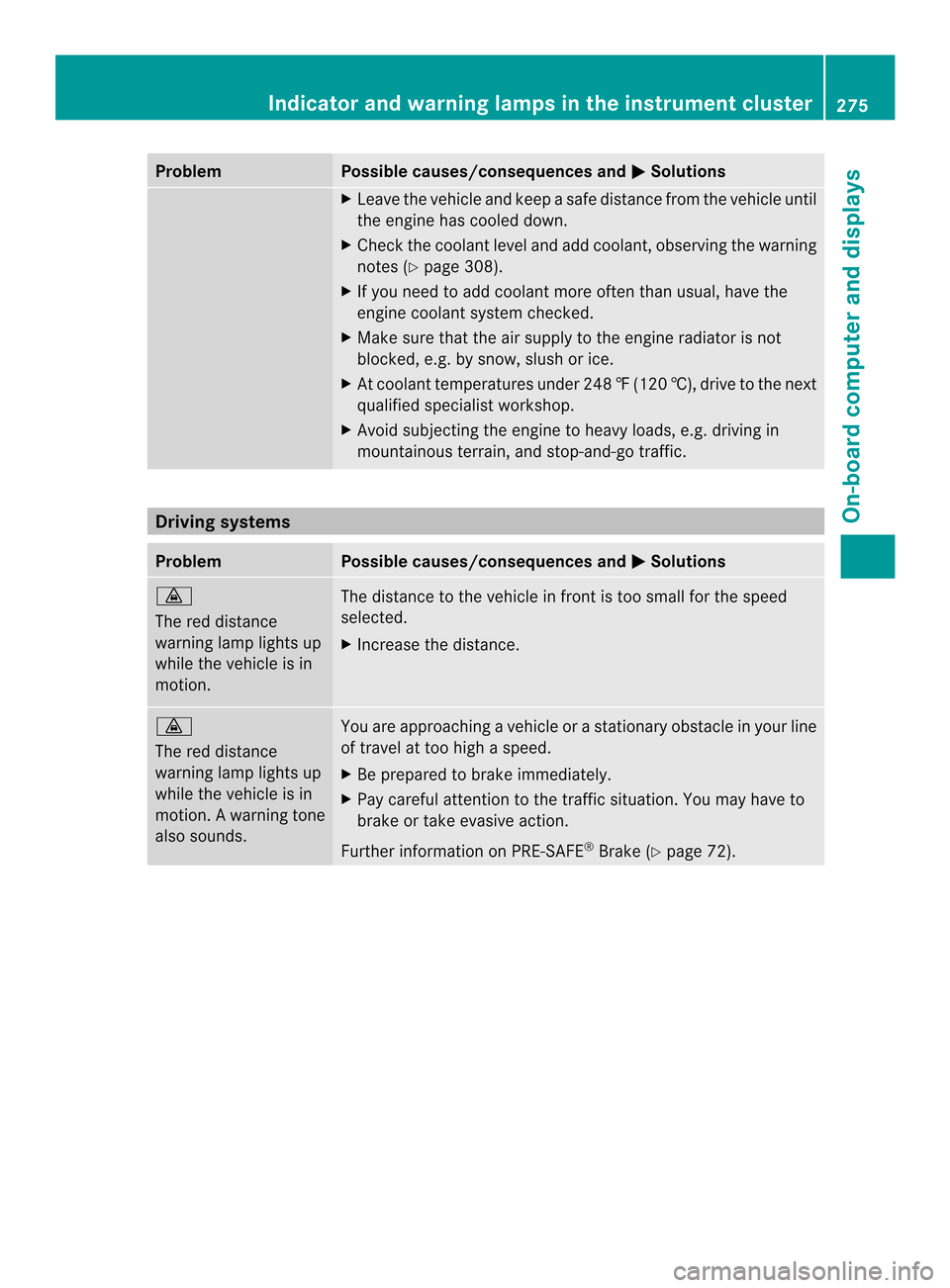
Problem Possible causes/consequences and
000B Solutions
X
Leave the vehicle and keep asafe distance from the vehicle until
the engine has cooled down.
X Check the coolant level and add coolant, observing the warning
notes (Y page 308).
X If you need to add coolant more often than usual, have the
engine coolant system checked.
X Make sure that the air supply to the engine radiator is not
blocked, e.g. by snow, slush or ice.
X At coolant temperatures under 248 ‡(120 †), drive to the next
qualified specialist workshop.
X Avoid subjecting the engine to heavy loads, e.g. driving in
mountainou sterrain, and stop-and-go traffic. Driving systems
Problem Possible causes/consequencesa
nd000B Solutions
0008
The red distance
warning lamp lights up
while the vehicle is in
motion.
The distance to the vehicle in front is too smal
lfor the speed
selected.
X Increase the distance. 0008
The red distance
warning lamp lights up
while the vehicle is in
motion
.Awarning tone
also sounds. You are approaching
avehicle or astationary obstacle in your line
of travel at too high aspeed.
X Be prepared to brake immediately.
X Pay careful attention to the traffic situation. You may have to
brake or take evasive action.
Further information on PRE-SAFE ®
Brake (Y page 72). Indicator and warning lampsint
he instrument cluster
275On-board computer and displays Z
Page 280 of 382
Useful information
i This Operator's Manual describes all
models and all standard and optional
equipment of your vehicle available at the
time of publication of the Operator's
Manual. Country-specific differences are
possible. Please not ethat your vehicle may
not be equipped with all features
described. This also applies to safety-
related system sand functions.
i Read the information on qualified
specialist workshops: (Y page 26).Stowage areas
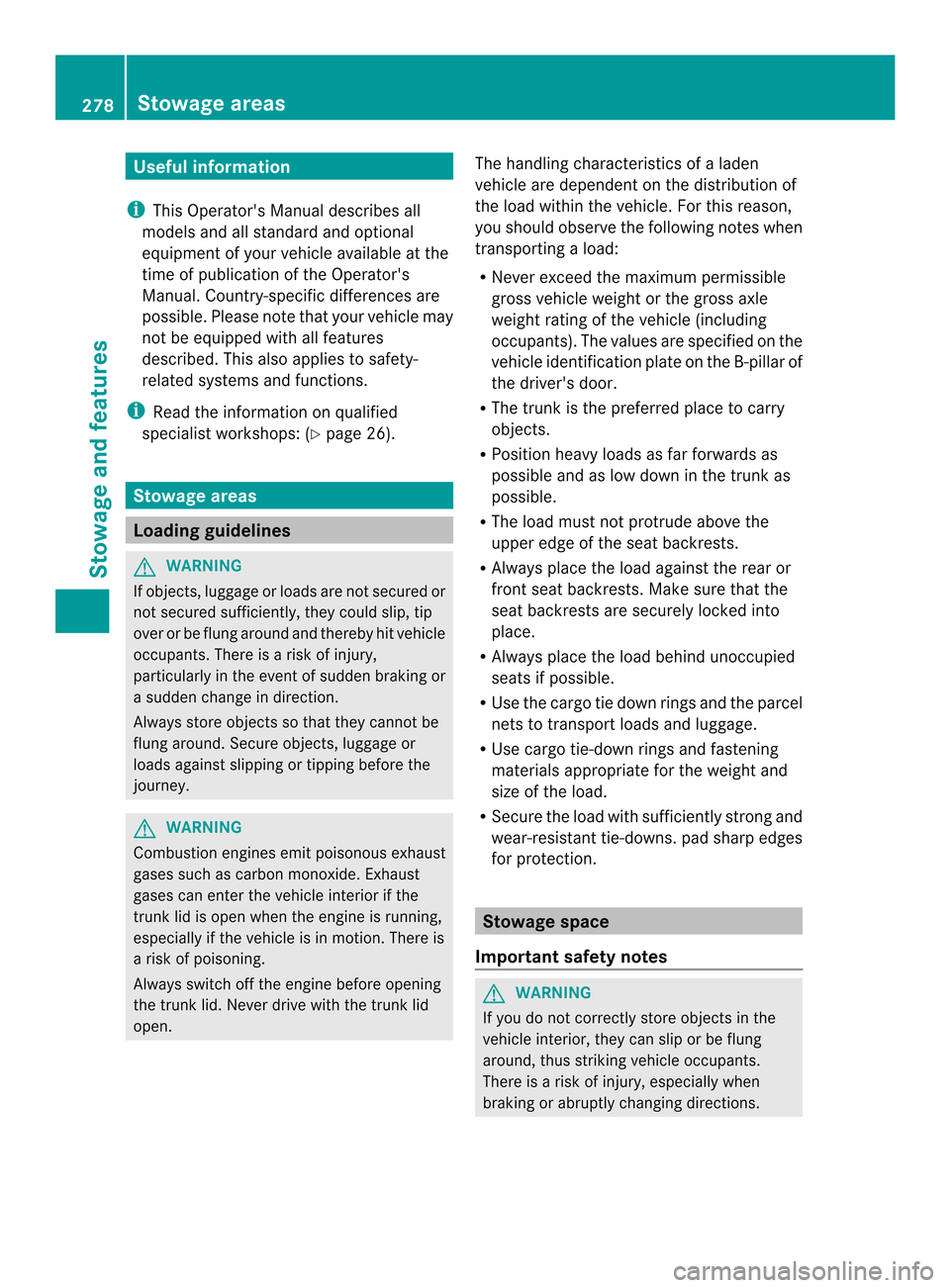
Loading guidelines
G
WARNING
If objects, luggage or loads are not secured or
not secured sufficiently, they could slip, tip
over or be flung around and thereby hit vehicle
occupants .There is arisk of injury,
particularly in the even tofsudden braking or
as udde nchange in direction.
Always store objectssot hat they cannot be
flung around. Secure objects, luggageor
loads against slipping or tipping before the
journey. G
WARNING
Combustion engines emit poisonous exhaust
gases such as carbon monoxide. Exhaust
gases can enter the vehicle interior if the
trunk lid is open when the engine is running,
especially if the vehicle is in motion. There is
ar isk of poisoning.
Always switch off the engine before opening
the trunk lid. Never drive with the trunk lid
open. The handling characteristics of
aladen
vehicle are dependent on the distribution of
the load within the vehicle. For this reason,
you should observe the following notes when
transporting aload:
R Never exceed the maximum permissible
gross vehicle weight or the gross axle
weight rating of the vehicle (including
occupants). The values are specified on the
vehicle identification plate on the B-pillar of
the driver's door.
R The trunk is the preferred place to carry
objects.
R Position heavy loads as far forwards as
possible and as low down in the trunk as
possible.
R The load must not protrude above the
upper edge of the seat backrests.
R Always place the load against the rear or
front seat backrests. Make sure that the
seat backrests are securely locked into
place.
R Always place the load behind unoccupied
seats if possible.
R Use the cargo tie down rings and the parcel
nets to transport loads and luggage.
R Use cargo tie-down rings and fastening
materials appropriate for the weight and
size of the load.
R Secure the load with sufficiently stronga nd
wear-resistant tie-downs. pad sharp edges
for protection. Stowage space
Important safety notes G
WARNING
If you do not correctly store objectsint he
vehicle interior, they can slip or be flung
around, thus strikingv ehicle occupants.
There is arisk of injury, especially when
braking or abruptly changing directions. 278
Stowage areasStowage and features
Page 291 of 382

AMG vehicles
Your attention must always be focused on the
traffic conditions. Only us ethe cigarette
lighte rwhen road and traffic conditions
permit.
X Turn the SmartKey to position 2in the
ignition lock (Y page 147).
X To open: briefly press the trim on
cover 001A.
The stowage compartmento pens.
X Press in cigarette lighter 0010.
Cigarett elighter 0010will pop out
automatically when the heatin gelemen tis
red-hot. 12
Vsockets
General notes X
Turn th eSmartKey to position 1in the
ignitio nlock (Y page 147).
The socket scan be used for accessories with
am aximum draw of 180 W(15 A).
Accessories include such items as lamps or
chargers for mobile phones.
If you use the socket sfor long periods when
the engine is switched off, the battery may
discharge.
i An emergenc ycut-out ensures that the
on-board voltage does not drop too low. If
the on-board voltage is too low, the power
to the socket sisautomatically cut. This
ensures that there is sufficient power to
start the engine. Socket under the armrest
X
Open the stowage compartment under the
armrest (Y page 280).
X Lift up the cover of socket 001A.
Socket in the front-compartment center
console All vehicles (except AMG)
X
To open: slide cover 001Aforwards until it
engages.
X Lift up the cover of socket 0010.
X To close: briefly press cover 001Aat the
front.
The cover moves back. Features
289Stowage and features Z
Page 301 of 382
Triggerin
gthe vehicle alarm With thi
sfun ction, yo ucan trigge rthe
vehicle's panic alarm via text message. An
alarm sounds and the exterior lighting
flashes. Depending on the setting, the panic
alarm lasts five or ten seconds. Afterwards,
the alarm switches off. Garage door opener
Important safety notes G
WARNING
When you operate or program the garage door
with the integrated garage door opener,
persons in the range of movement of the
garage door can become trapped or struck by
the garage door. There is arisk of injury.
When using the integrated garage door
opener, always make sure that nobody is
within the rang eofmovemen tofthe garage
door. G
WARNING
Combustion engines emit poisonous exhaust
gases such as carbo nmonoxide. Inhaling
these exhaust gases leads to poisoning. There
is ar isk of fatal injury. Therefore never leave
the engine runnin ginenclosed spaces
without sufficient ventilation.
The HomeLink ®
garage door opener
integrated in the rear-view mirror allows you
to operate up to three different door and gate
systems.
Use the integrated garage door opener only
on garage doors that:
R have safety stop and reverse features and
R meet current U.S. federal safety standards
When programming agarage door opener,
park the vehicle outside the garage.
i Certain garage door drives are
incompatible with the integrated garage
door opener. If you have difficulty
programming the integrated garage door opener, contact an authorized Mercedes-
Benz Center.
Alternatively, you can call the following
telephone assistance services:
R USA: Mercedes-Benz Customer
Assistance Center at
1-800-FOR-MERCedes
R Canada: Customer Servic eat
1-800-387-0100
R HomeLink ®
hotline 1-800-355-3515
(free of charge)
More information on HomeLink ®
and/or
compatible products is also available
online at http://www.homelink.com.
i Notes on the declaration of conformity
(Y page 25).
USA:F CC ID: CB2HMIHL4
Canada: IC: 279B-HMIHL4
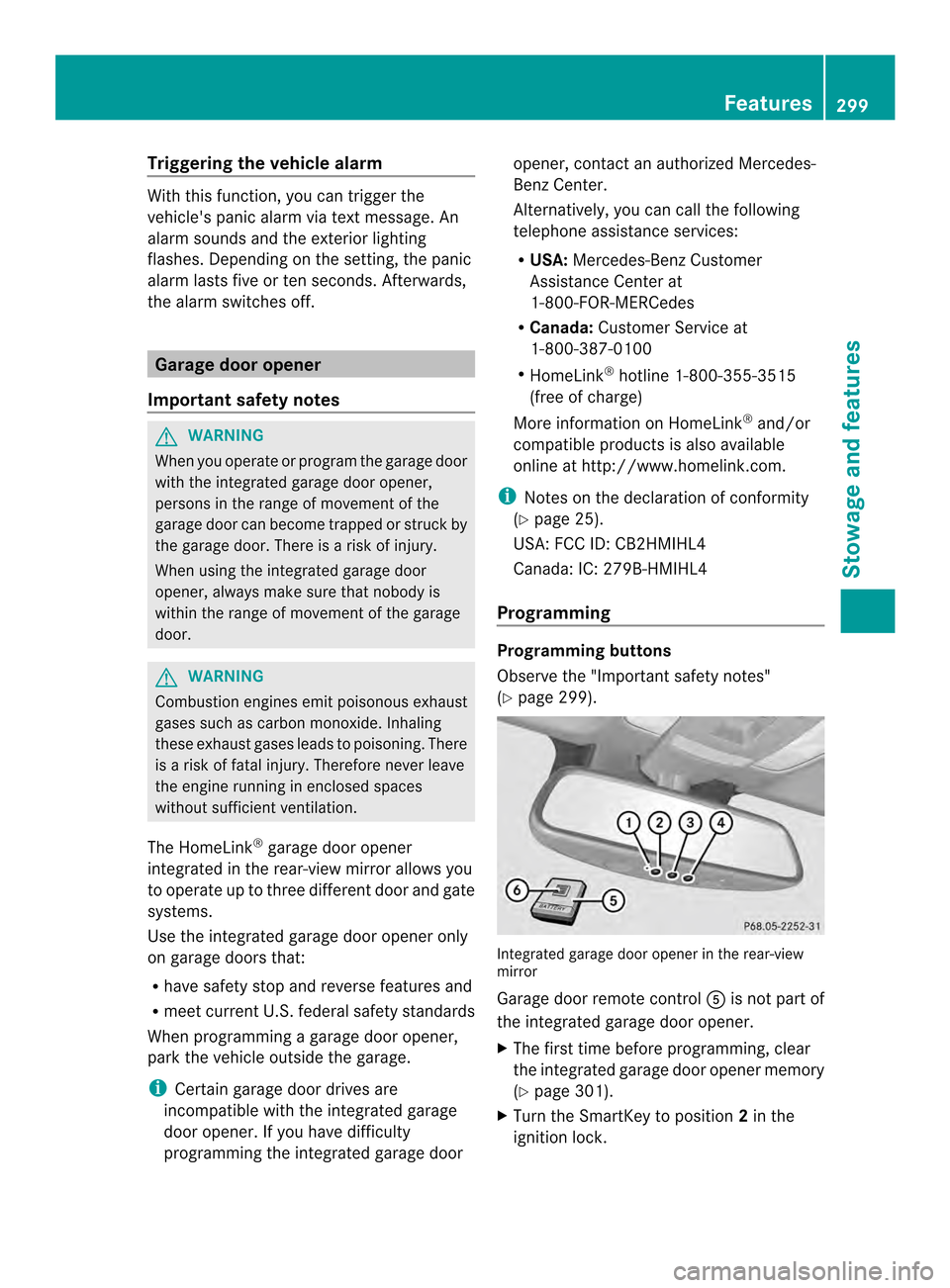
Programming Programming buttons
Observe the "Important safety notes"
(Y page 299). Integrated garage door opener in the rear-view
mirror
Garage door remote control 001Eis not part of
the integrated garage door opener.
X The first time before programming, clear
the integrated garage door opener memory
(Y page 301).
X Turn the SmartKey to position 2in the
ignition lock. Features
299Stowage and features Z
Page 307 of 382
Useful information
............................306
Engine compartment ........................306
Maintenance ...................................... 309
Care .................................................... 311 305Maintenance and care
Page 308 of 382
Useful information
i This Operator's Manual describes all
models and all standard and optional
equipment of your vehicle available at the
time of publication of the Operator's
Manual. Country-specific differences are
possible. Please not ethat your vehicle may
not be equipped with all features
described. This also applies to safety-
related system sand functions.
i Read the information on qualified
specialist workshops: (Y page 26).Engine compartment
Hood
Important safet ynotes G
WARNING
If the hood is unlatched, it may open up when
the vehicle is in motion and block your view.
There is arisk of an accident.
Never unlatc hthe hood while driving. G
WARNING
When openin gand closin gthe hood, it may
suddenly fall int othe closed position .There is
ar isk of injury to persons within range of
movement of the hood.
Open and close the hood only when no one is
within its range of movement. G
WARNING
Certain components in the engine
compartment, such as the engine, radiator
and parts of the exhaust system, can become
very hot. Working in the engine compartment
poses arisk of injury.
Where possible, let the engine cool down and
touch only the components described in the
following. G
WARNING
Opening the hood when the engine is
overheated or when there is afire in the
engine compartmentc ould expose you to hot
gases or other service products. There is a
risk of injury.
Let an overheated engine cool down before
opening the hood. If there is afire in the
engine compartment, keep the hood closed
and contact the fire department. G
WARNING
The engine compartment contains moving
components. Certain components, such as
the radiator fan, may continue to run or start
again suddenly when the ignition is off. There
is ar isk of injury.
If you need to do any work inside the engine
compartment,
R switch off the ignition
R never reach into the area where there is a
risk of danger from moving components,
such as the fan rotation area
R keep clothin gaway from moving parts G
WARNING
The ignition system and the fuel injection
system work under high voltage. If you touch
components which are under voltage, you
could get an electric shock. There is arisk of
injury.
Never touch components of the ignition
system or fuel injection system when the
ignition is switched on.
Opening the hood G
WARNING
When the hood is open and the windshield
wipers are set in motion ,you can be injured
by the wiper linkage. There is arisk of injury.
Always switch off the windshield wipers and
the ignition before opening the hood. 306
Engine compartmentMaintenance and care
Page 309 of 382

!
Make sure that the windshieldw ipers are
not folded away fro mthe windshield. You
could otherwise damage the windshield
wipers or the hood. X
Make sure that the windshield wipers are
turned off.
X Pull release lever 001Aon the hood.
The hood is released. X
Reach into the gap, pull hood catch
handle 0010up and lift the hood.
If you lift the hood by approximately
15 inches (40c m),the hood is opened and
held open automatically by the gas-filled
strut.
Closing theh ood X
Lower the hood and let it fall from aheight
of approximately 8inche s(20 cm).
X Check that the hood has engaged properly.
If the hood can be raised slightly ,itisnot
properly engaged. Open it again and close
it with alittle more force. Engine oil
General notes Depending on the driving style, the vehicle
consume
supto0.9 US qt (0.8 liters) of oil
over adistanc eof600 miles (1,000 km). The
oil consumption may be higher than this when
the vehicle is new or if you frequently drive at
high engin espeeds.
Depending on the engine, the oil dipstic kmay
be in adifferent location.
When checking th eoil level:
R park th evehicle on aleve lsurface.
R thee ngines hould be switched off for
approximately fiv eminute siftheengin eis
at normal operatin gtem perature.
R if th eengineisn otat normal operating
temperature, e.g .ifthe engine was only
started briefly, wait about 30 minutes
before carrying out the measurement.
Checking the oil level using the oil
dipstick X
Pull oil dipstick 001Aout of the dipstick guide
tube.
X Wipe off oil dipstick 001A.
X Slowly slide oil dipstick 001Ainto the guide
tube to the stop, and take it out again.
If the level is between MIN mark 0024and
MAX mark 0010,the oil level is correct.
X If the oil level has dropped to MIN mark
0024 or below, add 1.1 US qt (1.0 liter) of
engine oil. Engine compartment
307Maintenance and care Z
Page 310 of 382
Adding engin
eoil G
WARNING
If engin eoil comes int ocontac twithh ot
component sintheengin ecom partment, it
may ignite. There is ariskoff irea nd injury.
Mak esuret hate ngineo il is no tspilled next
to the filler neck. Let the engin ecool down
and thoroughly clean the engin eoil off the
component sbefore starting the engine. H
Environmental note
When adding oil, take care not to spill any. If
oil enters the soil or waterways, it is harmful
to the environment.
! Only use engin eoils and oil filter sthat
have been approved for vehicles with a
servic esystem. You can obtain alist of the
engin eoils and oil filter stested and
approved in accordance with the
Mercedes-Benz Specification sfor Service
Product satany Mercedes-Benz Service
center.
Damage to the engin eorexhaust system is
caused by the following:
R using engin eoils and oil filter sthat have
not been specifically approved for the
servic esystem
R replacing engin eoil and oil filter safter
the interval for replacemen tspecified by
the servic esystem has been exceeded
R using engin eoil additives.
! Do not add too much oil. adding too much
engin eoil can result in damage to the
engin eortot he catalytic converter. Have
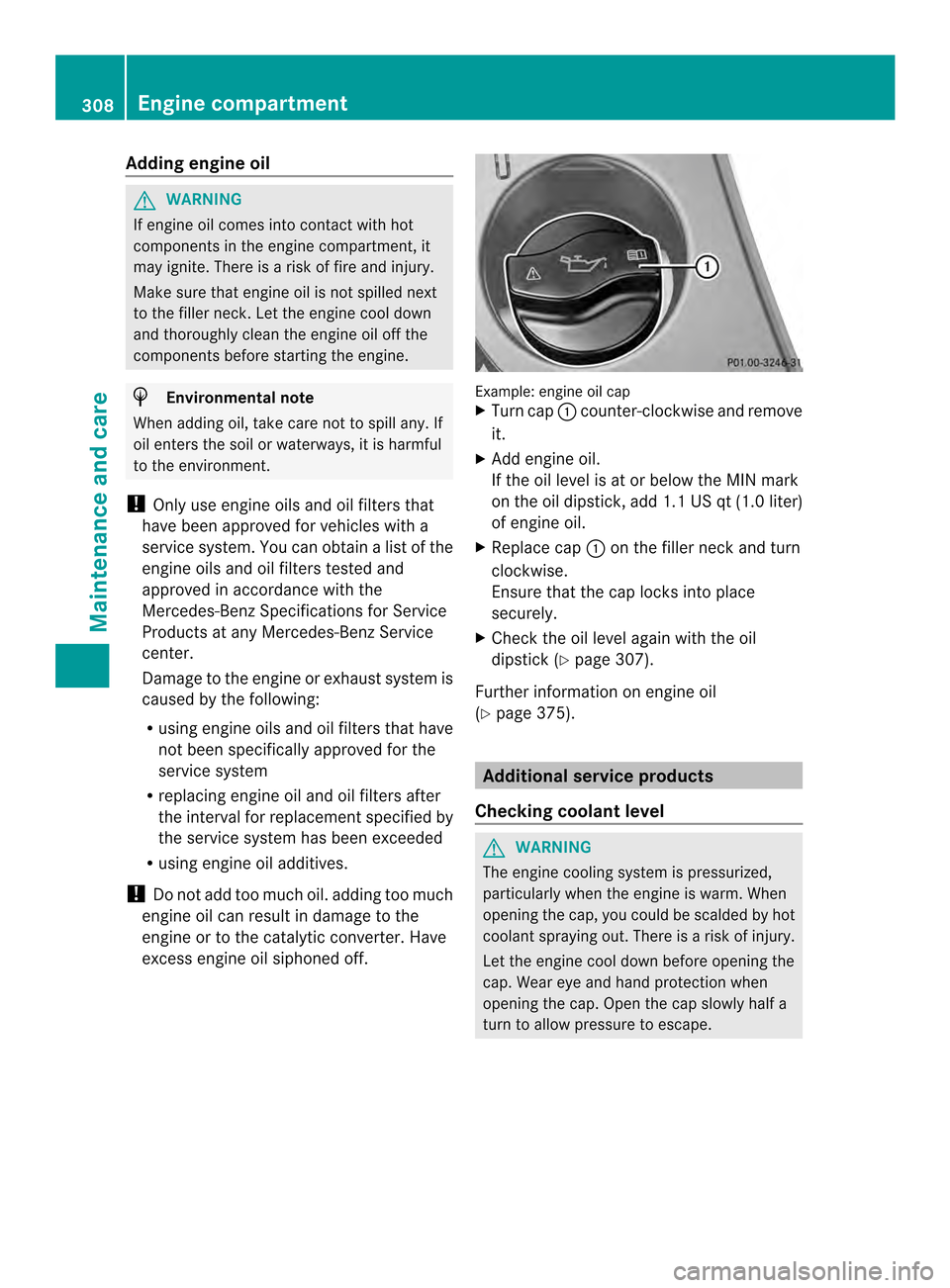
excess engin eoil siphoned off. Example: engin
eoil cap
X Turn cap 001Acounter-clockwise and remove
it.
X Add engin eoil.
If the oil level is at or below the MIN mark
on the oil dipstick, add 1.1 US qt (1.0 liter)
of engine oil.
X Replace cap 001Aon the fille rneck and turn
clockwise.
Ensur ethatthe cap locks into place
securely.
X Check the oi llev el agai nwith the oil
dipstick (Y page 307).
Further information on engine oil
(Y page 375). Additiona
lservice products
Checking coolant level G
WARNING
The engine cooling system is pressurized,
particularly when the engine is warm. When
opening the cap, you could be scalde dbyhot
coolan tspraying out. There is arisk of injury.
Let the engin ecool down before openin gthe
cap. Wear eye and hand protection when
openin gthe cap. Open the cap slowly half a
turn to allow pressure to escape. 308
Engine compartmentMaintenance and care
Page 311 of 382
X
Park the vehicle on alevel surface.
Only check the coolant level when the
vehicle is on alevel surface and the engine
has cooled down.
X Turn the SmartKey to position 2in the
ignition lock (Y page 147).
On vehicles with KEYLESS-GO, press the
Start/Stop button twice (Y page 147).
X Check the coolant temperature display in
the instrument cluster.
The coolant temperature must be below
158 ‡(70 †).
X Turn the SmartKey to position
0(Y page 147) in the ignition lock.
X Slowly turn cap 001Ahalf aturn counter-
clockwise to allow excess pressure to
escape.
X Turn cap 001Afurther counter-clockwise and
remove it.
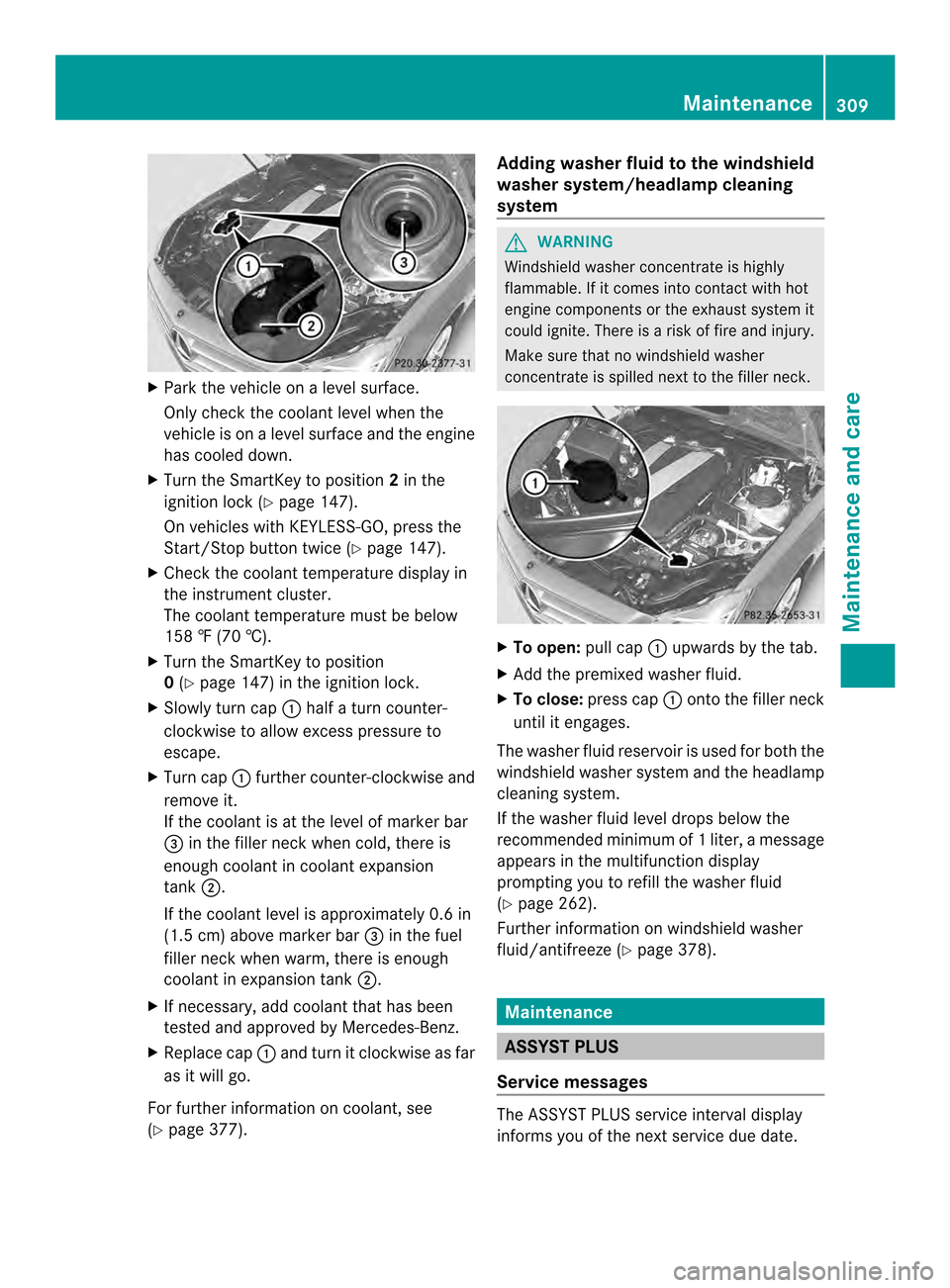
If the coolant is at the level of marker bar
0024 in the filler neck when cold, there is
enough coolant in coolant expansion
tank 0010.
If the coolant level is approximately 0.6 in
(1.5 cm) above marker bar 0024in the fuel
filler neck when warm, there is enough
coolant in expansion tank 0010.
X If necessary, add coolant that has been
tested and approved by Mercedes-Benz.
X Replace cap 001Aand turn it clockwise as far
as it will go.
For further information on coolant ,see
(Y page 377). Adding washer fluid to the windshield
washer system/headlam
pcleaning
system G
WARNING
Windshield washer concentrate is highly
flammable. If it comes int ocontac twith hot
engin ecomponent sorthe exhaust syste mit
could ignite. There is ariskoff ire and injury.
Make sure that no windshield washer
concentrate is spilled nex ttothe filler neck. X
To open: pull cap001Aupwards by the tab.
X Add the premixed washer fluid.
X To close: press cap 001Aontothe filler neck
until it engages.
The washer fluid reservoir is used for both the
windshield washer system and the headlamp
cleaning system.
If the washer fluid level drops below the
recommended minimum of 1liter ,am essage
appears in the multifunction display
promptin gyou to refill the washer fluid
(Y page 262).
Further information on windshield washer
fluid/antifreeze (Y page 378). Maintenance
ASSYST PLUS
Service messages The ASSYS
TPLUS service interval display
inform syou of the nex tservice due date. Maintenance
309Maintenance and care Z