engine MERCEDES-BENZ CLS-Class 2014 W218 Owner's Manual
[x] Cancel search | Manufacturer: MERCEDES-BENZ, Model Year: 2014, Model line: CLS-Class, Model: MERCEDES-BENZ CLS-Class 2014 W218Pages: 382, PDF Size: 5.36 MB
Page 312 of 382
Information on the type of service and service
intervals (see the separate Maintenance
Booklet).
You can obtain further information from an
authorized Mercedes-Benz Center or at
http://www.mbusa.com (USA only).
i The ASSYST PLUS service interval display
does not show any information on the
engine oil level.O bserve the notes on the
engin eoil level (Y page 307).
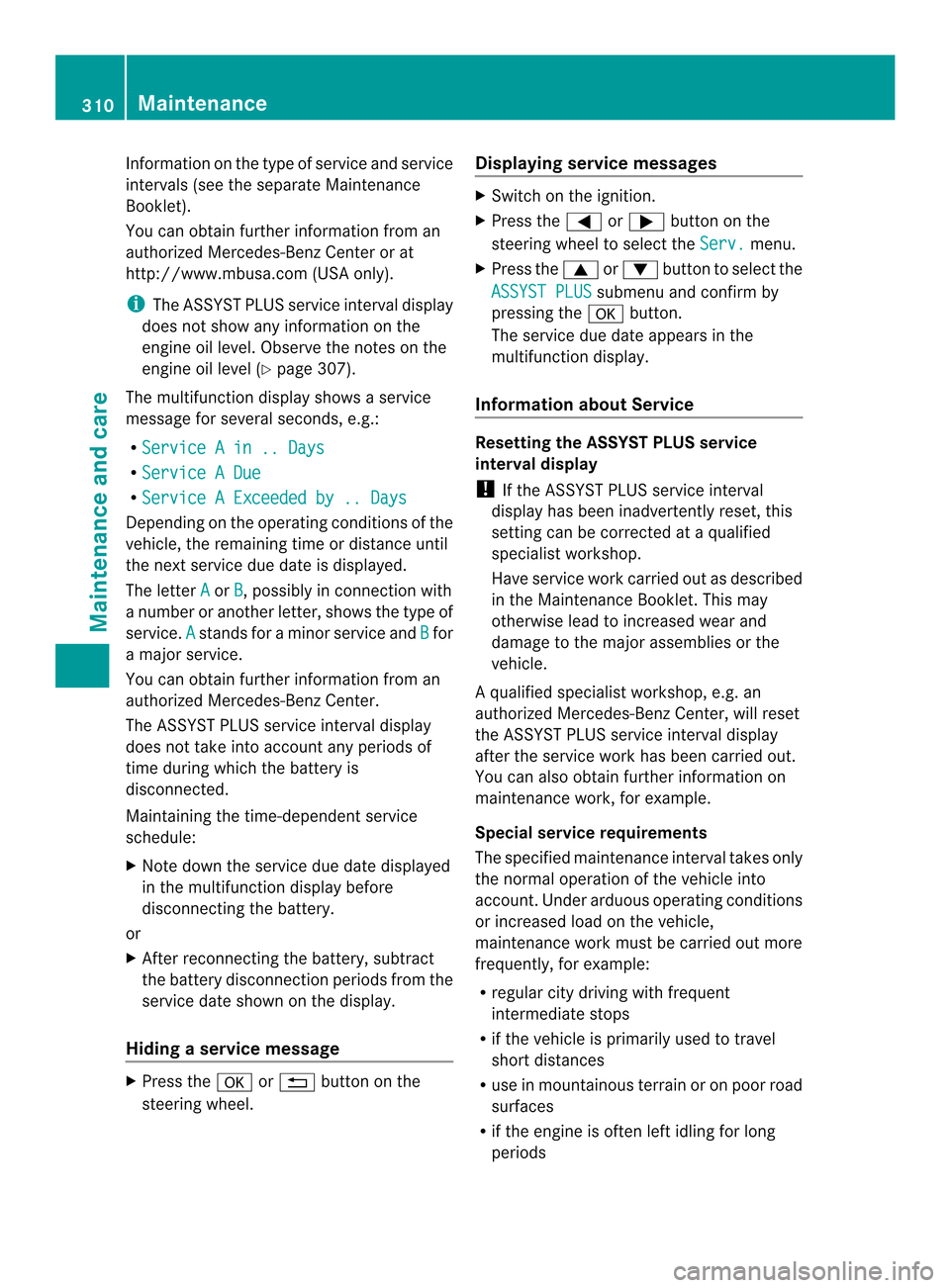
The multifunction display shows aservice
message for several seconds, e.g.:
R Servic eAin..D ays R
Servic eADue R
Servic eAExceeded by .. Days Depending on the operatin
gcondition softhe
vehicle, the remainin gtime or distance until
the nex tservice due date is displayed.
The letter A or
B ,p
ossibly in connection with
an umber or another letter, shows the type of
service. A stands for
aminor servic eand B for
am ajor service.
You can obtain further information from an
authorized Mercedes-Benz Center.
The ASSYST PLUS servic einterval display
does not take intoa ccountany periods of
time during which the battery is
disconnected.
Maintaining the time-dependent service
schedule:
X Note down the servic eduedate displayed
in the multifunctio ndisplay before
disconnecting the battery.
or
X After reconnecting the battery, subtract
the battery disconnection periods fro mthe
service date shown on the display.
Hiding aservice message X
Pres sthe 000C or0002 button on the
steerin gwheel. Displaying service messages X
Switch on th eignition.
X Pres sthe 000A or0004 button on the
steerin gwheel to selec tthe Serv. menu.
X Press the 0006or0005 button to select the
ASSYST PLUS submenu and confirm by
pressing the 000Cbutton.
The service due date appears in the
multifunction display.
Information about Service Resetting the ASSYST PLUS service
interval display
!
If the ASSYST PLUS service interval
displayh as been inadvertently reset, this
settingc an be corrected at aqualified
specialist workshop.
Have service work carried out as described
in the MaintenanceB ooklet. This may
otherwise lead to increased wear and
damage to the major assemblies or the
vehicle.
Aq ualified specialist workshop, e.g. an
authorize dMercedes-Ben zCenter, will reset
the ASSYST PLUS servic einterval display
after the servic ework has been carried out.
You can also obtain further information on
maintenanc ework, for example.
Special service requirements
The specified maintenanc einterval takes only
the normal operation of the vehicle into
account. Under arduous operatin gconditions
or increased load on the vehicle,
maintenanc ework must be carried out more
frequently, for example:
R regular city driving with frequent
intermediate stops
R if the vehicle is primarily used to travel
short distances
R use in mountainous terrain or on poor road
surfaces
R if the engin eisoften left idling for long
periods 310
MaintenanceMaintenance and care
Page 313 of 382
Under these or similarc
onditions, have, for
example, the air filter, engine oil and oil filter
replaced or changed more frequently. Under
arduous operating conditions, the tires must
be checked more often.F urther information
can be obtained at aqualified specialist
workshop, e.g. an authorized Mercedes-Benz
Center.
Driving abroad
An extensive Mercedes-Benz Servic enetwork
is also available in other countries. You can
obtain further information from any
authorized Mercedes-Benz Center. Care
General notes
H
Environmental note
Dispose of empty packagin gand cleaning
cloth sinane nvironmentally responsible
manner.
! For cleanin gyour vehicle, do not use any
of the following:
R dry, rough or hard cloths
R abrasive cleanin gagents
R solvents
R cleanin gagents containin gsolvents
Do not scrub.
Do not touch the surfaces or protective
films with hard objects, e.g. aring or ice
scraper. You could otherwise scratch or
damage the surfaces and protective film.
! Do not park the vehicle for an extended
period straight after cleanin git, particularly
after having cleaned the wheels with wheel
cleaner. Wheel cleaners could cause
increased corrosion of the brake discs and
brake pads/linings. For this reason, you
should drive for afew minutes after
cleaning. Braking heats the brake discs and
the brake pads/linings, thus drying them.
The vehicle can then be parked. Regular care of your vehicle is
acondition for
retaining the quality in the long term.
Use care product sand cleanin gagents
recommended and approved by Mercedes-
Benz. Washing the vehicle and cleaning the
paintwork
Automatic car wash G
WARNING
Braking efficiency is reduced after washing
the vehicle. There is arisk of an accident.
After the vehicle has been washed, brake
carefully while paying attention to the traffic
conditions until full brakin gpower is restored.
! If DISTRONIC PLUS or the HOLD function
is activated, the vehicle brakes
automatically in certain situations. To
preven tdamage to th evehicle ,deactivate
DISTRONI CPLUS and the HOLD function in
the following or other similar situations:
R when towing the vehicle
R in the car wash
! Never clean yourv ehicle inaTouchless
Automatic Car Wash as these use special
cleanin gagents .These cleaning agents can
damage the paintwork or plastic parts.
! Make sure that:
R the side windows and the sliding sunroof
are fully closed.
R the ventilation/heating is switched off
(the OFF button has been pressed).
R the windshield wiper switch is in position
0.
Otherwise, the vehicle might be damaged.
! In car washes with atowing mechanism,
make sure that the automatic transmission
is in transmission position N,otherwise the
vehicle could be damaged.
R Vehicles with aSmartKey: Care
311Maintenance and care Z
Page 314 of 382
Do not remove the SmartKe
yfromt he
ignition lock. Do not open the driver's
door or front-passenge rdoor when the
engine is switched off. Otherwise, the
automatic transmission selects park
position Pautomatically and locks the
wheels. You can prevent this by shifting
the automatic transmission to N
beforehand.
R Vehicles with KEYLESS-GO:
Do not open the driver's door or front-
passenger door when the engine is
switched off. Otherwise, the automatic
transmission selects park position P
automatically and locks the wheels.
Observe the following to make sure that the
automatic transmission stays in position N:
X Make sure the vehicle is stationary and the
ignition is switched off.
X Turn the SmartKey to position 2in the
ignition lock (Y page 147).
Use the SmartKey instead of the Start/
Stop button on vehicles with KEYLESS-GO.
X Depress and hold the brake pedal.
X Shift the automatic transmission to
position N.
X Release the brake pedal.
X Release the electric parking brake.
X Switch off the ignition and leave the
SmartKey in the ignition lock.
You can wash the vehicle in an automatic car
wash from the very start.
If the vehicle is very dirty, pre-wash it before
cleaning it in an automatic car wash.
After using an automatic car wash, wipe off
wax from the windshield and the wiper
blades. This will prevent smears and reduce
wiping noises caused by residue on the
windshield.
Washing by hand In some countries, washing by hand is only
allowe
datspecially equipped washing bays. Observe the legal requirements in all
countries concerned.
X
Do not use hot water and do not wash the
vehicle in direct sunlight.
X Use asoft sponge to clean.
X Use amild cleaning agent, such as acar
shampoo approved by Mercedes-Benz.
X Thoroughly hose down the vehicle with a
gentle jet of water.
X Do not point the water jet directly towards
the air inlet.
X Use plenty of water and rinse out the
sponge frequently.
X Rinse the vehicle with clean water and dry
thoroughly with achamois.
X Do not let the cleaning agent dry on the
paintwork.
When using the vehicle in winter, remove all
traces of road salt deposits carefully and as
soon as possible.
Power washers G
WARNING
The water jet from acircular jet nozzle (dirt
blasters) can cause invisible exterior damage
to the tires or chassis components.
Component sdamaged in this way may fail
unexpectedly. There is arisk of an accident.
Do not use power washers with circular jet
nozzles to clean the vehicle. Have damaged
tires or chassis components replaced
immediately.
! Always maintain adistance of at least
11.8in( 30 cm) between the vehicl eand the
powe rwasher nozzle. Information about
th ec orrec tdistanc eisavailabl efromt he
equipmen tmanufacturer.
Mov ethe power washe rnozzle around
when cleaning your vehicle.
Do not aim directly at any of the following:
R tires
R door gaps, roof gaps, joints, etc.
R electrical components 312
CareMaintenance and care
Page 323 of 382
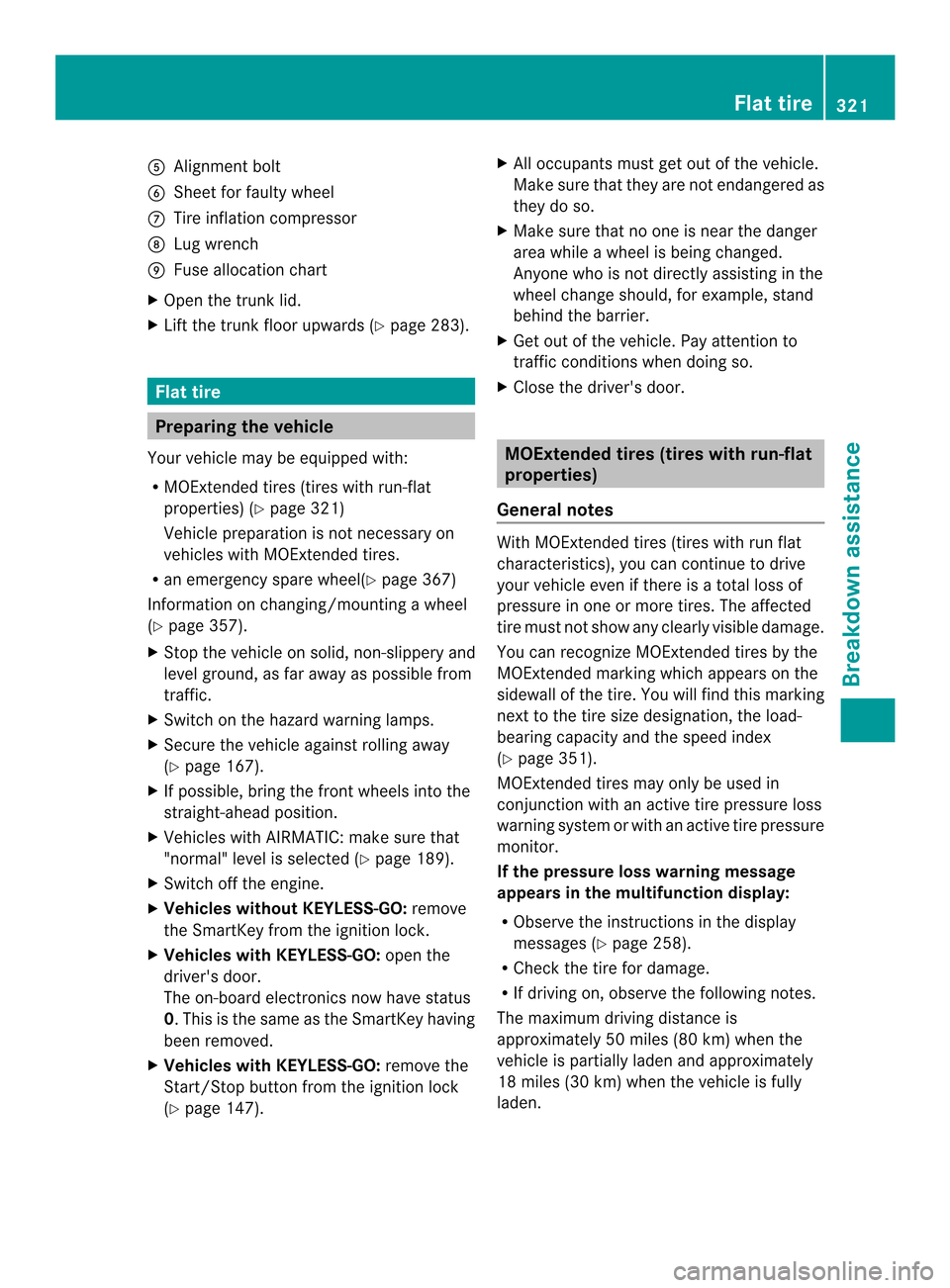
001E
Alignment bolt
0025 Sheet for faulty wheel
0009 Tire inflation compressor
0016 Lugw rench
001D Fusealloc ation chart
X Ope nthe trunk lid.
X Lift the trunk floor upwards (Y page 283).Flat tire
Preparing the vehicle
Your vehicle may be equipped with:
R MOExtended tires (tires with run-flat
properties) (Y page 321)
Vehicle preparation is not necessary on
vehicles with MOExtended tires.
R an emergency spare wheel(Y page 367)
Information on changing/mounting awheel
(Y page 357).
X Stop the vehicle on solid, non-slippery and
level ground, as far away as possible from
traffic.
X Switch on the hazard warning lamps.
X Secure the vehicle against rolling away
(Y page 167).
X If possible, bring the front wheels into the
straight-ahead position.
X Vehicles with AIRMATIC: make sure that
"normal" level is selected (Y page 189).
X Switch off the engine.
X Vehicles without KEYLESS-GO: remove
the SmartKey from the ignition lock.
X Vehicles with KEYLESS-GO: open the
driver's door.
The on-board electronicsn ow have status
0.T his is the same as the SmartKey having
been removed.
X Vehicles with KEYLESS-GO: remove the
Start/Stop button from the ignition lock
(Y page 147). X
All occupants must get out of the vehicle.
Make sure that they are not endangered as
they do so.
X Make sure that no one is near the danger
area while awheel is being changed.
Anyone who is not directly assisting in the
wheel change should, for example, stand
behind the barrier.
X Get out of the vehicle. Pay attention to
traffic conditionsw hen doing so.
X Close the driver's door. MOExtended tires (tires with run-flat
properties)
General notes With MOExtended tires (tires with run flat
characteristics), you can continue to drive
your vehicle even if there is
atotal loss of
pressure in one or more tires. The affected
tire must not show any clearly visible damage.
You can recognizeM OExtended tires by the
MOExtended marking which appears on the
sidewall of the tire. You will find this marking
next to the tire size designation, the load-
bearing capacity and the speed index
(Y page 351).
MOExtended tires may only be used in
conjunction with an active tire pressure loss
warning system or with an active tire pressure
monitor.
If the pressurel oss warning message
appearsint he multifunction display:
R Observe the instructions in the display
messages (Y page 258).
R Check the tire for damage.
R If driving on, observe the following notes.
The maximum driving distance is
approximately 50 miles (80 km) when the
vehicle is partially laden and approximately
18 miles (30 km) when the vehicle is fully
laden. Flat tire
321Breakdown assistance
Page 325 of 382
Befor
ehandling the battery ,touch the vehicle
bod ytor emove any existing electrostatic
build-up.
The highly flammable ga smixture forms when
charging the battery as well as whe njump-
starting.
Always mak esure that neither you no rthe
battery is electrostatically charged. Abuild-
up of electrostati ccharge can be caused, for
example:
R by wearing clothing made from synthetic
fibers
R due to friction between clothing and seats
R if you push or pull the battery across the
carpet or other synthetic materials
R if you wipe the battery with acloth G
WARNING
During the charging process, abattery
produces hydrogen gas. If ashort circuit
occurs or sparks are created, the hydrogen
gas can ignite. There is arisk of an explosion.
R Make sure that the positive terminal of a
connected battery does not come into
contact with vehicle parts.
R Never place metal objectsort ools on a
battery.
R It is important that you observe the
described order of the battery terminals
when connecting and disconnecting a
battery.
R When jump-starting, make sure that the
battery poles with identical polarity are
connected.
R It is particularly important to observe the
described order when connecting and
disconnecting the jumper cables.
R Never connect or disconnectt he battery
terminals while the engine is running. G
WARNING
Batterya cid is caustic. There is arisk of injury.
Avoid contact with the skin, eyes or clothing.
Do not inhale any battery gases. Do not lean over the battery. Keep children away from
batteries. Wash battery acid immediately with
water and seek medical attention.
H
Environmental note Batteries contain dangerous
substances. It is against the
law to dispose of them with
the household rubbish. They
must be collected separately
and recycled to protect the
environment. Dispose of batteries in an
environmentally friendly
manner. Take discharged
batteries to aqualified
specialist workshop or a
special collection point for
used batteries.
! Have the battery checked regularly at a
qualified specialist workshop.
Observe the service intervals in the
MaintenanceB ooklet or contact aqualified
specialist workshop for more information.
! You should have all work involving the
battery carried out at aqualified specialist
workshop. In th eexcepti onal cas ethatitis
necessar yfor you to disconnect th ebattery
yourself, mak esure that:
R you switch off th eenginea nd remove the
SmartKey. On vehicles wit hKEYLESS-
GO, ensure that th eignition is switched
off .C heck that all the indicator lamps in
the instrumentc luster are off.Otherwise,
electroni ccomponents, such as the
alternator ,may be damaged.
R you first remove the negative terminal
clamp and then the positive terminal
clamp. Never swap the terminal clamps.
Otherwise, the vehicle's electronic
system may be damaged.
R the transmission is locked in position P
after disconnectingt he battery. The
vehicle is secured against rolling away.
You can then no longer move the vehicle. Battery (vehicle)
323Breakdown assistance Z
Page 327 of 382
over the battery. Keep children away from
batteries. Wash battery acid immediately with
water and seek medical attention. G
WARNING
Ad ischarged battery can freeze at
temperatures below freezin gpoint .When
jump-starting the vehicle or charging the
battery, gases can escape from the battery.
There is arisk of an explosion.
Allow the frozen battery to thaw out before
charging it or jump-starting.
! Only use battery chargers with a
maximum charging voltage of 14.8 V.
! Only charge the battery using the jump-
startingc onnection point.
The jump-starting connection point is in the
engine compartment( Ypage 326).
X Open the hood (Y page 306).
X Connect the battery charger to the positive
terminal and ground point in the same
order as when connecting the donor
battery in the jump-starting procedure
(Y page 326).
If, at low temperatures, the indicator lamps/
warning lamps in the instrumentc luster do
not light up, it is highly likely that the
discharged battery has frozen.Int his case,
you may neither charge the battery nor jump-
start the vehicle. The service life of athawed-
out battery may be shorter. The starting
characteristics may be impaired, especiallyat
low temperatures. Have the thawed-out
battery checked at aqualified specialist
workshop.
Never charge abattery still installed in the
vehicle unless abattery charger unit
approved by Mercedes-Ben zisbeing used. A
battery charger unit speciallya dapted for
Mercedes-Benz vehicles and tested and
approved by Mercedes-Benz is available as an
accessory. It permits the charging of the
battery in its installed position. Contact an
authorized Mercedes-Benz Center for further information and availability. Read the battery
charger's operating instructions before
charging the battery. Battery (vehicle)
325Breakdown assistance Z
Page 328 of 382
Jump-starting
For the jump-starting procedure, use only the jump-starting connection point, consisting of a
positive terminal and an earth point, in the engine compartment. G
WARNING
Battery acid is caustic. There is arisk of injury.
Avoid contact with the skin, eyes or clothing. Do not inhale any battery gases. Do not lean over
the battery. Keep children away from batteries. Wash battery acid immediately with water and
seek medical attention. G
WARNING
During charging and jump-starting, explosive gases can escape from the battery. There is arisk
of an explosion.
Particularly avoid fire, open flames, creating sparks and smoking. Ensure there is sufficient
ventilation while charging and jump-starting. Do not lean over abattery. G
WARNING
During the charging process, abattery produces hydrogen gas. If ashort circuit occurs or sparks
are created, the hydrogen gas can ignite. There is arisk of an explosion.
R Make sure that the positive terminal of aconnected battery does not come into contact with
vehicle parts.
R Never place metal objects or tools on abattery.
R It is important that you observe the described order of the battery terminals when connecting
and disconnecting abattery.
R When jump-starting, make sure that the battery poles with identical polarity are connected.
R It is particularly important to observe the described order when connecting and disconnecting
the jumper cables.
R Never connect or disconnectt he battery terminals while the engine is running.G
WARNING
Ad ischarged battery can freeze at temperatures below freezin gpoint .When jump-starting the
vehicle or charging the battery, gases can escape from the battery. There is arisk of an explosion.
Allow the frozen battery to thaw out before charging it or jump-starting.
! Avoid repeated and lengthy startinga ttempts. Otherwise, the catalytic converter could be
damaged by the non-combusted fuel.
Do not start the vehicle using arapid charging device. If your vehicle's battery is discharged,
the engine can be jump-started from another vehicle or from asecond battery using jumper
cables. Observe the following points:
R The battery is not accessible in all vehicles. If the other vehicle's battery is not accessible,
jump-start the vehicle using asecond battery or ajump-starting device.
R You may only jump-start th evehicl ewhen th eenginea nd exhaust system are cold.
R Do no tstart th eengineift hebattery is frozen .Let th ebattery thaw first. 326
Jump-startingBreakdown assistance
Page 329 of 382

R
Only jump-start from batteries with a12Vvoltage rating.
R Only use jumper cables which have asufficient cross-section and insulated terminal clamps.
R If the battery is fully discharged, leave the battery that is being used to jump-start connected
for afew minutes before attempting to start. This charges the battery slightly.
R Make sure that the two vehicles do not touch.
Make sure that:
R the jumper cables are not damaged.
R when the jumper cables are connected to the battery, uninsulated sections of the terminal
clamp do not come into contact with other metal sections.
R the jumper cables cannot come into contact with parts which can move when the engine
is running, such as the V-belt pulley or the fan.
X Apply the parking brake firmly.
X Shift the transmission to position P.
X Switch off all electrical consumers (e.g. radio, blower, etc.).
X Open the hood.
Position number 0025identifies the charged battery of the other vehicle or an equivalent jump-
starting device. X
Slide cover 001Aof positive terminal 0010in the direction of the arrow.
X Connect positive terminal 0010on your vehicle to positive terminal 0024of donor battery 0025
using the jumper cable, always begin with positive terminal 0010on your own vehicle first.
X Start the engine of the donor vehicle and run it at idling speed.
X Connect negative terminal 0021of donor battery 0025to ground point 001Eof your vehicle using
the jumper cable, connecting the jumper cable to battery of other vehicle 0025first.
X Start the engine.
X Before disconnecting the jumper cables, let the engine run for several minutes. Jump-starting
327Breakdown assistance Z
Page 333 of 382
X
Turn the SmartKey to position 2in the
ignition lock.
X Shift the automatic transmission to
position N.
As soon as the vehicle is loaded:
X Prevent the vehicle from rolling away by
applying the parking brake.
X Shift the automatic transmission to
position P.
X Turn the SmartKey to position 0in the
ignition lock and remove the SmartKey
from the ignition lock.
X Secure the vehicle. Notes on 4MATIC vehicles
! Vehicles with 4MATI Cmust not be towed
with either the frontort he rear axle raised,
as doing so will damage the transmission.
If the vehicle has transmission damage or
damage to the front or rear axle, have it
transported on atransporter or trailer.
In the event of damage to the electrical
system
If the battery is defective, the automatic
transmission will be locked in position P.To
shift the automatic transmission to position
N,y ou must provide power to the vehicle's
electrical system in the same way as when
jump-starting (Y page 326).
Have the vehicle transported on atransporter
or trailer. Tow-starting (emergency engine
starting)
! Vehicles with automatic transmission
must not be started by tow-starting. This
could otherwise damage the transmission.
You can find information on "Jump-starting"
at (Y page 326). Fuses
Important safety notes
G
WARNING
If you manipulate or bridge afaulty fuse or if
you replace it with afuse with ahigher
amperage, the electric cables could be
overloaded. This could result in afire. There
is ar isk of an accident and injury.
Always replace faulty fuses with the specified
new fuses having the correct amperage.
! Only use fuses that have been approved
for Mercedes-Ben zvehicles and which
have the correct fuse ratin gfor the system
concerned. Otherwise, componentsor
systems could be damaged.
The fuses in your vehicle serve to close down
faulty circuits. If afuse blows ,all the
component sonthecircuit and their functions
stop operating.
Blown fuse smust be replace dwith fuses of
the same rating, which you can recognize by
the color and value. The fuse ratings are listed
in the fuse allocation chart.
If an ewly inserted fuse also blows, have the
cause traced and rectified at aqualified
specialist workshop, e.g. an authorized
Mercedes-Ben zCenter. Befor
echanging afuse
X Secure the vehicle against rolling away
(Y page 167).
X Switc hoff all electrical consumers.
X Turn the SmartKey to position 0in the
ignition lock and remove it (Y page 147).
or
X On vehicles with KEYLESS-GO, make sure
the ignition is switched off (Y page 147).
All indicator lamps in the instrument cluster
must be off. Fuses
331Breakdown assistance Z
Page 334 of 382

The fuses are located in various fuse boxes:
R Fuse box in the engine compartment on the
left-hand side of the vehicle, when viewed
in the direction of travel
R fuse box in the trunk on the right-hand side,
when viewed in the direction of travel
the fuse allocation chart is located in the
vehicle tool kit in the stowage compartment
under the trunk floor (Y page 320).Fuse box in the engine compartment
G
WARNING
When the hood is open and the windshield
wipers are set in motion ,you can be injured
by the wiper linkage. There is arisk of injury.
Always switch off the windshield wipers and
the ignition before opening the hood.
! Make sure that no moisture can enter the
fuse box when the cover is open.
! When closing the cover, make sure that it
is lying correctly on the fuse box. Moisture
seeping in or dirt could otherwise impair
the operation of the fuses.
X Make sure that the windshield wipers are
turned off.
X Open the hood. X
Use adry cloth to remove any moisture
from the fuse box.
X To open: remove lines 0010from the guides.
X Move lines 0010aside. Route the lines behind
connection 0024to do this. X
Open clamp 001A.
X Remove the fuse box cover forwards.
X To close: check whether the rubber seal is
lying correctly in the cover.
X Insert the cover at the rear of the fuse box
into the retainer.
X Fold down cover and close clamps 001A.
X Secure lines 0010in the guides.
X Close the hood. Fuse box in the trunk
! Make sure that no moisture can enter the
fuse box when the cover is open.
! When closing the cover, make sure that it
is lying correctly on the fuse box. Moisture
seeping in or dirt could otherwise impair
the operation of the fuses.
X Open the trunk lid. X
To open: release cover 001Aat the top right
and left-hand sides with aflat object.
X Open cover 001Adownwards in the direction
of the arrow. 332
FusesBreakdown assistance