steering wheel MERCEDES-BENZ CLS-Class 2014 W218 Manual PDF
[x] Cancel search | Manufacturer: MERCEDES-BENZ, Model Year: 2014, Model line: CLS-Class, Model: MERCEDES-BENZ CLS-Class 2014 W218Pages: 382, PDF Size: 5.36 MB
Page 343 of 382
when adjustin
gthe tirep ressure
(Y page 338).
i The actual values for tires are vehicle-
specific and may deviat efromt he values in
the illustration. Checking the tire pressures
Important safety notes Observe the notes on tire pressure
(Y
page 338).
Information on air pressure for the tires on
your vehicle can be found:
R on the vehicle's Tire and Loading
Information placard on the B-pillar
(Y page 345)
R on the tire pressure label on the fuel filler
flap (Y page 165)
R in the "Tire pressure" section
R under "Tire pressure" (Y page 338)
Checking tire pressures manually To determine and set the correct tire
pressure, proceed as follows:
X Remove the valve cap of the tire that is to
be checked.
X Press the tire pressure gauge securely onto
the valve.
X Read the tire pressure and compare it with
the recommended value on the Tire and
Loading Information placard (Y page 338).
X If the tire pressure is too low, increase it to
the recommended value.
X If the tire pressure is too high, release air
by pressing down the metal pin in the valve.
Use the tip of apen, for example. Then,
check the tire pressure again using the tire
pressure gauge.
X Screw the valve cap onto the valve.
X Repeatt hese steps for the other tires. Tire pressurel
oss warning system
(Canada only)
General notes While the vehicle is in motion, the tire
pressure loss warning system monitors the
set tire pressure using the rotational speed of
the wheels. This enables the system to detect
significant pressure loss in
atire. If the speed
of rotation of awheel changes as aresult of
al oss of pressure, acorresponding warning
message will appearint he multifunction
display.
You can recognizet he tire pressure loss
warning by the Run Flat Indicator Active Press 'OK' to Restart message
which appears in the Serv. menu of the
multifunction display. Further information on
the message displayc an be found under
"Restarting the tire pressure loss warning
system" section (Y page 342).
Important safety notes The tire pressure warning system does not
warn you of an incorrectly set tire pressure.
Observe the notes on the recommended tire
pressure (Y
page 338).
The tire pressure loss warning does not
replace the need to regularly check the tire
pressure. An even loss of pressure on several
tires at the same time cannot be detected by
the tire pressure loss warning system.
The tire pressure monitor is not able to warn
you of asudden loss of pressure, e.g. if the
tire is penetrated by aforeign object.Int he
event of asudden loss of pressure, bring the
vehicle to ahalt by braking carefully. Avoid
abrupt steering maneuvers.
The function of the tire pressure loss warning
system is limited or delayed if:
R snow chains are mounted on your vehicle's
tires.
R road conditionsa re wintry.
R you are driving on sand or gravel. Check
341Wheels and tires Z
Page 344 of 382

R
you adop taverys porty driving style
(cornering at high speeds or driving with
high rates of acceleration).
R you are driving with aheavy load( in the
vehicl eoront he roof).
Restarting the tire pressure loss
warnin gsystem Restart the tire pressure loss warning system
if you have:
R changed the tire pressure
R changed the wheels or tires
R mounted new wheels or tires
X Before restarting, make sure that the tire
pressures are set properly on all four tires
for the respective operating conditions.
The recommende dtire pressures can be
found on the Tire and Loading Information
placard on the B-pillar on the driver's side
or the tire pressure table on the fuel filler
flap .The tire pressure loss warning system
can only give reliablew arnings if you have
set the correct tire pressure. If an incorrect
tire pressure is set, these incorrectv alues
will be monitored.
X Als oobserv ethe note sinthesectio nontire
pressures (Y page 338).
X Make sure that the SmartKey is in position
2in the ignition lock (Y page 147).
X Press the 000Aor0004 button on the
steerin gwheel to selec tthe Serv. menu.
X Press the 0006or0005 button on the
steering wheel to select the TirePressure menu.
X Press the 000Cbutton.
The Run Flat Indicator Active Press 'OK' to Restart message
appears in the multifunction display. If you wish to confirm the restart:
X
Press the 000Cbutton.
The Tire Pressure Now OK? message
appears in the multifunction display.
X Press the 0006or0005 button to select
Yes .
X Press the 000Cbutton.
The Run Flat Indicator Restarted message appears in the multifunction
display.
After
ateach-in period, the tire pressure
loss warning system will monitor the set
tire pressures of all four tires.
If you wish to cancel the restart:
X Press the 0002button.
or
X When the Tire Pressure Now OK? message appears, press the
0006
or 0005 button to select Cancel .
X Press the 000Cbutton.
The tire pressure values stored at the last
restart will continue to be monitored. Tire pressurem
onitor
General notes If
at ire pressure monitor is installed, the
vehicle's wheels have sensors that monitor
the tire pressures in all four tires. The tire
pressure monitor warns you if the pressure
drops in one or more of the tires. The tire
pressure monitor only functions if the correct
sensors are installed on all wheels.
Information on tire pressures is displayed in
the multifunction display. After afew minutes
of driving, the current tire pressure of each
tire is shown in the Service menu of the
multifunction display. For further information
on displaying this message, refer to the
"Checking the tire pressure electronically"
section (Y page 344). 342
CheckWheels and tires
Page 345 of 382
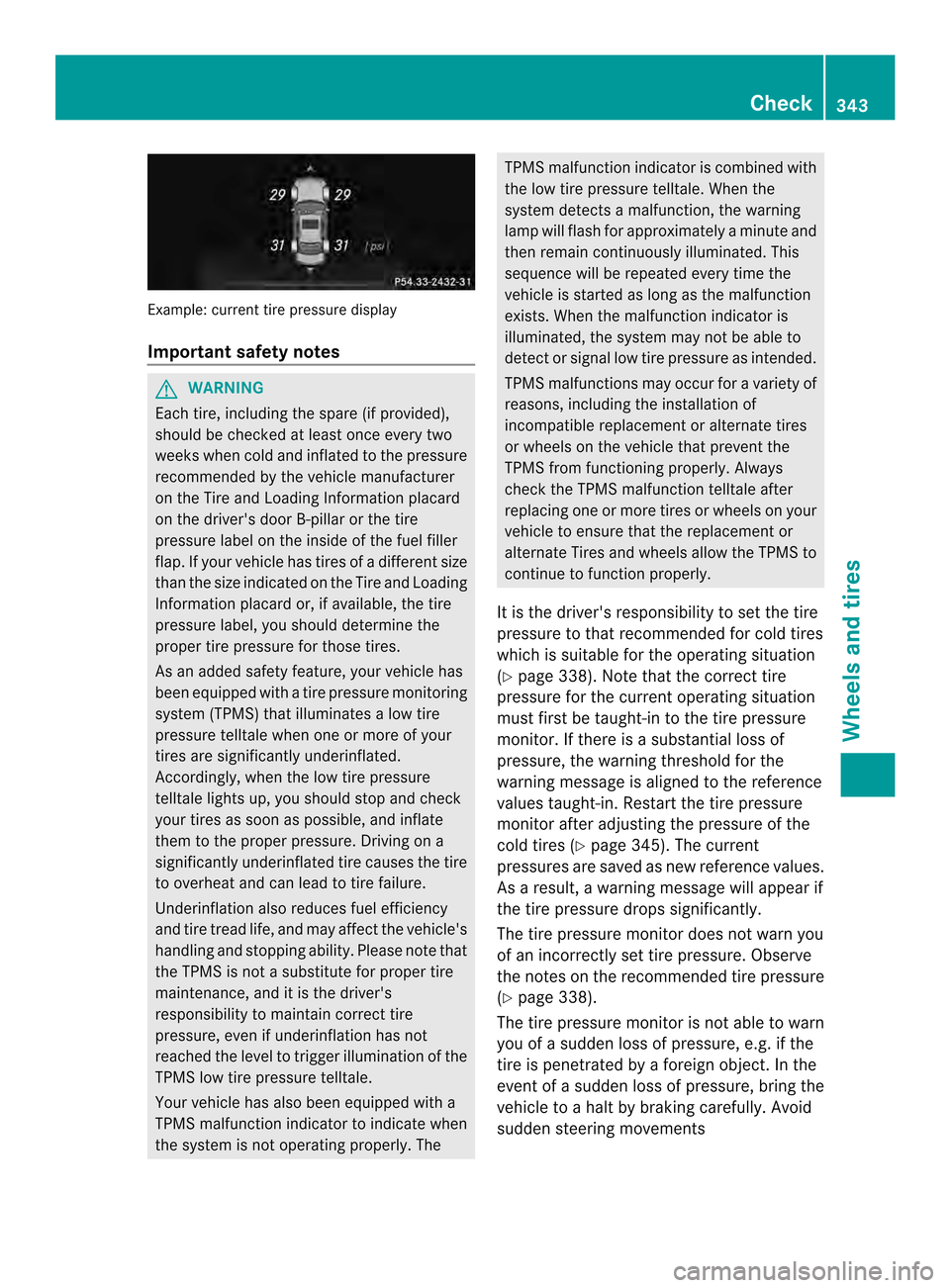
Example: current tire pressure display
Important safety notes
G
WARNING
Each tire ,including the spare (i fprovided),
should be checked at least once every two
weeks when cold and inflated to the pressure
recommended by the vehicl emanufacturer
on the Tire and Loading Information placard
on the driver' sdoor B-pillar or the tire
pressure label on the inside of the fuel filler
flap .Ify our vehicle has tires of adifferent size
than the size indicated on the Tire and Loading
Information placard or, if available, the tire
pressure label, you should determin ethe
proper tire pressure for those tires.
As an added safety feature, your vehicle has
been equipped with atire pressure monitoring
system (TPMS) that illuminates alow tire
pressure telltale when one or more of your
tires are significantly underinflated.
Accordingly, when the low tire pressure
telltale lights up, you should stop and check
your tires as soon as possible, and inflate
them to the proper pressure. Drivin gona
significantly underinflated tire causes the tire
to overheat and can lead to tire failure.
Underinflation also reduces fuel efficiency
and tire tread life, and may affect the vehicle's
handling and stopping ability. Please note that
the TPMS is not asubstitute for proper tire
maintenance, and it is the driver's
responsibility to maintain correc ttire
pressure, even if underinflation has not
reached the level to trigger illumination of the
TPMS low tire pressure telltale.
Your vehicle has also been equipped with a
TPMS malfunction indicator to indicate when
the system is not operating properly. The TPMS malfunction indicator is combined with
the low tire pressure telltale. When the
system detect
samalfunction, the warning
lamp will flash for approximately aminute and
then remain continuously illuminated. This
sequence will be repeated every time the
vehicle is started as long as the malfunction
exists. When the malfunction indicator is
illuminated, the system may not be able to
detect or signal low tire pressure as intended.
TPMS malfunctions may occur for avariety of
reasons, including the installation of
incompatible replacement or alternate tires
or wheels on the vehicle that prevent the
TPMS from functioning properly. Always
check the TPMS malfunction telltale after
replacing one or more tires or wheels on your
vehicle to ensure that the replacement or
alternate Tires and wheels allow the TPMS to
continue to function properly.
It is the driver's responsibility to set the tire
pressure to that recommended for cold tires
which is suitable for the operating situation
(Y page 338). Note that the correc ttire
pressure for the current operating situation
must first be taught-in to the tire pressure
monitor. If there is asubstantial loss of
pressure, the warning threshold for the
warning message is aligned to the reference
values taught-in .Restart the tire pressure
monitor after adjustin gthe pressure of the
cold tires (Y page 345). The current
pressures are saved as new reference values.
As aresult, awarning message will appear if
the tire pressure drops significantly.
The tire pressure monitor does not warn you
of an incorrectly set tire pressure. Observe
the notes on the recommended tire pressure
(Y page 338).
The tire pressure monitor is not able to warn
you of asudden loss of pressure, e.g. if the
tire is penetrated by aforeign object. In the
event of asudden loss of pressure, bring the
vehicle to ahalt by brakin gcarefully. Avoid
sudden steering movements Check
343Wheels and tires Z
Page 346 of 382

The tire pressure monitor has
ayellow
warning lamp in the instrument cluster for
indicatin gapressure loss or malfunction.
Whether the warning lamp flashes or lights up
indicates whether atire pressure is too low or
the tire pressure monitor is malfunctioning:
R if the warning lamp is lit continuously, the
tire pressure on one or more tires is
significantly too low. The tire pressure
monitor is not malfunctioning.
R if the warning lamp flashes for around a
minute and then remains lit constantly, the
tire pressure monitor is malfunctioning.
If the tire pressure monitor is malfunctioning,
it may take more than ten minutes for the tire
pressure warning lamp to inform you of the
malfunction by flashing for approximately one
minute and then remaining lit. When the
malfunction has been rectified, the tire
pressure warning lamp goes out after afew
minutes of driving.
The tire pressure values indicated by the on-
board computer may differ from those
measured at agas station with apressure
gauge. The tire pressures shown by the on-
board computer refer to those measured at
sea level. At high altitudes, the tire pressure
values indicated by apressure gauge are
higher than those shown by the on-board
computer .Inthis case, do not reduce the tire
pressures.
The operation of the tire pressure monitor can
be affected by interference from radio
transmitting equipment (e.g. radio
headphones, two-way radios) that may be
being operated in or near the vehicle.
Checking the tire pressure
electronically X
Make sure that the SmartKey is in position
2(Y page 147) in the ignition lock .
X Press the 000Aor0004 button on the
steering wheel to select the Serv. menu.X
Press the 0006or0005 button to select
Tire Pressure .
X Press the 000Cbutton.
The current tire pressure of each tire is
shown in the multifunction display.
If the vehicle was parked for longer than
20 minutes ,the Tire pressures will be
displayed after driving
afew minutes message is shown.
After ateach-in process, the tire pressure
monitor automatically detects new wheels or
new sensors. As long as aclear allocation of
the tire pressure value to the individual
wheels is not possible, the Tire Pressure Monitor Active displaym
essage is shown
instead of the tire pressure display. The tire
pressures are already being monitored.
i If an emergency spare wheel is mounted,
the system may continue to show the tire
pressure of the wheel that has been
removed for afew minutes. If this occurs,
note that the value displayed for the
position where the spare wheel is mounted
is not the same as the current tire pressure
of the emergency spare wheel.
Tire pressurem onitor warning
messages If the tire pressure monitor detects
apressure
loss in one or more tires, awarning message
is shown in the multifunction displaya nd the
yellow tire pressure monitor warning lamp
comes on.
R If the Correct Tire Pressure message
appears in the multifunction display, the
tire pressure in at least one tire is too low
and must be corrected at the next
opportunity.
R If the Check Tire Pressure message
appears in the multifunction display, the
tire pressure in one or more tires has
dropped significantly and the tires must be
checked.
R If the Tire Malfunction appears in the
multifunction display, the tire pressure in 344
CheckWheels and tires
Page 347 of 382
one or more tires has dropped suddenly
and the tires must be checked.
Observe the instructions and safety notes in
the display messages in the "Tires" section
(Y page 258).
i If the wheel positions on the vehicle are
rotated, the tire pressures may be
displayed for the wrong positions for a
short time. This is rectified after afew
minutes of driving, and the tire pressures
are displayed for the correc tpositions.
Restarting the tire pressur emonitor When you restart the tire pressure monitor,
all existin gwarning messages are deleted and
the warning lamps go out. The monitor uses
the currently set tire pressures as the
reference values for monitoring. In most
cases, the tire pressure monitor will
automatically detect the new reference
values after you have changed the tire
pressure. However, you can also define
reference values manually as described here.
The tire pressure monitor then monitors the
new tire pressure values.
X Set the tire pressure to the value
recommended for the corresponding
driving situation on the Tire and Loading
Information placard on the B-pillar on the
driver's side (Y page 338).
Additional tire pressure values for different
loads can also be found on the tire pressure
table on the inside of the fuel filler flap
(Y page 338).
X Make sure that the tire pressure is correct
on all four wheels.
X Make sure that the SmartKey is in position
2 in the ignition lock.
X Press the 000Aor0004 button on the
steerin gwheel to select the Serv. menu.
X Press the 0006or0005 button to select
Tire Pressure .
X Press the 000Cbutton.
The multifunction display shows the
current tire pressure for each tire or the Tire pressures will be displayed after driving
afew minutes message.
X Press the 0005button.
The multifunction display shows the Use Current Pressures as New Reference
Values message.
If you wish to confirm the restart:
X Press the 000Cbutton.
The Tire Press. Monitor Restarted message appears in the multifunction
display.
After driving for
afew minutes, the system
checksw hether the current tire pressures
are within the specified range. The new tire
pressures are then accepted as reference
values and monitored.
If you wish to cancel the restart:
X Press the 0002button.
The tire pressure values stored at the last
restart will continue to be monitored. Loading the vehicle
Instruction labels for tires and loads
G
WARNING
Overloaded tires can overheat, causing a
blowout. Overloaded tires can also impair the
steering and driving characteristics and lead
to brake failure. There is arisk of accident.
Observe the load rating of the tires. The load
rating must be at least half of the GAWR of
your vehicle. Never overload the tires by
exceeding the maximum load.
Two instruction labels on your vehicle show
the maximum possible load.
(1) The Tire and Loading Information placard is on the B-pillar on the driver's side. The
Tire and Loading Information placard
shows the maximum permissible number
of occupant sand the maximum
permissible vehicle load. It also contains Loading the vehicle
345Wheels and tires Z