check oil MERCEDES-BENZ CLS-Class 2014 W218 Owner's Manual
[x] Cancel search | Manufacturer: MERCEDES-BENZ, Model Year: 2014, Model line: CLS-Class, Model: MERCEDES-BENZ CLS-Class 2014 W218Pages: 382, PDF Size: 5.36 MB
Page 11 of 382
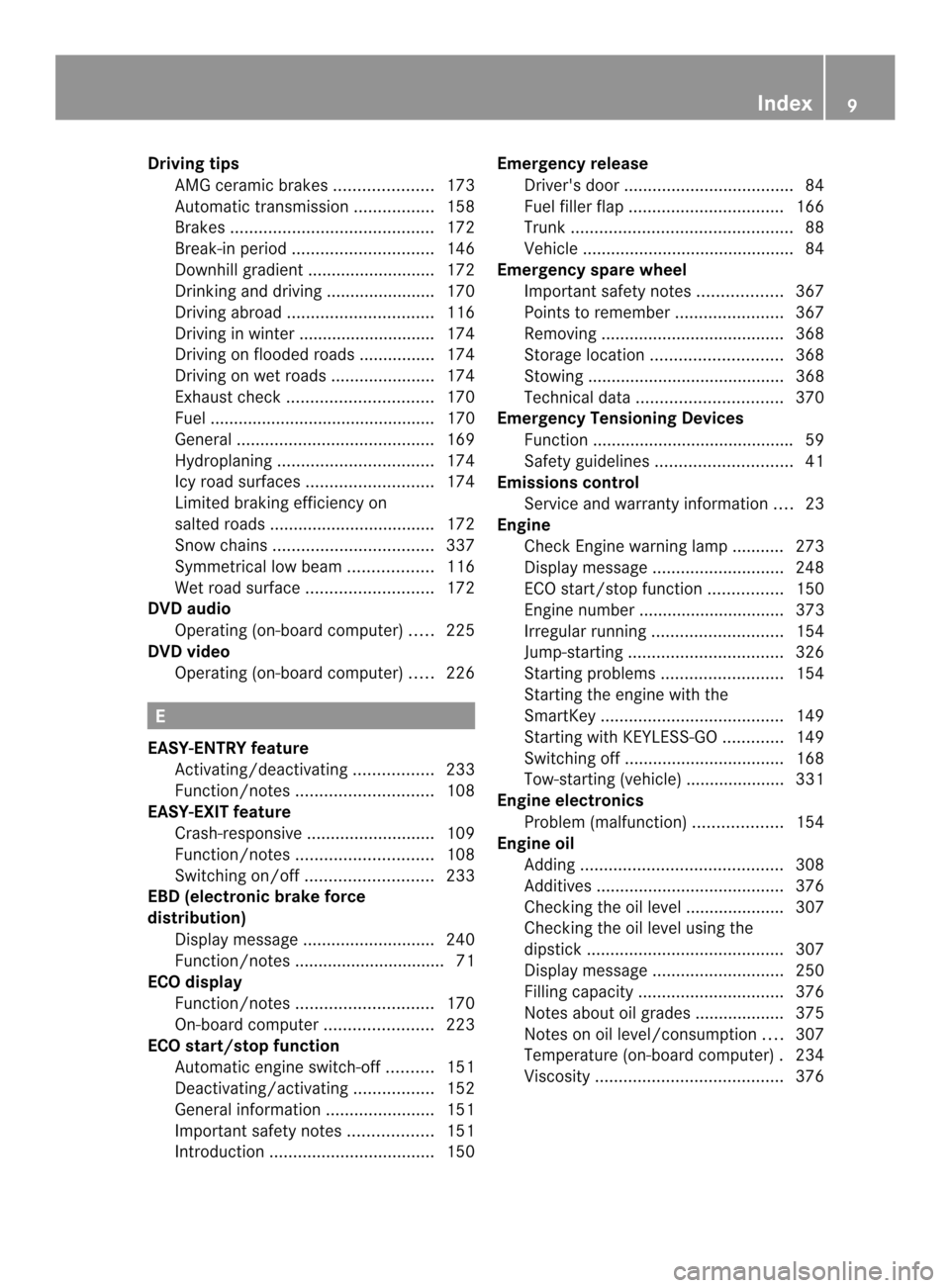
Driving tips
AMGceramic brakes ..................... 173
Automatic transmission .................158
Brakes ........................................... 172
Break-in period .............................. 146
Downhill gradient ........................... 172
Drinking and driving .......................170
Driving abroad ............................... 116
Driving in winter ............................ .174
Driving on flooded road s................ 174
Driving on wet road s...................... 174
Exhaus tcheck ............................... 170
Fuel ................................................ 170
General .......................................... 169
Hydroplaning ................................. 174
Icy road surfaces ........................... 174
Limited braking efficiency on
salted road s................................... 172
Snow chains .................................. 337
Symmetrical low bea m.................. 116
Wet road surface ........................... 172
DVD audio
Operating (on-board computer) .....225
DVD video
Operating (on-board computer) .....226 E
EASY-ENTRY feature Activating/deactivating .................233
Function/notes ............................. 108
EASY-EXIT feature
Crash-responsive ........................... 109
Function/notes ............................. 108
Switching on/off ........................... 233
EBD (electronic brake force
distribution)
Display message ............................ 240
Function/notes ................................ 71
ECOd isplay
Function/notes ............................. 170
On-board computer .......................223
ECOs tart/stop function
Automatic engine switch-off ..........151
Deactivating/activating .................152
General information .......................151
Important safety notes ..................151
Introduction ................................... 150Emergency release
Driver's door .................................... 84
Fuel filler fla p................................. 166
Trunk ............................................... 88
Vehicle ............................................. 84
Emergency spare wheel
Important safety notes ..................367
Points to remember .......................367
Removing ....................................... 368
Storage location ............................ 368
Stowing .......................................... 368
Technical data ............................... 370
Emergency Tensioning Devices
Function .......................................... .59
Safety guideline s............................. 41
Emissions control
Service and warranty information ....23
Engine
Check Engine warning lamp ........... 273
Display message ............................ 248
ECO start/stop function ................150
Engine numbe r............................... 373
Irregularr unning............................ 154
Jump-starting ................................. 326
Starting problems ..........................154
Starting the engine with the
SmartKey ....................................... 149
Starting with KEYLESS-GO .............149
Switching off .................................. 168
Tow-starting (vehicle )..................... 331
Engine electronics
Problem (malfunction) ...................154
Engine oil
Adding ........................................... 308
Additives ........................................ 376
Checking the oil leve l..................... 307
Checking the oil leve lusing the
dipstick .......................................... 307
Display message ............................ 250
Filling capacity ............................... 376
Notes about oil grades ................... 375
Notes on oil level/consumption ....307
Temperature (on-board computer) .234
Viscosity ........................................ 376 Index
9
Page 19 of 382
Stowag
enet ................................... 281
Unde rdriver' sseat/front-
passenger sea t.............................. 280
Stowage net ....................................... 281
Stowage space Center console (rear) .....................280
Stowage well beneath the trunk
floor .................................................... 283
Summer tires ..................................... 336
Sun visor ............................................ 286
Surround lighting (on-board
computer) .......................................... 231
Suspensio ntuning
AIRMATIC ...................................... 190
AMG adaptive sport suspension
system ........................................... 191
SETUP (on-board computer) ..........234
Switchin gair-recirculation mode
on/off ................................................. 141
Switchin goff the alarm (ATA) ............74 T
Tachometer ........................................ 219
Tail lamps Display message ............................ 246
Tank content
Fuel gauge ............................... 31, 219
Technical data
Capacities ...................................... 373
Emergency spare wheel .................370
Information .................................... 372
Tires/wheels ................................. 362
Vehicle data ................................... 379
TELEAID
Call priority .................................... 294
Downloading destinations
(COMAND) ..................................... 294
Downloading route s....................... 298
Emergency call .............................. 291
Geo fencing ................................... 298
Important safety notes ..................290
Locating astolen vehicl e............... 297
MB info call button ........................293
Remote vehicle locking ..................296
Roadside Assistance button ..........293
Search &Send ............................... 295
Self-test ......................................... 291Speed alert
.................................... 298
System .......................................... 291
Triggering the vehicle alarm ........... 299
Vehicle remote malfunction
diagnosi s....................................... 297
Vehicle remote unlocking ..............296
Telephone
Accepting acall............................. 226
Display message ............................ 262
Menu (on-board computer) ............226
Number from the phone book ....... .226
Redialing ........................................ 227
Rejecting/ending acall................. 226
Temperature
Coolant .......................................... 219
Coolant (on-board computer) ......... 234
Engine oil (on-board computer) ...... 234
Outside temperature ..................... .220
Setting (climate control) ................138
Theft deterren tsystems
ATA (Anti-Theft Alarm system) .........74
Immobilize r...................................... 73
Through-loading feature ...................281
Timing (RACETIMER) .........................235
Tire pressure Calling up (on-board computer) .....342
Checking manually ........................341
Display message ............................ 258
Maximum ....................................... 340
Notes ............................................. 339
Recommended ............................... 338
Tire pressure los swarning system
General notes ................................ 341
Important safety notes ..................341
Restarting ...................................... 342
Tire pressure monitoring system
Checking the tire pressure
electronically ................................. 344
Function/notes ............................. 342
Restarting ...................................... 345
Warning lamp ................................. 276
Warning message .......................... 344
Tires
Aspect ratio (definition) .................356
Averag eweight of the vehicle
occupants (definition) ....................355
Bar (definition) ............................... 354
Changing awheel .......................... 357 Index
17
Page 166 of 382
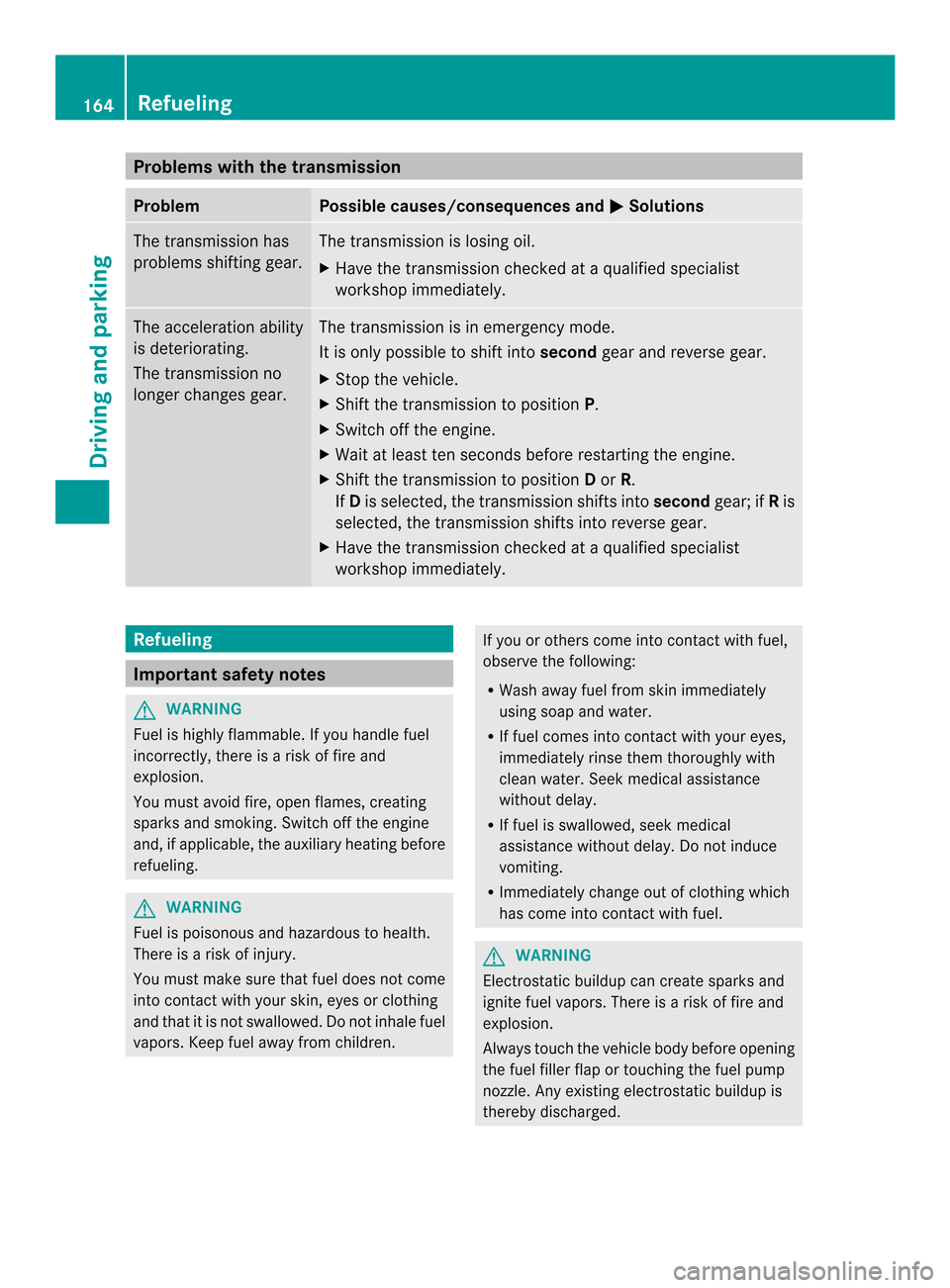
Problems with the transmission
Problem Possible causes/consequences and
000B Solutions
The transmission has
problems shifting gear. The transmission is losing oil.
X
Have the transmission checked at aqualified specialist
workshop immediately. The acceleration ability
is deteriorating.
The transmission no
longer changes gear. The transmission is in emergency mode.
It is only possible to shift into
secondgear and reverse gear.
X Stop the vehicle.
X Shift the transmission to position P.
X Switch off the engine.
X Wait at least ten seconds before restarting the engine.
X Shift the transmission to position Dor R.
If D is selected, the transmission shifts into secondgear; ifRis
selected, the transmission shifts into reverse gear.
X Have the transmission checked at aqualified specialist
workshop immediately. Refueling
Important safety notes
G
WARNING
Fuel is highly flammable. If you handle fuel
incorrectly, there is arisk of fire and
explosion.
You must avoid fire, open flames, creating
sparks and smoking. Switch off the engine
and, if applicable, the auxiliary heating before
refueling. G
WARNING
Fuel is poisonous and hazardous to health.
There is arisk of injury.
You must make sure that fuel does not come
into contact with your skin, eyes or clothing
and that it is not swallowed. Do not inhale fuel
vapors. Keep fuel away from children. If you or others come into contact with fuel,
observe the following:
R
Wash away fuel from skin immediately
using soap and water.
R If fuel comes into contact with your eyes,
immediately rinse them thoroughly with
clean water. Seek medical assistance
without delay.
R If fuel is swallowed, seek medical
assistance without delay.Don ot induce
vomiting.
R Immediately change out of clothin gwhich
has come into contact with fuel. G
WARNING
Electrostatic buildu pcan create sparks and
ignite fuel vapors. There is arisk of fire and
explosion.
Always touch the vehicle body before opening
the fuel filler flap or touching the fuel pump
nozzle. Any existin gelectrostatic buildu pis
thereby discharged. 164
RefuelingDriving and parking
Page 252 of 382
Display messages Possible causes/consequences and
000B Solutions
001C The battery is no
tbeing charged.
Aw arning tone also sounds.
Possible causes are:
R ad efective alternator
R at ornp oly-V-belt
R am alfunctio nintheelectronics
X Pull ove rand stop the vehicl esafelya nd switch off the engine,
paying attentio ntoroada nd traffic conditions.
X Secure the vehicl eagain st rolling away (Y page 167).
X Ope nthe hood.
X Check whether the poly-V-belt is torn.
If the poly-V-belt is torn:
! Do not continue driving. The engine could otherwise overheat.
X Consult aqualified specialist workshop.
If the poly-V-belt is not damaged:
X Visit aqualified specialist workshop. 0009
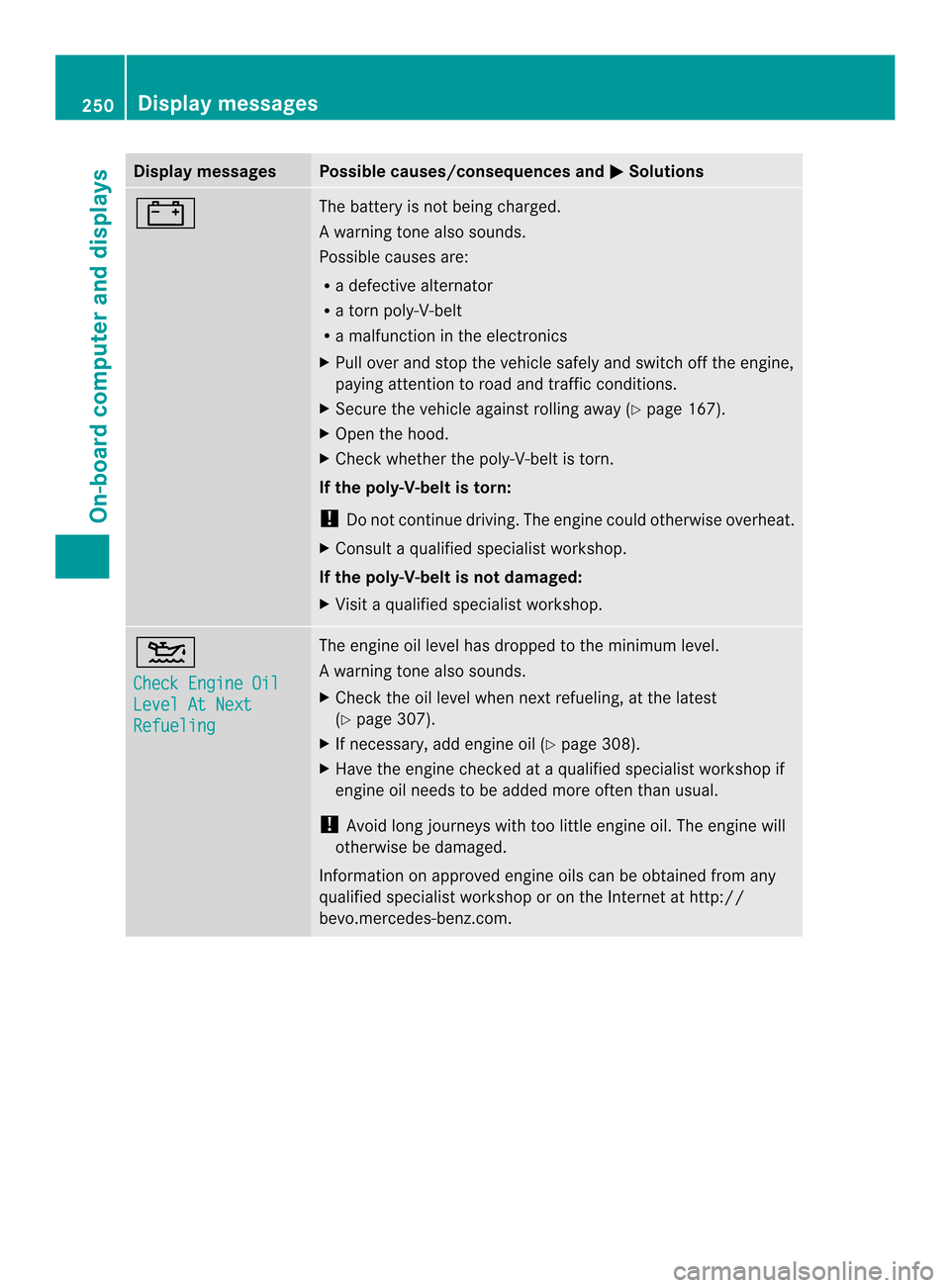
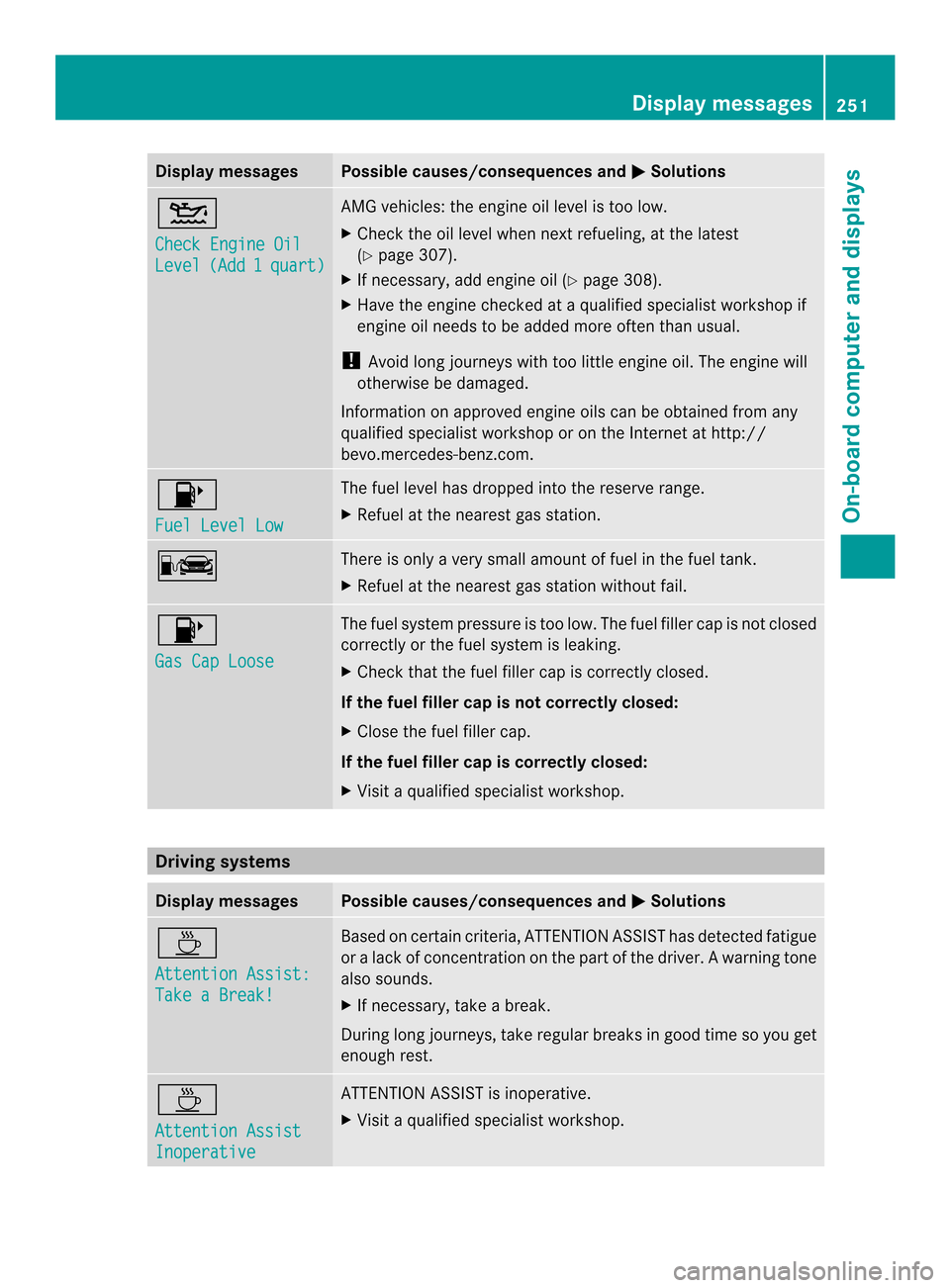
Check Engine Oil
Level At Next
Refueling The engine oil level has dropped to the minimum level.
Aw
arning tone also sounds.
X Chec kthe oil level when next refueling, at the latest
(Y page 307).
X If necessary, add engine oil (Y page 308).
X Have the engine checked at aqualified specialist workshop if
engine oil needs to be added more often than usual.
! Avoid long journeys with too little engine oil. The engine will
otherwise be damaged.
Information on approved engine oils can be obtained from any
qualified specialist workshop or on the Internet at http://
bevo.mercedes-benz.com. 250
Display messagesOn-board computer and displays
Page 253 of 382
Display messages Possible causes/consequences and
000B Solutions
0009
Check Engine Oil
Level (Add 1 quart) AM
Gvehicles: th eengineo il level is to olow.
X Chec kthe oil level when next refueling, at the latest
(Y page 307).
X If necessary, add engine oil (Y page 308).
X Have the engine checked at aqualified specialist workshop if
engine oil needs to be added more often than usual.
! Avoid long journeys with too little engine oil. The engine will
otherwise be damaged.
Information on approved engine oils can be obtained from any
qualified specialist workshop or on the Internet at http://
bevo.mercedes-benz.com. 0007
Fuel Level Low The fuel level has dropped into the reserve range.
X
Refuel at the nearest gas station. 0014 There is only
avery small amount of fuel in the fuel tank.
X Refuel at the nearest gas station without fail. 0007
Gas Cap Loose The fuel system pressure is too low. The fuel filler cap is not closed
correctly or the fuel system is leaking.
X
Check that the fuel filler cap is correctly closed.
If the fuel filler cap is not correctly closed:
X Close the fuel filler cap.
If the fuel filler cap is correctly closed:
X Visit aqualified specialist workshop. Driving systems
Display messages Possible causes/consequencesa
nd000B Solutions
0001
Attention Assist:
Take
aBreak! Based on certain criteria, ATTENTION ASSIST has detected fatigue
or
alack of concentratio nonthe part of th edriver. Awarning tone
alsos ounds.
X If necessary ,take abreak.
During long journeys, take regular breaks in good time so you get
enoug hrest. 0001
Attentio
nAssist Inoperative ATTENTION ASSIST is inoperative.
X
Visi taq ualified specialist workshop. Display messages
251On-boardcomputer and displays Z
Page 309 of 382

!
Make sure that the windshieldw ipers are
not folded away fro mthe windshield. You
could otherwise damage the windshield
wipers or the hood. X
Make sure that the windshield wipers are
turned off.
X Pull release lever 001Aon the hood.
The hood is released. X
Reach into the gap, pull hood catch
handle 0010up and lift the hood.
If you lift the hood by approximately
15 inches (40c m),the hood is opened and
held open automatically by the gas-filled
strut.
Closing theh ood X
Lower the hood and let it fall from aheight
of approximately 8inche s(20 cm).
X Check that the hood has engaged properly.
If the hood can be raised slightly ,itisnot
properly engaged. Open it again and close
it with alittle more force. Engine oil
General notes Depending on the driving style, the vehicle
consume
supto0.9 US qt (0.8 liters) of oil
over adistanc eof600 miles (1,000 km). The
oil consumption may be higher than this when
the vehicle is new or if you frequently drive at
high engin espeeds.
Depending on the engine, the oil dipstic kmay
be in adifferent location.
When checking th eoil level:
R park th evehicle on aleve lsurface.
R thee ngines hould be switched off for
approximately fiv eminute siftheengin eis
at normal operatin gtem perature.
R if th eengineisn otat normal operating
temperature, e.g .ifthe engine was only
started briefly, wait about 30 minutes
before carrying out the measurement.
Checking the oil level using the oil
dipstick X
Pull oil dipstick 001Aout of the dipstick guide
tube.
X Wipe off oil dipstick 001A.
X Slowly slide oil dipstick 001Ainto the guide
tube to the stop, and take it out again.
If the level is between MIN mark 0024and
MAX mark 0010,the oil level is correct.
X If the oil level has dropped to MIN mark
0024 or below, add 1.1 US qt (1.0 liter) of
engine oil. Engine compartment
307Maintenance and care Z
Page 310 of 382
Adding engin
eoil G
WARNING
If engin eoil comes int ocontac twithh ot
component sintheengin ecom partment, it
may ignite. There is ariskoff irea nd injury.
Mak esuret hate ngineo il is no tspilled next
to the filler neck. Let the engin ecool down
and thoroughly clean the engin eoil off the
component sbefore starting the engine. H
Environmental note
When adding oil, take care not to spill any. If
oil enters the soil or waterways, it is harmful
to the environment.
! Only use engin eoils and oil filter sthat
have been approved for vehicles with a
servic esystem. You can obtain alist of the
engin eoils and oil filter stested and
approved in accordance with the
Mercedes-Benz Specification sfor Service
Product satany Mercedes-Benz Service
center.
Damage to the engin eorexhaust system is
caused by the following:
R using engin eoils and oil filter sthat have
not been specifically approved for the
servic esystem
R replacing engin eoil and oil filter safter
the interval for replacemen tspecified by
the servic esystem has been exceeded
R using engin eoil additives.
! Do not add too much oil. adding too much
engin eoil can result in damage to the
engin eortot he catalytic converter. Have
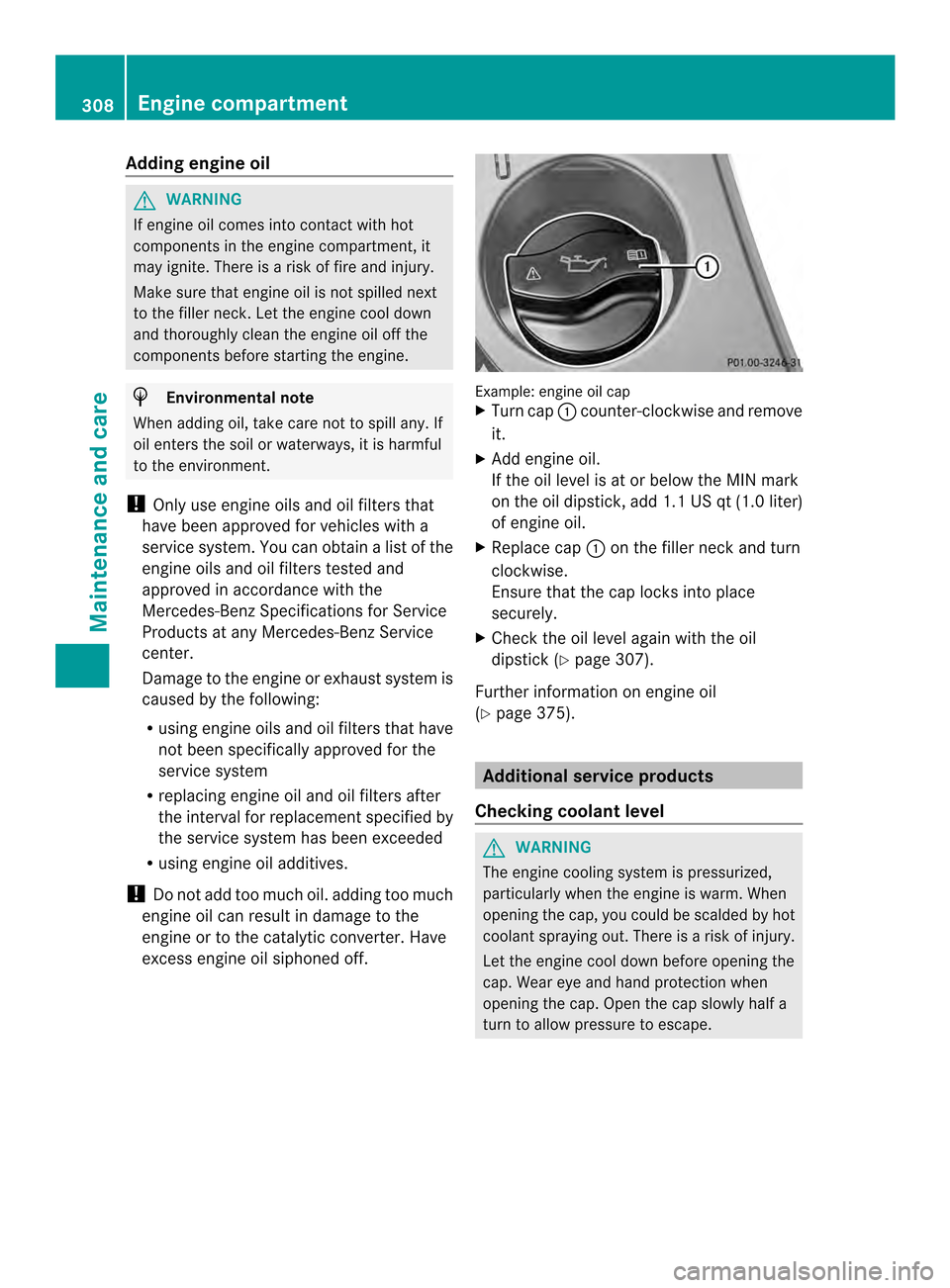
excess engin eoil siphoned off. Example: engin
eoil cap
X Turn cap 001Acounter-clockwise and remove
it.
X Add engin eoil.
If the oil level is at or below the MIN mark
on the oil dipstick, add 1.1 US qt (1.0 liter)
of engine oil.
X Replace cap 001Aon the fille rneck and turn
clockwise.
Ensur ethatthe cap locks into place
securely.
X Check the oi llev el agai nwith the oil
dipstick (Y page 307).
Further information on engine oil
(Y page 375). Additiona
lservice products
Checking coolant level G
WARNING
The engine cooling system is pressurized,
particularly when the engine is warm. When
opening the cap, you could be scalde dbyhot
coolan tspraying out. There is arisk of injury.
Let the engin ecool down before openin gthe
cap. Wear eye and hand protection when
openin gthe cap. Open the cap slowly half a
turn to allow pressure to escape. 308
Engine compartmentMaintenance and care
Page 313 of 382
Under these or similarc
onditions, have, for
example, the air filter, engine oil and oil filter
replaced or changed more frequently. Under
arduous operating conditions, the tires must
be checked more often.F urther information
can be obtained at aqualified specialist
workshop, e.g. an authorized Mercedes-Benz
Center.
Driving abroad
An extensive Mercedes-Benz Servic enetwork
is also available in other countries. You can
obtain further information from any
authorized Mercedes-Benz Center. Care
General notes
H
Environmental note
Dispose of empty packagin gand cleaning
cloth sinane nvironmentally responsible
manner.
! For cleanin gyour vehicle, do not use any
of the following:
R dry, rough or hard cloths
R abrasive cleanin gagents
R solvents
R cleanin gagents containin gsolvents
Do not scrub.
Do not touch the surfaces or protective
films with hard objects, e.g. aring or ice
scraper. You could otherwise scratch or
damage the surfaces and protective film.
! Do not park the vehicle for an extended
period straight after cleanin git, particularly
after having cleaned the wheels with wheel
cleaner. Wheel cleaners could cause
increased corrosion of the brake discs and
brake pads/linings. For this reason, you
should drive for afew minutes after
cleaning. Braking heats the brake discs and
the brake pads/linings, thus drying them.
The vehicle can then be parked. Regular care of your vehicle is
acondition for
retaining the quality in the long term.
Use care product sand cleanin gagents
recommended and approved by Mercedes-
Benz. Washing the vehicle and cleaning the
paintwork
Automatic car wash G
WARNING
Braking efficiency is reduced after washing
the vehicle. There is arisk of an accident.
After the vehicle has been washed, brake
carefully while paying attention to the traffic
conditions until full brakin gpower is restored.
! If DISTRONIC PLUS or the HOLD function
is activated, the vehicle brakes
automatically in certain situations. To
preven tdamage to th evehicle ,deactivate
DISTRONI CPLUS and the HOLD function in
the following or other similar situations:
R when towing the vehicle
R in the car wash
! Never clean yourv ehicle inaTouchless
Automatic Car Wash as these use special
cleanin gagents .These cleaning agents can
damage the paintwork or plastic parts.
! Make sure that:
R the side windows and the sliding sunroof
are fully closed.
R the ventilation/heating is switched off
(the OFF button has been pressed).
R the windshield wiper switch is in position
0.
Otherwise, the vehicle might be damaged.
! In car washes with atowing mechanism,
make sure that the automatic transmission
is in transmission position N,otherwise the
vehicle could be damaged.
R Vehicles with aSmartKey: Care
311Maintenance and care Z
Page 359 of 382
Occupant distribution
The distribution of occupant
sinavehicleat
their designated seating positions.
Total load limit
Rated cargo and luggagel oadp lus
68 kilograms (150 lb) multiplied by the
number of seats in the vehicle. Changing
awheel Flat tire
You can find information on wha ttodointhe
event of aflat tire in the "Breakdown
assistance" section (Y page 321).
Information on driving with MOExtended tires
in the event of aflat tire can be found under
"MOExtended tires (tires with run-flat
characteristics" (Y page 321).
Vehicle with emergency sparew heel:in
the event of aflat tire, the emergenc yspare
wheel is mounted as described under
"Mounting awheel" ( Ypage 358). Rotating the wheels
G
WARNING
Interchangin gthe front and rear wheels may
severely impair the driving characteristics if
the wheels or tires have different dimensions.
The wheel brakes or suspension components
may also be damaged. There is arisk of
accident.
Rotate front and rear wheels only if the wheels
and tires are of the same dimensions.
! On vehicles equipped with atire pressure
monitor, electronic components are
located in the wheel.
Tire-mounting tools should not be used
near the valve. This could damage the
electronic components.
Only have tires changed at aqualified
specialist workshop. Always observe the instructions and safety
notes in the "Mounting
awheel" section
(Y page 358).
The wear patternsont he front and rear tires
differ, depending on the operating conditions.
Rotate the wheels before aclear wear pattern
has formed on the tires. Front tires typically
wear more on the shoulders and the rear tires
in the center.
If your vehicle's tire configuration allows, you
can rotate the wheels according to the
intervals in the tire manufacturer's warranty
book in your vehicle documents. If this is not
available, the tires should then be replaced
every 3,000 to 6,000 miles (5,000 to
10,000 km), or earlier if the tire wear requires
this. Do not change the direction of wheel
rotation.
Cleant he contact surfaces of the wheel and
the brake disc thoroughly every time awheel
is interchanged. Check the tire pressure and,
if necessary, restart the tire pressure loss
warning system or the tire pressure monitor. Direction of rotation
Tires with aspecified direction of rotation
have additional benefits, e.g. if there is arisk
of hydroplaning. You will only gain these
benefits if the correct direction of rotation is
maintained.
An arrow on the sidewall of the tire indicates
its correct direction of rotation. Storing wheels
Storew heels that are not being used in acool,
dry and preferably dark place. Protect the
tires from oil, grease, gasoline and diesel. Cleaningt
he wheels G
WARNING
The water jet from acircular jet nozzle (dirt
blasters) can cause invisible exterior damage Changing
awheel
357Wheels and tires
Z
Page 379 of 382
Only use brake fluid approved by Mercedes-
Benz according to MB Approval 331.0.
Information abouta
pproved brake fluid can
be obtaine datany qualified specialist
workshop or on the Internet at
http://bevo.mercedes-benz.com.
i Have the brake fluid regularly replaced at
aq ualified specialist workshop and the
replacemen tconfirmed in the Maintenance
Booklet. Coolant
Important safety notes G
WARNING
If antifreez ecomes into contact with hot
components in the engine compartment, it
may ignite. There is arisk of fire and injury.
Let the engine cool down before you add
antifreeze. Make sure that antifreez eisnot
spilled next to the filler neck.T horoughly
clean the antifreeze from components before
startingt he engine.
! Only add coolant that has been premixed
with the desired antifreezep rotection. You
coul dotherwise damage the engine.
Further information on coolants can be
found in the Mercedes-Benz Specifications
for Service Products, MB Specifications for
Service Products 310.1, e.g. on the
Internet at
http://bevo.mercedes-benz.com .Or
contact aqualified specialist workshop.
! Always use asuitable coolant mixture,
even in countries where high temperatures
prevail.
Otherwise, the engine cooling system is not
sufficiently protected from corrosio nand
overheating.
Comply with the important safety precautions
for service products when handling coolant
(Y page3 73). The coolant is
amixture of water and
antifreeze/corrosion inhibitor. It performs
the following tasks:
R corrosio nprotection
R antifreeze protection
R raising the boiling point
If the coolant has antifreeze protection down
to -35 ‡(-37 †), the boiling point of the
coolant during operatio nisapproximately
266 ‡(130 †).
The antifreeze/corrosion inhibitor
concentration in the engine cooling system
should:
R be at least 50%. This will protect the engine
cooling system against freezing down to
approximately -35 ‡(-37 †).
R not exceed 55% (antifreeze protection
down to -49 ‡[-45 †]). Otherwise, heat
will not be dissipated as effectively.
If the vehicle has lost coolant, add equal
amounts of water and antifreeze/corrosion
inhibitor.
Mercedes-Benz recommends an antifreeze/
corrosion inhibitor concentrate in
accordance with MB Specifications for
Service Products 310.1.
The coolant is checked with every
maintenance interval at aqualified specialist
workshop.
i When the vehicle is first delivered, it is
filled with acoolant mixture that ensures
adequate antifreeze and corrosion
protection.
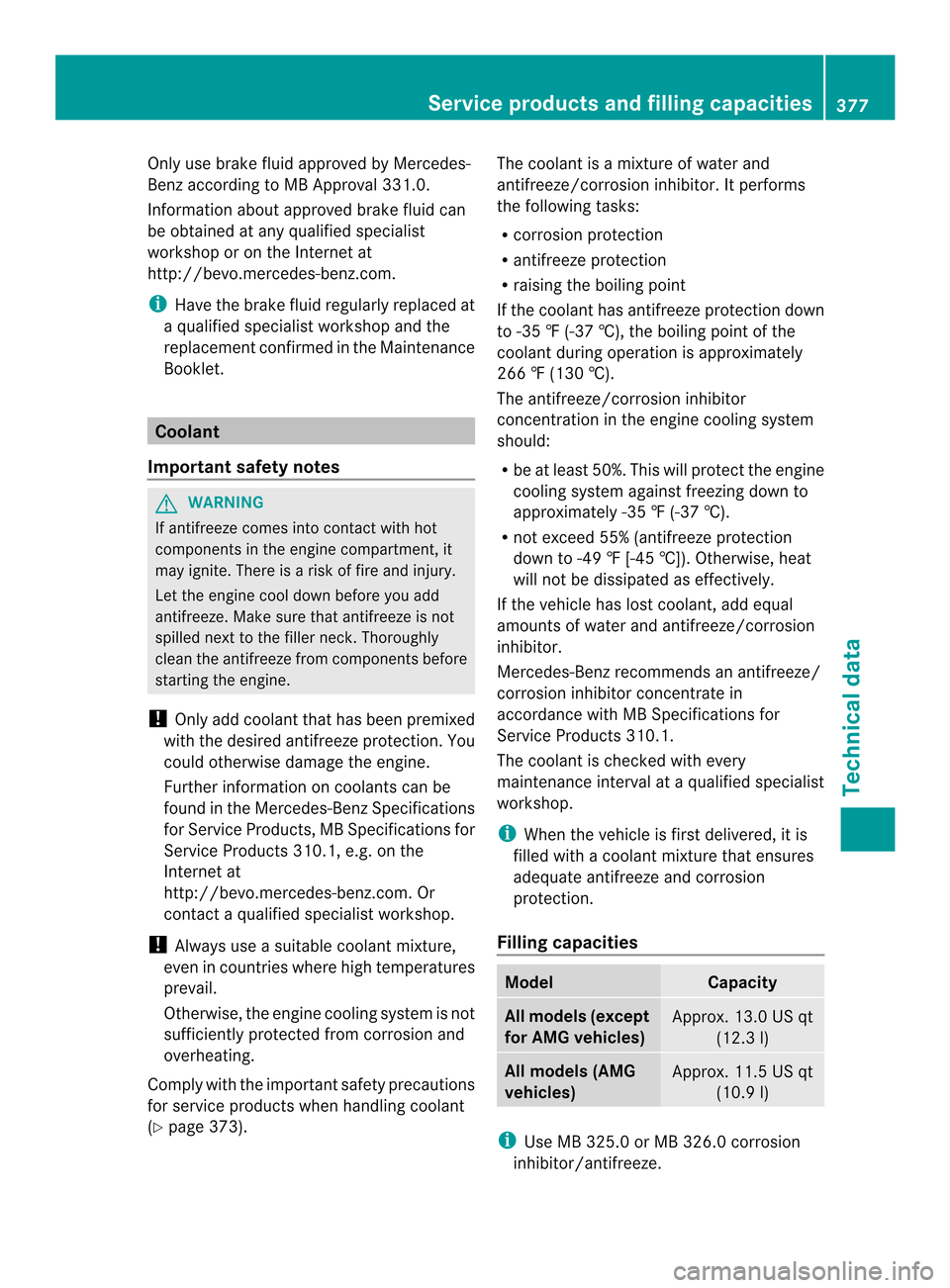
Filling capacities Model Capacity
All models (except
for AMG vehicles)
Approx. 13.0 US qt
(12.3 l) All models (AMG
vehicles) Approx. 11.5 US qt
(10.9 l) i
Use MB 325.0 or MB 326.0 corrosion
inhibitor/antifreeze. Service products and filling capacities
377Technical data Z