flat tire MERCEDES-BENZ CLS-Class 2014 W218 Owner's Manual
[x] Cancel search | Manufacturer: MERCEDES-BENZ, Model Year: 2014, Model line: CLS-Class, Model: MERCEDES-BENZ CLS-Class 2014 W218Pages: 382, PDF Size: 5.36 MB
Page 8 of 382
Parking brake
................................ 169
Warning lamp ................................. 266
Breakdown
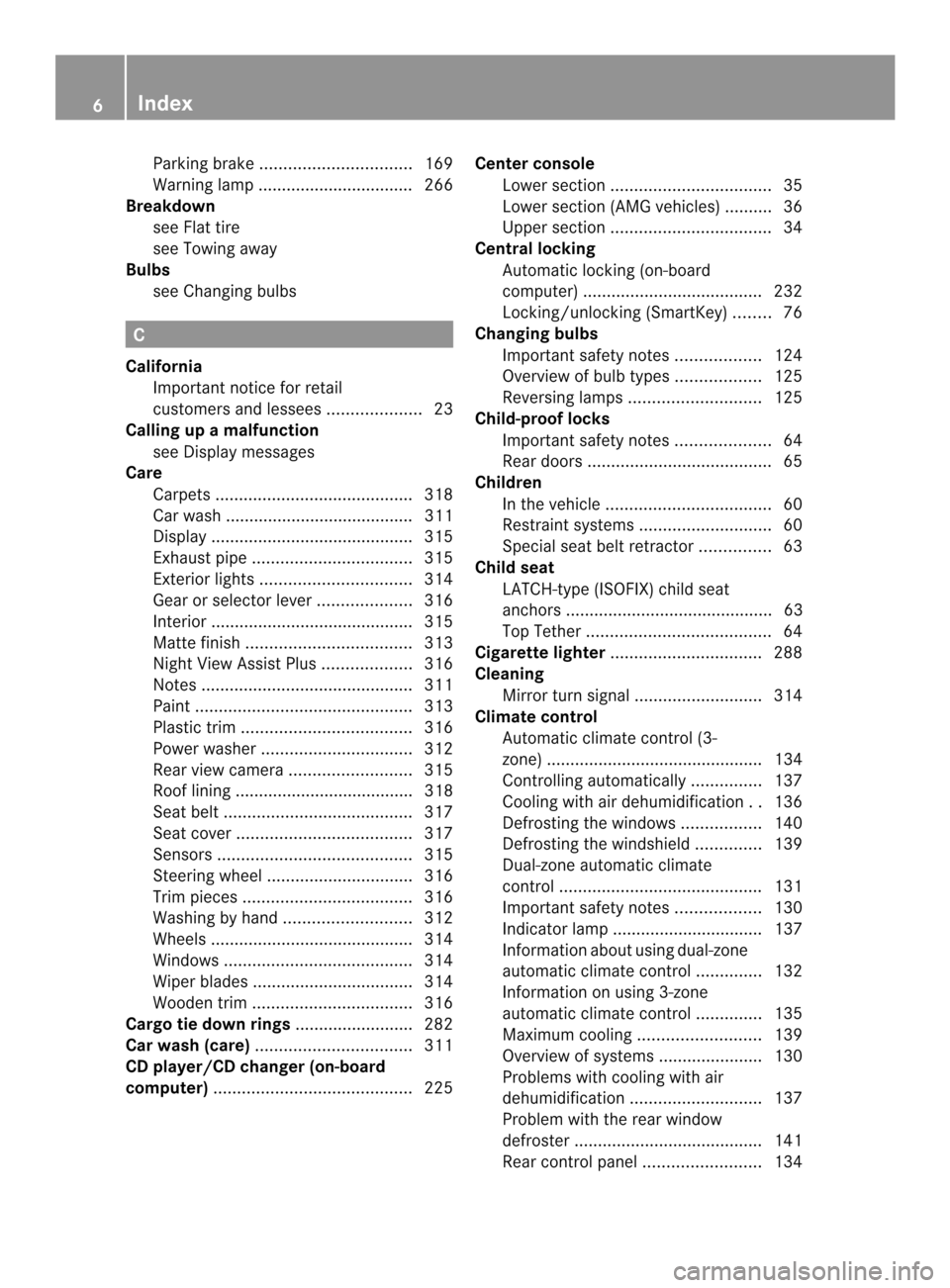
see Flat tire
see Towing away
Bulbs
see Changing bulbs C
California Important notice for retail
customers and lessees ....................23
Calling up amalfunction
see Display messages
Care
Carpets .......................................... 318
Carw ash. ....................................... 311
Display ........................................... 315
Exhaus tpipe .................................. 315
Exterior lights ................................ 314
Gea rors electo rlever .................... 316
Interior ........................................... 315
Matte finish ................................... 313
Nigh tView Assist Plus ...................316
Notes ............................................. 311
Paint .............................................. 313
Plastic trim .................................... 316
Power washer ................................ 312
Rea rview camera .......................... 315
Roo flining ...................................... 318
Seat bel t........................................ 317
Seat cover ..................................... 317
Sensors ......................................... 315
Steering wheel ............................... 316
Trim pieces .................................... 316
Washing by hand ........................... 312
Wheels ........................................... 314
Windows ........................................ 314
Wiper blades .................................. 314
Wooden trim .................................. 316
Cargo tie dow nrings ......................... 282
Car wash (care) ................................. 311
CD player/CD changer (on-board
computer) .......................................... 225Center console
Lowe rsection .................................. 35
Lowe rsection (AMG vehicles) ..........36
Uppe rsection .................................. 34
Central locking
Automatic locking (on-board
computer) ...................................... 232
Locking/unlocking (SmartKey) ........76
Changing bulbs
Important safety notes ..................124
Overview of bul btypes .................. 125
Reversing lamps ............................ 125
Child-proof locks
Important safety notes ....................64
Rea rdoors ....................................... 65
Children
In the vehicle ................................... 60
Restraint systems ............................ 60
Specia lseat belt retractor ...............63
Child seat
LATCH-typ e(ISOFIX) chil dseat
anchors ............................................ 63
Top Tether ....................................... 64
Cigarette lighter ................................ 288
Cleaning Mirro rturn signal ........................... 314
Climate control
Automatic climate control (3-
zone) .............................................. 134
Controlling automatically ...............137
Cooling with aird ehumidification..136
Defrosting the windows .................140
Defrosting the windshield ..............139
Dual-zone automatic climate
control ........................................... 131
Important safety notes ..................130
Indicator lamp ................................ 137
Information about using dual-zone
automatic climate control ..............132
Information on using 3-zone
automatic climate control ..............135
Maximum cooling .......................... 139
Overview of systems ......................130
Problems with cooling with air
dehumidification ............................ 137
Problem with the rear window
defroster ........................................ 141
Rea rcontrol panel ......................... 1346
Index
Page 12 of 382
ESP
®
(Electronic Stability
Program) AMGm enu( on-board computer) ...234
Deactivating/activating (AMG
vehicles) .......................................... 70
Deactivating/activating (except
AMG vehicles) ................................ 227
Deactivating/activating (notes;
except AMG vehicles) ......................69
Display message ............................ 238
ETS/4ETS ........................................ 69
Function/notes ................................ 68
Important safety information ...........68
Warning lamp ................................. 269
ETS/4ETS (Electronic Traction
System) ................................................ 69
Exhaus tcheck ................................... 170
Exhaus tpipe (cleaning
instructions) ...................................... 315
Exterior lighting Setting options .............................. 116
see Lights
Exterior mirrors
Adjusting ....................................... 109
Dipping (automatic) .......................111
Folding in/ou t(automatically) .......110
Folding in/ou t(electrically) ...........110
Folding in whe nlocking( on-board
computer) ...................................... 233
Out of position (troubleshooting) ...110
Setting ........................................... 110
Storing settings (memory
function) ........................................ 112
Storing the parking position ..........111
Eyeglasses compartment .................279 F
Fille rcap
see Fuel filler flap
First-aid kit ......................................... 320
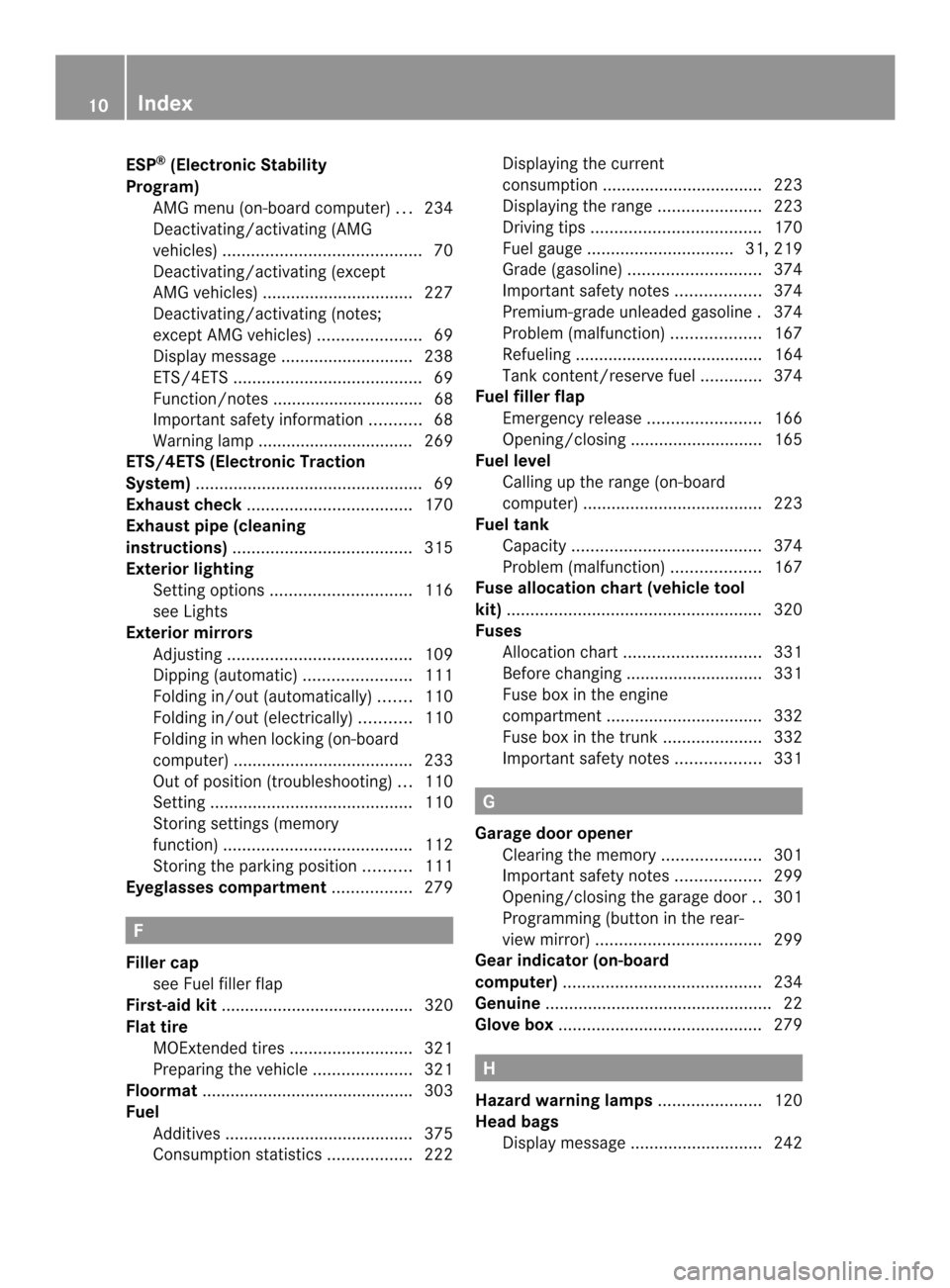
Flat tire MOExtended tires ..........................321
Preparing the vehicle .....................321
Floormat ............................................ .303
Fuel Additives ........................................ 375
Consumption statistics ..................222Displaying the current
consumption
.................................. 223
Displaying the range ......................223
Driving tips .................................... 170
Fuel gauge ............................... 31, 219
Grade (gasoline) ............................ 374
Important safety notes ..................374
Premium-grade unleade dgasoline .374
Problem (malfunction) ...................167
Refueling ........................................ 164
Tank content/reserve fuel .............374
Fue lfiller flap
Emergency release ........................166
Opening/closing ............................ 165
Fue llevel
Calling up the range (on-board
computer) ...................................... 223
Fue ltank
Capacity ........................................ 374
Problem (malfunction) ...................167
Fuse allocatio nchart (vehicle tool
kit) ...................................................... 320
Fuses Allocation chart ............................. 331
Before changing ............................. 331
Fuse box in the engine
compartment ................................. 332
Fuse box in the trunk .....................332
Important safety notes ..................331 G
Garage door opener Clearing the memory .....................301
Important safety notes ..................299
Opening/closing the garage door ..301
Programming (button in the rear-
view mirror) ................................... 299
Gear indicator (on-board
computer) .......................................... 234
Genuine ................................................ 22
Glove box ........................................... 279 H
Hazard warning lamps ......................120
Head bags Display message ............................ 24210
Index
Page 20 of 382
Characteristics
.............................. 354
Checking ........................................ 335
Definition of terms .........................354
Direction of rotatio n...................... 357
Display message ............................ 258
Distributio nofthe vehicle
occupants (definition) ....................357
DOT, Tire Identification Number
(TIN) .............................................. .354
DOT (Department of
Transportation) (definition) ............355
GAWR (Gross Axle Weight Rating)
(definition) ..................................... 355
GVW (Gross Vehicle Weight)
(definition) ..................................... 355
GVW R(Gross Vehicle Weight
Rating) (definition) .........................355
Important safety notes ..................334
Increase dvehicle weight due to
optional equipment (definition) ......355
Kilopascal (kPa )(definition) ...........355
Labeling (overview )........................ 351
Load bearing index (definition) ......356
Load index ..................................... 353
Load index (definition) ...................355
Maximum loaded vehicle weight
(definition) ..................................... 355
Maximum loa donatire
(definition) ..................................... 356
Maximum permissible tire
pressure (definition) ....................... 356
Maximum tire loa d......................... 353
Maximum tire loa d(definition) .......356
MOExtended tires ..........................336
Optional equipment weight
(definition) ..................................... 356
PSI (pounds per square inch)
(definition) ..................................... 356
Replacing ....................................... 357
Service life ..................................... 336
Sidewall (definition) .......................356
Speed rating (definition) ................355
Storing ........................................... 357
Structure and characteristics
(definition) ..................................... 354
Temperature .................................. 350
TIN (Tire Identification Number)
(definition) ..................................... 356Tire bea
d(definition) ...................... 356
Tire pressure (definition) ................356
Tire pressure s(recommended )...... 355
Tire size (data) ............................... 362
Tire size designation, load-bearing
capacity, spee drating .................... 351
Tire tread ....................................... 335
Tire tread (definition) .....................356
Total loa dlimit (definition) .............357
Traction ......................................... 350
Traction (definition) .......................356
Trea dwear ..................................... 350
Uniform Tire Quality Grading
Standard s...................................... 349
Uniform Tire Quality Grading
Standard s(definition) .................... 355
Unladen weight (definition) ............356
Wea rindicato r(definition) .............356
Whee lrim (definition ).................... 355
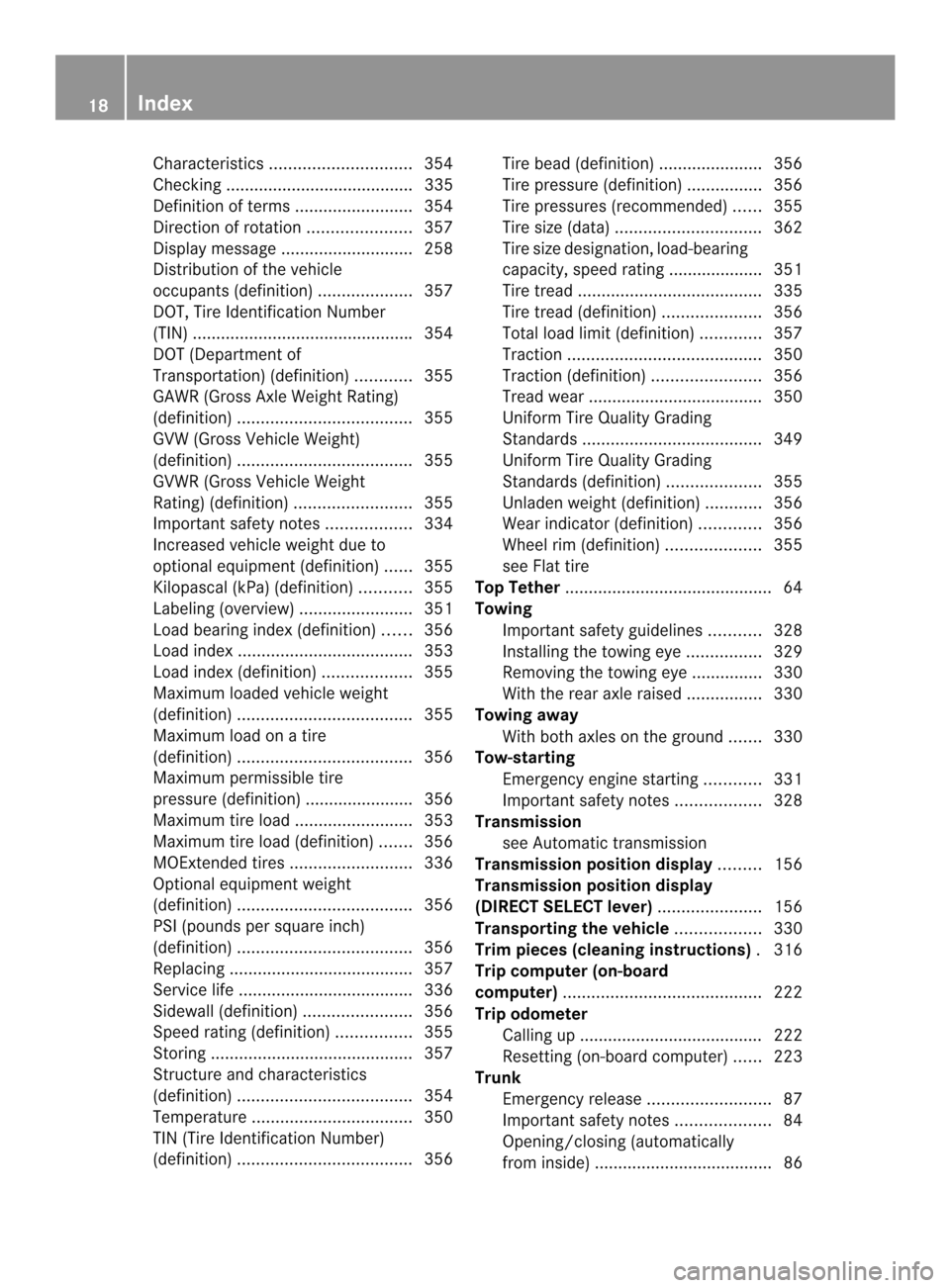
see Flat tire
Top Tether ............................................ 64
Towing Important safety guidelines ...........328
Installing the towing eye. ...............329
Removing the towing eye. ..............330
With the rear axle raised ................330
Towing away
With both axle sonthe ground .......330
Tow-starting
Emergency engine starting ............331
Important safety notes ..................328
Transmission
see Automatic transmission
Transmission position display .........156
Transmission position display
(DIRECT SELECTl ever)...................... 156
Transporting the vehicle ..................330
Trim pieces (cleaning instructions) .316
Trip computer (on-board
computer) .......................................... 222
Trip odometer Calling up ....................................... 222
Resetting (on-board computer) ......223
Trunk
Emergency release ..........................87
Important safety notes ....................84
Opening/closing (automatically
from inside) ...................................... 86 18
Index
Page 172 of 382
distracted from traffic conditions. You could
also lose control of the vehicle. There is arisk
of an accident.
Only operate this equipment when the vehicle
is stationary.
Observe the legal requirements for the
country in which you are driving .Some
jurisdiction sprohibit the driver from using a
mobile phone while driving avehicle.
If you make acall while driving ,alwaysu se
hands-free mode. Only operate the telephone
when the traffic situation permits. If you are
unsure, pull over to asafe location and stop
before operatin gthe telephone.
Bear in mind that at aspeed of only 30 mph
(approximately 50 km/h) the vehicle covers
ad istanc eof44ft( approximately 14 m) per
second.
Drive sensibly –save fuel Observe the following tips to save fuel:
X
The tires should always be inflated to the
recommended tire pressure.
X Remove unnecessary loads.
X Remove roof racks whe nthey are not
needed.
X Warm up the engine at low engine speeds.
X Avoid frequent acceleration or braking.
X Have all maintenancew ork carried out as
indicated by the service intervals in the
MaintenanceB ooklet or by the service
interval display.
Fuel consumption also increases when
driving in cold weather, in stop-start traffic
and in hilly terrain.
Drinking and driving G
WARNING
Drinking and driving and/or taking drugs and
driving are very dangerous combinations.
Even asmall amount of alcohol or drugs can
affect your reflexes, perceptions and
judgment. The possibility of
aserious or even fatal
accident are greatly increased when you drink
or take drugs and drive.
Do not drink or take drugs and drive or allow
anyone to drive who has been drinking or
taking drugs.
Emission control G
WARNING
Combustion engines emit poisonous exhaust
gases such as carbon monoxide. Inhaling
these exhaust gases leads to poisoning. There
is ar isk of fatal injury. Therefore never leave
the engine running in enclosed spaces
without sufficient ventilation.
Certain engine systems are designed to keep
the level of poisonous components in exhaust
fumes within legal limits.
These systems only work at peak efficiency if
they are serviced exactly in accordance with
the manufacturer's specifications. For this
reason, only have work on the engine carried
out by qualified and authorized Mercedes-
Benz technicians.
The engine settings must not be changed
under any circumstances. Furthermore, all
specific service work must be carried out at
regular intervals and in accordance with the
Mercedes-Ben zservice requirements. Details
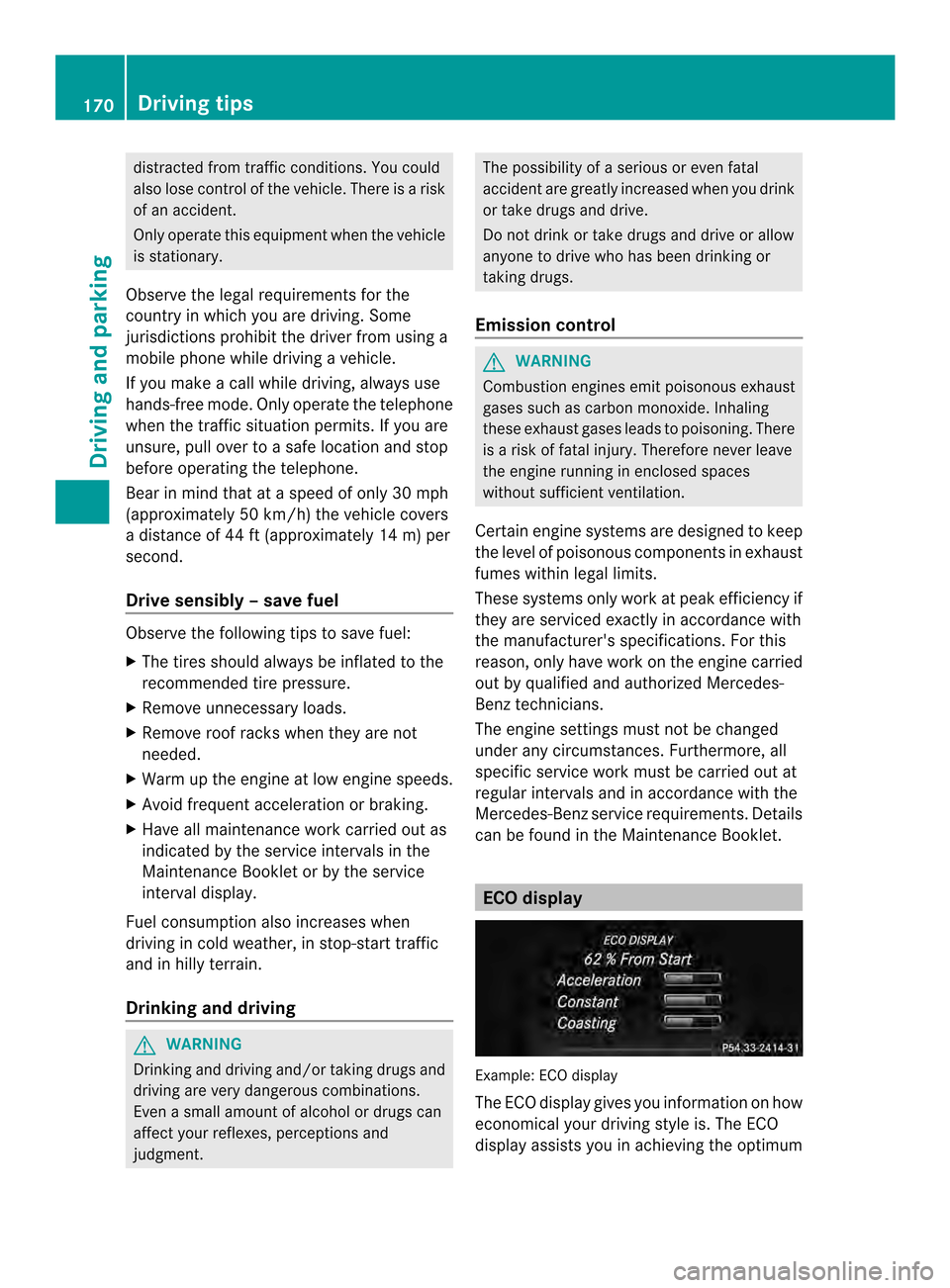
can be found in the Maintenance Booklet. ECO display
Example: ECO display
The ECO display gives you information on how
economical your driving style is. The ECO
display assists you in achieving the optimum170
Driving tipsDriving and parking
Page 260 of 382

Tires
Display messages Possible causes/consequence
sand 000B Solutions
Check
Tir
ePressure Soon The tire pressure loss warnin
gsystem has detecte dasignificant
los sinp ressure.
Aw arning tone also sounds.
G WARNING
Wit htirep ressure swhicha re to olow, there is ariskoft he
following hazards:
R they may burst, especiallyast he load and vehicle speed
increase.
R they may wear excessively and/or unevenly, which may greatly
impair tire traction.
R the driving characteristics, as well as steering and braking, may
be greatly impaired.
There is arisk of an accident.
X Stop the vehicle without making any sudden steering or braking
maneuvers. Pay attention to the traffic conditionsasy ou do so.
X Secure the vehicle against rolling away (Y page 167).
X Check the tires and, if necessary, follow the instructions for a
flat tire (Y page 321).
X Check the tire pressures and, if necessary, correct the tire
pressure.
X Restart the tire pressure loss warning system when the tire
pressure is correct (Y page 342).Check Tire Pressure
Then Restart Run
Flat Indicator The tire pressure loss warning system generated
adisplay
message and has not been restarted since.
X Set the correct tire pressure in all four tires.
X Restart the tire pressure loss warning system (Y page 342).Run Flat Indicator
Inoperative The tire pressure loss warning system is faulty.
X
Visit aqualified specialist workshop. Rectify
Tire Pressure The tire pressure is too low in at least one of the tires, or the tire
pressure difference between the wheels is too great.
X
Check the tire pressures at the next opportunity (Y page 342).
X If necessary, correct the tire pressure.
X Restart the tire pressure monitor (Y page 345).258
Display messagesOn-board computer and displays
Page 261 of 382
Display messages Possible causes/consequences and
000B Solutions
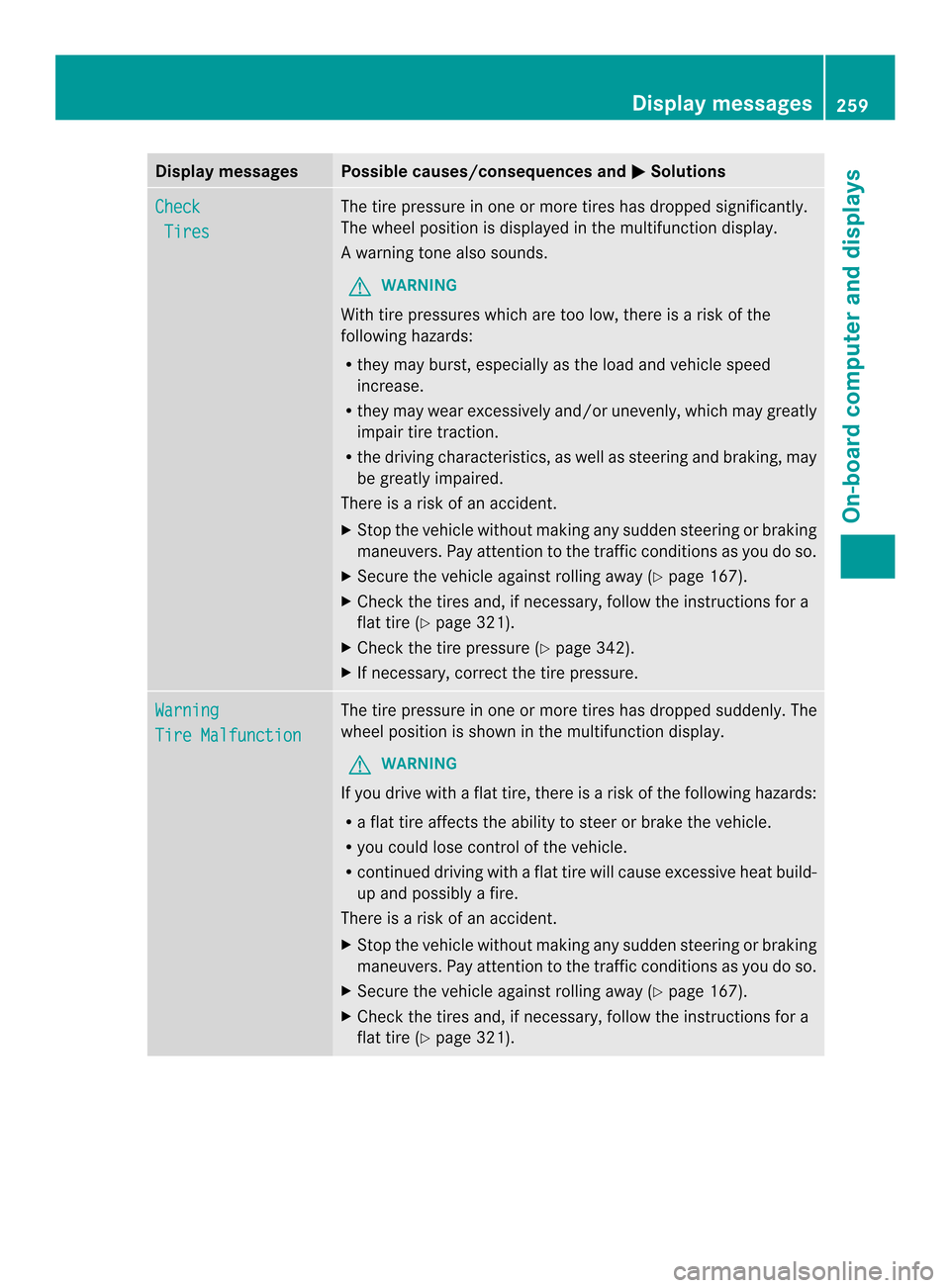
Check
Tires The tire pressur
einoneor mor etires has dropped significantly.
The whee lposition is displayed in th emultifunction display.
Aw arning tone also sounds.
G WARNING
Wit htirep ressure swhicha re to olow, there is ariskoft he
following hazards:
R they may burst, especiallyast he load and vehicle speed
increase.
R they may wear excessively and/or unevenly, which may greatly
impair tire traction.
R the driving characteristics, as well as steering and braking, may
be greatly impaired.
There is arisk of an accident.
X Stop the vehicle without making any sudden steering or braking
maneuvers. Pay attention to the traffic conditionsasy ou do so.
X Secure the vehicle against rolling away (Y page 167).
X Check the tires and, if necessary, follow the instructions for a
flat tire (Y page 321).
X Check the tire pressure (Y page 342).
X If necessary, correct the tire pressure. Warning
Tire Malfunction The tire pressure in one or more tires has dropped suddenly. The
wheel position is shown in the multifunction display.
G WARNING
If you drive with aflat tire, there is arisk of the following hazards:
R af lat tire affects the ability to steer or brake the vehicle.
R you could lose control of the vehicle.
R continued driving with aflat tire will cause excessive heat build-
up and possibly afire.
There is arisk of an accident.
X Stop the vehicle without making any sudden steering or braking
maneuvers. Pay attention to the traffic conditionsasy ou do so.
X Secure the vehicle against rolling away (Y page 167).
X Check the tires and, if necessary, follow the instructions for a
flat tire (Y page 321). Display messages
259On-board computer and displays Z
Page 278 of 382
Tires
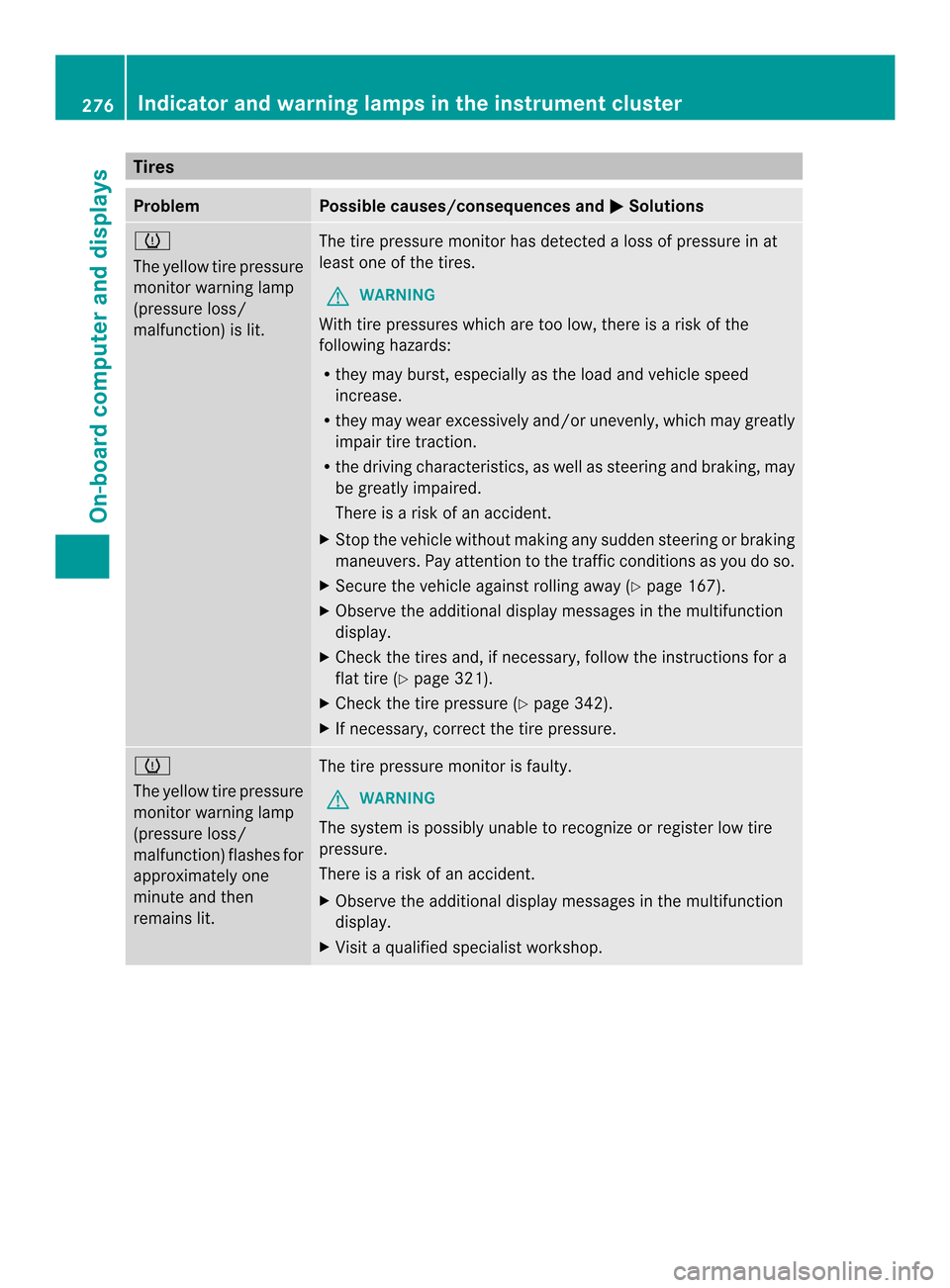
Problem Possible causes/consequence
sand 000B Solutions
0008
The yellow tire pressure
monitor warnin
glamp
(pressure loss/
malfunction) is lit. The tire pressure monitor ha
sdetecte dalossofp ressure in at
leas tone of the tires.
G WARNING
With tire pressures which ar etoo low, there is arisk of the
following hazards:
R they may burst, especially as the load and vehicle speed
increase.
R they may wear excessively and/or unevenly, which may greatly
impair tire traction.
R the driving characteristics, as well as steerin gand braking, may
be greatly impaired.
There is arisk of an accident.
X Stop the vehicle without making any sudden steerin gorbraking
maneuvers. Pay attention to the traffic conditions as you do so.
X Secure the vehicle against rolling away (Y page 167).
X Observe the additional display messages in the multifunction
display.
X Check the tires and, if necessary, follow the instructions for a
flat tire (Y page 321).
X Check the tire pressure (Y page 342).
X If necessary, correc tthe tire pressure. 0008
The yellow tire pressure
monitor warning lamp
(pressure loss/
malfunction) flashes for
approximately one
minute and then
remains lit.
The tire pressure monitor is faulty.
G WARNING
The system is possibly unable to recognize or register low tire
pressure.
There is arisk of an accident.
X Observe the additional display messages in the multifunction
display.
X Visit aqualified specialist workshop. 276
Indicator and warning lampsint
he instrument clusterOn-board computer and displays
Page 321 of 382
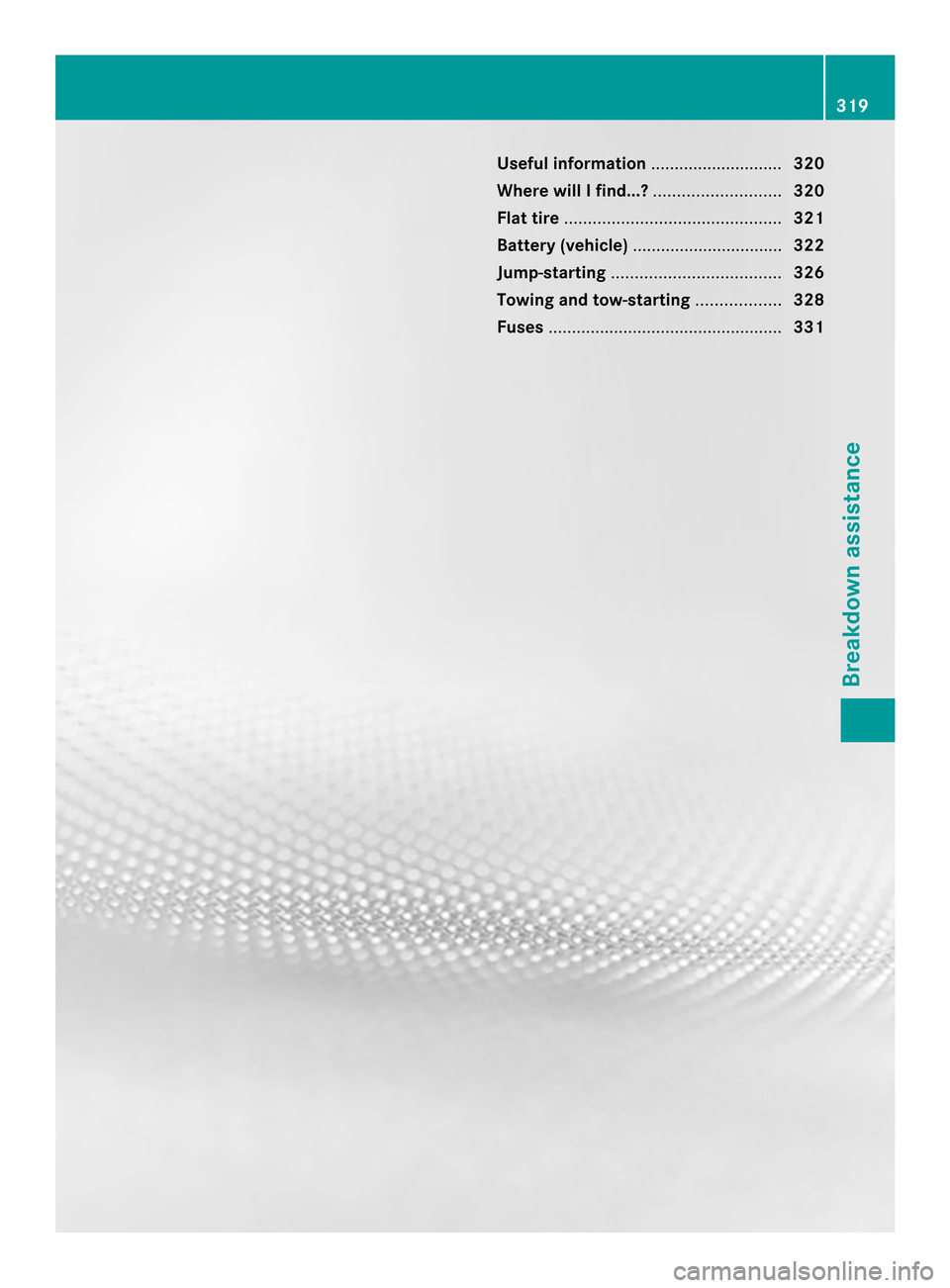
Useful information
............................320
Wher ewillIfind...? ........................... 320
Flat tire .............................................. 321
Batter y(vehicle) ................................ 322
Jump-starting .................................... 326
Towing and tow-starting ..................328
Fuses .................................................. 331 319Breakdown assistance
Page 323 of 382
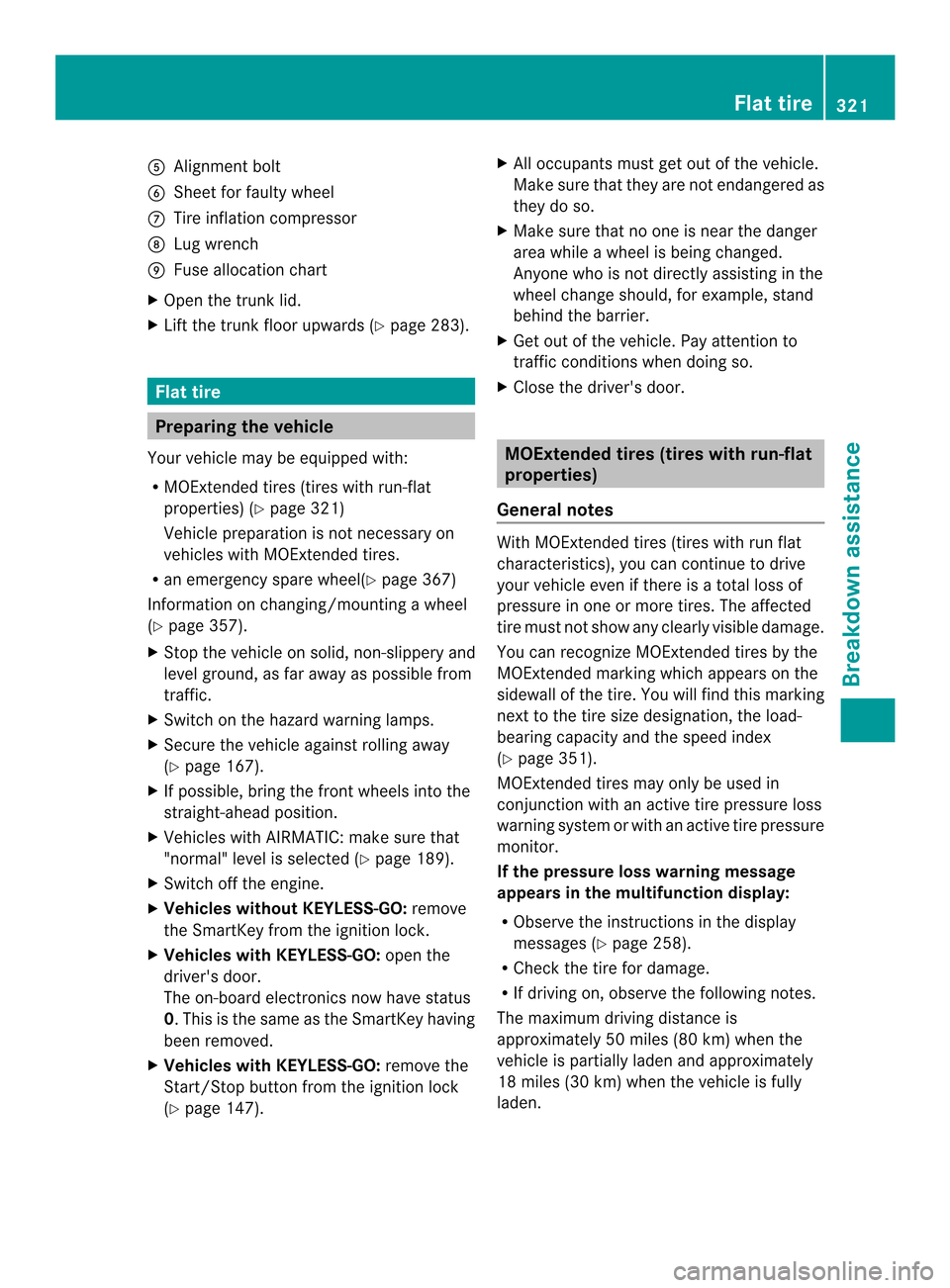
001E
Alignment bolt
0025 Sheet for faulty wheel
0009 Tire inflation compressor
0016 Lugw rench
001D Fusealloc ation chart
X Ope nthe trunk lid.
X Lift the trunk floor upwards (Y page 283).Flat tire
Preparing the vehicle
Your vehicle may be equipped with:
R MOExtended tires (tires with run-flat
properties) (Y page 321)
Vehicle preparation is not necessary on
vehicles with MOExtended tires.
R an emergency spare wheel(Y page 367)
Information on changing/mounting awheel
(Y page 357).
X Stop the vehicle on solid, non-slippery and
level ground, as far away as possible from
traffic.
X Switch on the hazard warning lamps.
X Secure the vehicle against rolling away
(Y page 167).
X If possible, bring the front wheels into the
straight-ahead position.
X Vehicles with AIRMATIC: make sure that
"normal" level is selected (Y page 189).
X Switch off the engine.
X Vehicles without KEYLESS-GO: remove
the SmartKey from the ignition lock.
X Vehicles with KEYLESS-GO: open the
driver's door.
The on-board electronicsn ow have status
0.T his is the same as the SmartKey having
been removed.
X Vehicles with KEYLESS-GO: remove the
Start/Stop button from the ignition lock
(Y page 147). X
All occupants must get out of the vehicle.
Make sure that they are not endangered as
they do so.
X Make sure that no one is near the danger
area while awheel is being changed.
Anyone who is not directly assisting in the
wheel change should, for example, stand
behind the barrier.
X Get out of the vehicle. Pay attention to
traffic conditionsw hen doing so.
X Close the driver's door. MOExtended tires (tires with run-flat
properties)
General notes With MOExtended tires (tires with run flat
characteristics), you can continue to drive
your vehicle even if there is
atotal loss of
pressure in one or more tires. The affected
tire must not show any clearly visible damage.
You can recognizeM OExtended tires by the
MOExtended marking which appears on the
sidewall of the tire. You will find this marking
next to the tire size designation, the load-
bearing capacity and the speed index
(Y page 351).
MOExtended tires may only be used in
conjunction with an active tire pressure loss
warning system or with an active tire pressure
monitor.
If the pressurel oss warning message
appearsint he multifunction display:
R Observe the instructions in the display
messages (Y page 258).
R Check the tire for damage.
R If driving on, observe the following notes.
The maximum driving distance is
approximately 50 miles (80 km) when the
vehicle is partially laden and approximately
18 miles (30 km) when the vehicle is fully
laden. Flat tire
321Breakdown assistance
Page 324 of 382
In addition to the vehicle load, the driving
distance possible depends upon:
R
Speed
R Roadc ondition
R Outside temperature
The driving distance possible in run-flat mode
may be reduced by extreme driving
conditions/maneuvers, or it can be increased
through amoderate style of driving.
The maximum permissible distance which
can be driven in run-flat mode is counted from
the moment the tire pressure loss warning
appears in the multifunction display.
You must not exceed amaximum speed of
50 mph (80 km/h).
i When replacing one or all tires, make sure
that you use only tires:
R of the size specified for the vehicle and
R marked "MOExtended"
If at ire has gone flat and cannot be
replaced with aMOExtended tire, a
standard tire may be used as atemporary
measure. Make sure that you use the
proper size and type (summe rorwinter
tire).
Important safety notes G
WARNING
When drivin ginemergenc ymode, the driving
characteristics deteriorate, e.g. when
cornering, accelerating quickly and when
braking. There is arisk of an accident.
Do not exceed the stated maximum speed.
Avoid abrupt steerin gand drivin gmaneuvers,
and drivin gover obstacles (curbs, potholes,
off-road). This applies in particular to aladen
vehicle.
Stop drivin ginemergenc ymode if:
R you hear bangin gnoises.
R the vehicle starts to shake.
R you see smok eand smell rubber. R
ESP ®
is intervenin gconstantly.
R there are tear sinthe sidewalls of the tire.
After drivin ginemergency mode, have the
wheel rims checked at aqualified specialist
workshop with regar dtotheir further use. The
defectiv etirem ust be replaced in ever ycase. Battery (vehicle)
Important safety notes
Special tools and expert knowledge are
require dwhen working on the battery, e.g.
removal and installing. You should therefore
have all work involvin gthe battery carried out
at aq ualified specialist workshop. G
WARNING
Work carried out incorrectly on the battery
can lead, for example, to ashor tcircuit and
thus damage the vehicle electronics. This can
lead to function restriction sapplying to
safety-relevan tsystems ,e.g.t he lighting
system, AB S(anti-loc kbrakin gsystem) or
ESP ®
(Electronic Stabilit yProgram). The
operating safet yofyour vehicl emay be
restricted. You could lose control of the
vehicle, for example:
R braking
R in th eevent of abrup tsteerin gmaneuver
and/o rwhen the vehicle's speed is not
adapted to the road conditions
There is arisk of an accident.
In the event of ashort circuit or asimilar
incident, contact aqualified specialist
workshop immediately. Do not drive any
further. You should have all work involving the
battery carried out at aqualifie dspecialist
workshop. G
WARNING
Electrostatic build-up can lead to th ecreation
of sparks ,whic hc ould ignite th ehighly
explosive gases of abattery. Ther eisariskof
an explosion. 322
Battery (vehicle)Breakdown assistance