lock MERCEDES-BENZ CLS COUPE 2012 Owners Manual
[x] Cancel search | Manufacturer: MERCEDES-BENZ, Model Year: 2012, Model line: CLS COUPE, Model: MERCEDES-BENZ CLS COUPE 2012Pages: 373, PDF Size: 9.12 MB
Page 260 of 373
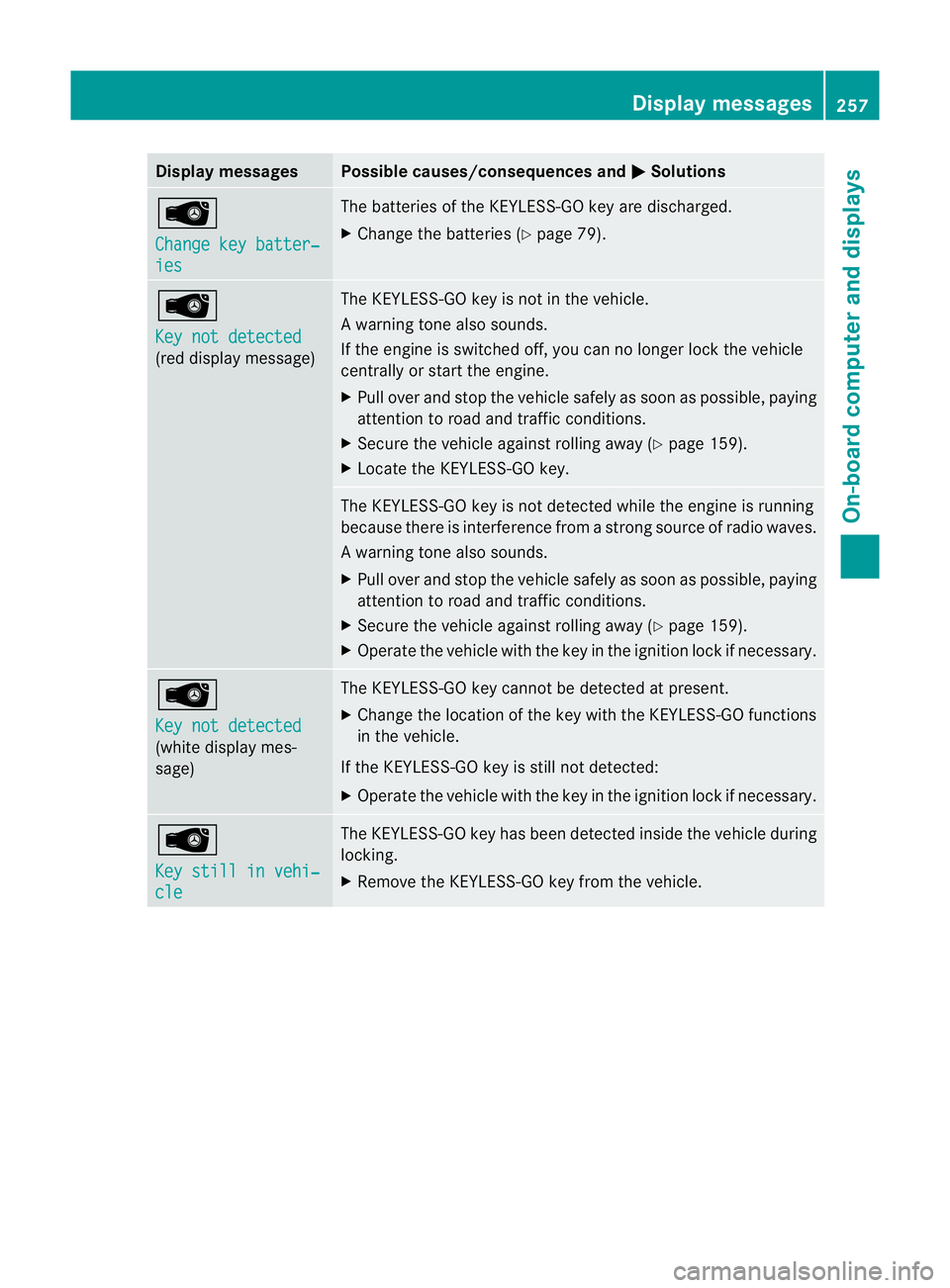
Display messages Possible causes/consequences and
M Solutions
Â
Change key batter‐
ies The batterie
softheKEYLESS-GO ke yare discharged.
X Change th ebatterie s(Ypage 79). Â
Key not detected
(re
dd isplay message) The KEYLESS-GO ke
yisnotin th evehicle.
Aw arning tone also sounds.
If th eengineiss witched off ,you can no longer loc kthe vehicle
centrally or start the engine.
X Pull over and stop the vehicle safely as soon as possible, paying
attention to road and traffic conditions.
X Secure the vehicle against rolling away (Y page 159).
X Locate the KEYLESS-GO key. The KEYLESS-GO key is not detected while the engine is running
because there is interference from
astrongs ource of radio waves.
Aw arning tone also sounds.
X Pull ove rand stop the vehicl esafelyass oonasp ossible,p aying
attention to road and traffic conditions.
X Secure the vehicle against rolling away( Ypage 159).
X Operate the vehicle with the key in the ignition lock if necessary. Â
Key not detected
(white displaym
es-
sage) The KEYLESS-GO key cannot be detected at present.
X
Change the location of the key with the KEYLESS-GO functions
in the vehicle.
If the KEYLESS-GO key is still not detected:
X Operate the vehicle with the key in the ignition lock if necessary. Â
Key still in vehi‐
cle The KEYLESS-GO key has been detected inside the vehicle during
locking.
X
Remove the KEYLESS-GO key from the vehicle. Display messages
257On-board computer and displays Z
Page 261 of 373
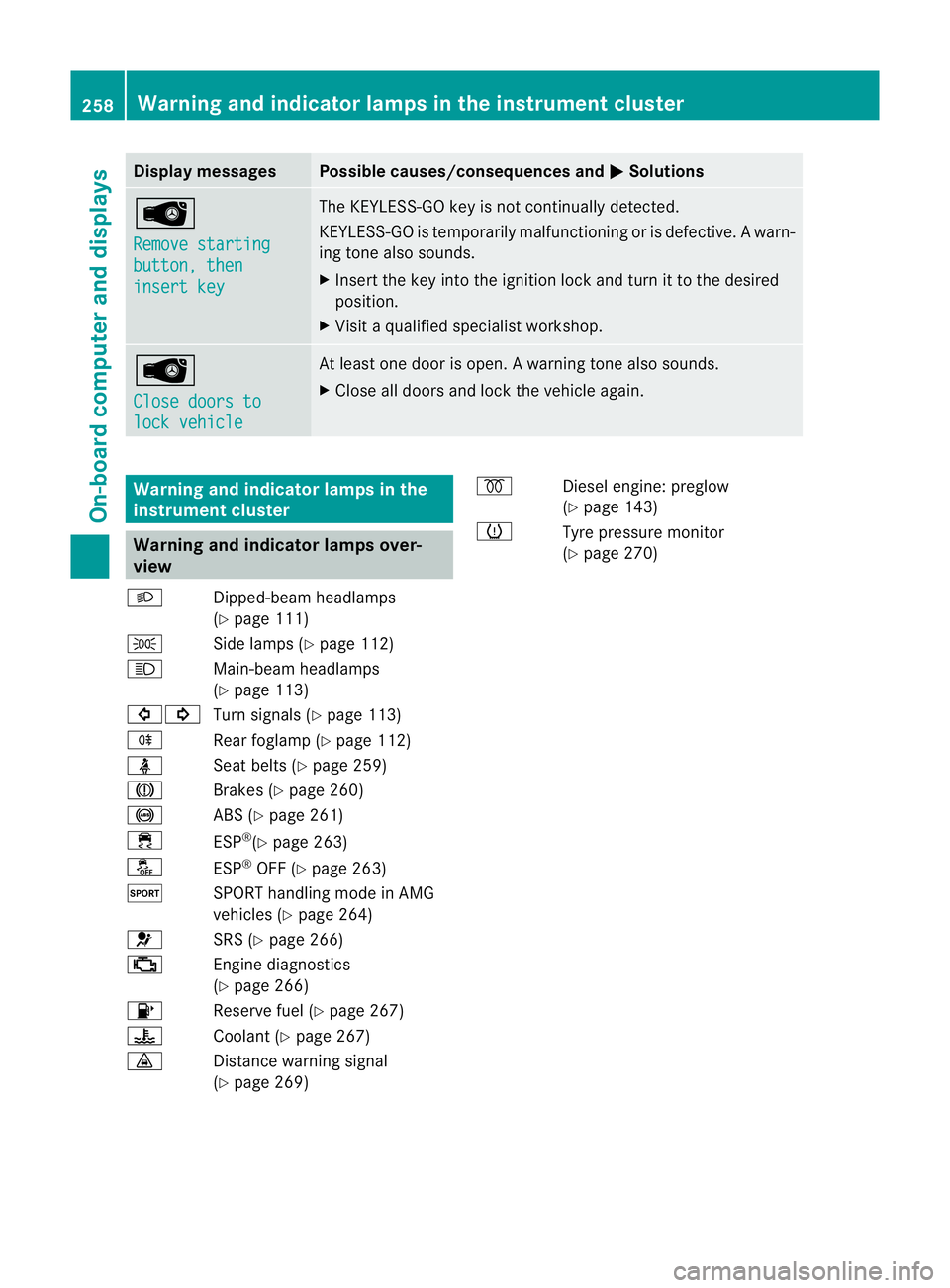
Display messages Possible causes/consequences and
M Solutions
Â
Remove starting
button
,then insert key The KEYLESS-GO ke
yisnot continually detected.
KEYLESS-GO is temporaril ymalfunctioning or is defective. Awarn-
ing tone also sounds.
X Inser tthe keyintot he ignition loc kand tur nittot hedesired
position.
X Visi taq ualified specialist workshop. Â
Close doors to
lock vehicle At least one door is open.
Awarning tone also sounds.
X Close all door sand loc kthe vehicle again. Warning and indicator lamps in the
instrument cluster
Warning and indicator lamps over-
view
L Dipped-beam headlamps
(Ypage 111)
T Side lamps (Y page 112)
K Main-beam headlamps
(Ypage 113)
#! Turn signals (Y page 113)
R Rear foglamp (Y page 112)
ü Seat belts (Y page 259)
J Brakes (Ypage 260)
! ABS (Ypage 261)
÷ ESP®
(Y page 263)
å ESP®
OFF (Y page 263)
M SPORT handling mode in AMG
vehicles (Ypage 264)
6 SRS (Ypage 266)
; Enginediagnostics
(Y page 266)
8 Reserve fuel (Y page 267)
? Coolant (Ypage 267)
· Distancewarning signal
(Y page 269) %
Diesel engine: preglow
(Ypage 143)
h Tyre pressure monitor
(Ypage 270) 258
Warning and indicator lampsint
he instrument clusterOn-board computer and displays
Page 264 of 373
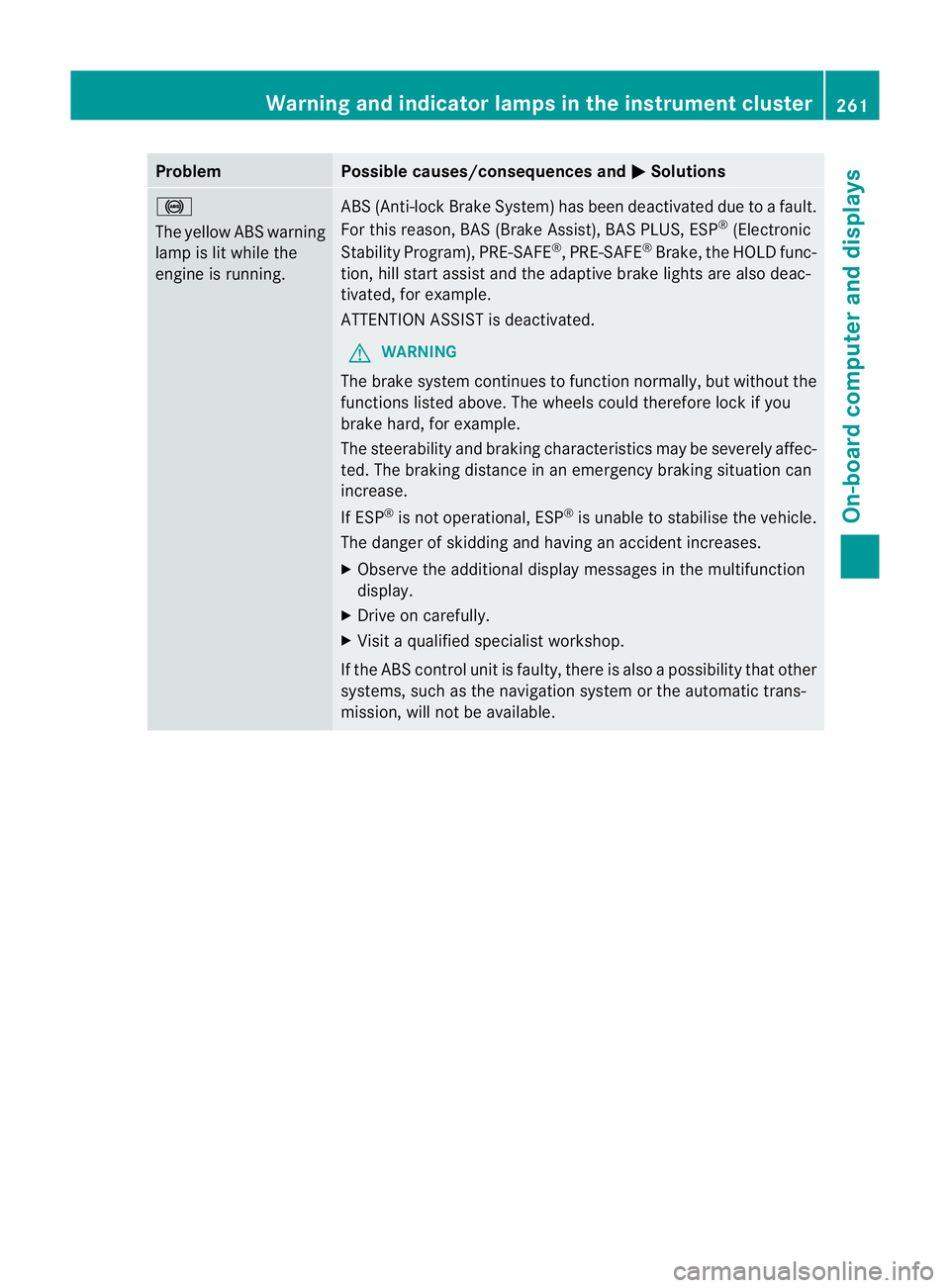
Problem Possible causes/consequences and
M Solutions
!
The yellowA
BS warning
lamp is lit while the
engine is running. ABS (Anti-lock Brake System) has been deactivated due to
afault.
For this reason, BAS (Brake Assist), BAS PLUS, ESP ®
(Electronic
Stability Program), PRE-SAFE ®
,P RE-SAFE ®
Brake ,the HOLD func-
tion, hill start assist and the adaptive brake lights are also deac-
tivated, for example.
ATTENTION ASSIST is deactivated.
G WARNING
The brake system continues to function normally, but without the
functions listed above. The wheels could therefore lock if you
brake hard, for example.
The steerability and braking characteristics may be severely affec-
ted. The braking distance in an emergency braking situation can
increase.
If ESP ®
is not operational, ESP ®
is unable to stabilise the vehicle.
The danger of skidding and having an accident increases.
X Observe the additional displaym essages in the multifunction
display.
X Drive on carefully.
X Visit aqualified specialist workshop.
If the ABS control unit is faulty, there is also apossibility that other
systems, such as the navigation system or the automatic trans-
mission, will not be available. Warning and indicator lampsint
he instrument cluster
261On-board computer and displays Z
Page 265 of 373
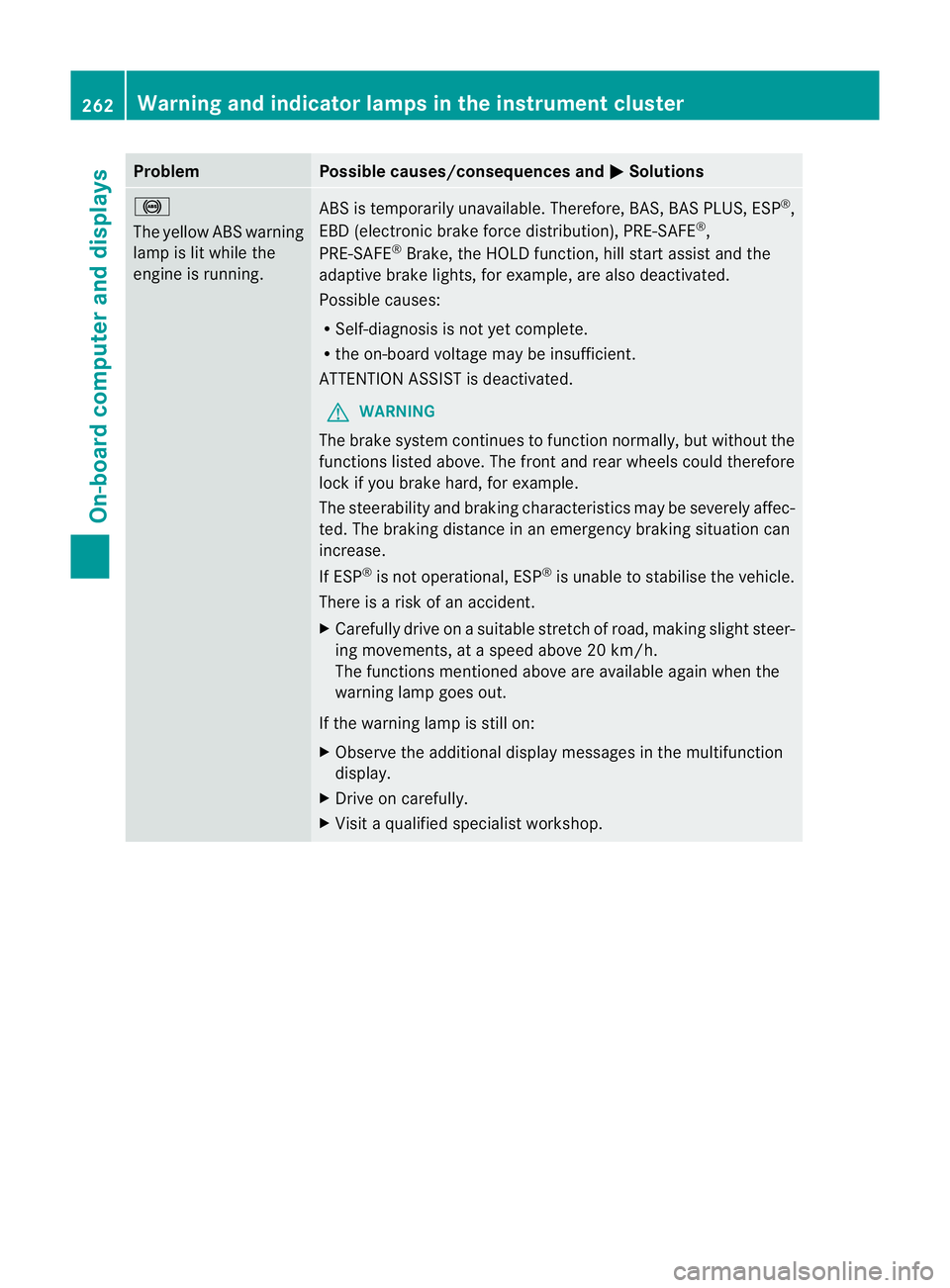
Problem Possible causes/consequences and
M Solutions
!
The yellowA
BS warning
lamp is lit while the
engine is running. ABS is temporarily unavailable. Therefore, BAS,B
AS PLUS, ESP®
,
EBD (electronic brake force distribution), PRE-SAFE ®
,
PRE-SAFE ®
Brake, the HOLD function, hill start assist and the
adaptive brake lights, for example, are also deactivated.
Possible causes:
R Self-diagnosis is not yet complete.
R the on-board voltage may be insufficient.
ATTENTION ASSIST is deactivated.
G WARNING
The brake system continues to function normally, but without the
functions listed above. The front and rear wheels could therefore
lock if you brake hard, for example.
The steerability and braking characteristics may be severely affec-
ted. The braking distance in an emergency braking situation can
increase.
If ESP ®
is not operational, ESP ®
is unable to stabilise the vehicle.
There is arisk of an accident.
X Carefullyd rive onasuitable stretch of road, making slight steer-
ing movements, at aspeed above 20 km/h.
The functions mentioned above are available again when the
warning lamp goes out.
If the warning lamp is still on:
X Observe the additional display messages in the multifunction
display.
X Drive on carefully.
X Visit aqualified specialist workshop. 262
Warning and indicator lampsint
he instrument clusterOn-board computer and displays
Page 266 of 373
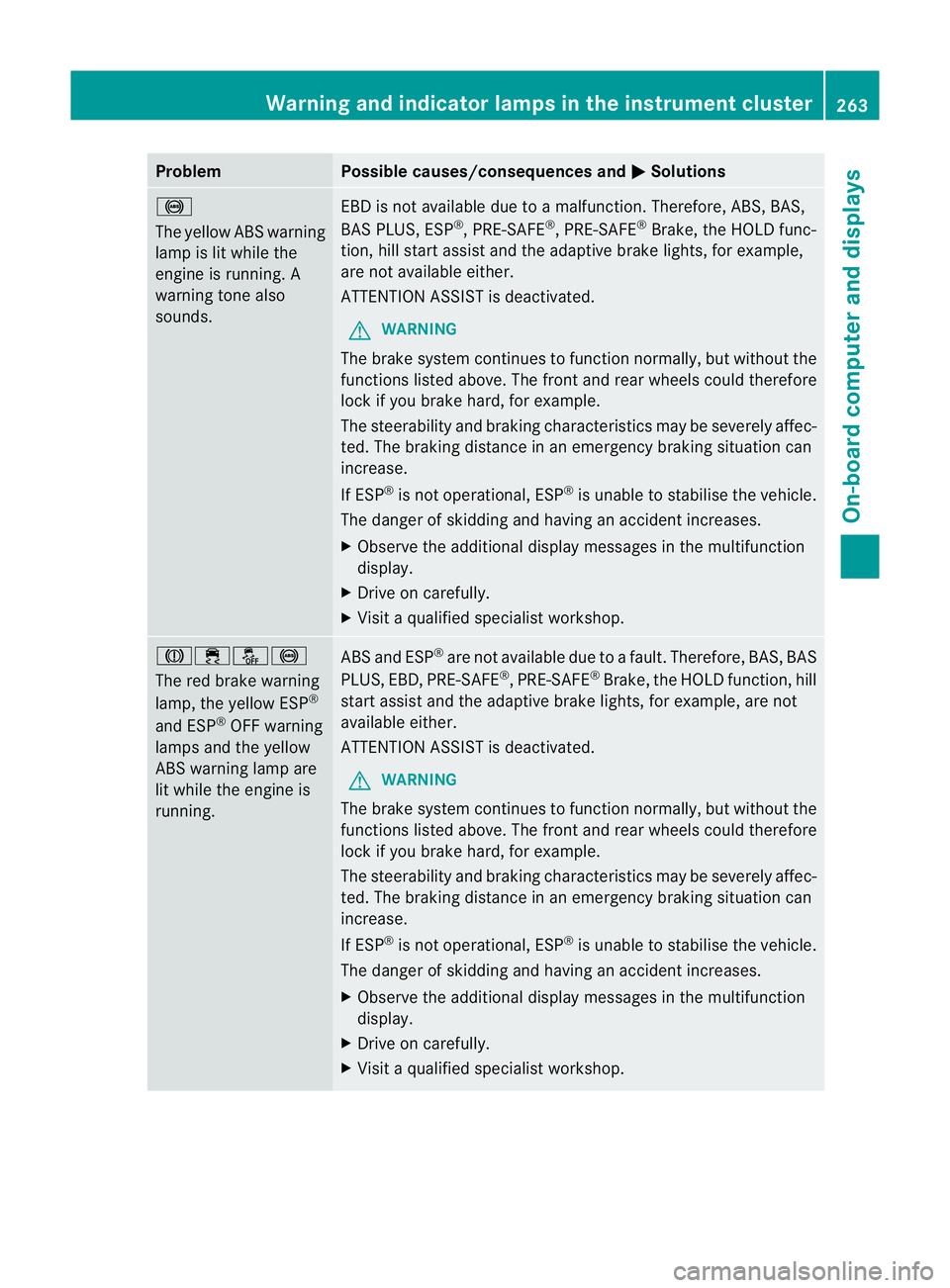
Problem Possible causes/consequences and
M Solutions
!
The yellowA
BS warning
lamp is lit while the
engine is running. A
warning tone also
sounds. EBD is not available due to
amalfunction .Therefore, ABS,B AS,
BAS PLUS, ESP ®
,P RE-SAFE ®
,P RE-SAFE ®
Brake, the HOLD func-
tion, hill start assist and the adaptive brake lights, for example,
are not available either.
ATTENTION ASSIST is deactivated.
G WARNING
The brake system continues to function normally, but without the
functions listed above. The front and rear wheels could therefore
lock if you brake hard, for example.
The steerability and braking characteristics may be severely affec-
ted. The braking distance in an emergency braking situation can
increase.
If ESP ®
is not operational, ESP ®
is unable to stabilise the vehicle.
The danger of skidding and having an accident increases.
X Observe the additional display messages in the multifunction
display.
X Drive on carefully.
X Visit aqualified specialist workshop. J֌!
The red brake warning
lamp, the yellow ESP
®
and ESP ®
OFF warning
lamps and the yellow
ABS warning lamp are
lit while the engine is
running. ABS and ESP
®
are not available due to afault. Therefore, BAS,B AS
PLUS, EBD,P RE-SAFE®
,P RE-SAFE ®
Brake ,the HOLD function ,hill
start assist and th eadaptive brak elights ,for example, are not
available either.
ATTENTION ASSIST is deactivated.
G WARNING
The brak esystem continues to function normally, but without the
function slisted above. The fron tand rea rwheels could therefore
lock if you brake hard, for example.
The steerability and braking characteristics may be severely affec-
ted. The braking distance in an emergency braking situation can
increase.
If ESP ®
is not operational, ESP ®
is unable to stabilise the vehicle.
The danger of skidding and having an accident increases.
X Observe the additional displaym essages in the multifunction
display.
X Drive on carefully.
X Visit aqualified specialist workshop. Warning and indicator lampsint
he instrument cluster
263On-board computer and displays Z
Page 271 of 373
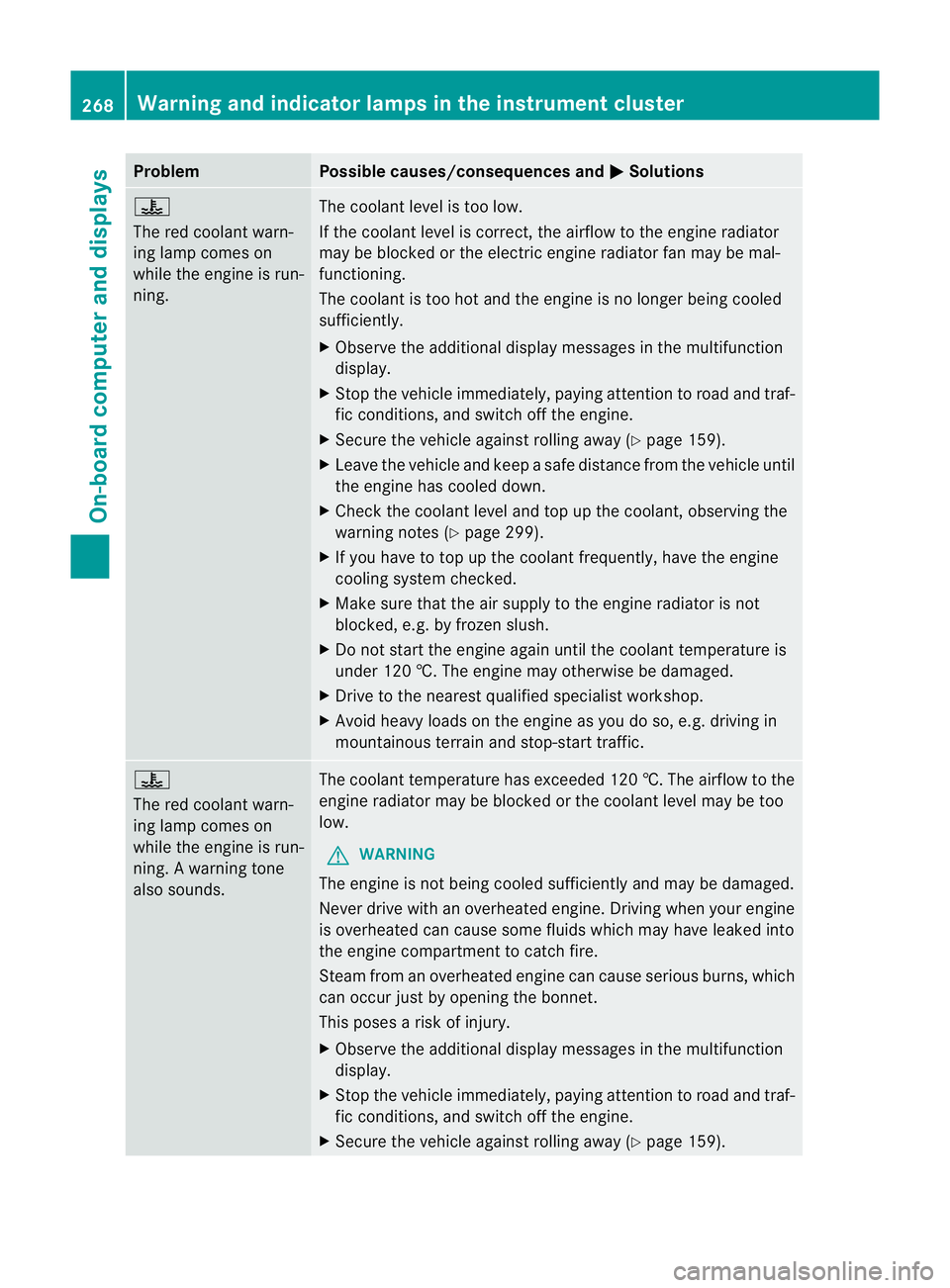
Problem Possible causes/consequences and
M Solutions
?
The red coolant warn-
ing lamp comes on
while the engine is run-
ning.
The coolant level is too low.
If the coolant level is correct, the airflow to the engine radiator
may be blocked or the electric engine radiator fan may be mal-
functioning.
The coolant is too hot and the engine is no longer being cooled
sufficiently.
X
Observe the additional display messages in the multifunction
display.
X Stop the vehicle immediately, paying attention to road and traf-
fic conditions, and switch off the engine.
X Secure the vehicle against rolling away (Y page 159).
X Leave the vehicle and keep asafe distance from the vehicle until
the engine has cooled down.
X Check the coolant level and top up the coolant, observing the
warning notes (Y page 299).
X If you have to top up the coolant frequently, have the engine
cooling system checked.
X Make sure that the air supply to the engine radiator is not
blocked, e.g. by frozen slush.
X Do not start the engine again until the coolant temperature is
under 120 †. The engine may otherwise be damaged.
X Drive to the nearest qualified specialist workshop.
X Avoid heavy loads on the engine as you do so, e.g. driving in
mountainous terrain and stop-start traffic. ?
The red coolant warn-
ing lamp comes on
while the engine is run-
ning.
Awarning tone
also sounds. The coolant temperature has exceeded 120 †. The airflow to the
engine radiator may be blocked or the coolant level may be too
low.
G WARNING
The engine is not being cooled sufficiently and may be damaged.
Never drive with an overheated engine. Driving when your engine
is overheated can cause some fluids which may have leaked into
the engine compartmen ttocatch fire.
Steam from an overheated engine can cause serious burns, which
can occur just by opening the bonnet.
This poses arisk of injury.
X Observe the additional display messages in the multifunction
display.
X Stop the vehicle immediately, paying attention to road and traf-
fic conditions, and switch off the engine.
X Secure the vehicle against rolling away (Y page 159).268
Warning and indicator lampsint
he instrument clusterOn-board computer and displays
Page 272 of 373
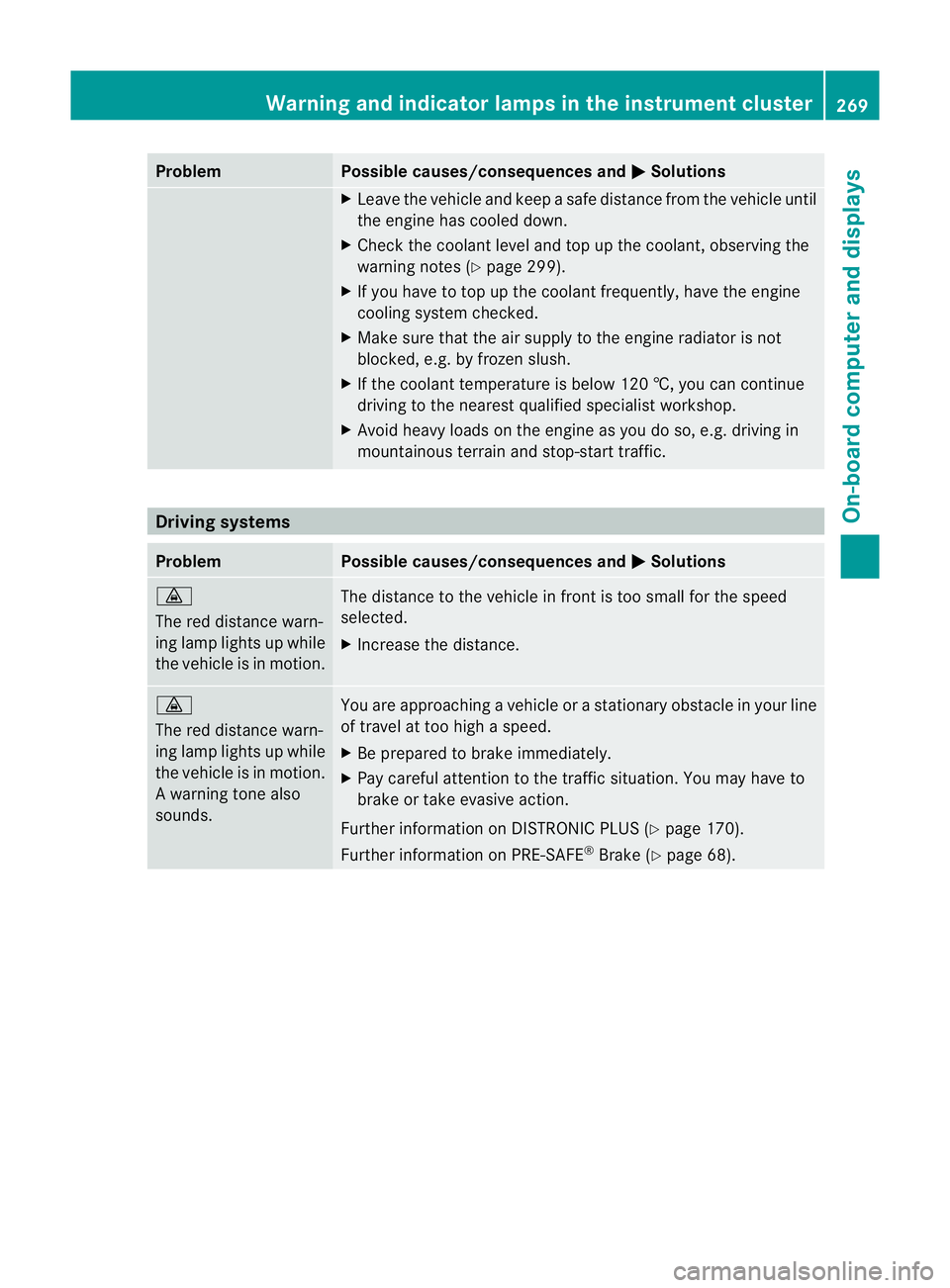
Problem Possible causes/consequences and
M Solutions
X
Leave the vehicle and keep asafe distance from the vehicle until
the engine has cooled down.
X Check the coolant level and top up the coolant, observing the
warning notes (Y page 299).
X If you have to top up the coolant frequently, have the engine
cooling system checked.
X Make sure that the air supply to the engine radiator is not
blocked, e.g. by frozen slush.
X If the coolant temperature is below 120 †, you can continue
driving to the nearest qualified specialist workshop.
X Avoid heavy loads on the engine as you do so, e.g. driving in
mountainous terrain and stop-start traffic. Driving systems
Problem Possible causes/consequences and
M Solutions
·
The red distance warn-
ing lamp lights up while
the vehicle is in motion.
The distance to the vehicle in front is too small for the speed
selected.
X
Increase the distance. ·
The red distance warn-
ing lamp lights up while
the vehicle is in motion.
Aw
arning tone also
sounds. You are approaching
avehicle or astationar yobstacle in your line
of travel at to ohigh aspeed.
X Be prepared to brak eimmediately.
X Pay careful attentio ntothetraffic situation. You may have to
brak eort akee vasive action.
Further informatio nonDISTRONICPLUS(Ypage 170).
Further informatio nonPRE-SAFE ®
Brake (Y page 68). Warning and indicator lamps in th
einstrumen tcluster
269On-boar dcomputer and displays Z
Page 275 of 373
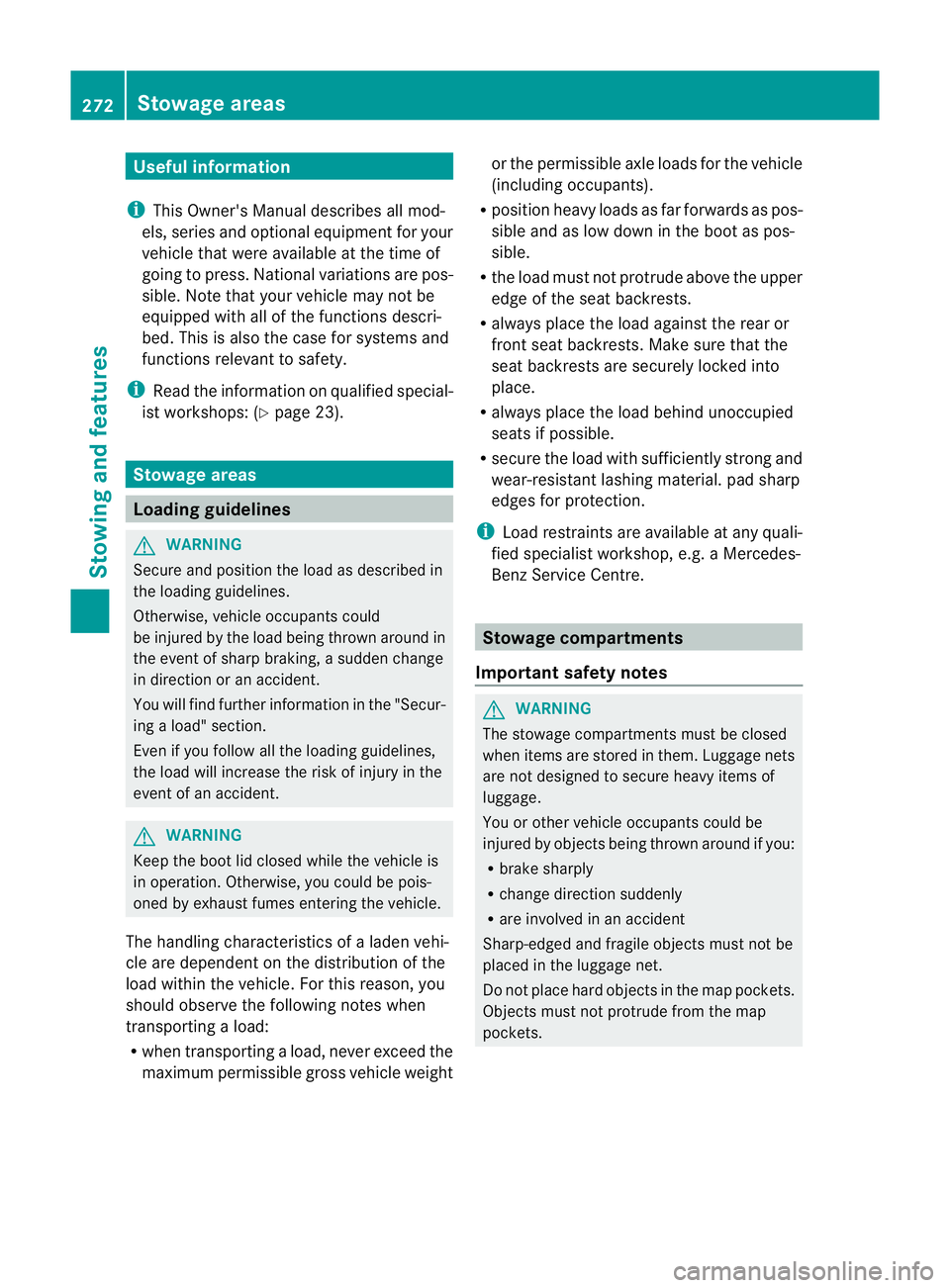
Useful information
i This Owner's Manual describes all mod-
els, series and optional equipment for your
vehicle that were available at the time of
going to press. National variation sare pos-
sible. Not ethat your vehicle may not be
equipped with all of the function sdescri-
bed. This is also the case for system sand
function srelevan ttosafety.
i Read the information on qualified special-
ist workshops: (Y page 23). Stowage areas
Loading guidelines
G
WARNING
Secure and position the load as described in
the loading guidelines.
Otherwise, vehicle occupants could
be injured by the load being thrown around in
the even tofsharp braking, asudden change
in direction or an accident.
You will find further information in the "Secur-
ing aload" section.
Even if you follow all the loading guidelines,
the load will increase the risk of injury in the
event of an accident. G
WARNING
Keep the boot lid closed while the vehicle is
in operation. Otherwise, you could be pois-
oned by exhaust fumes enteringt he vehicle.
The handling characteristics of aladen vehi-
cle are dependent on the distribution of the
load within the vehicle. For this reason, you
should observe the following notes when
transporting aload:
R when transporting aload, never exceed the
maximum permissible gross vehicle weight or the permissible axle loads for the vehicle
(including occupants).
R position heavy loads as far forwards as pos-
sible and as low down in the boot as pos-
sible.
R the load must not protrude above the upper
edge of the seat backrests.
R always place the load against the rear or
front seat backrests. Make sure that the
seat backrests are securely locked into
place.
R always place the load behind unoccupied
seats if possible.
R secure the load with sufficiently stronga nd
wear-resistant lashing material. pad sharp
edges for protection.
i Load restraintsa re available at any quali-
fied specialist workshop, e.g. aMercedes-
Benz Service Centre. Stowage compartments
Important safety notes G
WARNING
The stowage compartments must be closed
when items are stored in them. Luggage nets
are not designed to secure heavy items of
luggage.
You or other vehicle occupants could be
injured by objectsb eing thrown around if you:
R brake sharply
R change direction suddenly
R are involved in an accident
Sharp-edged and fragile objectsm ust not be
placed in the luggagen et.
Do not place hard objectsint he map pockets.
Objectsm ust not protrude from the map
pockets. 272
Stowage areasStowing and features
Page 276 of 373
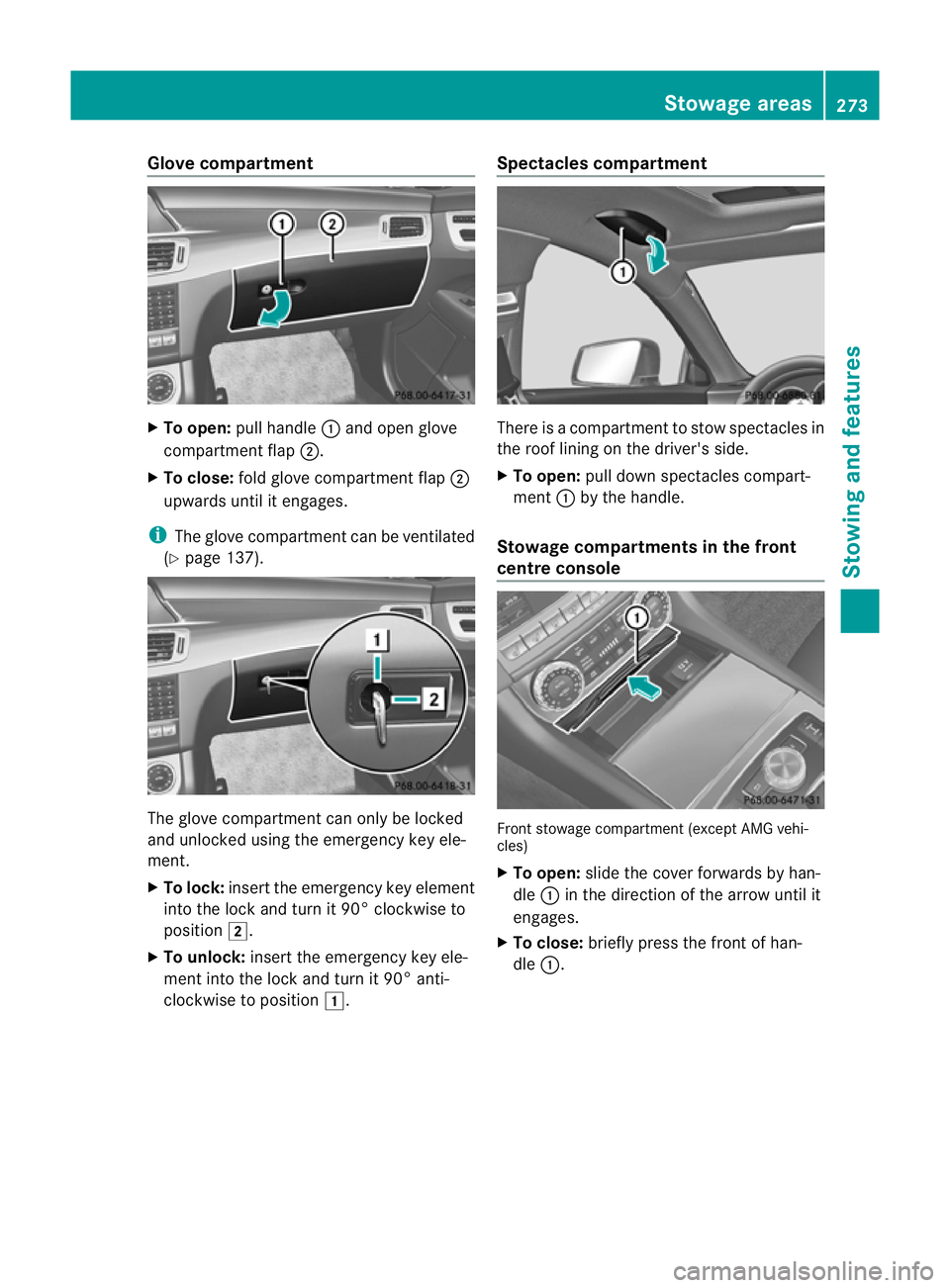
Glove compartment
X
To open: pullhandle :and open glove
compartment flap ;.
X To close: fold glove compartment flap ;
upwards until it engages.
i The glove compartment can be ventilated
(Y page 137). The glove compartment can only be locked
and unlocked using the emergency key ele-
ment.
X To lock: insert the emergency key element
into the lock and turn it 90° clockwise to
position 2.
X To unlock: insert the emergency key ele-
ment into the lock and turn it 90° anti-
clockwise to position 1. Spectacles compartment There is
acompartment to stow spectacle sin
the roof lining on the driver's side.
X To open: pulldown spectacle scompart-
ment :by the handle.
Stowag ecompartments in the front
centre console Front stowag
ecompartment (except AMG vehi-
cles)
X To open: slidethe cover forwards by han-
dle :in the direction of the arrow until it
engages.
X To close: brieflypress the front of han-
dle :. Stowage areas
273Stowing and features Z
Page 281 of 373
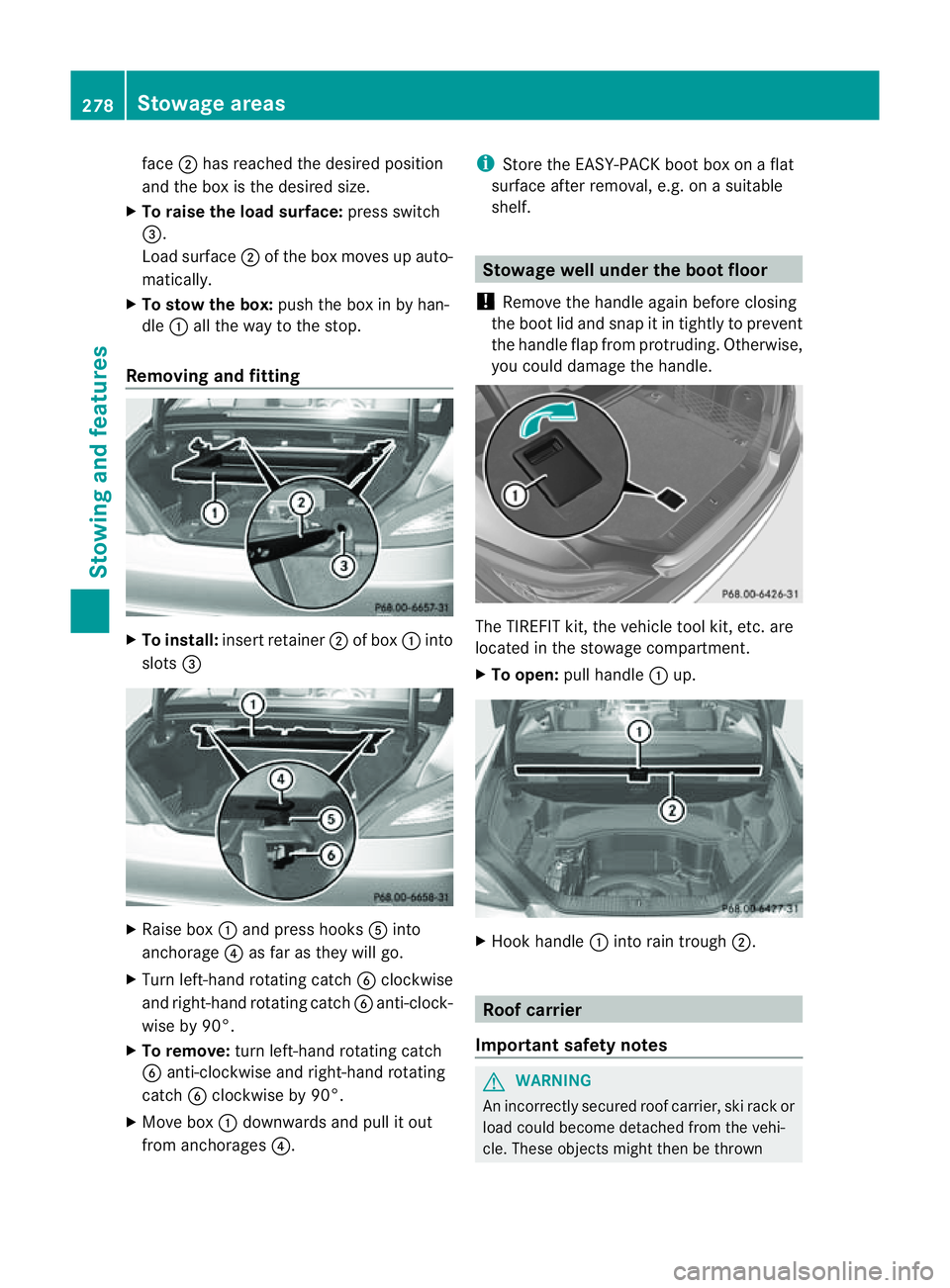
face
;has reache dthe desired position
and the box is the desired size.
X To raise the load surface: press switch
=.
Load surface ;of the box moves up auto-
matically.
X To stow the box: pushthe box in by han-
dle :allt he waytot he stop.
Removing and fitting X
To install: insert retainer ;of box :into
slots = X
Raise box :and press hooks Ainto
anchorage ?as far as they wil lgo.
X Turn left-hand rotating catch Bclockwise
and right-hand rotating catch Banti-clock-
wis eby9 0°.
X To remove: turn left-hand rotating catch
B anti-clockwise and right-hand rotating
catch Bclockwise by 90°.
X Move box :downward sand pul litout
from anchorages ?. i
Store the EASY-PACK boot box on aflat
surface after removal, e.g. on asuitable
shelf. Stowage well under the boo
tfloor
! Remove the handle again befor eclosing
the boot lid and snap it in tightly to prevent
the handle flap fro mprotruding. Otherwise,
you coul ddamage the handle. The TIREFIT kit, the vehicl
etool kit, etc. are
located in the stowage compartment.
X To open: pullhandle :up. X
Hook handle :into rain trough ;. Roof carrier
Important safety notes G
WARNING
An incorrectly secure droof carrier, ski rack or
load could become detached from the vehi-
cle. These object smight then be thrown 278
Stowage areasStowing and features