ESP MERCEDES-BENZ CLS COUPE 2012 Owners Manual
[x] Cancel search | Manufacturer: MERCEDES-BENZ, Model Year: 2012, Model line: CLS COUPE, Model: MERCEDES-BENZ CLS COUPE 2012Pages: 373, PDF Size: 9.12 MB
Page 344 of 373
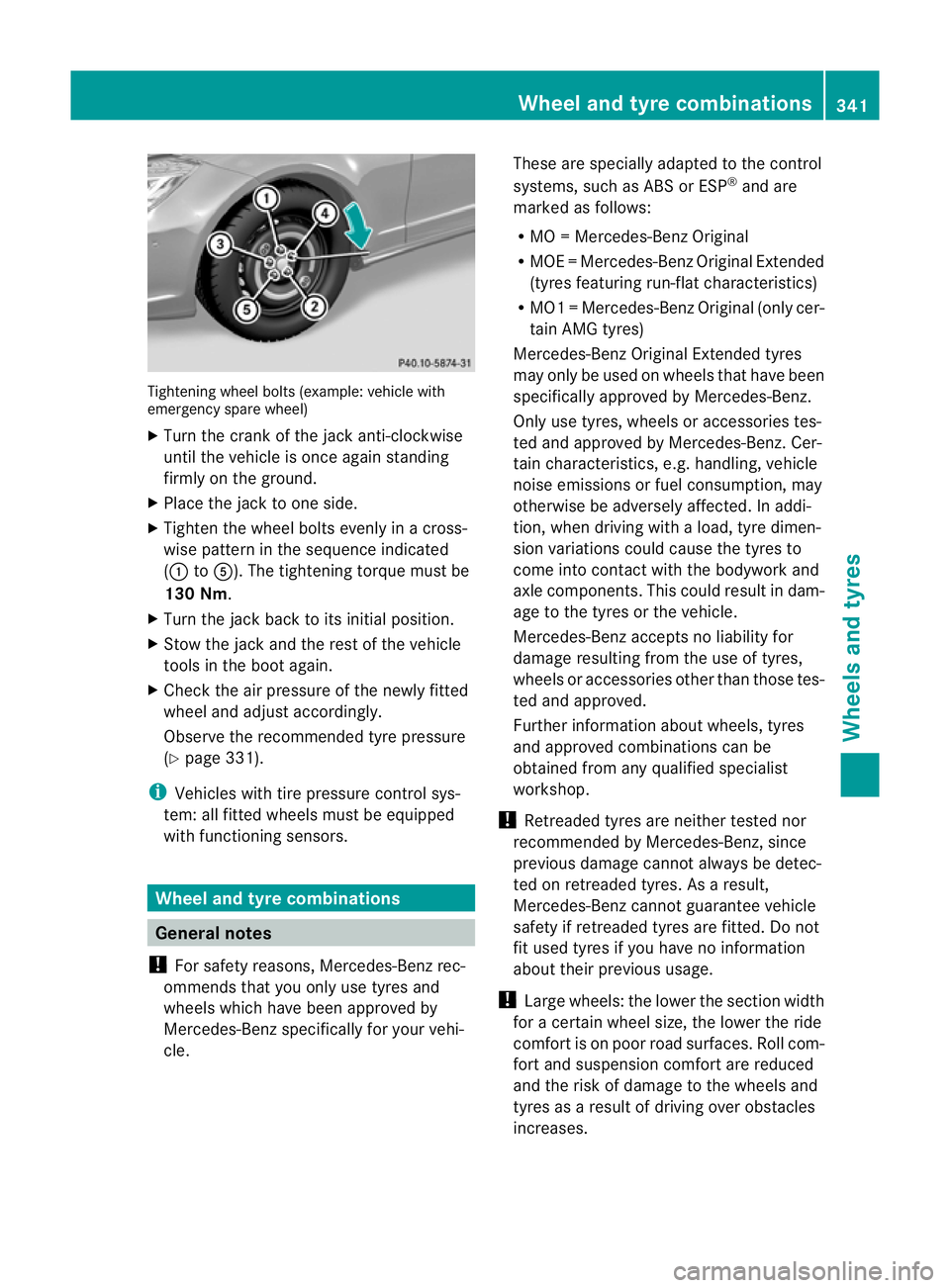
Tightenin
gwheel bolts (example: vehicle with
emergenc yspare wheel)
X Turn the crank of the jack anti-clockwise
until the vehicle is once again standing
firmly on the ground.
X Place the jack to one side.
X Tighten the wheel bolts evenly in across-
wise pattern in the sequence indicated
(: toA). The tightening torque must be
130 Nm.
X Turn the jack back to its initial position.
X Stow the jack and the rest of the vehicle
tools in the boot again.
X Check the air pressure of the newly fitted
wheel and adjust accordingly.
Observe the recommended tyre pressure
(Y page 331).
i Vehicles with tire pressure control sys-
tem: all fitted wheels must be equipped
with functioning sensors. Wheel and tyrec
ombinations General notes
! For safety reasons, Mercedes-Benz rec-
ommends that you only use tyres and
wheels which have been approved by
Mercedes-Benz specifically for your vehi-
cle. These are specially adapted to the control
systems, such as ABS or ESP
®
and are
marked as follows:
R MO =Mercedes-BenzO riginal
R MOE =Mercedes-Benz Original Extended
(tyres featuring run-flat characteristics)
R MO1 =Mercedes-BenzO riginal (only cer-
tain AMG tyres)
Mercedes-Benz Original Extended tyres
may only be usedonw heels that have been
specifically approved by Mercedes-Benz.
Only use tyres, wheels or accessories tes-
ted and approved by Mercedes-Benz. Cer-
tain characteristics, e.g. handling, vehicle
noise emissions or fuel consumption, may
otherwise be adversely affected. In addi-
tion, when driving with aload, tyre dimen-
sion variations could cause the tyres to
come into contact with the bodywork and
axle components.T his could result in dam-
age to the tyres or the vehicle.
Mercedes-Ben zaccepts no liability for
damag eresulting from the us eoftyres,
wheel soraccessorie sothe rthan those tes-
ted and approved.
Further information about wheels, tyres
and approved combinations can be
obtained from any qualified specialist
workshop.
! Retreaded tyres are neither tested nor
recommended by Mercedes-Benz, since
previous damage cannot always be detec-
ted on retreaded tyres. As aresult,
Mercedes-Ben zcannot guarante evehicle
safety if retreade dtyres are fitted. Do not
fit used tyres if you have no information
about their previous usage.
! Large wheels :the lower the section width
for acertain wheel size, the lower the ride
comfort is on poor road surfaces. Roll com-
fort and suspension comfort are reduced
and the risk of damage to the wheels and
tyres as aresult of driving over obstacles
increases. Wheel and tyrec
ombinations
341Wheels and tyres Z
Page 354 of 373
Emergency spare wheel
Important safety notes
G
WARNING
The wheel/tyr edimension sand th etyret ype
of th espar ew heel/emergency spar ewheel
and th ewheel to be replaced may differ. Fit-
tin gas parew heel/emergency spar ewheel
may severel yimpair th edriving characteris-
tics. Ther eisarisk of accident.
To prevent hazardous situations:
R Adap tyour driving style accordingly and
drive carefully.
R Never fit more than one spare wheel/emer-
gency spare wheel if the dimesions are dif-
ferent to those of the wheel being replaced.
R Only use aspare wheel/emergency spare
wheel briefly if the dimesions are different
to those of the wheel being replaced.
R Do not switch off ESP ®
.
R Have the spare wheel/emergency spare
wheel in question replaced at the nearest
qualified specialist workshop. Make sure
that the wheel/tyre dimensions and tyre
type are correct.
When using an emergenc yspare wheel or
spare wheel of adifferent size, you must not
exceed the maximum speed of 80 km/h.
Snow chains must not be fitted to emergency
spare wheels. General notes
You should regularly check the pressure of all
your tyres, including the emergenc yspare
wheel, particularly prior to long trips, and cor-
rect the pressure as necessary (Y page 331).
The applicabl evalue is found on the wheel or
under "Technical data" (Y page 354).
An emergenc yspare wheel may also be fitted
against the direction of rotation .Observe the
time restriction on use as well as the speed
limitation specified on the emergency spare
wheel. Replace the tyres after six years at the latest,
regardless of wear. This also applies to the
emergency spare wheel.
i
When you are drivin gwith the collapsible
emergency spare wheel fitted, the tyre
pressure loss warning system or the tyre
pressure monitor cannot function reliably.
Only restart the tyre pressure loss warning
system/tyre pressure monitor when the
defective wheel has been replaced with a
new wheel.
Vehicles with tyr epressure monitor:
after mounting an emergency spare wheel,
the system may still display the tyre pres-
sure of the removed wheel for afew
minutes. The value displayed for the moun-
ted emergency spare wheel is not the same
as the curren ttyre pressure of the emer-
genc yspare wheel. Removing the "Minispare" emer-
gency spar
ewheel/collapsible emer-
gency spar ewheel
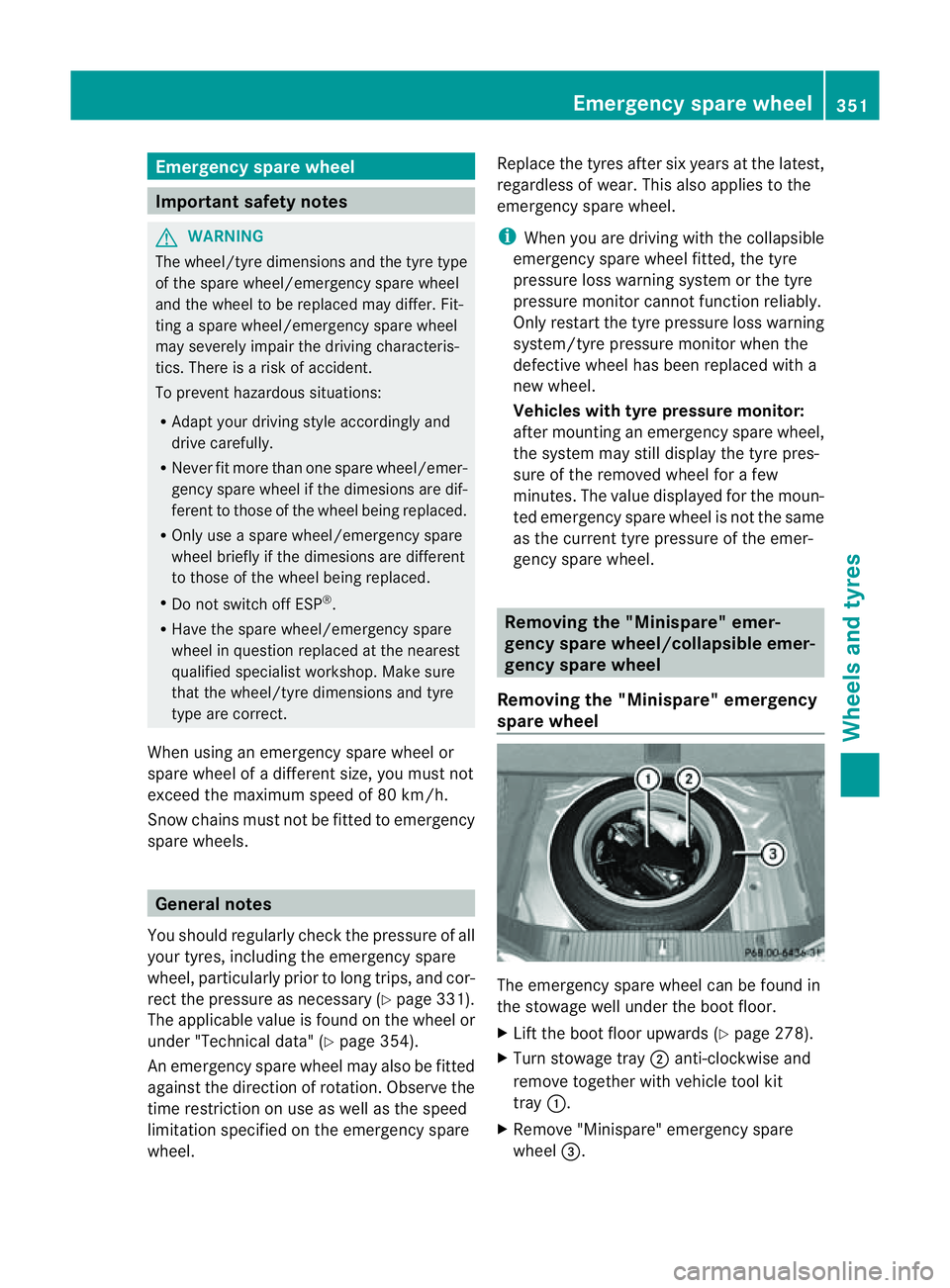
Removing the "Minispare" emergency
spar ewheel The emergency spare wheel can be found in
the stowage well under the boot floor.
X Lift the boot floor upwards (Y page 278).
X Turn stowage tray ;anti-clockwise and
remov etogether with vehicle tool kit
tray :.
X Remove "Minispare" emergency spare
wheel =. Emergency spare wheel
351Wheels and tyres Z
Page 359 of 373
Useful information
i This Owner's Manual describes all mod-
els, series and optional equipment for your
vehicle that were available at the time of
going to press. National variation sare pos-
sible. Not ethat your vehicle may not be
equipped with all of the function sdescri-
bed. This is also the case for system sand
function srelevan ttosafety.
i Read the information on qualified special-
ist workshops: (Y page 23). Information on technical data
You can find curren ttechnical data on the
Interne tat:
http://www.mercedes-benz.com
i The technical data was determined in
accordance with EC Directives .All data
applies to the vehicle' sstandard equip-
ment .The data may therefore differ for
vehicles with optional equipment .You can
obtain further information from a
Mercedes-Benz Servic eCentre. Genuine Mercedes-Benz parts
G
WARNING
Drivin gsafety may be impaired if non-
approved parts, tyres and wheels or safety-
relevant accessories are used.
This could lead to malfunctions in safety-rel-
evant systems, e.g. the brake system. This
could cause you to lose control of your vehicle
and cause an accident.
For this reason, Mercedes-Benz recommends
that you use genuine Mercedes-Benz parts or
parts of equal quality. Only use tyres, wheels
and accessories that have been specifically
approved for your vehicle. H
Environmental note
Daimler AG also supplies reconditioned
assemblies and parts which are of the same
quality as new parts. For these, the same war-
ranty applies as for new parts.
! Airbags and seat belt tensioners, as well
as control units and sensors for these
restraint systems, may be installed in the
following areas of your vehicle:
R doors
R door pillars
R door sills
R seats
R dashboard
R instrument cluster
R centre console
Do not install accessories such as audio
systems in these areas. Do not carry out
repairs or welding. You could impair the
operating efficienc yofthe restraint sys-
tems.
Have accessories retrofitted at aqualified
specialist workshop.
Mercedes-Benz testsg enuine parts and con-
version parts and accessories that have been
specifically approved for your vehicle for their
reliability, safety and suitability. Despite
ongoing market research, Mercedes-Benz is
unable to assess other parts. Mercedes-Benz
accepts no responsibility for the use of parts
that have been independently or officially
approved.
In Germany, certain parts are only officially
approved for installation or modification if
they comply with legal requirements. This
also applies to some other countries. All gen-
uine Mercedes-Benz parts meet the approval
requirements. The use of non-approved parts
may invalidate the vehicle's general operating
permit. 356
Genuine Mercedes-Benz partsTechnical data
Page 361 of 373
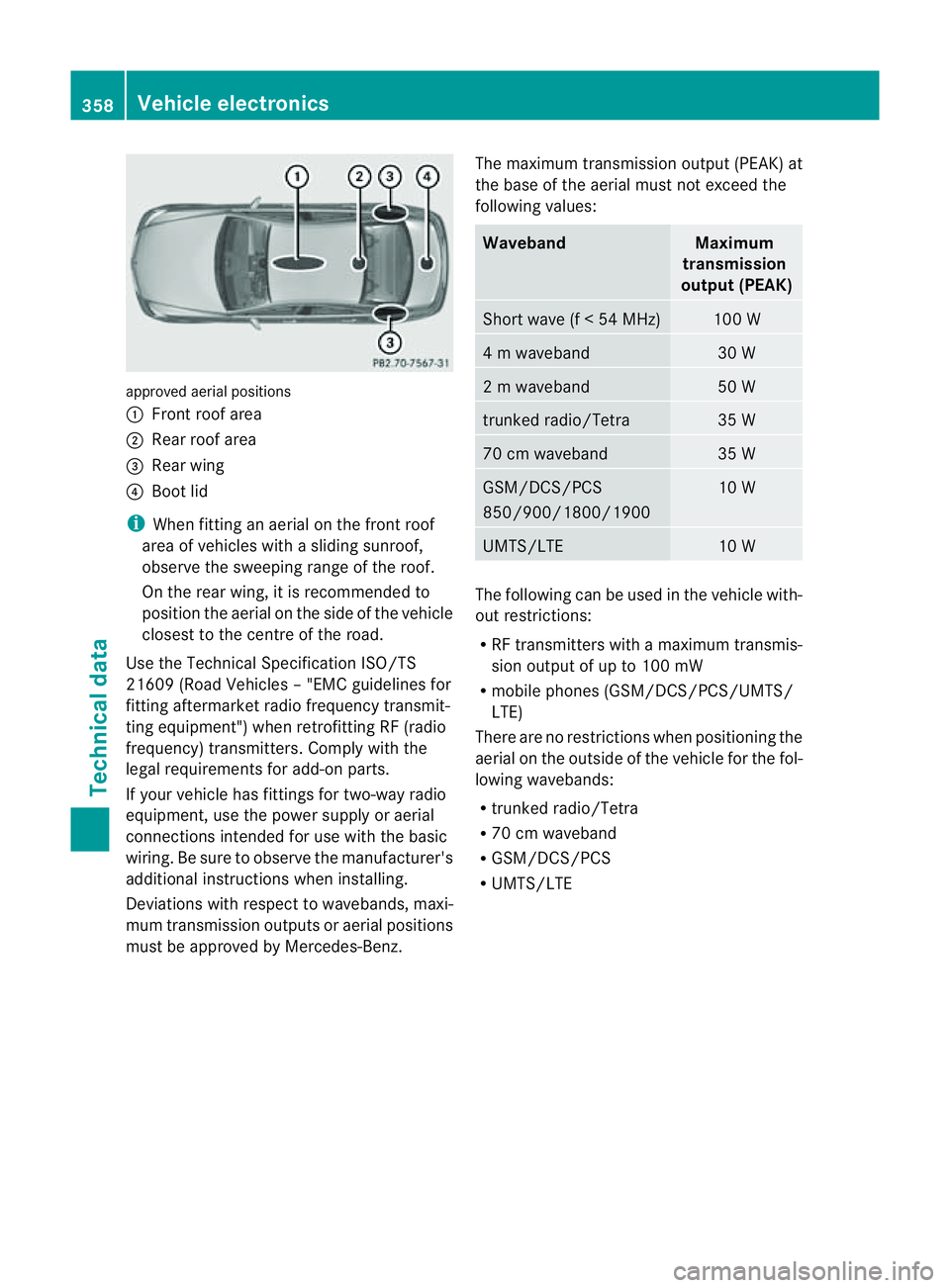
approved aerial positions
:
Fron troo fa rea
; Rear roo farea
= Rearw ing
? Boot lid
i When fittin ganaerial on the front roof
area of vehicles with aslidin gsunroof,
observe the sweepin grang eoft he roof.
On the rear wing, it is recommende dto
position the aerial on the side of the vehicle
closest to the centr eofthe road.
Use the Technical Specification ISO/TS
21609 (Road Vehicles –"EMC guideline sfor
fitting aftermarket radi ofrequency transmit-
ting equipment") when retrofitting RF (radio
frequency )transmitters .Comply with the
legal requirements for add-on parts.
If your vehicle has fittings for two-way radio
equipment, use the power supply or aerial
connection sintended for use with the basic
wiring. Be sure to observe the manufacturer's
additional instructions when installing.
Deviation swith respect to wavebands, maxi-
mum transmission outputs or aerial positions
must be approved by Mercedes-Benz. The maximum transmission output (PEAK)at
the base of the aerial must not exceed the
following values: Waveband Maximum
transmission
output( PEAK) Short wave (f
<54MHz) 100 W
4mw
aveband 30 W
2mw
aveband 50 W
trunked radio/Tetra 35 W
70 cm waveband 35 W
GSM/DCS/PCS
850/900/1800/1900 10 W
UMTS/LTE 10 W
The following can be used in the vehicle with-
out restrictions:
R
RF transmitters with amaximum transmis-
sion output of up to 10 0mW
R mobile phones (GSM/DCS/PCS/UMTS/
LTE)
Ther eare no restriction swhen positioning the
aerial on the outside of the vehicle for the fol-
lowing wavebands:
R trunked radio/Tetra
R 70 cm waveband
R GSM/DCS/PCS
R UMTS/LTE 358
Vehicle electronicsTechnical data
Page 362 of 373
Identification plates
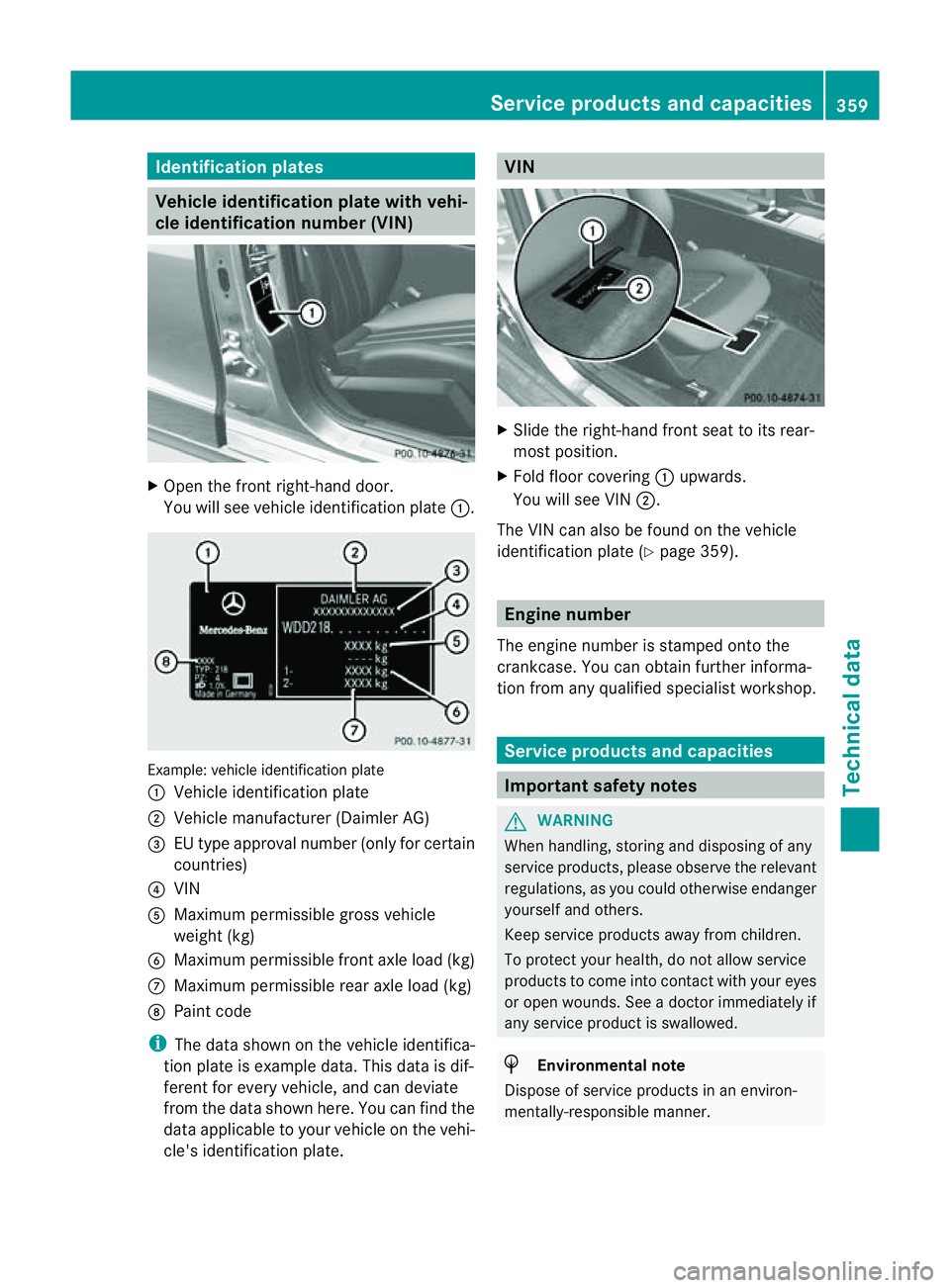
Vehicle identification plate with vehi-
cle identification number (VIN) X
Open th efront ri ght-han ddoor.
You will see vehicle identification plate :.Example: vehicle identification plate
:
Vehicle identification plate
; Vehicle manufacturer (Daimler AG)
= EU type approval number (only for certain
countries)
? VIN
A Maximum permissible gros svehicle
weight (kg)
B Maximum permissible front axle load (kg)
C Maximum permissible rear axle load (kg)
D Paint code
i The data shown on the vehicle identifica-
tion plate is example data. This data is dif-
ferent for ever yvehicle, and can deviate
fro mt he data shown here. You can find the
data applicable to your vehicle on the vehi-
cle's identification plate. VIN
X
Slide the right-hand front seat to its rear-
most position.
X Fold floor covering :upwards.
You will see VIN ;.
The VIN can also be found on the vehicle
identification plate (Y page 359). Engine number
The engine number is stamped onto the
crankcase. You can obtain further informa-
tion from any qualified specialist workshop. Service products and capacities
Important safety notes
G
WARNING
When handling, storing and disposing of any
service products, please observe the relevant
regulations, as you could otherwise endanger
yourself and others.
Keep service products away from children.
To protect your health, do not allow service
products to come into contact with your eyes
or open wounds. See adoctor immediately if
any service product is swallowed. H
Environmental note
Dispose of service products in an environ-
mentally-responsible manner. Service products and capacities
359Technical data Z
Page 364 of 373
R
M85 (petrol with 85 %methanol)
R M100 (100 %methanol)
R Petrol with metallic additives
R Diesel
Do not mix these fuels with petrol, and do
not use any additives. This can otherwise
lead to engine damage. This does not
include cleaning additives for the removal
and prevention of residue build-up. Only
cleaning additives recommended by
Mercedes-Ben zshould be added to petrol,
see "Additives". You can obtain further
information from any Mercedes-Benz
Service Centre.
Usuallyy ou will find information about the
fuel grade on the pump. If you cannot find the
label on the petrol pump, ask the filling sta-
tion staff.
i E10 fuel contains up to 10 %bioethanol.
Your vehicle is suitable for use with E10
fuel. You can refuel your vehicle using E10
fuel.
i If the recommended fuel is not available,
but only as atemporary measure, you may
also use unleaded petrol with an octane
rating of 91 RON/82.5 MON. This may
reduce engine performance and increase
fuel consumption .Avoid driving at full
throttle.
Information on refuelling (Y page157).
AMG vehicles
! Only refue lusing super unleadedp etrol
with at least 98 RON/88 MON that con-
forms to European standard EN 228 or an
equivalent specification.
You can otherwise impair engine outpu tor
damage the engine.
! Premium-grade unleaded petro lwith an
octane ratin gof95RON/85 MON may be
used as atemporary measure if the recom-
mended fuel is not available. This may
reduce engin eperformanc eand increase
fuel consumption .Asmuch as possible,
avoid driving at full throttle. !
Regular unleadedp etrol with an octane
rating of 91 RON/82.5 MON may also be
used as atemporary measure if the recom-
mended fuel is not available.
Doing so results in noticeably higher fuel
consumption, and the engine power output
is noticeably reduced. Avoid driving at full
throttle.
If only regularu nleaded petrol with an
octane rating of 91 RON/82.5 MON or
lowe risa vailable, you must have the vehi-
cle adapted to this fuel at aqualified spe-
cialist workshop.
i E10 fuel contains up to 10 %bioethanol.
Your vehicle is suitablef or use with E10
fuel. You can refuel your vehicle using E10
fuel.
CLS 350 BlueEFFICIENCY
! Only refuel using premium-grade sulphur-
free unleadedp etrol with at least 95 RON/
85 MON that conformstoE uropean stand-
ard EN 228 or an equivalent specification.
You could otherwise impair engine output
or damage the emission control system.
i In some countries, the available petrol
may not be sufficiently low in sulphur. This
fuel can temporarily produce unpleasant
odours, especially on short journeys. As
soon as sulphur-free fuel (sulphur content
<10p pm) is used for refuelling, the odours
are reduced.
Additives
! Do not refuel with low grade fuel and do
not use fuel additives that have not been
tested and approved for Mercedes-Benz
vehicles. Otherwise the fuel system could
malfunction or be damaged.
One of the major problems with low-grade
fuel is the creation of carbon deposits during
the proces sofburningfuel. Mercedes-Benz
recommends that you use fuel brands that
have additives.
If you use fuels without these additives for a
longer period of time, ther emay be abuild-up Service product
sand capacities
361Technical data Z
Page 365 of 373
of carbon deposits. These will form especially
on the inlet valves and in the combustion
chamber.
This could lead to engine runnin gproblems,
e.g.:
R longer engine warm-up phase
R uneven idle
R engine noise
R misfiring
R loss of power
In areas where petrol with the required addi-
tives is not available, carbon deposits can
build up. In this case, Mercedes-Benz recom-
mends the use of additives that have been
approved for Mercedes-Benz vehicles; see
http://bevo.mercedes-benz.com.
The quality of the fuel available in some coun-
tries may not be sufficient .Residue could
build up as aresult. In such cases, and in
consultation with aMercedes-BenzS ervice
Centre, the petrol may be mixed with the
additive recommended by Mercedes-Benz
(part no. A000989254510). You must
observe the notes and mixin gratios specified
on the container.
Consult aMercedes-BenzS ervice Centreto
view alist of approved products. Observe the
instructions for use in the product descrip-
tion.
Do not mix other fuel additives with fuel. This
causes unnecessary cost sand could damage
the engine.
Diesel (EN 590) Fuel grade
G
WARNING
Do not use petrol to refuel vehicles with adie-
sel engine. Do not mix diesel with petrol. This
would result in damage to the fuel system and
engine, which could lead to avehicle fire.
! When refuelling, only use diesel fuel that
conforms to the European standard EN 590
or is of equivalent quality. Fuel that does not conform to EN 590 can lead to
increased wear as well as damage to the
engin
eand exhaust system.
! Do not use the following:
R marine diesel
R heating oil
R bio-diesel
R vegetable oil
R petrol
R paraffin
R kerosene
Do not mix such fuels with diesel fuel and
do not use any special additives. This can
otherwise lead to engin edamage. This
does not include flow improver additives.
For further information ,see "Flow improv-
ers".
! Vehicles with adiesel particle filter: in
countries outside the EU, only refuel with
low-sulphur Euro diesel with asulphur con-
ten tunde r50p pm; otherwise the emission
contro lsystem could be damaged.
! Vehicles without adiesel particle fil-
ter: in countries where only diesel fuel with
ah igh sulphur conten tisavailable, you will
need to carry out your vehicle's oil change
at shorter intervals. More information
aboutt he interval for oil change can be
obtained from any qualified specialist
workshop.
Usuallyy ou will find information about the
fuel grade on the pump. If you cannot find the
label on the petrol pump, ask the filling sta-
tion staff.
Information on refuelling (Y page 157).
Low outside temperatures
In winter months, diesel fuel with an improved
cold flow quality is available. In Europe, the
EN 590 standard defines various climate-
dependent temperature categories. Malfunc-
tions can be avoided by refuelling with diesel
fuel that corresponds to the climatic specifi-
cations outlined in EN 590. At unusually low 362
Service products and capacitiesTechnical data
Page 366 of 373
outside temperatures, it is possible that the
flow characteristics of the diesel fuel could be
insufficient. Accordingly, diesel fuel from
warmer areas may not be suitable for opera-
tion in colder climatic conditions.
i Further information on country-specific
fuel properties can be obtained from oil
companies, e.g. at filling stations.
Flow improvers
To improve the low-temperature resistanc eof
diesel fuel, aflow improver can be attached.
The effectiveness of aflow improver is not
guaranteed for every fuel.
Only use flow improvers tested and approved
by Mercedes-Benz. During use, please
observe the information on operation.
Correct dosage and sufficient mixing are deci-
sive in improving low-temperature resistance
with the flow improver. Overdosage can
potentially even decrease low-temperature
resistanc eand must therefor ebeavoided.
Follow the manufacturer's guidelines on dos-
age.
Mix the additive into the diesel in good time,
before the flow characteristics of the diesel
become insufficient. Otherwise, malfunctions
can arise through heating the fuel system,
e.g. through parking in aheated garage.
More information about recommended flow
improvers can be obtained from any qualified
specialist workshop.
Fuel consumption information H
Environmental note
CO 2(carbon dioxide) is the gas which scien-
tists believe to be principally responsible for
global warming (the greenhouse effect). Your
vehicle's CO 2emissions are directly related to
fuel consumption and therefor edepend on:
R efficient use of the fuel by the engine
R driving style
R other non-technical factors, such as envi-
ronmental influences or road conditions You can minimise your vehicle's CO
2emis-
sions by driving carefully and having it serv-
iced regularly.
The vehicle will use more fuel than usual in
the following situations:
R at very low outside temperatures
R in urban traffic
R on short journeys
R in mountainous terrain
i Only for certain countries: you can find
the current consumption and emission val-
ues of your vehicle in the COC documents
(EU CERTIFICATE OF CONFORMITY). These
document sare delivered with your vehicle.
The consumption figures were in each case
based on the currently applicabl eversion:
R for vehicles that comply with standards
up to and including the EURO 4standard,
in accordanc ewithEUD irective
80/1268/EEC
R for vehicles tha tcomply with or exceed
the EURO 5standard, in accordanc ewith
Regulatio n(EC )N o. 715/2007
Deviation sfrom these values may occur
under normal operating conditions. Engine oil
General notes The quality of the engine oil is decisive for the
function and service life of an engine. After
extensive tests, Mercedes-Benz approves
engine oils that correspon dtothe current
technical standard.
Therefore, only Mercedes-Benz approved
engine oils may be used in Mercedes-Benz
engines.
Further information on tested and approved
engine oils can be obtained from any
Mercedes-Benz Servic eCentre. Mercedes-
Benz recommends that you have the oil
change carried out at aqualified specialist
workshop. Mercedes-Benz approval is indica- Service products and capacities
363Technical data Z
Page 367 of 373
ted on the oi
lcontaine rbytheinscription "MB
Approval" and th ecorre spondin gdesigna-
tion ,e.g.MBA pproval 229.51.
You can cal lupanoverview of approved
engin eoils on th eInterne tat:
http://bevo.mercedes-benz.com by enter-
ing the designation, e.g .229.5.
The table shows which engine oils have been
approved for your vehicle. Petrol engines MB Approval
CL
S3 50 BlueEFFI-
CIENCY 229.3, 229.5
CL
S5 00 BlueEFFI-
CIENCY
CL S5 00 4MATIC Blue-
EFFICIENCY
CL S63A MG 229.5
Diesel engine
swith
diese lparticle filter MB Approval
CL
S2 50 CDIBlueEFFI-
CIENCY
CL S3 50 CDIBlueEFFI-
CIENCY
CL S3 50 CDI4MATIC
BlueEFFICIENCY 228.51,
229.31
,229.51 Use onl
ySAE 0W-40 or SAE 5W-40 engine oils
for AMG vehicles.
i If the engine oils listed in the table ar enot
available, yo umayaddt he following engine
oils unti lthe next oi lchange:
R vehicles with apetrol engine :MB
Approval 229.1 229.3 or ACEA A3
R diese lengines: MB Approval 229.1,
229.3, 229.5 or ACEA C3
Use onl ySAE 0W-40 or SAE 5W-40 engine
oils for AMG vehicles.
Thi sm ayonl ybet oppedupo nce,and the
quantity must not be greate rtha n1 .0l. Ca
pacities The following value
srefe rtoano il change
including the oil filter. Model Replacement
amount CLS 250 CDI Blue-
EFFICIENCY
CLS 350 BlueEFFI-
CIENCY
6.
5l CLS 350 CDI Blue-
EFFICIENCY
CLS 350 CDI
4MATIC BlueEFFI-
CIENCY
CLS 500 BlueEFFI-
CIENCY
CLS 500 4MATIC
BlueEFFICIENCY
8.
0l CLS 63 AMG
8.
5l Additives
!
Do not use any additives with the engine
oil. This could damage the engine.
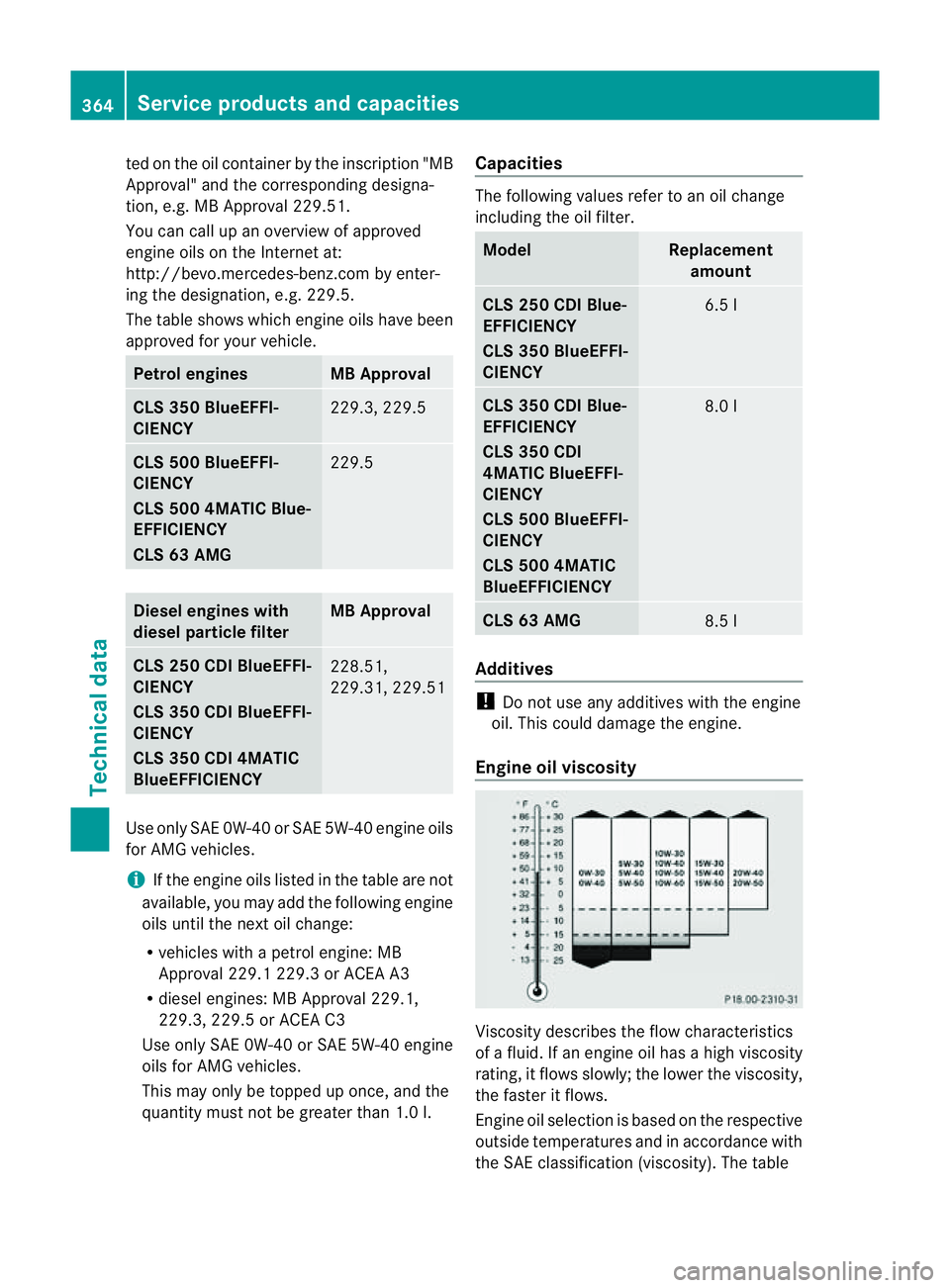
Engine oil viscosity Viscosit
ydescribes the flow characteristics
of afluid. If an engine oil has ahigh viscosity
rating, it flows slowly; the lower the viscosity,
the faster it flows.
Engine oil selection is based on the respective
outside temperatures and in accordance with
the SA Eclassification (viscosity). The table 364
Service products and capacitiesTechnica
ldata