light MERCEDES-BENZ CLS COUPE 2014 Owners Manual
[x] Cancel search | Manufacturer: MERCEDES-BENZ, Model Year: 2014, Model line: CLS COUPE, Model: MERCEDES-BENZ CLS COUPE 2014Pages: 417, PDF Size: 14.15 MB
Page 359 of 417
R
Jump-starting may only be performed using batteries with a nominal voltage of 12 V.
R Only use jump leads that have a sufficient cross-section and insulated terminal clamps.
R If the battery is fully discharged, leave the battery that is being used to jump-start connected
for a few minutes before attempting to start. This charges the empty battery a little.
R Make sure that the two vehicles do not touch.
Make sure that:
R The jump leads are not damaged.
R Non-insulated parts of the terminal clamps do not come into contact with other metal parts
while the jump leads are connected to the battery.
R The jump leads cannot come into contact with parts which can move when the engine is
running, such as the V-belt pulley or the fan.
X Firmly depress the parking brake.
X Shift the transmission to position P.
X Switch off all electrical consumers, e.g. rear window heating, lighting etc.
X Open the bonnet.
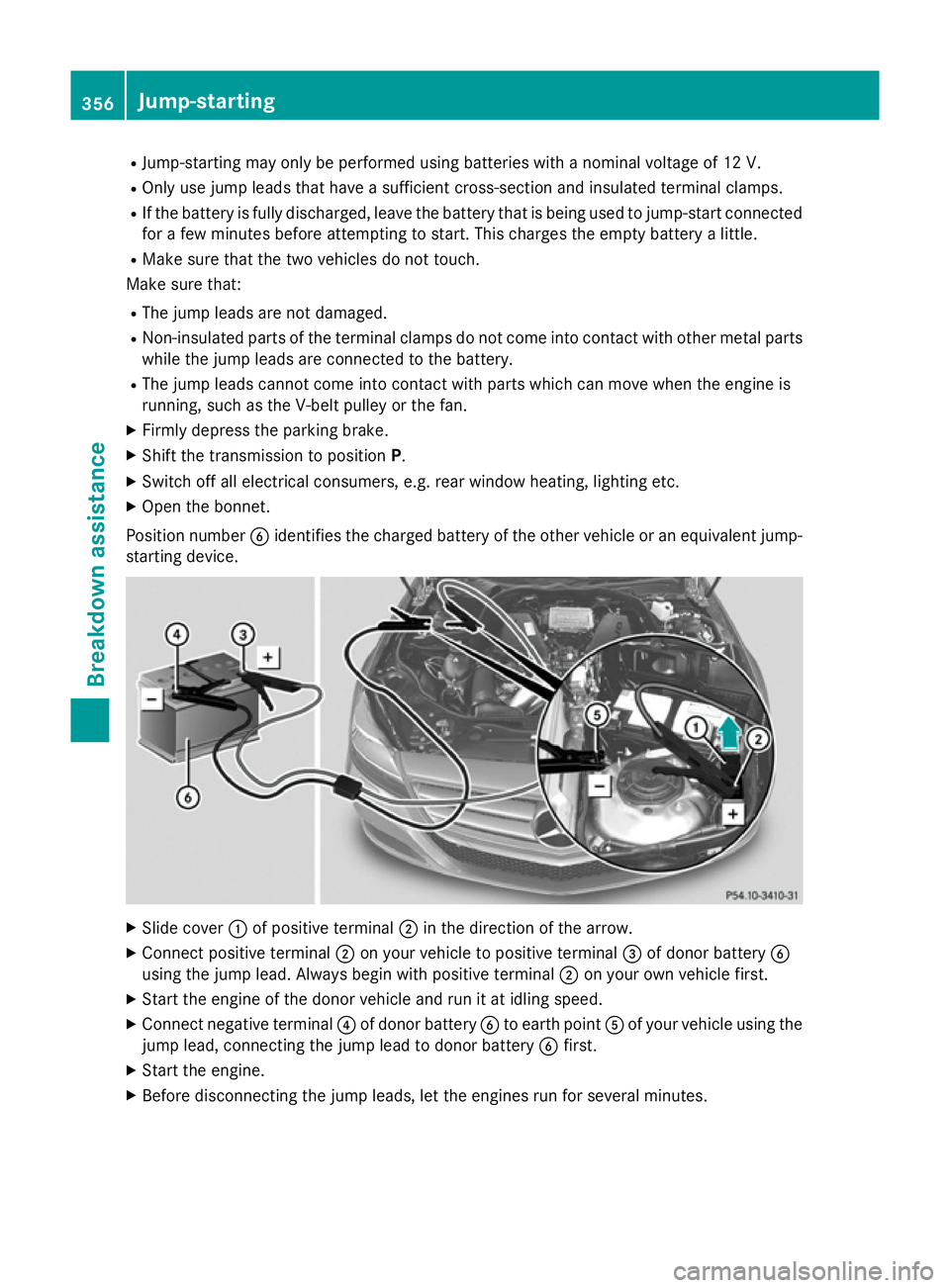
Position number Bidentifies the charged battery of the other vehicle or an equivalent jump-
starting device. X
Slide cover :of positive terminal ;in the direction of the arrow.
X Connect positive terminal ;on your vehicle to positive terminal =of donor battery B
using the jump lead. Always begin with positive terminal ;on your own vehicle first.
X Start the engine of the donor vehicle and run it at idling speed.
X Connect negative terminal ?of donor battery Bto earth point Aof your vehicle using the
jump lead, connecting the jump lead to donor battery Bfirst.
X Start the engine.
X Before disconnecting the jump leads, let the engines run for several minutes. 356
Jump-startingBreakdown assistance
Page 371 of 417
Observe the recommended tyre pressures
and check the tyre pressure of all the tyres
including the spare wheel:
R every day before starting a journey
R when the load changes
R prior to long journey
R for changed operating conditions, e.g. off-
road driving
If necessary, correct the tyre pressure. G
WARNING
If you fit unsuitable accessories onto tyre
valves, the tyre valves may be overloaded and malfunction, which can cause tyre pressure
loss. Due to their design, retrofitted tyre pres-
sure monitors keep the tyre valve open. This
can also result in tyre pressure loss. There is a risk of accident.
Only screw standard valve caps or valve caps
specifically provided by Mercedes-Benz for
your vehicle onto the tyre valve. G
WARNING
If the tyre pressure drops repeatedly, the
wheel, valve or tyre may be damaged. Tyre
pressure that is too low may result in a tyre
blow-out. There is a risk of accident.
R Check the tyre for foreign objects.
R Check whether the wheel is losing air or the
valve is leaking.
If you are unable to rectify the damage, con-
tact a qualified specialist workshop. H
Environmental note
Check the tyre pressure regularly, at least
every 14 days.
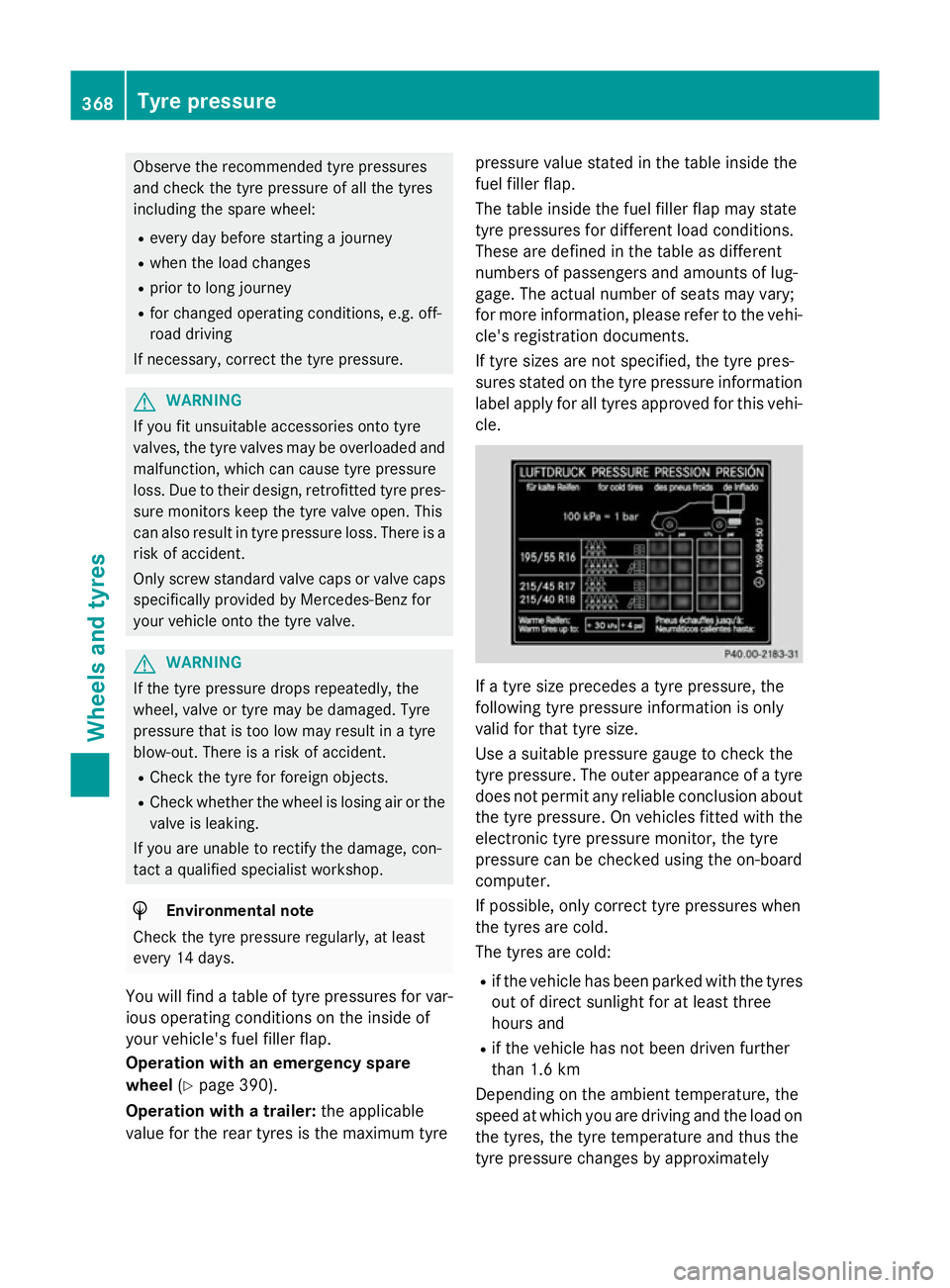
You will find a table of tyre pressures for var- ious operating conditions on the inside of
your vehicle's fuel filler flap.
Operation with an emergency spare
wheel (Ypage 390).
Operation with a trailer: the applicable
value for the rear tyres is the maximum tyre pressure value stated in the table inside the
fuel filler flap.
The table inside the fuel filler flap may state
tyre pressures for different load conditions.
These are defined in the table as different
numbers of passengers and amounts of lug-
gage. The actual number of seats may vary;
for more information, please refer to the vehi-
cle's registration documents.
If tyre sizes are not specified, the tyre pres-
sures stated on the tyre pressure information
label apply for all tyres approved for this vehi- cle. If a tyre size precedes a tyre pressure, the
following tyre pressure information is only
valid for that tyre size.
Use a suitable pressure gauge to check the
tyre pressure. The outer appearance of a tyre does not permit any reliable conclusion aboutthe tyre pressure. On vehicles fitted with the
electronic tyre pressure monitor, the tyre
pressure can be checked using the on-board
computer.
If possible, only correct tyre pressures when
the tyres are cold.
The tyres are cold:
R if the vehicle has been parked with the tyres
out of direct sunlight for at least three
hours and
R if the vehicle has not been driven further
than 1.6 km
Depending on the ambient temperature, the
speed at which you are driving and the load on the tyres, the tyre temperature and thus the
tyre pressure changes by approximately 368
Tyre pressureWheels and tyres
Page 372 of 417
10 kPa (0.1 bar/1.5 psi) per 10 †. Take this
into account when checking the pressure of
warm tyres. Only correct the tyre pressure if it
is too low for the current operating condi-
tions.
Driving with tyre pressure that is too high or
too low can:
R shorten the service life of the tyres
R cause increased tyre damage
R have a negative effect on handling charac-
teristics and thus driving safety (e.g. aqua-
planing)
i The tyre pressure values given for low
loads are minimum values which offer you
good ride comfort characteristics.
However, you can also use the values given for higher loads. These are permissible and
will not adversely affect the running of the
vehicle.
For speeds up to 210 km/h (does not
apply to AMG vehicles): for speeds up to
210 km/h, the values given on the tyre pres- sure information label (fuel filler flap) may be
reduced by 20 kPa (0.2 bar/3 psi) without a
reduction in safety.
This improves the ride comfort of your vehi-
cle; however, fuel consumption may increase
slightly. Tyre pressure loss warning system
General notes While the vehicle is in motion, the tyre pres-
sure loss warning system monitors the set
tyre pressure using the rotational speed of
the wheels. This enables the system to detect significant pressure loss in a tyre. If the speed
of rotation of a wheel changes as a result of a loss of pressure, a corresponding warning
message will appear in the multifunction dis- play.
You can recognise the tyre pressure loss
warning by the Run Flat Indicator
Run Flat Indicator
active Restart with OK active Restart with OK message whichappears in the
Serv.
Serv.menu of the multifunc-
tion display. Information on the message dis- play can be found in the "Restarting the tyre
pressure loss warning system" section
(Y page 369).
Important safety notes The tyre pressure warning system does not
warn you of an incorrectly set tyre pressure.
Observe the notes on the recommended tyre
pressure (Y page 367).
The tyre pressure loss warning does not
replace the need to regularly check the tyre
pressures. An even loss of pressure on sev-
eral tyres at the same time cannot be detec-
ted by the tyre pressure loss warning system.
The tyre pressure monitor is not able to warn you of a sudden loss of pressure, e.g. if the
tyre is penetrated by a foreign object. In the
event of a sudden loss of pressure, bring the
vehicle to a halt by braking carefully. Avoid
abrupt steering manoeuvres.
The function of the tyre pressure loss warning
system is limited or delayed if:
R snow chains are fitted to your vehicle's
tyres
R road conditions are wintry
R you are driving on sand or gravel
R you adopt a very sporty driving style (cor-
nering at high speeds or driving with high
rates of acceleration)
R you are towing a very heavy or large trailer
R you are driving with a heavy load (in the
vehicle or on the roof)
Restarting the tyre pressure loss warn-
ing system Restart the tyre pressure loss warning system
if you have:
R changed the tyre pressure
R changed the wheels or tyres
R fitted new wheels or tyres
X Before restarting, make sure that the tyre
pressures are set properly on all four tyres Tyre pressure
369Wheels and tyres Z
Page 374 of 417
the notes on the recommended tyre pressure
(Y page 367).
The tyre pressure monitor is not able to warn you of a sudden loss of pressure, e.g. if the
tyre is punctured by a foreign object. In the
event of a sudden loss of pressure, bring the
vehicle to a halt by braking carefully. Avoid
abrupt steering manoeuvres.
The tyre pressure monitor has a yellow warn-
ing lamp in the instrument cluster for indicat-
ing a pressure loss or malfunction. Depending on how the warning lamp flashes or lights up,
a tyre pressure that is too low or a malfunc-
tion in the tyre pressure monitor is indicated:
R if the warning lamp is lit continuously, the
tyre pressure on one or more tyres is sig-
nificantly too low. The tyre pressure moni-
tor is not malfunctioning.
R if the warning lamp flashes for around a
minute and then remains lit constantly, the
tyre pressure monitor is malfunctioning.
i In addition to the warning lamp, a mes-
sage appears in the multifunction display.
Further information can be found at
(Y page 280).
If the tyre pressure monitor is malfunctioning,
it may take more than ten minutes for the tyre pressure warning lamp to inform you of the
malfunction by flashing for approximately one
minute and then remaining lit. When the fault
has been rectified, the tyre pressure warning lamp goes out after you have driven for a few
minutes.
The tyre pressure values indicated by the on- board computer may differ from those meas-
ured at a filling station using a pressure
gauge. The tyre pressures shown by the on-
board computer refer to those measured at
sea level. At high altitudes, the tyre pressure
values indicated by a pressure gauge are
higher than those shown by the on-board
computer. In this case, do not reduce the tyre
pressures.
The operation of the tyre pressure monitor
can be affected by interference from radio transmitting equipment (e.g. radio head-
phones, two-way radios) that may be being
operated in or near the vehicle.
Checking the tyre pressure electroni-
cally X
Make sure that the key is in position 2in the
ignition lock (Y page 159).
X Press the =or; button on the steer-
ing wheel to select the Service
Service menu.
X Press the 9or: button to select
Tyre pressure Tyre pressure.
X Press the abutton.
The current tyre pressure for each wheel
will be displayed in the multifunction dis-
play.
If the vehicle has been parked for over
20 minutes, the Tyre Tyrepressures
pressures will
willbe
be
displayed after a few minutes of
displayed after a few minutes of
driving driving message appears.
After a teach-in period, the tyre pressure
monitor automatically detects new wheels or new sensors. As long as a clear allocation of
the tyre pressure values to the individual
wheels is not possible, the Tyre pressure Tyre pressure
monitor active monitor active display message is shown
instead of the tyre pressure display. The tyre
pressures are already being monitored.
i If an emergency spare wheel is fitted, for
a few minutes the system may continue to
show the tyre pressure of the wheel that
has been removed. If this occurs, note that the value displayed for the position where
the spare wheel is fitted is not the same asthe current tyre pressure of the emergencyspare wheel. Tyre pressure
371Wheels and tyres Z
Page 378 of 417
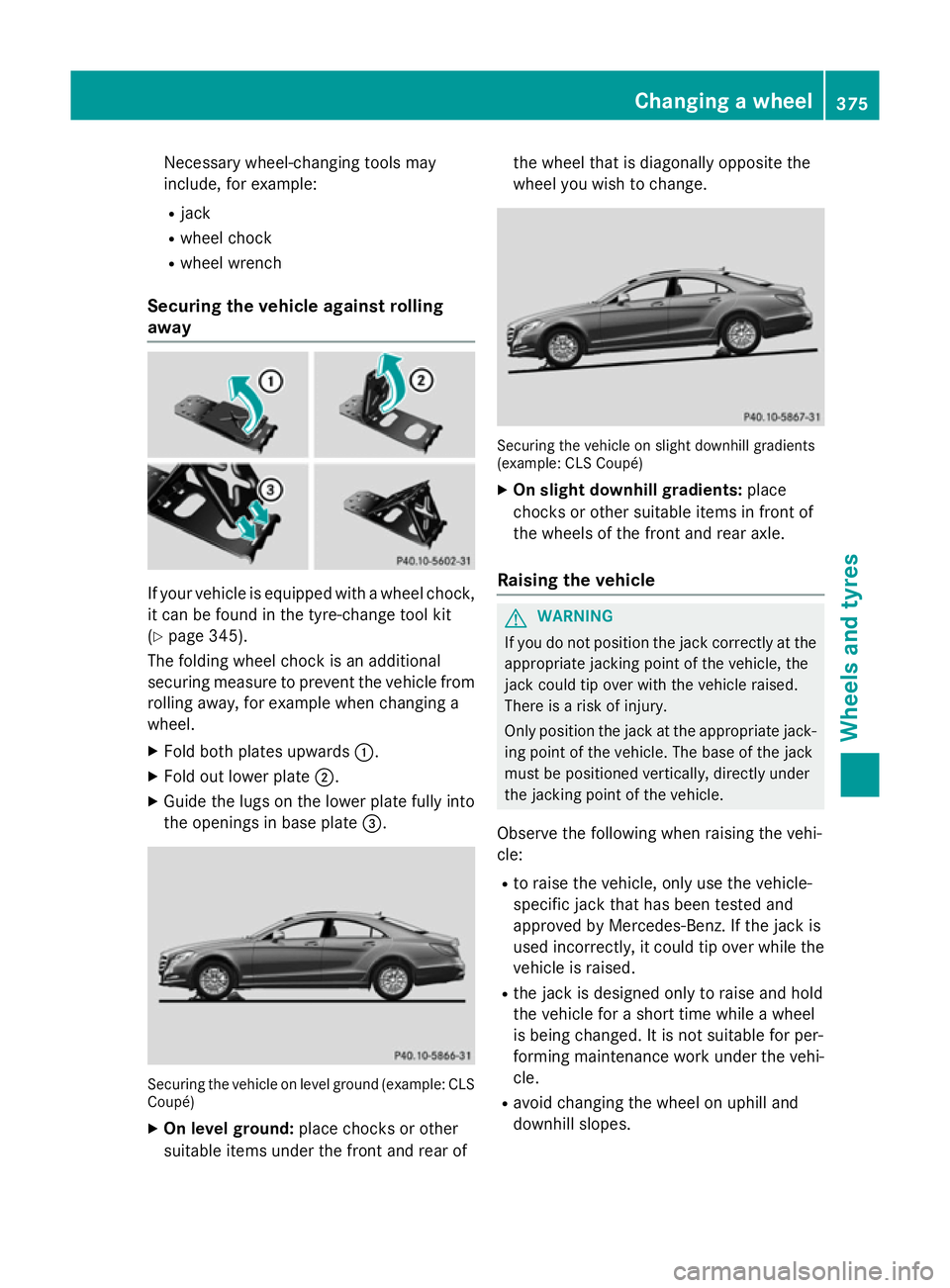
Necessary wheel-changing tools may
include, for example:
R jack
R wheel chock
R wheel wrench
Securing the vehicle against rolling
away If your vehicle is equipped with a wheel chock,
it can be found in the tyre-change tool kit
(Y page 345).
The folding wheel chock is an additional
securing measure to prevent the vehicle from rolling away, for example when changing a
wheel.
X Fold both plates upwards :.
X Fold out lower plate ;.
X Guide the lugs on the lower plate fully into
the openings in base plate =.Securing the vehicle on level ground (example: CLS
Coupé)
X On level ground: place chocks or other
suitable items under the front and rear of the wheel that is diagonally opposite the
wheel you wish to change.
Securing the vehicle on slight downhill gradients
(example: CLS Coupé)
X On slight downhill gradients: place
chocks or other suitable items in front of
the wheels of the front and rear axle.
Raising the vehicle G
WARNING
If you do not position the jack correctly at the appropriate jacking point of the vehicle, the
jack could tip over with the vehicle raised.
There is a risk of injury.
Only position the jack at the appropriate jack-
ing point of the vehicle. The base of the jack
must be positioned vertically, directly under
the jacking point of the vehicle.
Observe the following when raising the vehi-
cle: R to raise the vehicle, only use the vehicle-
specific jack that has been tested and
approved by Mercedes-Benz. If the jack is
used incorrectly, it could tip over while the vehicle is raised.
R the jack is designed only to raise and hold
the vehicle for a short time while a wheel
is being changed. It is not suitable for per-
forming maintenance work under the vehi-
cle.
R avoid changing the wheel on uphill and
downhill slopes. Changing a wheel
375Wheels and tyres Z
Page 383 of 417
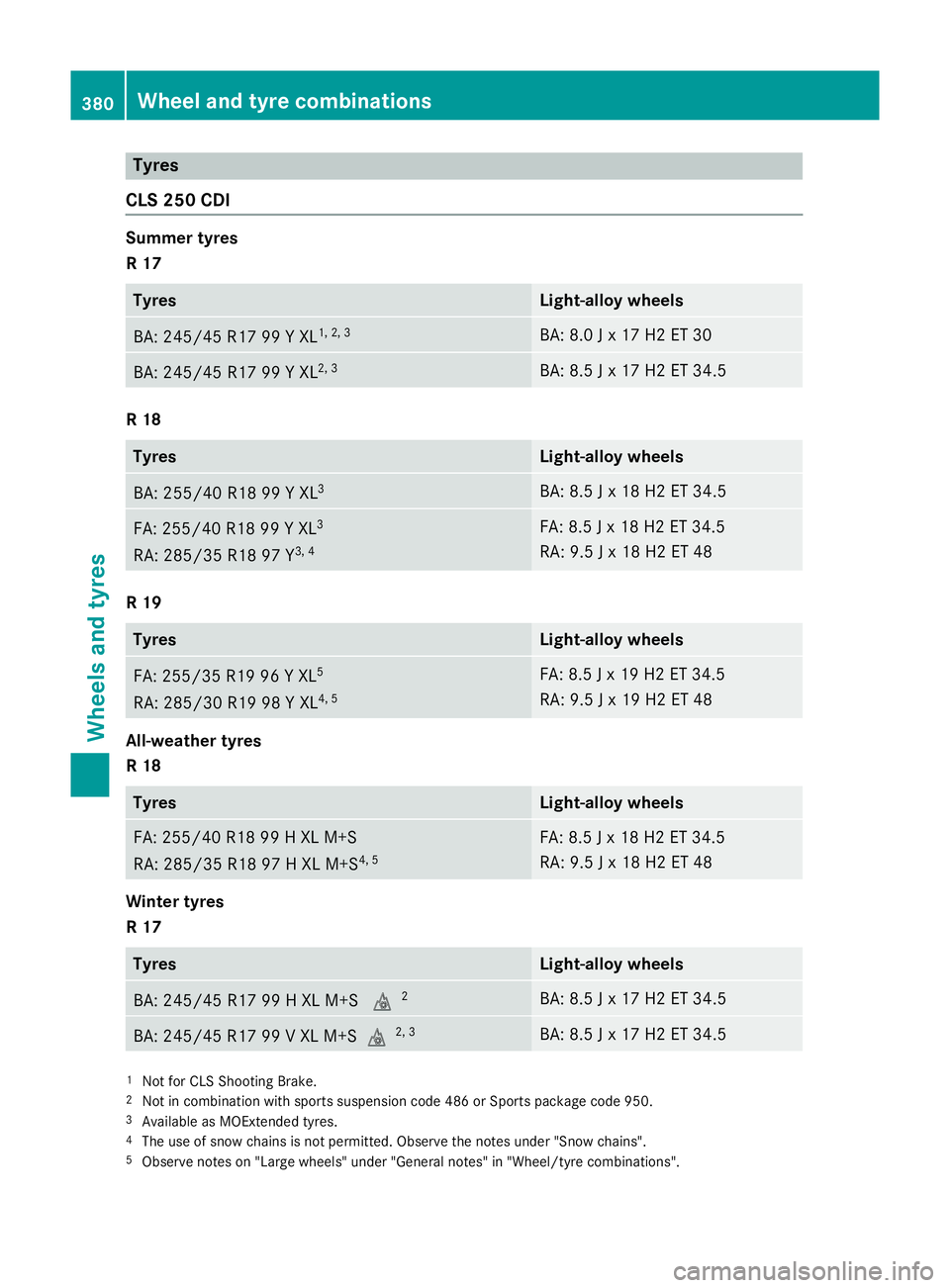
Tyres
CLS 250 CDI Summer tyres
R 17
Tyres Light-alloy wheels
BA: 245/4
5 R17 99 Y XL 1, 2, 3 BA: 8.0 J x 17 H2 ET 30
BA: 245/45 R17 99 Y XL
2, 3 BA: 8.5 J x 17 H2 ET 34.5
R 18
Tyres Light-alloy wheels
BA: 255/40 R18 99 Y XL
3 BA: 8.5 J x 18 H2 ET 34.5
FA: 255/40 R18 99 Y XL
3
RA: 285/35 R18 97 Y 3, 4 FA: 8.5 J x 18 H2 ET 34.5
RA: 9.5 J x 18 H2 ET 48
R 19
Tyres Light-alloy wheels
FA: 255/35 R19 96 Y XL
5
RA: 285/30 R19 98 Y XL 4, 5 FA: 8.5 J x 19 H2 ET 34.5
RA: 9.5 J x 19 H2 ET 48
All-weather tyres
R 18 Tyres Light-alloy wheels
FA: 255/40 R18 99 H XL M+S
RA: 285/35 R18 97 H XL M+S
4, 5 FA: 8.5 J x 18 H2 ET 34.5
RA: 9.5 J x 18 H2 ET 48
Winter tyres
R 17
Tyres Light-alloy wheels
BA: 245/45 R17 99 H XL M+S
i2 BA: 8.5 J x 17 H2 ET 34.5
BA: 245/45 R17 99 V XL M+Si
2, 3 BA: 8.5 J x 17 H2 ET 34.5
1
Not for CLS Shooting Brake.
2 Not in combination with sports suspension code 486 or Sports package code 950.
3 Available as MOExtended tyres.
4 The use of snow chains is not permitted. Observe the notes under "Snow chains".
5 Observe notes on "Large wheels" under "General notes" in "Wheel/tyre combinations". 380
Wheel and tyre combinationsWheels and tyres
Page 384 of 417
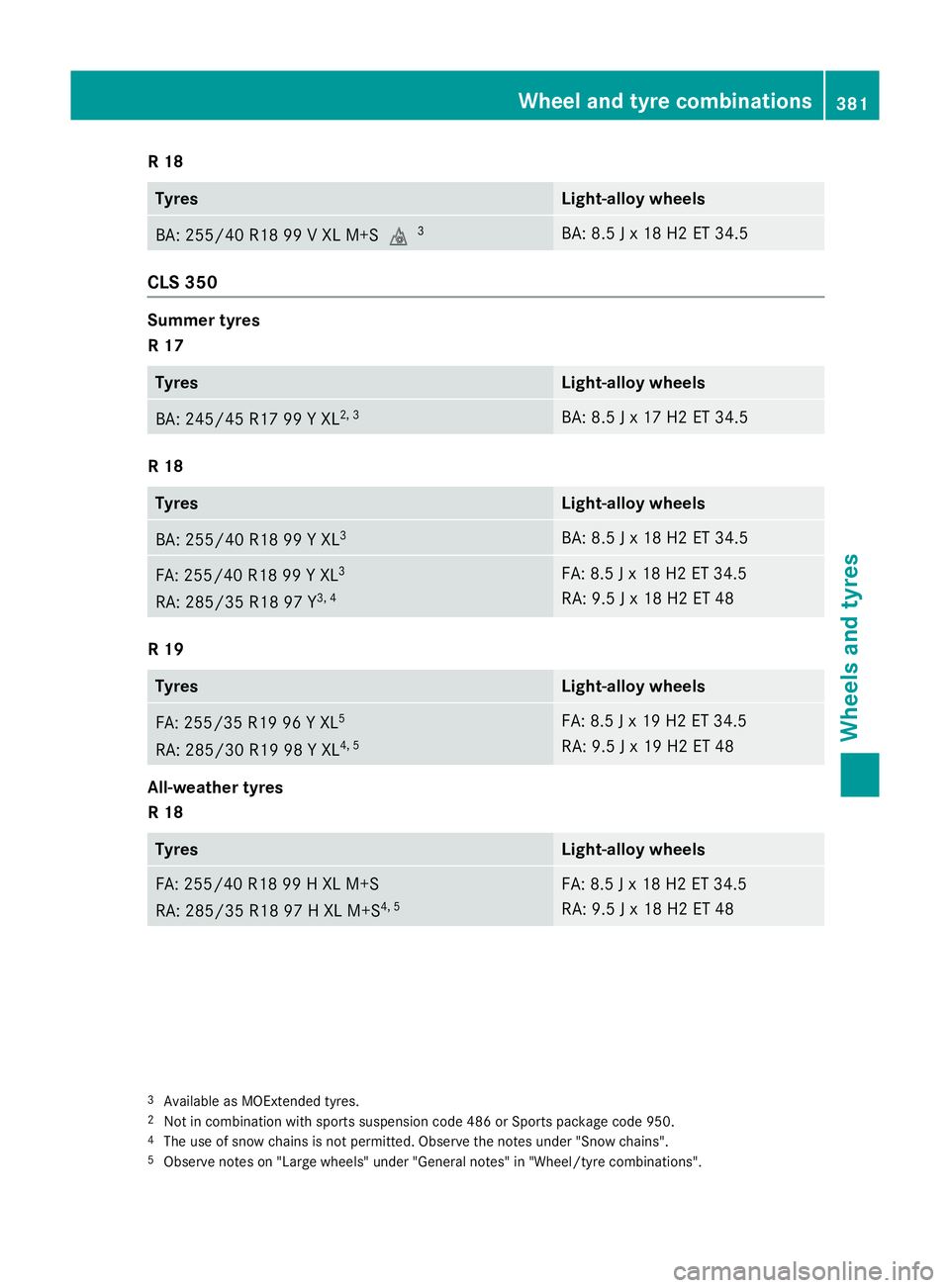
R 18
Tyres Light-alloy wheels
BA: 255/40 R18 99 V XL M+Si
3 BA: 8.5 J x 18 H2 ET 34.5
CLS 350
Summer tyres
R 17
Tyres Light-alloy wheels
BA: 245/45 R17 99 Y XL
2, 3 BA: 8.5 J x 17 H2 ET 34.5
R 18
Tyres Light-alloy wheels
BA: 255/40 R18 99 Y XL
3 BA: 8.5 J x 18 H2 ET 34.5
FA: 255/40 R18 99 Y XL
3
RA: 285/35 R18 97 Y 3, 4 FA: 8.5 J x 18 H2 ET 34.5
RA: 9.5 J x 18 H2 ET 48
R 19
Tyres Light-alloy wheels
FA: 255/35 R19 96 Y XL
5
RA: 285/30 R19 98 Y XL 4, 5 FA: 8.5 J x 19 H2 ET 34.5
RA: 9.5 J x 19 H2 ET 48
All-weather tyres
R 18
Tyres Light-alloy wheels
FA: 255/40 R18 99 H XL M+S
RA: 285/35 R18 97 H XL M+S 4, 5 FA: 8.5 J x 18 H2 ET 34.5
RA: 9.5 J x 18 H2 ET 48
3
Available as MOExtended tyres.
2 Not in combination with sports suspension code 486 or Sports package code 950.
4 The use of snow chains is not permitted. Observe the notes under "Snow chains".
5 Observe notes on "Large wheels" under "General notes" in "Wheel/tyre combinations". Wheel and tyre combinations
381Wheels and tyres Z
Page 385 of 417
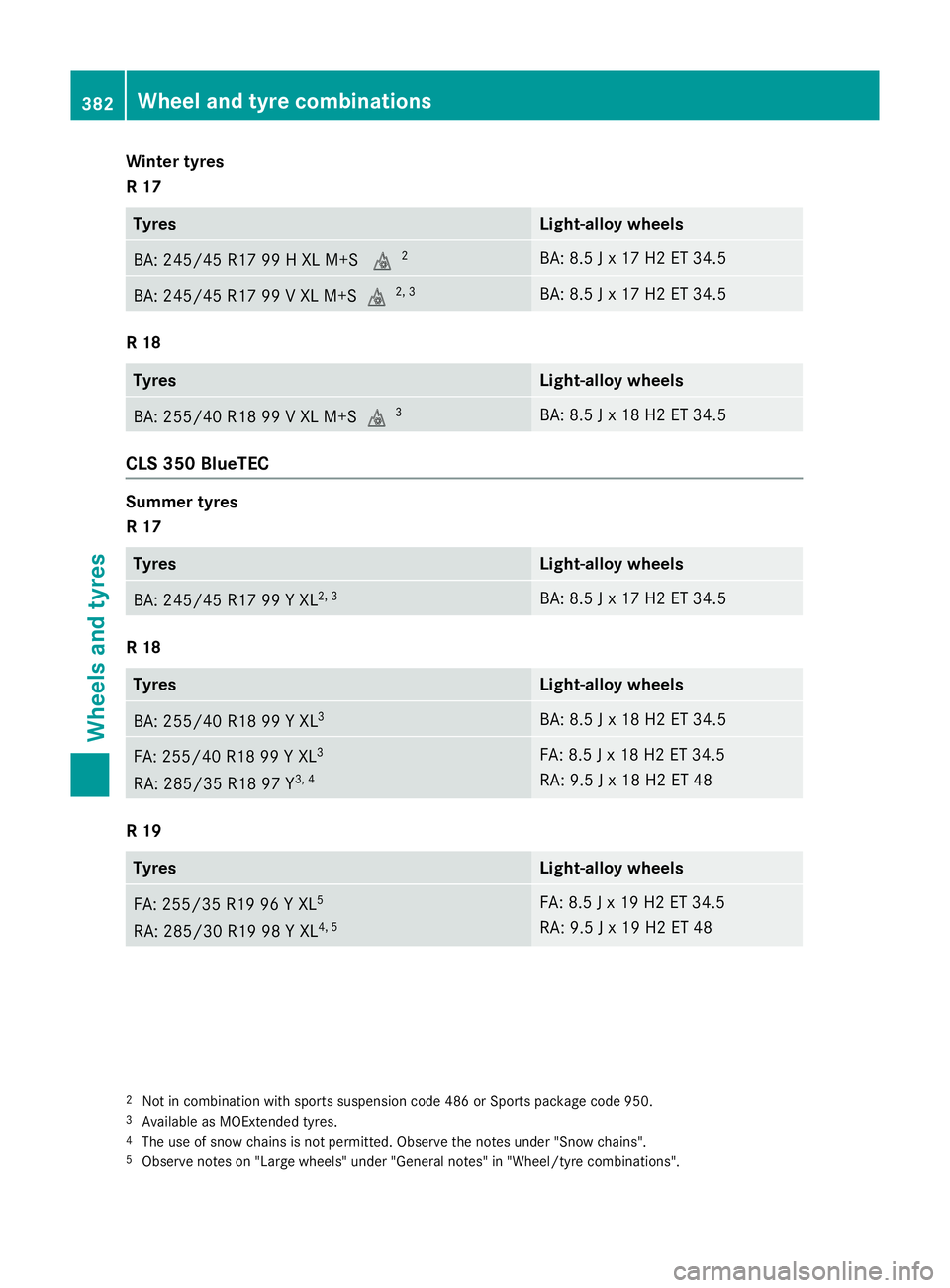
Winter tyres
R 17
Tyres Light-alloy wheels
BA: 245/45 R17 99 H XL M+S
i2 BA: 8.5 J x 17 H2 ET 34.5
BA: 245/45 R17 99 V XL M+Si
2, 3 BA: 8.5 J x 17 H2 ET 34.5
R 18
Tyres Light-alloy wheels
BA: 255/40 R18 99 V XL M+Si
3 BA: 8.5 J x 18 H2 ET 34.5
CLS 350 BlueTEC
Summer tyres
R 17
Tyres Light-alloy wheels
BA: 245/45 R17 99 Y XL
2, 3 BA: 8.5 J x 17 H2 ET 34.5
R 18
Tyres Light-alloy wheels
BA: 255/40 R18 99 Y XL
3 BA: 8.5 J x 18 H2 ET 34.5
FA: 255/40 R18 99 Y XL
3
RA: 285/35 R18 97 Y 3, 4 FA: 8.5 J x 18 H2 ET 34.5
RA: 9.5 J x 18 H2 ET 48
R 19
Tyres Light-alloy wheels
FA: 255/35 R19 96 Y XL
5
RA: 285/30 R19 98 Y XL 4, 5 FA: 8.5 J x 19 H2 ET 34.5
RA: 9.5 J x 19 H2 ET 48
2
Not in combination with sports suspension code 486 or Sports package code 950.
3 Available as MOExtended tyres.
4 The use of snow chains is not permitted. Observe the notes under "Snow chains".
5 Observe notes on "Large wheels" under "General notes" in "Wheel/tyre combinations". 382
Wheel and tyre combinationsWheels and tyres
Page 386 of 417
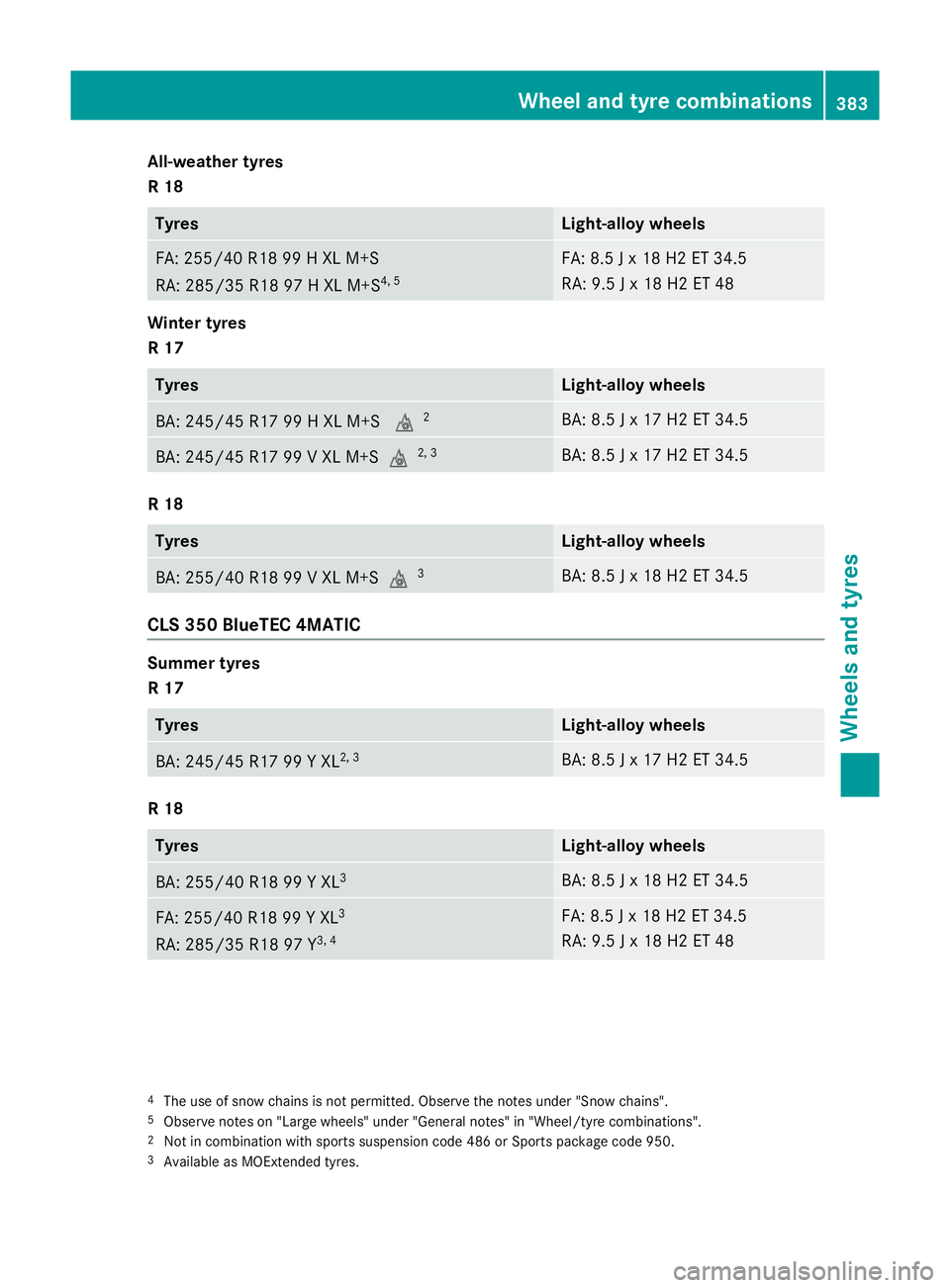
All-weather tyres
R 18
Tyres Light-alloy wheels
FA: 255/40 R18 99 H XL M+S
RA: 285/35 R18 97 H XL M+S 4, 5 FA: 8.5 J x 18 H2 ET 34.5
RA: 9.5 J x 18 H2 ET 48
Winter tyres
R 17
Tyres Light-alloy wheels
BA: 245/45 R17 99 H XL M+S
i2 BA: 8.5 J x 17 H2 ET 34.5
BA: 245/45 R17 99 V XL M+S
i2, 3 BA: 8.5 J x 17 H2 ET 34.5
R 18
Tyres Light-alloy wheels
BA: 255/40 R18 99 V XL M+S
i3 BA: 8.5 J x 18 H2 ET 34.5
CLS 350 BlueTEC 4MATIC
Summer tyres
R 17
Tyres Light-alloy wheels
BA: 245/45 R17 99 Y XL
2, 3 BA: 8.5 J x 17 H2 ET 34.5
R 18
Tyres Light-alloy wheels
BA: 255/40 R18 99 Y XL
3 BA: 8.5 J x 18 H2 ET 34.5
FA: 255/40 R18 99 Y XL
3
RA: 285/35 R18 97 Y 3, 4 FA: 8.5 J x 18 H2 ET 34.5
RA: 9.5 J x 18 H2 ET 48
4
The use of snow chains is not permitted. Observe the notes under "Snow chains".
5 Observe notes on "Large wheels" under "General notes" in "Wheel/tyre combinations".
2 Not in combination with sports suspension code 486 or Sports package code 950.
3 Available as MOExtended tyres. Wheel and tyre combinations
383Wheels and tyres Z
Page 387 of 417
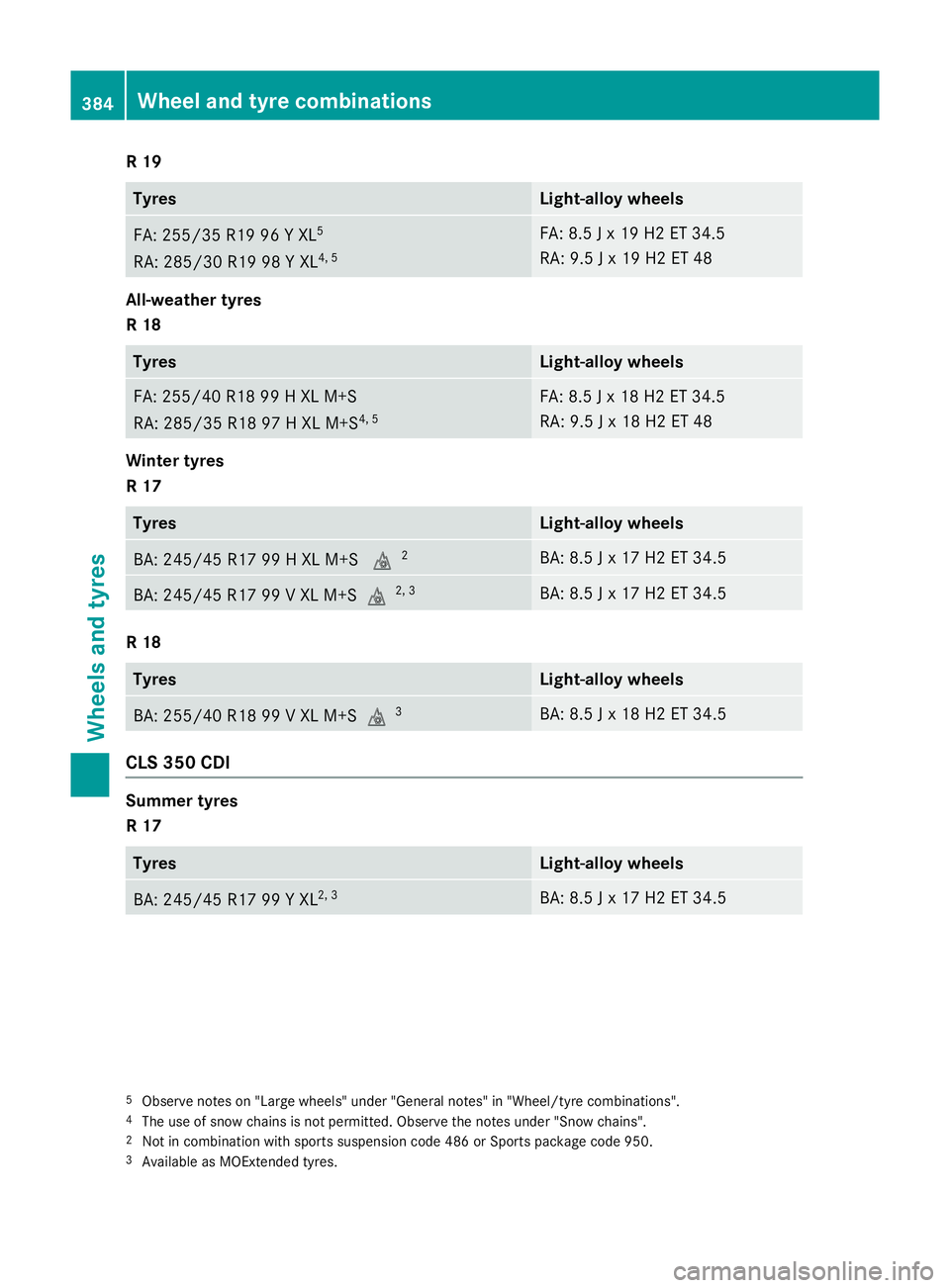
R 19
Tyres Light-alloy wheels
FA: 255/35 R19 96 Y XL
5
RA: 285/30 R19 98 Y XL 4, 5 FA: 8.5 J x 19 H2 ET 34.5
RA: 9.5 J x 19 H2 ET 48
All-weather tyres
R 18 Tyres Light-alloy wheels
FA: 255/40 R18 99 H XL M+S
RA: 285/35 R18 97 H XL M+S
4, 5 FA: 8.5 J x 18 H2 ET 34.5
RA: 9.5 J x 18 H2 ET 48
Winter tyres
R 17
Tyres Light-alloy wheels
BA: 245/45 R17 99 H XL M+S
i2 BA: 8.5 J x 17 H2 ET 34.5
BA: 245/45 R17 99 V XL M+Si
2, 3 BA: 8.5 J x 17 H2 ET 34.5
R 18
Tyres Light-alloy wheels
BA: 255/40 R18 99 V XL M+Si
3 BA: 8.5 J x 18 H2 ET 34.5
CLS 350 CDI
Summer tyres
R 17
Tyres Light-alloy wheels
BA: 245/45 R17 99 Y XL
2, 3 BA: 8.5 J x 17 H2 ET 34.5
5
Observe notes on "Large wheels" under "General notes" in "Wheel/tyre combinations".
4 The use of snow chains is not permitted. Observe the notes under "Snow chains".
2 Not in combination with sports suspension code 486 or Sports package code 950.
3 Available as MOExtended tyres. 384
Wheel and tyre combinationsWheels and tyres