brakes MERCEDES-BENZ E-CLASS CABRIOLET 2010 Owner's Manual
[x] Cancel search | Manufacturer: MERCEDES-BENZ, Model Year: 2010, Model line: E-CLASS CABRIOLET, Model: MERCEDES-BENZ E-CLASS CABRIOLET 2010Pages: 333, PDF Size: 7.64 MB
Page 191 of 333
Gen
eral information i
When towing atrail er,s et the tyr epres-
sure on th erear axle of the towing vehicle
for am aximum load; se ethe tyr epressure
table in th efuel filler flap.
You will find installatio ndimensions and loads
in the "Technical data” section
(Y page 322).
The maximum permissible trailer drawbar
noseweight on the ball coupling is 75 kg.
However ,the actual noseweight must not
exceed the value given on the trailer tow hitch
and trailer identification plates. The lowest
weight applies.
! Use anoseweight as close as possible to
the maximum permissible noseweight .Do
not use anoseweight of less than 50 kg,
otherwise the trailer ma ycome loose.
Bear in min dthat the payload and the rear
axl eload ar ereduced by the actual nose-
weight.
Please not ethat when towing atrailer, PARK-
TRONIC (Y page 174) and parkin gguidance
(Y page 177 )are onl yavail ablew ith limita-
tions, or not at all.
i The height of the ball coupling changes
with the load of the vehicle. If necessary,
use atrailer wit haheight-adjustable draw-
bar.
Driving tips i
Observ ethe notes on ESP ®
trailer stabi-
lisation (Y page 58).
In Germany, the maximum permissible speed
for vehicle/ trailer combinations depends on
the type of trailer and is either 80 km/ hor
100 km/h. In some countries ,higher maxi-
mum speeds are permissible for vehicle/
trailer combinations. Befor ebeginnin gthe
journey ,check the trailer's documen tsto see
what the maximum permitted speed is.
For certain Mercedes-Benz vehicles, the max-
imum permissible rear axle load is increased
when towing atrailer. Refer to th e"Technical data
"section to fin dout whether this applies
to your vehicle. If you utilise any of the added
maximum rear axle load when towing atrailer,
th ev ehicle/ trailer combination may not
exceed amaximum spee dof100 km/h for
reasons concerning the operating permit.
This als oapplies in countries in which the
permissible maximum speed for vehicle/
trailer combinations is above 10 0km/h.
When towing atrailer, your vehicle's handling
characteristics wil lbedifferent in comparison
to when drivin gwithout atrailer.
Th ev ehicle/ trailer combination:
R is heavier
R is restricted in its acceleration and gradi-
ent-climbin gcapability
R has an increased braking distance
R is affected more by stron gcrosswinds
R demand smore sensitive steering
R consume smore fuel
On long and steep downhil lgradients ,you
must shift to alower gear in good time, or on
vehicles with automatic transmission ,select
the shift range 1,2or 3.
i This also applies if you have activated
cruise control, SPEEDTRONIC or DI S-
TRONIC PLUS.
This will use the brakin geffect of th eengine,
so les sbraking wil lberequired to maintain
the speed. This relieves the load on the brake
system and prevent sthe brakes from over-
heating and wearing too quickly .Ifyou need
additional braking, depress the brake pedal
repeatedly rather than con tinuously.
Driving tips R
Maintain agreater distance from th evehi-
cle in front than when driving without a
trailer.
R Avoid braking abruptly. If possible, brake
gently at first to allow the trailer to run on.
Then increase the braking force rapidly.
R The values given for gradient-climbing
capabilities from astandstill refer to sea 188
Trailer towingDrivin
gand pa rking
BA 20 7ECE ÄJ 2010 /1a; 1; 2, en-GB
mkalafa Version: 3.0.2.11 2010-01-26T13:03:22+01:00 -Seite 188
Page 218 of 333

Applying th
ebrakes Display messages Possible causes/consequences and
M Solutions
J ABS and
ESP cur‐
rently
unavaila‐
ble See
Owner's
Manual G
Risk of accident
AB S(Anti-lock Brakin gSystem), ESP ®
(Electronic Stability
Program), BA S(Brake Ass ist), PRE-SAFE ®
,t he HOL Dfunction,
hill start assis tand ESP ®
trailer stabilisation are temporarily
not available .For example, the on-boar dvoltage ma ybeinsuf-
ficient. BAS PLUS (Brake Assist PLUS) and PRE-SAFE ®
Brake
may be inoperative as well .Ina ddition, the ä,å
and ! warning lamps light up in the instrumen tcluster.
ATTE NTION ASSIS Tisdeactiva ted.
The brak esystem continues to function normally, but without
the function slisted above. The wheels could therefore lock if
you brak ehard, for example.
X Drive on carefully.
If the display message disappears, the functions listed
above are available again.
If the display message continues to be displayed:
X Drive on carefully.
X Visit aqualified specialist workshop. J AB
Sa nd
ESP inop‐
erative
See Own‐
er's Man‐
ual G
Ris
kofa ccident
ABS, ESP ®
,B AS ,PRE-SAFE ®
,t he HOL Dfunction, hill start
assis tand ESP ®
traile rstabilisatio nare not avail able due to a
malf unction. BAS PLUS and PRE-SAFE ®
Brake may als ohave
failed. In addition, the ä,åand! warning lamps
light up in the instrument cluster.
ATTENTION ASSIST is deactivated.
The brake system continues to function normally, but without
the functions listed above. The wheels coul dtherefore lock if
you brake hard, for example.
X Drive on carefully.
X Visit aquali fieds pecialist workshop. Display messages
215On-boardcomputer and displays
BA 20 7ECE ÄJ 2010/1a; 1; 2, en-GB
mkalafa Version:3.0.2.11
2010-01-26T13:03:22+01:0
0-Seite 215 Z
Page 239 of 333
Warnin
gand indicator lamps in th einstrument cluster Applying th
ebrakes Problem Possible causes/consequence
sand M Solutions
J
The red brak
esystem
warning lamp comes on
while the vehicl eis
moving .Awarning tone
also so unds. Yo
ua re driving wit hthe parking brake enga ged.
X Releas ethe parking brake.
The warning lamp goes out and the warning ton eceases. J
The red brak
esystem
warning lamp comes on
while the engine is run-
ning. Awarning tone
also so unds. G
Risk of accident
There is insufficient brake fluid in the fluid reservoir.
X Pul lover and stop th evehicle safely as soon as possible, paying
attention to road and traffic conditions. Do not continue driv ing
unde rany circumstances.
X Engag ethe parking brake.
X Consult aqualified specialist worksho pimmediatel y.
X Obser ve theadditional display messages in the multifunction
display.
Do not top up the brak efluid. This wil lnot rectif ythe prob lem. Seat be
lt Problem Possible causes/consequence
sand M Solutions
7
The red seat belt warn-
ing lamp lights up for
six seconds after the
engine starts
39
. The seat belt warning lamp reminds the driver and fron
tpassenger
to fasten their seat belts.
X Fasten your seat belt (Y page 40).7
Af
ters tarting the
engine ,the red seat
belt warnin glamp lights
up. In addition, awarn-
ing tone sounds for up
to 6s econds. 39 G
Risk of inju
ry
The driver' sseat belt is not fastened.
X Fasten your seat belt (Y page 40).
The warning ton eceases. 39
Only for cer tain countries. 236
Warnin
gand indicator lam psin th einstrument clusterOn-boa rdcomputer and displays
BA 20 7ECE ÄJ 2010/1a; 1; 2, en-GB
mkalafa Version:3.0.2.11
2010-01-26T13:03:22+01:0
0-Seite 236
Page 267 of 333
thi
sreason, following acar wash, drive with
particular care unti lthe brakes are dry. G
Risk of accident
Th ev ehicle is braked when th eHOLDfunction
or DISTRONI CPLUSisa ctivated. Therefore,
dea ctivate th eHOLD function and DISTRONIC
PLU Sbefor ethe vehicle is washed in an auto-
matic car wash.
You can wash the vehicle in an automatic car
wash from the ver ystart.
! We recommend automatic car washes
with an adjustable 40
high-pressure pre-
cleaning program. In car washes that use
hig hw ater pressures, there is adanger that
as mall quantity of water may leak int othe
vehicle.
! Cabriolet: do not treat the vehicle with
hot wax under any circumstan ces.
! Cabriolet: pull the key out of the ignition
lock when washing the vehicle .This
ensures that the win ddeflector on the
windscreen is retracted. The wind deflector
may otherwise be damaged.
If the vehicle is ver ydirty, pre-wash it before
cleaning it in an automatic car wash.
! In car washes with atowing mechanism,
make sure that the automatic transmission
is in transmission position N,otherwis ethe
vehicle could be damaged.
! Make sur ethat the side windows ar ecom-
pletel yclosed, that the ventilation/heater
blowe risfully turned off and that the wind-
screen wiper switch is set to 0.Otherwi se,
the rain/light senso rmay be activated, trig-
gering unintended wiper movemen ts.T his
could cau se damage to the vehicle.
After using an automatic car wash, wip eoff
wax from th ewindscreen and the wiper
blades. This will prevent smears and reduce
wiping noises caused by residue on the wind-
screen. High-pressur
ecleaners G
Risk of accident
Do not use high-pressur ecleaners with circu-
lar-jet nozzles (dirt grinders) to clean your
vehicle, in particular the tyres. You could oth-
erwise damage the tyres and cause an acci-
dent.
! Always maintain adistance of at least
30 cm between the vehicle and the high-
pressure cleaner nozzle. Information about
the correct distance is available from the
equipment manufacturer.
Move the high-pressure cleaner nozzle
around when cleaning your vehicle.
Do not aim directly at any of the following:
R tyres
R door joint
R soft top (Cabriolet)
R wind deflector net (Cabriolet)
R electrical components
R battery
R connectors
R lights
R seals
R trim elements
R ventilation slots
Damaged seals or electrical components
can lead to leaks or failures.
Cleanin gthe whee ls !
Do not use acidic whee lcleaning products
to remov ebrake dust .This could damage
wheel bolts and brake componen ts.
! Do not park up the vehicle for an extended
perio dstraight after cleaning it, particularly
after having cleaned the wheels with wheel
cleaner. Wheel cleaners could cause
increased corrosio nofthe brake discs and
brake pads/linings. For this reason, you
should drive for afew minutes after clean-
ing. Brakin gheats the brak ediscs and
40 In accordance with the specification sfor Cabriolet programs. 264
CareMaintenance and care
BA 20
7ECE ÄJ 2010/1a; 1; 2, en-GB
mkalafa Version: 3.0.2.11 2010-01-26T13:03:22+01:00-Seite 264
Page 319 of 333
Vehicl
emodel Replacement
amou nt with oil fil-
ter E2
00 CGI 60
E2 50 CGI 60 5.5 l
E2
20 CDI 60
E2 50 CDI 60 6.5 l
E3
5061
E3 50 CGI 60
E3 50 CDI 60 8.0 l
E5
00 8.5 l
Lubricant additives
!
Do not mix any lubrican tadditives with
the engin eoil. This could damage the
engine. Damage resultin gfrom th euse of
suc hlubricant additives in the engine oil is
not covered by the Mercedes-Benz implied
warranty.
Engin eoil viscosity Viscosit
ydescribes the flow characteristics
of afluid. If an engin eoil has ahigh viscosity,
this means that it is thick; alow viscosity
means that it is thin.
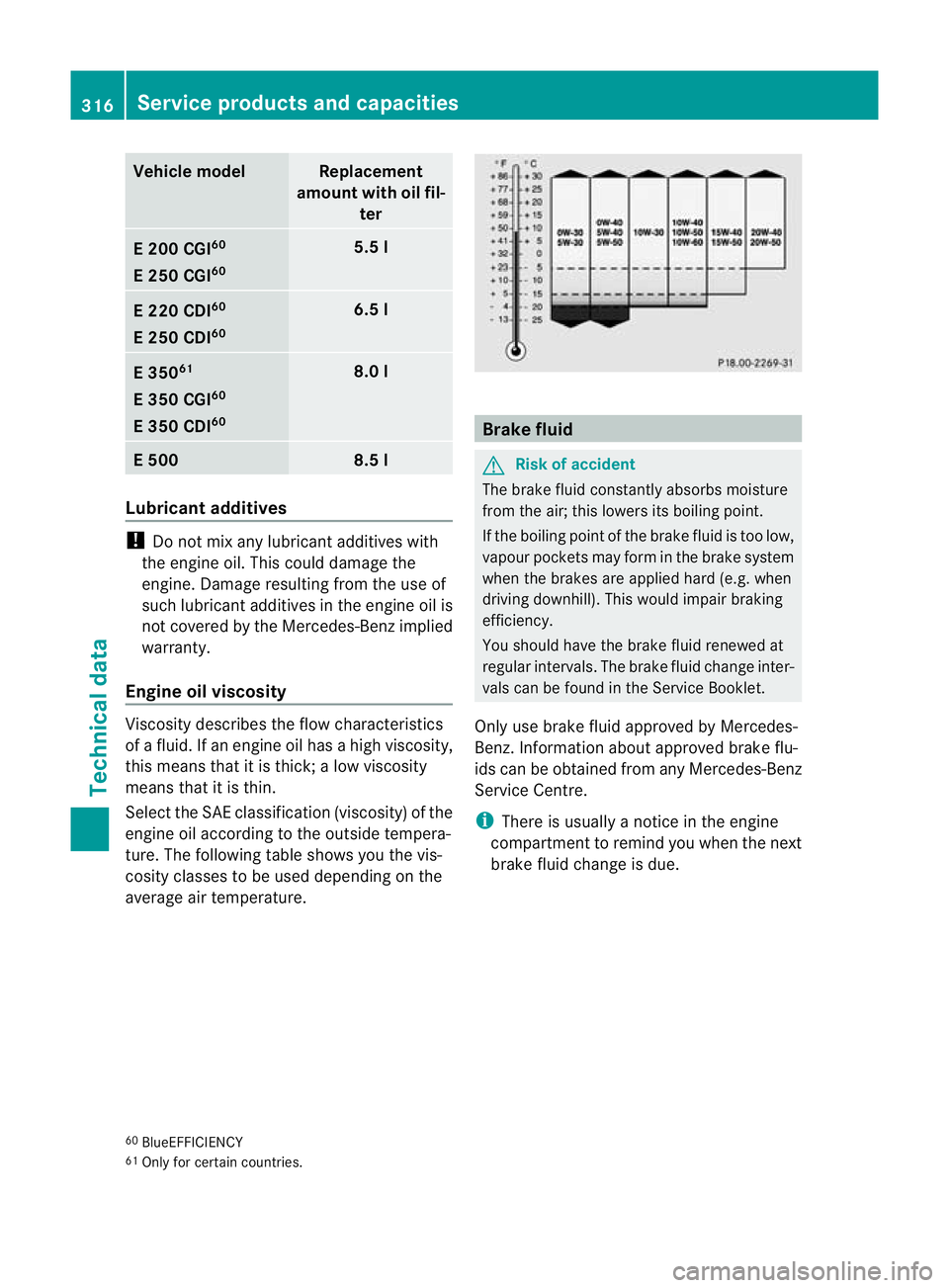
Selec tthe SA Eclassification (viscosity )ofthe
engine oil accordi ngto the outside tempera-
ture. The followin gtable shows you the vis-
cosity classes to be used depending on the
average air temperature. Brake fluid
G
Risk of accident
The brak efluid constantly absorbs moisture
fro mt he air ;this lower sits boiling point.
If the boiling point of the brake fluid is too low,
vapour pockets may form in the brake system
when the brakes are applied hard (e.g. when
driving downhill). Thi swould impair braking
efficiency.
You should have the brake fluid renewed at
regular intervals. The brake fluid change inter-
val sc an be found in the Service Booklet.
Only use brake fluid approved by Mercedes-
Benz .Information abou tapproved brak eflu-
ids can be obtained from any Mercedes-Benz
Service Centre.
i There is usually anotic eint he engine
compartmen ttoremin dyou when the next
brake fluid change is due.
60 BlueEF FICIENCY
61 Only for certain countries. 316
Service products and capacitiesTechnical data
BA 20
7ECE ÄJ 2010 /1a; 1; 2, en-GB
mkalafa Version: 3.0.2.11 2010-01-26T13:03:22+01:00 -Seite 316