light MERCEDES-BENZ E-CLASS CABRIOLET 2010 Repair Manual
[x] Cancel search | Manufacturer: MERCEDES-BENZ, Model Year: 2010, Model line: E-CLASS CABRIOLET, Model: MERCEDES-BENZ E-CLASS CABRIOLET 2010Pages: 333, PDF Size: 7.64 MB
Page 131 of 333

or down (Y
page 122) until the Por
O symbol appear sint he display.
i You should only selec tthis setting until
the windscreen is clea ragain. Rea
rwindow heating
Switching on/off G
Risk of accident
Clear all windows of ice or snow befor esetting
off .O therwise, impaired visibility could
endanger you and others.
The rear windo wheatin ghasah igh cur rent
draw. You should therefore switc hitoff as
soon as th ewindow is clear as it only switches
off automatically after several minutes.
If the battery voltage is too low, the rear win-
dow heatin gmay switc hoff.
X Turn th ekey to position 2in the ignition
lock.
X Press the ¤button.
The indicator lam pabove the ¤button
light supo rgoes out.
Problems with th erearw indow hea ting The rea
rwindow heatin ghas deactivated
itself prematurely or cannot be activated.
X Switch off any consumers that are not
required, e.g. readin glamps or interior
lighting.
When the battery is sufficiently charged,
the rear window heatin gisactivated again
automatically. Activating/deactivating air-recircula-
tion mode
You can deactivate the flow of fresh air if
unpleasant odours are entering the vehicle
from outside .The air already insid ethe vehi-
cle will then be recirculated. The operation of the air-recirculation mode is
the sam
efor all contr ol panels. G
Ris
kofa ccident
Only switc hover to air-recirculation mode
briefly at low outside temperatures .Other-
wise ,the windows coul dmist up, thus impair-
ing visibility and endangering yourself and
others. This may prevent you from observing
the traffic conditions, thereby causing an
accident.
X Turn the key to position 2in the ignition
lock.
X To activate: press thegbutton.
The indicator lamp above the gbutton
lights up.
i Air-recirculation mode is activated auto-
matically at high outside temperatures.
When air-recirculation mode is activated
automatically, the indicator lamp above the
g button is not lit.
Outside air is added after about 30
minutes.
X To deactivate: press thegbutton.
The indicator lamp above the gbutton
goes out.
i Air-recirculation mode switches off auto-
matically:
R after approximately five minutes at out-
side temperatures below approximately
5†
R after approximately five minutes if cool-
ing with air dehumidification is deactiva-
ted
R after approximately 30 minutes at out-
side temperatures above approximately
5† 128
Operating climat
econtrol systemsClimate control
BA 20 7ECE ÄJ 2010 /1a; 1; 2, en-GB
mkalafa Version: 3.0.2.11 2010-01-26T13:03:22+01:00 -Seite 128
Page 132 of 333

Convenience opening/closing with
th
ea ir recirculation button G
Ris
kofi njury
Mak esure that nobody can become trapped
between the side window and the door frame
as the side windows are opened and closed.
Do not place objec tsor lean against the side
window swhen the yare being opened or
closed. Yo uorthe object scould be drawn in
or becom etrapped between th eside window
and the door frame as the window moves. If
there is arisk of entrapment, press the
g button again. Press the switch for stop-
ping, opening or closing the side windows in
the opposite direction as appropriate.
Coupé: make sure that nobody can become
trapped as the panoram asliding sunroof is
opened and closed. If there is arisk of entrap-
ment ,pres sthe g button again .Pres sthe
switc hfor stopping, openin gorclosing the
panoram asliding sunroof in the opposite
direction as appropriate.
X Convenience closing feature: press and
hold the gbutton until the side win-
dows and the sliding sunroof/panorama
sliding sunroof 28
are closed.
The indicator lamp above the gbutton
lights up. Air-recirculation mode is activa-
ted.
X Convenience opening feature: press and
hold the gbutton until the side win-
dows and the panoram asliding sunroof 28
have reached their original position.
The indicator lamp above the gbutton
goes out. Air-recirculation mode is deacti-
vated.
i If you open the side windows or the pan-
orama sliding sunroof 28
manually after
closing with the convenienc eclosing fea-
ture, they will remain in this position when
opened using the convenienc eopening fea-
ture. Switching the residu
alheat on/off
Th e" residua lheat" function is only available
with THERMOTRONI Cluxury 3-zone auto-
matic climate control.
It is possible to make use of the residual heat
of the engine to continue heating the station-
ary vehicle for up to 30 minutes after the
engine has been switched off. The heating
time depends on the temperature that has
been set.
Coupé: the "residua lheat" function only
work soptimally when the side windows and
panorama sliding sunroof are closed.
Cabriolet: the "residual heat" function only
work soptimally when the soft top is closed.
i The blower will run at alow speed regard-
less of the airflow setting.
i If you activate the "residual heat" func tion
at high temperatures, only the ven tilation
will be activated. The blower runs at
medium speed.
i It is possible that the "residual heat" func-
tion may be activated automatically an hour
after the key is removed. The vehicle is then
ventilated for 30 minutes to dry the air-
conditioning system.
X Turn the key to position 0in the ignition
lock or remov eit.
X To switch on: press theÌbutton.
The indicato rlamp above the Ìbutton
lights up.
X To switch off: press theÌbutton.
The indicator lamp above button Ìgoes
out.
i Residua lheat is deactivated automati-
cally:
R after about 30 minutes
R when the ignition is switched on
R if the batter yvoltage drops
R if the coolant temperatur eist oo low
28 Coup éonly. Operating climate control systems
129Climatecontrol
BA 20 7ECE ÄJ 2010 /1a; 1; 2, en-GB
mkalafa Version: 3.0.2.11 2010-01-26T13:03:22+01:00 -Seite 129 Z
Page 139 of 333

Sta
rting the engine
Impor tant safety instructions G
Risk of poisoning
Never leav ethe engin erunning in enclosed
spaces .The exhaust gases con tain carbon
monoxide. Inhaling exhaust fumes consti-
tutes ahealth hazar dand could lead to loss
of consciousness or even death.
! Do not depress the accelerator pedal
whe nstartin gthe engine.
Manua ltran smission X
Depress the brake pedal and keep it
depressed.
X Fully depress the clutch pedal.
X Shif tton eutral N.
i You can only star tthe engin ewhen the
clutc hpedal is fully depressed.
Automa tict ran smission X
Shif tthe transmission to position P.
i You can also star tthe engin ewhen the
transmission is in position N.
Sta rting procedur ewith the key X
To star tapetrol engine: turn the key to
position 3in the ignition lock
(Y page 135 )and releas eita ss oon as the
engin eisrunning.
X To star tadiesel engine: turn the key to
position 2in the ignition lock
(Y page 13 5).
The % preglow indicator lam pinthe
instrumen tcluster lights up.
X When the %preglow indicator lamp
goes out, tur nthe key to position 3
(Y page 135) and release it as soon as the
engin eisrunning.
i You can start the engine without preglow
if the engine is warm. i
Vehicles with automatic transmis-
sion: you can also use the touch-star tfunc-
tion. To do this, turn the key to position
3(Y page 135 )and releas eitimmediately.
Th ee ngine then starts automatically.
Starting the engine usin gKEYLESS-GO G
Risk of injury
Your vehicle can be started using avalid KEY-
LESS-GO key. For this reason, children should
never be left unsupervised in the vehicle.
Always take the key with you when leaving the
vehicle, even if you are only leaving it for a
short time.
i The Start/Stop button can be used to
start the vehicle manually without inserting
the key in the ignition lock. This mode for
startin gthe engin eoperates independently
of the ECO start /stop automatic engine
start function.
X Depres sthe brake pedal and keep it
depressed.
X To sta rtap etrol engine: press the Start/
Stop button (Y page 135) once.
The engin estarts.
X To start adiesel engine: press the Start/
Stop button (Y page 135)once.
Preglow is activated and the engin estarts. Pulling away
Manual transmission X
Depress the brake peda land keep it
depressed.
X Fully depress the clutch pedal.
X Shift to either first gea rorreverse gear R.
X Release the parkin gbrake (Y page 153).
X Releas ethe brake pedal.
X Slowly release the clu tchpedal and gently
depress the acc elerator pedal.136
Dr
ivingDriving and parking
BA 20 7ECE ÄJ 2010/1a; 1; 2, en-GB
mkalafa Version:3.0.2.11
2010-01-26T13:03:22+01:0
0-Seite 136
Page 144 of 333

Problem Possible causes/consequences and
M Solutions
Vehicles with
apetrol
engine:
The engine is not run-
ning smoothly and is
misfiring. There is
amalfunction in the engine electronics or amechanical
componen tofthe engin emanagement system.
X Only depress the accelerator pedal slightly.
X Have the cause rectified immediately at aqualified specialist
workshop.
Otherwise, non-combusted fuel may get into the catalytic con-
verter and damage it. The coolant tempera-
ture display is showing
more than 120 †. The
coolant warning lamp
may also be lit and a
warning tone may
sound. (Y
page 192). The coolant level is too low. The coolant is too hot and the engine
is no longer being cooled sufficiently.
X
Stop as soo naspossible and allow the engin eand the coolant
to cool down.
X Check the coolant level (Y page261). Observe the warning
notes as you do so and top up the coolan tifnecessary. If the coolan
tlevel is correc t,the radiator fan may be faulty. The
coolant is too hot and the engine is no longe rbeing cooled suffi-
cien tly.
X If the coolant temperature is less than 120 †, you can continue
driving to the nearest qualified specialist workshop.
X Avoid heavy loads on the engine as you do so, e.g. driving on
mountain roads and stop/start driving. Manual transmission
Gear lever
Gear lever
!
Whe nshifting between 5thand 6thgear,
you should always push the gear lever all
the way to the right. Otherwise, you could
shift uninte ntionally into 3rdor4th gear
and damage the transmission. Do not exceed the maximum speed for the
individual gears.
Shiftin
gdown at too high aspeed (trans-
mission braking) can cause the engine to
overrev ,leading to engine damage.
! On long and steep downhill gradients,
especiall yifthe vehicle is laden or towing
at railer, yo umust shift into gear 1, 2or3
in good time. This uses the engine's braking
effect .This relieves the load on the brake
system and prevents the brakes from over-
heating and wearing too quickly. Neutral
Nwhen the ECO start/stop
functio nisactive
In neutral N,the engin eisswitched off when
the vehicle speed is below acertain threshold
and the clut chpedal is not depressed. Manual transmission
141Driving and parking
BA 207ECE ÄJ 2010/1a; 1; 2, en-GB
mkalafa Version:3.0.2.11
2010-01-26T13:03:22+01:0
0-Seite 141 Z
Page 156 of 333

Problem Possible causes/consequences and
M Solutions
X
Consult aqualified specialist workshop. Parking
Important safety notes
G
Risk of accident
Only remove the key from the ignition lock
when the vehicle is stationary, as you cannot
steer the vehicle when the key is removed.
Never leave children unsupervised in the vehi-
cle. They could release the parking brake. This
could lead to aserious or fatal accident. G
Risk of fire
Make sure that the exhaust system does not
under any circumstances com einto contact
with easily ignitable material such as dry grass
or petrol .Otherwise, the flammable material
may ignite and set the vehicle on fire.
To ensure that the vehicle is secured against
rolling away unintentionally:
R the parking brake must be appl ied.
R on vehicles wit hmanual transmission,
engage first gear or reverse gear.
R on vehicles with automatic transmission,
the transmissio nmust be in position Pand
the key must be removed from the ignition
lock.
R on steep uphill or downhill gradients, turn
the front wheel stowards the kerb. Parking brake
X
To ap ply:depress parking brake ;firmly.
The J indicator lamp in the instrument
cluster lights up if the engine is running.
X To release: depress the brak epedal and
keep it depressed.
X Pull release handle :.
The J indicator lam pint he instrument
cluster goes out. Parking
153Driving and pa rking
BA 20 7ECE ÄJ 2010 /1a;1;2,e n-GB
mkalafa Version: 3.0.2.11 2010-01-26T13:03:22+01:00-Seite 153 Z
Page 158 of 333

Heav
yand light loads G
Risk of accident
Never depr esst he brake pedal continuously
while the vehicle is in motion ,e.g. never cause
the brakes to rub by applying cons tant slight
pedal pressure. Thi scauses the brake system
to overheat, increases the braking distance
and can lead to the brakes failing completely.
If the brakes have been subjected to aheavy
load, do not stop the vehicle immediately ,but
drive on for ashort while. This allow sthe air-
flo wtoc ool the brakes mor equickly.
If the brakes have been used only moderately,
you should occasionally test their effective-
ness. To do this, brake more firmly from a
higher speed. This improves the grip of the
brakes.
Wet roads If driving in heavy rain for
aprolonged period
of time without braking, there may be a
delayed reaction from th ebrake swhen brak-
ing for the first time. This ma yalso occur after
the vehicle has been washed.
You have to depress the brake pedal more
firmly. Maintain agreater distance from the
vehicl einfront.
After driving on awet road or havin gthe vehi-
cle washed, brake firml ywhile paying atten-
tion to the traffic conditions. This will warm
up the brake discs, thereby drying them more
quickly and protecting them against corro-
sion.
Limited braking perfo rmance on salt
treated roads G
Risk of accident
The layer of salt on the brake discs and the
brake pads/linings may cause adelay in the
braking effect ,resultin ginas ignifican tlyl on-
ger brakin gdistance, which could lead to an
accident.
To avoid this danger, you should: R
occasionally brake carefully, without put-
ting other road users at risk, when you are
drivin gons alted roads. This helps to
remove any salt that may have started to
build up on the brake discs and the brake
pads/linings.
R maintain agreater distance to th evehicle
ahead and driv ewith particular care.
R carefully apply the brakes at the end of a
trip and immediately after commencing a
new trip, so that salt residues are removed
from the brake discs.
New brake pads/linin gs G
Risk of accident
New brake pads/lining sonly reach thei ropti-
mum braking effect after severa lhundred kil-
ometres of driving. Before this optimum brak-
ing effect is reached, you should compensate
for the reduced braking effect by applying
greater pressure when braking. This also
applies after the brake discs or the brake
pads/lining shave been replaced.
For safety reasons, Mercedes-Benz recom-
mends that you only have brake pads/linings
fitted to your vehicle which have been
approved for Mercedes-Benz vehicles or
which correspond to an equivalent quality
standard. Brake pads/lining swhich hav enot
been approved for Mercedes-Benz vehicles or
which ar enot of an equivalent quality could
affect your vehicle' soperating safety. Ty
re traction G
Risk of accident
Whil ethe vehicle can be fully con trolled at a
cer tain speed on dry roads, you must reduce
your speed on wet or icy roads to achieve the
same road safety. Otherwise, you could cause
an accident.
Pay particular attention to the road conditions
at temperatures around freezin gpoint. Driving tips
155Driving and parking
BA 207ECE ÄJ 2010 /1a; 1; 2, en-GB
mkalafa Version: 3.0.2.11 2010-01-26T13:03:22+01:00 -Seite 155 Z
Page 160 of 333

characteristics cause
dbythe differ enttyres.
You shoul dtherefor eadapt your drivin gstyle
and drive carefully.
Have the spare whee lreplaced at the nearest
qualified specialist workshop which has the
necessar yspecialist knowledge and tools to
carry out the work required. Mercedes- Benz
recommends that you use aMercedes-Benz
Ser vice Centre for thi spurpose. In particular,
work relevant to safety or on safety-related
systems must be carried out at aqualified
specialist workshop.
Snow chains For safety reasons
,Mercedes-Benz recom-
mends that you only use snow chain swhich
hav ebeen speciall yapproved for your vehicle
by Mercedes-Benz ,ora re of acorresponding
standar dofquality.
If you intend to fit snow chains, pleas ebear
the following point sinmind:
R you may not attac hsnow chains to all
wheel-tyre combinations ;see the "Tyres
and wheels" section in the "Techni caldata"
chapter.
R snow chains must not be fitted to emer-
gency spare wheels ,e.g. a"Minispare"
emergency spar ewheel.
R fit snow chains only in pair sand only to the
rear wheels .Observ ethe manufacturer's
installation instructions.
Do not exceed the maximum permissible
speed of 50 km /h.
i You may wish to deactivat eESP®
when
pulling away with snow chains fitted
(Y page 57). This way you can allow the
wheels to spin in acontrolled manner, ach-
ieving an inc reased driving forc e(cutting
actio n).
Slipper yroad surfaces G
Risk of accident
Do not shift down for additional engine brak-
ing on aslippery road surface. This could cause the drive wheels to lose their grip and
the vehicle could skid.
You should drive particularly carefully on slip-
pery road surfaces. Avoid sudden accelera-
tion ,steering and braking manoeuvres.
If the vehicle threatens to skid or cannot be
stopped when movin gatlow speed:
X Vehicles with manua ltransmission: engage
neutral.
X Vehicles wit hautomatic transmission: shift
the transmission to position N.
X Try to bring the vehicle under control using
corrective steering.
i For more information on driving with
snow chains, see (Y page 157). Drivin
gabroad
General notes An extensiv
eMercedes–Benz Ser vice net-
work is als oavailable in othe rcountries. The
Ser vice Hotline's current telephone numbers
for use whe nyou ar eabroad are to be found
in the "Service24h" section of the Ser vice
Boo klet.
Only low-oc tane fuel is available in certain
countries.
You can find further information about fuel
grade son(Ypage 14 8).
Sym metrical dipped-beam headlamps If your journey takes you to countries where
vehicle
sare driven on th eopposite side of the
road to the country in which the vehicle is
registered, your headlamps must be switched
to symmetrical dipped beam. This prevents
oncomin gtraffic from being dazzled.
Have th eheadlamps conver tedasc lose as
possible to the border before drivin ginthese
countries. When usin gsymmetrical lights, the
edg eoft he carriageway is not lit as widely
and as fa rahead as nor mal. Drivin
gtips
157Driving and parking
BA 207ECE ÄJ 2010/1a; 1; 2, en-GB
mkalafa Version:3.0.2.11
2010-01-26T13:03:22+01:0
0-Seite 157 Z
Page 161 of 333

On vehicle
swith Intelligent Light System the
headlamps can be conver tedint he on-board
compute r(Ypage 206).
Switching over dipped-beam headlamps
on vehicles with halogen headlamps :
Protec tive cap
; Switchover lever
X Turn protectiv ecap : anti-clockwise and
remove it.
X Push switchover lever ;down.
X Insert protective cap :and turn it clock-
wise.
When you are driving back on the same side
of the road as the country where the vehicle
is registered, have the headlamps changed
back to asymmetrical dippe dbeam as soon
as possibl eafter crossing th eborder. Driving systems
Cruise control
Import ants afety notes Cruise control maintain
saconstant road
speed for you. It brakes automatically in order
to avoid exceeding the set speed. On long and
steep downhil lgradients ,especially if the
vehicle is laden or towing atrailer, yo umust
shift to alower gear in good tim eorselect
shift range 1,2or 3on vehicles with auto-
matic transmission. By doing so, you will
mak euse of the brakin geffect of th eengine,
which relieves the load on the brake system and prevents the brakes from overheating
and wearing too quickly. G
Risk of accident
Do not change down for additional engine
braking on aslippery road surface. This could
cause the drive wheels to lose their grip and
the vehicle could skid.
Use cruise control only if road and traffic con-
ditions make it appropriate to maintain a
steady speed for aprolonged period. Yo ucan
store any road spee dabove 30 km/h. G
Risk of accident
Cruise control cannot take account of road
and traffic conditions.
Always pay atten tion to traffic conditions
even when cruise control is activated.
Cruise control is only an aid designed to assist
driving. You are responsible for the vehicle's
speed and for brakin gingood time. G
Risk of accident
Do not use cruise control:
R in road and traffic condition swhich do not
allow you to maintain aconstant speed (e.g.
heavy traffic or winding roads). You could
otherwise cause an accident.
R on slippery roads. Brakin goraccelerating
coul dcause the drive wheels to lose trac-
tion and the vehicle could then skid.
R when there is poor visibility, e.g. due to fog,
heavy rain or snow
Cruise control lever You can operate cruise control and variable
SPEEDTRONIC with the cruise control lever.
The LIM indicator lamp on the cruise control
lever indicates which system you have selec-
ted:
R
LIM indicator lamp off: cruise control is
selected.
R LIM indicator lamp on: variableSPEED-
TRONI Cisselected. 158
Driving systemsDriving and parking
BA 20
7ECE ÄJ 2010/1a; 1; 2, en-GB
mkalafa Version: 3.0.2.11
2010-01-26T13:03:22+01:00
-Seite 158
Page 162 of 333
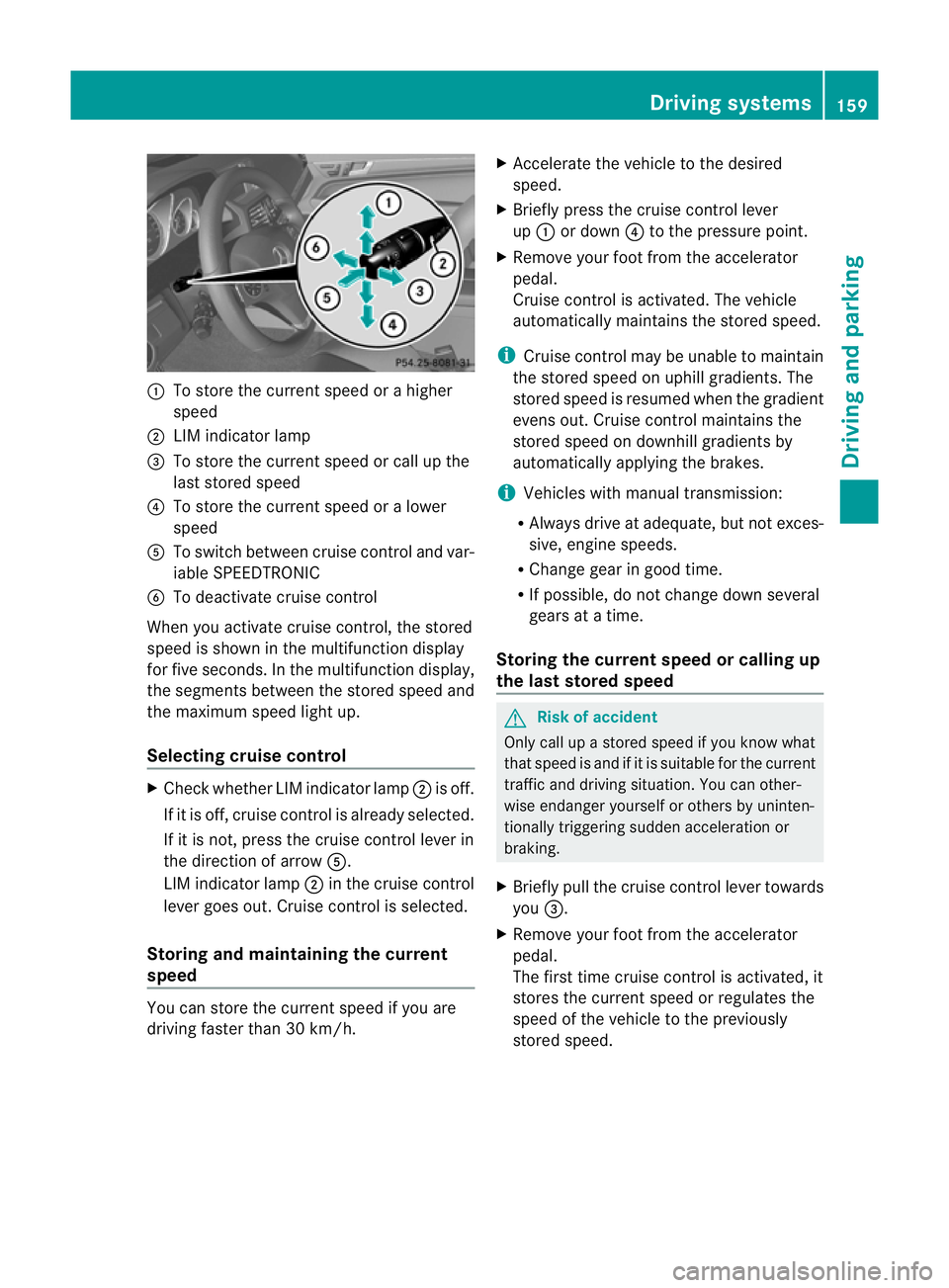
:
To store the curren tspeed or ahigher
speed
; LIMi ndicator lamp
= To sto rethe curren tspeed or call up the
last stored speed
? To stor ethe curren tspeed or alower
speed
A To switc hbetween cruise control and var-
iable SPEEDTRONIC
B To deactivate cruise control
When you activate cruise control ,the stored
speed is shown in the multifunction display
for fiv eseconds. In the multifunction display,
the segments between the stored speed and
the maximu mspeed light up.
Selecting cruise control X
Check whether LI Mindicator lamp ;is off.
If it is off, cruise contro lisalready selected.
If it is not ,pres sthe cruise contr ol leverin
the direction of arrow A.
LIM indicator lamp ;in the cruise control
lever goe sout. Cruise contro lisselected.
Storing and maintaining the cur rent
speed You can stor
ethe curren tspeed if you are
drivin gfaster than 30 km/h. X
Accelerat ethe vehicle to the desired
speed.
X Briefly press the cruise contr ol lever
up : or down ?to the pressure point.
X Remove your foot from the accelerator
pedal.
Cruise contr ol is activated. The vehicle
automatically maintains the stored speed.
i Cruise contr ol maybeu nable to maintain
the sto reds peed on uphill gradien ts.T he
stored speed is resumed when the gradient
even sout. Cruise contro lmaintains the
stored speed on downhill gradients by
automatically applying the brakes.
i Vehicles with manual transmission:
R Always driv eatadequate, but no texces-
sive, engine speeds.
R Chang egearing oodt ime.
R If possible, do not change down several
gears at atime.
Storin gthe curre nt speedorc allingup
the last stored speed G
Risk of accident
Only call up astored spe ed ifyou know what
that spee disand if it is suitable for the current
traffic and driving situation. You can other-
wise endanger yourself or others by uninten-
tionally triggering sudden acceleration or
braking.
X Briefly pull the cruise control lever towards
you =.
X Remove your foot from the accelerator
pedal.
Th ef irst time cruise control is activated, it
stores the current speed or regulates the
speed of the vehicle to the previously
stored speed. Drivin
gsystems
159Drivingand pa rking
BA 20 7ECE ÄJ 2010 /1a; 1; 2, en-GB
mkalafa Version: 3.0.2.11 2010-01-26T13:03:22+01:00 -Seite 159 Z
Page 165 of 333
mus
talsoa pply the brakes yourself if this
braking powe risnot sufficient.
If DISTRONIC PLU Sdetect sarisk of collision
with avehicle in front, an intermit tent warning
tone sounds. In addition, the ·distance
warning lamp in the instrument cluste rlights
up. Brak etoavoidac ollision.
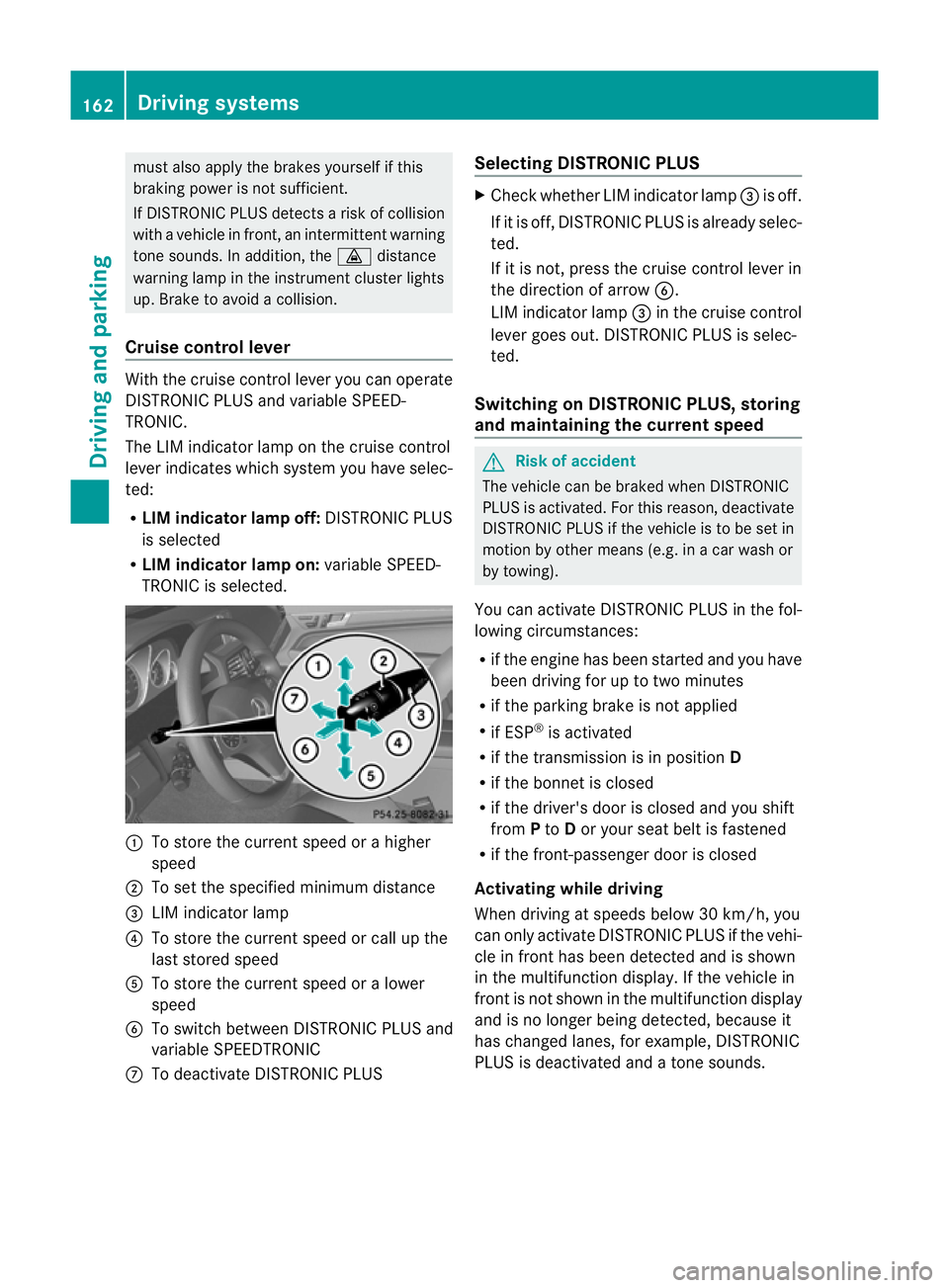
Cruise control lever With the cruise control lever you can operate
DI ST RONIC PLUS and variable SPEE D-
TRONIC.
The LI Mindicator lamp on the cruise control
lever indicates which system you have selec-
ted:
R LIM indicator lamp off: DISTRONIC PLUS
is selected
R LIM indicator lamp on: variable SPEED-
TRONIC is selected. :
To sto rethe curren tspeed or ahigher
speed
; To set the specified minimum distance
= LIMi ndicator lamp
? To sto rethe curren tspeed or call up the
last stored speed
A To stor ethe curren tspeed or alower
speed
B To switc hbetween DI STRONIC PLUS and
variable SPEEDTRONIC
C To deactivate DISTRONIC PLUS Selecting DISTRONIC PLUS X
Check whether LIM indicator lamp =is off.
If it is off, DISTRONIC PLUS is already selec-
ted.
If it is not ,pres sthe cruise contr ol leverin
the direction of arrow B.
LIM indicator lamp =in the cruise control
lever goe sout. DISTRONIC PLUS is selec-
ted.
Switching on DISTRONIC PLUS ,storing
and maintaining the current speed G
Risk of accident
The vehicle can be braked when DISTRONIC
PLUS is activated. For this reason, deactivate
DISTRONIC PLUS if the vehicle is to be set in
motion by othe rmeans (e.g. in acar wash or
by towing).
You can activate DISTRONIC PLUS in the fol-
lowing circumstances:
R if the engine has been started and you have
been drivin gfor up to two minutes
R if the parkin gbrake is not applied
R if ESP ®
is acti vated
R if the transmission is in position D
R if the bonnet is closed
R if the driver' sdoor is closed and you shift
from Pto Dor your seat belt is fastened
R if the front-passenger door is closed
Activating while driving
When drivin gatspeeds below 30 km/h, you
can only acti vate DISTRONIC PLUS if the vehi-
cle in fron thas been detected and is shown
in the multifunction display. If the vehicle in
front is not shown in the multifunction display
and is no longe rbeing detected, because it
has changed lanes, for example, DISTRONIC
PLU Sisd eactivated and atone sounds. 162
Driving systemsDriving and pa
rking
BA 20 7ECE ÄJ 2010 /1a; 1; 2, en-GB
mkalafa Version: 3.0.2.11 2010-01-26T13:03:22+01:00 -Seite 162