brake MERCEDES-BENZ E-CLASS CABRIOLET 2010 Manual Online
[x] Cancel search | Manufacturer: MERCEDES-BENZ, Model Year: 2010, Model line: E-CLASS CABRIOLET, Model: MERCEDES-BENZ E-CLASS CABRIOLET 2010Pages: 333, PDF Size: 7.64 MB
Page 293 of 333
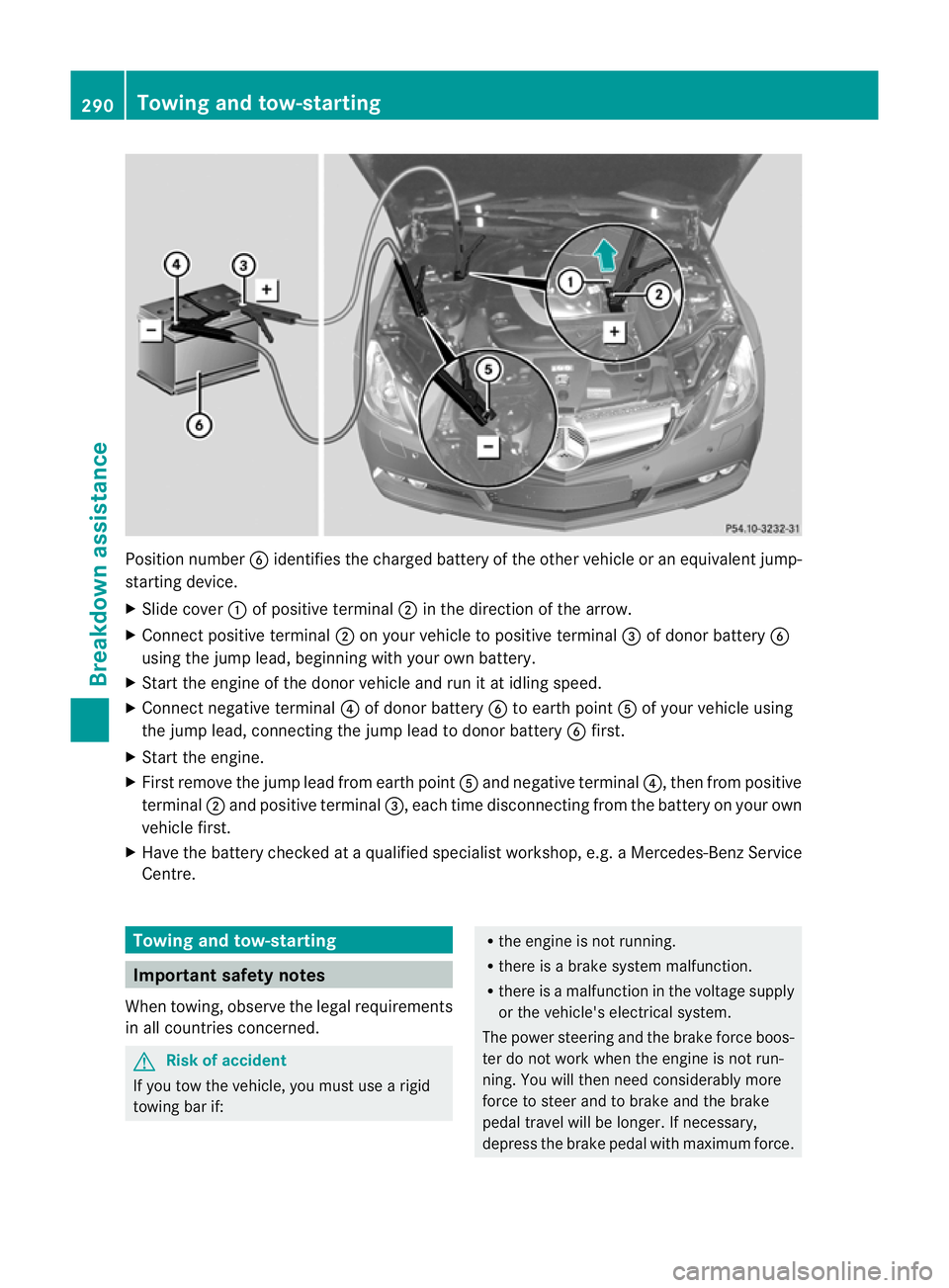
Position number
Bidentifie sthe charged batter yofthe other vehicle or an equivalen tjump-
starting device.
X Slide cover :of positive terminal ;in the direction of the arrow.
X Connec tpositiv eterminal ;on your vehicle to positiv eterminal =of donor battery B
using the jum plead, beginning with your own battery.
X Start the engine of the donor vehicle and run it at idling speed.
X Connect negative terminal ?of donor battery Bto eart hpoint Aof your vehicle using
the jum plead, connectin gthe jum plead to donor battery Bfirst.
X Start the engine.
X First remove the jum plead from eart hpoint Aand negative terminal ?,then from positive
terminal ;and positive terminal =,each time disconnecting from the battery on your own
vehicle first.
X Have the battery checked at aqualified specialist workshop, e.g. aMercedes-Ben zService
Cent re. Towin
gand tow-star ting Important safet
ynotes
When towing, observe the legal requirements
in all countries concerned. G
Risk of accident
If you tow the vehicle, you must use arigid
towing bar if: R
the engin eisnot run ning.
R there is abrake system malfunction.
R there is amalfunction in the voltage supply
or the vehicle's electrical system.
The power steering and the brake forc eboos-
ter do not work when the engin eisnot run-
nin g. Yo uwill then need considerably more
forc etos teer and to brake and the brake
peda ltrave lwill be longer. If necessary,
depress the brake pedal with maximum force. 290
Towing and tow-startingBreakdown assistance
BA 207 ECE ÄJ 2010/1a; 1; 2, en-GB
mkalafa
Version: 3.0.2.11
2010-01-26T13:03:22+01:00
-Seite 290
Page 294 of 333
Befor
etowing away ,make sur ethat the steer-
ing can be mov edand is not locked.
If yo utow or tow- start another vehicle, its
weigh tmustn ot excee dthe maximum per-
missible gross vehicle weigh tofyour vehicle. G
Risk of accident
The vehicle is braked when the HOL Dfunction
or DISTRONIC PLUS is activated. Therefore,
deactivate HOLD and DISTRONIC PLUS if the
vehicle is to be towed.
It is better to have the vehicle transported
than to have it towed.
! Whe ntowing, pull away slowly and
smoothly. If the tractive power is too high,
the vehicles coul dbedamaged.
! Do not use the towing eye for recovery,
as this could damage the vehicle. If in
doubt, recover the vehicle with acrane.
! Youm ay tow the vehicle for amaximum
of 50 km. Atowing speed of 50 km /h must
no tbee xceeded.
For towing distances over 50 km, the entire
vehicl emust be lifted up and transported.
! On vehicles with KEYLESS-GO, use the
key instead of the Start/Stop button .Turn
the key to position 2in the ignition lock and
shif tthe automatic transmission to N.
Then, turn the key back to 0and leave it in
the ignitio nlock.
! Only secur ethe tow cable or towing bar
to the towing eyes. You could otherwise
damage the vehicle.
Please note:
R vehicles with an automatic transmission
must not be tow-started.
R if you ar etowing the vehicle over alonger
distance, this must be done with the rear
axle raised.
R the ignition must be switched off if you are
towin gthe vehicle with the rea raxle raised. Intervention by ESP
®
could otherwis edam-
age the brake system.
R if the vehicle has suffered transmission
damage, only tow it with the propelle rshaft
disconnected.
R if the engin edoes not start, tr yjump-start-
ing it (Y page 289).
R if it is not possible to jump-start the vehicle,
have it towed to the nearest qualified spe-
cialist workshop, e.g. aMercedes-Benz
Servic eCentre.
R the automatic transmission must be in
position Nwhen the vehicle is being towed.
Before towing the vehicle, mak esure that the
battery is connected and charged. You will
otherwis ebeunable to switch on the ignition
or shift the transmissio ntoNin vehicles with
an automatic transmission.
i Switch off the automatic locking feature
before the vehicle is towed (Y page 208).
You could otherwise be locked out when
pushing or towing the vehicle. Fitting the towing eye
Vehicles with atrailer to whitch: if you intend
to use the vehicle for towing, fold out the ball
coupling and connect the towbar to it
(Y page 186).
X Take the towing eye and the wheel wrench
from the vehicle tool kit (Y page 274).
The mountings for the removable towing eyes
are located in the bumpers. They are at the
front and at the rear ,under the covers. Towing and tow-starting
291Breakdown assistance
BA 207 ECE ÄJ 2010/1a;1;2,e n-GB
mkalafa Version: 3.0.2.11 2010-01-26T13:03:22+01:00-Seite 291 Z
Page 295 of 333
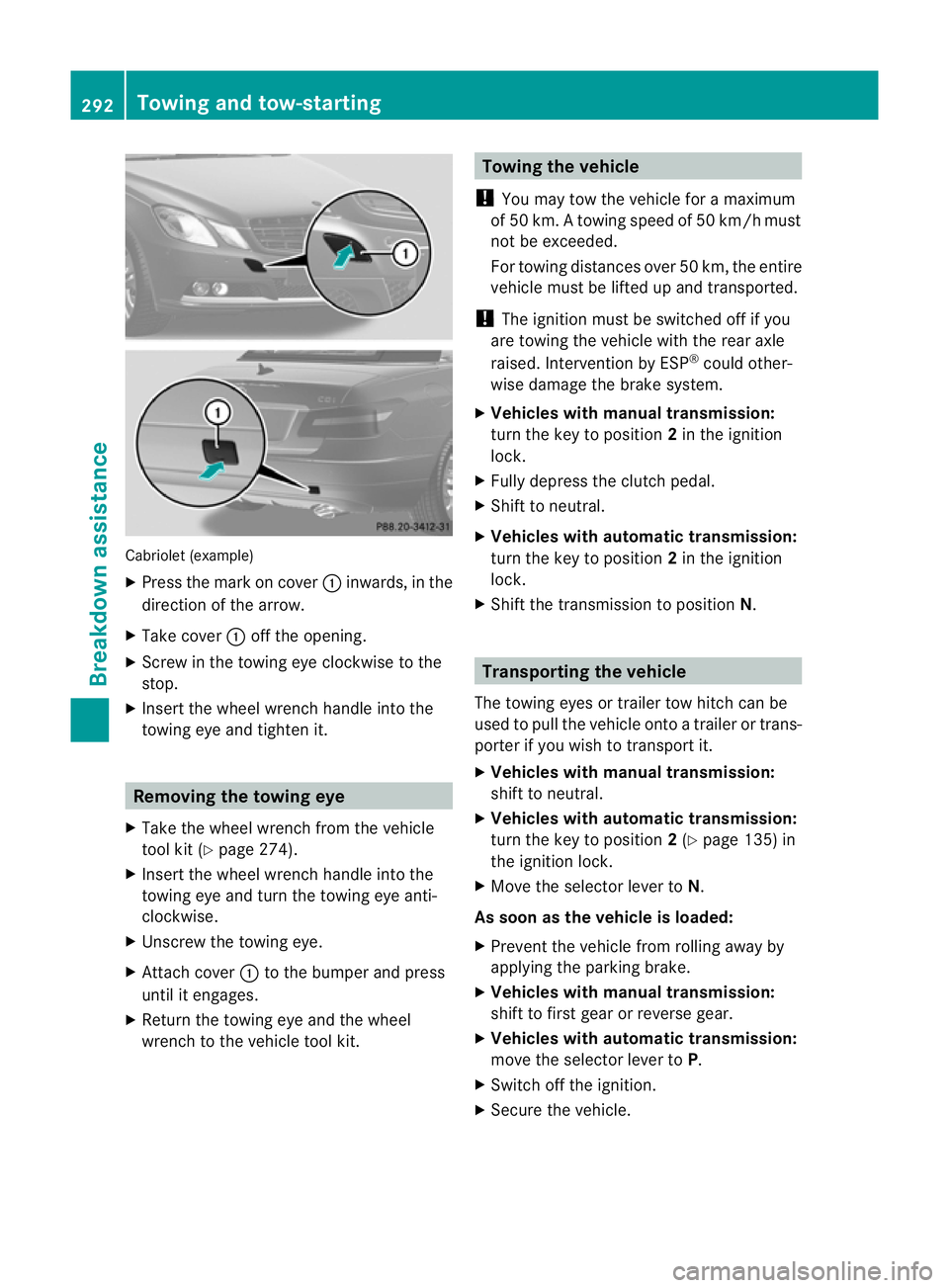
Cabriolet (example)
X
Press the mark on cover :inwards, in the
direction of the arrow.
X Take cover :off the opening.
X Screw in the towing eye clockwise to the
stop.
X Insert the wheel wrench handle into the
towin geye and tighte nit. Removing the towing eye
X Take the whee lwrenc hfrom th evehicle
tool kit (Y page 274).
X Insert the wheel wrench handle into the
towing eye and tur nthe towing eye anti-
clockwise.
X Unscrew the towing eye.
X Attach cover :to the bumper and press
until it engages.
X Return the towing eye and the wheel
wrenc htothe vehicle tool kit. Towing th
evehicle
! You may tow the vehicle for amaximum
of 50 km. Atowing speed of 50 km/h must
not be exceeded.
For towin gdistances over 50 km, the entire
vehicle must be lifted up and transported.
! The ignition must be switched off if you
are towing the vehicle with the rear axle
raised. Interven tion by ESP ®
coul dother-
wise damage the brake system.
X Vehicles with manua ltransmission:
turn the key to position 2in the ignition
lock.
X Fully depress the clutch pedal.
X Shift to neutral.
X Vehicles with automatic transmission:
turn the key to position 2in the ignition
lock.
X Shift the transmission to position N. Transporting the vehicle
The towing eyes or trailer tow hitch can be
used to pull the vehicle onto atrailer or trans-
porter if yo uwish to transport it.
X Vehicles with manu altransmission:
shift to neutral.
X Vehicles with automatic transmission:
turn the key to position 2(Y page 135) in
the ignition lock.
X Move the selector lever to N.
As soon as the vehicl eisloaded:
X Prevent the vehicle from rolling away by
applying the parking brake.
X Vehicles with manua ltransmission:
shift to first gear or reverse gear.
X Vehicles with automatic transmission:
move the selector lever to P.
X Switch off the ignition.
X Secure the vehicle. 292
Towing and tow-startingBreakdown assistance
BA 207 ECE ÄJ 2010
/1a;1;2,e n-GB
mkalafa Version: 3.0.2.11 2010-01-26T13:03:22+01:00-Seite 292
Page 296 of 333
!
Only lash the vehicle down by the wheels
or wheel rims, not by parts of the vehicle
suc hasa xle or steering components. Oth-
erwise, the vehicl ecould be damaged. Tow-star
ting (emergency engine
starting)
Please note:
R vehicles with an automatic transmission
must not be tow-started.
R the batter ymust be connected.
R the engine and catalytic converter must be
cold.
R avoid repeated and lengthy starting
attempts.
Vehicles with manual transmission:
X Turn the key to position 2in the ignition
lock.
X Fully depres sthe clutc hpedal.
X Shif tton eutral.
X Tow the vehicle or let it roll.
X Shif ttoas uitable gear and bring the clutch
pedal up slowly. Do not depres sthe accel-
erator pedal.
The engin eisstarted. Fuses
Important safet
ynotes
The fuses in your vehicle serve to close down
faulty circuits. If afuse blows, all the compo-
nen tson th ecircuit and their function swill
fail. G
Ris
koff ire
Only use fuses that have been approve dfor
Mercedes-Ben zvehicles and which have the
cor rect fuse rating for the systems con-
cerned. Do not attempt to repai rorbridge
faulty fuses .Otherwise, acircuit overload
could cause afire. Have the cause traced and
rectified at aqualified specialist workshop,
e.g. aMercedes-Benz Ser vice Centre. Blow
nfuses must be replaced with fuses of
the same rating, which you can recognise by
the colour and value. The fuse ratings are lis-
ted in the fuse allocation chart .AMercedes-
Ben zService Cent rewill be happy to advise
you.
If the newly inserted fuse also blows, have the
cause traced and rectified at aqualified spe-
cialist workshop, e.g. aMercedes-Benz
Ser vice Centre.
! Onlyuse fuses that hav ebeen approved
for Mercedes-Ben zvehicles and which
have the cor rect fuse rating for the system
concerned. Otherwise, compo nentso rsys-
tems could be damaged. Befor
echangin gafuse
X Park th evehicle and apply the parking
brake.
X Swit choff all elect rical consumers.
X Remove the key from the ignitio nlock.
The fuses ar elocated in variou sfuse boxes:
R fuse box on the driver' sside of the dash-
board
R fuse box in the engin ecompartmen tonthe
driver's side
R fuse box in the boot on the right when
viewed in the direction of travel
The fuse allocation char tisl ocated in the
vehicle tool kit (Y page 274)in the stowage
compar tment under the boot floor. Fuse box under the dashboard
! Do not use apointed objec tsuch as a
screwdriver to open the cover in the dash-
board. You could damage the dashboard or
the cover. Fuses
293Breakdown assistance
BA 207ECE ÄJ 2010/1a; 1; 2, en-GB
mkalafa Version:3.0.2.11
2010-01-26T13:03:22+01:00
-Seite 293 Z
Page 301 of 333
Vehicl
eequipment
i Thismanua ldesc ribe sallthe standard
and optional equipment of your vehicle
which wa savailable at th etime of pur-
chase. Countr y-specif ic differences are
possible. Bear in mind tha tyour vehicle
ma ynot featur eall function sdescribed
here. Important safet
ynotes G
Risk of accident
Tyres, wheels or accessories which have not
been approved by Mercedes-Benz for your
vehicle or are not used as they should be, can
impair drivin gsafety. As aresult, you could
cause an accident. Befor epurchasing and
using them, enquire about their suitability,
legal stipulatio nsand factory recommenda-
tions at aMercedes-Benz Ser vice Centre.
! For safety reasons ,Mercedes-Ben zrec-
ommends that you only use tyres, wheels
and accessories which have been approved
by Mercedes-Ben zspecifically for your
vehicle. These tyres have been specially
adapted for use with the contro lsystems,
such as AB SorESP®
,a nd are marked as
follows:
R MO =Mercedes-Ben zOriginal
R MOE =Mercedes-Ben zOriginal Extended
(tyres with run-flat characteristics)
R MO1 =Mercedes-Ben zOriginal (AMG)
Only use Mercedes-Benz Original Extended
tyres on wheels that have been specifically
approved by Mercedes-Benz.
If you use other tyres, wheels and acces-
sories, Mercedes-Benz cannot accept any
responsibility for damage that may result
from this. Further informat ionabout tyres,
wheels and approved combinations can be
obtained from any Mercedes-Benz Service
Centre. !
Retreaded tyres are neither tested nor
recommended by Mercedes-Benz, since
previous damage cannot alway sbedetec-
ted on retreaded tyres. As aresult,
Mercedes-Ben zcannot guarantee vehicle
safety if retreade dtyres are fitted. Do not
fit use dtyres if you have no information
about their previous usage.
Mod ification work on the brake system and
wheels is not permitted, nor is the use of
space rplates or brake dust shields .This inva-
lidates the Genera lOperating Permit for the
vehicle.
i Further information about tyres and
wheels can be obtained from any
Mercedes- Benz Servic eCentre. Directives to be observed
R Only fit tyres and wheels of the same type
and make.
R Only fit tyres of the correc tsize ont othe
wheels.
R Afterf itting new tyres, run them in at mod-
erate speeds for the first 100 km as they
only reach their full performanc eafter this
distance.
R Do not drive wit htyres which have too little
tread depth ,asthis significantly reduces
the traction on wet roads (aquaplaning).
R While driving, pay attention to vibrations,
noises and unusual handling characteris-
tics, e.g. pulling to one side. This ma yindi-
cate that the wheels or tyres are damaged.
If you suspect that atyre is defective,
reduce your speed immediately. Stop the
vehicle as soo naspossible to chec kthe
wheels and tyres for damage. Hidden tyre
damage could also be causing the unusual
handling characteristics. If you fin dno
signs of damage, hav ethe wheels and tyres
examined at aspecialist workshop, for 298
Directives to be observedTyres and wheels
BA 20
7ECE ÄJ 2010 /1a; 1; 2, en-GB
mkalafa Version: 3.0.2.11 2010-01-26T13:03:22+01:00 -Seite 298
Page 306 of 333
For safety reasons, Mercedes-Benz recom-
mends that yo
uonly use wheel bolts of the
correct size which hav ebeena pproved for
Mercedes-Benz vehicles.
The wear patterns on the fron tand rea rtyres
differ ,dependin gonthe opera tingconditions.
Interchange the wheels befor eaclear wear
pattern ha sform edon the tyr es.F ront tyres
typicall ywearm ore on the shoulder sand the
rea rtyre sint he centre.
On vehicles that have the same size front and
rear wheels, you can interchange the wheels
every 500 0kmto10,000 km depending on
the degre eoftyre wear. Do not reverse the
direction of tyre rotation.
Clea nthe con tact surface softhe wheel and
the brake disc thoroughly ever ytime awheel
is interchanged. Chec kthe tyr epressure and,
if necessary, restart th etyre pressure loss
warning system. Wheel and tyr
ecombinations Please bear the followin
ginmind
! For safety reasons, Mercedes-Ben zrec-
ommends that you only use tyres, wheels
and accessories which have been approved
by Mercedes-Ben zspecifically for your
vehicle. These tyres have been specially
adapted for use with the contro lsystems,
such as AB SorESP®
,a nd are marked as
follows:
R MO =Mercedes-Ben zOriginal
R MOE =Mercedes-Ben zOriginal Extended
(tyres with run-flat characteristics)
R MO1 =Mercedes-Ben zOriginal (AMG)
Only use Mercedes-Benz Original Extended
tyres on wheels that have been specifically
approved by Mercedes-Benz.
If you use other tyres, wheels and acces-
sories, Mercedes-Benz cannot accept any
responsibility for damage that may result
from this. Further informat ionabout tyres,
wheels and approved combinations can be obtained from any Mercedes-Benz Service
Centre.
! If you fit tyres other than those tested and
recommended by Mercedes-Benz, charac-
teristics such as handling, noise levels and
fuel consumption, etc. may be adversely
affected. In addition, when driving with a
load, tyre dimensional variations could
caus ethe tyres to com einto contact with
the bod ywork and axle components. This
could result in dam agetot he tyres or the
vehicle.
i Further information about tyres and
wheels can be obtained from any
Mercedes-Benz Servic eCentre.
i You will fin datable of tyre pressures on
the insid eofyourv ehicle' sfuel filler flap.
For further information on tyre pressure,
see (Y page 299).
i Notes on the vehicle equipment:
Always fit the vehicle:
R with tyres of the same size on agiven axle
(left/right)
R with the same type of tyres at agiven
time (summer tyres, winter tyres,
MOExtended tyres)
i Vehicles featurin gthe MOExtended run-
fla ts ystem are not equipped with the
TIREFIT kit.
It is therefore recommended that you addi-
tionally equip your vehicle with the TIREFIT
kit if you fit tyres that do not feature run-
flat properties, e.g. winter tyres.
AT IREFIT kit is availa blef rom any qu alified
specialist workshop, e.g. aMercedes-Benz
Ser vice Centre. Wheel and tyr
ecombinations
303Tyres and wheels
BA 207ECE ÄJ 2010/1a; 1; 2, en-GB
mkalafa Version:3.0.2.11
2010-01-26T13:03:22+01:0
0-Seite 303 Z
Page 316 of 333
numb
er (VIN) is also stamped onto th evehicle
body.
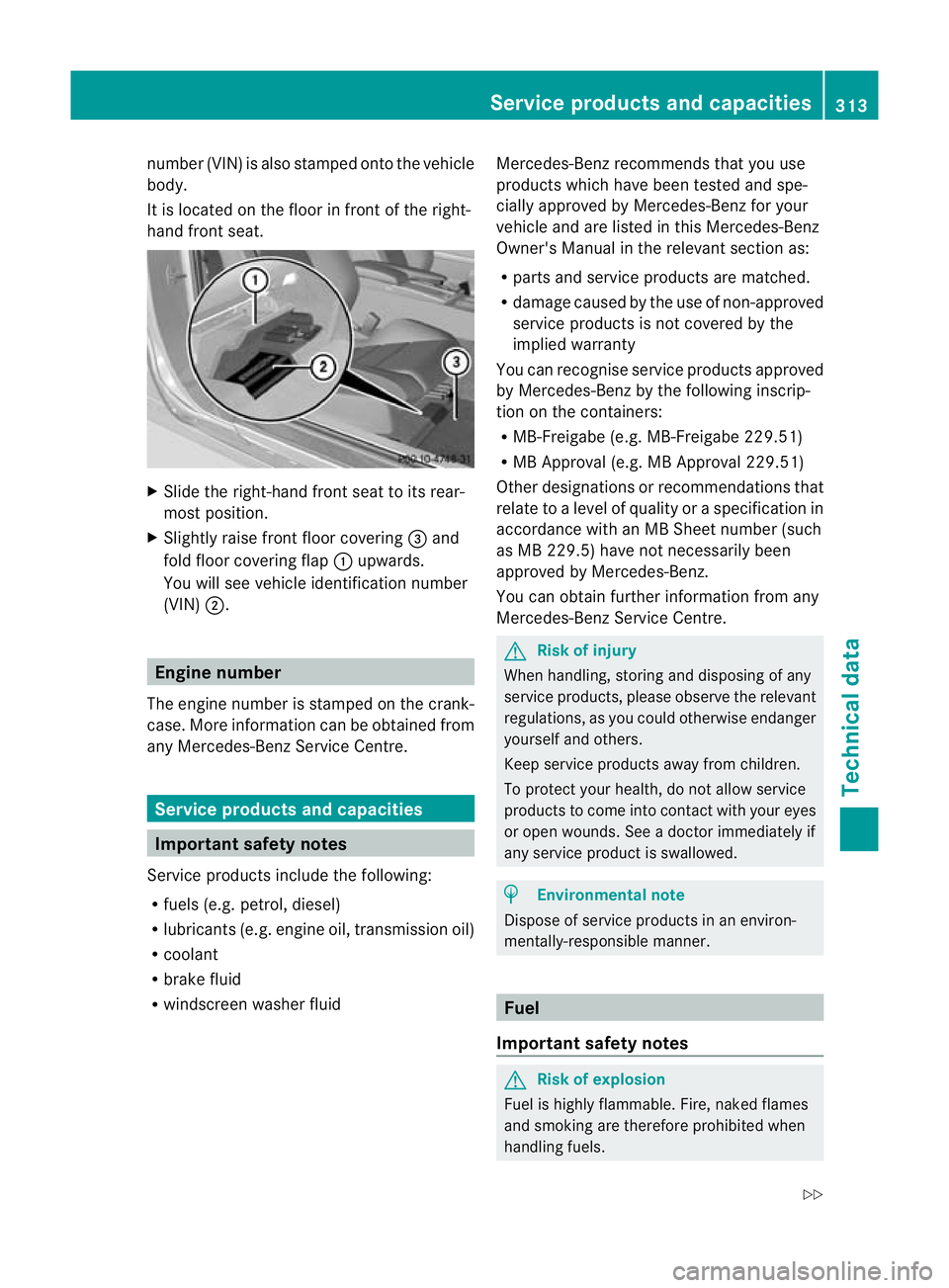
It is located on the floor in front of the right-
hand front seat. X
Slide the right-hand front seat to its rear-
most position.
X Slightl yraise front floor covering =and
fold floor covering flap :upwards.
You will see vehicle identification number
(VIN) ;. Engine number
The engine number is stamped on the crank-
case. More information can be obtained from
any Mercedes-Benz Service Centre. Servic
eproducts and capacities Important safety notes
Service products include the following:
R fuels (e.g. petrol, diesel)
R lubricants (e.g. engine oil, transmission oil)
R coolant
R brake fluid
R windscreen wash erfluid Mercedes-Ben
zrecom mends that you use
product swhich hav ebeen tested and spe-
ciall yapproved by Mercedes-Ben zfor your
vehicle and ar elisted in this Mercedes-Benz
Owner' sManual in the relevant section as:
R parts and service products are matched.
R damage caused by the use of non-approved
service products is not covered by the
implied warranty
You can recognise service products approved
by Mercedes-Benz by the following inscrip-
tion on the containers:
R MB-Freigabe (e.g. MB-Freigabe 229 .51)
R MB Approval (e.g. MB Approval 229.51)
Othe rdesignations or recommendations that
relate to alevel of quality or aspecification in
accordan cewith an MB Sheet number (such
as MB 229 .5)h ave not necessarily been
approved by Mercedes-Benz.
You can obtain further information from any
Mercedes-Benz Servic eCentre. G
Risk of inju
ry
When handling, storin gand disposing of any
service products, please observe the relevant
regulations ,asyou coul dotherwis eendanger
yourself and others.
Keep service products away from children.
To protect your health, do not allo wservice
products to com einto contact with your eyes
or ope nwounds. See adoctor immediately if
any service product is swallowed. H
Environmental note
Dispose of service products in an environ-
men tally-responsible manner. Fuel
Important safety notes G
Risk of explosion
Fuel is highly flammable. Fire, naked flames
and smokin gare therefore prohibited when
handling fuels. Servic
eprodu cts and capacities
313Technical data
BA 207ECE ÄJ 2010 /1a; 1; 2, en-GB
mkalafa Version: 3.0.2.11 2010-01-26T13:03:22+01:00 -Seite 313 Z
Page 319 of 333
Vehicl
emodel Replacement
amou nt with oil fil-
ter E2
00 CGI 60
E2 50 CGI 60 5.5 l
E2
20 CDI 60
E2 50 CDI 60 6.5 l
E3
5061
E3 50 CGI 60
E3 50 CDI 60 8.0 l
E5
00 8.5 l
Lubricant additives
!
Do not mix any lubrican tadditives with
the engin eoil. This could damage the
engine. Damage resultin gfrom th euse of
suc hlubricant additives in the engine oil is
not covered by the Mercedes-Benz implied
warranty.
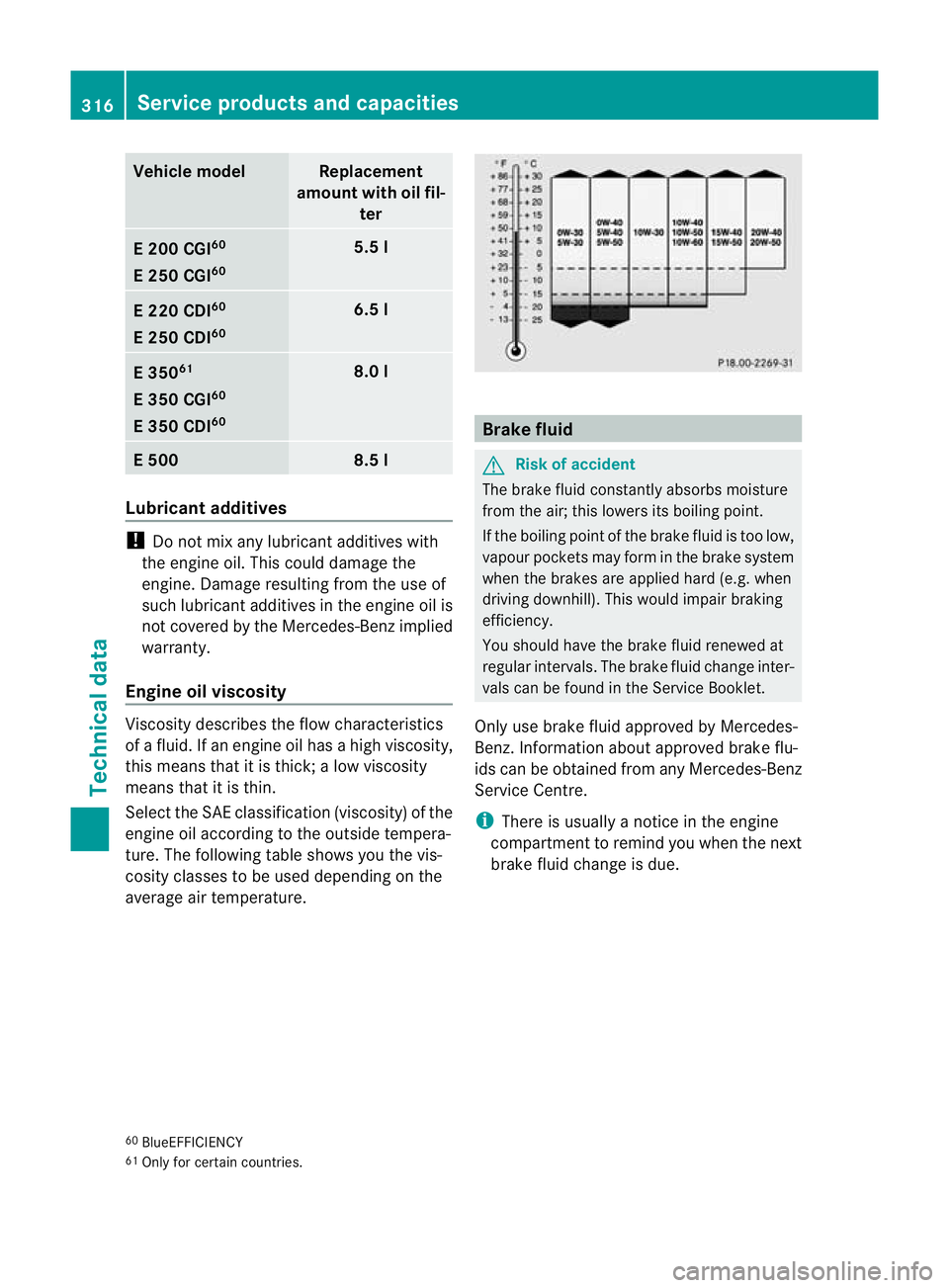
Engin eoil viscosity Viscosit
ydescribes the flow characteristics
of afluid. If an engin eoil has ahigh viscosity,
this means that it is thick; alow viscosity
means that it is thin.
Selec tthe SA Eclassification (viscosity )ofthe
engine oil accordi ngto the outside tempera-
ture. The followin gtable shows you the vis-
cosity classes to be used depending on the
average air temperature. Brake fluid
G
Risk of accident
The brak efluid constantly absorbs moisture
fro mt he air ;this lower sits boiling point.
If the boiling point of the brake fluid is too low,
vapour pockets may form in the brake system
when the brakes are applied hard (e.g. when
driving downhill). Thi swould impair braking
efficiency.
You should have the brake fluid renewed at
regular intervals. The brake fluid change inter-
val sc an be found in the Service Booklet.
Only use brake fluid approved by Mercedes-
Benz .Information abou tapproved brak eflu-
ids can be obtained from any Mercedes-Benz
Service Centre.
i There is usually anotic eint he engine
compartmen ttoremin dyou when the next
brake fluid change is due.
60 BlueEF FICIENCY
61 Only for certain countries. 316
Service products and capacitiesTechnical data
BA 20
7ECE ÄJ 2010 /1a; 1; 2, en-GB
mkalafa Version: 3.0.2.11 2010-01-26T13:03:22+01:00 -Seite 316
Page 326 of 333
recommend
sthat you use aMercedes-Benz
Ser vice Centre for thi spurpose. In particular,
work relevant to safety or on safety-related
systems must be carried out at aqualified
specialist workshop.
! If you have atrailer to whitchr etrofit ted,
changes to the cooling system may be nec-
essary, depending on the vehicle type.
If you have atrailer to whitchr etrofit ted,
observe the anchorage point sonthe chas-
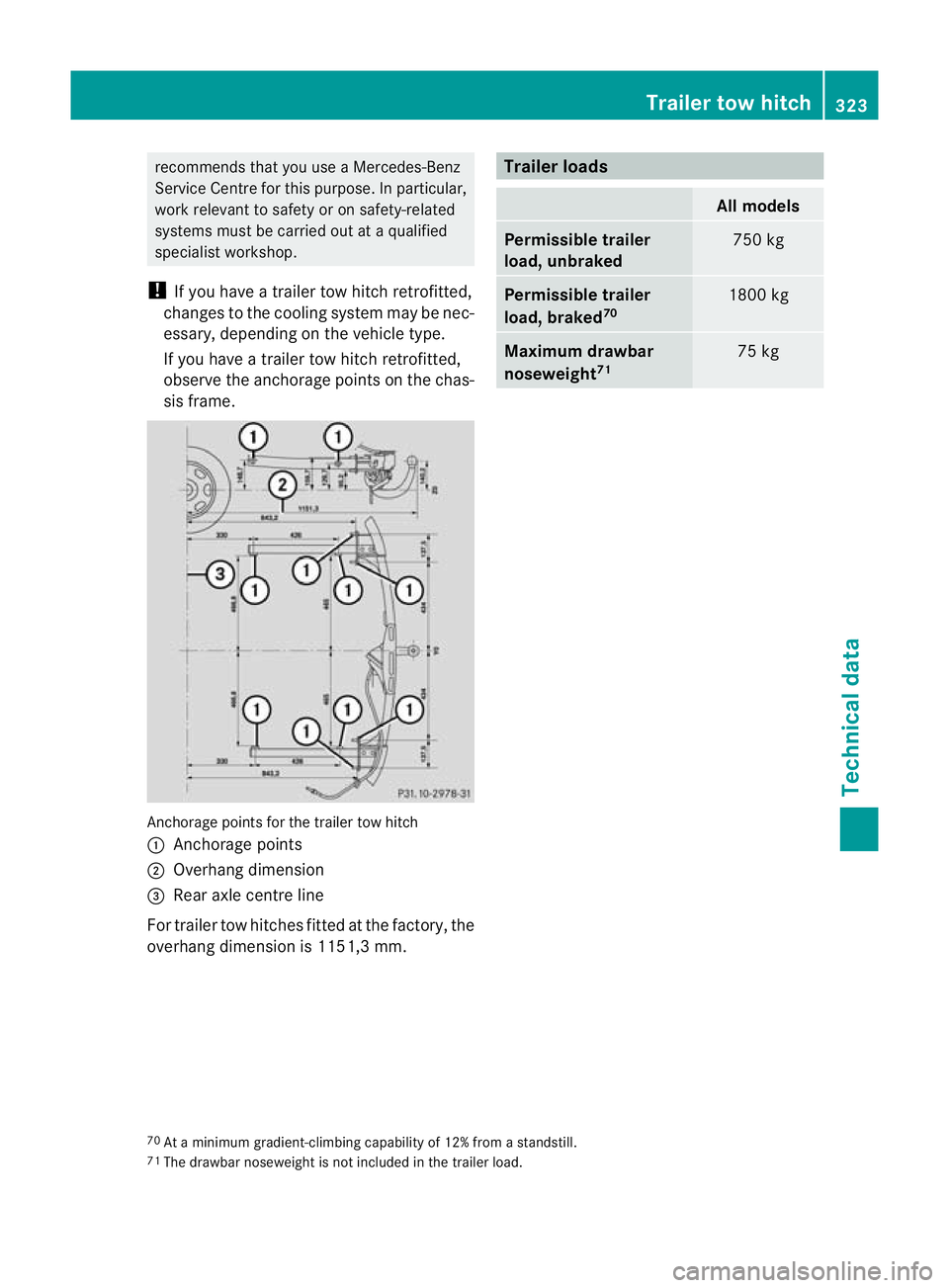
sis frame. An
chorage point sfor the trailer tow hitch
: Anchorage points
; Overhang dimension
= Rear axle centre line
For trailer tow hitches fitted at the factory ,the
overhang dimension is 1151,3 mm. Trailer loads
All models
Permissible trailer
load, unbraked
75
0kg Permissible trailer
load, braked
70 1800 kg
Maximu
mdrawbar
nose weight71 75 kg
70
At am inimum gradient-climbing capability of 12% from astandstill.
71 The drawbar noseweigh tisnot included in the trailer load. Trailer tow hitch
323Technical data
BA 207ECE ÄJ 2010 /1a;1;2,e n-GB
mkalafa Version: 3.0.2.11 2010-01-26T13:03:22+01:00-Seite 323 Z
Page 327 of 333
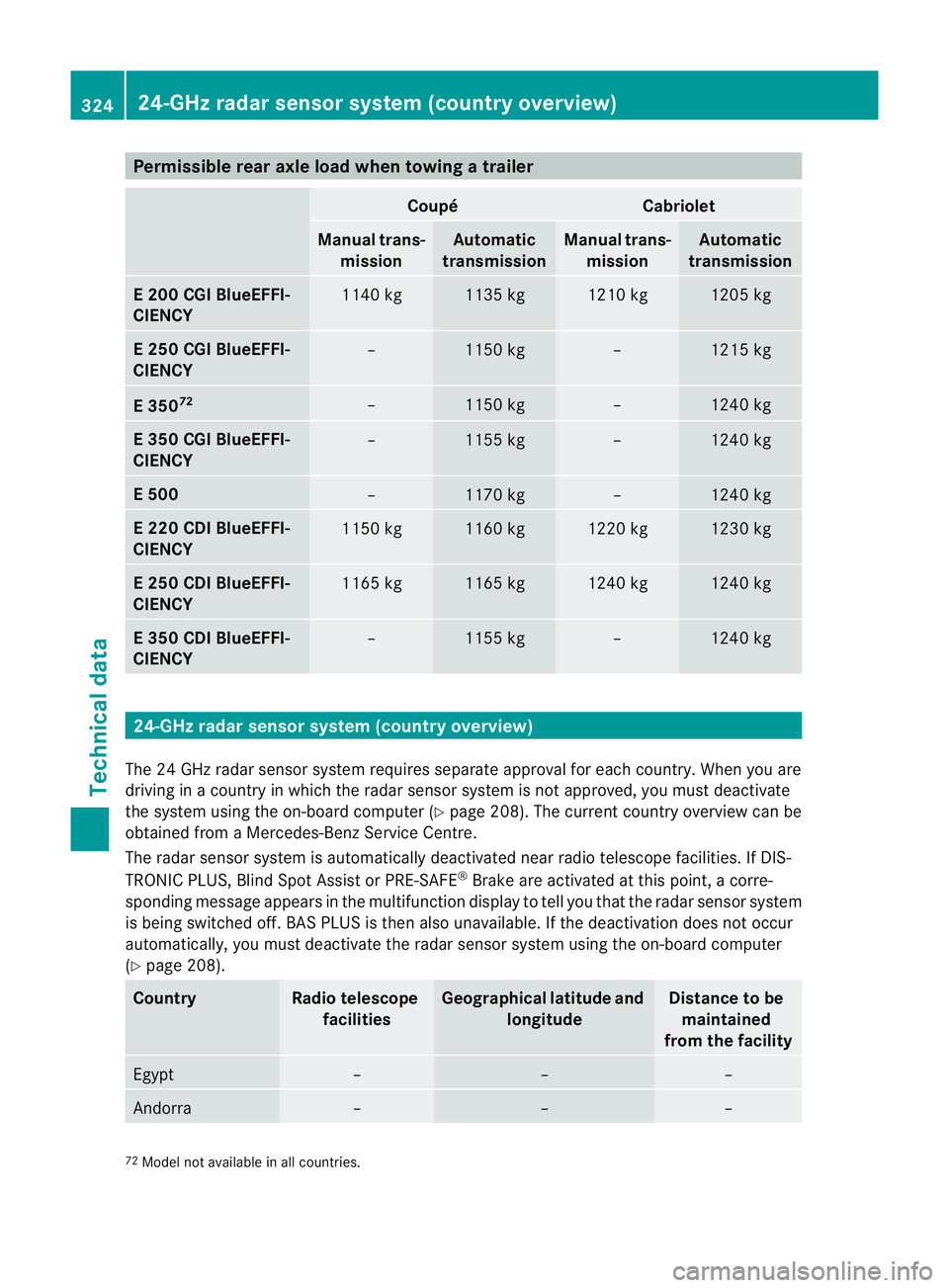
Permissible rea
raxle loa dwhen towin gatrailer Coupé Cabriolet
Manual trans-
mission Automatic
transmission Manual trans-
mission Automatic
transmission E2
00 CGI BlueEFFI-
CIENCY 114
0kg 1135 kg 1210 kg 1205 kg
E2
50 CGI BlueEFFI-
CIENCY – 115
0kg – 1215 kg
E3
5072 – 115
0kg – 1240 kg
E3
50 CGI BlueEFFI-
CIENCY – 115
5kg – 1240 kg
E5
00 – 1170 kg – 1240 kg
E2
20 CDIBlueEFFI-
CIENCY 1150 kg 1160 kg 1220 kg 1230 kg
E2
50 CDIBlueEFFI-
CIENCY 1165 kg 1165 kg 1240 kg 1240 kg
E3
50 CDIBlueEFFI-
CIENCY – 1155 kg – 1240 kg
24-GHz radar sensor syste
m(coun try overview)
Th e24G Hz radar sensor system requires separate approval for each country. Whe nyou are
dri ving in acoun tryinw hichthe ra dar sensor system is no tapproved, you must deacti vate
the syste musing the on-boar dcompu ter( Ypage 20 8).T he curren tcountry over view can be
obtain ed fromaMercedes-Benz Ser vice Centre.
Th er adar sensor sys temi sautomatically deactivated near radi otelescope facilities. If DIS-
TRONIC PLUS, Blind Spot Assist or PRE-SAFE ®
Brake are activa tedatt hisp oint, acorre-
spondin gmessage appears in th emultifunction display to tell you that th eradar sensor system
is being switche doff. BAS PLUS is then also unavailable. If the deactivation doe snot occur
automatically, you must deactivate the radar sensor system using the on-board computer
(Y page 208). Country Radio telescope
facilities Geographical latitude and
longitude Distance to be
maintained
from the facility Egypt – – –
Andorra – – –
72
Model not available in all countries. 324
24-GHz radar sensor system (country overview)Technical data
BA 207 ECE ÄJ 201
0/1a; 1; 2, en-GB
mkalafa Version: 3.0.2.11 2010-01-26T13:03:22+01:00-Seite 324