display MERCEDES-BENZ E-CLASS CABRIOLET 2011 Owner's Manual
[x] Cancel search | Manufacturer: MERCEDES-BENZ, Model Year: 2011, Model line: E-CLASS CABRIOLET, Model: MERCEDES-BENZ E-CLASS CABRIOLET 2011Pages: 353, PDF Size: 8.42 MB
Page 34 of 353
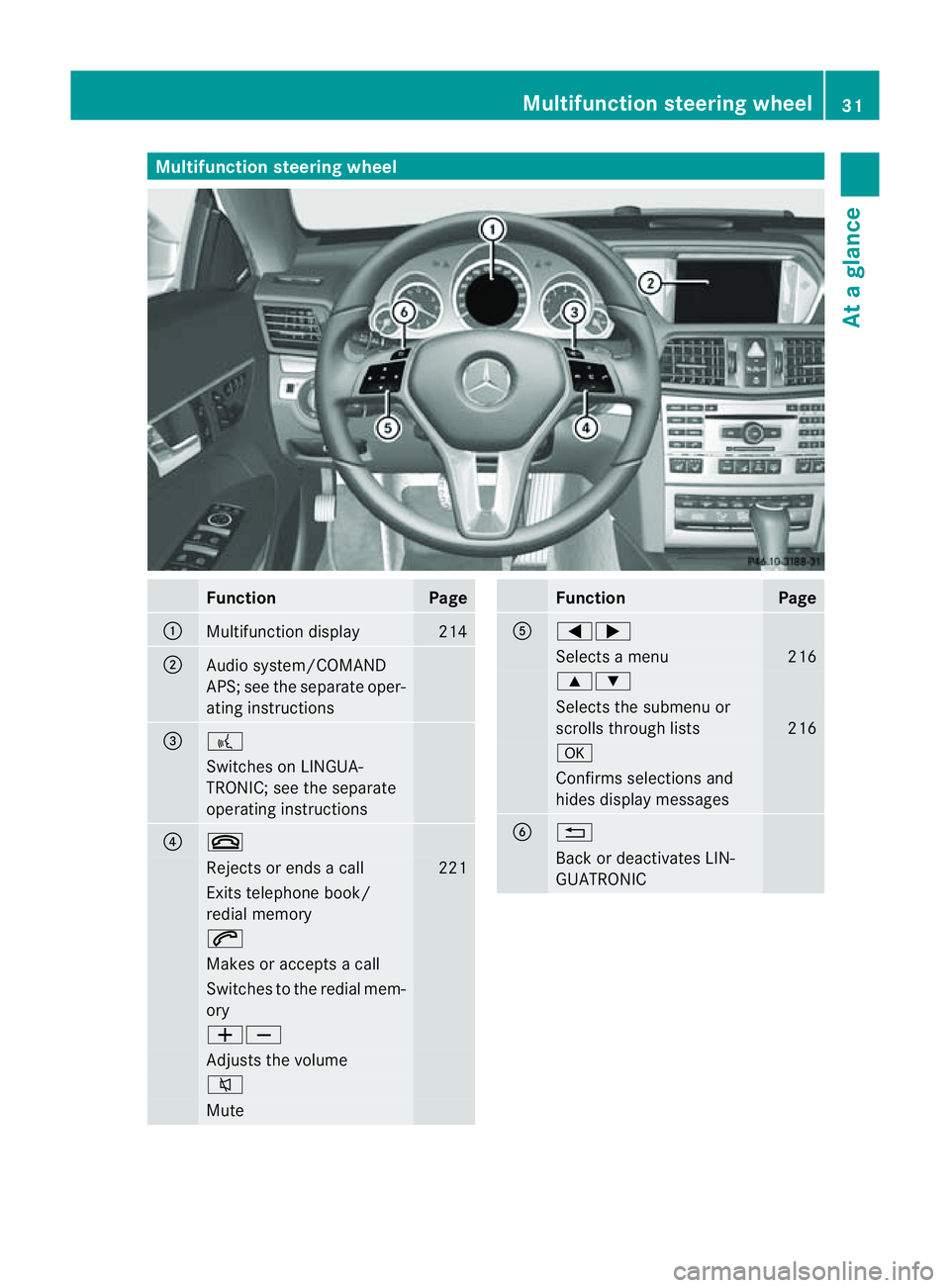
Multifunction steering wheel
Function Page
:
Multifunction display 214
;
Audi
osystem/COMAND
APS; see the separate oper-
ating instructions =
?
Switches on LINGUA-
TRONIC; see the separate
operating instructions
?
~
Rejects or ends
acall 221
Exits telephone book/
redial memory
6
Makes or accepts
acall Switches to the redial mem-
ory
WX
Adjusts the volume
8
Mute Function Page
A
=;
Selects
amenu 216
9:
Selects the submenu or
scroll
sthrough lists 216
a
Confirm
sselections and
hide sdisplay messages B
%
Back or deactivates LIN-
GUATRONICMultifunction steering wheel
31Atag lance
Page 48 of 353
When the roll bars are extended, the rear
head restraints also extend automatically.
Oncet he roll bars are extended, you can no
longer lower the rear head restraints. The soft
top can no longer be operated. In this case,
visit the nearest qualified specialist work-
shop. G
WARNING
If the roll bar is malfunctioning, the A
Malfunction Consult workshop message
appears in the multifunction display. The roll
bars will then not be extended in the event of
an accident .This could result in severe or
even fatal injuries to you and other occupants.
In this case, visit aqualified specialist work-
shop immediately and have the roll bar
checked. PRE-SAFE
®
(preventative occupant
protection)
PRE-SAFE ®
takes pre-emptive measures to
protect occupants in certain hazardous sit-
uations.
PRE-SAFE ®
intervenes:
R in emergency braking situations, e.g. if BAS
is activated or for vehicles with DISTRONIC
PLUS, BAS PLUS intervenes powerfully
R if the radar sensor system detects an immi-
nent danger of collision in certain situa-
tions (on vehicles with DISTRONIC PLUS)
R in critical driving situations, e.g. when phys-
ical limits are exceed and the vehicle under-
steers or oversteers severely
PRE-SAFE ®
takes the following measures
depending on the hazardous situation detec-
ted:
R the front seat belts are pre-tensioned.
R vehicles with the memory function: it
adjusts the front-passenger seat if it is in
an unfavourable position. R
vehicles with amulticontour seat: the air
pressure in the seat side cushions and in
the backrest side bolsters is increased.
R if the vehicle skids, the front side windows
and, on the Coupé,t he panorama sliding
sunroof, are closed so that only asmall gap
remains.
If the hazardous situation passes without
resulting in an accident, PRE-SAFE ®
slackens
the belt pretensioning. The air pressure in the
side bolsters on the multicontour seat is
reduced again. All settings made by PRE-
SAFE ®
can then be reversed.
If the seat belts are not released:
X Move the backrest or seat back slightly, but
only when the vehicle is stationary.
The belt pretensionin gisreduced and the
locking mechanism is released. G
WARNING
When adjusting the seat, make sure that
nobody can become trapped.
! Make sure that there are no objectsint he
footwell or behind the seats when moving
the seat back. There is arisk that the seats
and/or the objectsc ould be damaged.
More information about seat-belt adjust-
ment, aconvenience function integrated into
PRE-SAFE ®
,c an be found in the "Seat-belt
adjustment" section (Y page 49). NECK-PRO head restraints
The NECK-PRO head restraints increase pro-
tection to the driver's and front passenger's
head and neck.Tot his end, the NECK-PRO
head restraints on the driver's and front-
passenger seats are moved forwards and
upwards in the event of arear-end collision of
ac ertain severity. This provides better head
support. Occupant safety
45Safety Z
Page 52 of 353
seat belt and guide the belt tongue to the belt
sash guide.
For more information aboutr eleasing the seat
belt with release button ?,see "Releasing
seat belts" (Y page 49).
Seat belt adjustment The seat-belt adjustment function adjusts the
driver's and front-passenger seat belt to the
upper body of the occupants.
The belt strap is tightened slightly when:
R you engage the belt tongue in the belt
buckle and you then turn the key to position
2 in the ignition lock.
R the key is in position 2in the ignition lock
and you then engage the belt tongue in the
buckle oncet he seat-belt extender has
retracted.
The seat-belt adjustment will apply acertain
tightening forc eifany slack is detected
between the occupan tand the sea tbelt. Do
not hold on to the seat belt tightly while it is
adjusting. You can switch the seat-belt
adjustment on and off in the on-board com-
puter (Y page 230).
The seat-belt adjustment is an integral part of
the PRE-SAFE ®
convenience function .More
information about PRE-SAFE ®
can be found
in the "PRE-SAFE ®
(preventativ eoccupant
protection)" section (Y page 45).
Releasing seat belts X
Press release button ?(Ypage 47) and
guide belt tongue ;back towards seat
belt extender :.
! Make sure that the seat belt is fully rolled
up. Otherwise, the seat belt or belt tongue
will be trapped in the door or in the seat
mechanism. This could damage the door,
the door trim panel and the seat belt. Dam-
aged seat belts can no longer fulfil their
protective function and must be replaced.
Consult aMercedes-BenzS ervice Centre. Belt warning for driver and front
passenger The
7 seat belt warning lamp in the instru-
ment cluster is areminder for all occupants
to fasten their seat belts. It may light up con-
tinuously or flash. In addition, ther emay be a
warning tone.
The 7 seat belt warning lamp goes out and
the warning tonec eases when the driver and
the fron tpassenger have fastened their seat
belt.
For certain countries only: regardless of
whether th edriver or th efront passenger
have fastened their seat belts, the 7seat
beltw arning lamp light supfor six seconds
after th eengineiss tarted. It then goes out if
th ed river and th efront pa ssenger have fas-
tene dtheir seat belts.
i For mor einformatio nonthe7 seat
belt warning lamp, see "Warning and indi-
cator lamps in th einstrumen tcluster, seat
belt" (Y page 255).
Rea rseat belt statu sindicator The rear-compartmen
tseat belt status indi-
cator tells you if the rear passengers have
their seat belts fastened.
The rear-compartment seat belt status indi-
cator indicates the rear seat on which the belt
is fastened.
The rear-compartment seat belt status indi-
cator appears in the multifunction display for
around 30 seconds if:
R you drive off and reach aspeed of approx-
imately 10 km/h.
R the rear passengers fasten or unfasten
their seat belts while the vehicle is in
motion.
R someon egets in or out of the vehicle and
the vehicle drives off again. Occupant safety
49Safety Z
Page 69 of 353
driving style to the differen
thandling charac-
teristics.
X Observ ethe note sonw arning and indicator
lamps (Y page 257) as well as display mes-
sages ( Ypage 234). ADAPTIV
EBRAKE
ADAPTIV EBRAKE enhances braking safety
and offers increased braking comfort. In addi-
tio ntot he brakin gfunction, ADAPTIVE BRAKE
alsoh as the HOLD function (Y page184) and
hills tart assist (Y page149). For further
information, see Driving tips (Y page167). PRE-SAFE
®
Brake
PRE-SAFE ®
Brake is only available in vehicles
with DISTRONIC PLUS.
i Observe the "Important safety notes" sec-
tion (Y page61).
PRE-SAFE ®
Brake can help you to minimise
the risk of afrontal collision with avehicle
ahead or reduce the effects of such acolli-
sion. If PRE-SAFE ®
Brake has detected arisk
of collision, you willbew arned visuallya nd
acoustically as wellasbya utomatic braking.
PRE-SAFE ®
Brake cannot prevent acollision
without youri ntervention.
Thi sfun ctio nwill issue awarnin gats peeds of
aroun d30k m/horm orei f:
R for aperiod of several seconds ,the dis-
tance to the vehicle in front is too shor tfor
the speed at which you are travelling. The
· distance warning lamp then lights up
in the instrument cluster.
R you are rapidly approaching the vehicle in
front.Ani ntermittent warning tonew ill
then sound and the ·distance warning
lamp will light up in the instrument cluster. X
Brake immediately in order to increase the
distance from the vehicle in front.
or
X Take evasive action provided it is safe to do
so.
If the driver and passengers have fastened
their seat belts, PRE-SAFE ®
Brake can also
can also perform the following at speeds of
above approximately 30 km/h:
R brake the vehicle automatically from a
speed of up to approximately 200 km/h
R trigger preventative passenger protection
measures (PRE-SAFE ®
)( Ypage 45)
Due to the nature of the system, particularly
complicated driving conditions may cause
unnecessary warnings or the unnecessary
intervention of PRE-SAFE ®
Brake. To end this,
you can either depress the accelerator pedal
further, activate kickdown or release the
brake pedal.
The braking action of PRE-SAFE ®
Brake is
ended automatically if:
R you drive slower than approximately
15 km/h.
R you manoeuvre to avoid the obstacle.
R there is no longer any danger of arear-end
collision.
R there is no longer an obstacle detected in
front of your vehicle.
With the help of the radar sensor system,
PRE-SAFE ®
Brake can detect obstacles that
are in front of your vehicle for an extended
period of time.
At speeds up to approximately 70 km/h,
PRE-SAFE ®
Brake may also detect stationary
obstacles, for example stopped or parked
vehicles.
If you approach an obstacle and PRE-SAFE ®
Brake detect sarisk of acollision, the system
will initially alert you both visually and acous-
tically. If you do not brake or take evasive
action, the system will warn you by automat-
ically braking the vehicle gently. If there is an
increased risk of collision, preventative 66
Driving safety systemsSafety
Page 70 of 353
passenger protection measures (PRE-SAFE
®
)
are activated (Y page 45). If the risk of colli-
sion remains and you do not brake, tak eeva-
sive action or accelerate significantly, the
vehicle may perfor mautomatic emergency
braking .Automatic emergenc ybraking is not
performed until immediately prio rtoanacci-
dent that can no longer be avoided. G
WARNING
Even if PRE-SAFE ®
Brake slows the vehicle
before an imminent rear-end collision, the
system cannot avert acollision without the
intervention of the driver. There is arisk of an
accident .Brake according to the situation or
take evasive action. Delayed intervention by
the driver can lead to an accident. G
WARNING
PRE-SAFE ®
Brake cannot alwaysc learly iden-
tify object sand complex traffic conditions.
In these cases, PRE-SAFE ®
Brake may:
R give an unnecessary warning and then
brake the vehicle
R not give awarning or intervene
There is arisk of an accident .Always pay par-
ticular attention to the traffic situation and be
ready to brake, especially if PRE-SAFE ®
Brake
warns you. Terminat ethe intervention in a
non-critical drivin gsituation.
In particular, the detection of obstacles can
be impaired if there is:
R dirt on the sensors or anything else cover-
ing the sensors
R sno worh eavy rain
R interference by other radar sources
R the possibilit yofstrong radar reflections,
for example in multi-storey car parks
R an arrow vehicle travellin ginfront,e.g. a
motorbike
R av ehicle travellin ginfront on adifferent
line G
WARNING
PRE-SAFE ®
Brak edoes not react:
R to people or animals
R to oncomin gvehicles
R to crossin gtraffic
R when cornering
As aresult ,PRE-SAFE ®
Brak emay not give
warnings or intervene in critical situations.
There is arisk of an accident .Always pay
careful attention to the traffic situation and be
ready to brake.
In order to maintain the appropriate distance
to the vehicle in front and thus prevent acol-
lision ,you must apply the brakes yourself.
X To activate/deactivate: activate or deac-
tivate PRE-SAFE ®
Brak eint he on-board
computer (Y page 223).
The Ä symbol appears in the multifunc-
tion display as long as the HOL Dfunction
is no tactivated (Y page 184).
On vehicles wit hparking guidance, the
Ä symbol is displayed when Pis
engaged or you are driving faste rthan
35 km/h.
The radar sensor system is switched off auto-
matically in the vicinity of radio telescope
facilities (Y page 345).
Vehicles without COMAND and anavigation
system and vehicles for Australia: the radar
sensor system and on-board computer must
be switched off in the vicinity of radio tele-
scope facilities (Y page 229).
For PRE-SAFE ®
Brake to assist you when driv-
ing, the radar sensor system must be
switched on (Y page 229) and be opera-
tional.
Following damage to the front end of the vehi-
cle, have the configuration and operation of
the radar sensors checked at aqualified spe-
cialist workshop. This also applies to colli-
sions at slow speeds where there is no visible
damage to the front of the vehicle. Driving safety systems
67Safety Z
Page 88 of 353
If the side window opens again slightly:
X Immediately pullt he corresponding switch
on the door control panel until the side win-
dow is completel yclosed (Y page 82).
X Hold the switch for an additional second.
X If the corresponding side window remains
closed after the button has been released,
the side window has been reset correctly.
If this is not the case, repeatt he steps
above again. Problems with the side windows
Problem: aside window cannot be closed
because it is blocked by objects, e.g.
leaves in th ewindow guide.
X Remove the objects.
X Close the side window.
Problem :aside window cannot be closed
and you cannot see th ecause. G
WARNING
Closing the side windows with increased force
or without the anti-entrapmen tfeature could
lead to serious or even fatal injury. Make sure
that nobody can becom etrapped when clos-
ing the side windows.
If as ide window is obstructed during closing
and reopen sagain slightly:
X Immediately afte rthe window blocks, pull
the corresponding switch again until the
side window has closed.
The side window is closed with increased
force.
If as ide window is obstructed again during
closing and reopens again slightly:
X Immediately after the window blocks, pull
the corresponding switch again until the
side window has closed.
The side window is closed without the anti-
entrapment feature. Soft top (Cabriolet)
Important safety notes
You can open or close the soft top:
R when the vehicle is stationary or
R when driving up to aspeed of 40 km/h.
If there is astrongh ead wind, it may not be
possible to close the soft top fully.Int his
case, reduce speed or stop in order to close
the soft top fully.
For safety reasons, Mercedes-Ben zrecom-
mends that you only open or close the soft
top when the vehicle is stationary. G
WARNING
Only drive with the soft top fully open or
closed.
If the soft top does not open or close fully, the
soft-top hydraulics are depressurised and the
soft top is lowered:
R after about seven minutes if the ignition is
switched on
R immediately if the ignition is switched off
Aw arning tone sounds shortly beforehand.
The Top being opened message appear
sin
th em ultifunction display.
Loc kthe soft top again before driving on. Oth-
erwise, the unlocked soft top could open dur-
ing the journey and cause you to lose control
of your vehicle. You or other persons could be
injured as aresult.
! Never sit on the soft-top compartment
cover and do not store any heavy objects
on it. You will otherwise damage the soft
top and soft-top compartmentc over of the
vehicle.
! When opening and closing the soft top,
make sure that:
R there is sufficient clearance above it, as
the soft top swings upwards
R the boot separator is closed.
R the boot is only loaded to below the boot
separator. Soft top (Cabriolet)
85Opening and closing Z
Page 89 of 353
R
the boot separator is not pushe dupby
the load.
R the boot li disclosed.
R no objects ar eonthe soft-top compart-
ment cover
R the fabri cisn ot dirty ,wetor frozen.
Yo uc ould otherwis edamag ethe soft top,
boot and other parts of the vehicle.
i Make sure tha tthe soft top is dry and
clean before closing it. Otherwise, water or
dirt could enter the vehicle interior or boot. Opening and closing with the soft-top
switch
Important safety notes G
WARNING
Make sure nobody can be trapped or injured
by moving parts, such as the soft-top linkage
or soft-top compartmentc over, when opening
or closing the soft top.
Release the soft-top switch in the event of
danger. The soft-top mechanism stops imme-
diately. G
WARNING
If the vehicle speed exceeds 40 km/h, the
soft top stops the opening or closing move-
ment and remains in that position. This could
impair your rear view. At high speeds, the soft
top may be damaged.
Reduce your speed to below 40 km/hors top
the vehicle in accordanc ewith the traffic con-
ditions. Press the soft-top switc hagain in
order to open or clos ethe soft top fully.
Opening and closing X
Make sure that the boot separator is closed
(Y page 92).
X Close the boot lid. X
Turn the key to position 2in the ignition
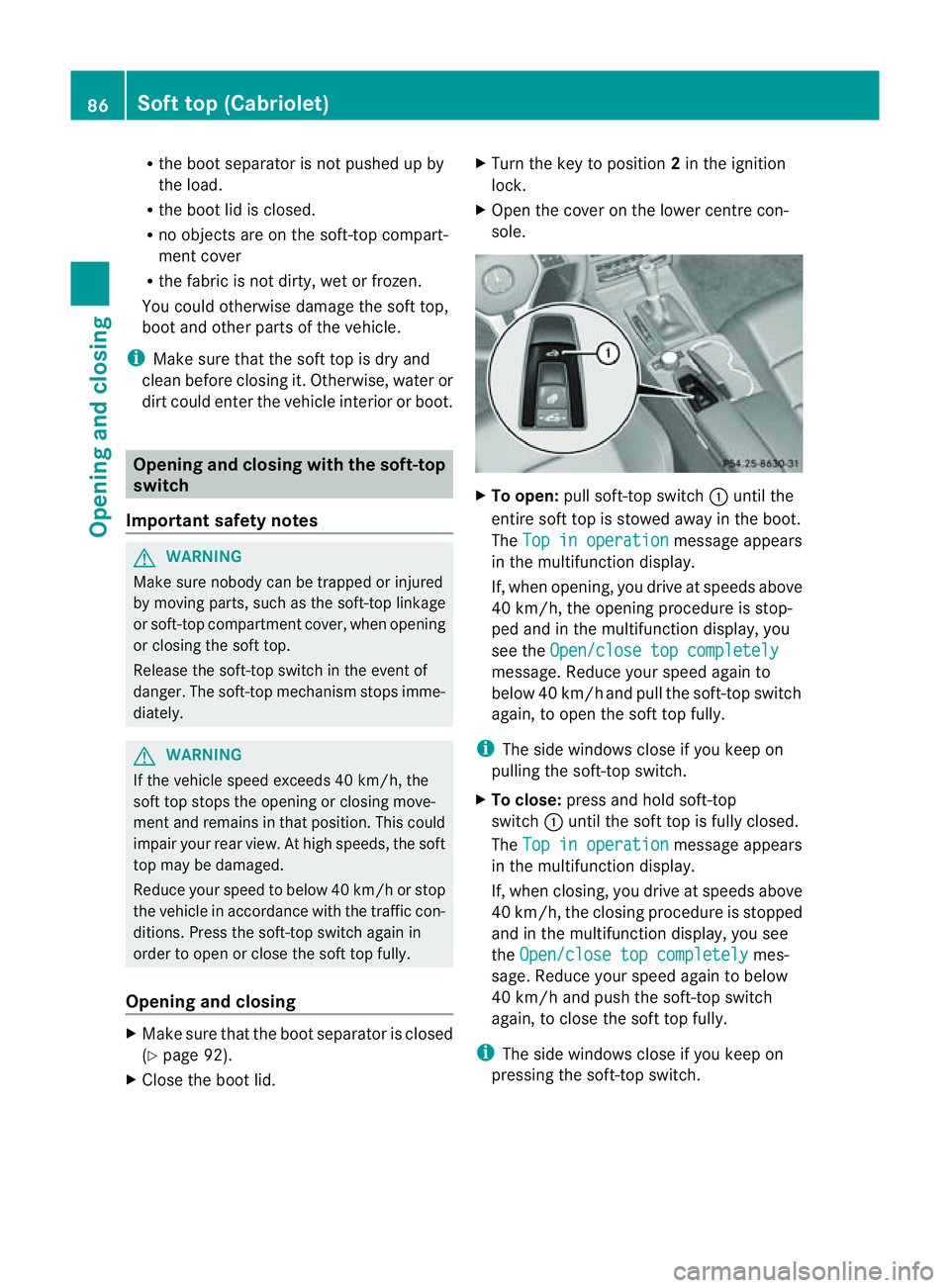
lock.
X Open the cover on the lower centr econ-
sole. X
To open: pull soft-top switch :until the
entire soft top is stowed away in the boot.
The Top in operation message appears
in the multifunction display.
If, when opening, you drive at speeds above
40 km/h, the opening procedure is stop-
ped and in the multifunction display, you
see the Open/close top completely message. Reduce your speed again to
below 40 km/h and pull the soft-top switch
again, to open the soft top fully.
i The side windows close if you keep on
pulling the soft-top switch.
X To close: press and hold soft-top
switch :until the soft top is fully closed.
The Top in operation message appears
in the multifunction display.
If, when closing, you drive at speeds above
40 km/h, the closing procedure is stopped
and in the multifunction display, you see
the Open/close top completely mes-
sage. Reduce your speed again to below
40 km/h and push the soft-top switch
again, to clos ethe soft top fully.
i The side windows close if you keep on
pressing the soft-top switch. 86
Soft top (Cabriolet)Opening and closing
Page 90 of 353
Opening and closing with the key
Important safet ynotes G
WARNING
Make sure nobody can be trapped or injured
by movin gparts such as the soft-top linkage
or soft-top compartment cover when opening
or closing the soft top.
If there is arisk of entrapment ,immediately
release the %or& button on the key.
The soft-top mechanism stops immediately.
Opening and closing i
The key must be close to the driver's door
handle.
X Point the tip of the key at the driver's door
handle.
X To open: press and hold the %button
on the key until the soft top is fully opened.
The Top in operation message appears
in the multifunction display. The seat ven-
tilation is switched on. The rear side win-
dows open.
X To close: press and hold the &button
on the key until the soft top is fully closed.
The Top in operation message appears
in the multifunction display. The soft top
and the side windows close. Closing the soft top manually
If the soft top cannot be closed automatically,
chec kthe following points:
R Is the boot separator engaged
(Y page 92)?
R Are the head restraintsont he rear bench
seats extended?
R Is the boot lid closed?
R Is the on-board voltage sufficient?
Start the engine if necessary.
If automatic operation still does not work, the
soft top can be closed manually.
This work must be performed by two persons. i
Closing the soft top manually is acom-
plex, technically demanding process which
requires agreat deal of force. Only close
the soft top manually in extreme emergen-
cies. In these situations, it is better to get
in touch with aqualified specialist work-
shop, e.g. aMercedes-Ben zService
Centre. G
WARNING
Remove wristwatches and any jewellery such
as rings or bracelets .You could otherwise get
caught, injured and damage the vehicle.
Always grip the soft top at the indicated grip-
ping points when closing the soft top man-
ually.Y ou could otherwise be injured.
X Depress the parking brake.
X Open the side windows.
X Lower the head restraint s(automatically
(Y page 103) or manually (Y page 103)).
X Remove the key from the ignition lock.
X Open the boot.
X Take the two straps out of the vehicle tool
kit (Y page 295).
X Take the hex-socket wrench out of the
Owner's Manual walleta nd keepitwith
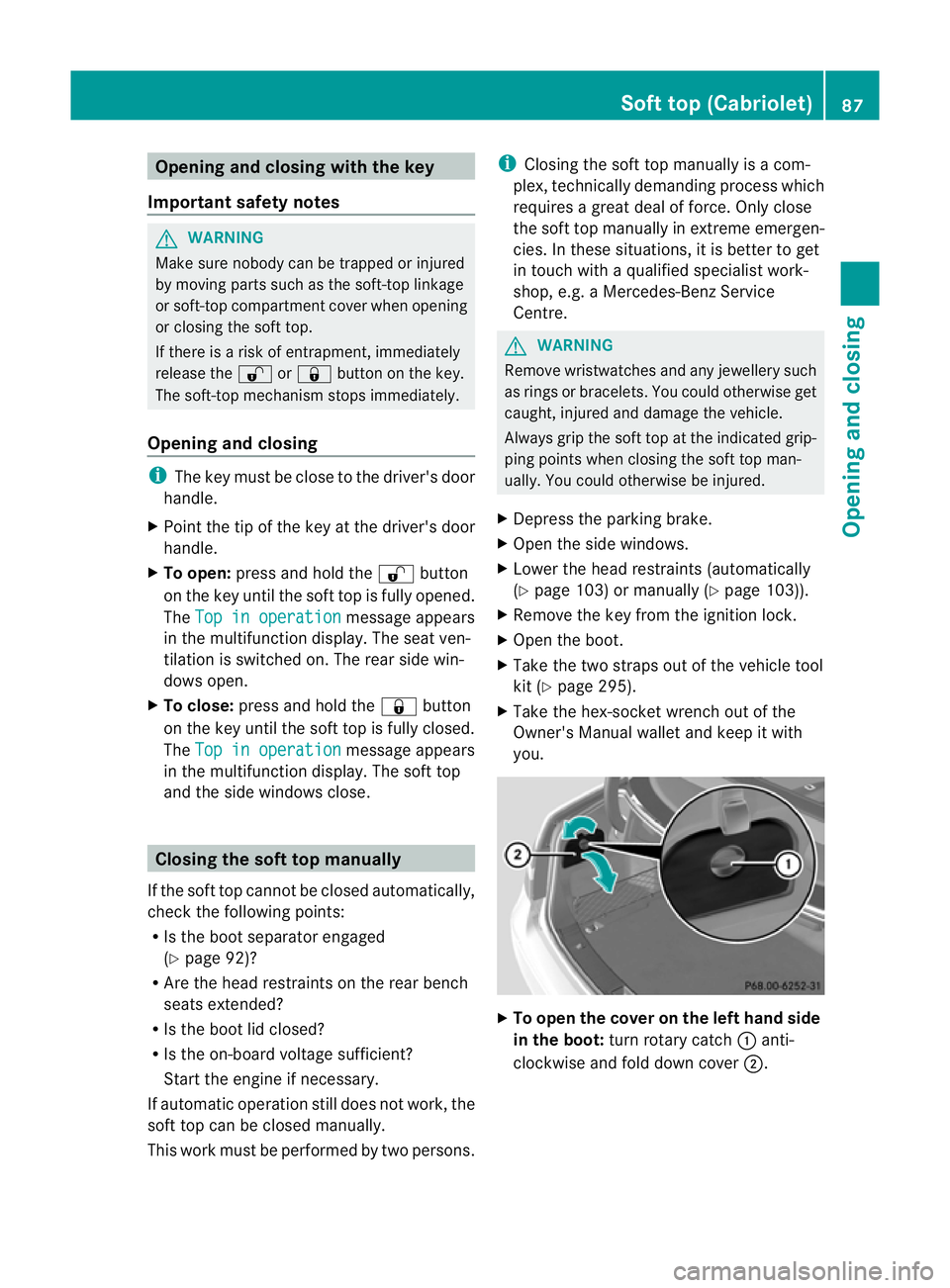
you. X
To ope nthe cove ronthe left hand side
in the boot: turn rotary catch :anti-
clockwise and fold down cover ;. Soft top (Cabriolet)
87Opening and closing Z
Page 94 of 353
X
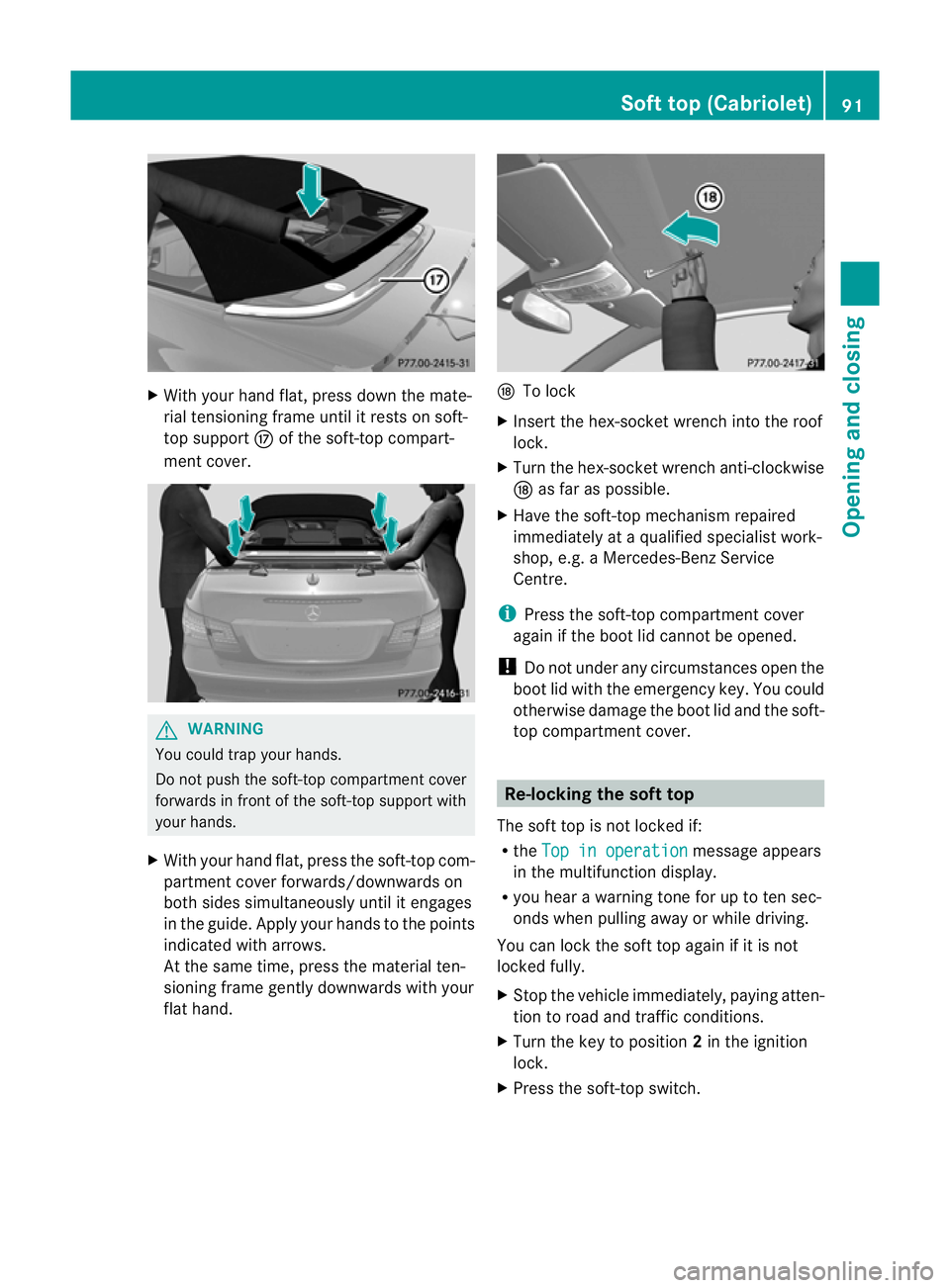
With your hand flat, press down the mate-
rial tensioning frame until it rests on soft-
top support Mof the soft-top compart-
ment cover. G
WARNING
You could trap your hands.
Do not push the soft-top compartment cover
forwards in fron tofthe soft-top support with
your hands.
X With your hand flat, press the soft-top com-
partmen tcover forwards/downwards on
both sides simultaneously until it engages
in the guide. Apply your hands to the points
indicated with arrows.
At the same time, press the material ten-
sioning frame gently downwards with your
flat hand. N
To lock
X Insert the hex-socket wrench into the roof
lock.
X Turn the hex-socket wrench anti-clockwise
N as far as possible.
X Have the soft-top mechanism repaired
immediately at aqualified specialist work-
shop, e.g. aMercedes-Benz Service
Centre.
i Press the soft-top compartment cover
again if the boot lid cannot be opened.
! Do not under any circumstances open the
boot lid with the emergenc ykey. You could
otherwise damage the boot lid and the soft-
top compartment cover. Re-locking the soft top
The soft top is not locked if:
R the Top in operation message appears
in the multifunction display.
R you hear awarning tonef or up to ten sec-
onds when pulling away or while driving.
You can lock the soft top again if it is not
locked fully.
X Stop the vehicle immediately, paying atten-
tion to road and traffic conditions.
X Turn the key to position 2in the ignition
lock.
X Press the soft-top switch. Soft top (Cabriolet)
91Opening and closing Z
Page 103 of 353
Useful information
i This Owner's Manual describes all models
and all standard and optional equipment
available to your vehicle at the time of pub-
lication of the Owner's Manual. Country-
specific deviation sare possible. Please
not ethat your vehicle may not be equipped
with all feature sdescribed. This also
applies to safety-relevan tsystems and
functions.
i Pleas ereadt he information on qualified
specialist workshop s(Ypage 22). Correct driver's sea
tposition Observe th
esafety guidelines on seat adjust-
men t(Ypage 101).
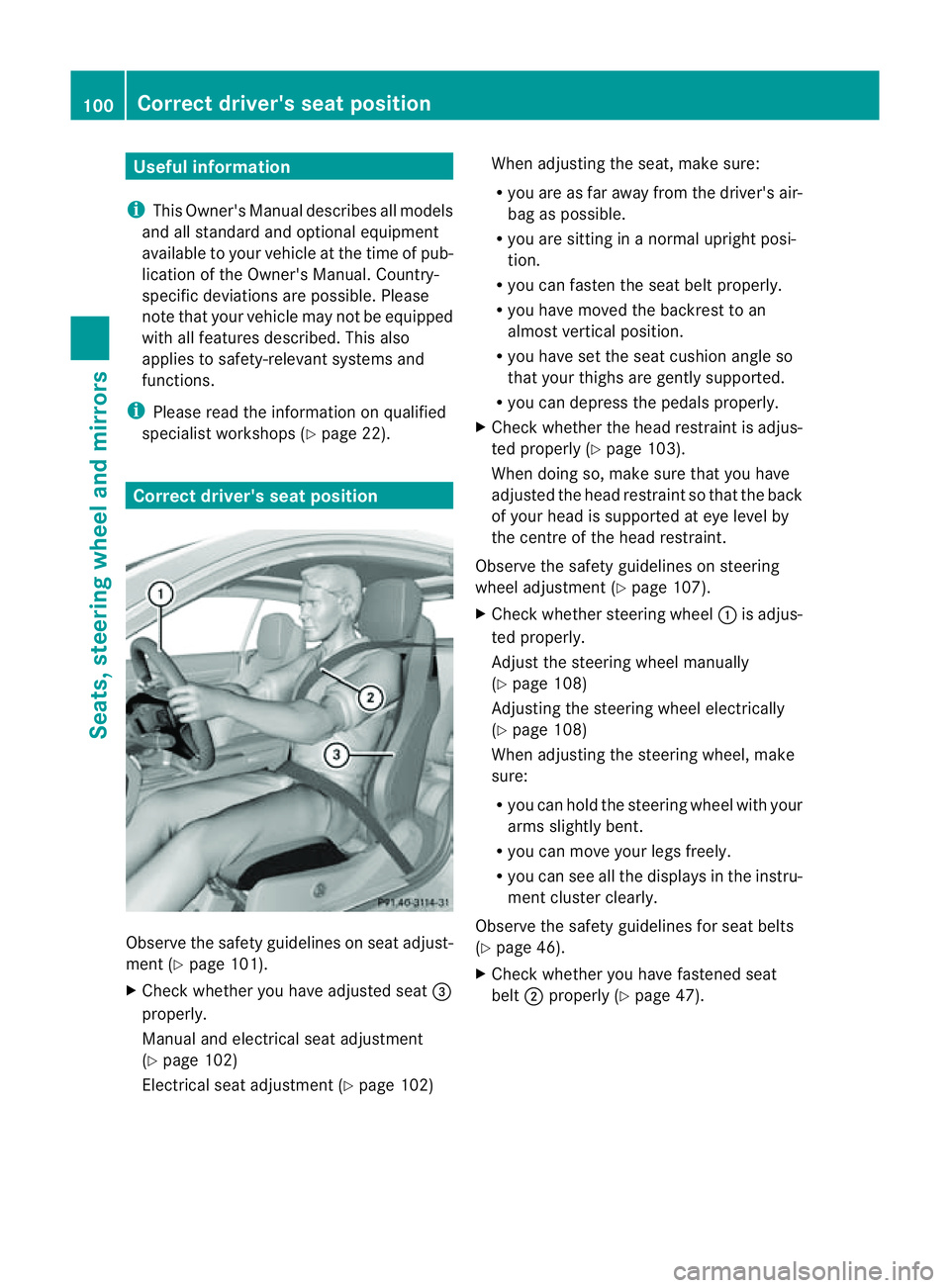
X Chec kwhether you have adjusted seat =
properly.
Manual and electrical seat adjustment
(Y page 102)
Electrical seat adjustment (Y page 102)When adjusting the seat, make sure:
R
you are as far away from the driver's air-
bag as possible.
R you are sitting in anormal upright posi-
tion.
R you can fasten the seat belt properly.
R you have moved the backrest to an
almost vertical position.
R you have set the seat cushion angle so
that your thighs are gently supported.
R you can depress the pedals properly.
X Check whether the head restraint is adjus-
ted properly (Y page 103).
When doing so, make sure that you have
adjusted the head restraint so that the back
of your head is supported at eye level by
the centre of the head restraint.
Observe the safety guidelines on steering
wheel adjustment (Y page 107).
X Check whether steering wheel :is adjus-
ted properly.
Adjust the steering wheel manually
(Y page 108)
Adjustingt he steering wheel electrically
(Y page 108)
When adjusting the steering wheel, make
sure:
R you can hold the steering wheel with your
arms slightly bent.
R you can move your legs freely.
R you can see all the displays in the instru-
ment cluster clearly.
Observe the safety guidelines for seat belts
(Y page 46).
X Check whether you have fastened seat
belt ;properly (Y page 47).100
Correct driver's seat positionSeats, steering wheela
nd mirrors