ignition MERCEDES-BENZ E-CLASS CABRIOLET 2020 Owners Manual
[x] Cancel search | Manufacturer: MERCEDES-BENZ, Model Year: 2020, Model line: E-CLASS CABRIOLET, Model: MERCEDES-BENZ E-CLASS CABRIOLET 2020Pages: 469, PDF Size: 8.47 MB
Page 38 of 469
Re
stra int sy stem Pr
otection pr ovided bythere stra int sy stem The
restra int sy stem includes thefo llowing com‐
ponents:
R Seat belt sy stem
R Airbags
R Child restra int sy stem
R Child seat securing sy stems
The restra int sy stem can help pr eventtheve hi‐
cle occupants from coming into contact with
parts of theve hicle interior in theev ent of an
accident. In theev ent of an accident, the
re stra int sy stem can also reduce thefo rc es to
which theve hicle occupants are subjected.
A seat belt can only pr ovide the best le vel of pro‐
te ction if it is worncor rectl y.Depending on the
de tected accident situation, seat belt tensioners
and/or airbags supplement the pr otection
of fere dby a cor rectly wornseat belt. Seat belt
te nsioners and/or airbags are not depl oyed in
eve ryaccident. In order
forth ere stra int sy stem toprov ide the
intended le vel of pr otection, each vehicle occu‐
pant must obser vethefo llowing information:
R Fasten seat belts cor rectl y.
R Sit in an almost up right seat position with
th eir back against the seat backrest.
R Sit with their feet resting on thefloor, if pos‐
sible.
R Alw ays secure persons under 1.50 m tall in
an additional restra int sy stem suitable for
Mercedes-Benz vehicles.
Ho wever,no sy stem available today can com‐
ple tely elimin ate injuries and fata lities in every
accident situation. In particular, the seat belt
and airbag generally do not pr otect against
objects penetrating theve hicle from the outside.
It is also not possible tocompl etely rule out the
ri sk of injury caused bythe airbag deploying. Re
duced restra int sy stem pr otection &
WARNING Risk of inju ryor death due to
modifications tothere stra int sy stem
Ve hicle occupants may no longer be pr otec‐
te d as intended if alterations are made tothe
re stra int sy stem. #
Never alter the parts of there stra int
sy stem. #
Neverta mp er with the wiring or any
electronic component parts or their
software. If it is necessary
tomodify theve hicle toaccom‐
modate a person with disabilities, con tact a
qu alified specialist workshop.
Mercedes-Benz recommends that you use driv‐
ing aids which ha vebeen appr ovedfo ryo ur vehi‐
cle byMercedes-Benz. Re
stra int sy stem functionality When
the ignition is switched on, a self-test is
per form ed, during which the6 restra int sys‐ Occupant saf
ety35
Page 39 of 469
te
m wa rning lamp lights up. It goes out no later
th an a few seconds af terth eve hicle is star ted.
The components of there stra int sy stem are then
functional. Malfunctioning
restra int sy stem A malfunction has occur
red in there stra int sys‐
te m if:
R the6 restra int sy stem warning lamp does
not light up when the ignition is switched on
R the6 restra int sy stem warning lamp
lights up continuously or repeatedly during a
journey &
WARNING Risk of inju rydue tomalfunc‐
tions in there stra int sy stem
Components in there stra int sy stem may be
activated unintentionally or not deploy as
intended in an accident. #
Have there stra int sy stem checked and
re paired immediately at a qualified spe‐
cialist workshop. Fu
nction of there stra int sy stem in an acci‐
dent How
there stra int sy stem works is de term ined by
th e se verity of the impact de tected and the type
of accident anticipated:
R Frontal impact
R Rear impact
R Side impact
R Rollover
The activation thre sholds forth e components of
th ere stra int sy stem are de term ined based on
th eev aluation of the sensor values measured at
va rious points in theve hicle. This process is pre-
em ptive in nature. The triggering/deployment of
th e components of there stra int sy stem must
ta ke place in good time at thest art of the colli‐
sion.
Fa ctors whi chcan only be seen and measu red
af te r a collision has occur red do not play a deci‐
sive role in the deployment of an airbag. Nordo
th ey prov ide an indication of airbag deployment.
The vehicle may be deformed significantly with‐
out an airbag being deplo yed. This is the case if only parts which are
relatively easily deformed
are af fected and thera te ofvehicle deceleration
is not high. Con versely, an airbag may be
deplo yedev en though theve hicle suf fers only
minor deformation. If very rigid vehicle parts
such as longitudinal members are hit, this may
re sult in suf ficiently high le vels of vehicle decel‐
eration.
Depending on the de tected deployment situa‐
tion, the components of there stra int sy stem can
be activated or deplo yed independently of each
ot her:
R Seat belt tensioner: frontal impact, rear
impact, side impact, rollo ver
R Driver's airbag, front passenger airbag: fron‐
talimpact
R Knee airbag: frontal impact
R Side airbag: side impact
R Head airbag: side impact, rollo ver,frontal
impact
The front passenger airbag can only be depl oyed
in an accident if thePA SSENGER AIR BAG OFF
indicator lamp is off. If the front passenger seat 36
Occupant saf ety
Page 43 of 469
*
NO
TEMercedes-AMG vehicles #
Obser vethe no tes in the Supplement.
Yo u could otherwise failto recognise
dangers. The seat belt
extender button is not available in
Mercedes-AMG vehicles.
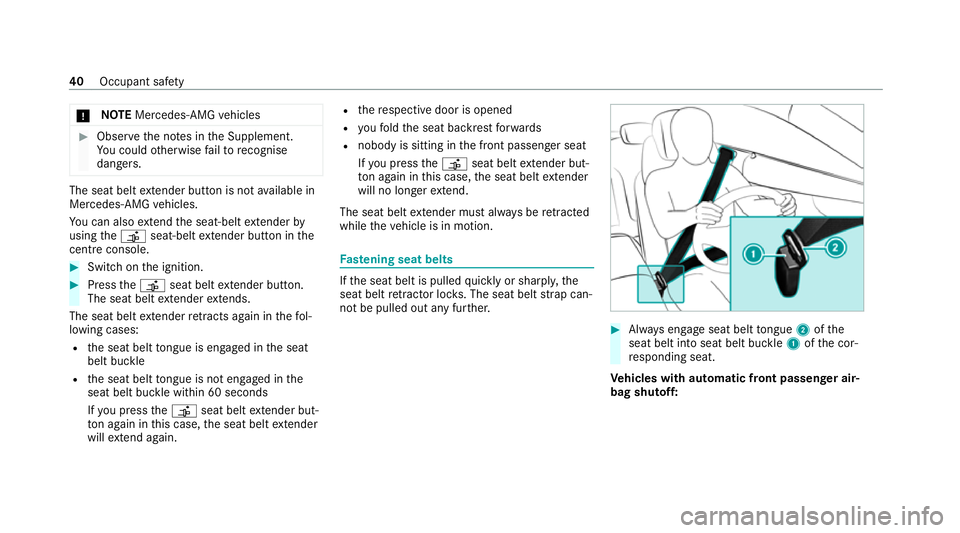
Yo u can also extend the seat-belt extender by
using theõ seat-belt extender button in the
centre console. #
Switch on the ignition. #
Press theõ seat belt extender button.
The seat belt extender extends.
The seat belt extender retracts again in thefo l‐
lowing cases:
R the seat belt tongue is engaged in the seat
belt buckle
R the seat belt tongue is not engaged in the
seat belt buckle within 60 seconds
If yo u press theõ seat belt extender but‐
to n again in this case, the seat belt extender
will extend again. R
there spective door is opened
R youfo ld the seat backrest forw ards
R nobody is sitting in the front passenger seat
If yo u press theõ seat belt extender but‐
to n again in this case, the seat belt extender
will no longer extend.
The seat belt extender mu stalw ays be retracted
while theve hicle is in motion. Fa
stening seat belts If
th e seat belt is pulled quickly or sharpl y,the
seat belt retractor lo cks. The seat belt stra p can‐
not be pulled out any fur ther. #
Alw ays engage seat belt tongue 2ofthe
seat belt into seat belt buckle 1ofthe cor‐
re sponding seat.
Ve hicles with automatic front passen ger air‐
bag shu toff: 40
Occupant sa fety
Page 45 of 469
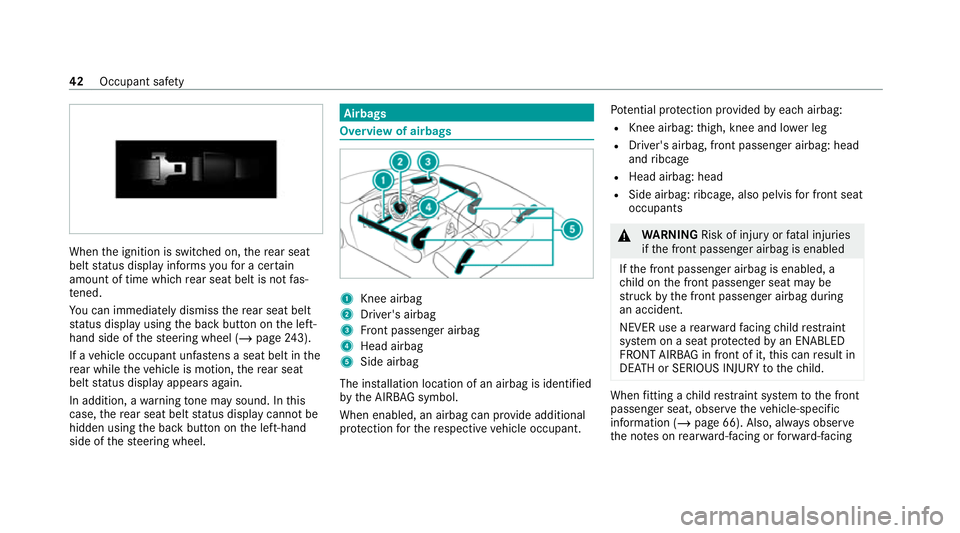
When
the ignition is switched on, there ar seat
belt status display informs youfo r a cer tain
amount of time which rear seat belt is not fas‐
te ned.
Yo u can immediately dismiss there ar seat belt
st atus display using the back button on the left-
hand side of thesteering wheel (/ page243).
If a vehicle occupant unfas tens a seat belt in the
re ar while theve hicle is motion, there ar seat
belt status display appears again.
In addition, a warning tone may sound. In this
case, there ar seat belt status display cannot be
hidden using the back button on the left-hand
side of thesteering wheel. Airbags
Overview of airbags
1
Knee airbag
2 Driver's airbag
3 Front passenger airbag
4 Head airbag
5 Side airbag
The ins tallation location of an airbag is identified
by the AIRB AGsymbol.
When enabled, an airbag can pr ovide additional
pr otection forth ere spective vehicle occupant. Pot
ential pr otection pr ovided byeach airbag:
R Knee airbag: thigh, knee and lo wer leg
R Driver's airbag, front passenger airbag: head
and ribcage
R Head airbag: head
R Side airbag: ribcage, also pelvis for front seat
occupants &
WARNING Risk of inju ryor fata l injuries
if th e front passenger airbag is enabled
If th e front passenger airbag is enabled, a
ch ild on the front passenger seat may be
st ru ck bythe front passenger airbag during
an accident.
NEVER use a rear wa rdfacing child restra int
sy stem on a seat pr otected byan ENABLED
FRONT AIRB AGin front of it, this can result in
DEATH or SERIOUS INJURY tothech ild. When
fitting a child restra int sy stem tothe front
passenger seat, obser vetheve hicle-specific
information (/ page 66). Also, alw ays obser ve
th e no tes on rear wa rd-facing or forw ard-facing 42
Occupant saf ety
Page 50 of 469
Fu
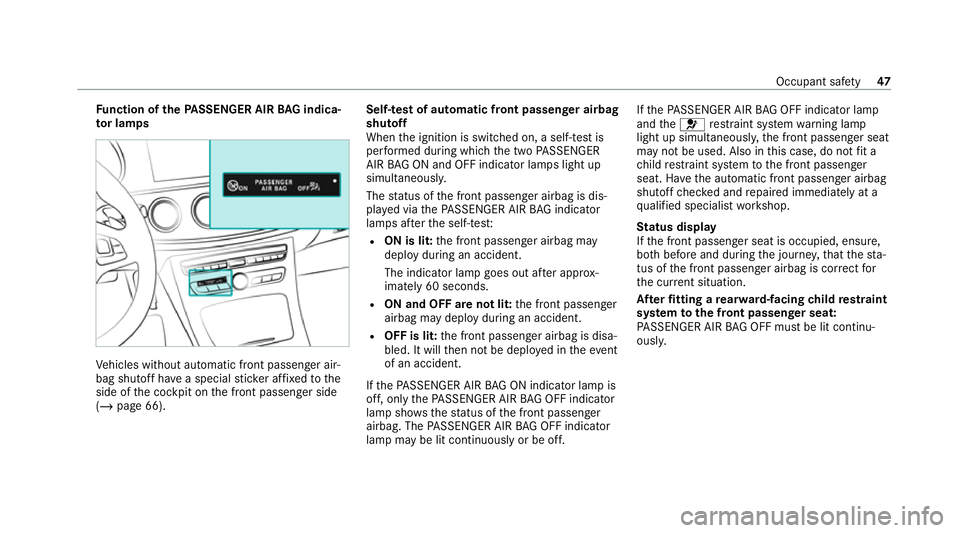
nction of thePA SSENGER AIR BAG indica‐
to r lamps Ve
hicles without automatic front passenger air‐
bag shutoff ha vea special sticke r af fixe dto the
side of the cockpit on the front passenger side
(/ page 66). Self-test of automatic front passenger airbag
shutoff
When
the ignition is switched on, a self-test is
per form ed during which the two PASSENGER
AIR BAG ON and OFF indicator lamps light up
simul taneously.
The status of the front passenger airbag is dis‐
pla yed via thePA SSENGER AIR BAG indicator
lamps af terth e self-tes t:
R ON is lit: the front passenger airbag may
deploy during an accident.
The indicator lamp goes out af ter appro x‐
ima tely 60 seconds.
R ON and OFF are not lit: the front passenger
airbag may deploy during an accident.
R OFF is lit: the front passenger airbag is disa‐
bled. It will then not be deplo yed in theev ent
of an accident.
If th ePA SSENGER AIR BAG ON indicator lamp is
off, on lythePA SSENGER AIR BAG OFF indicator
lamp sho wsthest atus of the front passenger
airbag. The PASSENGER AIR BAG OFF indicator
lamp may be lit continuously or be off. If
th ePA SSENGER AIR BAG OFF indicator lamp
and the6 restra int sy stem warning lamp
light up simultaneousl y,the front passenger seat
may not be used. Also in this case, do not fit a
ch ild restra int sy stem tothe front passenger
seat. Ha vethe automatic front passenger airbag
shutoff checked and repaired immediately at a
qu alified specialist workshop.
St atus display
If th e front passenger seat is occupied, ensure,
bo th before and during the journe y,that thest a‐
tus of the front passenger airbag is cor rect for
th e cur rent situation.
Af terfitting a rear wa rd-facing child restra int
sy stem tothe front passenger seat:
PA SSENGER AIR BAG OFF must be lit continu‐
ousl y. Occupant saf
ety47
Page 80 of 469
#
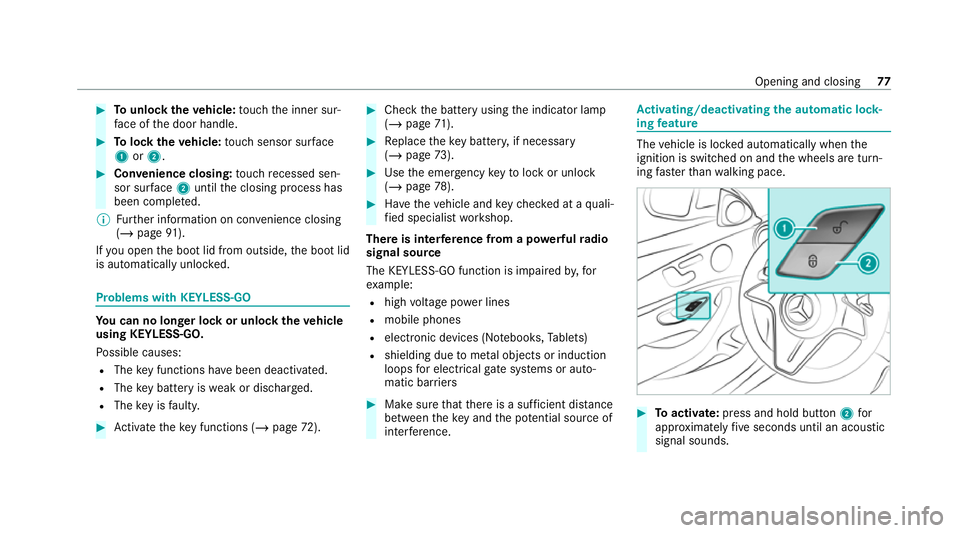
Tounlo cktheve hicle: touch the inner sur‐
fa ce of the door handle. #
Tolock theve hicle: touch sensor sur face
1 or2. #
Convenience closing: touch recessed sen‐
sor su rface 2until the closing process has
been comple ted.
% Further information on con venience closing
(/ page 91).
If yo u open the boot lid from outside, the boot lid
is automatically unloc ked. Problems with KEYLESS-GO
Yo
u can no lon ger lo ckor unlock theve hicle
using KEYLESS-GO.
Po ssible causes:
R The key functions ha vebeen deactivated.
R The key bat tery iswe ak or dischar ged.
R The key is faulty. #
Activate theke y functions (/ page72). #
Check the battery using the indicator lamp
(/ page 71). #
Replace theke y bat tery, if necessary
(/ page 73). #
Use the emer gency keyto lock or unlock
(/ page 78). #
Have theve hicle and keych ecked at a quali‐
fi ed specialist workshop.
There is inter fere nce from a po werful radio
signal source
The KEYLESS-GO function is impaired by,for
ex ample:
R high voltage po wer lines
R mobile phones
R electronic devices (No tebooks, Tablets)
R shielding due tome tal objects or induction
loops for electrical gate systems or auto‐
matic bar riers #
Make sure that there is a suf ficient di stance
between theke y and the po tential sou rce of
inter fere nce. Ac
tivating/deactivating the automatic lo ck‐
ing feature The
vehicle is loc ked automatically when the
ignition is switched on and the wheels are turn‐
ing fast erthan walking pace. #
Toactivate: press and hold button 2for
appr oximately five seconds until an acoustic
signal sounds. Opening and closing
77
Page 86 of 469
Fo
r saf etyre asons, Mercedes-Benz recommends
opening or closing the soft top when theve hicle
is stationar y.
To open or close the soft top while you are driv‐
ing, do not exceed a maximum speed of
50 km/h. Toavo id inter rupting the closing proc‐
ess while you are slightly exceeding this speed,
do not drive at a speed greater than 60 km/h. #
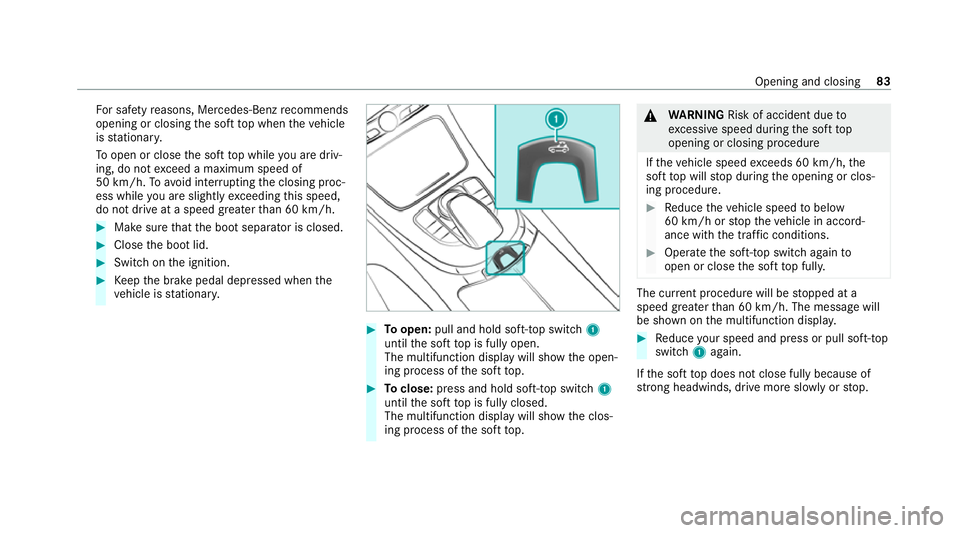
Make sure that the boot separator is closed. #
Close the boot lid. #
Switch on the ignition. #
Keep the brake pedal depressed when the
ve hicle is stationar y. #
Toopen: pull and hold soft- top switch 1
until the soft top is fully open.
The multifunction display will show the open‐
ing process of the soft top. #
Toclose: press and hold soft- top switch 1
until the soft top is fully closed.
The multifunction display will show the clos‐
ing process of the soft top. &
WARNING Risk of accident due to
exc essive speed during the soft top
opening or closing procedure
If th eve hicle speed exceeds 60 km/h, the
soft top will stop during the opening or clos‐
ing procedure. #
Reduce theve hicle speed tobelow
60 km/h or stop theve hicle in accord‐
ance with the traf fic conditions. #
Ope rate the soft-to p switch again to
open or close the soft top full y. The cur
rent procedu rewill be stopped at a
speed greater than 60 km/h. The message will
be shown on the multifunction displa y. #
Reduce your speed and press or pull soft- top
switch 1again.
If th e soft top does not close fully because of
stro ng headwinds, drive more sl owly or stop. Opening and closing
83
Page 87 of 469
Re
locking the soft top &
WARNING Risk of becoming trapped
due tothe soft top lo wering unexpect‐
ed ly
If yo u do not fully open/close the soft top,
th e soft-to phy draulics will depressurise af ter
a short time. #
Alw ays fully open or close the soft top. If
th e soft top has not been comple tely lo cked,
th e multifunction display will show the message
Open/close soft top completely. In addition, you
will hear a warning tone for up toten seconds
while driving. #
Stop theve hicle immediately in accordance
with the traf fic conditions. #
Makesure that the ignition is switched on. #
Fully close the soft top using the soft-top
switch. Opening or closing
the boot sepa rator The boot separator co
vers luggage or loads in
th e boot.
Depending on the equipment, theve hicle may be
equipped with a manual or automatic boot sepa‐
ra tor.
The soft top can be opened only when the man‐
ual boot separator is closed.
In vehicles with an automatic boot separator,
th is will automatically close when the soft top is
opened.
* NO
TEDama getothe soft top or load
due tolong objects The soft
top or load may be damaged with
th e soft top open. #
Do not place any overly long objects
inside or behind the side luggage nets
when the boot separator is open. #
Make sure that the load does not push
th e boot separator upwards. #
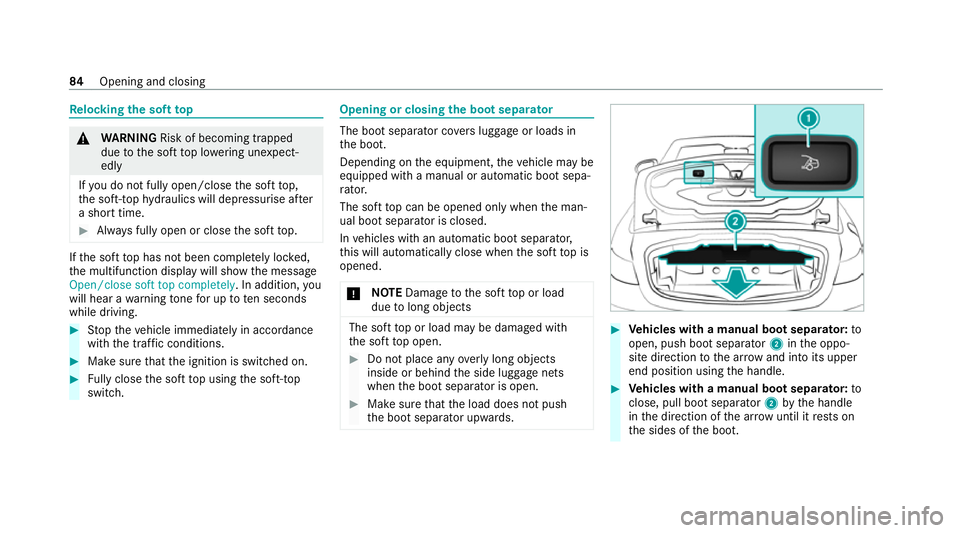
Vehicles with a manual boot separator: to
open, push boot separator 2inthe oppo‐
site direction tothe ar row and into its upper
end position using the handle. #
Vehicles with a manual boot separator: to
close, pull boot separator 2bythe handle
in the direction of the ar row until it rests on
th e sides of the boot. 84
Opening and closing
Page 88 of 469
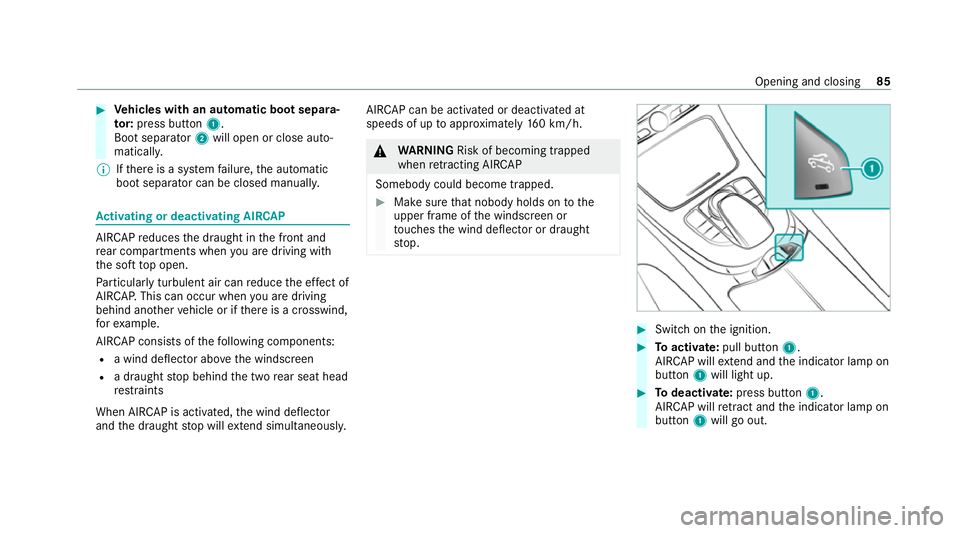
#
Vehicles with an automatic boot separa‐
to r:press but ton1.
Boot separator 2will open or close au to‐
matical ly.
% Ifth ere is a sy stem failure, the automatic
boot separator can be closed manually. Ac
tivating or deactivating AI RCAP AI
RCA Pre duces the draught in the front and
re ar compartments when you are driving with
th e soft top open.
Pa rticular lyturbulent air can reduce the ef fect of
AIR CAP.This can occur when you are driving
behind ano ther vehicle or if there is a crosswind,
fo rex ample.
AI RCA P consists of thefo llowing components:
R a wind deflector abo vethe windscreen
R a draught stop behind the two rear seat head
re stra ints
When AI RCAP is acti vated, the wind deflector
and the draught stop will extend simultaneously. AIR
CAP can be activated or deactivated at
speeds of up toappr oximately 160 km/h. &
WARNING Risk of becoming trapped
when retracting AIR CAP
Somebody could become trapped. #
Makesure that nobody holds on tothe
upper frame of the windscreen or
to uches the wind deflector or draught
st op. #
Switch on the ignition. #
Toactivate: pull button 1.
AIR CAP will extend and the indicator lamp on
button 1will light up. #
Todeactivate: press button 1.
AIR CAP will retract and the indicator lamp on
button 1will go out. Opening and closing
85
Page 89 of 469
If
th eve hicle is par ked with the soft top open
and the ignition is switched off, AIR CAP will
re tract au tomatical ly.
When youre start the engine af ter having been
par ked, AIR CAP will extend again au tomatically. Fi
tting and removing the folding draught
stop &
WARNING Risk of accident when using
th e draught stop in poor visibility condi‐
tions
The draught stop impairs your view tothe
re ar. #
Use the draught stop only in good visi‐
bility conditions. &
WARNING Risk of accident and inju ry
due toan incor rectly fitted draught stop
The draught stop may become loose while
yo u are driving and endan gerot her road
users. #
Fitthe draught stop as described. #
Do not place any objects on thefitted
draught stop. *
NO
TEThe draught stop can be damaged
if fitted when the soft top is closed The
vehicle interior or the draught stop can
be damaged if fitted when the soft top
closed. #
Tofit, open the soft top. *
NO
TEDama getothe draught stop due
to collision wi thseat backrests The draught
stop may collide with the front
seat backrests when fitted. #
Adjust the backrest positions of the
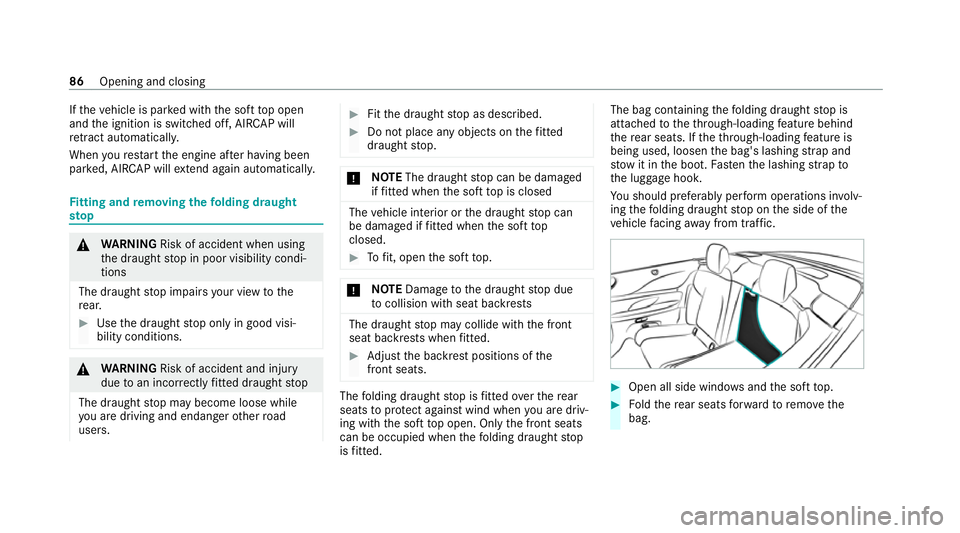
front seats. The
folding draught stop is fitted overth ere ar
seats toprotect against wind when you are driv‐
ing with the soft top open. Only the front seats
can be occupied when thefo lding draught stop
is fitted. The bag containing
thefo lding draught stop is
attached totheth ro ugh-loading feature behind
th ere ar seats. If theth ro ugh-loading feature is
being used, loosen the bag's lashing stra p and
stow it inthe boot. Fasten the lashing stra pto
th e luggage hook.
Yo u should preferably per form operations in volv‐
in g th efo lding draught stop on the side of the
ve hicle facing away from traf fic. #
Open all side windo wsand the soft top. #
Foldthere ar seats forw ard toremo vethe
bag. 86
Opening and closing